The Effectiveness of the Use of Computer Technology
Compared to the Traditional Methods in the Process
of a Foreign Language Teaching
Yelena Anatolyevna Andreyeva
*, Anastasia Viktorovna Fakhrutdinova, Inna Germanovna Korneva,
Alexander Sergeevich Chugunov
Kazan Federal University, Institute of International Relations, Kazan, Russian Federation
Received July 12, 2019; Revised September 20, 2019; Accepted September 27, 2019
Copyright©2019 by authors, all rights reserved. Authors agree that this article remains permanently open access under the terms of the Creative Commons Attribution License 4.0 International License
Abstract
In this article, the effectiveness of the use of computer technology is analyzed in the process of a foreign language teaching compared to the traditional methods based on the results of a long-term experiment. The experiment was carried out with an e-learning program "Talk to me" owned by French company Auralog, the electronic textbook "German for Economists" (content authoring), and the electronic educational resource "English for geographers (physical geography)" (content authoring). The purpose of the study is to investigate the computer technologies for foreign language teaching. The subject of the research is the investigation of the quality of mastering knowledge, skills, and abilities in linguistic aspects (vocabulary, grammar, phonetics) and types of speech activity (reading, listening, speaking, writing). The purpose of the study is to determine the effectiveness of the use of computer technology in the process of language teaching aspects and types of speech activity compared to traditional teaching methods. The study is important since nowadays the development of the development of telecommunication technologies is becoming one of the principal areas for improving higher education institutions and the education system in general terms. The development and implementation of computer technology in the educational process is an essential condition for improving the efficiency of teaching at universities. The pedagogical experiment and observation, interview, questioning, testing, and also quantitative and statistical method have been used in this research. The result of the research revealed that the use of computer technology in the process of a foreign language teaching allows achieving better results in almost all language aspects and types of speech activity compared to traditional teaching methods.Keywords
Education, Student, Training, Foreign Language, Pedagogical Experiment, E-Learning Program,Electronic Textbook, Electronic Educational Resource
1. Introduction
The intensification of the educational process is becoming an inevitable condition of success and learning efficiency due to the widespread introduction of interactive technologies [6]. Institutions need to provide time, effort, different learning styles, and resources to assist students to achieve the desired proficiency in a foreign language. The use of technology in learning environments has presented itself as a necessity for continued lifelong learning. Research suggests that institutions that lag behind in integrating technology «will be unable to meet the needs of knowledge-based societies and as a result, will not survive the change in the paradigm of education» [7]. If a technology-enhanced lesson is integrated into the more extensive curriculum with direct connections, students are more likely to infuse the knowledge into existing cognitive structures [8, 10, 11, 12, 13, 14,22].
Bibauw et al. [16] pointed that applications allowing a learner to have a conversation in a foreign language with a computer under various names (dialogue systems, conversational agents, chatbots, etc.) affect the students' proficiency in foreign languages significantly. Nikolopoulou et al. [17;21] conclude that ICT is a useful tool that can support children's reading skills in English as a foreign language (EFL), while teachers' perceptions affect their classroom practices. Jung et al. [18;20] confirm that Foreign language instruction has benefited from the development of instructional technology, such as synchronous computer-mediated communication (SCMC). Xu et al. [19] believe that there are significant differences between the gained scores by students learned using computer software and those who did not; students' learning motivation after learning using computer software is in high levels; students' perceived learning after using computer software is also in high levels
2. Methods
The following methods were used in the process of research: pedagogical experiment, pedagogical observation, interview, questioning, testing, quantitative method, statistical method. For the experimental use of the e-learning program "Talk to me", the researcher formed a group of 14 first-year students in pre-intermediate level in management major at Kazan Institute of Russian State University of Trade and Economics (Group 1). A similar group of the same major with the same level of knowledge was trained according to the traditional methodology without using the e-learning program (Group 2). In the groups, the subject "Foreign Language" was taught for 136 class hours annually (lessons were held twice a week). The experiment lasted for one year.
3. Results
Working with the e-learning program "Talk to Me" was performed in a language laboratory equipped with computers. "Talk to Me" is an interactive computer course for learning foreign languages developed by the French company Auralog.
The e-learning program "Talk to Me" assists in mastering the perception of oral speech by ear, in fixing the correct pronunciation, and in teaching conversational speech. The main characteristics of the program are as follows: interactive dialogues; speech recognition and pronunciation visualization; articulation of sounds in animated videos; speech skills development exercises; individual work settings; monitoring learning outcomes.
The "Talk to me" training program is useful at all stages of a foreign language teaching (both at the stage of the knowledge and skills formation and the stage of their improvement). It contributes to the formation of phonetic
skills, listening skills, mastering and consolidating of a grammatical and new lexical material, expanding students' cultural vision, allows getting acquainted with the culture of the country which the language being studied belongs to. Thus, for instance, within the framework of the lesson "Acquaintance", the application of the computer program is exercised during three classes. The algorithm of work with the electronic training program is as follows:
1. Dialogue speech. The features of the program allow the student to enter into a dialogue with a computer relying on the phrases appearing on the screen that corresponds to a given situation. The lexical material on the subject of "Acquaintance" includes greeting, farewell, self-presentation, description of appearance, and clothes. The dialogue with the computer imitates colloquial speech with common phrases and reflects the facts of the daily lives of native speakers. 2. Phonetic exercises. The work on the pronunciation
occurs by repeating individual phrases and sentences by a speaker. The degree of identity (intonation, stress, phonetic correctness) is presented graphically and evaluated employing a scale from 1 to 7 points. Students can train phonetic material, selectively paying more attention to difficult issues for them. The program allows individualizing the learning process. 3. Exercises to consolidate: a) lexical material:
"Vocabulary associations" (finding antonyms), "Erudite" (crossword puzzle); b) skills of working with grammatical material: "Filling in the gaps", "Word order". Each type includes several exercises with thematic vocabulary designed to improve the level of students' vocabulary. Exercises can be performed in any order as desired by a student. The results are recorded in real-time.
4. Dictation. This type of work allows consolidating both the skills of listening and correct spelling in writing. Students type a sentence pronounced by a speaker; simultaneously, they can see spelling errors highlighted in red color; thus, a student has an opportunity to correct them and see the results of the activity.
The quality of learned course content was checked throughout the year by an oral survey (with the record of the result), written tests, testing, listening, assessment of reading, project work, conducting discussions, round tables, and contests.
Table 1. The assessment of the mastery of knowledge, skills, and abilities
Group Vocabulary Grammar Phonetics
Group 1 85,7% 92,8% 100%
Group 2 71,4% 64,2% 64,2%
Тable 2. Evaluating the speech activities Group Reading Speaking Listening Writing
Group 1 92,8% 92,8% 92,8% 100%
Group 2 85,7% 64,3% 85,7% 85,7%
The experiment on the use of the e-learning program "Talk to Me" pointed out that the results in Group 1 are higher than in Group 2 in all aspects of the language and types of speech activity. Excellent results of Group 1 in terms of "Phonetics" testify to the high effectiveness of the program for working out skills of correct pronunciation. The language aspect "Vocabulary" is well developed through lexical exercises and crosswords. In addition, excellent results in the types of speech activity "Writing" and "Listening" allow us to conclude the advantages of the type of work called "Dictation" — moreover, thematic dialogues with a computer to develop “Speaking” skills.
The experimental work with the electronic textbook "German for economists" (compiled by F.L. Mazitova, E.A. Andreeva) was conducted throughout a year with 12 third-year students in intermediate levels at Kazan Institute of Russian State University of Trade and Economics and majored in Foreign Economic Activity (Group 1). The length of the course was 136 contact hours, two practical lessons per week. A similar group of the same major with the same level of knowledge was trained according to the traditional methodology without using the e-learning program (Group 2).
The electronic textbook "German for Economists" includes eight topics covering information about Germany, its economy, and the legal forms of entrepreneurship. Each topic covers 12 sections, including a primary text, vocabulary, text exercises, oral speech, texts on the topic, texts for additional reading, texts for listening, video material, grammatical material with exercises and electronic tests on grammar, a set of aphorisms, proverbs, sayings, and idioms. Most sections are presented in the “PowerPoint” program.
Let us consider the sections of the first topic of the textbook named "Germany" in more details, representing a basic text and extra-textual components which facilitate understanding of the text and ease of its adsorption. The primary text "Germany" includes critical information about the country with hyperlinks to presentations on Germany and its cities. The dictionary covers vocabulary with some grammatical notes (gender, singular, and plural of nouns; transitivity) and translation into Russian. Forty-seven questions and nine exercises to the next section will help to consolidate the material and understand the content of the reading.
The "Oral Speech" section includes a dialogue about Berlin and its sights. The texts on the topic offer linguistic information about the history of the national flag of Germany, color of symbols, while texts for further reading represent the sights of the German capital, episodes from the lives of ordinary people (short stories). A separate section in each topic is devoted to business German with dialogues, their translation and sound accompaniment ("At the airport", "At the company").
The "Video" section is presented by an authentic video course "Alles Gute!", demonstrating real situations from the lives of German students.
The grammatical material includes theoretical and practical parts on the topic "Verb". The acquisition of lexical and grammatical material is evaluated by electronic testing with the output of the results of the students' mastering of the studied material on display.
The aphorisms on the topic "Germany" are presented by the statements of famous people about the country. The "Proverbs and Sayings" section assists in enriching the vocabulary of students.
The work of the educational and reference system of the electronic textbook "German language for economists" is organized to the effect that students have an opportunity to consult a dictionary or grammatical reference book, which provides the free decision of the direction of study due to flexible hypertext, presentation of textual and illustrative material, films, sound, testing knowledge in self-learning mode.
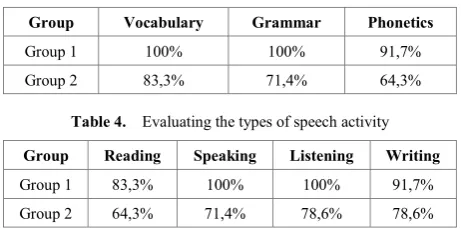
Students’ mastery of knowledge, skills, and abilities within the framework of the studied material was evaluated by language aspects (see Table 3) and by types of speech activity (see Table 4).
Table 3. Evaluating the language aspects Group Vocabulary Grammar Phonetics
Group 1 100% 100% 91,7%
Group 2 83,3% 71,4% 64,3%
Тable 4. Evaluating the types of speech activity Group Reading Speaking Listening Writing
Group 1 83,3% 100% 100% 91,7%
Group 2 64,3% 71,4% 78,6% 78,6%
[image:3.595.306.537.495.609.2]the section "Business German") and "Listening" (sound dialogue support; authentic video course "Alles Gute!").
The group of 14 second-year students in the intermediate level and primary in Geography at Kazan Federal University (Group 1) was picked for the experimental work with the electronic educational resource "English for geographers (physical geography)" (compiled by E.A. Andreeva, I.G. Korneva, E.V. Kapustina, G.F. Gali). Another group of the same major with the same level of knowledge was studying English according to the traditional methodology without using the e-learning program (Group 2). The length of the course was 216 contact hours, three practical lessons per week throughout an academic year.
The purpose of this electronic educational recourse is to introduce and consolidate professional vocabulary according to the students' major, to develop reading and translation skills, and also speaking and writing skills, to assist in mastering linguistic, socio-cultural and sociolinguistic competences.
The electronic resource “English for geographers (physical geography)” consists of eight sections, which include professional-oriented texts, as well as thematic videos in a foreign language. The resource contains information on the physical geography of such countries as the Russian Federation (including the Republic of Tatarstan), the United Kingdom of Great Britain and Northern Ireland, the United States of America, Canada, Australia, New Zealand, and Ireland.
Each part of the electronic educational recourse includes: text for reading - "Reading" task with the "Gap-fill exercise", "Matching exercise", "Mixed-up sentence" exercise; English-Russian glossary to the text; "Watching and listening" video and "Watching and listening Quiz" assignment; chat "Explore geography of the country with friends", where a student communicates with classmates in English on the topics specified in the chat; activity for the development of writing skills, "Writing Task", which involves making a presentation on one of the topics given in the PowerPoint program; "Final test" in a module including 10 questions.
Each module includes information, training, and check blocks that contribute to the implementation of the principle of systematicity and consistency in the structure of the electronic educational recourse. The principles of visualization and interactivity in the recourse are displayed in the form of the presentation of the material (the availability of maps, tables), the rapid response of a computer to a person's actions (correct and incorrect answers when doing exercises, as well as testing utilizing the Hot Potatoes program).
The students themselves do the activities offered in the electronic resource; they also monitor the results (testing is possible for the multiple-choice answers activities). The correctness of the exercise is displayed in percentage. If errors are found, students have an opportunity for repeating
and redoing the exercises.
While producing the electronic educational resource, special attention was paid to extra-textual components (interactive activities, video content, communication, projects).
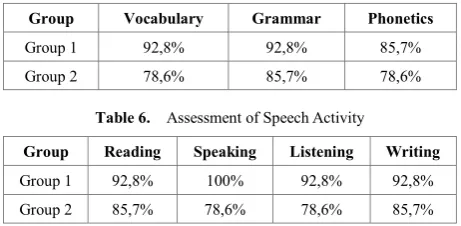
[image:4.595.306.537.185.298.2]The assessment of learning material includes language aspects (Table 5) and types of speech activity (Table 6).
Table 5. Assessment of Learning Material Includes Language Aspects Group Vocabulary Grammar Phonetics
Group 1 92,8% 92,8% 85,7%
Group 2 78,6% 85,7% 78,6%
Тable 6. Assessment of Speech Activity
Group Reading Speaking Listening Writing
Group 1 92,8% 100% 92,8% 92,8%
Group 2 85,7% 78,6% 78,6% 85,7%
The usage of the electronic educational resource "English for geographers (physical geography) " provides excellent results in the language aspect "Vocabulary" (professionally-oriented authentic texts with a glossary; interactive lexical exercises and testing in the Hot Potatoes program), and in such types of speech activity as "Speaking" (chat "Explore geography of the country with friends", "Writing Task" involving presentations), "Listening" (thematic videos with testing and discussion).
5. Conclusions
The results of the research indicated that the use of computer technology in the process of a foreign language teaching allows achieving better results in almost all language aspects and types of speech activity compared to traditional teaching methods.
The experiment on the use of the e-learning program "Talk to Me" revealed excellent results in the aspect of "Phonetics", which indicates high efficiency of the program for practicing the skills of correct pronunciation. Lexical exercises and crosswords well develop the language aspect of "Vocabulary". Also, excellent results in "Writing" and "Listening" types of speech activity allow us to conclude the advantages of the work called "Dictation". The usage of thematic dialogues with a computer develops "Speaking" skills.
linguistic cultural studies; project and discussion tasks; thematic dialogues and dialogues in the section "Business German"), and "Listening" (sound dialogue support; authentic video course "Alles Gute!").
The use of the electronic educational recourse “English for geographers(physical geography) "provides excellent results in the language aspect "Vocabulary" (professionally-oriented authentic texts with a glossary; interactive lexical exercises and testing in the Hot Potatoes program), and such types of speech activity as "Speaking" (chat "Explore geography of the country with friends"; "Writing Task" with the assignment of preparing presentations) and "Listening" (thematic videos with testing and discussion).
The experiment indicated that the use of computer technology in teaching a foreign language contributes to enhancing the activity of students in practical lessons, which is due to the high level of the information content of the activities; the communicative nature of electronic educational resources; ease of navigation; the presence of feedback; the possibility of demonstrating audio and video assignments; and visual presentation of educational information.
The application of computer technologies in language instruction provides a student-centered learning environment. It allows teachers to diversify lesson presentation styles to motivate students of varying interests, provides learning opportunities outside the classroom (hence increasing student interaction with the language), and is perceived to provide more for individual differences [15].
Electronic resources in a foreign language correspond to the didactic principles of the educational process, including consistency, activity, visibility, accessibility, the connection of theory with practice, and the retention of learning. Their content considers the age characteristics of students, the principles of humanization, and the humanization of education, which are relevant in the context of intercultural communication and contribute to the disclosure of the creative possibilities of future specialists.
Acknowledgements
The work is performed according to the Russian Government Program of Competitive Growth of Kazan Federal University.
REFERENCES
Al-Mahrooqi, R., & Troudi, S. (Eds.). (2014). Using [1]
technology in foreign language teaching. Cambridge Scholars Publishing.
Bagnato, K. (2004). Learning virtually. Community College [2]
Week, 6-8.
Baylor, A., Ritchie, D. (2002). What factors facilitate teacher [3]
skill, teacher morale, and perceived student learning in technology-using classrooms? Journal of Computers & Education, 39(1), 401.
Cononelos, T., & Oliva, M. (1993). Using computer [4]
networks to enhance foreign language/culture education. Foreign Language Annals, 26(4), 527-534.
Denisova, A. L. (2005). Conceptual framework for the [5]
design of continuous professional training systems in a multi-level complex: monograph / A.L. Denisova, N.V. Molotkova, E.E. Zakharzhevskaya. - Eagle: Publishing house ORAGS, 328 p.
Fakhrutdinova, A. V., Nurkhamitov, M. R. (2016). [6]
Technologies of interactive learning in higher education. International Journal of Humanities and Cultural Studies; Special Volume, 383-389.
Grigoriev, S. G., Krasnova, G. A., Robert, I. V. (2019). The [7]
technology of electronic learning tools creating / S.G .Grigoriev, G.A. Krasnova, I.V. Robert. - URL: http://uu.vlsu.ru/files/Tekhnologija_sozdanija_EHSO.pdf (access date: 04.02.).
Motteram, G. (2013). Innovations in learning technologies [8]
for English language teaching. – London: British Council. Nazmieva, E. I., Andreyeva, Ye. A., Yuzmukhametova, L. [9]
N. (2018). Foreign Language Teaching Modeling for Students Majoring in Social Studies and Humanities. The Journal of Social Sciences Research, 352-357.
O’Neill, K., Singh, G., & O’Donoghue, J. (2004). [10]
Implementing elearning programmes for higher education: A review of the literature // Journal of Information Technology Education, 2004, 3.– p. 320.
Peltier, J. W., Drago, W., Schibrowsky, J. A. (2003). Virtual [11]
communities and the assessment of online marketing education. Journal of Marketing Education, 25, 260-276. Sagitova, R. R. (2014). Training students to be autonomous [12]
learners / R.R. Sagitova. International Journal of Humanities Education, 12(1), 27-34.
Sagitova, R. R., Fahrutdinova, A. V., Kharitonov, E. A. [13]
(2017). Interactive Technologies of Formation of Self Educational Competence of University Students in the Process of Foreign Language Learning: Project Method. International Journal of Scientific Study, 5(6), 67-70. Shirobokova, M. V. (2013). Possibilities of electronic [14]
textbooks in effective teaching of a foreign language / M.V. Shirobokova. Text. Book. Book publishing, 2(4), 25. Yaverbaum, G. J., Kulkarni, M., Wood, C. (1997). [15]
Multimedia Projection: An Exploratory Study of Student Perceptions Regarding Interest, Organization, and Clarity. Journal of Educational Multimedia and Hypermedia, 6(2), 139-153.
Bibauw, S., François, T., & Desmet, P. (2019). Discussing [16]
Nikolopoulou, K., Akriotou, D., & Gialamas, V. (2019). [17]
Early Reading Skills in English as a Foreign Language Via ICT in Greece: Early Childhood Student Teachers’ Perceptions. Early Childhood Education Journal, 1-10. Jung, Y., Kim, Y., Lee, H., Cathey, R., Carver, J., & [18]
Skalicky, S. (2019). Learner perception of multimodal synchronous computer-mediated communication in foreign language classrooms. Language Teaching Research, 23(3), 287-309.
Xu, Z., Banerjee, M., Ramirez, G., Zhu, G., & Wijekumar, K. [19]
(2019). The effectiveness of educational technology applications on adult English language learners’ writing quality: a meta-analysis. Computer Assisted Language Learning, 32(1-2), 132-162.
Putri, S. K., Hasratuddin, & Syahputra, E. (2019). [20]
Development of Learning Devices Based on Realistic Mathematics Education to Improve Students’ Spatial Ability and Motivation. International Electronic Journal of Mathematics Education, 14(2), 393-400. https://doi.org/10. 29333/iejme/5729.
Nuriyev, M., Sovetkanova, D., & Seysenbayeva, Z. (2018). [21]
Achievements and new challenges in the area of education of independent Kazakhstan. Opción, 34(85-2), 337-352. Parvizian, F., Ghojavand, K., & Niknejadi, F. (2015). [22]