Wireless Personal Area Network based Simulation and
Design to Control the Speed of
Permanent Magnet DC
Motor using Zigbee Transceiver
Protocol
Jeetender Singh Chauhan
1,
Gyan Prabhakar
2,
Sunil Semwal
3, Atul Kumar Pandey
41
Research Scholar, Instrumentation & Control Engineering Graphic Era University, Dehradun
2Head Electronics & Communication Engineering Dep’t
Saroj Institute of Technology & Management, Lucknow
3Asst. Professor, Electrical and Electronics Engineering Dep’t
Graphic Era University, Dehradun
4Asst. Lecturer, Electronics & Communication Engineering Dep’t
Saroj Institute of Technology & Management, Lucknow
ABSTRACT
DC motor has wide range of applications ranging from industrial applications to household applications. In industrial applications several parameters have to be considered for optimized production i.e. rate of production. DC motor speed and orientation control provides sustainable systems with smoother operation, controlled torque, utilization of one system for different processes etc. This paper provides wireless speed control of DC motor for efficient utilization in industrial applications. The system consists of a transmitter which generates control signals which are wirelessly transmitted to the receiver. The receiver according to the control signals controls the speed of the DC motor provided by Pulse Width Modulation (PWM).The control signals are transmitted using RF wireless module Zigbee. Hence forth the speed of the DC Motor can be controlled wirelessly through a control room which makes the system sustainable.
Keywords:
DC Motor, Wireless speed control, Pulse Width Modulation, Zigbee, sustainable1.
INTRODUCTION
The vast potential in wireless personal area networks is an emerging area of research in recent years. By networking large numbers of tiny motes or nodes, it is possible to obtain data about physical phenomena that was difficult or even sometimes impossible to obtain in conventional ways. The wireless nodes have certain tradeoffs in terms of size, power, cost, code size, and data rate. The hardware design is simple and cheap, but is larger in terms of size when compared with Mica Mote. Zigbee wireless standard was chosen as a communication protocol. The transmission achieved is a real time data transmission with data rate of 250kbps.The applications of DC motor range from household products i.e. vacuum cleaners, hair driers to Industrial applications i.e. reciprocating machines, presses shears. This paper provides a system that can utilized to use DC motor for various applications. We can utilize the DC Motor for various applications by controlling the speed and
[image:1.612.324.542.534.655.2]orientation according to the field of interest. The system consists of a Transmitter module which generates control signals which contains information about the speed and orientation of motor depending on the application area. These signals are transmitted to the Receiver wirelessly through wireless RF module Zigbee. The receiver according to the control signals controls the speed of the motor by Pulse Width Modulation (PWM).Pulse Width Modulation (PWM) is the technique of utilizing switching devices to produce the effect of a continuously varying analog signal. This PWM conversion generally has very high electrical efficiency and can be used in controlling either a three-phase synchronous motor or a three-phase induction motor .It is desirable to create three perfectly sinusoidal current waveforms in the motor windings, with relative phase displacements of 120°. The production of sine wave power using a linear amplifier system would have low efficiency, maximum of 64%. Efficiency can be increase up to 95% if instead of the linear circuitry, fast electronic switching devices are used, depending on the properties of the semiconductor power switch. The result is a load current waveform that depends mainly on the modulation of the duty ratio.
2.
H
ARDWARED
EVELOPMENTHardware of this wireless system basically constitute of two parts: Transmitting or Slave End node design and receiving or coordinator node design.
(a)
Slave End node design-
Components of the slave system is given below [image:2.612.321.590.215.490.2](1)Power supply modules-
This module is basically designed to achieved 5V, 500mA.This consists of a transformer which is used to step down the AC voltage, IN4007 diodes used to form a bridge rectifier to convert AC to DC, capacitor 1000uF which used as a filter circuit, 7805 regulator to obtain a 5V at the output of the regulator, 330 ohm resistance, LED as indicator.Fig 2: Diagram of power supply section
(2)AVR Microcontroller-
There is a whole wide rangeof microcontroller available in the market. But this particular project is developed using AVR series of microcontroller (ATMEGA16) because of its inbuilt ADC port and its variable frequency. ATmega16 is a low-power CMOS 8-bit microcontroller based on the AVR RISC architecture. By executing powerful instructions in a single clock cycle, the ATmega16 achieves throughputs approaching 1 MIPS per MHz, allowing the system designed to optimize power consumption versus processing speed. Further it also minimizes the cost of this personal area network.
(3)Display Module-
The LCD(liquid crystal display) unit receives character codes (8 bits per character) from a microprocessor or microcomputer, latches the codes to its display data RAM (80-byte) DD RAM for storing 80 characters, transforms each character code into a 5 ´ 7 dot-matrix character pattern, and displays the characters on its LCD screen. We are 16*2 LCD„s which have 16 columns and 2 rows with 16 hardware pins connected as pin 1,3and 16 are connected to ground, pin 2 and 15 are connected to +5v pin 3, 4, 5 are RS, RW and enable respectively enable pin is always low. Data pins of LCD are 11,12,13,14 which are used for 4 bit parallel communication.(4)Zigbee Module(Transmitting module (RF
Modem, 9600 bps,TTL logic)-
It is a low power andlow cost 2.4 GHz transceiver designed for wireless applications. which can facilitate the OEM designers to design their remote control applications in remote control in the quickest way. These modules are based on IC CC2500 by Texas Instrument. The main operating parameters and the 64-byte transmit/receive FIFOs of CC2500 can be controlled with the help of an SPI interface. In a typical system, the CC2500 can be used together with a microcontroller and some passive components.
Fig 3: Block Diagram of transmitter section
(5)MAX232 (level converter)-
MAX232 is a dualdriver/receiver IC that includes a capacitive voltage generator to supply EIA-232 voltage levels from a single 5-V supply. Each receiver converts EIA-232 inputs to 5-5-V TTL/CMOS levels. These receivers have a typical threshold of 1.3 V and a typical hysteresis of 0.5 V, and can accept ±30-V inputs. Each driver converts TTL/CMOS input levels into EIA-232 levels. This can be made to work with the help of a few capacitors attached to it.
[image:2.612.79.294.255.422.2]Potentiometers are commonly used to control electrical devices such as volume controls on audio equipment.
[image:3.612.74.305.100.357.2]
Fig 4: Simulation diagram of transmitter
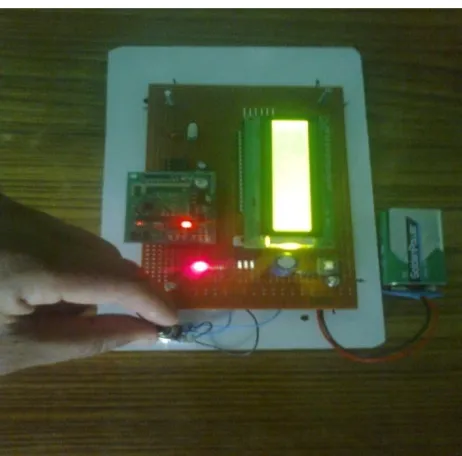
Fig 5: View of Transmitting Section
(b)Coordinator node design-
Components of the node design system is given below [image:3.612.325.542.160.270.2](1)Power supply unit-
This module is basically designed to achieved 5V, 500mA.This consists of a transformer which is used to step down the AC voltage, IN4007 diodes used to form a bridge rectifier to convert AC to DC, capacitor 1000uF which used as a filter circuit, 7805 regulator to obtain a 5V at the output of the regulator, 330 ohm resistance, LED as indicator.Fig 6: 12V Power Supply Simulation Diagram
(2)Zigbee module-( Receiving module (RF
Modem, 9600 bps , TTL logic)-
It is a low power andlow cost 2.4 GHz transceiver designed for wireless applications. which can facilitate the OEM designers to design their remote control applications in remote control in the quickest way. These modules are based on IC CC2500 by Texas Instrument. The main operating parameters and the 64-byte transmit/receive FIFOs of CC2500 can be controlled with the help of an SPI interface. In a typical system, the CC2500 can be used together with a microcontroller and some passive components.
(3) ISP Connector-
ISP or In Circuit Programming of a microcontroller refers to programming the microcontroller while it is in the target circuit. Data transfer and you also need to connect RESET PIN of microcontroller to the ISP Connector so that programmer can put it in programming mode. One more pin should be there, that is the common or ground of the two systems. So all you need is a five PIN connector for programming. AVR programmer has one additional PIN that is not connected to anything so you need a six PIN connector in your target system.Fig 7: AVR ISP programmer
[image:3.612.75.306.384.612.2] [image:3.612.327.555.545.666.2]capability per channel and providing 1.2 peak output current (non repetitive) per channel and also have internal over temperature protection. It consists of a Half H Bridge to provide high current in order to drive motors.
(5)MAX232 (level converter)-
MAX232 is a dualdriver/receiver IC that includes a capacitive voltage generator to supply EIA-232 voltage levels from a single 5-V supply [2]. Each receiver converts EIA-232 inputs to 5-5-V TTL/CMOS levels. These receivers have a typical threshold of 1.3 V and a typical hysteresis of 0.5 V, and can accept ±30-V inputs. Each driver converts TTL/CMOS input levels into EIA-232 levels. This can be made to work with the help of a few capacitors attached to it.
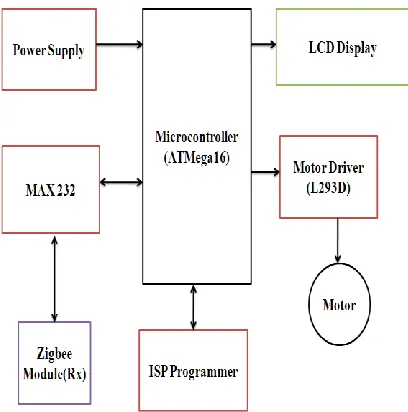
Fig 86: Block Diagram of Receiving Section
(6)DC Motor-
DC motors have a rotating armature winding but non-rotating armature magnetic field and a static field winding or permanent magnet. Different connections of the field and armature winding provide different inherent speed/torque regulation characteristics. The speed of a DC motor can be controlled by changing the voltage applied to the armature or by changing the field current.Fig 9: Simulation Diagram of Receiving Section
Fig 10: View of Receiving Section [image:4.612.73.277.249.455.2]
3.
SOFTWARE DEVELOPMENT
Microcontroller, when it is used to operate as a wireless network involves following steps:
Fig 11: Steps for software development
(a) Coding / Debugging
-
Coding or debugging is onein a high-level language (such as c or java). Compiler for a high level language helps to reduce production time. To program the microcontrollers WinAVR was used using C language. The source code has been commented to facilitate any occasional future improvement and maintenance. WinAVR is a suite of executable, open source software development tools for the Atmel AVR series of RISC microprocessors hosted on the Windows platform. It includes the GNU GCC compiler for C and C++. WinAVR contains all the tools for developing on the AVR. This includes AVR-gcc (compiler), AVR-gdb (debugger) etc.
(b)Compiling-
After compiling the program, it is converted to machine level language in the form of o‟s ans1‟s.This file is called as the Hex file and is saved with the extension (.Hex). The compiler also generates errors in the program which should be removed for proper execution of the program.(c) Burning
-Burning the machine language (hex) file
into the microcontroller‟s program memory is achieved with a dedicated programmer, which attaches to a PC‟s peripheral. PC‟s serial port has been used for the purpose. for this purpose Ponyprog programmer was used to burn the machine language file into the microcontroller‟s program memory. Ponyprog is serial device programmer software with a user-friendly GUI framework available for Windows95/98/ME/NT/2000/XP and Intel Linux. Its purpose is reading and writing every serial device. It supports I²C Bus, Micro wire, SPI EEPROM, and the Atmel AVR and Microchip PIC microcontroller. The microcontrollers were programmed in approximately two seconds with a high speed-programming mode. The program memory, which is of Flash type, has, just like the EEPROM, a limited lifespan. On AVR microcontroller family it may be reprogrammed up to a thousand times without any risk of data corruption Atmega16 Programmer(ISP) which is used to burn the program into AVR microcontrollers.
(d) Evaluation-
If the system performs as desired by the user and performs all the tasks efficiently and effectively the software development phase is over and the project is ready to be installed in any of the industrial sites as a personal area network. If not, the entire process is repeated again to rectify the errors. One of the difficulties of programming microcontrollers is the limited amount of resources the programmer has to deal with. In PCs resources such as RAM and processing speed are basically limitless when compared to microcontrollers. In contrast to a PC, the code on microcontrollers should be as low on resources as possible, but being cost effective and power efficient makes it a better option.In the programming of the proposed system is used the following .c and .h file
(1) lcd.c
-This c file contains the code for control of
functionality of the attached LCD module. The code controls the initialization of the LCD, data writing on the LCD, and also the movement, characteristics and location of the cursor. It offers the facility to write data on the LCD character-by-character or string-wise. The command set used in the software is based on the command set used in the LCD based on Hitachi HD44780 ICs. This file contain INitlcd ( ), remove ( ), display ( ) and displaying ( ).(i) To initialize the LCD:
Void INitlcd( ) {
//This function initializes the lcd module
Must be called before calling lcd related functions Arguments:
Style = LS_BLINK, LS_ULINE (can be "OR"ed for combination)
LS_BLINK: The cursor is blinking type
LS_ULINE: Cursor is "underline" type else "block" type
}
(ii) To display strings to LCD:
Void display (const char *data) {
//This function writes a given string to LCD at the current cursor location.
Arguments:
Msg: a null terminated string to print}
(2) Lcd.h
-
This header file contains all the constant variable values and names of the subroutines used by various files used in the software. It clearly indicates which variable can be used as a global variable and which of the subroutines can be used across the software files.(3)Usart_lib.c
-
This file contains the code for controlling the USART of ATMEGA‟S. This is contain three major functions USARTInit ( ), USARTReadChar ( ) and USARTWriteChar ( ).Initialization of USART:
Void USARTInit (uint16_t ubrr_value) {
UBRR= ubrr_value; //Set Baud rate
UCSRC= (1<<URSEL)|(3<<UCSZ0);// Set Frame Format UCSRB= (1<<RXEN)|(1<<TXEN);// //Enable The receiver and transmitter
}
Reading From the USART:
This function will read data from the USART. Char USARTReadChar ()
{
While (! (UCSRA & (1<<RXC))) //Wait until a data is available
{
//Do nothing }
Return UDR; //Now USART has got data from host and is available is buffer
}
Writing to USART:
Void USARTWriteChar (char data) {
While (! (UCSRA & (1<<UDRE))) //Wait until the transmitter is ready
{
//Do nothing }
UDR=data; //Now write the data to USART buffer }
(4)Adc.c-
This file contains the code for controlling the ADC of ATMEGA‟S. This is contain two major functions initializeADC ( ), int ReadADC (uint8_t ch). This helps us to read various sensors.(i)-Initialization of ADC:
Initialize ADC () {
ADMUX= (1<<REFS0);// For Aref=AVcc; ADCSRA= (1<<ADEN)|(7<<ADPS0); }
(ii) Read data from ADC:
Int ReadADC (uint8_t ch) {
//Select ADC Channel ch must be 0-7
//Start Single conversion
//Wait for conversion to complete
//Clear ADIF by writing one to it
return(ADC);
}
(5) Functions used in program:
The codewhich is used to program the controller include some functions as:
(i) To provide delay in the program
Void delay (unsigned char value) {
For (unsigned int i=0; i<value; i++) {
_delay_ms (1); }
}
(ii) Controlling of the motor
Void motor (char data) {
Switch (data) {
Case „a‟: motor at 100%; Speed;
Case „b‟: motor at 75%; Speed;
Case „c‟: motor at 50%; Speed;
Case„d‟: motor at 25 %; Speed;
Default: motor at 0%; Speed ;}}
Fig 13: View of Complete simulation
4. RESULT
The electrical as well as electronics circuit have been designed for controlling the speed of DC motor wirelessly, which is very much cost friendly as well as environmentally. The module was successfully developed and tested in the laboratory with environmental conditions. The transmitter was able to transmit the data up to 40mts distance. The following table-1 shows the Potentiometer (inputs voltage), ADC (Bits) and Motor (outputs) TABLE-1
S.No Potentiometer(Inputs
Voltage)
ADC (Bits) Motor(Outputs) %
1. 0 V 0 bits 0%
2. 0.25V 51.2 bits 5%
3. 0.5V 102.4 bits 10%
4. 3.75V 153.6 bits 15%
5. 1V 204.8 bits 20%
6. 1.25V 256 bits 25%
7. 1.5V 307.2 bits 30%
8. 1.75V 358.4 bits 35%
9. 2V 409.6 bits 40%
10. 2.25V 460.8 bits 45%
11. 2.5V 512 bits 50%
12. 2.75V 563.2 bits 55%
13. 3V 614.4 bits 60%
15. 3.5V 716.8 bits 70%
16. 3.75V 768 bits 75%
17. 4V 819.2 bits 80%
18. 4.25V 870.4 bits 85%
19. 4.5V 921.6 bits 90%
20. 4.75V 972.8 bits 95%
21. 5V 1024 bits 100%
[image:7.612.323.597.87.710.2]Fig: 14 Snapshot Speed 0%
[image:7.612.74.302.88.258.2]Fig: 15 Snapshot Speed Less 25%
[image:7.612.74.292.424.688.2]Fig: 16 Snapshot Speed Greater 25%
Fig: 17 Snapshot Speed 50%
[image:7.612.73.288.426.688.2]Fig: 19 Snapshot Speed 100%
5. CONCLUSION
This system is proposed to control the speed of dc motor using using Zigbee protocol in wireless personal area network. The hardware is first simulated in proteus software with suitable hex code generated by AVR studio 4 for the selection of appropriate components to design a wireless personal area network to control the speed of DC motor. The designing of a sustainable system to control the speed and orientation of a Permanent Magnet DC Motor was successfully implemented in this paper. The system is capable of controlling the speed of a remotely located DC motor from a control room wirelessly, consequently can be realized for a variety of application. The paper provides a platform for further advancement in the field of industrial use of DC motors.
6.
ACKNOWLEDGMENTS
We hereby acknowledge our Coordinator Sunil Semwal and Dr. Rajesh Kumar for guiding us in the right direction and for giving tremendous support and encouragement to make this project a success
.
7. REFERENCES
[1] MEMS for Distributed Wireless Sensor Network, Brett A,Kristofer S.J. Pister, Berkeley Sensor and Actuator Center, 9th IEEE International Conference on Electronics, Circuits, and System, Setember 16,2002
[2]Jeetender Singh Chauhan;GyanPrabhakar;Sunil Semwal; Atul Kumar Pandey “Zigbee Transceiver Protocol Based Wireless Sensor Networks for Emergency Response Notification for Indoor Situations” in International Journal of Engineering Research and Development(IJERD) ISSN : 2278-067X (Online) | ISSN : 2278-800X (Print) IJERD Vol.6,Issue 10,APRIL -MAY 2013
[3] A. Mainwaring, R. Szewczyk, D. Culler, J. Anderson, Wireless sensor network for habitat monitoring international Workshop on Wireless Sensor Networks and Applications (WSNA), 2002 [4] Zulhani Rasin, Mohd Rizal Abdullah (2009) “Water Quality
Monitoring System Using ZigBee Based Wireless Sensor Network” International Journal of Engineering & Technology IJET
[4] Young Wung Kim; Sang Jin Lee; Guk Hee Kim; Gi Joon Jeon(2009),"Wireless electronic nose network for real-time gas monitoring system," Robotic and Sensors Environments, IEEE International Workshop on , vol., no.5, pp.169-172, 6-7 Nov. 2009
[5] Sanjay Singh Rajesh Singh and Su kumar Ray chaudhri “DESIGN OF NODES IN WIRELESS SENSOR NETWORK USING RF MODULE ” in international journal Association of advancement in combinatorial Sciences (Ref.: ITAS-2-4/10).
[6] Jeetender Singh Chauhan; Atul Kumar Pandey; Gyan Prabhakar (2013) “PC Based Speed Control of Stepper Motor Using Wired Communication” in International Journal on Computer Science and Technology (IJCST) ISSN: 0976-8491 (Online) | ISSN: 2229-4333 (Print) IJCST Vol.4, Issue 1, JAN -MAR 2013.
[7] Eli S. Leland, Elaine M. Lai, Paul K. Wright, A Self Powered Wireless Sensor for indoor environmental monitoring
[8] Zhao Xiaoqiang; Zhang Zuhou (2010),"Development of Remote Waste Gas Monitor System," Measuring Technology and Mechatronics Automation (ICMTMA), 2010 International Conference on, vol.1, no., pp.1105-1108, 13-14 March