Mathematics Teachers’ and Students’ Perceptions on the
Implementation of the Dynamic Learning Program
(DLP)
Ma. Lorena B. Aloquina*, Eliseo P. Marpa**
*
Department of Education, Sagay City **
Faculty of Teachers Development Philippine Normal University Visayas
Abstract- The study aims to determine mathematics teachers’ and students’ perceptions on the implementation of the Dynamic Learning Program. To determine the perceptions of mathematics teachers and students, the researcher utilized the descriptive method of research using the developed research instrument used to measure mathematics teachers and students’ perceptions on the implementation of the DLP to the 16 mathematics teachers and 783 high school students. Statistical tools such as the mean, standard deviations, and t-test for independent means were used to answer problems of the study. Results show that mathematics teachers and students were positive towards the implementation of DLP. Mathematics teachers strong agree that learning materials are available and help raise the achievement level of the students. Results also show that mathematics teachers are well prepared in writing plans that are congruent to the lessons objectives. Likewise, they are prepared in the implementation of the learning plan. Furthermore, mathematics teachers and students agree that high school students’ class attendance was improved during their DLP classes. Considering significant differences in the perceptions of mathematics teachers and students on the implementation of DLP, results reveal that mathematics teachers and students do not differ significantly in their perceptions. This means that mathematics teachers and students were almost the same in their perceptions towards the implementation of the DLP. They both agree that the DLP improves mathematics performance of the students. Likewise, students have developed positive attitude towards the subjects when DLP was used in the mathematics classes. In this regard, teachers are encouraged to continue and strengthen the delivery of DLP in the mathematics class. Likewise, the use of the DLP should be given more attention but teachers are likewise encouraged to vary their approaches because different subject matter requires different approaches.
Index Terms- Dynamic Learning Program, Mathematics Teachers, Perceptions, Students
I. INTRODUCTION
t has always been the ultimate vision and mission of the Department of Education (DepEd) to achieve quality education. The DepED is always confronted with problems which are hindrances to quality of education. Several reforms have been instituted, yet quality and excellence have not been
attained. In comparative international tests measuring academic achievement, the Philippines ranked among the lowest in the developing world. The inevitable conclusion is that Filipino children go to school but not learn as much as they should, or worse, some of them do not learn at all (Miguel and Barsaga, 1997).
Likewise, results of the past and present national and international mathematics achievement test shows unsatisfactory results. Along this line data from the National Education Testing Center (NETRC, 2000) showed that the National Elementary Achievement Test (NEAT) results of January 2000 were disappointing. Based on the national result, English, mathematics and science were among the areas which obtained a lower percentage of performance (Gonzales, 2001).
In addition to this, NETRC as a governing body in administering nationalized achievement and aptitude test also showed that whether it is achievement or aptitude that is being assessed, what comes out consistently is the very low performance of pre-college youth in mathematics and science. Scores in the National College Entrance Examination (NCEE) from 1984 to 1988 showed poorest performance in mathematics (Ibe, 1996).
A parallel finding for the National Secondary Achievement Test (NSAT), over the years spanning 1994 to 1999, showed mathematics to be the second most difficult subject to science (Ibe, 2000). This low level of performance was confirmed further in the Third International Mathematics and Science Study (TIMSS) in 1995), where the Philippines ranked second and third from the bottom in science and mathematics respectively, among forty one (41) countries; more or less the same rank obtained by the country in the TIMMS-Report in 1999.
To address this scenario, in 2002 a program to enhance quality teaching and learning has been introduced. Christopher Bernido and his wife, Ma. Victoria Carpio-Bernido introduced a cost effective method of teaching science and non-science project called the Dynamic Learning program (DLP). The Dynamic Learning Program works on the principle of “learning is by doing”, it is student-centered, it’s a system of teaching that focuses on student activity rather than on traditional classroom lectures. In this program the students learn independently, because each activity is provided with a clear, learning target. However this program with all its novelty has found its potential foes not only to the school administrators but also to the teachers who are implementers and facilitators of learning. It is therefore in this context that the researcher wants to find out the
perceptions of mathematics teachers and students on the implementation of DLP in the Division of Sagay City.
II. Statement of the Problem
The purpose of this study was to determine mathematics teachers’ and students’ perceptions on the implementation of DLP in the Division of Sagay City. Specifically, this study aims to: (1) determine the perceptions of mathematics teachers’ and high school students on the implementation of DLP on the availability/preparation of learning materials, teacher preparation, assessment and evaluation, students’ attitude towards mathematics, cognitive development, affective development, and psychomotor development; (2) significant difference between mathematics teachers and students perceptions on the implementation of DLP.
III. Conceptual Framework
This study focused on mathematics teachers and students perception on the implementation of DLP.
The Dynamic Learning Program works on the principle of “learning by doing”, it is student-centered, it’s a system of teaching that focuses on student activity rather than on traditional classroom lectures. The set-up is 70% student activity–30% lecture/discussion, and usually national experts do the majority of the lectures via video. The students learn independently, because each activity is provided with a clear, learning target. The student will try to understand the lesson on their own by reading the concept notes and by doing the exercises before the lesson is discussed and explained. Some examples of student activities are solving exercises, answering guide questions and copying notes. Each student keeps a portfolio of his work as a representative documentation of his schoolwork. This would later on serve as his reviewer and proof also of his performance in school.
According to Christopher, the goal of DLP is to develop students to their fullest potential and ensure that students learn "how to learn." It motivates students by introducing them to
attainable activities and develops their confidence by letting them progress from simple to complex tasks.
With this, the teacher just facilitates the learning and because they only facilitate they can now handle three classes at the same time on any given concept, for example Math. The program has resolved the problem of lack of teachers since a single teacher can now handle more sections. DLP is 70 to 80 percent student activities and only 20 to 30 percent lecture. It is designed to solve existing problems plaguing the academe like the dearth of qualified teachers, few or error-filled textbooks and the large number of students per class in public schools.
The activity sheets form part of a student’s portfolio which will be the basis for grading a student’s performance. Students cannot take their activity sheets home so that the students can really rest and relax when they get home or help their parents in their livelihood. And because so much work is already done in class, there is no more need to do assignments at home. The program also allows students a “strategic break” from academics every Wednesday, when they focus on physical education, music and arts classes. Teachers can plan and prepare the activity sheets for the whole school year before classes start in June using DLP modules designed by the Bernidos. Even those who teach multiple classes may find it easy to follow the program.
Christopher also added that the goal of DLP is to develop students to their fullest potential and ensure that students learn "how to learn." It motivates students by introducing them to attainable activities and develops their confidence by letting them progress from simple to complex tasks.
[image:2.612.113.478.523.686.2]With the contentions presented above, this study looks into the perceptions of mathematics teachers and students on the initial implementation of DLP. Perceptions in this regard will focus issues on students’ attitude toward mathematics and how this DLP will develop students’ cognitive, affective, and psychomotor aspect.
Figure 1 on the next page illustrates the Conceptual Framework of the study.
IV. Methods The descriptive-survey method research was used in this study. It is a fact-finding procedure with adequate analysis and Mathematics Teachers’
Perception on the implementation of DLP
• Learning Materials
• Teacher Preparation
• Assessment and Evaluation
• Students’ Attitude towards Mathematics
• Cognitive Development
• Affective Development
• Psychomotor Development
Students’ Perception on the implementation of DLP
• Learning Materials
• Teacher Preparation
• Assessment and Evaluation
• Students’ Attitude towards Mathematics
• Cognitive Development
• Affective Development
• Psychomotor Development
interpretation. Specifically, the study will employ the survey type of descriptive research. Gay and Airasian (2000) state that the descriptive method or survey research involves collecting data in order to answer questions about the current status of the subject or topic of study. They added that descriptive studies are carried out to obtain information about the preferences, attitudes, practices, concerns, interests, and perceptions of some group of people.
The participants of the study were the mathematics teachers and the high school students of the Division of Sagay City. In this study total enumeration was used by the researcher for the mathematics teachers since the number of mathematics teachers as actual participants of the study was manageable. On the other hand, students as participants of the study were determined using stratified proportionate random sampling. In this regard, each high school in the Division of Sagay City was considered as stratum from which actual participants of the study was determined.
To elicit information on the perceptions of secondary school mathematics teachers and students on the implementation of DLP in the Division of Sagay City, the researcher utilized two sets of questionnaire developed by the researcher. The developed research instrument was 5-point Likert scale used to measure the perception of mathematics teachers and students on the implementation of DLP in the issues raised such as: (1) availability/preparation of learning materials, (2) on teacher preparation, (3) assessment and evaluation, (4) on pupils’ attitude towards mathematics, (5) on cognitive development, (6) on affective development, and (7) on psychomotor development. These sets of issues were perceived by mathematics teachers only. On the other hand issues perceived by the students focused only on (1) on students’ attitude towards mathematics, (2) on cognitive development, (3) on affective development, and (4) on psychomotor development. Each of the issues raised will consist of 6 items, respectively with five options for the respondents to choose from. These items on the six issues raised were subjected to expert validation and reliability.
V. Results and Discussion
Mathematics Teachers Perceptions on the Implementation of DLP
Table 1 shows that mathematics teachers strongly agree (M = 4.38) that learning materials are available for use in the implementation of DLP. Likewise, they strongly agree (M = 4.38) that learning materials in the DLP help raise the achievement level of the high school students. They also agree that learning materials are user friendly, effective in teaching mathematics and are in line with the learning objectives specified in the budget outlay. This is supported by the obtained mean scores of 4.13, 3.94, and 3.75, respectively.
Result presented in this table reflects that learning materials in the DLP are available and will really help raise the achievement level of the high school students in mathematics. Responses of mathematics teachers in this regard indicate that with the use of learning activities in DLP, achievement in mathematics of the high school students will improve. This was
supported by Jekayinfa in http://www.unilorin.edu.ng/publications /jekayinoluwa.html,
downloaded July 14, 2016) which revealed that adequate supply
of instructional resources have significant effects on students’ performance in history. Furthermore, the results revealed that schools with adequate teacher quality and material resources in History showed superiority in achievements on the history test than schools without adequate teacher quality and material resources. Furthermore, findings revealed that there is a significant difference in the achievement of students taught using standard instructional materials, those taught with improvised instructional material and those in the conventional instruction. Thus, the students taught with improvised instructional materials obtained the highest achievement score at post test, followed by those with standard instructional materials, while the control group scored the lowest (Oladejo, et.al., 2011)
Aside from these, mathematics teachers likewise believed that learning materials are user friendly which means that even without the presence of the teacher, students can still work with their learning activities. Furthermore, result can also be interpreted to mean that mathematics teachers believed that learning materials are effective in teaching mathematics which they also believe that the learning objectives are specified in their budget outlay.
Table 1
Mathematics Teachers Perceptions on the Implementation of DLP in Terms of the Issue on Learning Materials
On Learning Materials Mean Interpretation Learning materials are available for
use 4.38
Strongly Agree Learning materials contain activities
that are user friendly 4.13 Agree Learning materials are effective in
teaching mathematics 3.94 Agree Learning materials are in line with the
learning objectives specified in the budget outlay
3.75 Agree
Learning materials help raise the achievement level of the students 4.38
Strongly Agree
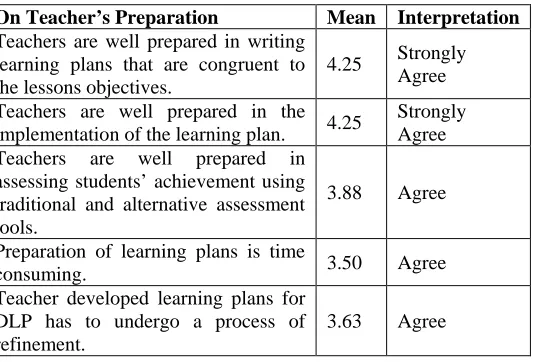
In terms of teacher’s preparation, mathematics teachers strongly agree (M = 4.25) that they are well prepared in writing learning plans that are congruent to lessons objectives. Although they agree (M = 3.50) that preparing the learning plan is time consuming. However, they strongly agree (M = 4.25) that they are well prepared in the implementation of the learning plan. Likewise, they agree that they are well prepared in assessing students’ achievement using traditional and alternative assessment tools. Furthermore, they agree (M = 3.63) that teacher developed learning plans for DLP to undergo a process of refinement.
It can be gleaned from mathematics teachers’ responses that they are well prepared in the implementation of the DLP. Their responses show that even though preparation of the learning plan is time consuming yet they are positive that they can do and refine all of this.
Table 2: Mathematics Teachers Perceptions on the Implementation of DLP in Terms of the Issue on Teacher’s
On Teacher’s Preparation Mean Interpretation Teachers are well prepared in writing
learning plans that are congruent to the lessons objectives.
4.25 Strongly Agree
Teachers are well prepared in the implementation of the learning plan. 4.25
Strongly Agree Teachers are well prepared in
assessing students’ achievement using traditional and alternative assessment tools.
3.88 Agree
Preparation of learning plans is time
consuming. 3.50 Agree
Teacher developed learning plans for DLP has to undergo a process of refinement.
3.63 Agree
Table 3 reveals that mathematics teachers strongly agree (M = 4.21) that classes using DLP improved students’ class attendance. Mathematics teachers also agree (M = 3.94) that the use of PLP improves students’ interest and participation in class activities and class discussion. Likewise, mathematics teachers agree (M = 3.75) that the use of DLP helps students express orally their responses to the questions related to the lesson. Similarly, they agree that authentic problems included in the learning activity sheets help students appreciate the usefulness of mathematics and its application to real life problems and the activities in the learning activity sheets motivate students to use other related references. This is supported by the obtained mean scores of 3.50, respectively.
Responses of the mathematics teachers in this regard indicate that they are positive and have witnessed that the use of DLP of improve high school students class attendance. It can be taken to mean that the activities prepared by the mathematics teachers do not bore them in their mathematics class. In other words high school students enjoy and have fun working with their activities. According to the mathematics teachers in their response to the informal interview conducted by the researcher, students really enjoy doing the activities prepared by them. Likewise, they observed that students gained self-esteem because doing it by themselves and with their classmates are something that really helps them improve their attitudes and likewise their achievement in mathematics. These responses of the learners can be best explained by the concept of individual learning and cooperative learning.
More and more, research on teaching mathematics explores approaches that require pupils to be more active in their own learning process. Instead of being knowledge-receptors, they can question and reflect on mathematics, or on their comprehension of mathematics. The results of Brush’s (1997) and Leikin and Zaslavsky’s (1997) research experimenting with co-operative learning, that of Choi and Hannafin (1997) who used contexts in problem-solving, and of Di Pillo, Sovchik and Moss (1997) who experimented with a learning journal, show that pupils were able to share their ideas regarding mathematics in order to better integrate their learning and find a means to communicate with their teacher.
Many studies (Meravech and Kramarski, 1997; Petit and Zawojwoski, 1997; Jitendra and Xin, 1997; Anthony, 1996; Goos
and Galbraith, 1996) have shown that interventions using non-traditional approaches (meta-cognitive activities, peer interaction, problem-solving, appropriate use of technologies) allowed pupils to develop positive attitudes toward mathematics, or to achieve better academic results.
Table 3: Mathematics Teachers Perceptions on the Implementation of DLP in Terms of the Issue on Students’
Attitude Towards Mathematics
On Students’ Attitude Towards Mathematics
Mean Interpretation
The use of DLP improves students’ interest and participation in class activities and class discussion.
3.94 Agree
The use of DLP helps students express orally their responses to the questions related to the lesson.
3.75 Agree
Classes using DLP have improved students’ class attendance. 4.21
Strongly Agree Authentic problems included in the
learning activity sheets help students appreciate the usefulness of mathematics and its application to real life problems.
3.50 Agree
The activities in the learning activity sheets motivate students to use other related references.
3.50 Agree
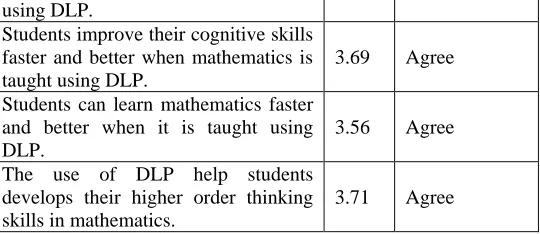
In terms of students’ cognitive aspects, mathematics teachers agree (M = 3.73) that DLP helps students learn mathematics easily. They also agree (M = 3.81) that high school students are more comfortable learning mathematics when it is taught using DLP. Likewise, they agree (M = 3.69) that high school students improved their cognitive skills faster and better when mathematics is taught using DLP. More so, mathematics teachers agree that high school students can learn mathematics faster and better and develops their higher order thinking skills when it is taught using DLP. This is supported by their obtained mean scores of 3.56 and 3.71, respectively.
[image:4.612.39.306.67.248.2]Responses of the mathematics teachers clearly shows that the use of DLP in teaching high school mathematics help students cognitive aspect. They learn mathematics easier, faster and better when it is taught using DLP. Likewise, it helps students develop their higher order thinking skills. This made possible because mathematics activities in DLP is design by the mathematics teachers for this purpose. Although there are students who are not at ease with the use of DLP in the mathematics classroom, however, majority of them likes mathematics when it is taught using DLP.
Table 4: Mathematics Teachers Perceptions on the Implementation of DLP in Terms of the Issue on Students’
Cognitive Aspects
On Students’ Cognitive Aspects Mean Interpretation DLP helps students learn mathematics
easily. 3.73 Agree
Students are more comfortable
using DLP.
Students improve their cognitive skills faster and better when mathematics is taught using DLP.
3.69 Agree
Students can learn mathematics faster and better when it is taught using DLP.
3.56 Agree
The use of DLP help students develops their higher order thinking skills in mathematics.
3.71 Agree
In terms of psychomotor aspects, mathematics teachers agree that activities in the DLP class develop students’ skills in constructing graphs and geometrical figures. This is indicated by the obtained mean scores of 3.63 and 3.50, respectively. Likewise, mathematics teachers agree that using DLP in the mathematics class develops students’ skills in the use of mathematics devices such as ruler, protractors, compass, and many others as shown by the obtained mean score of 3.94. Mathematics teachers also agree that using DLP develops students’ skill in the use of technology and manipulative in the mathematics classroom.
Results in this regard reflect that the use of the DLP does not only helps improve students attitude towards mathematics and their cognitive aspects but likewise, it helps improve students psychomotor skills more specially in the use of mathematics devices as well as the use of manipulative and technology in the mathematics classroom.
Table 5: Mathematics Teachers Perceptions on the Implementation of DLP in Terms of the Issue on Students’
Psychomotor Aspects
On Students’ Psychomotor Aspects Mean Interpretation The use of DLP develops students’
skills in constructing graphs. 3.63 Agree The use of DLP develops students’
skills in constructing geometrical figures.
3.60 Agree
The use of DLP develops students’ skills in using mathematics devices such as ruler, protractors, compass and many others.
3.94 Agree
The use of DLP develops students’ skills in the use of technology in mathematics classroom.
3.50 Agree
The use of DLP develops students’
skills in the use of manipulative. 3.69 Agree
When the perceptions of mathematics teachers were taken altogether and individually, Table 6 reveals that they are positive towards the implementation of DLP. This is supported by the obtained mean scores ranging from 3.67 to 4.11.
Responses of the mathematics teachers show that the use of DLP in the mathematics class is good. Students attitudes towards the subject has improved, they enjoy mathematics activities provided to them by their mathematics teachers. When students develop positive attitudes towards the subject, it then follows that
their academic performance also improves. As observed and supported by researches, attitude towards mathematics is related to students academic performance.
[image:5.612.35.305.59.176.2]Mathematics teaching does not always allow pupils to develop positive attitudes toward the discipline, and it seems that the more pupils progress in their studies, the stronger the relationship is between their attitudes toward mathematics and their academic results; in other words, at the beginning of junior high school, for example, if attitudes toward mathematics are positive, good academic results are likely in future. In a meta-analysis, Ma and Kishor (1997) stress that between the first four years and the last two years of elementary school, the relation between attitudes toward mathematics and academic performance increases by 367%, that it increases by 79% between the end of elementary school and the beginning of high school, and that it diminishes by 20% between the beginning and the end of high school. In our view, it is therefore important to intervene as early as elementary school, so that pupils do not develop too many negative attitudes toward mathematics, and can thus enjoy increased success in this discipline.
Table 6: Mathematics Teachers Perceptions on the Implementation of DLP When Taken as a Whole
Issues Mean Interpretation
On learning materials 4.11 Positive On teacher’s preparation 3.90 Positive On students’ attitude towards
mathematics
3.78 Positive
On students’ cognitive aspect 3.71 Positive On students’ psychomotor aspect 3.67 Positive
As a whole 3.83 Positive
High School Students Perceptions in the Implementation of DLP
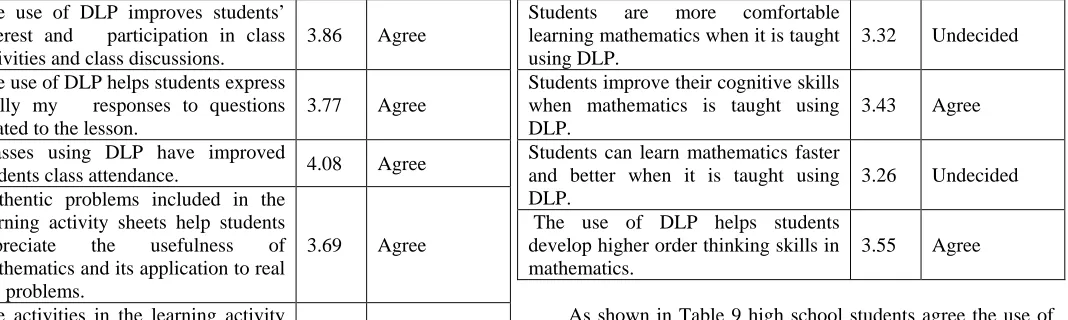
As shown in Table 7, high school students agree (M = 4.08) that mathematics classes using DLP have improved students class attendance. They also agree (M = 3.86) that the use of DLP improves their interest and participation in class activities and class discussions. High school students likewise agree (M = 3.77) that the use of DLP helps them express orally their responses to questions related to the lesson. More so, they agree (M = 3.69) that authentic problems included in the learning activity sheets help them appreciate the usefulness of mathematics and its application to real life problems. Lastly, they agree (M = 3.60) that activities in the learning activity sheets motivate students to use other related references.
As indicated by the responses of the high school students, the use of DLP in mathematics classes has contributed in developing students’ positive attitude towards the subject. The same with mathematics teachers’ responses that the use of DLP improved students’ class attendance.
Table 7: High School Students Perceptions on the Implementation of DLP in the Issue on Students’ Attitude
Towards Mathematics
On Students’ Attitude Towards Mathematics
The use of DLP improves students’ interest and participation in class activities and class discussions.
3.86 Agree
The use of DLP helps students express orally my responses to questions related to the lesson.
3.77 Agree
Classes using DLP have improved
students class attendance. 4.08 Agree Authentic problems included in the
learning activity sheets help students appreciate the usefulness of mathematics and its application to real life problems.
3.69 Agree
The activities in the learning activity sheets motivate students to use other related references.
3.60 Agree
Table 8 reveals that high school students agree that DLP help them learn mathematics easily (M = 3.57) and develop their higher order thinking skills (M = 3.55). Likewise, they agree that the use of DLP improves their cognitive skills (M = 3.43). However, they are undecided whether they are comfortable or not in learning mathematics using DLP (M = 3.32) and whether they can learn mathematics faster and better when it is taught using DLP (M = 3.26).
Results presented in this table reflects that high school students believed that activities in the DLP program help improves their cognitive aspects but they are not sure whether they can learn faster and better using DLP. Their responses in this regard can be taken to mean that since DLP is new to them, they are still in the period of adjustment may be because they are used of the traditional approach of teaching mathematics. Likewise their responses indicated that they are not sure that they can be comfortable with the subject when it is taught using DLP. These responses of the high school students indicate that since DLP is activity based one thing students are not sure is possibly on the instructions given to them by their teachers in the activity sheets. Sometimes students were not able to follow instructions correctly. In other words students are poor in understanding of the instructions. This situation implies that high school students are poor in reading comprehension. Several studies show that reading comprehension is related to students’ academic performance in mathematics more specifically in word problem solving. According to Murcia (2012) it cannot be denied that problem solving is an important part of Mathematics education. Mathematics, in general, is an important subject because of its practical role to a person and the society as a whole. However, before a student can successfully solve a problem, he has to posses’ good reading comprehension, analytic and computational skills. She also added that mathematics problem-solving and reading comprehension go hand-in-hand.
Table 8: High School Students Perceptions on the Implementation of DLP in the Issue on Students’ Cognitive
Aspects
On Students’ Cognitive Aspects Mean Interpretation DLP helps students’ learn
mathematics easily. 3.57 Agree
Students are more comfortable learning mathematics when it is taught using DLP.
3.32 Undecided
Students improve their cognitive skills when mathematics is taught using DLP.
3.43 Agree
Students can learn mathematics faster and better when it is taught using DLP.
3.26 Undecided
The use of DLP helps students develop higher order thinking skills in mathematics.
3.55 Agree
As shown in Table 9 high school students agree the use of DLP in teaching mathematics developed their skills in constructing graphs (M = 3.50). They likewise agree that DLP develops their skills in using mathematics devices such as ruler, protractors, compass, and others (M = 3.59). More so, they agree that DLP will develop their skills in the use of technology in the mathematics classroom (M = 3.47). However, high school students are undecided whether or not the use of DLP in mathematics classes will develop their skills in constructing geometrical figures (M = 3.38) and the use of manipulative (M = 3.36).
[image:6.612.49.583.58.218.2]Responses of the high school students in this aspect indicate that the use of DLP in teaching mathematics helps them improve their psychomotor aspects but not sure of the issue that “the use of DLP developed students’ skills in constructing geometrical figures” and “the use of DLP developed students’ skills in the use of manipulative”. These responses of the high school students can be taken to mean that there are limitations in the use of manipulative. Manipulative is not used in other areas of mathematics and likewise, with the use of geometrical figures.
Table 9: High School Students Perceptions in the Implementation of DLP in the Issue on Students’
Psychomotor Aspects
On Students’ Psychomotor Aspects Mean Interpretation The use of DLP developed students’
skills in constructing graphs. 3.50 Agree The use of DLP developed students’
skills in constructing geometrical figures.
3.38 Undecided
The use of DLP developed students’ skills in using mathematics devices such as ruler, protractors, compass and many others.
3.59 Agree
The use of DLP developed students’ skills in the use of technology in mathematics classroom.
3.47 Agree
The use of DLP developed students’
skills in the use of manipulative. 3.36 Undecided
undecided. This is supported by the obtained mean scores of 3.56, 3.43, and 3.46, respectively. This means that they are not yet sure whether or not the implementation of DLP in the mathematics classes will help improve the cognitive and psychomotor aspects of the students. Although there are items in this issues where they are positive but summing it up they are not yet sure of the benefits they can deduced from the use of DLP in the mathematics classes.
[image:7.612.28.587.351.460.2]However, they are positive that the use of DLP in teaching mathematics improves students’ attitude towards mathematics as shown by the obtained mean score of 3.80. This means that they like and enjoy the activities presented by the teacher.
Table 10: High School Students Perceptions in the Implementation of DLP When Taken as a Whole
Issues Mean Interpretation
On students’ attitude towards mathematics
3.80 Positive
On students’ cognitive aspect 3.43 Undecided On students’ psychomotor aspect 3.46 Undecided
As a whole 3.56 Undecided
Significant Differences in Mathematics Teachers and High School Students Perceptions on the Implementation of DLP
Table 11 reveals that as whole, there is no significant difference between mathematics teachers and high school students’ reactions on the implementation of DLP (t = -1.49, ρ = 0.14). Likewise, when issues were considered individually, the same results of no significant differences are observed. This is supported by the obtained t-ratios of 0.12, -1.21, and -1.00 at probability values of 0.90, 0.23, and 0.32, respectively. Since the obtained probability values are less than the 0.05 level of significance, hypothesis which states that there is no significant difference between mathematics teachers and high school students’ initial reactions in the implementation of DLP is therefore accepted.
Results in this regard can be taken to mean that mathematics teachers and high school students do not differ significantly in their initial reactions on the implementation of DLP in mathematics classes. This means that what they see and observed regarding the use of DLP in mathematics classes are almost the same. Although there are differences, however, differences are not significant.
Table 11: Differences in Mathematics Teachers and Students Reactions on the Implementation of DLP
II. CONCLUSIONS AND RECOMMENDATIONS
Instructional materials are considered as one of the most important tool in the teaching-learning process. Mathematics teachers believe that learning materials help raise the achievement level of the students. In this regard, it is accorded that mathematics teachers should be well prepared in writing learning plans that are congruent to the lessons objectives. Likewise, they strongly believed that teachers are well prepared and are ready in the implementation of the learning plan. Furthermore, mathematics teachers strongly believed that classes using DLP have improved students’ class attendance. On the other hand, they believed that the use of DLP improves students’ interest and participation in class activities and class discussion; helps students express orally their responses to the questions related to the lesson; authentic problems included in the learning activity sheets help students appreciate the usefulness of mathematics and its application to real life problems; and the activities in the learning activity sheets motivate students to use other related references.
The study also concludes that DLP helps students learn mathematics easily; students are more comfortable learning mathematics when it is taught using DLP; students improve their
cognitive skills faster and better when mathematics is taught using DLP; students can learn mathematics faster and better when it is taught using DLP; and the use of DLP helps students develop their higher order thinking skills in mathematics. They also developed skills in constructing graphs; the use of DLP develops students’ skills in constructing geometrical figures; The use of DLP develops students’ skills in using mathematics devices such as ruler, protractors, compass and many others; the use of DLP develops students’ skills in the use of technology in mathematics classroom; and the use of DLP develops students’ skills in the use of manipulative.
For the high school students using DLP in their mathematics class helps develop their interest and participation in class activities and class discussions. The DLP also help them express orally their responses to questions related to the lesson when DLP is used in teaching. High school students have improved their class attendance in their mathematics class because of the program. They also appreciate the usefulness of mathematics because assessments are authentic and its applications focus more on real life problems. Likewise, high school students were motivated to use related references because of the learning activities. Likewise, high school students strongly believed that they developed positive attitude towards mathematics and they
Issues Respondents Mean Sd Df t ρ Interpretation
Attitude towards mathematics
Teachers Students
3.80 3.78
0.78
0.50 384 0.12 0.90 Not Significant
cognitive aspects Teachers Students
3.43 3.71
0.92
0.60 384 -1.21 0.23 Not Significant
psychomotor aspects Teachers Students
3.46 3.65
0.77
0.43 384 -1.00 0.32 Not Significant
As a whole Teachers
Students
3.56 3.83
0.71
believed that they have developed their cognitive skills in their mathematics classes using DLP.
In this regard, teachers are encouraged to strengthen delivery of DLP in the mathematics class. Likewise, the use of DLP should be given more attention but teachers are likewise encouraged to vary their approaches because appropriateness of the approach to be used in a particular topic is very important.
REFERENCES
[1] Adams, G.L., &. E.S. (1996). Research on Direct Instruction: 25 years beyond DISTAR. Seattle, WA: Educational Achievement Systems.
[2] Bodilly, S.J. (1998). Lessons from the New American Schools Development Corporation’s development phase. Washington, DC: RAND. [3] Clune, W.H., & White, P.A. (1988). School-based management:
Institutional variation, implementation, and issues for further research.
New Brunswick, NJ: Rutgers University, Center for Policy Research in Education, Eagleton Institute of Politics.
[4] Cohen, D., & Spillane, J. (1992). Policy and practice: The relations between governance and instruction. In G. Grant (Ed.), The review of research in education (pp. 3-49). Washington, DC: American Educational Research Association.
[5] Cohen, D.K. (1988). Teaching practice: Plus queça change. In P.W. Jackson (Ed.),Contributing to educational change: Perspectives on research and practice (pp. 27-84). Berkeley, CA: McCutchan Publishing Corporation. [6] Cohen, J. (1969). Statistical power analysis for the behavioral science. New
York: Wiley. Cooper, R., Slavin, R.E., & Madden, N.A. (1998). Success for All: Improving the quality of implementation of whole-school change through the use of a national reform network. Education and Urban Society, 30 (3), 385-408.
[7] Cooper, R., & Slavin, R.E. (1997). Scaling up Success for All: Second year report to the Pew Charitable Trust. Baltimore, MD: Johns Hopkins University, Center for Research on the Education of Students Placed At Risk.
[8] Cooper, R., Slavin, R.E., & Madden, N. (1997). Success for All: Exploring the technical, normative, political, and socio-cultural dimensions of scaling up (Report No. 16). Baltimore, MD: Johns Hopkins University, Center for Research on the Education of Students Placed At Risk.
[9] Cuban, L. (1990). Reforming again, again, and again. Educational Researcher, 19 (1), 3-13. Elmore, R.E., & McLaughlin, M.W. (1988).
Steady work: Policy, practice and the reformof American education. Santa Monica, CA: RAND Corporation.
[10] Firestone, W.A (1989). Educational policy as an ecology of games.
Educational Researcher, 18 (7), 18-23.
[11] Hirsch, E.D. (1993). The Core Knowledge curriculum: What’s behind its success? Educational Leadership, 50 (8), 23-30.
[12] Johnson, W., Snyder, K., Anderson, R., & Johnson, A. (1996). School work culture and productivity. The Journal of Experimental Education, 64 (2), 139-156.
[13] Jordan, W.J., Lara, J., & McPartland, J. (1996). Exploring the causes of early dropout among race-ethnic and gender groups. Youth and Society, 28
(1), 62-94.27
[14] Lusi, S. (1997). The role of State Departments of Education in complex school reform. New York: Teachers College Press. Mojkowski, C., & Fleming, D. (1988). School-site management: Concepts and approaches. [15] Andover, MA: Regional Laboratory for Educational Improvement of the
Northeast and Islands. Murphy, J. (1992). Restructuring America’s schools: An overview. In C. Finn and T. Rebarbert, Education reform in the 1990s.
New York: MacMillan.
[16] Oakes, J. (1992). Can tracking research inform practice? Technical, normative, and political considerations. Educational Researcher, 21, (4), 12-21.
[17] Petri, H.G. (1990). Reflections on the second wave of reform: Restructuring the teaching profession. In S.L. Jacobson and J.A. Conway (Eds.),
Educational leadership in anera of reform. New York: Longman.
[18] Slavin, R.E., & Fashola, O.S. (1998). Show me the evidence! Proven and promising programs for America’s schools. Thousand Oaks, CA: Corwin Press.
[19] Slavin, R.E. (1995). Cooperative learning: Theory, research, and practice
(2nd ed.). Boston: Allyn & Bacon.
[20] Slavin, R.E., Madden, N.A., Dolan, L., & Wasik, B. (1992). Success for All: A relentless approach to prevention and early intervention in elementary schools. Arlington,VA: Educational Research Service.
[21] Slavin, R.E., Madden, N.A., Dolan, L., & Wasik, B. (1996a). Every child, every school: Success for All. Thousand Oaks, CA: Corwin Press.
[22] Slavin, R.E., Madden, N.A., Dolan, L., & Wasik, B. (1996b). Success for All: Summary of research. Journal of Education for Students Placed At Risk, 1 (1), 41-76.
[23] Slavin, R.E., Madden, N.A., Karweit, N., Dolan, L., Wasik, B., Ross, S.M., & Smith, L.J. (1994). Whenever and wherever we choose: The replication of Success for All. PhiDelta Kappan, 75, 639-647.
[24] Smith, M.S., & O’Day, J. (1990). Systemic school reform. In Politics of Education Association yearbook 1990 (pp. 233-267). New York: Taylor & Francis.
[25] Stringfield., S., Millsap, M., Herman, R., Yoder, N., Brigham, N., Nesselrodt, P., Schaffer, E., Karweit, N., Levin, M., & Stevens, R. (1997).
Special strategies studies: Finalreport. Washington, DC: U.S. Department of Education.
[26] Stringfield, S., Ross, S., & Smith, L. (1996). Bold plans for school restructuring: The New American Schools designs. Mahwah, NJ: Erlbaum. [27] Thompson, B., & Borrello, G. (1986). Second-order factor structure of the
MBTI: A construct validity assessment. Measurement and Evaluation in Counseling andDevelopment, 18, 148-153.
[28] U.S. Department of Education (1993). Reinventing Chapter 1. Washington, DC: Author.
AUTHORS
First Author – Ma. Lorena B. Aloquina, Department of Education, Sagay City