ANALYSIS OF BER-BASED ON-DEMAND AND LINK STATE ROUTING
PROTOCOLS UNDER REALISTIC CONDITIONS
Tiguiane Yélémou1, Jonathan Ledy2, Benoît Hilt3, Philippe Meseure2 and Anne-Marie Poussard2 1Polytechnic University of Bobo-Dioulasso, Burkina Faso
2University of Poitiers, XLIM CNRS Lab, France
3Department of Networks and Telecommunication, University of Haute Alsace, MIPS Lab, France E-Mail: [email protected]
ABSTRACT
Wireless networks are known to offer lower performance compared to wired ones. These networks are lossy due to obstacles in the wave propagation field, frequent topology change and interference due to simultaneous transmissions. To address these limits, many improvements of basic protocols are proposed. However, few studies focus on a detailed analysis and performance comparison of QoS protocols. In this paper, we first highlight the impact of wave propagation model on the performance of wireless network routing protocols. Second we detail the behavior of Bit Error Rate (BER)-based approaches on link-state and on-demand routing protocols. A fine-analysis allows us to understand the performance of Optimized Link State Routing protocol (OLSR) and Zone Routing Protocol (ZRP) compared to Ad hoc On-Demand Distance Vector Protocol (AODV) in urban environment. In this study, we highlight the need to reconsider the node vicinity when filling routing tables in QoS-based link-state protocols. We also point out benefits and limits of blacklisting approach often proposed for reactive protocols enhancement.
Keywords: wireless networks, routing algorithms, bit error rate, performance evaluation.
1. INTRODUCTION
Due to their low cost, ease of deployment and agility, wireless networks give new perspectives for the future of mobile networking. However, due to some issues such as high-level interference, node mobility and limited bandwidth, these networks fail to provide a quality of service capable of fulfilling the strict requirements of multimedia applications. Radio links are vulnerable and their topology is unstable. Thus standard techniques developed to ensure QoS, such as resources reservation, buffering, channeling traffic, admission control, etc., are not effective in this context. A substantial work for fitting routing protocols with wireless network context has been done. Proposed routing protocols can be classified as table driven [1] [2] and on-demand [3] [4] [5].
Table driven protocols are proactive. Routes are immediately available for data transmissions. This induces low transmission delay but requires a high routing overhead. Indeed, links state must be periodically communicated (broadcasted) to keep updated routing tables. A part of the available bandwidth is therefore consumed by control messages. Optimized Link State Routing protocol (OLSR) is a well known link state routing protocol. It implements the Multi Point Relays (MPR) mechanism [1] to reduce routing overhead.
On-demand protocols are reactive. Routes are not immediately available and should be creates on-demand when nodes want to communicate via a route request mechanism. Depending on the topology this may induce a considerable delay. Except Hello messages to maintain neighborhood information, nodes do not periodically broadcast control messages as proactive protocols do. Indeed request and error broadcast may have critical importance if known routes contains inaccuracy.
To address the problems of these two families of protocols, hybrid ones tend to exploit the advantages of
both reactive and proactive strategies. It is anticipated that these hybrid protocols reduce the routing load (since the dissemination of control messages is limited to neighborhood nodes) and end-to-end delay (since paths to close nodes are already available). Among these three categories of protocols, we will focus on the ones commonly used: Ad hoc On-Demand Distance Vector protocol (AODV), Optimized Link State Routing protocol (OLSR) and Zone Routing Protocol (ZRP).
Research efforts have not focused enough on fine analysis of routing protocols fundamental characteristics when link quality is taken into account in the routing table calculation process. Likewise, very few papers compare performances of QoS-routing approaches in realistic conditions. Very often effects of interference remain untested or are simulated with unrealistic propagation model. To overcome this, we use a realistic wave propagation simulator, CRT (Communication Ray Tracer) [6]. It takes into account multipath, reflexions, scattering, etc. and allows the calculation of Bit Error Rate of each received packet in a realistic manner (based on impulses responses). This BER becomes available for integration into routing protocols. Under these conditions, we test and analyze performance of Bit Error Rate (BER)-based approaches of these protocols. The strengths and suitability for deployment of these so called QoS protocols are pointed out in this article in different scenarios.
The main contributions of this paper include:
A comprehensive study of the behavior of different routing approaches when radio link quality is taken into account,
Performance tests of wireless static networks under realistic conditions,
This work is structured as follows. In Section II, we present related work and analyze simulation hypotheses impacts on protocols performance. In Section 3, we present our BER-based approach to enhance the protocols’ performance. Simulation results are studied in Section 4. We conclude in Section 5.
2. POSITIONING OF OUR SOLUTION
To design routing protocols for wireless networks, authors were inspired by those already used in wired networks. However, early works do not consider radio link quality. In the past few years, some authors highlight the importance of taking into account link quality in routing protocols. To test the performance of these improved protocols, many rely on simulation. Unfortunately their simulation conditions are questionable (see Subsections II-B, II-C). In this section, first, we present some enhancements of wireless network routing protocols. Then, we explain impacts of propagation model on performance results. Finally, we present multicommunication effects.
A. QoS routing
Standard well known protocols like AODV and OLSR (their basic layouts) only take into account number of hops criterion in their path selection processes. Indeed, AODV chooses first-built paths, that, in practice, means the paths with lowest delays and accordingly one with a low number of hops (but not necessarily the lowest). Nevertheless, some links of these paths can have a low quality that allows small-sized messages such as route requests and replies packets to be transmitted, but not large ones. On such links, several transmissions can be mandatory to ensure data packet transmissions which induces more delay. Therefore, the chosen paths appear not as relevant as expected.
The routing computation mechanism used by the basic layouts of OLSR is also based on the minimization of the number of hops. The MPR computation mechanism is heavily based on the number of 2hop-neighbors that MPR candidates can reach [1]. This MPR mechanism can lead to a bad network capacity, since a node have a partial knowledge of the network [7]. This can result in low Packet Delivery Ratio (PDR) and important end-to-end delay due to retransmissions.
ZRP implementation [8] has three components: IntrAzone Routing Protocol (IARP), Interzone Routing Protocol (IERP) and Bordercast Resolution Protocol (BRP). IARP is a limited-scope proactive routing protocol [9]. Since each node monitors changes in its surrounding R-hop neighborhood (routing zone), global route discovery processes to local destinations can be avoided. IERP is the reactive routing component of ZRP [10]. It adapts existing reactive routing protocol implementations to take advantage of the known topology of each node surrounding R-hop neighborhood (routing zone). The availability of routes towards neighboring nodes allows IERP to pass over route queries for local destinations. In the bordercasting process, a bordercasting node sends a route request packet to each of its peripheral nodes by
unicast or multicast system [11]. By employing query control mechanisms, route requests can be steered away from areas of the network that have already been covered [8, 12].
During recent years, efforts have been made to take into account the link quality in the route choice process. Several methods are proposed with different QoS metrics including bandwidth, delay, packet delivery ratio. Khaled et al. [13] propose an on-demand routing protocol based on path robustness. Authors states that intermediate nodes must examine lifetime and delay of RREQ packets and compare them to specific limitations before to forward it in order to increase the robustness of each path. With this techniques, five examinations are performed and the size of the packet is raised at each intermediate node. Thus, this algorithm induces more weakness in the routing protocol than advantage because it increases routing messages size and delays. Some works, such as [14], use a link metric optimal value for the path selection. This choice may not provide the best path. For example, considering number of expected retransmissions metric, a path with link metric optimal value m, is prefered to any other containing just one link whose metric value is upper than m even if its other links are better. m value of a path is assumed to be the maximum link metric value, considering all links of the path.
Some authors use additive or multiplicative metric to enhance routing in wireless network context. For example, Kim et al. [15] have modified AODV protocol and particularly the RREQ mechanism in order to discover to best path. Authors states that all viable routes should be considered into the RREQ mechanism. To achieve this objective, authors used Expected Transmission Time (ETT) [16] which gives an indication on link quality to choose one path over another. According to Kim et al., this method allows to double the rate of received packets. However, this conclusion is based on simulations that rely on optimistic assumptions such as a ideal propagation model.
Some variants of OLSR algorithm try to take into account quality of selected links in MPR selection mechanism. Munaretto et al. [17] and Ge et al. [18] propose a modification of the selection process by selecting MPR among nodes with good quality links in terms of bandwidth. In the same idea, Ingelrest et al. [19] suggested to qualify links with the probability of correct reception to reflect fluctuations due to attenuations caused by obstacles. To mathematically model this probability, the lognormal shadowing model is used. The probability of good reception is therefore considered during MPR calculation. [20] [21] [22] also present heuristics addressing the issue of QoS in wireless network routing protocols.
from the source. This allows a quick construction of a path and thereby reduces control overhead packets and end-to-end delay. As ZRP is the merge of proactive and reactive routing approaches, improvements that are proposed for AODV and OSLR may be applied to it.
Often, standard protocols are compared to their modified version. Some works compare wireless network standard routing protocols: AODV, DSR, DSDV, OLSR, etc. But very few studies have focused on the comparison of different QoS-enhanced routing approaches under realistic conditions. To the best of our knowledge, no detailed performance evaluation has been conducted to compare BER-based routing protocols under realistic wave propagation model. Our study highlights the impact of simulation conditions, carries out more detailed tests involving the three main routing approaches (on-demand, link-state and hybrid ones).
B. Propagation model
Researchers, often, use simulation to test protocols’ effectiveness. Successfully reproduce realistic conditions of wireless communication is not easy. Simulation hypotheses have a major impact on analysis of protocols’ performances evaluations. In wireless networks, many factors like wave propagation environment, interference from other transmissions, dynamic topology of ad hoc network negatively impact probability of successful packet reception. On-demand and link states routing protocols suffer differently from these factors. To compare the efficiency of protocols, the effects of these factors have to be taken into consideration. In this sub-section we want to highlight the impact of these simulation conditions.
Many research works do not take into account any environment when modeling propagation channel. The authors suppose that two nodes can communicate based on various empirical formulas. These works used models such as free-space or two ray ground which are highly optimistic as they do not consider the majority of perturbations of the channel propagation. Free-space and two ray ground models only take into account the direct signal among two nodes. Propagation model dedicated to wireless networks should at least consider the path loss effect combined with the fading and the shadowing effects. Any propagation models that do not take into account environment may lead to distorted simulations and optimistic results since negative effects of the propagation are not considered. Previous works have already validated this statement [23] [24]. In this work, we used a propagation simulator [6] that takes into account all effects of the signal propagation in a 3D environment. The name of the simulator is Communication Ray Tracer (CRT). The signal modeling is based on a ray tracing approach which does not neglect any negative effect relying upon the environment. We conduct a semi-deterministic simulation with CRT. The impulse responses from the simulation are precisely computed. The BER of the radio links is estimated from these impulse responses. In fact, errors to the message originally sent are counted.
To estimate the impact of radio wave propagation environment, authors in [23] compare protocols performances with free-space propagation model and the CRT simulator. They shown that results with free space model are optimistic. For example, when packet delivery rate is almost 100% with the Free-space model, CRT model offers about 60%. When with the CRT model the minimum number of hops is 2.5, it is 1.2 in free-space model scenario. Authors conclude that all effects which rely on the signal propagation into the environment must be included into the propagation model in order to examine properly the performances of networks.
C. Multicommunication
The communication method in wireless networks is the broadcast. In ad hoc network, there is no central equipment that handles communications. Several source nodes can transmit their messages during the same period. This multi-communication induced interference that impact on network performance and undermine the efforts of routing protocols. Several studies [25] [26] have shown that, indeed the number of nodes is essential to ensure proper connectivity in the network, but beyond a certain density, increasing the number of nodes has a negative impact on network efficiency. To optimize throughput, routing protocols must therefore exploit nodes not already involved in several communications. In this case, shortest path based routing protocols do not allow better use of network capacity. Authors in [27] address this issue in the same direction. When establishing transmission path, they consider that routing protocols must exploit nodes far from network center. Those are supposed to be less involved in several communications and thus, less congested. Some authors like Gupta [25] and Hekmat [28] establish a formal relationship between evolution of throughput and number of simultaneous communications or number of nodes. These statements have to be examined with realistic propagation model.
3. BER-BASED ROUTING PROTOCOLS
simplistic in this paper. It depends on the signal-to-noise ratio (SNR) measured at any receiving node. For purpose of simplicity, they assumed that radio signal is only affected by free space loss. Reserve-and-go (RESGO) [35] MAC protocol is used but it is a very simplistic and is based on the assumption of immediate relaying at intermediate nodes, without any anti-collision mechanism. This protocol is known to be a low-delay MAC protocol and is relatively weak in reducing the inter-node interference (INI). This enhanced routing protocol performance is limited to low interference wireless networking scenarios. Our BER criterion is computed from the impulse responses of communications simulated with CRT. It is calculated using actual data packets, and not control messages like in [36]. It is symmetrical. In this paper, we use this criterion at the network level (cross-layer). This method allows using only good path (depending on the BER) for data transmission. The next sub-sections show the BER enhancement method apply to multiple protocols.
A. AODV-BER
AODV is a source-initiated routing protocol. In standard AODV [3], route discovery is initiated when a source requires a path for data transmission. An intermediate node may respond if it knows a recent path to the destination, otherwise the destination responds to the first received route request. AODV-BER picks out AODV where we apply the blacklisting approach described below to the route discovery process. Any intermediate node may discard a RREQ packet if its associated BER is higher than a predetermined threshold. Packets that ar not discarded are simply forward as in the standard AODV.
Using path with high BER may create path with high packet loss or high delay because of the retransmissions that it can create. Yet, this technique has severe drawbacks such as the filtering of viable routing option [37]. Several paths may be ignored and the reliability of the network may be decrease because ignoring bad BER links may induce a bad behaviour into the routing protocol and then decrease its performances. We set this threshold to 0.001 (that mean 1 bits over 1000 are correct). In our context if one bit is erroneous, the packet is discarded. To select the threshold, we conducted the following analysis.
If we suppose a multimedia stream with constant packet size of n bits, the packet error rate is per=1−(1−ber)n. Furthermore, the expected number of transmissions to get a successful packet can be computed as 1/(1 − per). Therefore, the expected number of transmissions is equal to:
nbtransmisions =1/(1-ber)n (1)
Figure-1 shows the number of expected retransmission depending on BER link and packet size. In view of equation 1, with a 512 bytes packet size, a BER of 0.001 is equivalent to nearly two retransmissions. Such a link could be taken as 3-hops path. If possible, these links should not be used. One can note that control message (usually lighter than data packet) can be successfully transmitted on bad BER link when messages with higher size can not be forwarded. When using this route selection technique, paths containing bad links are dismissed which limit the dissemination of RREQ messages. So it also decreases routing overhead.
B. OLSR-BER
Standard OLSR implements the Multi Point Relays (MPR) mechanism [1] to reduce routing overhead. But, as a consequence, a node has only a partial view of the different communication possibilities. If the MPR node selection and route selection mechanisms don’t take into account link quality, they can lead to a non optimal use of network capacity. The basic idea in our BER-based OLSR consists in selecting the path that offers the best BER during both the choice of MPR nodes and the path computation in routing Tables [7]. Respecting the overall structure of the original MPR selection [1], our BER-based MPR selection mechanism mainly consists in considering that a 2hop-neighbor is not covered until the 1hop-neighbor that provides the best route in term of BER is found. Heuristics that take into account link quality in MPR selection usually occur at the third step of the original algorithm, where it is pointed out that such heuristics are applied to only 25% of MPR nodes to be selected [38]. Instead of addressing this limitation, we choose to modify the standard MPR selection mechanism from its second step. At this step, a neighbor that is the only one able to access a given 2hop-neighbor is chosen as MPR. Other 2hop-neighbors are considered covered by this new MPR node only if no other neighbor offers a better path toward it. Then, at the third step, neighbor with lowest path BER toward a given 2hop-neighbor is preferred to others offering greater coverage of 2hop-neighbors [7]. An additional field about the link quality has been included in the records of neighbors. In our implementation, Topology Control (TC) messages have been extended to support the BER of each link. Our new MPR selection mechanism allows nodes to disseminate good links (in term of BER) in the network but this is not sufficient to supply routing tables with better paths. Routing tables calculation must also be modified to find paths with the lowest BER first. We show in Appendix 5 that BER-metric is an additive metric.
C. ZRP-BER
BER-based approaches are applied to both IARP and IERP protocols. As in OLSR-BER (Section 3.2), the basic idea in IARP-BER consists in better paths selection in terms of BER during routing table calculation (for neighboring nodes). When link state packets are received, the indicated destinations are integrated into routing tables if they do not already exist. Otherwise, records relating to such destinations are changed (next hop and global BER values) if new paths with a lower global BER toward these given destinations are observed. For BER-based IERP, in addition to the blacklisting approach already applied to AODV, links and path BER informations carried by the route reply packets, allow IARP to improve node neighborhood informations. Considering our BER-based approach of IARP algorithm, this enhanced IERP improves substantially ZRP global routing process. The combination of both BER-based IARP and BER-based IERP allows taking into account the BER among emitter and receiver [39].
4. PERFORMANCE EVALUATION
In this section, we first present our experimental setup and simulation conditions. Then, we analyze simulations results.
A. Experimental setup
To test the effectiveness of enhanced protocols, we rely on a network simulation using NS-2 [40] enhanced with CRT [6]. Our QoS protocols directly rely on BER values computed by this software. As routing protocols references, we use the standard ones as detailled by Request for Comments (RFC) 3626, 3561, 2026 and implemented in NS-2. Their BER-based QoS versions described in Section 3 are then compared to these references. Global parameters for every simulation are given in Table-1.
Table-1.Simulation parameters.
Parameter Value
Network simulator ns-2 Simulation time 65s Simulation area 1000m*1000m ZRP (IARP) Zone radius 2
Transmission power 100 mW
Data type CBR
Data packet size 512 bytes
MAC layer 802.11a
Mac rate 24Mbps
The CRT environmet used is the Munich town (urban outdoor environment that includes building, printed in red, in Figure-2). Points represent nodes. The average node density is 3.1.
To compare protocols, we rely on PDR, average end-to-end delay of data packets and Routing Overhead (RO) as performance parameters, while varying various network parameters such as the number of nodes and the number of simultaneous data transmissions. PDR is the ratio between the number of successfully delivered data packets over sent ones. End-to-End Delay concerns only successfully delivered packets. This may include delays caused by buffering latency during route discovery, queuing at the interface queue, retransmission delays at MAC layer and propagation and transfer times. Routing overhead is the number of control packets send by the protocol. It permits to evaluate the effective use of the wireless medium by data traffic.
Figure-2. Simulation environment with number of nodes=60. Obstacles are printed red; emmiter 18 and receiver 2 are pointed out.
B. Simulation results
To undertake a detailed study of the behavior of the six routing approaches, we perform three rounds of tests. The first set of tests relates to a single communication, a target communication that is alone in the network (source-destination: 18-2). In the second set, we observe the same communication with 9 other source-destination transmissions in the network. The 10
simultaneous transmissions are the following source-destination communications : 18-2, 2-9, 4-6, 7-8, 5-19, 3-0, 8-13-0, 1-5, 17-12 and 14-15 (see Figure-2). In the third set, we analyze more deeply the impact of multi-communication (we increase the number of simultaneous transmissions). We use the term multicommunication for simultaneous source-destination data transmissions. Table-2 summarizes the simulation conditions.
Table-2. Network configuration - fixed and variable parameters: communications (com), nodes, speed.
Context Fixed parameters Variable parameters Section
Static
1 com 20 to 60 nodes B1
10 com 20 to 60 nodes B2
60 nodes 3 to 20 com B3
Mobility 60 nodes & 10 com 4 to 20 m/s B4
18-2 single-transmission results
In this first set of simulations, the number of nodes increases from 20 to 60 nodes. Our goal is to study protocols behavior in different node densities. Protocols’ performances are under the influence of link breakages in low densities (low connectivity), routing overhead issues and new paths in high densities (strong connectivity).
Please note that the goal is not to provide an accurate statistical comparison of protocols but rather to identify major trends and identify differences in the behavior of concerned protocols.
between these two nodes are listed with their BER and their ratio in Table-3.
Table-3. Used paths.
Path usage
Path BER OLSR-st OLSR-BER AODV-st AODV-BER ZRP-st ZRP-BER
S F S F S F S F S F S F
18-9-2 0,0015 57% 43% 10% 2% 63% 13%
18-42-2 0,0022 6% 3% 1% 1% 1% 0%
18-30-2 0,0035 12% 10%
18-26-2 0,0071 5% 20% 0% 1%
18-3-2 0,0102 0% 10% 18-31-2 0,0068 1% 19% 18-4-2 0,0059 1% 10% 18-30-3-2 0,0021 1% 2%
18-10-51-2 0,0010 4% 2%
18-30-26-2 0,0000 94% 0%
18-16-32-2 0,0000 100% 0%
18-50-2 0,0003 8% 0%
18-1-2 0,0011 4% 0%
18-32-2 0,0011 4% 0%
18-10-2 0,0014 4% 1% 4% 0%
18-19-2 0,0016 3% 0%
18-16-2 0,0007 80% 1% 8% 0%
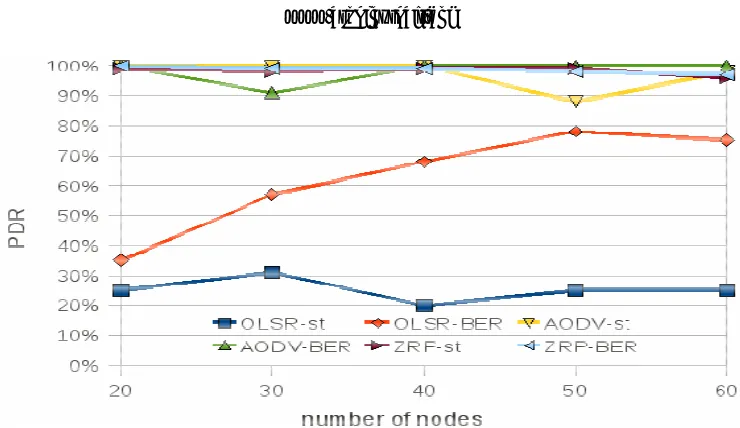
It appears that the on-demand (i.e. AODV) approach uses better paths in term of BER resulting in a better PDR and a shorter path in terms of round trip time (delay). The difference of PDR performance for AODV-st and AODV-BER is not significant; however AODV-BER performs better than the standard one. AODV-BER chooses the 3-hop-paths 18-16-32-2 in all cases. Links involved in this transmission are not subject to errors (Global BER value near 0.0) as shown in Table-3.
With OLSR protocols, the difference is more important. OLSR-BER performs better than OLSR-st from 10 to 55 points. To understand these different performances we analyze the trace files. It appears that OLSR-st, whose metric is based on the number of hops, has chosen these routes 18-26-2 in 25% of cases, 18-30-2 in 22% and 18-31-2 in 20% of cases (cf Table-3). These three paths make 49% of the packets failures because 18-31 and 18-26 are very bad links (BER values are 0, 0068 and 0, 0071). BER-based version of this protocol uses path 18-9-2 in all cases which has better links (BER value is 0, 0015).
ZRP (with its IARP process) is expected to give performances close to OLSR. Indeed, our routing radius is 2 (i.e. node routing zone is its neighbors and 2-hops
neighbors) and the largest part of the viable paths are 2hop-paths as shown in Table-3. The good performance of ZRP-BER compared to OLSR-BER observed in Figure-3 is due to the fact that the routing table established by the IARP algorithm is improved by the IERP process. Indeed, after a first failure, a route request process is initiated before IARP reconstructs a new route. So when a node receives a Route Reply packet bringing the BER values of any paths toward nodes previously traveled, it updates its routing table if it finds better paths. This behavior of ZRP-BER is explained in [39].
Figure-3. PDR evolution according to the number of nodes for single source-destination transmission: 18-2.
In Figure-3, the underachievement of OLSR-BER compared to AODV (AODV-st and AODV-BER) can be explained by the enhanced algorithm [7] that we used that does not change OLSR fundamentally. In this protocol [1], neighbors and 2hop-neighbors are automatically integrated into the node’s routing table and are supposed to be accessible respectively with 1hop or 2hops. For further destinations (more than two hops), the BER-based approach finds the best path. In theses cases the real Dijkstra algorithm is applied. To enhance this protocol, neighborhood designation should be reviewed for routing table filling. Even if a node detects a neighbor, it should not integrate it in its routing table automatically as 1-hop accessible. Instead it should first ensure that there is no better path (in term of global BER) with more than 1hop. Idem for 2hop-neighbors.
[image:8.612.121.494.499.680.2]Figure-4 shows the PDR of the 18-2 communication when only node 18 is transmitting (in blue, on the left) in 50 nodes situation. The red bar (on the right) shows the PDR result of the same communication when nine other nodes communicate simultaneously. We can clearly see that the interference due to the multi communication degrades the performance of the network. The falling rate of received packets in this multi-communication context is explained by the fact that nodes 9 and 51 are common to four source-destination transmissions including 18-2 one. Number of dropped packets due to node saturation is high at these intermediate nodes. The next subsection gives more details on this subject.
Ten simultaneous transmissions results
This subsection is a generalization of the previous one. To test the robustness of the protocols, we add nine other source-destination transmissions in addition to the 18–2 communication, namely : 18-2, 2-9, 4-6, 7-8, 5-19, 3-0, 8-10, 1-5, 17-12 and 14-15. The 10 source-nodes begin their transmissions simultaneously.
Figure-5 shows that, globally, BER-based protocols outperform their standard ones. For 50 nodes, unlike previous results (sub-section 4.2.1), the OLSR-BER protocol is the best one when considering PDR measure.
When the destination is more than three hops, the OLSR-BER protocol is able to find the best path (in terms of BER). In low density, ZRP protocols (BER-based and standard ones) give better PDR than standard AODV and OLSR, but from 40 nodes, they give the worst results. We know that when the number of nodes increases, transmitters have new opportunities to communicate but also that routing overhead increases. AODV and OLSR protocols maintain their performances (PDR above 65%) whereas ZRP is more sensitive to congestion. As an hybrid protocol, its routing load increases faster.
Figure-5. PDR evolution according to the number of nodes.
About delay (Figure-6), the proactive approaches perform better than on-demand ones and OLSR-BER outperforms standard OLSR. Globally with the same number of hops, OLSR-BER selects paths with lower global BER than OLSR-st. Number of retransmissions is expected to be upper on lossy path. From 40 nodes,
Figure-6. Delay evolution according to the number of nodes
Concerning Routing Overhead (Figure-7), BER generates slightly more control packets than OLSR-st. The BER-based approach of MPR selection induces a greater proportion of MPR nodes. Only these MPR nodes are allowed to broadcast Topology Control (TC)
messages. Besides, the blacklisting approach used by AODV-BER restricts the dissemination of RREQ messages. Therefore AODV-BER has less routing load. ZRP-BER finds better paths compared to ZRP-st, which limits route request repetitions.
Figure-7. Routing overhead evolution according to the number of nodes.
Multi-communication results
In this subsection, we use the same environment (Fig. 2) with 60 fixed-nodes. We vary the number of simultaneous pair-to-pair transmissions from 3 to 20. Thus we increase the losses due to collisions and congestions to see how our enhanced protocols behave when interferences increase.
Figure-8. PDR evolution according to the number of simultaneous transmissions.
Figure-10. Routing Overhead evolution according to the number of simultaneous transmissions.
Figures 5 and 8 have the same trend and confirm our previous statements, especially about the particular sensitivity of ZRP protocols to significant overhead. We also note that Fig. 10 shows the positive impact of blacklisting mechanism on AODV-BER. As RREQ are not forwarded in case of bad link quality, this allows to a drastic reduction of the routing overhead when the number of simultaneous transmissions increases.
All BER-based protocols behave better than the standard ones in terms of PDR. The small differences between BER-based and standard protocols can be explained: although the BER metric takes into account the effects of channel propagation (OSI level 1), it does not take into account interferences caused by simultaneous transmissions in the surrounding area that relies on access layer (OSI level 2). Thus, a route with the best global BER remains the best route even if the environment is noisy. In case of transmission route failure, link-state approach may quickly re-build
a new route.
5. CONCLUSION AND PROSPECTS
In this paper, we conduct a meticulous analysis of on-demand and link-state routing protocols under BER-based link quality consideration. In the proactive routing approaches, a node is aware of different existing paths to reach another node in the network. Our BER-based approach consists in selecting the path with the lowest global BER in this context. In reactive methods, a node which receives a route request packet will not rebroadcast this packet if the link on which the packet is reveived has a BER value above a certain threshold. This prevents lossy paths to be established and limits control packets broadcasting.
Simulations results, obtained under realistic propagation conditions, allow us to highlight the major trends of reactive protocols compared to proactive ones
and the limits of our BER-based approaches. First of all, contrary to what is widely shown in the literature, on-demand protocols are not globally better than table-driven protocols for simultaneous transmissions when they are tested in realistic static conditions. Secondly, overall BER-based enhancement improves protocols performance (PDR, Delay, Routing Overhead) in static nodes contexts. Finally, channel and congestion interferences should be considered co-jointly in routing protocols to better improve them.
Future works would concern the use of BER in a different way. Physical and access layers should be managed together in routing algorithms. Tests could be resumed in a context of mobile nodes.
ACKNOWLEDGEMENTS
We would like to thank the XLIM-SIC laboratory of University of Poitiers for the simulation tools developped and particularly Communication Ray Tracer (CRT).
Appendix A: considering BER as an additive metric We suppose that a message travels from node A to node C via node B, thus using two links. We suppose that berAB and berBC are the corresponding binary error
rates. The probability that a transmitted bit is received correctly by C, implies that the bit is erroneous neither on the first nor the second links.
The probability to get a correct bit is
as link metric, the obtained distance range starts from 0 (when ber = 0, no error) to 1 (when ber = 1, i.e. the bit is always erroneous) and is strictly monotonous.
The metric between A and C is therefore:
That can be written as
Usually, even a large ber appears negligible compared to 1 (for instance 10-2 means that 1 bit over 100 is erroneous in average and provides very bad transmission conditions). We can thus apply a first order approximation:
Thus, the metric can be approximated as a pure additive metric:
The generalization to paths with more hops is straightforward.
REFERENCES
[1] T. Clausen, P. Jacquet, C. Adjih, A. Laouiti, P. Minet, P. Muhlethaler, A. Qayyum, L. Viennot. 2003. Optimized link state routing protocol - olsr, Tech. Rep. RFC3626, IETF Network Working Group.
[2] S. Murthy, J. J. G. L. Aceves. 1995. A routing protocol for packet radio networks, in: MOBICOM. pp. 86-95.
[3] Perkins, E. BeldingRoyer, S. Das. 2003. Ad hoc on demand distance vector routing protocol, Tech. Rep. RFC3561, IETF Network Working Group.
[4] Johnson, D. Maltz. 1996. Dynamic source routing in ad hoc wireless networks, in: Mobile Computing. pp. 153-181.
[5] V. Park, M. Corson. A highly adaptive distributed routing algorithm for mobile wireless networks, IEEE INFOCOM 97.
[6] R. Delahaye. 2007. Simulation réaliste et efficace de la couche physique pour l’aide au routage des réseaux ad hoc, Ph.D. thesis, University of Poitiers.
[7] T. Yélémou, P. Meseure, A.-M. Poussard. 2011. A new BER-based approach to improve OLSR protocol, in: Eighth IEEE and IFIP International Conference on wireless and Optical communications Networks Paris France.
[8] N. Beijar. 2002. Zone routing protocol (zrp), [Online], Available: http://citeseer.ist.psu.edu/538611.html.
[9] Z. J. Haas, M. R. Pearlman, P. Samar. 2002. The intrazone routing protocol (iarp) for ad hoc networks, draft-ietfmanet- zone-iarp-02.txt, Internet-Draft, IETF.
[10]Z. J. Haas, M. R. Pearlman, P. Samar. 2002. The interzone routing protocol (ierp) for ad hoc networks, draft-ietfmanet- zone-ierp-02.txt, Internet-Draft, IETF.
[11]Z. J. Haas, M. R. Pearlman, P. Samar. 2002. The bordercast resolution protocol (brp) for ad hoc networks, draft-ietfmanet- zone-brp-02.txt, Internet-Draft, IETF.
[12]Z. Haas, M. Pearlman. 2011. The performance of query control schemes for the zone routing protocol. IEEE Transactions on Networking. pp. 427–438.
[13]K. Al-Soufy, A. Abbas. 2010. A path robustness based quality of service routing for mobile ad hoc networks, in: International Conference on Internet Multimedia Services Architecture and Application. pp. 1-6.
[14]Y. Chen, Z. Xiang, W. Jian, W. Jiang. 2009. A cross layer aomdv routing protocol for v2v communication in urban vanet, in: IEEE MASS.
[15]K. Seongkwan, L. Okhwan, C. Sunghyun, L. Sung-Ju, Comparative analysis of link quality metrics and routing protocols for optimal route construction in wireless mesh networks, Ad Hoc Networks. 9 (7) (2011): 1343-1358.
[16]P. Esposito, M. Campista, I. Moraes, L. Costa, O. Duarte, M. Rubinstein. 2008. Implementing the expected transmission time metric for OLSR wireless mesh networks, in: Wireless Days 2008. pp. 1-5.
[18]Y. Ge, T. Kunz, L. Lamont. 2003. Quality of service in ad-hoc networks using OLSR. In: 36th Hawai International Conference on System Sciences.
[19]F. Ingelrest, D. Simplot-Ryl. Maximizing the delivery of MPR broadcasting under realistic physical layer assumptions. Journal of computer science and technology.
[20]N. Enneya, K. Oudidi, M. Elkoutbi. 2009. Enhancing delay in manet using OLSR protocol. International Journal of Communications, Network and System. 5: 392-399.
[21]M. SreeRangaRaju, J. Mungara. 2010. Performance evaluation of zrp in ad-hoc mobile wireless network using qualnet simulator, in: Signal Processing and Information Technology. pp. 457-466.
[22]Fahmy, L. Nassef, I. Saroit, S. Ahmed. 2010. Qos parameters improvement for the hybrid zone-based routing protocol in manet. In: International Conference on Informatics and Systems. pp. 1-9.
[23]W. Hamidouche, R. Vauzelle, C. Olivier, Y. Pousset, C. Perrine. 2009. Impact of realistic mimo physical layer on video transmission over mobile ad hoc network. In: Personal, Indoor and Mobile Radio Communications Symposium. pp. 187-191.
[24]M. W. M. Gunes, A. Zimmermann. 2007. Realistic mobility and propagation framework for manet simulations, in: NETWORKING 2007. 4479: 97-107.
[25]P. Gupta, P. Kumar. 2000. The capacity of wireless networks, IEEE Transactions on Information Theory. 46: 388-404.
[26]G. Parissidis. 2008. Interference aware routing in wireless multihop networks, Ph.D. thesis, University Paris VI.
[27]Jain, J. Padhye, V. Padmanabhan, L. Qiu. 2003. The impact of interference on multi hop wireless network performance. In: MOBICOM 2003. 11: 471-487.
[28]R. Hekmat, P. V. Mieghem. 2004. Interference in wireless multi-hop ad-hoc networks and its effect on network capacity, Journal on Wireless Networks. 10: 389-399.
[29]Shi, A. Fapojuwo, N. Viberg, W. Hoople, N. Chan. 2008. Methods for calculating bandwidth, delay, and packet loss metrics in multi-hop IEEE 802.11 ad hoc
networks, in: Vehicular Technology Conference, VTC Spring. pp. 103-107.
[30]Zuniga, I. Irzynska, J. Hauer, T. Voigt, C. Boano, K. Roemer. 2011. Link quality ranking: Getting the best out of unreliable links. In: International Conference on Distributed Computing in Sensor Systems. pp. 1-8.
[31]D. Johnson, G. Hancke. 2009. Comparison of two routing metrics in OLSR on a grid based mesh network, Ad Hoc Networks. 7: 374-387.
[32]S. Szu-Lin, S. Yi-Wen, J. Jing-Yen. 2007. A novel qos admission control for ad hoc networks. In: IEEE WCNC. pp. 4193-4197.
[33]B. Bakhshi, S. Khorsandi. 2011. Complexity and design of qos routing algorithms in wireless mesh networks. Computer Communications. 34: 1722-1737.
[34]Wisitpongphan, G. Ferrari, S. Panichpapiboon, J. Parikh, O. Tonguz. 2005. Qos provisioning using ber based routing in ad hoc wireless networks. In: Vehicular Technology Conference, VTC Spring. 4: 2483-2487.
[35]G. Ferrari, O. Tonguz. 2003. Mac protocols and transport capacity in ad hoc wireless networks: Aloha versus pr-csma, in: IEEE MILCOM. 2: 1311-1318.
[36]D. Couto, D. Aguayo, J. Bicket, R. Morris. 2005. A high throughput path metric for multi hop wireless routing. Wireless Networks. 11: 419-434.
[37]J. H. O. Gnawali, M.D. Yarvis, R. Govindan. 2004. Interaction of retransmission, blacklisting, and routing metrics for reliability in sensor network routing. In: IEEE Conference on Sensor and Ad hoc Communication and Networks.
[38]A. Busson, N. Mitton, E. Fleury. 2005. An analysis of multi-point relays selection in OLSR, Tech. Rep. 5468, INRIA.
[39]T. Yélémou, P. Meseure, A. Poussard. 2012. Improving zrp performance by taking into account quality of links, in: IEEE WCNC, Paris, France.