Development and Evaluation of a Serrated Disc
Groundnut Decorticator
Chilakpu, Kingsley Ogueri
Agricultural and Bioresources Engineering Department, Federal University of Technology Owerri. DOI: 10.29322/IJSRP.8.6.2018.p7857
http://dx.doi.org/10.29322/IJSRP.8.6.2018.p7857
Abstract- A Groundnut decorticator was developed using locally available materials. This machine consists of a hopper, a 450mmm diameter cylindrical stripping chamber, a chute and a 75 x75mm wooden frame. The stripping chamber houses two serrated disc fixed at an experimentally determined space of 1.15cm. One disc is fixed (static) on the chamber inner wall while the second and the mobile disc is mounted on a flange attached to the power shaft. The flange carrying the mobile disc at the point of attachment to the driving shaft has an adjustable groove to vary the space between both discs. The evaluation results show that optimal shelling efficiency of 95% and 92% unbroken kernel were achieved when operated at 50% metering device opening at a shaft speed of 240rpm and throughput capacity of 782.61kg/hr. The best result was obtained in the course of the experiment at 10% moisture content (wet bases) of the product.
Index Terms- Serrated disc, Decorticator, Development, Stripping, Chamber.
I. INTRODUCTION
roundnut (Arachis hypogea) is a leguminous plant with indehiscent pods as fruit. The nutritional value of the crop has endeared it and it’s by – products for human consumption, raising of livestock and for industrial uses [1]. These include its use as spices, snacks, and major ingredient in the production of vegetable oil. It has been found that, the concentrated food values of groundnut have more protein mineral and vitamins than beef calories of energy than sugar. Groundnut contains about 26% protein, 40-49% oil, 11.5% starch, 4.5% soluble sugar and 2.1% crude fiber. The seed contains about 63% carbohydrate, 19% protein and 6.5% oil [2]
The discovery of the food value of groundnut and the increasing demand for its by–products awakened the need for improved groundnut processing technique. Production of this crop has reached 17.3 million tons per annum covering an area of 18.9 million hectares [3]. Nigeria is among the world leading producers of groundnut [4]. To effectively process this vital crop, improved machines are required in the harvest and post harvest process operations. This will reduce the labour time and cost of processing associated with manual and other traditional methods of decorticating groundnut.
Known Methods of Decorticating Groundnut.
Traditionally, manual decortication of groundnut involves the application of shear force on a pod held between the fingers. Hand shelling is the process in which the pod is pressed between the thumb and first finger so that the kernel is released. It is the most predominantly used method in small holder agriculture, while hand shelling keeps the rate of kernel breakage low, it is labour intensive, energy requirement is high and leads to “sore thumb syndrome” when large quantities are handled. In traditional method, individual output per hour is as low as 2-4kg [5]. In some other cases, the pods are placed in a sealed sack and a stick is used to hit the bag at several points to achieve opening of the pods. These techniques are not only labour intensive but with high seed breakage rate and poor shelling efficiency. In recent time, various machines have been developed to replace these traditional methods. Most of these machines have their associated problems ranging from excessive breaking of the seeds to greater percentage of unshelled pods.
In the recent past, different machines have been fabricated and used to shell wide variety of groundnut pods. These machines are too costly and complex in operation and maintenance [6]. The major objective of this work is to develop and construct a serrated disc groundnut decorticating machine that will be easy to operate and also improve on the short falls of the existing machines in the area of machine efficiency and seed breakage.
II. MACHINE DESCRIPTION
The discharge opening is created at the lower end of the shelling drum and directed into the seed cleaning system.
III. DESIGN CONSIDERATION
A simple vibratory pod movement and size analysis was carried out on Nwaerrente specie from an open market Ahiazu Mbaise. The result shows that the pod tends to move with the blunt/base end leading the way. This mode of movement is fairly common to all of them because, the base end is usually larger and heavier than the tip end. The irregular shade of the pods makes rolling of the pods more difficult. Thus, the base end was used as reference point for size measurement. A direct size measurement carried out on 50 randomly picked groundnuts from the sample size revealed that the average size of the pods is 11mm when measured with a vernier caliper along its lateral section Thus, the space between the two serrated discs was chosen to be 11.5mm. This tolerance of 0.5mm is to allow for free fall of the nuts after decortications. However, slot was made on the power shaft for a tro and fro adjustment of the rotating disc to accumulate different sizes or species of pods.
To design for an appropriate cracking force, a simple shelling force analysis was carried out on pods at different moisture levels. This was done by allowing a known weight falling on the pod of known moisture level form a determined height. The height at which cracking was achieving without crashing the kernel was noted.
IV. MATERIALS AND METHODS
To maintain good level of local content in material selection; mild steel and wooden members where mainly used in the construction of the new machine. Arc welding and bolt and nut arrangement were used where necessary to fasten the joints. SHELLING FORCE
The force required to shell the pods without crushing the seeds was determined using
equation 1.
Where
F = Force (newton), M= mass (gram);
h= Height of fall (metre)
V. SHAFT DESIGN
Considering the shear strength and equivalent twisting moment on the shaft, equation 2 and 3 as proposed by Akande and Onifade [7] was used.
M = Bending moment (Nmm)
T = Twisting moment (or torque) acting upon the shaft (Nmm)
= Shear stress induced due to twisting moment/ allowable shear stress (N/mm2)
d = Diameter of shaft (mm).
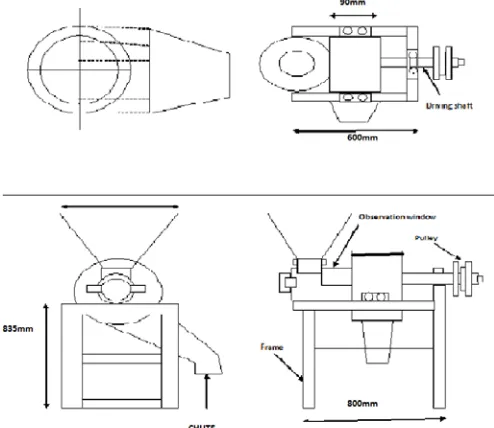
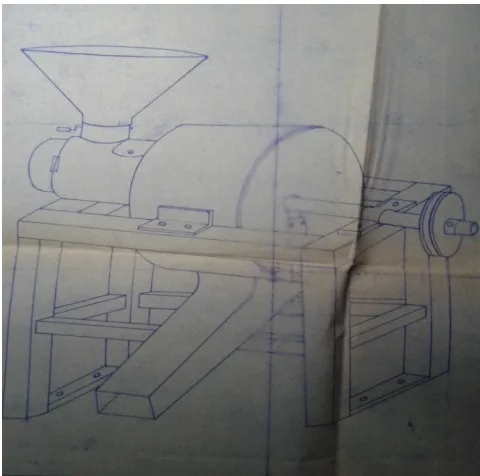
[image:2.612.320.567.195.409.2] [image:2.612.322.570.437.674.2]The orthographic projection, assemble diagram and isometric views of the developed machine are as presented by Figure 1,2,and 3 respectively
Fig. 1 Orthographic Projection of the Machine
Fig.3 Isometric Diagram of New Machine
VI. PERFORMANCE EVALUATION OF MACHINE.PROCEDURE
Weighing scale was used to measure out various quantities of pods to be processed. A stop watch was used for timing the processing period. Wet cotton wools were used to increase the moisture level of the pods by placing the groundnut in the water soaked wools for 20 minutes. Electric oven method was used to determine the moisture level (wet bases) of the pods before processing. Three levels of product moisture were considered; 6%, 10% and 20% wet bases. Two rates of product feeding into the machine were considered at 50% and 100% opening of the metering device.
The machine was started at no load for 10 minutes to ensure that every part is functioning at a stable condition. After the idling period, while the machine was still running at set speed of 240rpm [8], weighed quantity of groundnut with known moisture level (mc) was introduced into the hopper and a stop watch started for recording shelling time. The watch was stopped when no more materials was coming out of the outlet this point is also marked by an audible change in sound of the machine indicating operations at no load. This procedure was replicated three times for each treatment of known quantity, moisture content, and feed rate their average values were recorded.
The processed materials were collected and reweighed, the broken kernels, chaffs, unshelled pods and unbroken kernels were handpicked and grouped. The weight of each group was recorded along with the shelling time. The percentage shelled, percentage unshelled, percentage of seeds broken and throughput capacity of the machine were determined using equations 4, 5, 6,and 7.
Percentage Shelled / Shelling Efficiency (SEff)
Percentage Unshelled (SUN)
Percentage of Seeds Broken (SBKN)
Throughput Capacity (Thcap)
VII. RESULTS AND DISCUSSIONS
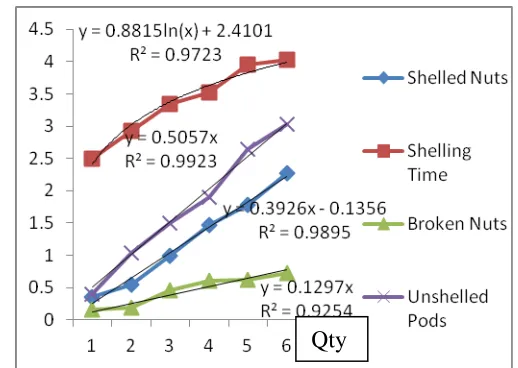
[image:3.612.321.573.321.484.2]Figures 4-10 presents the evaluation results in a graphical form for easy and clear understanding.
[image:3.612.319.572.519.676.2]Fig. 5 Graph of listed variables against introduced Quantity at 6% mc and 50% metering device opening
Fig. 6 Graph of listed variables against introduced Quantity at 10% mc and 50% metering device opening
Qty
Fig. 7 Graph of listed variables against introduced Quantity at 20% mc and 50% metering device opening
Fig. 8 Graph of listed variables against introduced Quantity at 6% mc and 100% metering device opening
Fig. 9 Graph of listed variables against introduced Quantity at 10% mc and 100% metering device opening.
Fig. 10. Graph of listed variables against introduced Quantity at 20% mc and 100% metering device opening.
VIII. RESULT DISCUSSION
In evaluating the developed machine, both the whole seeds and the broken ones were grouped under the shelled nuts so as to have proper accessement of the machine’s performance At 50% opening of the metering device, the machine was observed to have a shelling efficiency of 78.83%, with 42.07% unbroken kernels and a throughput capacity of 818.15kg/hr at 6% moisture level of the product. At a moisture content of 10% of the product (wet bases) the shelling efficiency was found to be 95% with 91.73% unbroken kernel, 1.24% unshelled pods and 7.03% broken nuts . The throughput capacity was 829.49kg/hr. At a 100% opening of the metering device, the different moisture levles of the groundnuts were also considered. At 6% moisture level of the product (wet bases), the machine efficiency was found to be 78.20% with 41.10% broken kernels. The throughput capacity was calculated to be 1168.83kg/hr. At 10% moisture content of the nuts, the machine sfficeiency was found to be 81% with 90% unbroken and 65% unbroken kernels. The throughput capacity was found to be 1440kg/hr when considered at a moisture level of 20% (wb).
[image:4.612.44.294.278.469.2]The graph on fig.5-10 summerized trend of shelled nuts (blue code), shelling time (red code),broken nuts (green code) unshelled pods (purple code) aginst the quantity introduce into the machine at any given period. Trend equations with their R2 were also developed.
Fig 5 presented logaritim trend equation for shelling time at 6% mc and 50% metering device opening as shown in equation 8 and 9;
y=1.812ln(x)+4.408 8 R² = 0.956 9 The trend equation for shelled nuts was given by equation 10 and 11 as;
y=0.740x 10
R² = 0.962 11
While the trend equation for broken nuts was expressed by
Qty
Qt
Qty
[image:4.612.43.296.498.669.2]Comparing the evaluation results of materials at the same moisture contents but at different feed rate recorded alomost a linear increase in the quantity of nuts shelled. The shelling time increased with more material quantity up to 4kg for 50% feed rate and up to 5kg for 100% feedrate, beyond these points the shelling was done almost at a constant rate. This could be an indication of the optimum shelling time for the machine. It was also noted that the unshelled nuts were more at 100% feed rate than in 50% feed rate.
Although, the throughput capacity and shelling efficiency were higher at 100% feed rate it will be desirable to have more of the whole/ unbroken seeds for the purpose of storage, planting and processing of some food items. This informed the choice of result presented on fig. 6 as a better result .
Fig 6 presented the log trend equation for shelling time at 6% mc and 50% metering device opening as shown in equation 14 and 15;
y=1.812ln(x)+4.408 14
R² = 0.956 15
The trend equation for shelled nuts was given by equation 16 and 17 as;
y=0.887x-0.394 16 R² = 0.999 17
While the trend equation for broken nuts was expressed by equation 18 and 19 as;
y=0.796x 18
R² = 0.986 19
At 10% moisture level of materials and 50% metering device opening (feed rate) the machine performed at optimal shelling efficiency of 95% and 92% unbroken kernel with throughput capacity of 782.61kg/hr. this was achieved at a literature determined machine speed of 240rpm.
IX. CONCLUSION.
The development and evaluation of a serrated disc groundnut decorticator was achieved. The results indicated that
groundnuts are better shelled at 10% moisture level to avoid excessive breakages or high percentage of unshelled nuts. Where seed breakage is not a serious problem, high machine speed and feed rate could be used, as it will guarantee higher throughput capacity and minimal percentage of unshelled pods. On the other hand, pre-sorting of the groundnut pods into uniform sizes will improve the shelling efficiency of this developed machine.
REFERENCES
[1] Tanimu, B. and Aliyu, L. (1996). Promoting the conservation and use of underutilized and neglected crops. Proceedings of the workshop on conservation and improvement of Bambara groundnut.
[2] Goli, A.E. (1997). Bambara groundnut. Bibliographic review. In Bambara groundnut. Vigna Subterranea (L.) verdc. Promoting the conservation and use of underutilized and neglected crops. Proceedings of the workshop On conservation and improvement of Bambara groundnut (Vigna subterranea (L.) verdc.
[3] Tusher, W, Praful.G, Ganesh, G, Ritesh, B (2017), Design and Fabrication of Groundnut Sheller Machine. International Journal of Engineering and Technology Vol. 4,Issue 3, Pp. 1606-1610.
[4] Bashiri,I.M, M. Zubairu andE. S. Olorunaye (2013). Design and Construction of a Machine for Decorticating Bambara Nuts.
[5] Oshan P Ghodkhande, Nilesh D Dhote, Sandip J Kadam (2015). Design and Modification of Ground-Nut Decorticator. International Journal of Innovative Research in Computer and Communication Engineering. Vol. 3, Issue 12,
[6] Okechuku Celestine Ugwuoke, Olawale James Okegbile, Ibukun Blessing Ikechukwu (2014). “Design and Fabrication of Groundnut Shelling and Separating Machine” International Journal of Engineering Science Invention. pp.60-66.
[7] Akande, F.B. and T.B. Onifade (2015). Modification of a Plantain Slicing Machine, Innovative Systems Design and Engineering, Vol.6, No.10, Pp 41-52.
[8] Ashish, R. and C.C Handa (2014), Design and Fabrication of Groundnut Sheller Machine. International Journal for Innovative Research in Science and Technology. VOL. 1; Issue 7.
AUTHORS