The Use of Edmodo In Blending And Segmenting
Interactively
Tengku Ahmad Kamal bin Tengku Abdul Rahman1, 3, Nurfarahin Adawiah binti Mohd Jalani 2, 3 and Melor Md
Yunus3
1. Sekolah Kebangsaan Merang, Setiu, Terengganu, Malaysia. 2. Sekolah Kebangsaan Brickfields 2, Kuala Lumpur, Malaysia. 3. Faculty of Education, Universiti Kebangsaan Malaysia, Selangor, Malaysia.
DOI: 10.29322/IJSRP.9.01.2019.p8584
http://dx.doi.org/10.29322/IJSRP.9.01.2019.p8584
Abstract- The impact of learning through the intergration of information and technology (ICT) has brought a big impact towards the
teaching and learning (T&L) processess. This is in line with the growth of the Fourth Industrial Revolution era in which most educators need to move ahead in ensuring the way of learning English should be fun and enjoyable. One of the tool used is Edmodo, that offers the communication and collaboration of three main stakeholders interactively which includes teachers, pupils and parents. The targeted pupils who did not pass the English Literacy Screening (LBI) had been detected to have difficulties in mastering the blending and segmenting skills especially the sounds and words. Therefore, this study aims to determine the effectiveness of using Edmodo in blending and segmenting among 50 Year 2 pupils in two different schools, one in Setiu Terengganu and another one in Brickfields, Kuala Lumpur. Various interactive activities through this Edmodo application had been prepared so as to give the pupils opportunity to learn in a fun and enjoyable way such as Unleash Your Voice, Sketch Up and Vocab Games. Pupils can easily record their voice to complete the blending and segmenting tasks; sketch the letters and words as well as drawing and finally, pupils can enrich the English vocabulary through Vocab Games. Besides being monitored by the teachers, the parents also have the chance to keep on track with the pupils’ progress and academic performance of the children. The data of pupils’ performances were recorded to provide the evidence. This study used a quasi-experimental design to determine the effectiveness of using Edmodo in blending and segmenting. Pre-test and post-test were used for data analysis to determine pupils’ learning outcomes. The final findings had proven that there is an improvement in pupils’ English literacy performance. Thus, it is recommended that the usage of the modules through this Edmodo application should be applied in the teaching of blending and segmenting to boost confidence among pupils.
Index Terms- Blending, Edmodo, English Literacy, Segmenting.
I. INTRODUCTION
he use of technology in education has been widely spoken over the last decade. There are many facilities available in schools to expose teachers and pupils to the use of technology. This is because technology is not only expected to enhance interaction between teachers and pupils in the classroom but also impacts on out-of-school life (Iftakhar, 2016). A survey from researcher through interviews with primary school teachers found that most of them still practiced teacher-centred teaching methods. The lack of technology in the teaching method makes teaching and learning process passive and not innovative. Many studies have highlighted the use of technology in education but there are still obstacles that have yet to achieve the desired success. Time, finance, and effort among the factors discussed that contribute to the barriers to using technology in schools (Weston & Bain, 2010). The targeted pupils who did not pass the English Literacy Screening (LBI) had been detected to have difficulties in mastering the blending and segmenting skills especially the sounds and words. This study aims to determine the effectiveness of using Edmodo in blending and segmenting among Year 2 pupils in two different schools, one in Setiu Terengganu and another one in Brickfields, Kuala Lumpur. Integrating technology to classroom learning is considered challenging (Erben, Ban, & Castañeda, 2009). Thus, teachers should concern on the principles of applying technology in language classrooms. A number of principles should be completed to offer pupils with meaningful learning environment (Bersin, 2004).
English Literacy Screening (LBI), which was introduced by the ministry in 2010, is a remedial programme under PPPM specifically introduced to ensure pupils acquire basic literacy and numeracy skills at the end of three years of primary education. Early literacy skills are crucial for children as these skills can help the learning progress of children in future. Children who are left behind in acquiring early literacy skills tend to struggle with reading and writing. As a result, these children tend to receive less practice in reading and less exposure to content knowledge, vocabulary and other language skills than do children who learn to read early and well (Ehri, 2002).
In Malaysia, the mastery of early literacy skills has been a focus since the early years of the Malaysian education system and this issue was especially critical in the 1960s (Sani & Idris, 2013). Many programs have been implemented yet illiteracy among youngsters is still a real problem. In 2011, the Defence Minister of Malaysia, Abdul Latiff Ahmad, revealed that nearly 1,000 out of the 11,000 youths chosen for national service training (PLKN) were illiterate (Special Module for National Service Trainees: Malaysia, 2011). Besides, it was reported in The Star newspaper that three students were barred from taking their Primary School Assessment Test (UPSR), due to their weak academic performance (The Star, 2014). All these issues have led to the conclusion that a better program needs to be executed so that all the children in Malaysia have a stable foundation in early literacy skills. Hence, the Ministry of Education (MOE) has introduced the Literacy and Numeracy Screening 2.0 (LINUS 2.0) program. According to this program, pupils should master the basic skills after three years of their primary education (Sani & Idris, 2013)
Teaching in a primary school, you get to witness a variety of literacy skills from pupils ranging in ages from 6 years old, as preschoolers, right up to pupils who are 12 year olds, the Year 6s. Those pupils who have learning problems or disabilities need to have intervention as soon as possible. Latest reading study provides convincing evidence that pupils who start poorly in reading typically remain poor readers throughout their schooling and beyond (Pullen, Lane, Lloyd, Nowak and Ryals, 2005). There is a research to support the idea of clear and systemic teaching of phonemic awareness, blending and segmenting increase the pupils’ ability to improve their understandings. This will improve pupils’ word attack strategies and knowledge, which in turn increase their capability to read words in separation and within a prose (Peterson, 2002, Pullen et al, 2005, Qi et al, 2000, Smith, 2003).
Study supports the explicit teaching of segmenting words into their individual sounds and blending individual sounds into words (Smith, 2003). Why these two skills? Evidence supports that phonemic segmentation (e.g., HAT = H-A-T- and blending (e.g., H-A-T = HAT) are the most vital skills which can be taught to pupils to help increase their literacy levels (Qi and O Connor, 2000). Pupils must combine individual sounds to form a word to blend sounds (Vukelich, Christie, & Enz, 2012). Segmenting words is where pupils break up words into individual sounds (McGee, 2007). Phonological awareness is an expansive term, which refers to the consciousness of the sound structure of speech (Vukelich, Christie, & Enz, 2012). One way to help struggling pupils is to offer clear, systematic instruction in phonological awareness and word decoding (Torgesen, 2000). Pupils can then be taught letter-sound correspondences and know that spoken words represented by written words (de Graaff, Bosman, Haselman, & Verhoeven, 2009).
One of the social networking sites for learning purposes that teachers can permit pupils to freely operate in is Edmodo. It is considered Facebook for education because the developers of Edmodo designed the Edmodo interface similar to Facebook. Therefore, it can be consider that pupils who are already Facebook users can use Edmodo without problems. Edmodo is a free online learning management system that allows pupils and teachers to share and discuss texts, images, audio files, and videos safely (Hordequin, 2014). It can be accessed via a web browser or smartphone application. By using Edmodo in teaching and learning, it can provides some pedagogical benefits. It is a tool for enhancing learning because it permits pupils to post comments as well as send notes, links, files, alerts, assignments, events, and direct messages to the teacher. Introvert pupils can use Edmodo to interact with the teacher by asking questions personally and teacher can explain their doubts in the subjects learnt (Looi and Yusop, 2011). This helps to lessen the discomfort of having to ask in front of other pupils. Moreover, Edmodo can motivate learning environment by allowing teachers to reward pupils with badges. Besides, parents are able to check pupils’ progress by using Edmodo for Parents.
Most of the pupils who did not pass The English Literacy Screening (LBI), having difficulties in mastering the blending and segmenting skills. The innovative modules used through Edmodo can improve Year 2 pupils’ ability to blend the sounds and segment the words interactively. Through Unleash Your Voice activity, pupils can record their voice doing the blending and segmenting tasks. This activity gives a voice to shy or anxious pupils who would go unheard in traditional classrooms. Edmodo breaks down barriers by giving pupils the confidence to communicate, all in a safe, private space. Pupils are instantly familiar with Edmodo's interface and can communicate more easily with each other and with the teachers.
Then, pupils are asked to sketch the letters, words as well as their drawing through Sketch Up! activity. By using their smartphones with Edmodo application, pupils can use sketch features to sketch. This feature can encourage pupils to use their creative side come up artistic result. Vocab Games activity through quiz features enabled pupils to learn and enrich their English vocabulary. Quiz features include the ability for teachers to create quizzes, edit and load previously created quizzes, provide a quiz description, set the time limit for a quiz, and preview a quiz before sending it to their pupils. Edmodo supports five question types: multiple choice, true/false, fill-in-the-blank, matching, and short answer. When the pupils submits the quiz, the teacher is notified. Once the questions are automatically scored, the grades are populated into the teacher’s Edmodo grade book.
II. METHODOLOGY
Edmodo. In order to see the differences in pupils’ learning by using and without Edmodo, the data were collected from the results of the pre-test and post-test that were conducted in the beginning and at the end of the research.
The experimental class in the research was pupils of class A and there are 25 pupils in this class. In the pre-test, the pupils were asked to answer blending and segmenting questions. The pre-test was done in order to see the pupils’ score before they were taught by using Edmodo. Based on the result of the pre-test, the mean score was 58.08 with the lowest score was 40 and the highest was 80. After the data were obtained from pre-test, the treatments for the experimental class were conducted by using Edmodo. After the treatment was done, the post-test was conducted.
[image:3.612.96.514.474.624.2]From the post-test that was done, the result of the post-test showed that there was a difference compared to the result of the pre-test. The mean score of the pupils increased to be 72.64 with the lowest score was 52, while the highest score was 92. After the data were obtained from the pre-test and post-test, it was found that the range of the mean score from the pre-test to post-test was 14.56. The summary result could be seen as follows:
Table 1 Pre-test and post-test mean score for class A
Score Mean
Pre-test 58.08
Post-test 72.64
In this research, the controlled class was class B. This class consisted of 25 pupils. The pre-test was done in order to see the pupils’ initial score. After the students were given normal lessons, they are asked to answer the post-test questions. The mean score of pre-test was 55.02 and post-test was 61.44. Median of the data was the value that separated between the highest and the lowest data. In this test, the median of test was 56, and post-test was 60. Modus was the scores that were frequently appeared which were 52 for pre-test and 64 for post-pre-test. For the minimum score from the pre-pre-test was 40 and post-pre-test was 52. Meanwhile, the maximum score of both pre-test and post-test was 80. The summary result could be seen as follows:
Table 2 Pre-test and post-test mean score for class B
Score Mean
Pre-test 55.02
Post-test 61.44
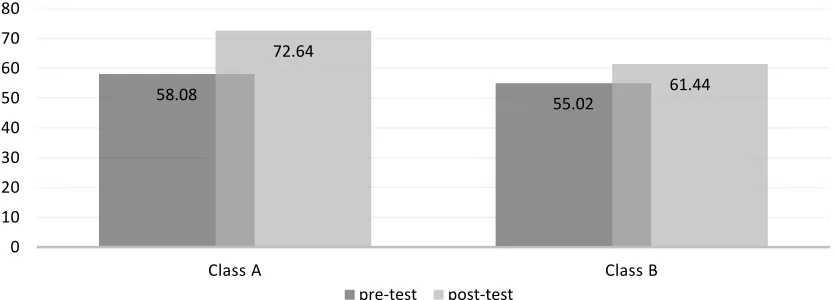
In order to provide more detailed data of result in this study, the summary bar chart below contained pupils’ pre-test and post-test mean score in both classes.
Figure 1 Pre-test and post-test mean score in both classes
The above bar chart showed that both classes increased their score in post-test. However, the score in the experimental class increased significantly compared to the score in the controlled class.
III. FINDINGS
In the description of the data which was taken from 25 pupils of experimental class, Table 1 showed the description of the experimental class score. The mean score of pre-test was 58.08 before the Edmodo application was applied in the classroom. Moreover, the pupils’ lowest score achieved was 40 and the highest score was 80. After the Edmodo application was applied, the mean score of post-test was
58.08 55.02
72.64
61.44
0 10 20 30 40 50 60 70 80
Class A Class B
72.64 with the minimum score was 52 and the maximum was 92. Table 2 showed the description of the control class score that has the mean score of pre-test 55.02 with the highest score was 80 and the lowest was 40. In addition, the mean score of post-test was 61.44 with the maximum score was 80 and the minimum was 52. Based on the mean scores in experimental class and controlled class, it can be seen that both of classes has a little gap. During the treatments, the pupils in the experimental class blend and segment words through Edmodo to foster their skill. In addition, the researcher gave treatments to the pupils in the experimental class for about four weeks. Before that, the researcher introduced and gave the explanation about the use of Edmodo in the classroom in the first meeting. Also, the researcher gave a tutorial about how to register, join the group, download material, submit task, etc.
In data analysis, the collected scores of both pre-test and post-test from experimental and controlled class are analysed by using t-test. However, there are two things that needed to analyse before calculating the statistical hypothesis. The test of normality and test of homogeneity. Kolmogorov-Smirnov and Shapiro-Wilk table was used for the normality test. Levene Statistic test was used to calculate the homogeneity test.
[image:4.612.36.580.277.363.2]After the normality and homogeneity test have been done, the collected data can be analysed to examine the hypothesis by using t-test. A hypothesis test was done to see whether or not there was a significant difference in the result of post-test after the treatment was conducted. The result will indicate the effectiveness of Edmodo on pupils’ blending and segmenting skills. The results are shown in the following tables:
Table 3 T-test analysis of pre-test score in experimental class and control class
Score F Sig. t df
Sig.
(2-tailed)
Mean Difference Standard Error 95% CI
Pre
Test
1.779 0.189 1.018 48 0.314 2.880 2.830
-2.809
8.569
From Table 3, it indicated the result of t-test analysis of pre-test score in experimental class and control class. In analysing this data, the equal variances assumed is used to read the result because the data is homogeneous as previously recognized. From the table, the independent sample test shows a result of p-value or sig (2-tailed) = 0.314. As this research refers to a significance value of sig α = 0.05 (5%), therefore, the p-value is higher than the significance value. In other words, when p-value = 0.314 > sig α = 0.05, so the null hypothesis is accepted while the alternative hypothesis is rejected. This indicated that there was no statistically significant difference of the pre-test result between the two classes.
Table 4 T-test analysis of post-test score in experimental class and control class
Score F Sig. t df
Sig.
(2-tailed)
Mean Difference Standard Error 95% CI
Post
Test
0.463 0.500 4.277 48 0.000 11.200 2.618
5.935
16.465
From Table 4, it indicated the result of t-test analysis of post-test score in both experimental and controlled class. The equal variances assumed is also used to read the result and refers to a significance value of sig α= 0.05 (5%). The independent sample test resulted in p-value or sig (2-tailed) = 0.000. From the result, it can be concluded that the null hypothesis was rejected and the alternative hypothesis was accepted because the p-value (0.000) was lower than sig α = 0.05 (5 %). It also meant that there was a significant difference statistically between the experimental and control class in the results of post-test.
In addition to t-test analysis of pre-test and post-test scores, the gained scores of the pre-test and the post-test result are also analysed. Based on the gained scores, the independent sample test resulted in p-value or sig (2-tailed) = 0.000. From the result, it can be concluded that the null hypothesis is rejected and the alternative hypothesis is accepted because the p-value (0.000) is lower than sig α = 0.05 (5 %). It also means that there is a significant difference between the gained score in experimental class and control class from their pre-test to post-pre-test results.
[image:4.612.34.578.471.553.2]IV. CONCLUSION
Based on the results, the positive achievement of the pupils proved that Edmodo can be used as an effective supplementary tool in the classroom because of its features and benefits. Edmodo allows teachers and students to stay connected without difficulty and many Edmodo features allow students to participate and get actively engaged. It can be said that Edmodo makes learning convenient and accessible for all. With Edmodo, a teacher can create and share multimedia resources to support students’ learning and provide learning tasks to scaffold students’ learning (Wallace, 2014). Students can access to all their online classes in one platform, and this helps to promote learning in any location and at any time via computer, tablets, or smartphones (Hammonds et al., 2013). It is clearly seen that Edmodo can encourage active participation in online class activities and students can access the site to use reference materials easily and conveniently.
However, it appears that using Edmodo could be time-consuming for some students who are not good at using technology. Another drawback of using Edmodo is that it is difficult to follow the procedures. From the study, some pupils suggested more training and detailed instructions from the teacher. This is similar to research conducted by Kongchan (2012) discussing that the teacher tended to overestimate pupils’ digital skills, but in fact some pupils did not possess this ICT skill and so they found using technological tools like Edmodo procedure difficult to follow and that might discourage them to be involved. The research, therefore, suggested the need of Edmodo training for pupils. Similarly, the study of Thongmak (2013) shows that in order to successfully incorporate Edmodo into class, a teacher should train pupils who are not familiar with Edmodo. In addition, Lin and Fang (2010) found that some pupils might feel comfortable about learning that is mediated by computers; on the other hand, some may find it difficult to collaborate, interact or communicate with their peers in an environment that is unfamiliar to them. It indicates that there seems to be a link between pupils’ learning styles and participation in a web-based learning environment and thus it is one of important points teachers should take into consideration when implementing technology into classrooms.
REFERENCES
[1] Allor, J.H., & McCathren, R.B. (2004). The efficacy of an early literacy tutoring program implemented by college students. Learning Disabilities Research and Practice, 19(2), 116-129.
[2] Ayala, S.M, & O’Connor, R. (2013). The effects of video self-modeling on the decoding skills of children at risk for reading disabilities. Learning Disabilities Research & Practice, 28(3), 142-154.
[3] Bersin, J. (2004). The blended learning book. San Fransisco: Pleiffer
[4] Cummings, K., Dewey, E., Latimer, R., & Good III, R. (2011). Pathways to word reading and decoding: The roles of automaticity and accuracy. School Psychology Review, 40(2), 284 - 295.
[5] Daly III, E.J., Chafouleas, S.M., Persampieri, M., Bonfiglio, C., & LaFleur, K. (2004). Teaching phoneme segmenting and blending as critical early literacy skills: An experimental analysis of minimal textual repertoires. Journal of Behavioral Education, 13(3), 165-178.
[6] Delacruz, S. (2013).Online reading response using Edmodo. The Florida Reading Journal, 49 (2), pp. 9-12.
[7] de Graaff, S., Bosman, A.M.T., Haselman, F., & Verhoeven, L. (2009). Benefits of systematic phonics instruction. Scientific Studies of Reading 13(4), 318-333. [8] Edmodo.com. (2015). Connect with Students and Parents in Your Paperless Classroom. Edmodo. Retrieved March 20, 2015 from http://www.edmodo.com. [9] Erben, T., Ban, R., &Castañeda, M. (2009). Teaching English language learners through technology. Oxon: Routledge.
[10] Ehri, L.C. (2002). Phases of reading acquisition in learning to read words and implications for teaching. In R. Stainthorp & P. Tomlinson (Eds.), Learning and teaching reading. London: British Journal of Educational Psychology Monograph Series II.
[11] Giess, S.A., Rivers, K.O., Kennedy, K., & Lombardino, L.J. (2012). Effects of multisensory phonics-based training on the word recognition and spelling skills of adolescents with reading disabilities. International Journal of Special Education, 27(1), 60-73
[12] Hourdequin, P. (2014) Edmodo: A Simple Tool for Blended Learning. The Language Teacher 38(1): 34-35.
[13] Iftakhar, S. (2016, February). Google classroom: What works and how? Journal of Education and Social Sciences, 3, pp. 12-18.
[14] Kongchan, C. (2013). How Edmodo and google docs can change traditional classrooms. Paper presented at The European Conference on Language Learning 2013 Official Conference Proceedings. Retrieved from www.iafor.org
[15] Kongchan, C. (2012). How a non-digital-native teacher makes use of Edmodo. Retrieved from www.conference.pixel-online.netf
[16] Lane, K., Fletcher, T., Carter, E., Dejud, C., & DeLorenzo, J. (2007) Paraprofessional-led phonological awareness training with youngsters at risk for reading and behavioral concerns. Remedial and Special Education, 28(5), 266-276.
[17] Looi, C. Y. and Yusop, F. D. (2011) Potential Use of Social Networking Tool to Assist Reading Comprehension: Implications for Practice and Future Research. Jurnal Pendidikan 31(1): 189-201
[18] Pullen, P.C., Lane, H.B., Lloyd, J.W., Nowak, R., & Ryals, J. (2005). Effects of explicit instruction on decoding of struggling first grade students: A data-based case study. Education & Treatment of Children, 28(1), 63-76.
[19] Peterson, Shelly. (2002) Phonemic Awareness: One Piece of the Learning-To-Read Puzzle. Orbit. Volume 33, Issue 1.
[20] Pullen, PC., Lane, HB., Lloyd, JW., Nowak, R. and Ryals, J. (2005). Effects of Explicit on Decoding of Struggling First Grade Students: A Data-Based Case Study. Education & Treatment of Children. February, Volume 28, Issue 1. p. 63 - 76.
[21] Qi, Sharon and O Connor, Rollanda. (2000) Comparison of Phonological Training Procedures in Kindergarten Classrooms. The Journal of Educational Research. March/April. Volume 93, Issue 4. P.226 233
[22] Ryder, J., Tunmer, W., & Greaney, K. (2007). Explicit instruction in phonemic awareness and phonemically based decoding skills as an intervention strategy for struggling readers in whole language classrooms. Read Write, 21(4), 349-369.
[23] Smith, Carl B. (2003) The Teaching of Phonics. Reading, Education and Communication. P.3 – 6
[24] Thongmak, M. (2013). Social network system in classroom: antecedents of Edmodo © adoption. IBIMA Publishing Journal of E-learning and Higher Education, 2013 (article ID 657749).
[25] Torgesen, J.K. (2000). Individual differences in response to early interventions in reading: The lingering problem of treatment resisters. Learning Disabilities Research and Practice, 15(1), 55-64. McGee, L. (2007). Transforming literacy practices in preschool. New York, NY: Scholastic
[26] Vukelich, C., Christie, J., & Enz, B. (2012). Helping young children learn language and literacy: Birth through kindergarten (3rd ed.). Boston, MA: Pearson Education, Inc.
[27] Yeh, S., & Connell, D. (2008). Effects of rhyming, vocabulary and phonemic awareness instruction on phoneme awareness. Journal of Research in Reading, 31(2), 243-25W.-K. Chen, Linear Networks and Systems (Book style). Belmont, CA: Wadsworth, 1993, pp. 123–135.
[28] Yunus, M.M, N. N. (2013). The Use of Information and Communication Technology (ICT) in Teaching ESL Writing Skills . English Language Teaching; Vol. 6, No. 7; 2013 ISSN 1916-4742 E-ISSN 1916-4750, 8.
[29] Yunus, M.M, H. S. (2012). The Effectiveness of Facebook Groups on Teaching and Improving Writing: Students’ Perceptions . INTERNATIONAL JOURNAL OF EDUCATION AND INFORMATION TECHNOLOGIES Issue 1, Volume 6, 2012, 10.
AUTHORS
First Author – Tengku Ahmad Kamal bin Tengku Abdul Rahman, B.Sc. (Hons), Dip.Ed., Sekolah Kebangsaan Merang, Setiu, Terengganu, Malaysia, [email protected].
Second Author – Nurfarahin Adawiah binti Mohd Jalani, B.Teach. (Hons), Sekolah Kebangsaan Brickfields 2, Kuala Lumpur, Malaysia, [email protected].