BIROn - Birkbeck Institutional Research Online
Roussos, George and Marsh, Andy and Maglavera, Stavroula (2005)
Enabling pervasive computing with smart phones.
IEEE Pervasive
Computing 4 (2), pp. 20-27. ISSN 1536-1268.
Downloaded from:
Usage Guidelines:
Please refer to usage guidelines at
or alternatively
research output of Birkbeck College
http://eprints.bbk.ac.uk
Roussos, George; Marsh, Andy and Maglavera, Stavroula
(2005) Enabling pervasive computing with smart phones.
IEEE Pervasive Computing
4
(2) 20-27.
This is an exact copy of a paper published in IEEE Pervasive Computing
(ISSN 1536-1268). It is reproduced with permission from the publisher.
Personal use of this material is permitted. However, permission to
reprint/republish this material for advertising or promotional purposes or for
creating new collective works for resale or redistribution to servers or lists, or
to reuse any copyrighted component of this work in other works must be
obtained from the IEEE. © 2005 IEEE.
Copyright and all rights therein are retained by authors or by other copyright
holders. All persons downloading this information are expected to adhere to
the terms and constraints invoked by copyright. This document or any part
thereof may not be reposted without the explicit permission of the copyright
holder.
Citation for this copy:
Roussos, George; Marsh, Andy and Maglavera, Stavroula (2005) Enabling
pervasive computing with smart phones. London: Birkbeck ePrints. Available
at:
http://eprints.bbk.ac.uk/archive/00000330
Citation as published:
Roussos, George; Marsh, Andy and Maglavera, Stavroula (2005) Enabling
pervasive computing with smart phones. IEEE Pervasive Computing
4
(2)
20-27.
http://eprints.bbk.ac.uk
20 PERVASIVEcomputing Published by the IEEE CS and IEEE ComSoc ■ 1536-1268/05/$20.00 © 2005 IEEE T H E S M A R T P H O N E
Enabling Pervasive
Computing with
Smart Phones
M
obile telephony’s technical and market success in Europe in the early 1990s attracted researchers’ interest in mobile systems. Some researchers began investigating appropriate architectures for provid-ing information services to cellular mobile tele-phony users, and the quest for the “killer” third-generation (3G) mobile telephony applica-tion dominated the EU Informa-tion Society Technology research program from 1998 to 2002. Dozens of projects launched to pursue this aim, and we were intimately involved in several of them. We report here on lessons learned during our involvement in this research and suggest how pervasive com-puting might benefit from this experience.3G and beyond
A common thread throughout this work is the desire to develop universal information services delivered over ubiquitous, high-speed wireless networks. While the second generation of mobile computing is largely a person-to-person voice (and increasingly short messaging) communica-tions medium, 3G visions add data services and corresponding infrastructures to support service provision. But 3G didn’t arrive as expected— today, mixed 2G, 2.5G, and 3G networks
oper-ate alongside local wireless networking systems, most based on Wi-Fi and Bluetooth protocols. Research focus has thus shifted to what’s cur-rently known as fourth-generation (4G) or beyond-3G (B3G) mobile networks, seen as an extension of the current situation. In many ways, the current assumptions of the European Infor-mation Society Technology research program (running until 2006) resemble those proposed in the US as ubiquitous or pervasive computing. Considerable differences exist, however—for example, regarding the appropriate development path for such infrastructures.
Also driving this shift in program priorities is the realization that miniaturizing sensing and computational devices allows for deeply embed-ded wirelessly networked systems. Ambient intel-ligence—the vision for the European Information Society Technology program’s next 15 years1—
resembles pervasive or ubiquitous computing, but it emphasizes the system infrastructure’s auto-nomic learning capability and interaction mech-anisms for users in particular social contexts. Its ultimate aim is to populate the environment with smart devices and make information services accessible everywhere.
Developing mobile telephony information ser-vices poses several ubiquitous computing chal-lenges. The very small form factor complicates user interaction, and devices might operate in insecure or even hostile environments. Also lack-ing are reliable network connectivity and
infra-Although some business and practical challenges exist, mobile phones
could serve as information service end points, control devices for
ubiquitous systems, network hubs for personal and body area networks,
and ID tokens.
George Roussos
Birkbeck College, University of London
Andy J. Marsh
VMW Solutions
Stavroula Maglavera
structures that support service delivery. However, currently available service delivery techniques for mobile and PDA-type smart phones’ small form factor should prove useful for similar devices used in pervasive systems. Some research on mobile information services provision explores voice as the primary interaction modality. (A review of methods and results appears elsewhere.2) Because
peo-ple frequently carry mobile phones wherever they go, distinct opportunities exist for harvesting profile and activity data and for delivering timely informa-tion services. Finally, many mobile phones currently feature wireless local networking capabilities that let them interact with other nearby devices.
Perhaps most importantly, pervasive computing and mobile telephony sys-tems operate in significantly different environments.3Whereas most pervasive
systems inherit the Internet’s legacy of open standards and systems and end-to-end application architectures, mobile phones operate within a more restricted environment. This offers distinct secu-rity advantages because the telephony network operator has greater control over management operations, but this environment’s clear separation of data transfer and control planes potentially leads to a fundamentally different ser-vice architecture.
Mobile phones as information
service end points
From the pervasive computing perspec-tive, the mobile phone’s most interesting use is as an end point for an information utility or service. Indeed, ubiquitous infor-mation delivery is one of the most often discussed scenarios of pervasive systems.
Popular scenarios include spatial navi-gational assistance and recommenda-tions for nearby places of interest, shop-ping, and entertainment; task-specific cognitive assistance; access to personal messaging and schedule information; and health care monitoring and diagno-sis. The pervasive computing vision dic-tates that such services should be acces-sible from any location and whenever needed, via various devices augmented with computational and communica-tions capability.
The literature discusses several device types supporting such interaction, rang-ing from ambient displays to tangible interfaces and more traditional appli-ances. Despite their considerable advan-tages, such devices are expensive and not widely available. Mobile phones offer a short-term solution readily available to much of the global population at rela-tively low cost. Moreover, their current computational capabilities compare favorably with common mobile applica-tion requirements and also against sev-eral device types often used in pervasive computing. Finally, today’s mobile phone networks provide an almost global ubiq-uitous wireless access network, which satisfies most requirements of pervasive computing information service delivery.
Mobile phones’ advanced processing capabilities offer many opportunities for developing novel information services. Although some of these can be delivered by voice, smart phones support more advanced interactive user interfaces. Sev-eral projects we’ve been involved with aimed to develop such services:
• mXpress4exploits location sensing
and tracking to provide navigational assistance within a trade exhibition space. The system lets preregistered users who’ve provided personal pro-files receive targeted content, such as notifications about specific events of interest (http://mexpress.intranet.gr). • MyGrocer,5a 2G pervasive retail
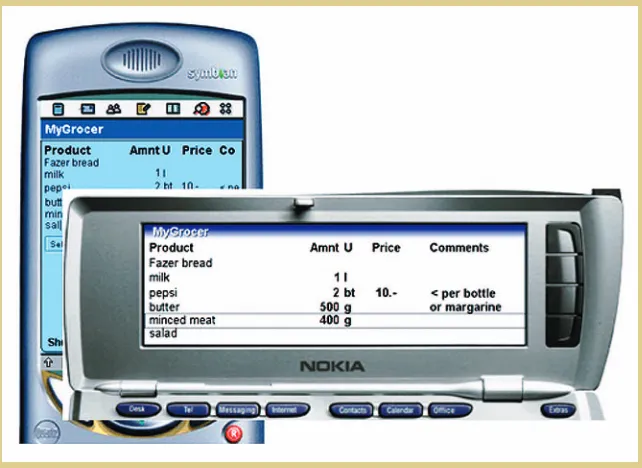
sys-tem (see Figure 1), includes a shopping list management and order placement client for smart phones (www.eltrun. aueb.gr/mygrocer).
• E-Care6developed a data-harvesting
system to collect patients’ vital mea-surements and provide a care-in-the-community monitoring and alerting service for people with chronic condi-tions (www.e-care-ist.net).
• TellMaris,7shown in Figure 2, employs
location sensing to display 3D maps, overlaid with tourist information (www.tellmaris.com).
APRIL–JUNE 2005 PERVASIVEcomputing 21
[image:4.585.217.538.90.324.2]These projects all need to provide con-textualized information. In this case, context refers to both the user’s cogni-tive context and the system’s operational context (such as available wireless band-width). Personal context information lets us minimize the number of steps required to carry out a specific action, and this in turn depends on adapting content and application functionality.8Unlike
desk-top systems, where functionality often takes precedence over speed, mobile devices’ small form factor and limited input facility (mostly a numeric keypad and in a few cases an Accupoint or point-ing stick) lessen the chances that users will complete tasks requiring a long inter-action sequence. More common meth-ods to develop personal context models include extracting common patterns from demographic and historical usage data, which the system then uses to antic-ipate user actions or better meet user information requirements.
We can further improve the success rate of predicting what users will choose if we also consider their current situa-tion. For example, we can use location and time-of-day information to identify specific user activities and roles, per-mitting faster access to specific content or appropriate application functional-ity configuration. Such mechanisms can be inaccurate, however, and we should use them conservatively and in addition to rather than instead of other system features that help users perform tasks efficiently. Indeed, a common pitfall is to optimize aggressively for user inter-action. When the system predicts the
wrong pathway or, even worse, prevents the user from accessing required func-tionality because it doesn’t appear to be a probable alternative, the user will more likely reject the system than if he or she only had to deal with the diffi-culty of navigating the interface.8
Finally, we can also adapt services to meet system capabilities, primarily in terms of user interface features and avail-able network bandwidth. For example, the user experience suffers if the system delivers rich content developed for a 3G network over a slower network segment that supports only GPRS, because per-formance will likely be inadequate.
In recent years, the priorities in per-sonalizing mobile information services have shifted considerably. The original stated goal was to make information ser-vices available to anyone, anywhere, at any time. But in practice many have interpreted this aim as providing every-one, everywhere, all available informa-tion all the time, leading to cognitive overload and service failure. For exam-ple, with mXpress we found it relatively easy to make massive amounts of infor-mation available to exhibition visitors, but users often had difficulty making sense of this information without appro-priate means to organize and track data.4
Today, personalization focuses on cre-ating information services that deliver the right information at the right time, in the right place, in the right way, to the right person. Indeed, in a world satu-rated with mobile information services, providers compete not to distribute mas-sive amounts of information but rather
to gain the user’s attention. Early attempts to develop information ser-vices for mobile phones assumed that mobile users were simply “mobile Inter-net” users. Services thus aimed to repro-duce the desktop Internet browser expe-rience, albeit with a more compact interface and less demanding data trans-fer requirements.
This view has proven erroneous— information services on the move play a fundamentally different role and cannot be developed just by trivially extending the desktop paradigm. Web navigation highlights the difference between desktop and mobile devices: desktop users can employ a search engine to retrieve several pages of relevant results and review them in turn, moving from site to site over time. This is hardly feasible for mobile users, who should be taken directly to a specific location to carry out a short, focused task.9Mobile information services must
be designed specifically for the context of their use and meet mobile users’ needs for brief, targeted sessions.
This application-layer property extends beyond the user interface and the appli-cation functionality to the service archi-tecture itself. The requirements of browsing Web pages on a mobile phone go well beyond the need to display con-tent in a condensed form. The concon-tent itself must be modified to meet user expectations and needs, and more importantly to match user activities. For example, we found in a recent study that the British Museum’s Compass, an extensive online database for objects in its collections, wouldn’t meet mobile users’ needs during museum visits. Com-pass pages often provide lengthy back-ground discussions of objects and exhi-bitions that require users to switch from the visit’s physical and social context to that of information browsing on the
22 PERVASIVEcomputing www.computer.org/pervasive
[image:5.585.47.369.93.229.2]T H E S M A R T P H O N E
pages should present the information in a less academic, more informal style bet-ter suited to the visit’s discursive nature. Although automated summarization techniques might help here, a person should author or edit mobile user con-tent to achieve the desired effect.
Likewise, TellMaris showed that the location itinerary dominates tourist vis-its, and a complex information service interferes with the actual experience. More appropriate and desirable is a sim-ple but authoritative response to a loca-tion-specific query or notification of a change in environmental condition.7
The finding that content should be authored specifically for mobile users’ activities suggests that transcoding archi-tectures developed in various mobile computing projects are less important than initially thought. Although this functionality is clearly feasible and in fact is now readily available in commercial platforms, it addresses a problem that has minor implications for a system’s success. Of course, achieving interoper-ability between devices of the same form factor is clearly desirable and should be accommodated whenever possible. But this finding may have design implica-tions for some emerging pervasive com-puting infrastructures. Content authored for a smart phone might be inappropri-ate for users interacting with tangible interfaces or proactive displays, and design principles developed for mobile telephony might not transfer well to these situations.
Mobile phones as remote
controllers
Pervasive computing requires the seamless interoperation of diverse devices and electronically augmented artifacts within spaces saturated with wireless
in a way that satisfies the needs of the family occupying this space. Although the pervasive computing vision dictates that such devices adapt automatically, current techniques cannot robustly and consistently support this on a large scale. The mobile phone offers a potential solu-tion by acting as a control device,
simi-lar to remote-control devices used in consumer electronics.10
This approach faces several challenges, not least the limited availability of stan-dards that are clearly essential for its suc-cess. Yet the concept has appeal in that the mobile phone fits this role well. Smart phones’ processing capability permits flexible functionality that can be adapted or extended to include control functions for particular devices. Larger-form-fac-tor smart phones allow for the provision of more intuitive user interfaces, such as a physical space abstraction to control multiple devices simultaneously or inter-pret higher-level commands to device-level management functions. Instructions can be transferred locally using a wire-less interface. In fact, although infrared communication is relatively low band-width and is often discounted in perva-sive computing systems in favor of higher-power access media, we’ve found it well suited to this role and a potentially appropriate solution.6Naturally, a mobile
device also offers the opportunity to man-age the home environment remotely, for example, via a control applet that
con-controller in a pervasive computing sit-uation. Ubiquitous computing systems users often have difficulty conceptualiz-ing the system and thus developconceptualiz-ing men-tal representations and appropriate strategies for interacting with it.12The
problem is that system functionality is transparent, and unlike other
comput-ing situations, ubiquitous systems offer no specific interaction point. People are used to interacting with information sys-tems via specific service end points, such as a personal computer, a bank teller machine, a digital television, or a mobile phone. Ubiquitous computing is, as Mark Weiser put it, “invisible, every-where computing that does not live on a personal device of any sort, but is in the woodwork everywhere.”13It thus
has no specific physical expression. As a point of contact, the mobile phone becomes a manifestation of the perva-sive service and thus much easier to con-ceptualize and interact with.
Mobile phones as pervasive
network hubs
We find a more interesting use of mobile phones in pervasive computing when considering their functionality rather than their form, that is, as a com-munications device offering wide-area networking capabilities. The cellular telephone can operate as the hub of a personal or body area network: it con-nects to remote services and the Internet,
APRIL–JUNE 2005 PERVASIVEcomputing 23
Smart phones’ processing capability
permits flexible functionality that can be
adapted or extended to include control
and the local area network connects to local devices.
The Healthcare Compunetics archi-tecture offers one incarnation of this con-cept.14It specifies a system that processes
data harvested from sensors into an appropriate XML-based specification called i-notes. It stores them for future use and, following a predefined policy, communicates them to the appropriate consultant for analysis. Because connec-tivity with health care systems might not
always be available, Healthcare Com-punetics provides two devices that work together to offer secure storage and seamless communication within a body area network. The first component is the
i-wand, a wearable storage and process-ing device with fprocess-ingerprint authentica-tion. It structures and stores personal data in i-note format, checks it on the fly for evidence of critical conditions locally, and encrypts it. The device employs wiz-ards that detect the type of sensor that’s transmitting data, and it currently sup-ports many homecare monitors, flat-padded water-resistant hypoallergenic dermal patches, and certain biocompat-ible sensor chips in ingestbiocompat-ible capsules. The second component, the Mobiliser, is a GUM (Global System for Mobile Communication) modem core attached to the i-wand that communicates with back-end servers over the cellular net-work. These two devices transform the mobile phone into an enabling device for typical ubiquitous information services, removing the recognizable form of the device itself.
This approach removes the mobile
phone’s form factor limitations and, taken to its extreme, lets us see the whole personal area network as an extended telephone. This view suggests several similarities between mobile phones and more typical pervasive com-puting devices. For example, Ericcson Research Labs’ Phone Glove15
intro-duces the idea of a fragmented tele-phone consisting of a basic communi-cations core embedded in user clothing and the remaining components
distrib-uted to the points of their actual use. We already see a form of this when people use an earphone instead of the mobile phone speaker. This model would also support electrical field sensing and the finger-joint gesture keypad input para-digm to replace the traditional telephone numeric pad. Phone Glove uses the fin-ger phalanges as the telephone keypad and the thumb as operator.
Other projects take a similar approach to provide wide area connectivity for wearable systems. In some cases, the tele-phone core transmits data harvested from associated sensors in the body area network; in other cases, the device acts as a network router to receive informa-tion from a remote locainforma-tion and passes the content along for further processing or display at another network compo-nent. By accessing remote services and the Internet, these systems can employ network-based authentication and authorization processes and thus par-tially address the problems of secure operation and privacy protection inher-ent in all pervasive computing environ-ments. In fact, some see smart phone
cores as the basis for developing a net-working model for ubiquitous comput-ing based on user-centered concentric spheres—for example, the Multi-Sphere Reference Model,16a current proposal
of the Wireless World Research Forum.
Mobile phones as ID tokens
Arguably, one of the most pressing challenges in pervasive computing is secu-rity and privacy protection.12Mobile
phones can address this challenge by act-ing as a secure personal devicethat stores information used to verify user identity and determines when to disclose this information. This generalizes a function that all mobile phones carry out under normal circumstances. For example, on a GUM network, they use their embed-ded unique ID code and the GUM fam-ily of cryptographic algorithms to iden-tify users to the network and verify their right to access resources and services.
The mobile phone can also store cre-dentials associated with specific infor-mation services—for example, electronic commerce account logins and payment information using the Electronic Com-merce Modeling Language, which sev-eral mobile phone manufacturers cur-rently support.17These credentials serve
to authenticate with remote services over the cellular network or over the local net-work by directly interacting with the payment facility using, for example, Bluetooth or RFID. NTT DoCoMo recently introduced the latter option as a commercially available system in Japan under the FeLiCa brand.
User ID mobility poses several other challenges.17Identity is mobile between
devices, between locations, and between roles and contexts. Although mobile phones can support some of these modes, they are less effective with oth-ers. For example, location mobility entails coordinating authority domains, because a person moving between loca-tions is also usually moving between
24 PERVASIVEcomputing www.computer.org/pervasive
T H E S M A R T P H O N E
Some see smart phone cores as the basis
for developing a networking model
for ubiquitous computing based on
information storage are physically located within a single authority domain regulated by their employer. But when they access information via a trading partner’s extranet, they cross organiza-tional boundaries, and the trust rela-tionship between the two organizations must be negotiated as well.
Clearly, smart phones can provide only a partial solution to this problem. Role and context mobility is even harder to address, and a mobile phone proba-bly can’t provide either the computa-tional power or the storage resources to maintain appropriate role representa-tions and predict suitable acrepresenta-tions inde-pendently. Of course, the three modes of mobility are not isolated. User actions (active or passive, such as moving between rooms) typically modify them concurrently and thus create much more complex situations than what a single mode implies in isolation. Finally, a mobile phone has limited capacity to hold ID credentials because the individ-ual elements comprising the mobile identity might be distributed between different locations, authority domains, and devices, often for regulatory or busi-ness reasons.
Business and practical
implications
Mobile phone use clearly differs from that of an open system such as the Inter-net because mobile operators com-pletely control their networks, includ-ing all data flows. This stems as much from historical reasons, given mobile operators’ evolution from fixed tele-phone network operators and their ten-dency to follow similar models and strategies, as from differing user expec-tations. Mobile phone users primarily communicate by voice, and their
expec-cumstances, and these parties will gen-erally enter a profit-sharing agreement with the operator.
Service availability and infrastructures
We must consider what services might become available if pervasive
comput-ing’s network access model follows that of today’s cellular mobile networks. Indeed, the oft-cited i-mode success story hinged on the operator’s ability to share in the profits of third-party providers given access to the service. Compare this to Internet users’ relationship with their service providers, who have limited or no control over user choice of consumed services.
Moreover, many mobile phone system operators, including several 3G opera-tors, don’t see information services as critical for their revenue development. In our work, we’ve often been restricted by operators that limit data movement on their networks in favor of voice. One major European operator limits GPRS (General Packet Radio Service) users’ available bandwidth to well below the technology’s capacity, often to a few Kbits. Even more characteristically, the UK’s first 3G operator completely pre-vents users from accessing information services and actively promotes a business model in which growth is based on video messaging. And despite the rapid prolif-eration of Wi-Fi networks, most
Euro-ness customers rather than a viable pub-lic-access alternative.
The mobile telephony experience to date provides significant lessons for mar-ket development of supporting service infrastructures. Indeed, even if the seam-less interoperation envisioned in perva-sive computing scenarios proves
techni-cally feasible, it might not happen because we lack successful business mod-els to support development of the neces-sary infrastructure. Of course, this might just be one of the teething problems of a wireless communications industry that doesn’t yet fully appreciate the opportu-nities pervasive computing offers.
Adapting to user needs
We’ve also learned that we can move much faster from one technology gener-ation to the next than individuals and groups can adjust their habits and behav-iors to make new technology part of everyday life. This proves especially true in the case of mobile telephony, com-pared to the development of the desktop or the server computer. Whereas previ-ous computing generations used tech-nology primarily for professional activ-ities, mobile telephony offers a more personal and intimate computing envi-ronment. As we’ve discovered consis-tently across our work, a mobile phone is a truly personal device, often seen as part of an individual’s identity.17
This personal identification makes it
APRIL–JUNE 2005 PERVASIVEcomputing 25
Many mobile phone system operators,
including several 3G operators,
don’t see information services as critical
26 PERVASIVEcomputing www.computer.org/pervasive
T H E S M A R T P H O N E
that much harder to demand that users adopt specific behaviors to operate the technology (as is the case for desktop office productivity systems). Thus we must adapt the technology itself to meet individuals’ needs and self-perceptions. This pressure to develop “calm technol-ogy” will only intensify as we introduce different pervasive computing technolo-gies that become part of everyday life and, to some extent, invade users’ per-sonal space and intimate activities.
Respecting user privacy and diversity
Finally, ubiquitous computing systems development must focus on protecting the user’s personal data. Retrofitting trust in any technology is considerably harder than building it in from the start, especially when users have already per-ceived it as invasive, intrusive, or dan-gerous. In particular, users must under-stand and agree to the rules of ownership and compensation for data created by user actions, a core requirement for pro-viding context-aware services. Lack of a clear framework to protect private func-tions or compensate for the use of
per-sonal data will appear unfair and create negative perceptions of a service.
Developing a substrate for providing universal services poses another core challenge to pervasive computing. Sys-tems must cater to widely varying national, cultural, and religious differ-ences, which might result in system incompatibilities or even the failure of such infrastructures to provide the required adaptation. Even within a region with relatively uniform legislation (such as the EU), different countries might interpret common rules in incom-patible ways, or in ways that prevent processing personal data lawfully across the region.18
O
ur work over the last decade has sought to make mobile information services practi-cal. During this time, our understanding of the services mobile users might find valuable has shifted considerably. We anticipate that mobile users will find the greatest benefit not in a single or a small number of services butin connectivity itself: always being con-nected to activities, people, and groups that play a central role in everyday life. They will interact with services not in long continuous segments, which are best facilitated by larger-form-factor computing devices, but rather in short and targeted interactions that fulfill spe-cific needs. Until practical ubiquitous interfaces and services emerge that allow for a greater wealth of interactions, the smart phone will remain the best avail-able personal computing device.
REFERENCES
1. N. Shadbolt, “Ambient Intelligence,” IEEE Intelligent Systems, vol. 18, no. 4, 2003, pp. 2–3.
2. B. Shum and P. Peterson, “A Data-Driven Methodology for Evaluating and Optimiz-ing Call Center IVRs,” Int’l J. Speech Tech-nology, vol. 5, no. 1, 2002, pp. 23–37.
3. P. Asunmaa et al., “Introduction to Mobile Internet Technical Architecture,” Wireless Personal Comm., vol. 22, no. 2, 2002, pp. 253–259.
4. G. Giaglis et al., “On the Potential Use of Mobile Positioning Technologies in Indoor Environments,” Proc. 15th Int’l Conf. Elec-tronic Commerce, Univ. of Maribor Press, 2002, pp. 413–429.
5. P. Kourouthanassis and G. Roussos, “Developing Consumer-Friendly Pervasive Retail Systems,” IEEE Pervasive Comput-ing, vol. 2, no. 2, 2003, pp. 32–39.
6. A. Marsh, “The E-CARE Project: Remov-ing the Wires,” Proc. Int’l Conf. Computer Science, vol. 2, Elsevier Science Publishers, 2002, pp. 1012–1018.
7. A. Schilling et al., “Introducing 3D GIS for the Mobile Community: Technical Aspects in the Case of TellMaris,” Proc. IMC Work-shop 2003, Fraunhofer IRB Verlag, 2003, pp. 86–92.
8. B. Smyth and P. Cotter, “MP3—Mobile Portals, Profiles, and Personalization,” Web Dynamics, Adapting to Change in Content, Size, Topology, and Use, M. Levene and A. Poulovassilis, eds., Springer SMB, 2004.
the
AUTHORS
George Roussosis a lecturer at the School of Computer Science and Information Systems, Birkbeck College, University of London. His research interests include ubiq-uitous computing and commerce. He received his PhD from Imperial College, Lon-don. He is a member of the IEEE, the ACM, and the IEEE Computer and Communi-cations societies. Contact him at the School of Computer Science and Information Systems, Birkbeck, Univ. of London, Malet St., London WC1E 7HX, UK; g.roussos@ bbk.ac.uk.
Andrew J. Marshis CEO of VMW Solutions. His research interests include wearable health care devices for vital-signs monitoring and optimization of the Healthcare Compunetics architecture. He is an expert evaluator and project reviewer for the European Commission and a consultant for the European Space Agency. He received his PhD in computer science from the University of Essex. Contact him at VMW Solutions, 9 Northlands Rd., Whitenal, Romsey, Hampshire SO51 5RU, UK; [email protected].
9. A. Sellen and R. Murphy, “The Future of the Mobile Internet,” Appliance Design, no. 3, 2001, pp. 7–13.
10. A. Sanguinetti et al., “FReCon: A Fluid Remote Controller for a Freely Connected World in a Ubiquitous Environment,” Per-sonal and Ubiquitous Computing, vol. 7, nos. 3–4, 2003, pp. 163–168.
11. E.A. Gryazin, J.O. Tuominen, and P. Kourouthanassis, “Distributed Information Systems Development for the Consumer Market,” Proc. 2003 Int’l Conf. Artificial Intelligence Systems(AIS 03), IEEE Press, 2003, pp. 88–95.
12. G. Roussos and T. Moussouri, “Privacy, Security and Trust in Ubiquitous Com-merce,” Personal and Ubiquitous Com-puting, vol. 8, no. 6, 2004, pp. 416–429.
13. M. Weiser, “The Computer of the 21st Cen-tury,” Scientific American, vol. 265, no. 3, Sept. 1991, pp. 66–75.
14. A. Marsh, G. Roussos, and Y. Vogiazou, “Healthcare Compunetics: An End-to-End Architecture for Self-Care Service Provi-sion,” Proc. 1st Int’l Workshop Body Sen-sor Networks, 2004, www.doc.ic.ac.uk/vip/ bsn/home/index.html.
15. M. Goldstein, M.G.O. Baez, and P. Daniels-son, “Employing Electrical Field Sensing for Detecting Static Thumb Position Using the Finger-Joint Gesture Keypad Input Para-digm,” Proc. 4th Int’l Symp. Wearable Com-puters, IEEE CS Press, 2000, pp. 173–174.
16. K. Crisler et al., “Considering the User in the Wireless World,” IEEE Comm., vol. 42, no. 9, 2004, pp. 56–62.
17. G. Roussos, D. Peterson, and U. Patel, “Mobile Identity Management: An Enacted View,” Int’l J. Electronic Commerce, vol. 8, no. 1, 2003, pp. 81–100.
18. O. Pitkänen et al., “Assessing Legal Chal-lenges on the Mobile Internet,” Int’l J. Com-merce, vol. 8, no. 1, 2003, pp. 101–120.
For more information on this or any other comput-ing topic, please visit our Digital Library at www. computer.org/publications/dlib.
APRIL–JUNE 2005 PERVASIVEcomputing 27
Mid Atlantic (product/recruitment)
Dawn Becker
Phone: +1 732 772 0160 Fax: +1 732 772 0161 Email: [email protected]
New England (product)
Jody Estabrook Phone: +1 978 244 0192 Fax: +1 978 244 0103 Email: [email protected]
New England (recruitment)
Robert Zwick
Phone: +1 212 419 7765 Fax: +1 212 419 7570 Email: [email protected]
Southeast (product)
Bill Holland
Phone: +1 770 435 6549 Fax: +1 770 435 0243 Email: [email protected]
Southern CA (product)
Marshall Rubin Phone: +1 818 888 2407 Fax: +1 818 888 4907 Email: [email protected]
Midwest/Southwest (recruitment)
Darcy Giovingo Phone: +1 847 498-4520 Fax: +1 847 498-5911 Email: [email protected]
Midwest (product)
Dave Jones
Phone: +1 708 442 5633 Fax: +1 708 442 7620 Email: [email protected]
Will Hamilton Phone: +1 269 381 2156 Fax: +1 269 381 2556 Email: [email protected]
Joe DiNardo
Phone: +1 440 248 2456 Fax: +1 440 248 2594 Email: [email protected]
Southwest (product)
Josh Mayer
Phone: +1 972 423 5507 Fax: +1 972 423 6858 Email: [email protected]
Northwest (product)
Peter D. Scott Phone: +1 415 421 7950 Fax: +1 415 398 4156 Email: [email protected]
Northwest/Southern CA (recruitment)
Tim Matteson Phone: +1 310 836 4064 Fax: +1 310 836 4067 Email: [email protected]
Southeast (recruitment)
Thomas M. Flynn Phone: +1 770 645 2944 Fax: +1 770 993 4423 Email: [email protected]
Connecticut (product)
Stan Greenfield Phone: +1 203 938 2418 Fax: +1 203 938 3211 Email: [email protected]
Japan (product/recruitment)
Tim Matteson Phone: +1 310 836 4064 Fax: +1 310 836 4067 Email: [email protected]
Europe (product/recruitment)
Hilary Turnbull Phone: +44 1875 825700 Fax: +44 1875 825701 Email:
[email protected] Charles River Media 8
FIFA 10
Kodak 12
MobiSys 2005 Cover 4
S3i Sound 12
Samsung 11
Sanyo 10
Sony Ericsson 11
SpinVox 10
Toshiba 12
uLocate Communications 10
Boldface denotes advertisements in this issue.
Advertising Personnel
Advertiser / Product Page Number
Marion Delaney
IEEE Media, Advertising Director Phone: +1 212 419 7766 Fax: +1 212 419 7589 Email: [email protected]
Marian Anderson
Advertising Coordinator Phone: +1 714 821 8380 Fax: +1 714 821 4010 Email: [email protected]
Sandy Brown
IEEE Computer Society, Business Development Manager Phone: +1 714 821 8380 Fax: +1 714 821 4010 Email: [email protected]
Advertising Sales Representatives
IEEE Pervasive Computing
10662 Los Vaqueros Circle
Los Alamitos, California 90720-1314
Phone: +1 714 821 8380; Fax: +1 714 821 4010 http://www.computer.org;