8421
A PROACTIVE DATA SECURITY SCHEME OF FILES
USING MINHASH TECHNIQUE
MEHDI EBADY MANAA 1, RASHA HUSSEIN JWDHA 2
1 , 2Department of Information Networks, Faculty of Information Technology,
University of Babylon, Iraq
Email: [email protected], [email protected]2
ABSTRACT
Data protection becomes an important issue for companies and organizations. Data security is one of the essential issues in the field of networks by synchronizing with the fast development of information technology, which is always seeking service providers to improve them in a way that serves the user and maintains the privacy of his data. It provides the goals of data security, which is confidentiality, availability, integrity. Cryptographic algorithms offer a healthy way for data confidentiality that used by many organizations using mainly two types of symmetric encryption and asymmetric encryption algorithms. The most important way to ensure the strength of the encryption algorithm is to generate the encryption key in robust ways. In this paper, the cryptosystem system is used the principle of the minhash technique to generate a group of keys in an efficient way. The block keys are generated using the k-shingle which is one of the main principles used in the minhash technique to convert the text file into a sequence of consecutive words. The length of shingles depends on the length of k value. The cryptosystem is used many hash functions to generate the cipher keys and then to encrypt text files using AES, DES, 3DES and Blowfish algorithms. The results show promised way to deny the hacker from unauthorized access. The AES and Blowfish algorithms have excellent results regarding encryption time, throughput, memory space, avalanche effect and entropy in term of security.
Keywords: Algorithms of Cryptography, Minhash Technique, Data Encryption, AES Algorithm, The Blowfish Algorithm.
1. INTRODUCTION
The cryptography is the art and science of converting essential information into a non-understandable form that can be not understood by the third part or attacker. The word Cryptography is derived from Greek origin, Crypto in the sense of secret and Graph in the sense of writing. The message in this science is converted from the readable form into the unreadable form and then sent to the recipient which he is only authenticated to decrypt the encrypted data or text using the agreed secret key shared by the sender and recipient[1][2].
The security criteria are Integrity, Availability, and Confidentiality (CIA) that can be conducted using the cryptography to protect the data for large organizations through access to the internet. It provides also authentication and non-repudiation for these organizations. In addition, these criteria provide an environment to use in different disciplines such mathematics, electrical engineering, computer science, and many applications such as computer password, ATM cards, message integrity
techniques, digital signatures, secure computation, interactive proof, identity authentication, and electronic commerce[3].
It is necessary to pay attention to data security, which is called information security to concern the studying and methods of protecting data that is stored in computers devices and communications networks. The methods of information security are provided defense against attacks and unauthorized access to stored databases or those intended to transfer, alter or destroy the information in these databases[4].
8422 Figure 1: Classification of the Modern Ciphers
Techniques[3].
The modern cipher categories can be classified into subcategories as below: -
I. The symmetric algorithms are used the shared secret key in the encryption and decryption process[5]. The main advantages of the symmetric algorithms are easy to use and fast to implement but one of the main drawbacks is to use these algorithms in large networks. Examples of algorithms that use the symmetric key are Data Encryption Standard(DES), Triple Data Encryption Standard(Triple
DES/3DES), International Data
Encryption Algorithm(IDEA),
Advanced Encryption Standard(AES), Blowfish, and others [6]. The simple form of the symmetric encryption is conducted using encryption and decryption between two parties (Alice and Bob) using shared key between them as depicted in figure (2).
Figure 2: An approach of symmetric key cryptography This form provides a secure communication between Bob and Alice against adversaries using one of the symmetric encryption algorithms to encrypted block/stream cipher.
II. The asymmetric key encryption (public key encryption) is a type of encryption where the user has a pair of encryption keys, public key, and the private key. The private key remains secret (special for the person that will decryption message). The public key shares between the parties and with everyone. The advantage of this type is that when the message is encrypted using the public key, it can only be decrypted by the corresponding private key. The main disadvantages of this type are slower than a symmetric algorithm. Examples of the asymmetric algorithm are Rivest-Shamir-Adleman(RSA), Digital Signature Algorithm(DSA), Diffie Hellman(DH) [7].
In this paper, we use block cipher based on a K-shingle with minhash technique to encrypt and decrypt the files that include sensitive information for the large organizations. The K-shingle is used to convert the text file into consecutive tokens depends on the length number of K. the minhash technique is used to generate many keys. These keys are manipulated as cipher keys for the symmetric algorithms such as AES, DES, 3DES, and Blowfish that used in this paper. The remaining of this paper is organized as follow. Section (2) presents the related work. The cipher method background in section (3). The key phase in section (4). The materials and results (proposed system) are illustrated in section (5). The results and discussion are shown in section (6).The comparison and limitation in section(7). Finally. Section (8) discussed the conclusion of the paper.
2. RELATED WORKS
The commonly related works for this work is illustrated in this part which is many of the research used symmetric algorithms to encrypt the sensitive data and then use the same key to decrypt it for original form.
[image:2.612.102.300.565.657.2]8423 and AES is the best in cryptographic strength. The high level of avalanche effect is 70% in the results.
The comparison between AES (Rijndael), Triple DES, DES, RC6, and Blowfish algorithms are conducted using the different setting in [9]. They use many evaluations parameters data size, data type, encryption and decryption time, key size and power consumption. Simulation results show a comprehensive evaluation for each algorithm.
The proposed work in [10] is applied DES, 3DES, AES, and the Blowfish. The ECB (Electronic Codebook) and CFB (The Output Feedback) modes of operation are applied on different hardware platforms (Pentium-l 266 MHz machine and Pentium-4, 2.4 GHz machine). The results show in term of time that the Blowfish was the best.
In [11], a new key and S-box generation process were developed based on Self Synchronization Stream Cipher (SSS) algorithm. The key generation process for this algorithm was modified to be used with the blowfish algorithm. The experiment results for different size of data show low memory and less time but it faster than standard algorithm due to a total of 272 iterations to generate the subkeys compared to 521 iterations.
In addition, The proposed work in [12] evaluates AES and DES cipher algorithms. The evaluation parameters are conducted using processing time, CPU usage and throughput using two platforms in laptop core I5, 2.5 GH CPU on Windows 7 and Mac platform for different data size. The simulation results are evaluated for different sizes of files.
The modified Blowfish algorithm is designed and implemented [13] for networking and communication application for enhanced network security and defense applications. They use single Blowfish round instead of many rounds. They use Xilinx ISE platform for evaluating the work based on VHDL language.
Also, the comparisons between the two algorithms blowfish and Skipjack are designed and implemented for encrypting input files of varying contents and sizes. The results show Blowfish is the best performing algorithm for implementation[14].
The AES algorithm is implemented for five different execution platforms by F. García in [15]. The main objective of this work is to provide a
limitation on the model for the configuration parameters of AES implementation.
In another study, various encryption algorithms (AES, Blowfish, Twofish, DES, RSA, and Diffie-Hellman) based on a different parameter are compared to choose the best data encryption algorithm by Gaurav and Aparna[16]. Simulation results are given to show the effectiveness of each algorithm with the encryption and decryption time, encryption speed and throughput.
3. THE BLOCK CIPHER ALGORITHMS
The most block cipher algorithms that used in this work are presented in the following sections. The work in implemented and analysis using Java. In spite of the Java compiler is generated Java Virtual Machine (JVM) that needs an interpreter to run it inside the machine code, the cipher algorithms show good results in term of many performance evaluation parameters and minhash technique.
3.1.Advanced Encryption Standard (AES) AES was known as Rijndael, is one of symmetric key block cipher developed by Joaen Daemen, Vincent Rijmen . The block size is 128 bits and it has three key sizes 128, 192 and 256 bits. The AES rounds are 10 when key size 128, 12 and 14 rounds with key size 192 and 256 respectively. AES uses key expansion to encrypt/ decrypt data where key expansion comes before the encryption process and before the decryption process. It comes the advance of DES and 3DES [17].
8424 3.1.1. Substitute bytes is illustrated by the
algorithm 1.
Algorithm 1: Pseudocode for Sub Bytes Transformation
Input: S (State is array of plaint text) Output: S1(Out State)
Begin
1. SubBytes(S)
2.
3. for(r=0 to 3)
4. for (c =0 to 3)
5. S1=subbyte(Sr,c)
6. }
7. Subbyte(byte)
8. {
9. a ← byte -1 //Multiplicative inverse in GF(28) with inverse of 00 to be 00 10. ByteToMatrix (a,b)
11. for (i = 0 to 7)
12. {
13. 𝑐 ← 𝑏 ⊕ b ⊕
𝑏 ⊕ 𝑏 ⊕
𝑏
14. 𝑑 ← 𝑐 ⊕
ByteToMatrix 0x63
15. } end for
16. MatrixToByte(d,d)→ S1
17. byte ←d
18. } End
3.1.2. Shift Rows is illustrated by the algorithm 2 Algorithm 2: Pseudocode for Shift Rows transformation
Input: S1 (State that out from SubByte) Output: S2(out State)
Begin
1. ShiftRows(S1)
2. {
3. for (j =1 to 3)
4. S2=Shiftrow(S_j, j) //sj is the rth row
5. }
6. //InvShift Rows
7. Shiftrow(r,n) // n is number of bytes to be shifted
8. {
9. CopyRow(r,tem) //tem is temporary row
10. for ( col=0 to 3)
11. 𝑟 ← 𝑡𝑒𝑚
12. }End
3.1.3. Mix columns are illustrated by the algorithm3.
Algorithm 3: Pseudocode for Mix Columns Transformation
Input: S2 (output state of Shift Rows) Output: S3 (output state)
Begin
1. MixCol(S2)
2. {
3. for (col=0 to 3)
4. S3=mixcol(S2col)
5. }
6. mixcol ( c )
7. {
8. Copycol(c,tem) //tem is a temporary column
9. 𝑐 ← 0𝑥02 • 𝑡𝑒𝑚 0𝑥03 •
𝑡𝑒𝑚1 𝑡𝑒𝑚2 𝑡𝑒𝑚3
10. 𝑐 ← 𝑡𝑒𝑚 ⨁ 0𝑥02 •
𝑡𝑒𝑚 0𝑥03 𝑡𝑒𝑚 𝑡𝑒𝑚
11. 𝑐 ← 𝑡𝑒𝑚 ⨁ 𝑡𝑒𝑚 ⨁ 0𝑥02 •
𝑡𝑒𝑚 0𝑥03 • 𝑡𝑒𝑚
12. 𝑐 ← 0𝑥03 •
𝑡𝑒𝑚 ⨁ 𝑡𝑒𝑚 ⨁ 𝑡𝑒𝑚 0𝑥02 •
𝑡𝑒𝑚
13. } End
3.1.4. Add round key is illustrated by the algorithm 4.
Algorithm 4: Pseudocode for AddRoundkey Transformation
Input: S3 (State) , W ( word is sub keys) Output: S4 (Cipher state)
Begin
1. AddRoundKey(S3)
2. for( c=0 to 3)
3. 𝑆4 𝑆3 ← 𝑆3 ⊕
𝑤
4.
5. End
3.2.Data Encryption Standard
8425 The main drawback of DES is used 56 bits for key length and it was broken by supercomputer for a total of 22 hours by DES cracker in 1998 [8]. For this reason, it was modified to a 3DES algorithm, which was used the three-time key to increasing the strength of the algorithm but it becomes slow in time [19]. DES work following algorithm 5.
Algorithm 5: Pseudocode for DES algorithm
Input: p[64](plain text block size is 64 bit), RK (Round key is 16 rounds and 48 bit), Fun()(round function)
Output:oB (output cipher block)
Begin {
1. Cipher( p[64],RK[16,48], c[64]) // c is cipher text block is 64 bit
2. {
3. Per (64,64,p,iB,IP Table) //iB is
inBlock , IP Table is
InitialPermutation Table
4. Spilt(64,32,iB,lB,rB) //lB is leftBlock and rB is rightBlock 5. for(rod = 1 to 16) //rod is round
6. {
7. Mix (lB,rB,RK[rod])
8. If(rod != 16)swp (lB,rB)
9. }
10. Cmb (32,64,lB,rB,oB)
11. Per (64,64,oB,c,FP Table) // oB is outBlock and FP table is FinalPermutation Table
12. }
13. Mix (lB[48],rB [48],RK[48])
14. {
15. Copy(32,rB,T1)
16. Fun (T1,RK,T2)
17. XOR(32,lB,T2,T3)
18. Copy( 32,T3,rB)
19. }
20. Swp (lB[32] ,rB [32])
21. {
22. Copy(32,lB,T)
23. Copy(32,rB,lB)
24. Copy(32, T,rB)
25.
26. Fun (iB[32],RK[48],oB [32]) 27.
28. per (32,48,iB,T1,EP Table) // EP table is Expansion Permutation Table
29. XOR(48,T1,RK,T2)
30. subs (T2,T3,Subs Tables) // Subs Table is Substitute Tables
31. per (32,32,T3,oB,SP Table) // SP Table is Straight Permutation Table
Algorithm 5: Pseudocode for DES algorithm
32. }
33. subs (inB[32], oB[48], Subs
Tables[8,4,16])
34. {
35. For(i= 1 to 8)
36. {
37. row ← 2 ×iB[ i ×6+1]+iB[i ×6+6]
38. col ← 8 ×iB[ i ×6+2]+4 ×iB[i ×6+3]
39. 2 ×iB[ i ×6+4]+iB[i ×6+5]
40. value=Subs Tables[i][row][col]
41. oB[[i ×4+1]←value∕8;
value ←value mod 8
42. oB[[i ×4+2]←value∕4;
value ←value mod 4
43. oB[[i ×4+3]←value∕2;
value ←value mod 2
44. oB[[i ×4+4]←value
45. }//end for
46. }// end substitute 47. }// End Algorithm
3.3. Triple Data Encryption Standard (3DES/Triple DES)
The enhanced version of DES without designing a whole new cryptosystem. It is the symmetric key block cipher algorithm (3DES). It was first published in 1998. The name of the 3DES comes from applying three times DES cipher. The main problem of 3DES is slower in the performance than DES but is much more secure. The main advantage was to increase the key size to provide more secure for the ciphers data with 112- and 168-bit length key for block cipher 64 168-bits [20]. 3.4. Blowfish Algorithm
8426 Algorithm 6: Blowfish Decryption Algorithm
Input: C (cipher text is 64 bit ); P1, P2, ..., P18(P-array is 18 sub keys) , fun( )(Round function)
Output: T (64 bits of clear text) Begin
1. Divide C into two 32bit halves: CL, CR 2. for j = 1 to 16
3. CL = CL P(19-j)
4. C fun C C
5. Swap C and C
6. Next j
7. Undo the last swap, Swap C and C
8. C C P
9. C C P
10. T Recombine C and C
11. Calculate Function fun
12. 𝐶 is divided into 4 eight-bit quarters: A1, A2, A3, and A4
13. fun [CL ]= ((S1[A1]+ S2 [A2] mod 232) S3[A3]) + S4[ A4] mod 232
14. End
4. KEY GENERATION METHODS
The main method to generate the keys in this work is described by the following subsections
4.1 K-shingle(N-grams)
The term of K-shingle is used heavily in document similarity, in this technique, documents are split into a set of tokens depending on the length of k. for example, if the document has the string "The weather is nice and the sky is blue". If we choose k=3, the number of the generated tokens is equal
𝑛
𝑘
1
where n is the total number of documents words k is the shingle length. The generated tokens are {“The weather is, weather is nice, is nice and, nice and the, and the sky, the sky is, sky is blue”}. In this paper, we split the text files into shingles based on the number length of k. then we applied the hash functions (MD5, SHA-512, and SHA-256) for each shingle. The minhash technique is applied for the hashed tokens4.2 Minhash Function
The principle of minhash technique is applied in this work. The general form of the minhash function is given in equation (1)[22].
h x ax b mod c … . 1
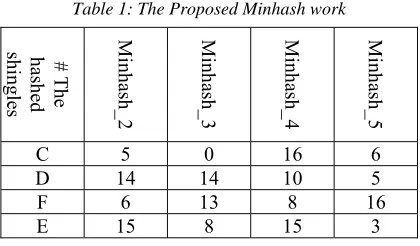
where a and b are two random values, x is the hash function value for the tokens and c is a prime number that is great than the maximum number of x [23]. For example, let we use 4
randomly generated minhash functions as shown in equations (2 to 5) respectively for supposing have shingles (C, D, F, E) and by applying four equations the results show in a table (1).
12𝑥 8 𝑚𝑜𝑑 17 … (2)
14𝑥 3 𝑚𝑜𝑑17 … 3
11𝑥 5 𝑚𝑜𝑑 17 … 4
16𝑥 7 𝑚𝑜𝑑 17 … 5
Suppose the real hash values for the first shingle is C and equal
C=101010011010111001101101110101101100001 11000101001100110011110010111101111110101 01100111101001010001100010100000101001101 011010
D=
10100001011110100000000001110010
0100001011001001100001010001011101
0100110101000100101101001100100010
1110011101001001000001111
F=
11110101011010111101000010011110
0001100111110001010011000001100111
0111010111010110010010101101010000
0010101010111001000010101010
E=10011011110100010001110010001101
0010100011010010101100001011110010
0110010101000111111000011011110100
1101110011110010011001110
[image:6.612.313.523.503.626.2]The hash functions in above are used to calculate the value of each hash token for the file text as depicted in a table (1) below.
Table 1: The Proposed Minhash work
# T
he
has
hed
shingles Minh
ash
_2
M
inh
ash
_3
M
inh
ash
_4
M
inh
ash
_5
C 5 0 16 6
D 14 14 10 5
F 6 13 8 16
E 15 8 15 3
8427 5. THE PROPOSED SYSTEM
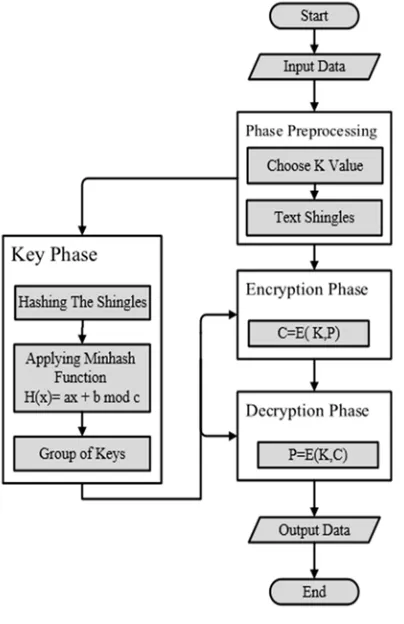
[image:7.612.94.296.257.569.2]In this work, we have implemented and compared four block cipher algorithms DES, 3DES, AES, and Blowfish. We have implemented algorithms in Java and using files in different sizes. The keys generation are applied based on K-shingles and minhash. The evaluation metrics are applied based on the encryption time, memory usage, entropy, throughput, and avalanche effect to evaluate the performance of these algorithms. The system results are explained in detail in the following subsections. The proposed system is illustrated in figure (3)
Figure 3: The Encryption/Decryption Files Proposed System.
5.1.The Key Generation Phase
At this phase, the K-shingle, hash function and minhash technique are used. K-shingle is the process of split the input of the data into substring according to the specified length of K. The punctuation marks and spaces are removed before applying the shingling process. The hash function MD5 is applied for each generated shingle.
The minhash function is implemented for each hashed shingle. In this work, we choose 10 hash functions to test the results which are the text files
such as .pdf, .docx, and .txt in the different size. The values of a and b are chosen randomly. The value of the x is represented the minimum value after applied the 10 hash functions in randomly setting for a and b values. The output of this stage is many keys for each shingle that used later for cipher process.
5.2. The Encryption/Decryption Phase
The generated keys from previous phases are applied for each block size text (n-k+1). For example, the key 1 is applied to block cipher 1 and key 2 is applied for block cipher 2 and so on.
In the decryption, the same keys are used for the encrypted text to convert it to its original form.
The main pseudo code steps for the proposed system is illustrated in the algorithm (7)
Algorithm 7: The Proposed System Algorithm Input: D (Input Data),𝐾𝑖 𝐾1, … . , 𝐾𝑛 : 𝑘 ⊂
𝑔 𝑎𝑥 𝑏 𝑚𝑜𝑑 𝑐 (Group of Keys
Output: E_file(Encryption file) Begin
1. Apply k-shingle on D 2. Set K value for K-shingle
3. Calculate Function k-shingle (k ,D){
4. Read (D)
5. Word [ ] =Preprocessing(D )
6. shingles = split Word [ ] into shingles based on (n-k +1) length
7. return shingles
8. End
9. Apply Hash function
10. Calculate function hash ( shingles){ 11. foreach shingles in k-shingle (k, D) 12. hash value = Hashing shingles
(MD5(shingles))
13. x= Convert hash value to decimal 14. return x
15. } // end hash function
16. Apply Minhash equation (Keys (Ki))
𝑎𝑥i 𝑏 𝑚𝑜𝑑 𝑐
17. Calculate Function Minhash { 18. Repeat
19. foreach shingles in K-shingle (k, D)
20. 𝑓𝑜𝑟 𝑖 ← 1 𝑡𝑜 10 𝑑𝑜
21. 𝑅𝑎𝑛𝑑𝑜𝑚 𝑟𝑛𝑑 𝑛𝑒𝑤 𝑅𝑎𝑛𝑑𝑜𝑚 ;
𝑎 𝑎𝑛𝑑 𝑏 𝑟𝑛𝑑. 𝑛𝑒𝑥𝑡𝑖𝑛𝑡 100 ;
22. 𝐼𝑓 𝑐 𝑥 && 𝑐 𝑎 && 𝑐
𝑏 && 𝑐 𝑖𝑠 𝑐ℎ𝑒𝑐𝑘𝑒𝑑 𝑝𝑟𝑖𝑚𝑒 𝑡ℎ𝑒𝑛
//a,b,c is parameters of minhash equation(1)
23. ℎ 𝑥 𝑎𝑥 𝑏 𝑚𝑜𝑑 𝑐
24. else
8428
26. end if
27. end for
28. 𝑟𝑒𝑡𝑢𝑟𝑛 𝑚𝑖𝑛 ℎ 𝑥
29. 𝑒𝑛𝑑 𝑓𝑜𝑟𝑒𝑎𝑐ℎ
30. Apply hash function again 31. ki=MD5(𝑚𝑖𝑛 ℎ 𝑥 )
32. 𝑟𝑒𝑡𝑢𝑟𝑛 𝑘𝑖
33. Until (End Minhash calculate of one shingle)
34. } End Minhash Function 35. Choose Cryptography algorithm
(DES,3DE, AES, Blowfish) 36. Encryption Phase
37. Pi= Shingling based on the number on K that choose in 2
38. Generate Cipher Text E_file = E (Ki, Pi)
39. Evaluation Cipher algorithm choose using Time , Throughput, Memory ,Avalanche effect and Entropy {
40. Calculate Time( (Start time – End time) 41. Calculate Throughput
42. Throughput=(D size in byte )/(Encryption Time (ms)) 43. Calculate Memory as
44. Total Memory = (Total
memory of instance – Free memory of instance /1024)
45. Calculate Avalanche effect
46. Avalanche effect=(no.of
flipped bits in E_file)/(no.of bits in E_file)
47. Calculate Entropy for all Shingles in E_file
48. 𝐻 𝑥 : ∑ 𝑃 𝑙𝑜𝑔 𝑃 // r is a
number of Shingles based ((n-k)+1) 49. } End evaluation
50. End Algorithm
6. RESULT AND DISCUSSION
The main criteria to evaluate the algorithms (DES, Triple DES, AES, and Blowfish), that are implemented in this work, are encryption time, memory usage, entropy, throughput and avalanche effect [8][24]. These results are all used K=5.
6.1. Encryption Time
Encryption time is the amount of time that the algorithm is needed to convert data from plaintext to ciphertext depending on the key size and data block size. The less time the algorithm takes, the better the algorithm is used to embed encryption it in other applications such as e-commerce, banking,
[image:8.612.86.544.61.541.2]and online transaction processing applications. In this work, we measure the time in milliseconds for different size of input files in bytes
Table 2: The Encryption Time at K=5 in K-shingle
Input Size (Bytes)
Times in Millisecond DES Triple DES AES Blowfish
114 85 123 2 1.23
1,164 243 636 11.43 4.99
2,492 321 756 21.8 8.21
12,571 1567 2341 144 14.14
24,490 703 3696 564 23.7
1,278,548 69231 108731 18003 587
2,240,213 85503 174378 32897 1124
3,600,365 98102 341260 53353 1417
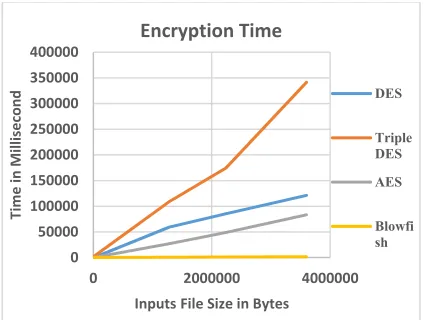
It is noticed from the figure (4) that the Blowfish and AES take less time for encryption, while DES and 3DES need a long time.
Figure4: Encryption Time for DES, Triple DES, AES, and Blowfish.
6.2. Throughput
The Throughput is calculated by using the equation (6)
𝑇ℎ𝑟𝑜𝑢𝑝ℎ𝑝𝑢𝑡 …. 6
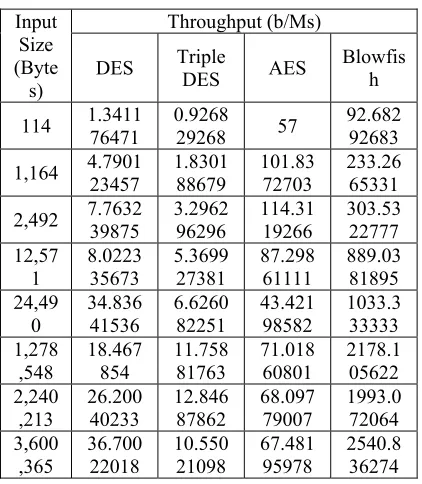
Table (3) shows the throughput values for different for the four-block cipher symmetric algorithms.
0 50000 100000 150000 200000 250000 300000 350000 400000
0 2000000 4000000
Time in
Millisecon
d
Inputs File Size in Bytes
Encryption Time
DES
Triple DES
AES
[image:8.612.312.524.378.538.2]8429 Table3: Throughput Values for DES, 3DES, AES, and
Blowfish Input
Size (Byte s)
Throughput (b/Ms)
DES Triple DES AES Blowfish
114 1.341176471 0.926829268 57 92.68292683
1,164 4.790123457 1.830188679 101.8372703 233.2665331
2,492 7.763239875 3.296296296 114.3119266 303.5322777 12,57
1 8.022335673 5.369927381 87.29861111 889.0381895 24,49
0
34.836 41536
6.6260 82251
43.421 98582
1033.3 33333 1,278
,548 18.467854 11.75881763 71.01860801 2178.105622 2,240
,213 26.20040233 12.84687862 68.09779007 1993.072064 3,600
,365 36.70022018 10.55021098 67.48195978 2540.836274
[image:9.612.312.521.107.282.2]It is noticed in figure (5), the two algorithms Blowfish and AES satisfy the best throughput values.
Figure 5: Throughput (b/Ms) using Encryption Algorithms.
6.3. Memory used
[image:9.612.90.301.114.356.2]The memory usage is the space that is reserved for implementation the algorithms which depend on the number of operations in the algorithm, key size, initialization vectors and type of mode operations. It is noticed from the memory usage results that the Blowfish algorithm is lower consumption of memory, as shown in the table (4).
Table 4: Memory usage for Cryptography algorithms Input
Size (Bytes)
Memory Usage (KB)
DES Triple
DES AES
Blowfis h
114 6101 7117 456 279
1,164 6899 8297 5162 4000
2,492 11430 13010 9206 7240
12,571 15631 20498 11192 9406
24,490 54988 79552 34045 28577
1,278,54
8 464104 805563 254758 161661
2,240,21 3
86166 8
127562 6
77942 5
618351
3,600,36
5 929829 1392101 566144 692257
It is noticed for the figure (6) that the Blowfish has the least memory consumption, while the DES algorithm has the highest memory consumption.
Figure 6: Memory Usage in Kb for four Encryption
Algorithms.
6.4. Avalanche effect
Equation (7) is used to calculate the avalanche effect by using the Hamming distance.
𝐴𝑣𝑎𝑙𝑎𝑛𝑐ℎ𝑒 𝑒𝑓𝑓𝑒𝑐𝑡
𝑛𝑜. 𝑜𝑓 𝑓𝑙𝑖𝑝𝑝𝑒𝑑 𝑏𝑖𝑡𝑠 𝑖𝑛 𝑡ℎ𝑒 𝑐𝑖𝑝ℎ𝑒𝑟𝑒𝑑 𝑡𝑒𝑥𝑡
𝑛𝑜. 𝑜𝑓 𝑏𝑖𝑡𝑠 𝑖𝑛 𝑐𝑖𝑝ℎ𝑒𝑟𝑒𝑑 𝑡𝑒𝑥𝑡 … 7
It can be calculated using the equation (8).
𝐴𝑣𝑎𝑙𝑎𝑛𝑐ℎ𝑒 𝑒𝑓𝑓𝑒𝑐𝑡
𝑛𝑜. 𝑜𝑓 𝑓𝑙𝑖𝑝𝑝𝑒𝑑 𝑏𝑖𝑡𝑠 𝑖𝑛 𝑐𝑖𝑝ℎ𝑒𝑟𝑒𝑑 𝑡𝑒𝑥𝑡
𝑛𝑜. 𝑜𝑓 𝑏𝑖𝑡𝑠 𝑖𝑛 𝑐𝑖𝑝ℎ𝑒𝑟𝑒𝑑 𝑡𝑒𝑥𝑡 … 8
It is noted from the table (5) using the equation (8) that the AES has the highest values and 0
10 20 30 40 50 60
0 10000 20000 30000
Thro
ughput
(b/Ms)
Inputs File Size in Bytes
Throughut (b/Ms)
DES
Triple DES AES
Blowfi sh
0 200000 400000 600000 800000 1000000 1200000 1400000 1600000
0 2000000 4000000
Memo
ry
U
sed
(Kb)
Input Size in Byte
Memory USed
DES Triple DES
[image:9.612.89.301.409.567.2]8430 satisfy the best results than DES which has the least value.
Table 5: Average of Avalanche effect in the plain text
No. of fillipe d bits
The Proposed Method (%)
DES DES DES DES DES
1 17.18 75
17.18 75
17.18 75
17.18 75
17.18 75
2 17.70 8
17.70 8
17.70 8
17.70 8
17.70 8
4 0 0 0 0 0
19 0 0 0 0 0
35 33.68 0
33.68 0
33.68 0
33.68 0
33.68 0 45 26.98
8
26.98 8
26.98 8
26.98 8
26.98 8 Avera
ge
15.92 7
15.92 7
15.92 7
15.92 7
15.92 7
It is cleared that the proposed method satisfy good results when we compare with results in [25][26] and)[27] in terms of these cipher algorithms.
6.5. Entropy Value
It is calculated using the Shanon law in equation (9). It is a measure of randomness which indicates that the power of the cipher algorithms against attack.
𝐻 𝑥 𝑝 𝑥𝑖 log 𝑝 𝑥𝑖 … 9
H(x) is entropy of x.
It is cleared from the table (6) that the AES and Blowfish have the highest values in randomizing.
TABLE 6:AVERAGE OF ENTROPY VALUES FOR CIPHER
ALGORITHMS
Input Size(B yte)
Entropy Value
DES DES
1,164 7.45121 7.45121 7.45121 7.45121
2,492 8.50779 8.50779 8.50779 8.50779
12,571 10.86936 10.87574 10.87574 10.87574
114 3.96981 4.08746 4.08746 4.08746
24,490 10.54109 11.54109 11.54109 11.54109
1,278,54 8
12.42301 448
17.20865 431
12.42337 858
12.42337 858 2,240,21
3 13.51286389 18.19757503 13.51286389 13.51286389
3,600,3
65 13.40274562 13.40274562 13.40274562 13.40274562
The Blowfish takes the smallest time in the encryption and the Triple DES takes more time in the encryption. If the speed is important in the application, the Blowfish is the best option and has the highest value in throughput. If the memory required for implementation is small, the blowfish is the best option and the 3DES is not preferable. Avalanche effect for the AES is high. Thus, it can be used for the applications where the confidentiality and integrity are of highest priority. Also, Blowfish and 3DES have high values of the avalanche effect. The entropy values for all algorithms have an efficient random value that is robust against guessing attacks.
7. THE COMPARISON AND LIMITATION
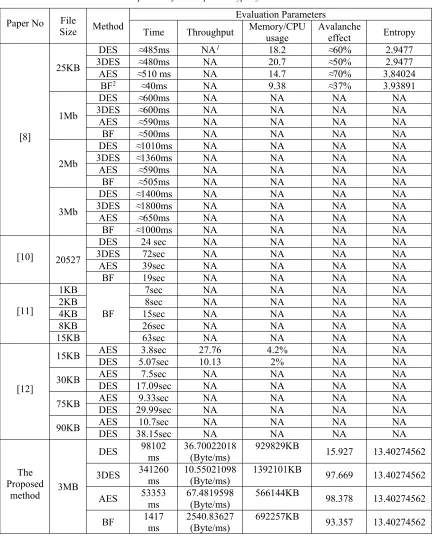
The comparison and limitation of the proposed cryptosystem show a promising tool for the cryptosystem when it is compared with related works in the table (7).
The limitation occurs when the data size is grown. Map-reduce is a more promising programming model when the data is huge.
8. CONCLUSION
8431 REFERENCES
[1] B. Schneier, Applied cryptography: Protocols, algorithm, and source code in C.
John Wiley & Sons, Inc., New York, NY, 1996.
[2] M. Ahmed, T. M. S. Sazzad, and M. E. Mollah, “Cryptography and State-of-the-art Techniques,” IJCSI International Journal of Computer Science Issues, vol. 9, no. 2–3,
2012.
[3] K. Goyal and S. Kinger, “Hybrid Approach Using Encryption Algorithms For Data Storage,” International Journal of Scientific & Engineering Research, vol. 4, no. 7, pp.
2063–2067, 2013.
[4] M. E.Whitman and H. J. Mattord, Principles of Information Security Fourth Edition,
Fourth Edi.
[5] A. Hussein Zyara, “Suggested Method for Encryption and Hiding Image using LCG and LSB,” Journal of University of Babylon,
vol. 26, no. 2, pp. 66–77, 2017.
[6] H. A. Lafta and R. Abdul-Wahid M. Ali, “Symmetric Cryptosystem Based on Petri Net,” Journal of University of Babylon, vol.
26, no. 1, pp. 1–8, 2017.
[7] P. Mahajan and A. Sachdeva, “A Study of Encryption Algorithms AES, DES and RSA for Security,” Global Journal of Computer Science and Technology Network, Web & Security, vol. 13, no. 15, 2013.
[8] P. Patil, P. Narayankar, D. G. Narayan, and S. M. Meena, “A comprehensive evaluation of cryptographic algorithms: DES, 3DES, AES, RSA and Blowfish,” Elsevier B. V. Procedia Computer Science., vol. 78, pp.
617–624, 2016.
[9] D. Salama Abdul. Elminaam, H. Mohamed Abdul Kader, and M. Mohamed Hadhoud, “Performance evaluation of symmetric
encryption algorithms,” IJCSNS
International Journal of Computer Science and Network Security, vol. 8, no. 12, pp.
280–286, 2008.
[10] A. Nadeem and M. Y. Javed, “A Performance Comparison of Data Encryption Algorithms,” in In Information and communication technologies, 2005. ICICT 2005. First international conference on (pp. 84-89). IEEE.
[11] T. S. Atia, “Development of A New
Algorithm for Key and S-Box Generation in Blowfish Algorithm,” Journal of Engineering Science and Technology, Vol. 9, No. 4, pp. 432–442, 2014.
[12] S. D. Rihan, A. Khalid, and S. Eldin F. Osman, “A Performance Comparison of Encryption Algorithms AES and DES,”
International Journal of Engineering Research & Technology (IJERT), vol. 4, no.
12, pp. 151–154, 2015.
[13] S. Manku and K. Vasanth, “Blowfish encryption algorithm for information security,” ARPN Journal of Engineering and Applied Sciences, vol. 10, no. 10, pp. 4717–
4719, 2015.
[14] A. Ahmad Milad, H. Zaiton Muda, Z. A. Bin Muhamad Noh, and M. Almahdi Algaet, “Comparative Study of Performance in Cryptography Algorithms (Blowfish and Skipjack),” Journal of Computer Science,
vol. 8, no. 7, p. 91, 2012.
[15] D. F. García, “Performance Evaluation of Advanced Encryption Standard Algorithm,” in Mathematics and Computers in Sciences and in Industry (MCSI), 2015 Second International Conference on. IEEE, 2015,
pp. 247–252.
[16] G. Yadav and A. Majare, “A Comparative Study of Performance Analysis of Various Encryption Algorithms,” in International Conference On Emanations in Modern Technology and Engineering, 2017, vol. 5,
no. 3, pp. 70–73.
[17] B. A.Forouzan, Cryptography and Network Security, 1st Editio. McGraw-Hill
Education, 2007.
[18] W. Stallings, Cryptography and Network Security: Principles and Practice, 6th
Editio. NJ, Englewood Cliffs:Prentice-Hall, 2006.
[19] C. Paar and J. Pelzl, Understanding cryptography: a textbook for students and practitioners. 2009.
[20] N. Aleisa, “A Comparison of the 3DES and AES Encryption Standards,” International Journal of Security and Its Applications, vol.
9, no. 7, pp. 241–246, 2015.
[21] T. Nie and T. Zhang, “A study of DES and blowfish encryption algorithm,” in Tencon 2009-2009 IEEE Region 10 Conference,
8432 [22] J. Leskovec, A. Rajaraman, and J. D.
Ullman, “Mining of Massive Datasets,” 2014.
[23] S. Reddy Nagireddy, “Scalable Techniques for Similarity Search,” 2015.
[24] C. Prakash Oewangan, S. Agrawal, A. Kumar Mandae, and A. Tiwari, “Study of avalanche effect in AES using binary codes,” in Advanced Communication Control and Computing Technologies (ICACCCT), 2012 IEEE International Conference on, 2012, pp. 183–187.
[25] C. Echeverri, “Visualization of the Avalanche Effect in CT2,” University of Mannheim, 2017.
[26] H. Agrawal and M. Sharma,
“Implementation and analysis of various symmetric cryptosystems,” Indian Journal of science and Technology, vol. 3, no. 12, pp.
1173–1176, 2010.
[27] A. Kumar and N. Tiwari, “Effective implementation and avalanche effect of AES,” International Journal of Security, Privacy and Trust Management (IJSPTM),
8433
Table 7: The comparison of the Proposed Cryptosystem with the Others works
Evaluation Parameters Method File Size Paper No Entropy Avalanche effect Memory/CPU usage Throughput Time 2.9477 ≈60% 18.2 NA1 ≈485ms DES 25KB [8] 2.9477 ≈50% 20.7 NA ≈480ms 3DES 3.84024 ≈70% 14.7 NA ≈510 ms AES 3.93891 ≈37% 9.38 NA ≈40ms BF2 NA NA NA NA ≈600ms DES
1Mb 3DES AES ≈600ms ≈590ms NA NA NA NA NA NA NA NA
NA NA NA NA ≈500ms BF NA NA NA NA ≈1010ms DES
2Mb 3DES AES ≈1360ms≈590ms NA NA NA NA NA NA NA NA
NA NA NA NA ≈505ms BF NA NA NA NA ≈1400ms DES
3Mb 3DES AES ≈1800ms≈650ms NA NA NA NA NA NA NA NA
NA NA NA NA ≈1000ms BF NA NA NA NA 24 sec DES 20527
[10] 3DES 72sec NA NA NA NA
NA NA NA NA 39sec AES NA NA NA NA 19sec BF NA NA NA NA 7sec BF 1KB
[11] 2KB 4KB 15sec 8sec NA NA NA NA NA NA NA NA
NA NA NA NA 26sec 8KB NA NA NA NA 63sec 15KB NA NA 4.2% 27.76 3.8sec AES 15KB [12] NA NA 2% 10.13 5.07sec DES NA NA NA NA 7.5sec AES
30KB DES 17.09sec NA NA NA NA
NA NA NA NA 9.33sec AES
75KB DES 29.99sec NA NA NA NA
NA NA NA NA 10.7sec AES
90KB DES 38.15sec NA NA NA NA
13.40274562 15.927 929829KB 36.70022018 (Byte/ms) 98102 ms DES 3MB The Proposed method 13.40274562 97.669 1392101KB 10.55021098 (Byte/ms) 341260 ms 3DES 13.40274562 98.378 566144KB 67.4819598 (Byte/ms) 53353 ms AES 13.40274562 93.357 692257KB 2540.83627 (Byte/ms) 1417 ms BF
1 - Not Available
![Figure 1: Classification of the Modern Ciphers Techniques[3].](https://thumb-us.123doks.com/thumbv2/123dok_us/8901097.954901/2.612.102.300.565.657/figure-classification-modern-ciphers-techniques.webp)