IJPSR (2014), Vol. 5, Issue 7 (Research Article)
Received on 28 January, 2014; received in revised form, 01 March, 2014; accepted, 08 April, 2014; published 01 July, 2014
MICROENCAPSULATION OF ISONIAZID BY TEMPERATURE CHANGE METHOD: PREPARATION AND CHARACTERIZATION
Athar Husain*, Amit Kaushik and Mohd. Rashid Ansari
Mahatma Gandhi Institute of Pharmacy, Junabganj, Kanpur Road, Banthra, Lucknow, U.P. India-227101
Keywords: Tuberculosis, Isoniazid, Microencapsulation, Ethyl cellulose,
Cyclohexane etc.
Correspondence to Author:
Athar Husain
Mahatma Gandhi Institute of Pharmacy, Junabganj, Kanpur Road, Banthra, Lucknow - 227101, Uttar Pradesh, India
Email: [email protected]
INTRODUCTION: Tuberculosis is a fatal
communicable disease, caused by bacteria
Mycobacterium tuberculosis, typically attacks the lungs but can also affect other part of the body, spread through air. About 1/3 of the world’s
population have infected by Mycobacterium
tuberculosis. Due to TB about 2 million people will
die yearly 1. WHO introduce the modern standard
short course therapy for tuberculosis treatment based on four drug regimen of isoniazid, rifampicin, pyrazinamide and ethambutol for 2 months followed by treatment with combination of
isoniazid and rifampicin for 4 months 2.
QUICK RESPONSE CODE DOI:
10.13040/IJPSR.0975-8232.5(7).2841-47
Article can be accessed online on: www.ijpsr.com
DOI link: http://dx.doi.org/10.13040/IJPSR.0975-8232.5(7).2841-47
N N H
NH2 O
ISONIAZID
Isoniazid is a first line antitubercular drug. It has broad spectrum antimicrobial activity. They act as
both bacteriostatics for resting bacilli and
bacteriocidal for dividing microorganisms. Isoniazid is a prodrug i.e. converted by enzyme known as mycobacterial catalase peroxidase into an active metabolite. Mycolic acid is a unique fatty acid component of mycobacterial cell wall. Isoniazid is inhibits the biosynthesis of mycolic acid in bacterial cell wall. Isoniazid acts on enoyl-ACP reductase of fatty acid synthase-II, cause saturation of fatty acid in mycolic acid biosynthesis
3
.
ABSTRACT: Aim: Isniazid is unstable in aqueous medium. The aim is to improve the aqueous stability of isoniazid by microencapsulation method. Methods: Isoniazid microcapsules were prepared by temperature change method. Ethyl cellulose used as coating material which forms a layer on pure drug. Ethyl cellulose was insoluble in cold cyclohexane when temperature rise about 70-750C it become soluble in cyclohexane.
Isoniazid is absorbed by oral and parental administration. Metabolized by liver, and excreted
in the urine, t1/2 is about 3 hours. Dose 5mg/kg
(adult dose = 300mg / day). Aluminum hydroxide inhibits the absorption of isoniazid. Para-amino salicylic acid inhibits the metabolism of isoniazid
and increase t1/2 of isoniazid. Isoniazid inhibit
metabolism of warfarin, phenytoin, carbamazepine and diazepam which may raise their concentration
in blood. Peripheral neutritis, neurological
manifestations, hepatotoxicity, rashes, fever, acne
and arthralgia etc. are common side effects 4.
Microencapsulation: Microencapsulation is a process in which small droplets or particles of liquid or solid material are surrounded or coated by
a continuous film of polymeric materials.5
Microencapsulation is a techniques in which entrapping of solid/ liquid or gases by coating material, improving pharmaceutical application like masking unpleasant taste and odors, protecting
drugs from moisture.6 Microencapsulation is occur
by incorpora-tion of thin coating material on core material having particle size ranges from 5-5000µm. With the help of coating material, improve the availability and physiochemical
properties of core material (drug).
Microencapsulation increases the absorption of drug and suppress the side effect like irritation of
GI mucosa 7. Microencapsulation has accepted for
controlled release of drugs 8. It has overcome some
of the problems of conventional therapy and
increased the therapeutic efficacy of drug 9.
Objectives:
The main reason for microencapsulation is
for sustained or prolonged release of the drug.
To improve the aqueous incompatibility.
MATERIALS AND METHODS: Double beam UV spectrophotometer, digital pH meter, hot magnetic stirrer, digital weighing balance, hot air oven, beaker, measuring cylinder, conical flask, stirring rod, funnel, methanol, cyclohexane, conc. HCl, Ethyl cellulose, microscope, capillary tube etc. Isoniazid pure drug obtained as a gift sample from Dr. Reddy’s Laboratories Ltd.
Preformulation studies
(A)Identification test: 100mg of isoniazid was dissolved in 2mL of Distilled water, added 10mL warmed solution of vanillin (1%, in water). Kept for aside for some minutes, after that scratch the inside of container with glass
rod, yellow precipitate was obtained.
Precipitate was recrystallized with 70% ethanol
(5mL) and dried at 105oC. Yellow precipitates
melt at 226oC -231oC.
(B)M.P. studies: isoniazid melts at 170ºC to 174 ºC.
(C)Solubility Analysis: Isoniazid freely soluble in water, sparingly soluble in alcohol, very
slightly soluble in ether 10.
(D)UV spectrophotometry studies:
Preparation of 0.012M HCl solution: 0.012M HCl was prepared as per IP 1996.
Preparation of standard solution: 100 mg of Isoniazid was transferred to a 100mL volumetric flask containing sufficient quantity of the 0.012M HCl solution to dissolve it. The volume of solution was made up to 100mL with 0.012M HCl solution (1mg/mL).
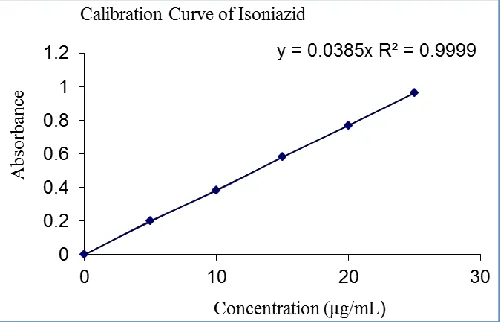
Preparation of calibration curve of isoniazid: A series of working solution of Isoniazid ranging
from 5 to 25 g/mL were prepared from standard
solution. The absorbance of all solution was
measured spectrophotometrically at 257 nm 11.
Formulation design:
Preparation of Isoniazid Microcapsules by Temperature Change Method: Microcapsules
were prepared a method described by 12 with slight
modification. 50mL cyclohexane was taken into a beaker with continue stirring at 200-400rpm and
maintained the temperature at 55oC. After that 4g
coating material (ethyl cellulose) was added into the solution. Increased the temperature of solution
to 70oC for solubilization in the solvent for 20
minutes. 2g of isoniazid (core material) was added,
maintained the temperature app. 70-75oC for 10
Cool at room temperature for 5 minutes. Excess cooling was gained with the addition of ice (temp.
5-10oC). Filtered the sample by using Buchner
funnel at the vacuum pump with Whatman filter paper No1. Microcapsules was rinsed with
n-hexane and dried at 45oC for 3-4 hrs. Stored in well
closed container for further studies (Bajaj et al., 2012).
EVALUATION OF MICROCAPSULES:
Color and Visual Appearance: Pure drug and microcapsules of isoniazid were visually seen for their overall appearance.
Particle Size Analysis by Microscopy: Particle size distribution plays a vital role in the evaluation
of the release character of microcapsules. The
sample of pure drug and prepared microcapsules was randomly selected and their size was determined using a simple microscopic method. About 100 microcapsules were counted for particle size analysis with the help of calibrated optical
microscope 13, 14.
Moisture content determination: humidity (moisture) was determination on the basis of dry weight from a wet solid, called as moist-ure content (MC). Percent moisture content was determined by
using following formula 15;
% MC= [wt. of water in sample/ wt. of dry sample] x 100
Bulk density:
Apparent bulk density (g/mL): Accurately weighed quantity of microcapsules (5g) was taken into clean and dry graduated measuring cylinder. Note the volume of microcapsule in measuring cylinder. Bulk density was determined by using
following formula 7:
Apparent bulk density
Tapped density: Firstly set bulk densitometer for 100 strokes. Microcapsules (5g) was placed on bulk densitometer, after 100 tapping note the volume of microcapsules in cylinder. Tapped density was
measured by using following formula 16:
Tapped density =
Carr’s index: it was calculated by using following formula 17, 18:
% Carr’s index =
Values of Carr’s index less than15% shows good flow personality, but more than 40% shows poor flowability.
Flow properties:
Angle of Repose: The flow property of microcapsules was determined by measuring angle of repose using fixed funnel method. Accurately weighed quantity of microcapsules (5g) was passed through funnel clamped on stand and measured the height and radius of the piles. Angle of repose was
estimated by using following formula 19:
tan θ = h/r
θ= tan-1
(h/r)
Where; θ= angle of repose, h= height of pile, r= radius of the base of the pile.
Flow rate: Accurately weighed quantities of microcapsules (5g) were taken and pass through a funnel clamp on stand. Time (in sec.) was noted required for falling of microcapsules from beginning to end by funnel orifice.
Coefficient of Friction: The tangents of angle of
repose were defined as coefficient of
interparticulate resistance or friction. If value of µ below 1 indicates good flow characteristics, but above 1 shows poor flow ability.
µ= tan θ,
Where, µ= coefficient of friction and θ= angle of repose
Dissolution rate studies of Microcapsules: Accurately weighed 100mg pure drug and 200mg microcapsules of isoniazid ware filled in hard gelatin capsules. Each capsule was placed in USP XXII dissolution apparatus, the studies was carried out by using 900mL of pH 7.4 phosphate buffer at 100 rpm. 10mL sample was withdrawn at every half hour of time interval and replaced with same amount of pH 7.4 buffer to maintain the ideal sink conditions, which were further diluted with pH7.4 buffer. Absorbance was taken at 263 nm with the
help of UV spectrophotometer 7.
Permeation test: Egg was buying from local market and removed the yolk, kept in HCl for 48 hrs. Egg membrane was leaving the wall of egg shell. Two both sided hollow test tubes were taken. One side test tube was wrapped by egg membrane. Took 100mg pure drug and 200mg microcapsules of isoniazid into these test tubes and about 1 cm test tube were dipped in beaker containing water. Withdraw 10 ml of sample every 30 minutes interval and replace by equal volume of water to maintain the sink condition. Absorbance was taken spectrophtometrically.
RESULT AND DISCUSSION:
Preformulation studies: Isoniazid was a white crystalline powder, freely soluble in water, sparingly soluble in alcohol, very slightly soluble in
ether. It was melted at 171oC and their pH was
found to be 7.1.
The entire calibration curve (Isoniazid) was found to obey the Beer-Lambert’s law within the concentration range of 5-25 µg/ml in respective 0.012M HCl solution. The calculation of drug
content and in-vitro drug release were based on
these calibration curves.
FIGURE 1: STANDARD CALIBRATION CURVE FOR ISONIAZID IN 0.012M HCl
Formulation studies: Isoniazid was reported unstable in aqueous medium and their highly acetylation occurs in liver. Hence enhanced the stability and prevent the acetylation by method of microencapsulation. Microcapsules were prepared
by coacervation phase separation method
(Temperature change method). Ethyl cellulose was insoluble in cold cyclohexane when temperature
increased about 70-75oC it become soluble.
Microcapsule prepared by temperature changed method was found to be fine, non-staining, coarse and free flowing characteristics.
Microcapsules of isoniazid were compared with pure drug shows changes in physical properties. Isoniazid, a white colored residue was changed into
irregular free flowing behavior after
microencapsulation. Particle size was determined
[image:4.612.316.567.93.254.2]with the help of optical microscope (table 1).
TABLE 1: PARTICLES SIZE ANALYSIS BY MICROSCOPE Particle size
ranges (µm)
No. of particles (F)
Mid-point (X)
D=X-A A=87.5
D’=D/H
H=25 FD’
0-25 26 12.5 -75 -3 -78
25-50 23 37.5 -50 -2 -46
50-75 20 62.5 -25 -1 -20
75-100 15 87.5 0 0 0
100-125 10 112.5 +25 +1 +10
125-150 6 137.5 +50 +2 +12
ΣF =100 ΣFD’ = -122
Mean = A + (ΣFD’ / ΣF x H) = 87.5 + (-122 / 100 x 25) = 87.5 – 30.5
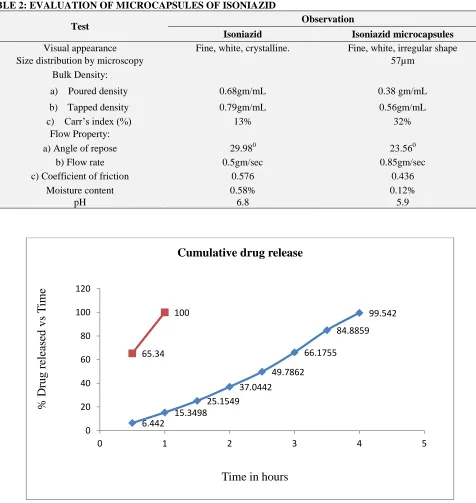
Microcapsules of isoniazid shows enhanced flow properties. Ethyl cellulose formed a film around the drug particles, which suppressed the generation of excess charge and finally improve the flow properties. Angle of repose and bulk density were decreased after microencapsulation. Moisture content of pure drug was decreased after microencapsulation which hint enhancement in stability. Dissolution studies of the drugs and
microcapsules were carried out in pH 7.4 phosphate buffer and graph of % drug released vs. time was plotted. Isoniazid in pure form released 90% about in 50 minutes. After microencapsulation T90% was
increased from 50 minutes to about 4 hours (table
2, figure 2).
Permeation test: The microcapsules of Isoniazid drug sustained the release through egg membrane
[image:5.612.66.542.205.708.2]with comparison to pure drug (figure 3).
TABLE 2: EVALUATION OF MICROCAPSULES OF ISONIAZID
Test Observation
Isoniazid Isoniazid microcapsules
Visual appearance Fine, white, crystalline. Fine, white, irregular shape
Size distribution by microscopy 57µm
Bulk Density:
a) Poured density 0.68gm/mL 0.38 gm/mL
b) Tapped density 0.79gm/mL 0.56gm/mL
c) Carr’s index (%) 13% 32%
Flow Property:
a) Angle of repose 29.980 23.560
b) Flow rate 0.5gm/sec 0.85gm/sec
c) Coefficient of friction 0.576 0.436
Moisture content 0.58% 0.12%
pH 6.8 5.9
FIGURE 2: DISSOLUTION STUDIES OF PURE DRUG AND MICROCAPSULES OF ISONIAZID 6.442
15.3498 25.1549
37.0442 49.7862
66.1755 84.8859
99.542
65.34 100
0 20 40 60 80 100 120
0 1 2 3 4 5
%
Dr
ug
re
lea
se
d
vs
T
im
e
Time in hours
FIGURE 3: PERMEATION TEST STUDIES OF PURE DRUG AND MICROCAPSULES OF ISONIAZID.
So aqueous instability of isoniazid pure drug was minimized by microencapsulation and improve the released of drug means sustained the release of drug.
CONCLUSION: Isoniazid was successfully microencapsulated using ethyl cellulose by phase separation Coacervation induced by temperature change method by using the combination of Isoniazid and ethyl cellulose in the ratio of 1:2 (Drug: polymer). Microencapsulation resulted in significant improvement in physical properties of the drugs especially with respect to flow properties,
bulk density and organoleptic properties.
Microencapsulation also resulted in delayed release
of the drugs. The in vitro drug release studies
indicated that the optimum release profile was found by formulation.
ACKNOLEDGEMENTS: The authors are thankful to Mr. Mukesh Tiwari and Dr. Zeashan Hussain Mahatma Gandhi Institute of Pharmacy, Lucknow, for availing the laboratory facilities during the course of research studies.
REFERENCE:
1. Sethumadhavan Santhosh, Theruvathil K. Sini, Rangasamy Anandan, Paruthapara T. Mathew: Hepatoprotective activity of chitosan against isoniazid and
rifampicin-induced toxicity in experimental rats. European Journal of Pharmacology 2007; 572: 69–73
2. Marcio Vinicius Bertacine Dias, Igor Bordin Vasconcelos, Adriane Michele Xavier Prado, Valmir Fadel, Luiz Augusto Basso, Walter Filgueira de Azevedo Jr: Diogenes Santiago Santos: Crystallographic studies on the binding of isonicotinyl-NAD adduct to wild-type and isoniazid resistant 2-trans-enoyl-ACP (CoA) reductase from Mycobacterium tuberculosis. Journal of Structural Biology 2007; 159:369–380
3. Goodman and Gilman: The Pharmacological basis of therapeutics. Maxwell Macmillan Publishing Corporation. 8th Edition. Vol. 2. 1980: 785-786.
4. Tripathi KD: Essencials of Medical Pharma-cology. Jaypee Brothers Medical publishers (P) Ltd. 6th Edition 2008: 740-741.
5. Bi-Botti C. Youan, Alamdar Hussain, and Nga T. Nguyen: Evaluation of Sucrose Esters as Alternative Surfactants in Microencapsulation of Proteins by the Solvent Evaporation Method. AAPS Pharm Sci 2003; 5(2). 1-9. Article 22 (http://www.pharmsci.org).
6. Nazar Mohammad Ranjha, Ikram Ullah Khan, Shahzad Naseem: Encapsulation and characte-rization of flurbiprofen loaded poly(e-caprola-ctone)– poly(vinylpyrrolidone) blend microspheres by solvent evaporation method. J Sol-Gel Sci Technol 2009; 50:281– 289; DOI 10.1007/s10971-009-1957-7
7. Indian Pharmacopoeia 1996: Ministry of Health and Family Welfare. Controller of Publications.
8. KPR Chowdary and SB Dana: Preparation and evaluation of ethylcellulose coated microcapsules for controlled release of Diclofenac. Research Journal of Pharmaceutical, Biological and Chemical Sciences 2011; 2(1):608-615 9. Nitika Agnihotri, Ravinesh Mishra, Chirag Goda, Manu
Delivery: A Review. Indo Global Journal of Pharmaceutical Sciences 2012; 2(1): 1-20.
10. Suryadevara Vidyadhara, Janga Ramesh Babu, Talamanchi Balakrishna, Pavuluri Triloc-hani, Modalavalasa Prathap Kumar., 2013. Design and evaluation of controlled release losartan potassium microcapsules. Journal of pharmacy research 2013; 6:470-475
11. Benetton SA, Kedor Hackmann ER, Santoro MI, Borges VM: Visible spectrophotometric and first-derivative UV spectrophotometric determination of rifampicin and isoniazid in pharmaceutical preparations. Talanta 1998; 47(3):639-643. PMID: 18967366 [Pub Med]; http://dx.doi.org/10.1016/S0039-9140(98)00111-8. 12. Ghulam Murtaza., Mahmood Ahamd., Naveed Akhtar and
Fatima Rasool: A comparative study of various microencapsulation techn-iques: effect of polymer viscosity on microcapsule characteristics. Pak. J. Pharm. Sci. 2009; 3:291-300.
13. Aulton M.E., Pharmaceutics the science of dosage form design. 2nd edition. 133-134.
14. B. Appa Rao, M.R. Shivalingam, Y.V. Kishore Reddy, N. Sunitha, T. Jyothibasu, T. Shyam., 2010. Design and evaluation of sustained release microcapsules containing diclofenac sodium. Int J Pharm Biomed Res 2010; 1(3): 90-93
15. Lachman L., Liberman H.A., Kanig JA: The theory and practice of industrial pharmacy. Varghese publishing house, Mumbai, 4th edition 1991: 430-453.
16. Ghulam Murtaza., Mahmood Ahamd., Naveed Akhtar and Fatima Rasool: A comparat-ive study of various microencapsulation techn-iques: effect of polymer viscosity on microca-psule characteristics. Pak. J. Pharm. Sci. 2009; 3:291-300.
17. Aulton M.E., Pharmaceutics the science of dosage form design. 2nd edition. 133-134.
18. Santhosh Kumar M, Chowdary K.A and Sammaiah G: Controlled Release Formulation and Evaluation of Aceclofenac by Microencapsula-tion. Pharmanest 2012; 2:133-145
19. T. V. Rao and S. Vidhyadhara., 2012. Formulation and in vitro evaluation of indomethacin microcapsules. Int. J. Chem. Sci. 2012; 10(1): 1-8; ISSN 0972-768X.
All © 2014 are reserved by International Journal of Pharmaceutical Sciences and Research. This Journal licensed under a Creative Commons Attribution-NonCommercial-ShareAlike 3.0 Unported License
This article can be downloaded to ANDROID OS based mobile. Scan QR Code using Code/Bar Scanner from your mobile. (Scanners are available on Google Playstore)
How to cite this article: