1253
INFORMATION SUPPORT SYSTEM DESIGNED FOR
TECHNICAL OPERATION PLANNING OF RECLAMATIVE
FACILITIES
IRINA YURCHENKO,
1Doctor of Technical Sciences,
All-Russia Research Institute of Hydraulic Engineering and Land reclamation of A.N. Kostyakov, 127550 Moscow, Russian Federation
E-mail: [email protected]
ABSTRACT
Automation of technical operation planning of reclamative facilities increases management efficiency through multivariate assessment and consideration of the projected consequences of decisions, reduction of
risk and unproductive expenses. The author provided analysis of the existing trends and assessment of
prospective development of information technology in the practical management of reclamation systems. The paper gives insight into the structure of the developed decision support systems at the federal and regional management levels, ensuring optimal distribution of investment in the technical operation of reclamative facilities under current restrictions. The author suggested using a system of diagnostic parameters and key performance indicators to model technical monitoring of land reclamation systems, defined the composition and structure of source database to be used in modelling. Effective managerial
decisions were determined with regard to relevant modelling results. Pilot operation of the proposed
decision support system in the technical operation management of reclamative water utilization system of the North Caucasus Federal District gave the possibility to achieve the following values of the main technical and economic indices: water use efficiency increased by 10 - 15%; prevention of damage caused by potential accidents – approximately 28.68 RUB bn; increase in automation level by 20% and increase in labor capacity by 30%.
Keywords: Control automation, Decision support, Planning automation, Reclamative systems,
Technological support
1. INTRODUCTION
In the world practice, automation presents the generally accepted instrument used to improve information and economic processes [1]-[3]. Using computer technology fundamentally changes control over reclamation activities [4] by the application of modeling and quantitative decision support methods with the view of considering changes in the natural and socio-economic processes related to agricultural production [5].
Transition of agriculture to the principles of sustainable development along with mandatory
consideration of environmental restrictions
regarding the use of agricultural landscapes requires radical changes in the economic and investment policies related to complex reclamation of agricultural land. Investment policies should be based on timely, complete and accurate information
regarding the current state and prospective development of reclamative stock with regard to entities and each individual reclamation system [6]. Using specific tools of the developed informational and technological support aimed at providing control, analysis, structural assessment and the planned use of land reclamation systems (RS) in the practical operation of reclamative
facilities improves administrative work
performance and the quality of relevant decisions, promotes justification of strategic decisions aimed at gaining competitive advantages and "digitizing" management models.
1254 functions and standardization of information and economic management processes [7].
The first commercial decision support systems (DSS) were management information systems (MIS), focused on the formation of structured periodic reports for managers [8]. Subsequently, model-oriented decision support systems (DSS) or management decision systems were developed since the end of 1960 [9]. In 1970-1980, developers focused on the thesaurus of management information systems [10], justification of efficiency criteria related to the development of managerial DSS [11], aspects related to their creation and design theory [11], development of information database for DSS classification [12], analysis of their distinguishing features and approaches to their practical development [13].
Versions of commercial information systems are developed to provide operational information support to managerial decisions taken by CEOs (Executive Information Systems, EIS); support to groups of users (staff) who perform a common task (group DSS - GDDS); solution of complex interdisciplinary problems that require knowledge and experience in various areas of management
(organizational DSS - ODDS). 1990s marked the appearance of specialized DSS that provided prompt analysis and online data processing with the view of supporting important decisions (Online Analytical Processing - OLAP).
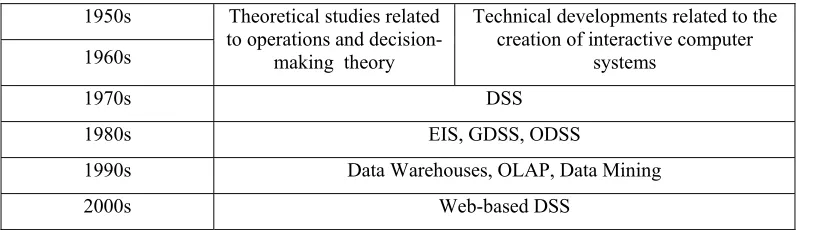
Table 1 shows a brief history of DSS development [7]. Ideology of decision support systems is based on studies related to the theory of decision-making and experience in the development of interactive computer systems [14].
Pursuant to various methods used to transform input information during the development of managerial decisions, information management systems could be divided into the following categories:
1) Automated data processing systems (ADPS), designed to solve problems by means of well-defined algorithms and mathematical models [15]; 2) Decision support systems (DSS), used to solve complex nonformalized problems [14], [16]; 3) Expert Systems (ES), imitating mental action inherent in professionals and managers in specific areas with recurring problems [17].
Table 1.Brief history of DSS development
1950s Theoretical studies related
to operations and decision-making theory
Technical developments related to the creation of interactive computer
systems 1960s
1970s DSS
1980s EIS, GDSS, ODSS
1990s Data Warehouses, OLAP, Data Mining
2000s Web-based DSS
The analysis of recent trends in the field of control automation and assessment of IT development prospects in the field of land reclamation show priority of DSS, as a system being in full compliance with the requirements related to the operational and strategic management in the field of information and economic production [18].
Apart from decision support capabilities in the complex nonformalized environment, modern DSS have the following specific features [18]:
- Objective that implies improving the effectiveness of decision-making;
- Providing support to managers in their decision – making process, not replacing them in terms of solution development;
- Application of data and models.
Currently, Russia lags far behind the United States and advanced Western countries practically in all major areas of IT-based management; its contribution to the global information technology industry does not exceed 0.6% [19].
[image:2.612.107.514.427.542.2]1255 technology. The software set is at best formed and more often purchased from different manufacturers to address specific management tasks, which in most cases, do not have functional, ergonomic and information links. Such a system does not provide common approaches to the ongoing processes at the enterprises and reduces the efficiency of control automation. That situation was typical for all post-Soviet countries, misuse and lack of timely
response lead to serious environmental
consequences. For example, agricultural policy of the Soviet Union caused shallowing of the Aral Sea, which was the fourth largest lake in the country. As of 2015, the Aral Sea area was reduced to 8303 square kilometers; this indicates lack of modern information technologies.
Management transformation in the Russian agricultural companies often occurs without due respect to the principle of "inadmissibility of chaotic automation" associated with the essence of control automation, which task is not to find ways of using a computer. More specifically, it aims at the understanding of control system functions; this requires new management techniques that could fit both production processes and the organizational structure. However, the training level of managers, financial capabilities and corporate production culture of the Russian agro-industrial enterprises defines "social order", related to a greater extent to accounting software. Computers are largely used to provide automation of routine work [20].
At the same time, mature economies are increasingly using advanced web technologies related to cloud computing. Their main distinctive feature implies providing computations on a web server, bypassing user station. The advantages of "cloud" technologies include: accessibility and
mobility; efficiency and flexibility; lease
opportunities; high manufacturability and
reliability. The main deficiencies include user’s dependence on software developers, providers of "cloud" services, stable Internet performance; problems related to integration of "cloud" computations with other personal data and data obtained through the "cloud" services of other suppliers; unavailability of data control [12].
In Russia, the share of "cloud" technologies in business structures, let alone the state-owned enterprises, is hardly noticeable. This is largely explained by a lack of available high-speed, permanent and uninterrupted Russia-wide Internet coverage; lack of relevant legal acts, establishing liability of "cloud" service providers in terms of privacy and security of stored data; poor
understanding of the "cloud" benefits by the enterprise authorities with due regard to the present
development of the country’s economic
management mechanism.
Models, algorithms and procedures of few IT tools used in terms of organizational and economic control over technical operation of reclamation systems (RS) is usually based on foreign designs, their automation objects and functioning conditions differ from the domestic ones. Due to the limited organizational, economic and financial support of domestic users, manufacturers do not provide reconfiguration and adaptation of the purchased systems. Therefore, effectiveness of these innovations in the technical operation of RS is reduced.
The lack and / or shortage of the required information is a fundamental reason for the low quality of managerial decisions. At the same time, increase in the amount of information required for decision-makers (DM), determined by the frequently changing requirements related to the controlled object and business environment significantly complicates their work, which also does not provide effective decision making.
Despite a noticeable lag of the domestic economy from the world’s leaders, reclamation in Russia is characterized by a positive trend in the creation, implementation and use of management information technologies. Its main feature implies the fact that heads of executive authorities got wise to the importance of scientific decision-making methods as an indispensable component of their own experience and intuition of decision-makers.
The aforesaid determined relevance of studies aimed at improving the effectiveness of the planned preventive measures related to technical operation of RS. The present research institutes developed
and implemented a specific information
management system combining databases and database management systems, tools and methods used to convert raw data referring to the monitoring of RS technical state into the information about actions required to improve their efficiency and financial support of the planned events.
1256 management existing in most foreign countries [21]. Economic globalization of the economy, search for technological cooperation niche and marketing outlets, require full knowledge of the operational environment for successful prediction of their implementation effectiveness and competitiveness at home and / or abroad [22]. The possibility to study and to use the third-party expertise in order to recreate a complete picture of the impact related to managerial decisions in such cases is of particular relevance [20].
Introduction of the desired changes can be confirmed by using findings of the present research carried out within the framework of the State contract between the Federal State Budgetary Scientific Institution "A.N. Kostyakov, All-Russian Research Institute of Hydraulic Engineering and Reclamation" and the Russian Ministry of Agriculture with the view of improving managerial decision-making procedures based on automation in the critical field of reclamation activities - technical operation of reclamation systems [23].
The purpose of this paper is to improve the level of information and technological support related to technical operation planning of reclamative water utilization system by means of managerial activity automation, providing optimal results through multivariate assessment and consideration of the projected consequences of decisions as well as by means of reducing unproductive expenses with regard to the limited budgetary funding.
Methodological and technological support of IMS automation requires solution of the following tasks:
- Analysis of the current trends related to the improvement of automation processes and assessment of further IT development in the field of management;
- Formation of diagnostic parameters and key indices related to the technical state of RS;
- Determining the structure and database content of IMS models;
- Development of models, algorithms and procedures with a view to provide technical state monitoring of RS and to determine the need to perform technical operation activities;
- Software development.
2. MATERIALS AND METHODS
Methodology of the automated RS facilities management is based on the RS management theory, the concepts of complex automatic control systems and decision support systems based on system approach, systematic research and systems analysis.
RS management theory is based on methods, procedures and techniques that disclose the rules related to the use of cognitive tools in relevant studies. System approach holds a special place in this regard since it implies considering the object of study as a system.
Specific features of RS facilities management are determined by relevant characteristics of the object under study and disclosed through mathematical methods applied to study onsite operations and DM activities, which also imply development of behavior models that allow increasing the limits of manageability. This approach was not used before because responsible executives had poor knowledge of quantitative analysis methodology.
The increasing relevance of using quantitative analysis methodology in the theory of RS facilities management is determined by the development and implementation of information technology aimed at automation of administrative work, having "user-friendly" interface that does not require high level of computer literacy and providing not only informational, but also technological decision support.
Powerful tools of the automated RS facilities
management presently include information
management systems providing management automation along with possible human involvement in the signal network based on IT tools; methods providing the possibility to convert raw data into the new information using computers as the main technical devices, which implement the control function.
IT planning of RS facilities management was
also based on scientifically substantiated
recommendations and their practical application experience, presented in the periodicals, holdings and in regulatory materials on the development,
implementation and use of information
1257
2.1 Data, Analysis and Results
Keeping in mind current socio-economic conditions and the preferences of domestic economic entities, the author developed a model - oriented DSS to improve RS technical operation management, with due regard to the current and projected IMS development.
Tasks related to informatization of planning, production, management and processes at the enterprise [20] was carried out with due regard to the experience of the countries that take the lead in the field of information. These include the United States and Canada, the countries of Northern and Western Europe, Japan, Australia, New Zealand, Hong Kong, Singapore, South Korea and Israel [7], [20], [21].
The author studied best practices related to: - Adaptation of information resources to the market economy requirements regarding economic activity support by providing systematic, reliable, available and user-friendly knowledge in the form of information systems;
- Provision of methodical, technological and information support of the automated control systems;
- Choice of IT software tools (shell);
- Assessment of cost-effectiveness and socio-psychological aspects of using DSS.
The system of diagnostic parameters related to the technical state of RS was developed with regard to:
• availability and the possibility of obtaining the information by users, who contribute to subsequent IMS vitality;
• relevance, which provides concordance between the desired and actual information referring to diagnostic parameters and reduces their number;
• feasibility of information collection, which provides the possibility to transmit input data to the control system database.
The author suggests choosing the most effective option of limited investment distribution with regard to simulation that takes into account maximum (as compared with optimization models) knowledge, experience and preferences of decision-makers in the formulation and analysis of possible solutions that differ by equipment configuration and by the structure of possible activities related to
technical operation of RS. This eliminates disadvantages of a purely formal approach to the selection of optimal solutions in the optimization modelling making the decision-makers focusing on the substantive aspects of results. It is well known that solutions of the optimization problem, which do not differ significantly on formal grounds (quantitative value of the optimality criterion), might be characterized by very different parameters, which leads to significantly different effects of the implemented decisions, the best of which do not always correspond to the optimal choice.
The developed optimization criteria are characterized by simplicity and accessibility of understanding their content; novelty and originality of their structure; presence and availability of source data required to generate quantitative values; focus on rapid assessment methods that promote the growing demand for practical application of information management systems.
Difficulties associated with finding and collecting open and reliable source data for IMS, were tackled by borrowing data from the certificates of reclamation facilities. RS certificate was developed on the instructions of the Department of Land Reclamation of the Ministry of Agriculture of Russia, and certificate database of the federal form of incorporation was used to analyze and to evaluate the technical state and the cost of reclamative water utilization system, which is currently performed by using traditional decision-making technologies.
DSS includes technologies developed with a view to provide collection / registration, storage and analysis (monitoring) of diagnostic parameters and key performance indices, to determine the need for the scheduled preventive RS activities, to optimize managerial decision on the distribution of scarce investment, allocated for these purposes, to automate preparation of output reports.
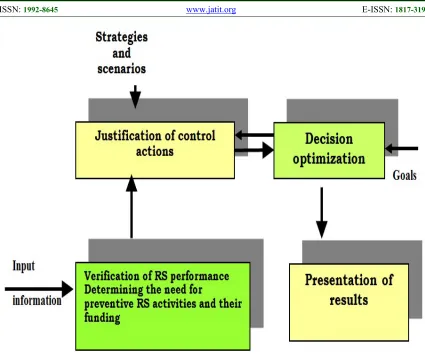
Another important reason for automation was to find management methods and techniques that could be relevant to the existing production processes and the organizational structure of land reclamation promoting the development of corporate culture in the land reclamation sector. Structure of the software package designed for technical operation planning of reclamative
1258
Figure 1.Structure Of The Software Package Designed For Executive Decision Making To Ensure Reliability Of
Reclamation Systems
IT monitoring software based on modern information and communication technologies provides the following:
- Modelling layouts of RS certificates; - Forming the database of standardized RS certificates and addenda, RS database management and submission of analytical reports;
- Automated processing of information related to the basic elements of RS and their components - reservoirs, waterworks, dams, intakes, canals, pipelines, pumping stations (approximately 40,000 elements). Addenda to RS certificates also contain information about the status of each MS component (wear and tear, the need for reconstruction, repair), facilities and their use;
- Import of information from RS certificates and addenda to the IMS database in order to provide technical operation activities;
- Update the certificate data in accordance with the planned changes in diagnostic indicators related to the technical state of RS.
The applied software providing justification of control actions aimed at the improvement of reclamative stock reliability provides the following: • automation of input, storage, processing and delivery of information, needed to assess the technical state of RS and their reliability, in a comfortable and user-friendly format;
• technical state assessment of RS facilities with regard to reliability and safety indices and implementation of measures in order to improve RS
performance (overhaul works, restoration,
reconstruction);
• classification, generalization and analysis of information on the required preventive measures with a view to increase efficiency of RS facilities.
2.2 Diagnostic parameters and key performance indicators
1259 verification of RS reliability and safety by using the following indicators:
- Gross deviations of actual water supply (water
removal) (
P
o) from its conditionally optimal valueо
opt
Р
Р
)
(
, %;- Actual irrigation water capacity factor (ήaiwcf)
compared to its conditionally optimal value
aiwcf
)
(
cov ,%.Criteria that determine implementation of preventive measures pursuant to the classification features include overhaul works, restoration, and reconstruction. These criteria represented by the numerical values of the above indicators are formed by DM according to expert estimates, and their own preferences based on social, ecological and economic requirements referring to the preservation and reproduction of nature resource potential of the agricultural landscape.
Optimization of scarce investment can be carried out at the federal level, when determining funding of technical operation measures by the federal state budgetary scientific institutions responsible for reclamation (FSBSI), and at the regional level through distribution of FSBSI facilities among specific reclamation systems. The distribution of investment between federal subjects could be performed proportionately with the specific criterion - "spending unit (federal subject) value j" - SUVj; numerical values of this
criterion depend on the values of its components (indicators).
Components of the “spending unit value”
include: reclaimed area (
S
j); book value ofreclamation systems in the region (BVj); technical
state of reclamation stock being in the federal
ownership (
T
J). Significance assessment of theindicators
a
ij is determined by the followingalgorithms:
1
1
/ J
j j j
j
a S S
;1 N
j n j
n
S S
(1)where
i
– index of each indicator; i1,...,I;I
-number of indicators defining priority of federal subjects provided public funding of maintenance
operational activities.
I
3
;j
– spending unitindex; j1,...,J ;
J
–number of spending units.1,...,
n N ;
N
- number of reclamation systemsin the region.
For irrigation systems,
1 0
1
* (1 / ) / J
j j j
j
a S S W S
, (at0
W ;V S0 /W 0), where
S
0 – area ofactually watered lands,
W
– annual intake.2 1 / J j j j j
B V B V
a
; 1 j n N n jB V B V
(2)3j
(1
j)
a
T
;T
j
O
j/
BV
j;1
N
j n j
n
O O
(3)where
O
j - net book value of the region's systems.The remaining indicators are derived from the preceding ones.
The “value” of the spending unit (SUVj) is
established by the following relationship (4):
( * )
I
ij ji i
j
SUV
b а (4)where
b
ij - “weight coefficient” indicatingimportance of indicators for
j
of the spendingunit.
The amount of funding planned for maintenance
operational activities of
j
spending unit (KSUj)equals to: 1 ( / ) * j i J j i К
K S U P V P V
; e q j j r КK S U (5)
where
K
- volume of public funding planned formaintenance operational activities of reclamative
stock;
К
reqj - volume of funding planned formaintenance operational activities required by
j
spending unit.
Optimization of decisions on the
1260 The first stage implies appropriation of funds to ensure the viability of reclamative facilities related to the "passive" ones, which do not depend on the intake volume. These include running repairs of drainage network and constructions, maintenance and repairs of civil and industrial buildings, flood control works, forest care and other expenses. The second stage implies appropriation of funds to ensure maintenance of the "active" reclamative facilities, which directly or indirectly depend on the intake volume: maintenance and repair of waterworks, gauging stations, protective dams and canals; pumping stations and wells, including electricity and fuel costs; cleaning of irrigation and drainage networks, preparation of emergency materials and other expenses.
The list of indicators that form the "value" (significance) criterion i of the system, setting its priority provided budgetary funding of maintenance operational activities related to passive facilities
(PVi) includes gross book value (CVi) and net book
value (
O
i) of the system. PVi is calculated by thefollowing equation (6):
1 2
1
* / * (1 / )
I
j j
i
i i i
i i
P V b C V C V b O C V
(6)
where
b
1j,b
2j - regional weight coefficients of the "value" criterion of the gross book value CVjand net book value (
O
i); i1,...,I - serialnumber of the system;
I
– number of systems inthe
j
region.The planned amount of funding related to the maintenance operational activities of passive facilities of the
i
system (KPi) is determined bythe relationship (7):
1
/ , *
( )
i i i
I
i
i
K P K P P V P V
e
i i
r q
K P
K P
;К
P
ireq
0.6
KCV
ireq (7)where KPireq =
КП
iтреб - funding of themaintenance operational activities required for passive facilities of the i system; Kireq - the need for
financing maintenance operational activities of the i
system in general.
According to the established practical operation of the country’s reclamative water utilization system, the proportion of funds allocated for the maintenance operational activities of passive
facilities (KP) is above 60% of the total funding
allocated for preventive works. Accordingly, 40% of funds are allocated for maintenance operational activities performed within the active reclamative
facilities (KA). Funds for preventive activities
within the active reclamative facilities of a specific
i
system in thej
region (КА
j) are allocatedproportionately with the “value” criterion VAi ,
which is calculated by the following formula (8):
1 4
1
* * ( ) / I req
j i j i i
i
i i
VA b S b CV O KА
(8)where
b
3j,b
4j - significance factors of thesystem area (
S
i) and wear of the key assets, (CVi -Oi); CVi – gross book value
i
of the region’ssystem
j
;O
i – net book valuei
of the region’ssystem
j
; KAireq – funding required for preventiveworks related to active facilities
i
of the region’ssystem
j
. i1,...,I- serial number of thesystem;
I
– number of systems in thej
region.Funding allocation required for maintenance
operational activities related to active facilities i of
the system (
КА
i) is determined by the followingformula (9):
1
( / I i) *
i i
i
V A V A
К А К А
r e q
i i
К А К А (9)
Total funding allocation planned for
maintenance operational activities
i
within thesystem (KCVi), which is equal to the sum of
funding allocations planned for maintenance
operational activities within the active (
КА
i) andpassive (KPi) facilities, should obey (10):
i
req
i i
К
P
КА
KCV
KCV
KP
КА
KCV
(10)1261
3. DISCUSSION
Development of software providing certification of reclamative systems for the first time gave the possibility to analyze and to assess the need of federal reclamative facilities for technical operation activities based on performance of specific systems. Analysis results (Table 2) indicate the urgent need for modernization, repair, reconstruction of the larger part of the existing irrigation and drainage systems and construction of new facilities pursuant
to current requirements. Depreciation of fixed assets related to reclamative water utilization systems (federal form of incorporation) of the entire Russian Federation generally makes 67.1%, increasing to 72.5% in the Southern Federal District, which comprises the essential part (over 50%) of the federal reclamation systems. Maximum wear degree (over 70%) refers to water intakes - 81.8%, pipelines - 78.0%, trough gutters - 80.5, pumping stations -74.4%.
Тable 2. Gross And Net Book Value, Wear Degree Of Reclamation Systems In The Federal Districts Of The Russian
Federation, %
Federal districts of the
Russian Federation Gross book value, RUB bn Net book value, RUB bn
Wear degree of reclamation systems,
%
Total 140 40 67.1
Central Federal
District 10 5 59.4
Northwestern Federal
District 5 2.5 60.2
Southern Federal
District 85 25 72.5
Volga Federal District 42 12.5 63.6
Ural Federal District 2 1 71.1
Siberian Federal
District 12.5 5 56.7
Far Eastern Federal
District 5 2.5 48.9
The average costs allocated for scheduled preventive measures within the network of inter-farm irrigation systems amount to 2624,2 thousand rubles and within the intrafarm network – 254,6 thousand rubles. The cost of preventive measures related to drainage systems makes approximately 198,538 thousand rubles, including overhaul works - 46,482 thousand rubles and reconstruction works - 152,056 thousand rubles.
According to the requests of subordinate entities of the Russian Federation, the amount of funding required for preventive measures within the reclamation systems (federal form of incorporation) reaches 23803.507 million rubles, i.e., exceeds the real amount by more than 9 times. One should remember that the requested amount of funding was determined with regard to the established practice of its allocation and subsequent spending. But even in this case the need for funding significantly exceeds the currently planned investments in preventive measures related to technical operation
of relevant facilities and the projected public funding in the short term.
Evaluation of funds allocated to perform the scheduled preventive measures related to irrigation systems of the federal form of incorporation (overhaul and reconstruction works), confirm the information regarding completely inadequate funding provided for these activities; this refers both to the inter-farm and, in particular, to the intrafarm network of irrigation systems.
1262 viability of reclamative facilities, in terms of their reliability, durability, maintainability, etc. In other words, the situation has almost reached the "point of no return" as regards the required properties. This situation is not widespread in the world practice; therefore it excessively increases the "managerial decision payoff" as regards restoration, modernization and development of the fixed assets of reclamative water utilization system in Russia. Current difficulties related to the distribution of the limited public funding predetermine relevance of using software developed to provide measures aimed at improving safety and reliability of reclamation systems, IT support required for taking effective managerial decisions.
The developed decision support system (DSS) is focused on the best possible use of knowledge, experience and intuition of decision-makers; it has a "user-friendly" interface and does not require high level of computer literacy. This system provides online the following:
• Collection, storage, processing, transformation and use of source and temporary information; • Certification and technical state monitoring of reclamative facilities;
• identification of the need to implement preventive measures and their general finance and resources provision for the entire reclamative water utilization system with regard to the selected classification criteria: modernization, restoration and reconstruction of reclamative facilities and separately located waterworks;
• Optimization of decisions related to the distribution of limited investment in the technical operation of reclamative facilities for the federal (FSBSI management) and regional (reclamation systems and separately located waterworks) technical operation levels;
• Formation and provision of the operational, strategic and archival documents;
Distinctive features of DSS include the following: • Use of quantitative assessments in the decision making process, assessment of personal decisions and their consequences by using mathematical methods;
• Creating the system of required and sufficient diagnostic indicators related to the technical state of
reclamative facilities, based on their accessibility, relevance and adaptability;
• Use of simulation modelling, which reflects substantive aspects of the decision-making process, as an alternative to the formalized optimization modeling;
• Development of new original criteria, optimization of decisions characterized by simplicity and availability of source data for the calculation of quantitative values and their possible use in proximate methods;
• Creating the database of open and reliable source information for DSS based on certificate data of reclamative facilities, which composition and structure were tested to analyze and to assess their technical state in the traditional way.
Table 3 shows optimized distribution of investments in the Federal state budgetary institutions (FSBI) of the Southern Federal District, which (keeping in mind conditionality in terms of choosing the volume of distributed funds), give an idea of the priority areas that require investments in the technical operation activities, which correspond to the knowledge of experts in the field of land reclamation.
The impact of information technology on the planned reduction of production growth period was confirmed [4]. Thus, provided fixed amount of investments, it was possible to double the quantity of renovated facilities being put into operation in comparison with the approach proposed by the Land Reclamation Department of the Ministry of Agriculture of Russia based on the traditional
"manual" technology. Information and
1263
Table 3. Investment In Technical Operation Activities (FSBI Of The Southern Federal District)
Sub-federal entities and companies of the
Southern Federal District Distribution of investment, RUB000's
Facilities Management Operation of hydro-technical utilities on Kuban and
Protoka Rivers 966048
Chechen Republic 116436
“Facilities Management of Terek-Kuma
Hydroelectric Complex” 196111
Facilities Management of Kuma Hydroelectric Complexes and Chogray
Reservoir
12835
Facilities Management of Big Stavropol
Canal 4882527
Ural Metal Hardware Company 692432
Stavropol Territory 138254
North Ossetia 28762
Rostov Region 4147489
Krasnodar Krai 102978
Karachay-Cherkessia 11998
Kalmykia 622681
Kabardino-Balkaria 14435
Ingushetia 695137
Dagestan 20849
Volgograd Region 9319
Astrakhan Region 21171
Adygeya 256472
Software testing in the Ministry of Agriculture of the Russian Federation showed that research findings were in compliance with the theory and
both global and domestic development,
implementation and use of DSS in terms of improving production management [5, 6].
Technical and economic indicators of the DSS pilot operation showed:
• improved efficiency of water use by reducing water intake volumes (through optimized administrative decisions) by 10 - 15%, that is from 1663.2 million cubic meters up to 2494.8 million cubic meters for the entire Southern Federal District and the North Caucasus Federal District;
• prevention of damage from potential accidents making approximately 28.68 RUB bn;
• increase in the management work automation level by 20%;
1264 developed IMS within the structure of the Ministry of Agriculture of Russia.
4. CONCLUSIONS
The author of this study considered the questions related to automated planning of technical operation of reclamative facilities at the organizational and economic management levels. The developed automated planning methodology is based on management theory, rules, procedures and techniques used to study complex decision support systems characterized by a system approach,
system studies and systems analysis. The paper provided analysis of the existing trends and assessment of IT prospects in practical management.
The author developed DSS at the federal and regional management levels, providing optimized allocation of limited investment in technical operation activities within reclamative facilities. The composition and structure of the original DSS database is focused on the best possible use of knowledge, experience and intuition of the decision-maker. It has a "user-friendly" interface and does not require high level of computer literacy.
Development of software providing certification of reclamative systems for the first time gave the possibility to analyze and to assess the need of federal reclamative facilities for technical operation activities based on performance of specific systems. Pilot use of DSS in the technical operation control of reclamative water utilization system of the North Caucasus Federal District provided the following technical and economic achievements: improved efficiency of water use by reducing water intake volumes (through optimized administrative decisions) by 10 - 15%; prevention of damage from potential accidents making approximately 28.68 RUB bn; increase in the management work automation level by 20% and workforce productivity increase by 30%.
Indicators showing economic efficiency of automation and optimization of managerial decisions aimed at the improvement of reclamative water utilization system determined during pilot DSS operation, as well as its ergonomic feasibility, gave the possibility to recommend using the developed IMS within the structure of the Ministry of Agriculture of Russia [20]. Thus, modernization of land reclamation systems in terms of information support will lead to economic growth and reduction of loss; safety level of these facilities will increase as well. Verification and timely response to problems associated with water resources will improve the country’s environmental performance.
It is obvious that further practical application of DSS and the growth of confidence to innovations in the field of management will require subsequent steps to ensure compliance of IMS related to land reclamation with the IT-based management requirements set by the leaders of the domestic economy and compatibility with global IT processes., In particular, these steps might include further development of software based on "cloud" technologies.
REFRENCES:
[1] M. M. Alam, and C. Wagner, “The Relative Importance of Monetary and Non-Monetary Drivers for Information and Communication
Technology Acceptance in Rural
Agribusiness”, Information Technology for Development, Vol. 22, No. 4, 2016, pp. 654-671.
[2] Y. V. Matveev, E. N. Valieva, O. V. Trubetskaya, and A. G. Kislov, “Globalization and Regionalization: Institution Aspect”, IEJME-Mathematics Education, Vol. 11, No. 8, 2016, pp. 3114-3126.
[3] Z. S. Kydyrova, K. B. Satymbekova, G. E. Kerimbek, Z. O. Imanbayeva, S. S. Saparbayeva, A. A. Nurgalieva, A. A. Ilyas, S. K. Zhalbinova, K. S. Jrauova, and and A. T. Kanafina, “Entrepreneurship Development and Business Climate of Kazakhstan”, International Journal of Environmental and Scence Education, Vol. 11, No. 14, 2016, pp. 6381-6393.
[4] “On information, information technologies and information protection. Federal Law of the Russian Federation dated 27 July 2006. [5] B. Bilbao, S. Dutta, and B. Lanvin, “The
Global Information Technology Report 2013: Growth and Jobs in a Hyperconnected World”. World Economic Forum, Geneva, 2013. [6] I. V. Olgarenko, and I. V. Selyukov, “Software
1265 [7] A. D. Sarayev, and O. A. Sherbina, “System
analysis and modern information
technologies”, Simferopol: SONAT, 2006. [8] G. Davis, “Management Information Systems:
Conceptual Foundations, Structure, and Development”,New York: McGraw-Hill, 1974. [9] D. J. Power, “Brief History of Decision
Support Systems”. Available at:
http://DSSResources.COM/history/dsshistory.( Accessed date: May 31, 2003)
[10] S. M. S. Morton, “Management Decision
Systems: Computer-based Support for
Decision Making”, Boston: Harvard
University, 1971.
[11] R. H. Bonczek, C. Holsapple, and A. B. Whinston, “Foundations of Decision Support Systems”, New York: Academic Press, 1981. [12] L. J. Williamson, “Candy Crush Saga’ Gives
Addicted Mobile-Game Players a Sugar Rush”. Available at: http://herocomplex.latimes.com. (Accessed date: May 25, 2013).
[13] R. H. Sprague, “A Framework for the Development of Decision Support Systems”, MIS Quarterly, Vol. 4, No. 4,1980, pp. 1-26. [14] P. G. W. Keen, and M. S. Scott Morton,
“Decision support systems : an organizational perspective”, New-York: Addison-Wesley Publishing Company, 1978.
[15] I. F. Yurchenko, “Management Information Systems of Reclamative Water Utilization System”, Journal of Agricaltural Science, No. 1, 2016, pp. 12–15.
[16] J. D. C. Little, “Models and Managers: The Concept of a Decision Calculus”, Management Science, Vol. 18, No. 8, 1970, pp. 1841–1853. [17] N. Bloom, L. Garicano, R. Sadun, and J. Van
Reenen, “The Distinct Effects of Information Technology and Communication Technology on Firm Organization”, Managemetn Science, Vol. 60, No. 12, 2014, pp. 2859–2885.
[18] B. Aubert, S. Rivard, and M. Party, “A
framework for information technology
outsourcing risk management”, ACM SIGMIS Database, Vol. 36, No. 4, 2015, pp. 9-28. [19] R. J. Thierauf, “Decision support systems for
effective planning and control : a case study approach”, New Jersey: Prentice-Hall, 1982. [20] B. V. Chernikov, “Management Information
Technologies”, Мoscow: Forum, 2013. [21] A. M. Galumyan, “Integrated information
systems: analysis and perspectives of their implementation in the enterprise management
process”, Economics and Management
Innovation and Technology, No. 5, 2014.
[22] I. F. Yurchenko, and V. V. Trunin, “Decision support system for water allocation based on Web technologies”, Scintific Research Journal of the Reclamation Problems, Vol. 14, No. 2, 2014, pp. 87–97.
[23] I. F. Yurchenko, “Perfect water use systems as a factor maintaining soil fertility and sustainability of agricultural production in the
irrigated agricultural landscapes”,