1357
EMOTIONAL LIGHTING SYSTEM ABLE TO EMOTION
REASONING USING FUZZY INFERENCE
1BO-RAM KIM, 2DONG KEUN KIM
1Department of Mobile Software, Graduate School, Sangmyung University, Seoul 03016, Korea
2Department of Intelligent Engineering Informatics for Human, College of Convergence Engineering,
Sangmyung University, Seoul 03016, Korea E-mail: 1[email protected], 2[email protected]
ABSTRACT
Recently, the development of emotional lighting technology has been attracting attention for its potential uses in various fields. This reflects the increasing awareness of and interest in the psychological and emotional states of people, and aligns with the increase in demanding for emotional-friendly products. In previous works focusing on emotional lighting, emotions were inferred by measuring the biometric signals of subjects using separate devices or genetic algorithms. However, these methods are unsuitable for mobile devices because of the complexity of both the measurement process and the inference of emotion. To solve this problem, a smart emotional lighting control system which infers emotions through fuzzy reasoning using heart rate and RR interval is proposed below. Experimental results yielded an average 90.67% accuracy in performance estimation for this fuzzy reasoning system. These results indicate that the proposed method has the potential to provide appropriate lighting through reasoning drawing directly from users’ emotions, and is expected to be of future use in various fields.
Keywords: Emotional Lighting, Fuzzy Reasoning, Lighting Control, Emotional Reasoning, Smart watch
1. INTRODUCTION
Recently, emotional lighting technologies have been attracting attention in accordance with the increasing demand for emotional-friendly products capable of reflecting the psychological and emotional states of users. Current emotional lighting technology, which infers emotions by processing a user’s information and deducing their current emotional state, has been developing towards applications in various fields.
The term “emotional lighting” is defined as a product that has the purpose of inducing emotional state of the user [1]. Also, the emotional lighting means a lighting product and a system having set values to change the color temperature and the illuminance so that the emotion of the user is induced according to the environment or the state of the user. Unfortunately, due to the complexity of the measurement process and the requirement for separate devices used for measuring the relevant bio-signals, these methods are not suitable for wearable or mobile devices.
In previous emotional lighting systems, system give uniform lighting. System do not give lighting
for personalized to the user [2]. In addition, the system does not control the lighting according to the user, but the system directly controls the lighting when the user desires. In conclusion, these methods are not optimized for the user's emotions and therefore do not directly affect the user's emotions.
In the case of existing emotional lighting systems, various measurement methods and various reasoning engines were used to infer emotion. There are research results that infer emotions using emotional language without using bio-signals [3]. In order to measure the bio-signals, the bio-signals were measured using a portable device and a dongle module [4] [5]. Sensitivity is inferred using genetic algorithm and fuzzy reasoning [6] [7].
1358 emotion is proposed. More specifically, this proposed method measures the HR (Heart Rate) and RRI (RR Interval) among various physiological signals using a smart watch and data is analyzed through a fuzzy reasoning algorithm that can implement human reasoning ability. Here, the reason for analyzing HR and RRI is bio-signals are controlled by the autonomic nervous system, this biometric data can be utilized to determine the user’s natural emotional state for emotional reasoning [6]. In addition, fuzzy inference is used for emotion inference using measured data. Fuzzy reasoning refers to a multi-valued logic system in which each object is assigned a degree of belonging to the group of interest according to a membership function, departing from the traditional binary logic of belonging vs not belonging. Fuzzy inference is a computerized representation of ambiguous inferences that can make inferences close to human reasoning ability [8]. Through this way, HR and RRI can be easily acquired by users and realistic emotional reasoning is possible. In addition, it is possible to infer emotion in real time using fuzzy inference that can be used in mobile devices, and to control personalized emotional lighting instead of uniformized emotional lighting.
2. RELATED WORK
D. K. Kim et al. [6] have showed recognize emotions using human physiological signals. Since emotions are complex, it is difficult to express them clearly and quantitatively. Physiological signals based on autonomic nervous system activity are very descriptive and easy to measure. It is good to recognize emotions. It can be mapped to emotion based on physiological signals generated in the autonomic nervous system. This response is relatively simple and inexpensive to measure with minimal limitations on subject behavior.
B. J. Park et al. [7] have showed Genetic algorithm was used for emotion recognition. By using genetic algorithms, it is possible to improve recognition results and recognition accuracy. Measuring a physiological signal (SKT, ECG, PPG, EDA) and uses an algorithm to extract the characteristics. Conventional well-known machine learning algorithms have a recognition rate of less than 50%. Genetic algorithm shows 83% sensitivity recognition rate.
B. H. Park et al. [5] have showed a multimodal emotional inference engine available in smart devices. The emotion inference engine is implemented to receive the measured time, space,
vital sign, and environmental information from the sensing device to infer emotion and perform personalization. Users can get various emotional fusion services by installing dongle type multimodal emotion inference engine in smart device.
J. H. Kim et al. [3] have showed Emotion reasoning using emotional words. It can be deduced in numerical detail, not just positive or negative. We measured emotion sentences using emotional flow of one sentence as well as emotional words and phrases. Higher performance than inference using only existing emotion features.
E. J. Jo et al. [9] have showed smart emotional lighting control system based on the android platform. The system can use the illumination sensor to select automatic control and manual control selection. It can be decreased the power consumption and efficient lighting control was possible. emotional lighting will be suitable conditions to control the illumination.
F. J. Chang et al. [10] have showed prediction of the water level. It used the adaptive network-based fuzzy inference system(ANFIS). It developed two ANFIS model: one with human decision as input, another without. From the results, ANFIS can be applied successfully and provide high accuracy and reliability.
3. PROPOSED SYSTEM
[image:2.612.317.516.509.592.2]The proposed system consist of a smart watch, controller, and lighting, as shown in Figure 1.
Figure 1: Diagram of the proposed system
3.1 Smartwatch
In this paper, Smart Watch used was the Samsung Gear S2 classic from SAMSUNG Korea, based on Tizen. Tizen Application is based on Web Application Platform, and development tool is Tizen IDE. The SDK version uses 2.3.0 Rev4.
1359 First, the user's signal data is measured. bio-signal data are measured with HR and RRI. With these two measurements, it is possible to obtain autonomic nervous system data that cannot be artificially controlled. Moreover, because these data sets are controlled by the autonomic nervous system, this biometric data can be utilized to determine the user’s natural emotional state for emotional reasoning [6].
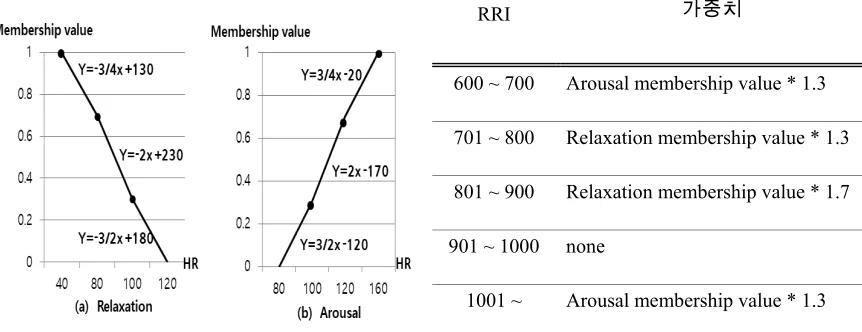
[image:3.612.317.541.251.398.2]Second, after measuring the HR and RRI, the user’s emotional state is inferred through fuzzy reasoning. Fuzzy reasoning refers to a multi-valued logic system in which each object is assigned a degree of belonging to the group of interest according to a membership function, departing from the traditional binary logic of belonging vs not belonging. More simply stated, human emotion that cannot be digitized can be represented qualitatively and quantitatively through this system [5]. To determine the emotional reasoning of human being, fuzzy reasoning was performed using the HR data. Furthermore, the membership functions of arousal and relaxation used in fuzzy inference are defined according to the average HR of users. the membership functions of arousal and relaxation are shown in Figure 2 (a) and (b), respectively. The x-axis represents the measured HR, estimated from the general user range. These measurements set the overall range between 40–160, the relaxation range between 40–120, and the arousal range between 80– 160. The y-axis represents the percent of belonging (membership value) each object has to the group, assigned as a value between 0 and 1. To accurately calculate emotion reasoning, stronger weighting was given to the belonging values in the overlapping 80–120 range as follows: in the range of 80–100, weight was given to relaxation, and in the 101–120 range, weight was given to arousal.
Figure 2: Relaxation, and arousal function
Using the measured HR and membership function, we can know the values of relaxation and arousal.
[image:3.612.92.523.542.708.2]We also use RRI with HR for accurate reasoning. Unlike HR, it is difficult to define membership values using the fuzzy function of RRI, RRI makes emotional reasoning using other methods. he results of RRI classification were used through Waikato Environment for Knowledge Analysis(WEKA) for more accurate emotional reasoning. The range of the RRI is set to 600 or more based on the data. Weights are assigned to arbitrary 100 units.
Figure 3: RRI classification
(gray-arousal black-relaxation)
The RRI weights are, respectively, as follows. 1. in the range of 600–700, 1.3 for arousal, 2. in the range of 701–800, 1.3 for relaxation, 3. in the range of 801–900, 1.7 for relaxation, 4. in case of more than 1001, 1.3 for arousal
Table 1: Weight based on RRI.
RRI 가중치
600 ~ 700 Arousal membership value * 1.3
701 ~ 800 Relaxation membership value * 1.3
801 ~ 900 Relaxation membership value * 1.7
901 ~ 1000 none
1360 The difference between the membership value of the arousal and the membership value of the relaxation calculated according to the HR and the RRI values can be calculated and finally the user's emotion value can be calculated.
Fuzzy theory can be used to classify arousal and relaxation. Neutral emotion does not exist in the emotion model, but neutral emotion is a big part in emotion that people feel in life [11]. Therefore, it is essential to consider neutral emotion in order to accurately grasp human emotional changes.
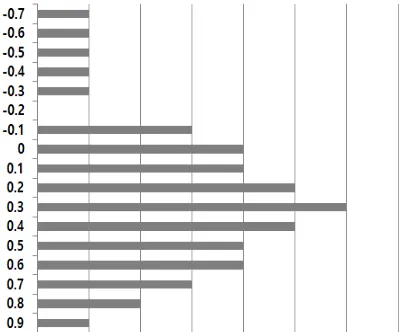
[image:4.612.93.296.343.509.2]In order to define the neutral emotion in the system, the neutral emotion standard is set by using separate data. Because neutral emotion accounts for a large part, we use HR and RRI data to calculate arousal and relaxation values using fuzzy theory, and define the range that can be set as neutral by checking the frequency of each value.
Figure 4: Emotion value frequency using fuzzy theory
Figure 4 shows the frequency of each value. The x-axis is the amount of data and the y-axis is the value of arousal and relaxation, calculated as fuzzy. Set the 0.2-0.5 area with the highest frequency to neutral. In addition, an area less than 0.2 in the other area is set as relaxation, and an area not less than 0.5 is set in arousal.
Finally, after emotion reasoning was performed from HR and RRI data, and emotional lighting is controlled using the results. Smart watch and controller that control lighting communicate via Bluetooth. Smart Watch to the controller using Bluetooth Adapter provided by Tizen can connect.
these values were converted into brightness and color temperature values to be transmitted to the controller. The brightness can be changed from 0 to 100, while the color temperature can be changed from 2700 to 6000 K. These values are transmitted to the controller via Bluetooth.
3.2 Controller
A lighting controller was fabricated to control the brightness and color temperature of the lighting. 24V SMPS to supply and control the current and set the communication speed of 9600 baudrate as a whole. Three MCUs are used to configure illumination, change color temperature, current brightness and color temperature output of lighting, and Bluetooth communication interface function with other devices.
The controller transmits and receives the value using the value of the communication register in the MCU through communication with the smart watch, and interprets the value using the specified protocol. The controller sends and receives the brightness and color temperature values of the light. converts the received values into DMX512 protocol signals, and transmits them to the lighting to control the lighting current. In addition, the current brightness and color temperature of the light can be converted into values, which can be confirmed by the user through the FND (Flexible Numeric Display).
The communication protocol for brightness and color temperature data exchange consists of four bytes as one frame as shown in the figure 5. The first byte of the four bytes stores the value for brightness. The value for brightness can be stored from 0 to 255. The second value is the header value for brightness and is fixed to 1. The third byte stores the value for the color temperature, and the color temperature is converted from 0 to 255 by using the conversion formula 2700 to 6000K and stored. The conversion formula is as follows.
The smart watch can be used to control the color temperature and brightness of a light, not emotional lighting. It is also possible to increase or decrease the value by using the wheel interface when controlling the lighting by taking advantage of the characteristics of the smart watch [12].
1361
Figure 5: The lighting equipment control protocol of the emotion light system
3.3 Lighting
As LED technology develops, LED lighting, which has low power, high efficiency and long life compared to conventional bulbs and fluorescent lamps, is utilized in various fields [13].
In this study, we also fabricated the lighting that can change the color temperature and brightness
using LED to provide high quality lighting to the users.
3.4 Lighting control system
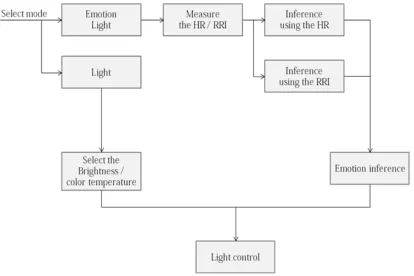
The proposed system in this study proceeds in the following order. figure 6 shows the flow chart for the system. First, select the mode in the system.
The modes are emotion light mode and simple light mode. The emotion light mode is a mode for providing appropriate brightness and color temperature by inferring the emotion of the user. The simple light mode is a mode for the user to select the desired brightness and color temperature. When the user selects the emotion light mode, the user's bio signal information HR and RRI are measured HR and RRI are used to make inferences, respectively. Finally, we combine the inferred results and conclude emotions according to the dimensional emotion model. Based on the two-dimensional emotion model, the brightness and color temperature suitable for the estimated emotion is transmitted to the light. When the user selects the simple light mode, the light is controlled when the user selects the brightness and the color temperature desired by the user.
1362
4. EXPERIMENT
4.1 Stimulus image
IAPS is an international emotional drawing system standardized by Professor Lang of the University of Florida Emotional Institute. The IAPS consists of 956 color photographs that you can encounter in everyday life. It has been repeatedly assessed over the past decade for Americans, and the evaluation results are presented in three dimensions: pleasant, arousal, and dominance. The evaluation of IAPS stimulation tried to consider various age, sex, etc., but did not consider cultural difference because it was experimented with only American people. Considering the difference between individualist culture and collectivist culture in the emotional response, the emotional response may be different even with the same stimulus [14].
4.2 Experimental process
The experimental environment consists of a monitor and a smart watch as shown in the figure 7.
[image:6.612.91.302.501.662.2]In the experiment, a total of 15 subjects (7 male and 8 female students) participating in the post-graduate course were tested. The subject wore a smart watch on his left wrist and gazed at the monitor plane. An image that induces arousal and relaxation on the monitor is output, and the bio-signal data is acquired in real time using the smart watch worn by the user, and the accuracy of the inference algorithm is estimated by inferring the sensibility derived using the fuzzy inference.
Figure 7: The experimental environment
International Affective Picture System (IAPS) images were used for emotional stimulation. Based on the evaluation report figures, a total of 200 images were selected: 100 arousal images with an
average of 6.5 or more and 100 relaxation images with an average of 3 or less. A random selection of the images used in the experiment is shown in Figure 8. In the experimental procedure, The reference data was measured for 20 seconds, and while measuring the reference data, an empty black screen was presented. After measuring the reference, we presented an image that induces arousal for 400 seconds. Again, the reference was measured for 20 seconds and the image inducing relaxation was presented for 400 seconds. The user's bio-signal were measured once every 4 seconds for 400 seconds to present the image. The experimental procedure is illustrated in Figure 9 below.
Figure8: The image from IAPS database
Figure 9: The experimental procedure
5. RESULTS
5.1 System UI
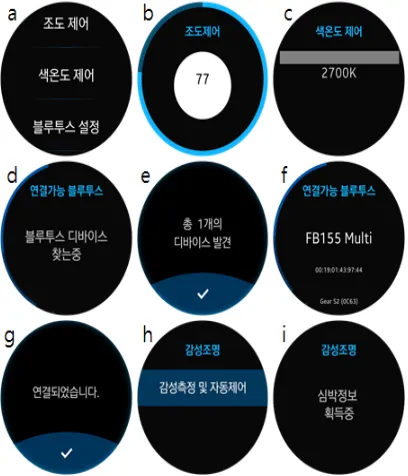
1363 (a) is the main menu of the system. You can use the menu to control brightness, control color temperature, and Bluetooth settings.
If you select the Brightness control in menu, it switches to screen (b). To control the brightness of light, the value is controlled using the wheel interface of smart watch. On each screen, turning the wheel interface to the left will decrease the value, turning it to the right will increase the value, will be sent to the lighting controller and the LED light will be controlled.
If you select color temperature of control menu, it switches to (b) screen and you can control the value using wheel interface in the same way. To control brightness and color temperature, set Bluetooth for lighting and Bluetooth connection. You can make a Bluetooth connection at (d). Then, it searches for devices that can be connected in order of (e), (f), and (g), and when the user selects a device, the device and the Bluetooth are opened.
[image:7.612.310.523.397.516.2]Emotional lighting menu is used to provide emotional lighting that induces user's emotions rather than basic lighting control. If emotion inference is selected (h) from the menu, the user's bio-signal is measured and the emotion is inferred from the (i) menu. It induces the emotion of the user by controlling the LED light appropriate to the inferred emotion.
Figure 10: A system UI
5.2 Accuracy of emotion inference
As a result of the experiment, 50 data items are extracted per subject. A total of 15 subjects were subjected to the experiment, and there were a total of 750 data for arousal and relaxation.
In order to confirm the accuracy of emotion inference, it is assumed that the state of the subject is arousal while the subject is induced to arousal and the state of the subject is relaxation while inducing relaxation.
[image:7.612.93.297.446.684.2]As a result of experiment, Table 2 shows the confusion matrix of the experimental data. 750 data were extracted per arousal and relaxation emotion. Infer the user's emotional arousal and relaxation in a while presenting stimuli to verify the performance of emotional reasoning. Of the total 750 arousal data, 703 data were inferred as arousal. When the relaxation stimulus was presented, 657 data of 750 relaxation data were deduced as relaxation. On the assumption that the subjects were well guided by arousal and relaxation, the fuzzy reasoning performance was 93.73% and the relaxation reasoning performance was 87.6%.
Table 2: The confusion matrix of the experimental data.
Real data
Arousal Relaxation
Prediction
data
Arousal 703 47
Relaxation 93 657
6. DISCUSSION
In the previous emotional lighting system research, emotion is inferred by various measurement methods and various reasoning engines in order to infer emotion.
1364 user's bio-signal but is difficult to use because it is difficult to use in everyday life.
In order to infer the emotion of the user, several types of inference engines were used. In previous systems, complex algorithms such as genetic algorithms were used [5]. In order to use such an algorithm, a device with high performance was required and it was difficult to deduce it quickly [17].
In this study, we propose emotional lighting control using smart watch to solve the disadvantages of previous research.
The smart watch can measure the bio-signals HR and RRI. Since these bio-signals are signals of the autonomic nervous system, the user can not arbitrarily control them. Therefore, it is possible to obtain the accurate data of the user and infer the accurate emotion. In addition, by using the smart watch, a user can measure a living body signal using a watch without needing a separate device or sensor to measure the living body signal.
Smart watch can do simple calculations, but complex calculations are difficult. We also designed the emotion inference algorithm using fuzzy inference. By using fuzzy inference, emotion inference can be processed in real time and emotion can be expressed numerically [18].
The smart emotional lighting system controls the smart emotional lighting by measuring the bio-signal and inferring the emotion in a relatively simple and quick way as compared with the existing research. Therefore, it is possible to control smart emotion lighting in real time. It is possible to infer the sensibility and control the smart emotion lighting by simply wearing the wearable device without intentionally controlling the emotion lighting by the user. Because it does not require a long time and high computing power to perform emotion inference by using fuzzy inference with wearable devices, it can provide emotion lighting appropriate for an individual rather than a predetermined emotion light value.
The disadvantage of this study is that the scope of users is limited to users who own wearable devices. In order to infer emotions, measuring bio-signals, inferring emotions, and controlling lighting with appropriate illumination and color temperature are all based on smart watch, so if you do not have a smart watch, It is difficult to use. In addition, it is a limitation that the user must refrain from moving for about 5 seconds to accurately measure the vital sign.
However, despite these limitations, by using a system using smart watch, it is possible to measure the autonomic nervous system bio-signals and infer the correct emotion using bio-signals and fuzzy reasoning.
7. CONCLUSION
The smart emotion lighting system proposed in this study uses sensory data using in bio-signal data. In this study, HR and RRI are used for bio-signal data used for emotion inference. The HR and RRI data are controlled by the autonomic nervous system, which allows the user to deduce the correct emotion because the user’s emotion was not manipulated, artificially. The user's HR is measured and applied to the set fuzzy membership function to infer the user's arousal and relaxation.
For more accurate emotion inference, RRI is analyzed to infer emotion using RRI, and weights emotion according to RRI value. The accuracy of inferred emotions is increased by using weights.
In general, the emotions of the users are arousal and relaxed, but the frequency of the neutral emotions is the highest, and the range of the neutral emotions is defined by deducing the emotions and examining frequency. We can infer emotions using bio-signal data, define arousal, neutral, and relaxation according to emotional values, and calculate the degree of emotional though it is the same arousal by using the values of arousal and relaxation.
Since fuzzy reasoning is used to infer emotions, smart watch can be used. Therefore, unlike previous research, emotion inference can be performed in real time and emotional light can be provided to the user.
In order to verify the performance of the emotional reasoning system using the fuzzy reasoning presented in this study, we show the image that induces the arousal and relaxation to the user and infer the emotion of the user by using the system with the fuzzy inference algorithm. As a result, 703 out of 750 emotional data were deduced as arousal and 657 out of 750 relaxation data were deduced as relaxation. As a result of analysis using confusion matrix using the result data, the performance of fuzzy inference was found to be accurate to 93.73%.
1365 with low arousal index were used because there was no index of relaxation. In addition, the accuracy was low due to the difficulty in inducing the relaxation sensation.
Since the system proposed in this study is a system using smart watch, it can be applied in various fields. It can apply different lighting to each space of home by applying to smart home field, and can apply lighting interior effect by applying to places such as hotels and restaurants. In addition, it can be applied to light therapy to help the user to treat sleep disorder or emotional depression.
Compared to other systems, you can control the lighting with a Bluetooth connection to a smart watch and lighting, which makes it easy to apply to a variety of applications. If further studies are conducted in the future, it is possible to infer sensibility of the user based on the two-dimensional emotion model by classifying the pleasantness and discomfort as well as arousal and relaxation by using user's additional information as well as HR and RRI.
In addition, if you develop a system based on a device that is more popular than smart watch, you can easily use it beyond the limits of devices. In the present study, it is focused on measuring the user's bio-signal and inferring emotion. In future research, it is possible to develop the emotional lighting by applying the brightness and color temperature, which can greatly affect the emotion of the users
ACKNOWLEDGMENTS
This work (Grants No.C0342667) was supported by Business for Academic-industrial Cooperative establishments funded Korea Small and Medium Business Administration in 2016.
REFRENCES:
[1] E. H. Lee, H. J. Suk, "The Emotional Response to Lighting Hue Focusing on Relaxation and Attention," J of Korean Society of Design Science , vol.25 no.2, pp. 27-39, 2012.
[2] H. S. Lee, "Development of a Lighting Control System based on Context-Awareness for Improving Student Learning," M.S. dissertation, Gongju University, Gongju, Chungcheong, 2013.
[3] J. H. Kim, J. H. In, S. H. Chae, "A Rating Inference of Movie Reviews Using Sentiment Patterns," The Korean Society For Emotion & Sensibility, vol.17 no.1, pp. 71-78,2014.
[4] Y. H. Jin, S. K. Oh, H. K. Kim, “Design of LED Sensitivity Lighting System Using Fuzzy Relation-based Inference,” Korea Institute of Intelligent System, Vol. 20, No. 2, pp. 141–144, 2010.
[5] B. H. Park, Y. C. Park, H. S. Hui, K. S. Choi , K. M. Jung, "The Development of Multimodal Emotion Recognition Engine for Smart Mobile Devices," Proceedings of Symposium of the Korean Institute of communications and Information Sciences, pp. 280-281, 2011. [6] D. K. Kim, S. M. Ahn, S. I. Park and M. C.
Whang, "Interactive emotional lighting system using physiological signals," IEEE Transactions on Consumer Electronics, vol. 59, no. 4, pp. 765-771, Nov. 2013.
[7] B. J. Park, E. H. Jang, S. H. Kim, C. Huh, J. H. Sohn, "Emotion Recognition and Feature Selection using Physiological Signals," Journal of the HCI Society of Korea, pp. 431-433, 2012. [8] H. J. Lee, S. Y. Cho, K. T. Kim, "Fuzzy Reasoning Considering the Causality of Fuzzy Rules," Journal of KIISE, vol.22 no.1, pp. 108-116, 1995
[9] E. J. Jo, C. H. Lin, "Smart motion Lighting Control System Based on Android Platform," The Journal of The Institute of Internet, Broadcasting and Communication, vol.14 no.3, pp. 147-153, 2014.
[10] F. J. Chang, Y. T. Chang, "Adaptive neuro-fuzzy inference system for prediction of water level in reservoir," Advances in water resources, vol.29 no.1, pp. 1-10, 2006.
[11] P. G. Im, M. C. Hwang, J. S. Lim, H. J. Kim, S. Y. Kim, “Individual Characteristics of Neutral Emotion in terms of EEG”
[12] B. R. Kim, D. K. Kim, "Smart Emotional lighting control method using a wheel interface of the smart watch," Journal of the Korea Institute of Information and Communication Engineering, Vol. 20, No. 8, pp. 1503-1510, 2016.
[13] H. N. Lee, D. K. Kim, “Development of real-time reactive emotion image contents player system to induce the user's emotion,” Journal of the Korea Institute of Information and Communication Enginering, vol.18 no.1, pp. 155-161, 2014.
1366 [15] Y.H. Jin, S. K. Oh, H. K. Kim, "Design of
Sensitivity Lighting System Based on Fuzzy Inference," INFORMATION AND CONTROL SYMPOSIUM, pp. 326-327, 2010.
[16] S.E. Kim, E.K. Kim, Y. G. Kim, "Cosmetic Recommendation System using Fuzzy Inference and Building Sentiment Dictionary," Journal of Korean Institute of Intelligent Systems, Vol. 27, No. 3, pp. 253~260, 2017.
[17] Karyotis, Charalampos, et al. "A fuzzy computational model of emotion for cloud based sentiment analysis," Information Sciences, 2017.