IMPLEMENTING AN EFFICIENT EXPERT SYSTEM FOR
SERVICES CENTER MANAGEMENT BY FUZZY LOGIC
CONTROLLER
1 MOHD KHANAPI ABD GHANI, 1,4 MAZIN ABED MOHAMMED, 2 MOHAMMED S. IBRAHIM,
3
SALAMA A. MOSTAFA, 2DHEYAA AHMED IBRAHIM
1
Biomedical Computing and Engineering Technologies (BIOCORE) Applied Research Group. Faculty of Information and Communication Technology, Universiti Teknikal Malaysia Melaka, Malaysia
2
Computer Science Department. College of Computer Science & Information Technology, University of Anbar, Iraq
3
Faculty of Computer Science and Information Technology, Universiti Tun Hussein Onn, Johor, Malaysia
4
Planning and Follow Up Department, University Headquarter, University of Anbar, Anbar, Iraq
E-mail: 1 [email protected], 1,4 [email protected],[email protected],
3
[email protected], 2 [email protected]
ABSTRACT
Expert System (ES) is considered to be the prominent reasoning practices which are commonly employed towards various application domains. Considering expert systems, human understanding regarding specific proficiency in accomplishing specific tasks could be signified as facts and rules towards their knowledge base, which finds and employs the data delivered by means of a manipulator. Reasoning procedure has been further employed towards the specified expertise by means of heuristic methods for formulating the elucidation. Mechanisms which employ knowledge based approaches are considered to be more candid when compared to other conservative approaches. Knowledge could be signified clearly towards knowledge base, thereby capable in alteration with comparative easiness, which commonly employs the concept of rules. Inference engines employ knowledge base subjects for solving specific problems based on user responses by means of interface (for instance, specify the situations needed for car assessment). This inference unit deeds with knowledge for applying this knowledge for specific problems. There are numerous approaches for control systems that are applied in all the major areas in industry. In all these approaches for controlling the systems, fuzzy has been deemed to be the best methodology, mainly because of its increased speed and cost-efficiency. For machine regulation, fuzzy logic is found to be vividly employed. This paper mainly focuses in designing the simulation model for fuzzy logic regulator in advising the supervisor of service center in maintaining definite delay in service towards acceptable limits to the customers by the usage of simulation package, the Fuzzy Logic Toolbox MATLAB Simulation tool.
Keywords: Expert Systems, Artificial Intelligence, Services Center Management, Fuzzy Logics,
Knowledge-Based Systems, Inference Engines.
1. INTRODUCTION
Expert Systems are one of the best methods which are typically employed in the assessment of application domains. Here, the expertise possessed by a human being in accomplishing specified tasks is enumerated as facts and rules at their knowledge bases [1], which commonly operates based on the data offered by users. In the specified knowledge, reasoning processes are carried out by means of heuristic methods in formulating solutions[2], [3]. ES could be defined as enumerated in [1] as: “An intelligent computer program that uses knowledge
and inference procedures to solve problems that are difficult enough to require significant human expertise for their solution” [4]. This contains two peculiar sections: knowledge bases and inference engines, also possessing one knowledge acquisition module and one explanation module as additional modules. Figure 1 explains the articulation and main components of a typical expert system.
the knowledge shall be signified obviously at knowledge bases, which is done in the form of rules.
Figure 1. Main Components Of ES [1].
Inference engines uses these contents in solving specific problems based on operator replies by means of interfaces (for instance, entering situations in car assessment). These inference modules deeds knowledge for applying them towards specified problems [1].
Problem explanation: One service center
accumulates replacement portions, thereby repairs the disastrous parts. One purchaser carries damaged parts, thereby purchases parts of identical types. Subsequently, the damaged parts on being repaired becomes spares, and are placed on shelves. On purchasing the needed parts that are located on the shelf, the customer leaves the premise. But, in conditions when there is non-availability of spares, the customer waits till the spares arrive. Here, the main goal of fuzzy logic is towards advising the managers of service centers in maintaining the actual delay to be within acceptable limits by customers.
For achieving the foremost objectives, this study
concentrates on some specific tasks. To
Understanding the overview and basic concepts about fuzzy logics. Fuzzy Logic Toolbox has some specified toolboxes that have to be understood clearly. There are no specified explanations, thereby this phase has to be well-versed in order to understand necessary processes. Constructing systems using Fuzzy Logic Toolbox encounter with the steps carried out in building or editing fuzzy systems by means of this toolbox. Constructing systems using Fuzzy Logic Controllers using Rule Viewer blocks by means of Simulink, thereby interconnects it with this toolbox. And the outcomes attained from simulation have to be evaluated.
The process of summing up numerous rules will result in better solution. The venture shall discuss and analyze the results attained for verifying the items signified below:
1. Execute these systems by means of
dissimilar amounts of rules for proving that precise results could be attained in totaling more amount of rules.
2. Numerous approaches and fuzzy
membership functions have to be encountered for finding finest technique which is employed for attaining the best needed results.
2. RESEARCH OBJECTIVES
This anticipated research work performs the policy based approach of fuzzy logic controller at service center in advising the supervisor towards defining decision strategies for keeping their customers gratified. The following points represent the objectives of the research:
• To integrate fuzzy logic and expert system in
service center management model.
• To implement the model via MATLAB
Simulation tool.
• To evaluate the performance of the
simulation.
3. RELATED WORKS
Roseline et al.[6], enumerated that there exist numerous practices existing in identifying diseases and evaluating their harshness, thereby approvals could be prepared on their basis, but the most frequently employed strategy is the knowledge of farmers and of agriculturists. Resultant ES created is of the mixture of the aforementioned issues together with the enumeration of technical developments. Therefore, novel type of diseases that attack the crops could be documented. This could also be expanded for incorporating several units such as combined pest administration, soil administration and fertilizer administration thereby creating it as a complete explanation earner, subsequently increases yielding. Gupta et al.[7], entailed an ES to categorize service providers for e-governance service centers. Based on the information to be gotten by several case studies that are attained from service centers, the classes are derived towards these providers on the basis of
demographic, knowledge and behavior
characteristics. These expert systems shall be assigning service providers towards categories that
are defined earlier and offers equivalent
relationship standards assumed for these systems by means of fuzzy logics. Prototype has been deliberated in this paper to identify the service providers on the basis of demographic, knowledge and behavior characteristics.
Shah et al.[8], enumerated a method to categorise the customer and customer service advisor (CSA) inside customer contact centre (CCC) atmosphere. Based on the information gathered by means of case-studies that are attained inside a CCC, two-step grouping examination inside SPSS has been employed in deriving classes for clients and consultants on the basis of demographic, knowledge, commercial worth and behaviour characteristics. This ES allocates fresh client or consultant towards the already defined classes and offers equivalent relationship standards. Authors have elucidated the stages that are needed towards the construction of this fuzzy ES. Prototype systems are created for identifying the category of clients and CSA on the basis of
demographic, knowledge and behaviour
characteristics. This approach has been
authenticated inside the case study by means of simulation results. Kozhakhmet et al.[9], claimed the unmapped expanses and brighter associations to implement ES towards inspecting, creating fuzzy-based information bases towards ES, incorporation of fuzzy quantities for developing endorsements in security inspection, etc. Hypothetical implications
in investigates are deliberated. This paper forms a part of entire systematic investigational methods and numerous problems to implement fuzzy logics towards data security inspecting and expansion of fuzzy ES, which is clear that these investigations are the best systematic and essential towards artificial intelligence domains.
Zarandi et al.[10], anticipated one fuzzy rule-based ES for evaluating the complete performance-degree of intelligent investment, by which the supervisors could comprehend enterprise-situation for each items of intelligent investment even though they do not encompass precisely the meaning of each items, also understands whether every items are significant for decision-making. Furthermore, by means of linguistic terms for objects assessment results in precise decision. The latest anticipated
method requested professionals about the
performance gradation and reputation gradation of every intelligent investment items. By such manners, the risk faced is that the specialists do not possess strong idea regarding all items, thereby their assessment results with inaccuracy. Therefore, employment of fuzzy ES could assist specialists in improving their decisions to be beneficial.
This work focuses on integrating fuzzy logic and expert system in service center management simulation. We intend to investigate different types of fuzzy rules and degrees of memberships. The aim is to improve the performance of the expert system in handling service center management.
4. ESSCMFL PROTOTYPE MODELING
A service center retains replacement portions and repairs the disastrous-ones. One client carries disastrous items and obtains spares of identical kind. Disastrous portions have been revamped, positioned on ledge, thereby becomes spare parts. The needed parts being obtainable from the shelf, the client buys it and returns from service center. Conversely, when spares are not available in the shelf, the client waits till the spare parts are ready. Fuzzy system here advises the supervisor in keeping actual delay in service within the limits the acceptable to customers.
4.1 Fuzzy Logic
from other conservative techniques because of its simplicity and rule based IF X AND Y THEN Z style for resolving control problems than by endeavoring towards mathematical systems. This strategy is empirical-based and trusting on operator-experience rather than practical indulgent of systems [13]. For instance, to deal with temperature control in terms such as "SP =500F", "T <1000F", or "210C <TEMP <220C", terms like "IF (process is too cool) AND (process is getting colder) THEN (add heat to the process)" or "IF (process is too hot) AND (process is heating rapidly) THEN (cool the process quickly)" were employed. Five principal graphical user interface (GUI) tools are employed for constructing, elimination and detecting fuzzy inference systems in their toolbox:
• Fuzzy Inference System-FIS Editor
• Membership Function
• Rule-Editor
• Rule-Viewer
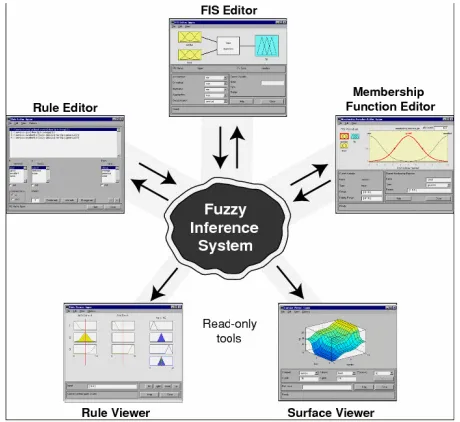
These GUI were vigorously associated, the variations made to one toolbox effects in variations in other GUIs. The toolbox also comprises of graphical ANFIS Editor GUI that could be employed in constructing and examining Sugeno-types adaptive neural fuzzy inference schemes as shown in figure 2.
Figure 2. An articulation of FIS Systems
4.4.1 FIS Editor
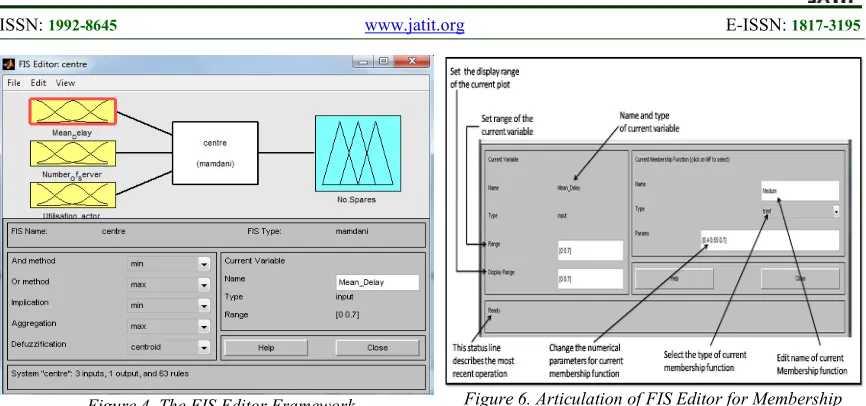
This editor maintains high-level problems in the systems. FIS editor shows the overall data regarding fuzzy inference system. The figure
illustrates the names of every input variables to be at left-side and outputs on right-side [14]. These subsequent steps reveal the processes involved in opening a FIS editor.
1. For starting the systems from scrape, fuzzy
has to be typed in the MATLAB prompt.
2. Pick Edit > Add Variable > Input (in case the
systems requiring three inputs).
3. Tick yellow box input1, which has been tinted
by means of red framework.
4. Manage Name section from input1 to
Mean_Delay, give Enter.
5. Tick yellow box input2, which has been tinted
by means of red framework.
6. Manage Name field from input2 to
Number_of_Server, give Enter.
7. Tick yellow box input3, which has been tinted
by means of red framework.
8. Manage Name field from input3 to
Utilisation_Factor, give Enter.
9. Tick blue box output1.
10.Manage Name field from output1 to
No.Spares, give Enter.
11.Pick File > Export > To workspace.section has
[image:4.612.72.302.447.658.2]to be in sentense case with no spacing above or blow the srat of it as shown in figure 3.
Figure 3. Pick File process
12. Give Workspace variable name center, tick
Figure 4. The FIS Editor Framework
4.1.2 Membership Function
The membership function editor parts few attributes towards FIS editor. It contracts the computer operator for displaying and editing all the membership functions related to every input variables and output variables towards the complete fuzzy inference scheme [15]. Steps in opening membership function editor has been entailed below.
• Inside FIS editor windows, pick Edit >
Membership functions.
• Inside FIS editor, double-click blue icon
referred as No.Spares.
• In command line, to be typed as mfedit.
[image:5.612.337.513.476.599.2]Articulation of the Membership Function Editor and Articulation of FIS Editor for Membership Function variableare shown in Figures 5,6.
Figure 5.Articulation of the Editor
Figure 6. Articulation of FIS Editor for Membership Function variable
This procedure of postulating input membership function for three input service center problem is enumerated by the subsequent steps [16].
1. Input variables and Mean_Delay are
selected by double clicking them. Range and Display Range are set to vector [0 0.7].
2. Remove All MFs has to be selected from
Edit menu, to eliminate every prevailing Membership Functions from Membership Function Editor.
3. Add MFs has to be selected from Edit
menu and the window gets opened as displayed below.
Figure 7.the Membership Function process
4. "trimf" MF Type and three Number of
MFs are chosen, thereby produces three trimf curves towards input variable Mean_Delay.
5. The curve is clicked once with the left
most hump. Alter the name of the curve as Very_Short. For adjusting the form of
membership function, tick on the
[image:5.612.93.307.502.681.2]parameter params listing will be appearing. The three inputs of params signify standard deviation, center and end for the trimf curve.
6. Subsequent to the editing of every values
and adjusting the membership functions, the system appears analogous to the figure displayed below.
Figure 8. The Membership Function
4.1.3 Rule Editor
To call for Rule Editor, click the Edit menu and Rules are selected, or rule edit is typed at the command line.
Figure 9. Schematic diagram of a Rule Editor
On the basis of descriptions of input variable and output variable enumerated within the FIS Editor, Rule Editor permits in constructing rule declarations routinely. From GUI:
• Rules are created by choosing an item in every
input variable and output variable box, single Connection item and ticking Add Rule. None can be chosen as one of the variable potentials for excluding that variable from a specified rule and select not under any variable name to contradict the related excellence.
• Clicking Delete Rule will result in deletion of
a rule.
• Clicking Change rule will result in editing of a
rule.
• Entering an anticipated number between 0 and
1 in Weight result in weight assessment of a rule. If weight is not needed to be specified, it is expected to be unity 1.
4.1.4 Rule Viewer
Rule Viewer displays the structure of the complete fuzzy inference procedure, which is based on fuzzy inference. Every rows are the rules and every columns are variables, and rule numbers were exhibited at left-side of every rows. For viewing rules at status lines, tick rule number [17]. To open Rule Viewer choose View menu and select Rules.
Figure 10. Articulation of Rule Viewer
5. RESULTS AND DISCUSSION
Service center model implemented by
and advantage from humble and ingenious thoughts. When the user fails in computing quantity of spares required, this application offers the user-advice on what should be done. The GUI executes as a communication instrument which interconnects users to the systems, thereby displaying the enquiries regarding delay and servers of Centre to be responded by users and displays equivalent outcomes.
[image:7.612.314.529.72.277.2]The Service Center was implemented 15 times with different inputs, and the system produced different output depending on the inputs that was entered by the user. Before introducing the computational results, we have introduced the interface of the system. The Service center interface provides faster access to the inputs and outputs plot, and also the general form of the system could be seen by clicking the "System" button. Also, the Rule Base of the system and Rule Viewer could be seen, relationships between the inputs and outputs could be tracked by clicking on their buttons.
Table 1. Results of implementing 15 offers
No Mean
delay
No. of Server
Utility Factor
No. of Spares
Linguist output
1. 0.600 0.400 0.500 0.548 Medium 2. 0.200 0.100 0.100 0.330 Small 3. 0.150 0.330 0.200 0.398 Very Small 4. 0.569 0.714 0.900 0.805 Large 5. 0.468 0.900 0.900 0.726 Rather Large 6. 0.173 0.400 0.994 0.343 Small 7. 0.600 0.260 0.340 0.489 Medium 8. 0.308 0.367 0.259 0.348 Small 9 0.650 0.700 0.840 0.820 Large 10 0.570 0.670 0.840 0.748 Rather Large 11 0.370 0.170 0.300 0.333 Small 12 0.358 0.753 0.367 0.492 Medium 13 0.670 0.670 0.801 0.752 Large 14 0.130 0.030 0.078 0.262 Very Small 15 0.150 0.660 0.480 0.426 Rather Small
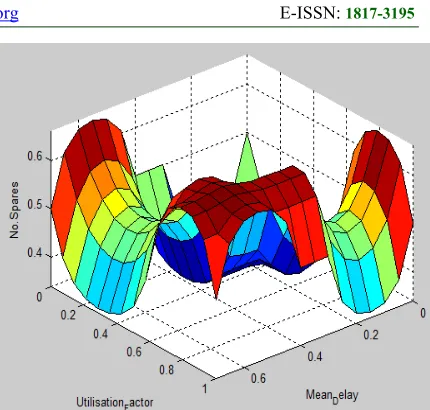
We introduce the relationships among inputs and outputs by using the surface viewer which is a tool provided by Matlab. This tool displays the relationships among inputs and outputs in 3-diminsional surfaces.
The relationships among Mean_Delay,
[image:7.612.312.523.311.491.2]Number_of_Server and Utilization_Factor with the Number of Spares output have been demonstrated in figures 11, 12, and 13 respectively.
[image:7.612.90.301.368.534.2]Figure 11. 3D association among Mean delay, Number of Server and Number of spares
Figure 12. 3D association among Mean delay, Utilization Factor and Number of spares
[image:7.612.313.525.534.700.2]The Service Center was implemented 15 times with different inputs, and the system produced different output depending on the inputs that was entered by the user. Before introducing the computational results, we have introduced the interface of the system. The Service center interface provides faster access to the inputs and outputs plot, and also the general form of the system could be seen by clicking the "System" button. Also, the Rule Base of the system and Rule Viewer could be seen, relationships between the inputs and outputs could be tracked by clicking on their buttons.
the possible application of the system is to give client or whatever other focus servicing system
more successfully than the current system. The
proposed system to help individuals and satisfy their prerequisites easily. This system comprised of components like giving client services information, set arrangements. The possible application of the system are restaurants, cafes, help desk services and customer center service.
6. CONCLUSION
In this paper, an efficient service centre expert system has been presented. This expert system has been tested using Matlab Toolbox. Fifteen runs have been achieved for different situations. From these runs, we could conclude that the system has shot its ability in resolving numerous service center issues. By this expert system, the manger will be able to select appropriate choice in fastest time, in this case the system will provide the following characteristics for the manager of service center such as Load balance: using this system there will be balancing in load and this will improve the performance of service center, Time management: there will be no wastage in time, the problems will be solved in reasonable time, Customer: the customer will be satisfied as the service will be
presented in an appropriate manner, and
Experience: the system can be updated to cover new changes in experiences with every new environments.
ACKNOWLEDGEMENTS
This research has been funded and supported by fellowship scheme (UTeM Zamalah scheme) by Universiti Teknikal Malaysia, Melaka, Malaysia.
REFRENCES
[1] M. A. Mohammed, "Design and Implementing an Efficient Expert Assistance System for car
evaluation via fuzzy logic controller,"
International Journal of Computer Science and Software Engineering (IJCSSE), vol. 4, pp. 60-8, 2015.
[2] S. A. Mostafa, M. S. Ahmad, M. A. Mohammed, and O. I. Obaid, "Implementing an expert diagnostic assistance system for car
failure and malfunction," IJCSI International
Journal of Computer Science Issues, vol. 9, pp. 1694-0814, 2012.
[3] O. A. Mahdi, M. A. Mohammed, and A. J. Mohamed, "Implementing a novel approach an convert audio compression to text coding
via hybrid technique," International Journal
of Computer Science Issues, vol. 9, pp. 53-59, 2012.
[4] S. S. A. Naser and A. Z. A. Ola, "An Expert System For Diagnosing Eye Diseases Using
Clips," Journal of Theoretical & Applied
Information Technology, vol. 4, 2008.
[5] A. Aggarwal and G. S. M. Thakur, "Design and Implementation of Fuzzy Rule Based Expert System for Employees Performance
Appraisal in IT Organizations," International
Journal of Intelligent Systems and
Applications, vol. 6, p. 77, 2014.
[6] P. Roseline, C. J. Tauro, and N. Ganesan, "Design and development of fuzzy expert system for integrated disease management in
finger millets," International Journal of
Computer Applications, vol. 56, 2012.
[7] M. Gupta and J. Mago, "Fuzzy Expert System to Evaluate the Quality of Service Provider in
the Implementation of E-Government,"
International Journal of Computer
Applications, vol. 67, 2013.
[8] S. Shah, R. Roy, and A. Tiwari,
"Development of Fuzzy Expert System for Customer and Service Advisor Categorisation within Contact Centre Environment," in
Applications of Soft Computing, ed: Springer, 2006, pp. 197-206.
[9] K. Kozhakhmet, G. Bortsova, A. Inoue, and L. Atymtayeva, "Expert System for Security
Audit Using Fuzzy Logic," in MAICS, 2012,
pp. 146-151.
[10] M. H. F. Zarandi, N. Mohammadhasan, and S. Bastani, "A fuzzy rule-based expert system for
evaluating intellectual capital," Advances in
[11] G. Klir and B. Yuan, Fuzzy sets and fuzzy logic vol. 4: Prentice hall New Jersey, 1995.
[12] J. M. Mendel, Uncertain rule-based fuzzy
logic systems: introduction and new
directions: Prentice Hall PTR Upper Saddle River, 2001.
[13] J. Yen and R. Langari, Fuzzy logic:
intelligence, control, and information: Prentice-Hall, Inc., 1998.
[14] Obaid, O.I., Ahmad, M., Mostafa, S.A. and
Mohammed, M.A., 2012. Comparing
performance of genetic algorithm with varying crossover in solving examination timetabling problem. J. Emerg. Trends Comput. Inf. Sci, 3(10), pp.1427-1434.
[15] Mohammed, M.A., Al-Khateeb, B. and Ibrahim, D.A., 2016. Case based Reasoning Shell Frameworkas Decision Support Tool. Indian Journal of Science and Technology, 9(42).
[16] M.A. Mohammed, et al., Artificial neural networks for automatic segmentation and identification of nasopharyngeal carcinoma, J.
Comput. Sci. (2017),
http://dx.doi.org/10.1016/j.jocs.2017.03.026.
[17] M.A. Mohammed, et al., Automatic
![Figure 1. Main Components Of ES [1].](https://thumb-us.123doks.com/thumbv2/123dok_us/8906627.957137/2.612.94.298.142.270/figure-main-components-of-es.webp)