A PROPOSED MODEL OF E-COMMERCE USING MODERN
SOCIAL MEDIA AND ITS IMPACT ON CUSTOMER
LOYALTY
1MOHAMMAD SHKOUKANI, 2 OMAR BADRAN, 3RAWAN ABU LAIL,
1
Associate Prof., Department of Computer Information Systems, Applied Science Private University,
Amman, Jordan 2
M.Sc., Business Development Manager at Hudhud Information technology, Amman, Jordan
3
Associate Prof., Department of Computer Science, Philadelphia University, Jordan
E-mail: [email protected], 2 [email protected], [email protected]
ABSTRACT
This study aims to find the impact of social media e-commerce on customer loyalty and discover the impact of each characteristic (measure) of the user experience on customer loyalty. These are Usability, Trustability, Relevancy, and Reputation. It also aims to find the difference in customer loyalty when demographic factors change in aspects of gender, age, and education. On the basis of the theoretical framework, hypotheses were proposed to describe the relationship between the independent variables (Usability, Trustability, Relevancy, Reputation), and the dependent variable loyalty, i.e. the demographic factors (gender, age and education). Data was collected from 990 university students and employees of all levels and ages, through a questionnaire instrument. The hypotheses were tested with hierarchal linear and simple regression analyses, which confirmed that the study hypotheses have positive relationships. Finally there is a significant impact of modern social media e-commerce on customer loyalty.
Keywords: Social media, E-commerce, Customer loyalty.
1. INTRODUCTION
Organizations are social essentials of stand-alone individuals that are designed and monitored to meet a necessity or to keep up with mutual goals for reaching competitive advantage and persuading organizational value [1]. At the moment, e-commerce will set the stanchion on forceful competence, which will influence the effect of organizations and their decision making of dynamic capabilities.
All organizations, in this day and time have an
e- commercial arrangement that defines
the relationships between different media to
its events and supporters, also sections
and gives roles, duties, along with authority to
handle different tasks. Establishments oblige the support between employees and customers for the success of their goals and objectives. For that reason, the study of customer loyalty is important in organizational, along with, in scholastic outlook.
Customer satisfaction is a significant proficiency guide for reviewing organization as loyalty has a significant impact on user’s behavior and attitude indirectly leading to Customers loyalty [2].
As a result, users are susceptible to greater or lesser customer loyalty; so individuals with a positive attitude on life, or who are beneficial, will have higher customer loyalty regardless of the product or brand they are in. So it depends on both internal and external circumstances, which are effected intensely to the environment in both the organization and users they are located.
This research paper examines factors that affect e-commerce using modern social media. The awareness of e-commerce using modern social
media has offered many challenges and
collaborative components affect consumer behavior
and satisfaction. The influences of this paper are unfolding. First, a conceptual model of the factors
influencing virtual consumer motivation is
presented (Satisfaction). This model draws on significant impact of social media e-commerce on customer loyalty. The model adapts concepts from Usability, Trustability, Relevancy, Reputation, and references components of use of satisfaction in enterprise. Second, this paper presents a mechanism that has been validated and field tests.
2. PROBLEM STATEMENT
In this era of international competition and quick trade development, businesses have the most challenging demand to deliver its services and products to get on top and gratefully stay there as long as they can. E-commerce is a critical factor of a presentation of the product and is accountable for a secure strategic advantage for industries; especially for new startups who launch new products that are similar to those of the competitors in the same market. Therefore, e-commerce using modern social media is a primary capability upon today’s businesses, in conjunction with the globalization of the markets, especially in Jordan that made one of the main developing resources for the national market worldwide. The following questions can help explaining the problems identified in this study:
1) What is the impact of social media e-commerce
on customer loyalty? This question can be subdivided into the following questions:
• What is the impact of Usability of social media
e-commerce on customer loyalty?
• What is the impact of Trustability of social
media e-commerce on customer loyalty?
• What is the impact of Relevancy of social
media e-commerce on customer loyalty?
• What is the impact of Reputation of social
media e-commerce on customer loyalty?
2) Are there any changes in the impact of social
media e-commerce on customer loyalty due to the demographic factors of gender, age and education? This question entails the following questions:
• Are there any changes in the impact of social
media e-commerce on customer loyalty due to gender?
• Are there any changes in the impact of social
media e-commerce on customer loyalty due to age?
• Are there any changes in the impact of social
media e-commerce on customer loyalty due to education?
3. OBJECTIVES OF THE STUDY
This study aims to find the impact of social media e-commerce on customer loyalty, which stands for Usability, Trustability, Relevancy, Reputation and satisfaction. In addition, the study attempts to find
the variation in customer loyalty when
demographic factors of gender, age and education change. In specific, the study’s objectives can be outlined as follows:
• Identifying social media e-commerce different
variables (Usability, Trustability, Relevancy,
Reputation and satisfaction) for products and services.
• Investigating the product’s vision intact and the
social media e-commerce remains reliable in order to keep its significance in the market competition.
• Identifying people’s constantly changing
opinions and demands to maintain, and even take a lead in the market.
• Preventing mistakes that new startups make early
in their existence, and their judgements to achieve and cover their chances.
4. RESEARCH HYPOTHESES
To answer the research questions, the following hypotheses were developed for testing:
Ho1: There is no statistical significant impact of
social media e-commerce (Usability, Trustability, Relevancy, Reputation and satisfaction) together on customer loyalty. This hypothesis can be further divided into:
Ho1-1: There is no statistical significant impact of Usability of social media e-commerce on customer loyalty.
Ho1-2: There is no statistical significant impact of Trustability of social media e-commerce on customer loyalty.
Ho1-3: There is no statistical significant impact of Relevancy of social media e-commerce on customer loyalty.
H1-4: There is no statistical significant impact of Reputation of social media e-commerce on customer loyalty.
H02: There are no statistical changes in the impact
due to the demographic factors (gender, age and
education).
Ho2-1: There are no statistical changes in the impact of social media e-commerce on customer loyalty due to gender.
Ho2-2: There are no statistical changes in the impact of social media e-commerce on customer loyalty due to age.
Ho2-3: There are no statistical changes in the impact of social media e-commerce on customer loyalty due to education.
5. SUGGESTED MODEL
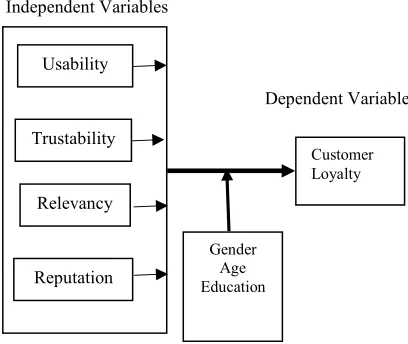
Based on the points of view about the subject and some previous studies [3], [4], [5], the researchers developed the following suggested model as shown in figure 1. The proposed model shows the independent variables which are usability, Trustability, Relevancy, and Reputation. It also presents the demographic factors which are gender, age and education as a moderate variable. Finally it shows the dependent variable which is customer loyalty.
Independent Variables
[image:3.612.94.298.384.556.2]Dependent Variable
Figure 1: Research Model
6. LITERATURE REVIEW
Regardless of the developing responsiveness of the term e-commerce, it has been very challenging to agree on a common and fixed definition, due to the nature and scope of e-commerce’s changing media and means that sets newer and innovative boundaries of ways to
communicate and therefore transact. The
expression “e-commerce” was brought to light by Michael Aldrich, an English entrepreneur that was credited with developing the predecessor to
online shopping in the mid-1970s. In the late 70s Aldrich connected a television set to a transaction processing computer with a telephone line and created what he coined, “teleshopping,” meaning shopping at a distance [6].
6.1 E-Commerce
By recent definition, e-commerce (electronic commerce or EC) is the buying and selling of goods and services, or the transmitting and transferring of funds or data, over an electronic network, primarily the internet [7]. These business transactions can be classified as business, business-to-consumer, consumer or consumer-to-business [7]. It is also divided into two parts, which are: Pure e-commerce or partial e-commerce depending on three factors; product or service, process, and delivery agent. If all of the factors are digital then the e-commerce is called pure, otherwise it will be called partial e-commerce [8].
There are many benefits of e-commerce some them: global reach, decrease cost, decrease time, ubiquity, instant delivery of digitized products, new business models, and customization. On the other hand there are some limitations of e-commerce which it can be divided into: technical limitations such as security, limited bandwidth especially for mobile commerce, and reliability. And non-technical limitation such as: lack of face to face interaction, possibility of fraud, and some people do not trust unknown sellers [7, 8].
E-commerce marketing can be divided into two over-all actions: driving website traffic and optimizing the user experience for conversion. Both are critical components for developing an online business, where the failure in one will seal the deal to weaken or even terminate any success in the other [9]. This takes the researchers to the second component of the study that resolves around the technique of social media as a method of e-commerce marketing.
6.2 Social Media
The internet has become a huge platform for exchanging commodities, and despite the fact many companies both large and small have adjusted objectively well to the need for more competitive online marketing, there are still challenges in the area of social media [10]. Starting from the top
social media which are
computer-mediated technologies that allow individuals,
companies, or even governments, and other organizations to view, create and share information, ideas, career interests, and other forms of expression via virtual communities and networks Customer
Loyalty
Gender Age Education Usability
Trustability
[11]. Through those different organizations
e-commencers have found a way to reach out to them in order to market their different products according to each party’s preference, which has recently emerged to a unique marketing method of its own in a form of internet marketing that utilizes social networking websites as a marketing tool [12]. The goal of social media marketing is to develop content that users will share with their social network to help a company increase brand exposure and stretch customer reach [13].
Nowadays, social media expenses makes up a small portion of most business’ marketing
budgets. Where a recent survey from Duke
University revealed that, on average, social media costs accounted for fairly 9% of the overall budget. On the other hand that figure is expected to multiply to nearly 22% in the coming five years [14]. However, research shows that social media does not have a firm record of directly creating sales. But again, social media is building another place; through the word of mouth, for the public to interact about the commencer’s brand or products [15, 16]. This is where customer trust first sees the light and plays an important factor when customers are deciding whether or not to buy a product.
A study showed that 90% of people are influenced by positive customer reviews of a product [17]. This indicates that customers trust the familiarity and recommendations of others, even those who they don’t know, more than they trust advertisements. This component is the core factor that the researchers have yet to scratch the surface.
6.3 Customer Loyalty
Definitions flop to recognize that loyalty goes side-by-side with emotions and human behavior. Customer loyalty is the result of steadily positive emotional experience, physical attribute-based satisfaction and perceived value of an experience, which includes the product or services [18]. However it is a misconception to assume that a customer is loyal only because the customer continues to purchase. There is more to why customers repeat purchasing which have little to do with being actually loyal [19].
Thus, loyalty can be defined as a customer continuing to believe that your organization’s product/service offer is their best option. That best fulfills their value proposition whatever that may be. Taking that offer whenever confronted with that purchasing decision [20]. In other words, the physiological state of attraction is developed through pointing out the customer’s values or at
least engineering the allusion of it; by trending and promoting of course. Then once the customer recognizes the product as valuable; for whatever reason, the intellect triggers the reward system in the brain, which then makes it a must and having it or not plays in the feeling of temporary fulfillment, pleasure and therefore satisfaction.
The customer loyalty is both an attitudinal and behavioral inclination to prefer one brand over all others, whether as a result of satisfaction with the product or service, its convenience or performance, or simply familiarity and comfort with the brand [21]. Nevertheless, what the customer needs and what the customer wants are two diverse sides of the equation, where usually “needs” are what drives a customer to buy the product at first, but “wants” is what makes the customer keep on purchasing that particular product and not shift to an equivalent alternative [2].
7. STUDY POPULATION
The researchers have distributed 1300
questionnaires randomly to Jordanian university students (BA, M.Sc., and PhD) and employees of all levels and ages. The valid responses that the researchers received were 990 responses.
8. VALIDITY AND RELIABILITY OF THE
INSTRUMENT
8.1 Validity of the Instrument
The aim of this test is to make sure that the phrases contained in the study tool can lead to collect data accurately, and to achieve this, the researchers disseminated the research questionnaire to the number of specialized experts and academics in the field in order to judge the whole questionnaire to void the indistinctness in the style of questions, extreme difficulty in the language that was used, suitable response types for some questions. To ensure that the questionnaire was well designed, it was written in both English and Arabic and was reviewed and validated by multiple scholars.
8.2 Reliability of the Instrument
values should be greater than 0.6 to be accepted as
reliable values [22].
Table 1: Reliability Statistics of the study
Variable Cronbach's Alpha No. of Items
Usability
0.867 6
Trustability
0.876 5
Relevancy
0.917 4
Reputation
0.870 4
It can be seen from Table 1 that all the values are high and greater than (0.60), which is statistically significant. The consistency rate was, acceptable and can be considered to be reliable to achieve the research undertakings.
9. DATA ANALYSIS AND RESULTS
9.1 Population Description
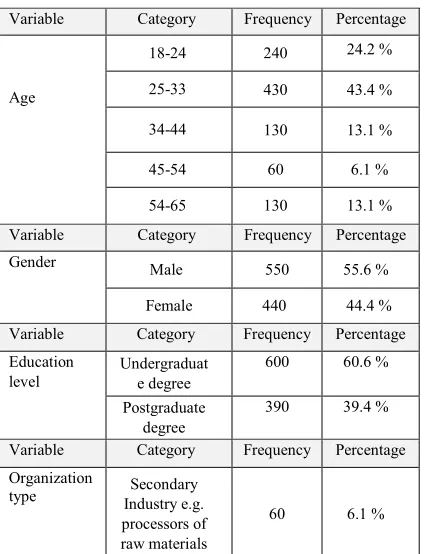
[image:5.612.91.305.446.723.2]Table 2 summarize the results of descriptive analysis according to the respondents’ age, gender, education level, organization type, number of years using social media, Type of Social Media used by Organization, Type of Social Media Preferred by Users, and How useful do you think that social media has been for your organization.
Table 2: population description
Variable Category Frequency Percentage
Age
18-24 240 24.2 %
25-33 430 43.4 %
34-44 130 13.1 %
45-54 60 6.1 %
54-65 130 13.1 %
Variable Category Frequency Percentage
Gender Male 550 55.6 %
Female 440 44.4 %
Variable Category Frequency Percentage
Education level
Undergraduat e degree
600 60.6 %
Postgraduate degree
390 39.4 %
Variable Category Frequency Percentage
Organization
type Industry e.g. Secondary
processors of raw materials
60 6.1 %
Services 930 93.9 %
Variable Category Frequency Percentage
Number of years using social media
Less than 6
months 60 6.1 %
6 months - 2
years 80 8.1 %
More than 2
years 850 85.9 %
Variable Category Frequency Percentage
Type of Social Media used by organization
Facebook 490 49.5 %
Facebook,
LinkedIn 60 6.1 %
Facebook,
Twitter 60 6.1 % Facebook,
Twitter, LinkedIn, YouTube
80 8.1 %
Facebook, Twitter, YouTube
150 15.2 %
Facebook,
YouTube 130 13.1 %
LinkedIn 20 2.0 %
Variable Category Frequency Percentage
Type of Social Media Preferred by Users
Facebook 420 42.4 %
Facebook,
LinkedIn 130 13.1 %
Facebook, LinkedIn, YouTube
170 17.2 %
Facebook,
Twitter 60 6.1 %
Facebook,
YouTube 210 21.2 %
Variable Category Frequency Percentage How useful do
you think that social media has been for your organization
Kind of useful 480 48.5 %
Not very useful 110 11.1 %
Very useful 400 40.4 %
with the older groups that are frequently used to
commerce online. Also, younger groups were more knowledgeable with latest technologies standards as shown in table 2.
Table 2 also shows that 55.6 % of the
respondents were males and 44.4 % were females.
Despite the fact that the survey was equally passed out among both genders, males were more cooperative and accurate in their answers and contribution.
9.2 Central tendency measures
The researchers used mean and standard deviation in order to describe attitudes to the questionnaire questions.
Table 3 shows the mean ratings of Social media e-commerce Usability with values greater than 3 for all questions on the five-point scale.
Table 3: Social media e-commerce Usability results
No. Social media
e-commerce Usability
Mean Std.
Deviation 1 I feel that it’s easy to
receive and advertise with my preferred Social media.
4.19 .687
2 I feel that it’s efficient to get things done with my preferred Social media.
4.07 .648
3 Reaching the wanted audience with my preferred Social media.
3.61 .720
4 My preferred Social media uses similar terms when advertising.
3.89 .780
5 It is easy to learn to advertise with my preferred Social media.
4.17 .727
6 My preferred Social media is considers for all levels of users when advertising.
[image:6.612.311.528.111.421.2].394 .657
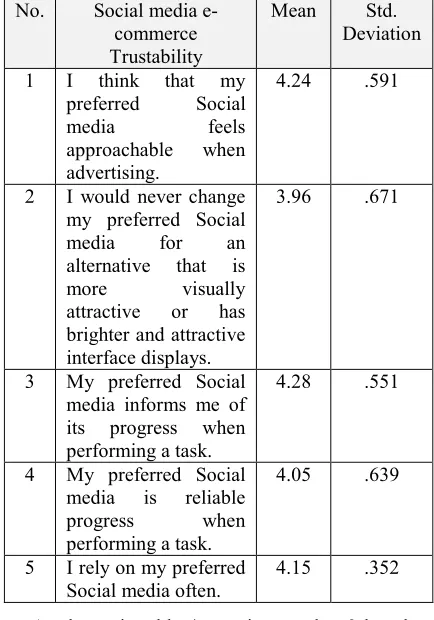
Table 4: Social media e-commerce Trustability
No. Social media
e-commerce Trustability
Mean Std.
Deviation
1 I think that my
preferred Social
media feels
approachable when
advertising.
4.24 .591
2 I would never change
my preferred Social
media for an
alternative that is
more visually
attractive or has
brighter and attractive interface displays.
3.96 .671
3 My preferred Social
media informs me of
its progress when
performing a task.
4.28 .551
4 My preferred Social
media is reliable
progress when
performing a task.
4.05 .639
5 I rely on my preferred
Social media often.
4.15 .352
As shown in table 4 question number 3 has the highest mean score.
Table 5: Social media e-commerce Relevancy
No. Social media
e-commerce Relevancy Mea
n
Std. Deviation
1 My preferred Social media provides me with ads that are appropriate to my preference.
4.17 .727
2 My preferred Social media reaches my target audience when advertising.
4.06 .826
3 My preferred Social media matches audiences to the right content advisements.
3.57 .821
4 My preferred Social media provides me with ads at the right time and occasion.
3.94 .657
Table 6: Social media e-commerce Reputation
No. Social media
e-commerce Reputation
Mean Std.
Deviation 1 To what extent do I trust
My preferred Social media provider?
3.77 .702
2 To what extent is My preferred Social media honest to me and/or my clients?
4.07 .619
3 To what extent can I rely on the services being provided My preferred Social media provider?
4.17 .660
4 Compared to the other providers, services are fairly estimated and serviced.
3.56 .763
The means of responds range are greater than 3 and question number 3 was the highest value as shown in table 6.
9.3 Hypotheses Testing
In testing the hypotheses, the researchers depends
on the following statistical rules which are mentioned and proved in [23], [24]:
• Accept Ho1 if F Sig. value is greater than 0.05
and reject Ho1 if Sig. F value is lower than 0.05
.
• Accept Ho1 if calculated F is less than tabulated
F and reject Ho1 if calculated F greater than tabulated F.
• Accept Ho1 if R Square Change value is 0 and
reject Ho1 if R Square Change value is greater than 0.
Hypothesis 1:
Ho1: There is no statistical significant impact of social media e-commerce (Usability, Trustability, Relevancy, reputation) together on customer loyalty.
Ha1: There is statistical significant impact of social
media e-commerce (Usability, Trustability,
[image:7.612.310.522.216.268.2]Relevancy, reputation) together on customer loyalty.
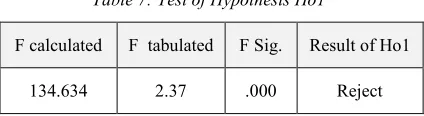
Table 7: Test of Hypothesis Ho1
F calculated F tabulated F Sig. Result of Ho1
134.634 2.37 .000 Reject
Referred to table 7, multiple linear regression was used to test the research main hypothesis and
the researchers found that (calculated F = 253.238) is greater than tabulated F, and F Sig. value is less than 0.05. According to the researchers’ decision rule: Accept Ho1 if F Sig. value is greater than 0.05 and reject Ho1 if Sig. F value is lower than 0.05. Therefore the researchers will reject Ho1 and accept the alternative hypothesis Ha1 Thus, there is a statistical significant impact of social media e-commerce on customer loyalty.
Table 8: Correlations
R R Square Adjusted R Square
.762 .581 .577
According to table 8 it was found that there is a positive and significant relationship between social media e-commerce and customer loyalty where (R=.762) which is high.
In order to test the first main hypothesis Ho1, there are four minor ones. These hypotheses are:
Ho1-1: There is no statistical significant impact of Usability of social media e-commerce on customer loyalty.
Ha1-1: There is statistical significant impact of Usability of social media e-commerce on customer loyalty.
Table 9: Test of Hypothesis Ho1-1
F calculated F tabulated F Sig. Result of Ho1-1
229.901 4.00 .000 Reject
Referred to table 9, Simple linear regression analysis was used to test the researchers’ hypothesis and F Sig. was 0.000, which is lower than 0.05. According to our decision rule: Accept Ho1-1 if F Sig. is greater than 0.05 and reject it if F Sig. is lower than 0.05. Therefore the researchers will reject Ho1-1 and accept the alternative hypothesis Ha1-1. Thus, there is a statistical significant impact of Usability of social media e-commerce on customer loyalty.
Ho1-2: There is no statistical significant impact of Trustability of social media e-commerce on customer loyalty.
Ha1-2: There is statistical significant impact of Trustability of social media e-commerce on customer loyalty.
[image:7.612.90.302.641.699.2]
F calculated F tabulated F Sig. Result of Ho1-2
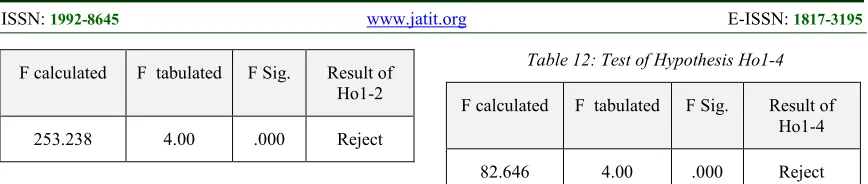
253.238 4.00 .000 Reject
According to table 10, Simple Regression analysis was used to test the researchers’ hypothesis. F Sig. = 0.000 is lower than 0.05. Based on the decision rule: Accept Ho1-2 if F Sig. value is greater than 0.05 and reject it if F Sig. value is lower than 0.05. The researchers will, therefore reject Ho1-2 and accept the alternative hypothesis Ha1-2. Thus, there is a statistical significant impact of trustability social media e-commerce on customer loyalty.
Ho1-3: There is no statistical significant impact of Relevancy of social media e-commerce on customer loyalty.
[image:8.612.90.524.69.161.2]Ha1-3: There is statistical significant impact of Relevancy of social media e-commerce on customer loyalty.
Table 11: Test of Hypothesis Ho1-3
F calculated F tabulated F Sig. Result of Ho1-3
14.218 4.00 .000 Reject
As table 11 indicates that simple linear regression used to test the hypothesis and it was found that F Sig. is lower than 0.05. It also found that calculated F = 14.218 is greater than tabulated F. Therefore, reject Ho1-3 and accept Ho1-3 which indicates that there is statistical significant impact of Relevancy of social media e-commerce on customer loyalty.
Ho1-4: There is no statistical significant impact of
Reputation of social media e-commerce on
customer loyalty.
Ha1-4: There is statistical significant impact of
Reputation of social media e-commerce on
customer loyalty.
Table 12: Test of Hypothesis Ho1-4
F calculated F tabulated F Sig. Result of Ho1-4
82.646 4.00 .000 Reject
Table 12 indicates that simple linear regression used to test the hypothesis and it was found that F Sig. is less than 0.05, therefore Ho1-4 is rejected and Ha1-4 is accepted, that means there is statistical significant impact of Reputation of social media e-commerce on customer loyalty.
Hypothesis 2:
Ho2: There are no statistical changes in the impact of social media e-commerce on customer loyalty, due to the demographic factors (gender, age and education).
Ha2: There are statistical changes in the impact of social media e-commerce on customer loyalty, due to the demographic factors (gender, age and education).
In order to test the second major hypothesis Ho2, there are three minor ones. These hypotheses are:
Ho2-1: There are no statistical changes in the impact of social media e-commerce on customer loyalty due to gender.
[image:8.612.90.297.389.450.2]Ha2-1: There are statistical changes in the impact of social media e-commerce on customer loyalty due to gender.
Table 13: Test of Hypothesis Ho2-1
R R Square R Square Change Result of Ho2-1
0.645 0.416 0.008 Reject
Referred to table 13, Hierarchal Regression analysis was used to test the researchers’ hypothesis
and the researchers found that R= 0.645, R2= 0.416
and R Square Change= 0.008. Since the R Square Change is 0.008, the researchers reject Ho2-1 and accept Ho2-1. This indicates that there are statistical changes in the impact of social media e-commerce on customer loyalty due to gender.
[image:8.612.313.523.510.572.2]Ha2-2: There are statistical changes in the impact
[image:9.612.89.299.147.207.2]of social media e-commerce on customer loyalty due to age.
Table 14: Test of Hypothesis Ho2-2
R R Square R Square Change Result of Ho2-2
0.653 0.427 0.018 Reject
According to table 14, Hierarchal Regression analysis was used to test the researchers’ hypothesis
and the researchers found that R= 0.653, R2=
0.427and R Square Change= 0.018, So Ho2-2 is rejected and Ha2-2 is accepted. The researchers will, therefore accept that there are statistical changes in the impact of social media e-commerce on customer satisfaction, due to age.
Ho2-3: There are no statistical changes in the impact of social media e-commerce on customer loyalty due to education.
[image:9.612.90.301.412.474.2]Ha2-3: There are statistical changes in the impact of social media e-commerce on customer loyalty due to education.
Table 15: Test of Hypothesis Ho2-3
R R Square R Square Change Result of Ho2-3
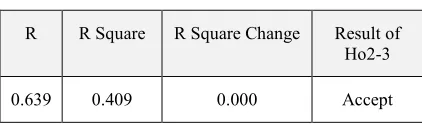
0.639 0.409 0.000 Accept
Table 15 shows that Hierarchal Regression analysis was used to test the researchers’ hypothesis and the researchers found that R= 0.639, R2= 0.409 and R Square Change= 0.000, So Ho2-3 is accepted, which means that there was no impact of social media e-commerce due to education, which
is equaled to 0% .
10. CONCLUSIONS AND
RECOMMENDATONS
10.1 Conclusions
Table 16: Conclusion study results
Hypotheses Result of Ho There is no statistical significant impact
of Usability of social media e-commerce on customer loyalty
Reject
There is no statistical significant impact of Trustability of social media
e-Reject
commerce on customer loyalty There is no statistical significant impact of Relevancy of social media e-commerce on customer loyalty
Reject
There is no statistical significant impact of Reputation of social media e-commerce on customer loyalty
Reject
There are no statistical changes in the impact of social media e-commerce on customer loyalty due to gender
Reject
There are no statistical changes in the impact of social media e-commerce on customer loyalty due to age.
Reject
There are no statistical changes in the impact of social media e-commerce on customer loyalty due to education.
Accept
The results of this study showed that social media e-commerce was adopted in the four dimensions which are (Usability, Trustability, Relevancy and Reputation). The idealized influence “Relevancy ", came in first place, followed by Trustability, then Usability and finally Reputation.
Table 16 shows that social media e-commerce with the four factors (Usability, Trustability, Relevancy and Reputation) have a significant impact on customer loyalty. The results of the study showed statistical changes in the impact of social media e-commerce of Jordanian businesses on customer loyalty, due to gender and age. Astonishingly, the results of the study show that there are no statistical changes in the impact social media e-commerce of Jordanian businesses on customer loyalty, due to education.
10.2 Recommendations
Based on the previous results, the researchers suggest the following recommendations:
• There is a need to promote interest in the
characteristics Usability, Trustability,
Relevancy, Reputation, due to their significant impact social media e-commerce of Jordanian businesses on customer loyalty, by developing frameworks that have more importance to the user in ways of better usability and convenience.
• There is a need to promote interest in both
combined characteristics Relevancy and
Trustability because both have a significant
impact. The interaction between both
characteristics lead them to support each other in reaching the highest customer loyalty.
• There is a need to indorse the most attention on
commerce methods according to age groups, by
developing framework approaches that are adaptable to the younger age group; because there are statistical changes in the impact of
social media e-commerce of Jordanian
businesses on customer loyalty, due to age.
• There is a need to promote interest in
developing stereotypical social media e-commerce methods according to gender or gender related preferences, by developing frameworks that can be easily customizable to reflect the user’s preference and style; because there are statistical changes in the impact of on
social media e-commerce of Jordanian
businesses on customer loyalty, due to gender.
11. ACKNOWLEDGMENTS
The authors are grateful to the Applied Science Private University, Amman, Jordan, for the full financial support granted to this research.
REFERENCES:
[1] Perrow, C., “A society of organizations”
Journal of Theory and society,
Vol.
20, Issue 6, 1991, pp. 725-762.[2] Ameer, Irfan, “Satisfaction- A behavioral perspective on consumer: Review, criticism
and contribution”, International Journal of
Research Studies in Management, Vol. 3, Issue. 1, 2014, pp. 75-82.
[3] Monika Hartmann, Jeanette Klink, Johannes Simons, “Cause related marketing in the German retail sector: Exploring the role of
consumers’ trust”, Food Policy, Elsevier, Vol.
52, April 2015, pp. 108–114.
[4] Mohd Zaine, Nor Elya, “To Study the
Relationship between Perceived Value,
Firm’s Reputation, Trust and Reliability Towards Online Repurchase Intentions”,
2015, Available at SSRN:
https://ssrn.com/abstract=2697888
[5] Sumarto, Prasetyo Hadi, Eko Purwanto, Dewi Khrisna, “ Antecedents of Trust and Its Impact on Loyalty: An Empirical Study on
E-Commerce's Customer in Surabaya”,
International Journal of Information and communication Technology Research, Vol. 2, No. 2, 2012, pp. 122-128.
[6] Yadav, V. K. “Global Prospect Of
E-Commerce”, International Journal Of Social
Science And Interdisciplinary Research, Vol.3 Issue 1, 2015, pp. 10-20.
[7] Mohammad Shkoukani, Rawan Abu Lail, Hesham Abusaimeh, and Loai Al Hamarneh, “The impact of establishing a Governmental
Consumer Agency in Jordan towards
expanding the use of E-business”, the
Canadian Center of Science and Education (CCSE), DOI: 10.5539/cis.v6n2p71, Vol. 6, No. 2, 2013, ISSN 8989 E-ISSN 1913-8997 Computer and Information Science, May 2013.
[8] Turban, E., King, D., Lee, J.K., Liang, T.-P., Turban, D.C., “Electronic Commerce A Managerial and Social Networks Perspective”,
ISBN 978-3-319-10091-3, Springer
International Publishing, 2015.
[9] Ryan, D., “Understanding digital marketing: marketing strategies for engaging the digital
generation”, Kogan Page Publishers, 2014.
[10] Kotler, P., & Armstrong, G., “Principles of marketing”, Pearson education publisher, 2010. [11] Obar, J., Wildman, S., “Social Media Definition and the Governance Challenge-An
Introduction to the Special Issue”, SSRN
2663153, 2015.
[12] Neti, S., “Social media and its role in
marketing”, International Journal of
Enterprise Computing and Business
Systems, Vol. 1, Issue 2, 2011, pp. 1-15. [13] Kim, A. J., Ko, E., “Do social media
marketing activities enhance customer equity? An empirical study of luxury fashion
brand”, Journal of Business Research, Vol.
65, Issue 10, 2012, pp. 1480-1486.
[14] Rust, R. T., Moorman, C., Bhalla, G.,
“Rethinking marketing”, Harvard business
review, Vol. 88 Issue 2, 2010, pp. 94-101. [15] Rodriguez, M., Peterson, R. M., Krishnan, V.,
“Social media’s influence on
business-to-business sales performance”, Journal of
Personal Selling & Sales Management, Vol. 32 Issue 3, 2012, pp. 365-378.
[16] Weber, L. “Marketing to the social web: How digital customer communities build your
business”, John Wiley & Sons Publisher,
2009.
[17] Jansen, B. J., Zhang, M., Sobel, K., Chowdury, A., “Twitter power: Tweets as electronic word
of mouth”, Journal of the American society for
information science and technology, Vol. 60 Issue 11, 2009, pp. 2169-2188.
[18] Customer loyalty.BusinessDictionary.com.
Retrieved December, 2016, from
BusinessDictionary.com:
[19] Ganiyu, R. A., Uche, I. I., Adeoti, O. E., “Is
Customer Satisfaction an Indicator of
Customer Loyalty?”, Australian Journal of
Business and Management Research, Vol. 2, Issue 7, 2012, pp. 14.
[20] Reichheld, F. F., & Teal, T., “The loyalty effect: The hidden force behind growth,
profits, and lasting value”, Harvard Business
Press, 2011.
[21] Manfred Krafft, Katrin Krieger, “Customer
relationship management and company
performance—the mediating role of new
product performance”, Journal of the
Academy of Marketing Science, Vol. 39, Issue 2, 2011, pp. 290-306.
[22] Saunders, Lewis, & Thornhill, “Research methods for business students”, 5th edition,
Pearson Education Limited, England, 2009.
[23] Marija J. Norusis, “IBM SPSS Statistics 19
Guide to Data Analysis”, Pearson Prentice
Hall, 2011.