Journal of Criminal Law and Criminology
Volume 50
Issue 2
July-August
Article 6
Summer 1959
Automobile Theft
Leonard D. Savitz
Follow this and additional works at:
https://scholarlycommons.law.northwestern.edu/jclc
Part of the
Criminal Law Commons,
Criminology Commons, and the
Criminology and Criminal
Justice Commons
This Criminal Law is brought to you for free and open access by Northwestern University School of Law Scholarly Commons. It has been accepted for inclusion in Journal of Criminal Law and Criminology by an authorized editor of Northwestern University School of Law Scholarly Commons.
Recommended Citation
AUTOMOBILE THEFT
LEONARD D. SAVITZ
The author is a member of the staff of the Department of Sociology in the University of Pennsyl-vania. He has published an article on "Capital Crime as Defined in American Statutory Law" in our Volume 46 (September-October, 1955), and another on "A Study in Capital Punishment" in Volume 49 (November-December, 1958.)-EDITOIZ.
A. THE NATURE OF AUTO THEF' (1, 11, 12)
The necessary first step in any discussion of auto theft in the United States is to become aware of certain legalistic peculiarities in American law as they apply to the crime of theft. The common law definition of larceny (or theft) hias, historically, come to include in it an element of attempted, or actual, permanent deprivation of the rightful owner of his chattel. A major legal problem, there-fore, arose in the past, as to whether an individual who only "borrowed" someone's car for "joy-riding" purposes could be classified as a thief. Not infrequently the accused, after convincing the court that he did not intend to keep or sell the car or, indeed, was returning it to its rightful owner when apprehended, was found not to have violated existing larceny statutes and was set free. Thus in one precedent case2 the appellate court decided that the trial court had been without fault in finding "joy-riding" a non-criminal action because of a lack of intent to permanently deprive the owner of his car. Only by a new, broadened, statutory definition of larceny, or, as more fre-quently occurred, the creation of a new criminal offense: operating a car without the consent of the owner-could the courts deal adequately with this type of behavior. It must be noted that this has been rather peculiarly a state problem. The federal law dealing with auto theft, the National Motor Vehicle Theft Act (also known as the "Dyer Act") while encompassing those who
".. .transport in interstate commerce, a motor vehicle knowing the same to be stolen," is suffi-ciently omnibus as to embrace the act of "joy-riding." Much has been made of the very wide area of activity covered by this act and recently (28) there have been vehement demands to more
1 Digits, 1 to 32 inclusive and enclosed in parentheses, refer to fully cited, pertinent items listed in the bibli-ography. (S-1) and the like refer to "Serials" which are listed following the General Bibliography.
2 Impson v. State, 47 Ariz. 573 (1930.)
narrowly restrict this offense within the federal jurisdiction.
B. THE PRESENT STATUS OF AUTO THEFT
I. EXTENT
The Uniform Crime Report for 1956 (S-5) shows an estimated 250,000 cars stolen for that year. The same source of data (S-4) reveals that of all auto thefts known to the police for the first six months of 1956, 29.2 percent were cleared by arrest (Figure 4), while 23.3 percent of the auto thefts known to the police resulted in someone's being charged (held for prosecution) for the crime. Of this 23.2 percent charged, 63.7 percent were found guilty, though not all for the crime of auto theft. Thus, there were 56,735 auto thefts known to the police, leading to 15,132 arrests, which resulted in 12,239 persons being charged with some crime, of whom 7,766 were convicted. However, only 6,886 were guilty of auto theft, the remainder were convicted for some other offense.
In 1946, auto thieves made up 21.8 percent of all federal prisoners (S-2, Table 12) and they were the single largest group of criminals in federal prisons. The Senate Interim Report (28) concluded that this high auto theft imprisonment rate was due to "excessive" convictions'under the Dyer Act; that the prohibition on transporting cars across state lines was not meant to cover "joy-riding juveniles"; and that many youngsters "mis-appropriate cars with no intent to steal."
II. TRENDS
AUTOMOBILE THEFT
million cars in the United States and about 165,000 cars were stolen in that year. In 1952, he further stated, the number of cars had risen to 53 million and auto thefts also rose to 226,000. In the period from 1949 to 1952, therefore, there was a 19 percent increase in the number of cars and a 32 percent increase in automobile theft (28).
Using the amount of auto theft in 1941 as the base line, the Uniform Crime Report (S-5, Figure 10) shows that there was less auto theft in 1948, 1949 (the nadir) and 1950. The 1941 rate was equalled in 1947, and was exceeded by less than 20 percent, in 1943, 1944, 1951, 1952, 1954, 1955; it was exceeded by over 20 percent in 1945, 1953, and 1956.
There were under 2,000 auto thieves in federal prisons each year from 1942 to 1946 (S-3, Table 3), while the period from 1947 to 1956 was char-acterized by between 2,000 and 4,000 prisoners per year. As James V. Bennett, director of the Federal Bureau of Prisons, testified, "It is around the automobile, by far and away, that the largest number of federal offenses revolve" (27).
I. RECOVERY
The National Auto Theft Bureau (27) reported that in 1952, of the 225,000 cars stolen, 92 percent were recovered. The value of the 8 percent not recovered was set at between 18 and 20 million dollars.
For 1956, the Federal Bureau of Investigation (S-5) found that 93.3 percent of all cars were recovered. (The value of all stolen cars was set at $131,558,605 (sic) and this was incomparably the highest average cost per criminal offense; the average crime "costs" $97.00, whereas the average car theft involved property valued at $873.00.) Shannon (29) noted that 90 percent of all autos were recovered in Chicago and almost always within two days.
Lunden (15) concluded from his study of auto theft in Iowa that the amount of car stealing varies with: resale value of the car, number of cars available, size of the community, economic conditions, presence of main highways, and the amount of traffic in the area.
C. DIFFERENTIALS
I. AGE
It is well established that most auto thefts are committed by youthful offenders, usually under 20 years of age.
a. The Senate Subcommittee (28) found that auto theft was the outstanding juvenile crime, constituting about 30 percent of all detected delinquencies.
b. In 1956 (S-5, Table 41) of 28,035 auto thieves arrested, 39 percent were 15 or under, 56 percent were 16 or younger and 73 percent were less than
18 years of age.
c. Of 4,314 auto thieves sentenced to prison in 1950 (S-1, Table 32), the largest age grouping was 20-24 (1571), with 25-29 next (949) and the 15-19 group the third most numerous (852).
d. In 1956, there were 2,637 offenders under 21 years of age in federal prisons (S-3) and over half of them (1456) were convicted of auto theft; of the 799 offenders under 17 in federal prison, 444 were in for auto theft.
e. Bennett (27) told the Senate Subcommittee that 55.5 percent of all cases of juveniles brought before federal courts involved car theft.
f. The National Auto Theft Bureau (27) deter-mined that 70 percent of all auto theft was com-mitted by individuals under 20 and they believed that the mean age was decreasing. Thus, in 1948, 17 percent of all car stealing was perpetrated by individuals under 17, whereas this figure rose to 52 percent in 1952.
Lunden (15) suggests that the youthfulness of the auto thief is due, in part, to the automobile offering a combination of "joy-riding" and a quick means of converting property to money.
II. SEX
It is quite certain that auto theft is over-whelmingly a male offense. The national sex ratio for arrests in 1956 (S-5, Table 43) is on the order of 40:1 (27,323 males and 712 females). This ratio mounts to over 120:1 for imprisoned auto thieves in 1950 (4314 males and 35 females) (S-1,
Table 31).
I. RACE
There is comparatively little data in this area and what there is is conificting. Some data indicates Negroes commit a greater proportion of this crime than their proportionate representation in the population:
LEONARD D. SA VITZ
the Negro has lodged against him a very high percentage of charges of disorderly conduct, rather than of auto theft.
b. The Uniform Crime Report (S-5, Table 44)
reveals that in 1956, of 28,035 persons arrested for car theft, 6,109 were Negroes. Negroes, constitut-ing approximately 10 percent of the population, were arrested, therefore, in 22 percent of the cases.
On the other hand:
c. Berg (4) found that Negroes constituted 12.8 percent of his 100 auto thieves but were 24A percent of the random group of other prisoners.
d. Wattenberg and Balistrieri (32) show (Table
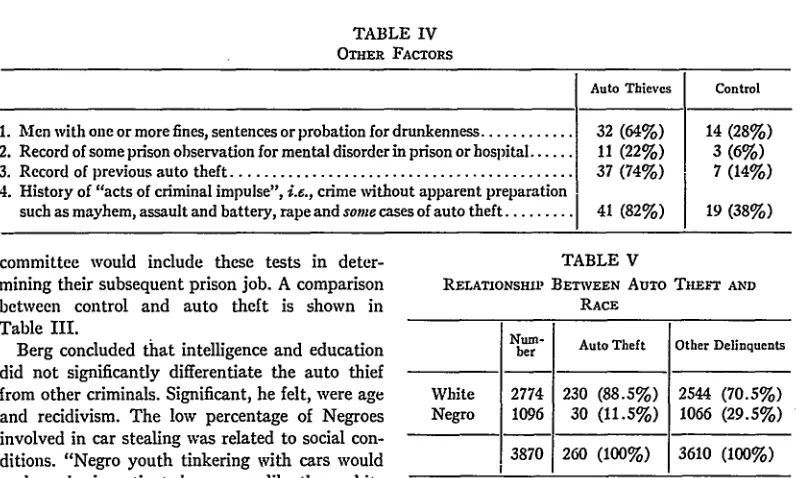
I) Negroes committed 11.5 percent of the auto thefts, while they committed 29.5 percent of "other" delinquencies. (Parenthetically, it might be added, Detroit, the city from which the delin-quents were selected, had a non-white population in 1950 which amounted to 16.4 percent of the total population.)
e. Of the 4314 car thieves committed to federal and state prisons in 1950 (S-1, Table 33), 15 per-cent were Negroes, whereas they constituted
29.2 percent of all new prisoners for the same year.
IV. MARITAL STATUS
The only information available (S-1, Table 34) reveals that in 1950, of 4,301 male auto thieves sentenced to prison with marital status known, 2402 (55.8 percent) were single. This constitutes one of the highest nonmarried rates for any offense.
V. URBAN AND REGIONAL DIFFERENTIALS
There can be no denying that auto theft is predominantly a crime of the urban offender. The actual relationship between this crime and city size is, however, not dear. Hall (12) states that auto theft varies directly with the size of the city; the larger the city, the higher the rate. If one uses the Uniform Crime Report (S-5, Table 32) dassification of cities into six groups (Group I: population over 250,000; Group II: 100,000 to 250,000; Group III: 50,000 to 100,000; Group IV: 25,000 to 50,000; Group V: 10,000 to 25,000; and Group VI: under 10,000) then there is a con-sistent, positive correlation between city size and amount of auto theft for the country as a whole, and for almost every region of the country. How-ever, a breakdown of Group I cities (Table 30) reveals their auto theft rates to be:
224.5 in cities of over 1,000,000 490.5 in cities of from 750,000 to
1,000,000
374.2 in cities of from 500,000 to
750,000
364.6 in cities of from 250,000 to 500,000
Thus, the very largest cities have the lowest auto theft rate within the entire grouping.
Utilizing the Uniform Crime Report six-fold urban-area classification, it was found (S-4, Table
15) that there was a regular increase in persons
arrested per 100 auto thefts known to the police, from Group I (26.4) to Group VI cities (47.6).
A similar situation occurred with persons charged
(held for prosecution) per 100 auto thefts known, from 20 charged in Group I cities, to 44.4 in Group VI towns. However, using a different instrument of measurement: Number of Persons Charged per 100,000 population (S-4, Table 17), the reverse is found and the large metropolitan areas (Group I cities) had a rate of 51, while the smallest urban centers (Group VI) had a rate of 37.7. [One is driven to conclude from these data that the car theft rate is so much higher in large cities, that even though they make almost 25 percent fewer arrests per 100 car thefts known than do the small towns, they (the large cities) still have, per popu-lation unit, a considerably greater number of indi-viduals charged with the offense.]
When rural and urban areas are contrasted, Lunden (15) finds that the auto theft rate is three to four times higher for cities than for rural popu-lations in Iowa from 1943 to 1948. He finds that the rate per 100,000 registered cars is 65 in farm counties, 85 in small towns under 5000, 90 in large towns between 5,000 and 10,000, 110 in small cities between 10,000 and 15,000 and 151 in large cities over 25,000 (sic). The Uniform Crime Report
(S-5, Table 30) reveals that the urban auto theft
rate is 233 per 100,000 population, while the rural rate of 67 (S-5, Table 34) was almost one-fourth of that.
VI. MONTHLY VARIATIONS
National figures (S-5) show that auto theft is highest in November and December and at its lowest point from May through August. Lunden (15) states that for Iowa in 1949 and 1950 the last six months of the year have a much higher rate than the first six months.
VII. SENTENCING
A UTOMOBILE THEFT
additional 53.5 percent were sentenced for two to four years. Of those getting indeterminate sen-tences, 80.9 percent received minimum sentences of under two years. The maxima however were rather severe, for 30 percent received between five and nine years, and in an additional 37 percent of the cases, it ran between ten and ninety-nine years.
There was a great deal of variation in sentencing within the federal jurisdiction. The average sen-tence for auto theft was 28.8 months (S-3, Table 22), but it ranged from a low of 13.8 months average in North Dakota, to a high of 52.3 months in the Northern Oklahoma district. An even wider disparity occurred among the various states where the average was 20 months (S-2) and the sentences ranged from a five months average in Vermont to 39 in West Virginia.
Along somewhat different lines, Lemert and Rosberg (14) attempted to examine differential sentencings by race of the offender, and they analyzed 277 car thieves in Los Angeles County in 1938, of whom 146 were white, 102 Mexican and 29 Negro. They found that 23.2 percent of the whites received probation, as did 17.2 percent of the Negroes and 5.8 percent of the Mexicans. The length of sentences for auto theft are shown in Table I. The authors concluded that the results were significant at a .05 level, and the greatest advantage to the whites laid in the extreme cate-gories with their being highest in the "less than 4 months" and lowest in the "over 12 month" categories. However, National Prisoner Statistics (S-2, Table 7) shows that in 1950, white prisoners served 21 months on the average for car theft, while Negroes served 20 months.
D. THE ETIOLOGY OF AUTO THEFT
There have been three major studies that have dealt with various causative elements in car theft. I. Selling (18) states that in an earlier study of his (19), he found three distinct "constellations of characteristics" along psychiatric, psychologic and social lines. The present study utilized psychi-atric criteria alone and he found only one dominant personality type among auto thieves: the psycho-pathic personality in which, however, there are no functional changes. Selling goes on to explain that a patient is mentally pathologic when his be-havior is so different from that of a "well-adjusted" person that he must be restrained. However, it does not follow that a person requiring
incarcera-tion is, of necessity, mentally abnormal. The purpose of this study was not to point up the normality or abnormality of a group in trouble, but to compare a homogeneous group of delin-quents (auto thieves) with a random group of individuals, and an "unselected" group of delinquents.
Selling studied 100 male auto thieves between 12 and 17 years of age in a state correctional insti-tution; the main sources of his data being auto-biographies and psychiatric interviews. These boys were compared with two other groups: 100 representative delinquents, including some car thieves, from the same institution and of approxi-mately the same age; and a non-delinquent group, also controlled for some factoxs which are never explicitly stated.
It was found that 89 of the auto thieves, and only 61 of the "representative" delinquents came from Chicago. This suggested to Selling the localization of boys having car stealing proclivities within a local area despite the fact that auto theft was probably easier in small, towns where more cares are left unlocked. It was also determined that 83 of the 100 car thieves came from the dis-organized areas (Zones I and II) of Chicago which suggested the basic abnormality of the social structure and pointed up the important effect of social processes in modifying the individual.
Concerning race and nationality, Selling found that almost all nationalities were represented among his auto thieves. He, therefore, suggested that there was no racial or nationality immunity. Table I showed that Negroes constituted 37 of the car thieves and 36 of the "representative" delinquent group; similarly, 29 of the auto thief group and 24 of the other delinquent group were Italian.
When "mental functions," i.e., thought content of the individual, was measured, Selling concluded
TABLE I
SENTENCES FOR Auio THr
Negro Mexican White
1. Less than 4 months 17% 17% 32%
(includes probation)
2. Four to nine months 41% 30% 35%
3. Ten to twelve months 21% 21% 23% 4. Over 12 months 21% 22% 10%
LEONARD D. SA VITZ
TABLE II
MOTIVATIONS AND EMOTIONAL DISTURBANCES
Represen-Auto tative Thieves Delin-quents
1. Lived in delinquency area be- 78 42 fore age of 6
2. Broken home 30 21
3. Father had no regular employ- 41 43 ment
4. Truancy 62 81
5. Stealing with a purpose 10 unk.
6. "Just to ride around" 41
-7. "Just to ride around and strip a 14
-car"
276 187
that it was certainly not true-that mental deficiency is a causative element in auto theft. The car thieves had I.Q. scores ranging from 57 to 112, with a median of 90. The control group (representative delinquents) ranged from 60 to 103, with a median of 83.
Next, emotional factors ("unconscious memory and drives") were examined, largely through the use of autobiographies. In Table II, Selling lists these factors. Selling found that the maladjust-ments contributing to auto theft were: a) living in an urban community before age of 8 (sic); b) living in disorganized area; c) familial mal-adjustments, including broken homes, unemploy-ment or difficulty with parents; d) school malad-justment, taking the form of truancy, fear of other students, or actual dislike of school.
Selling next compared the "Wishes for an Automobile" of the auto thieves, 50 non-delin-quents, and 100 "representative" delinquents. He found 93 of the 100 auto thieves, 47 (of 50) of the non-delinquents, and 61 of the representative delinquents wished for a car. However, only six of the car thieves had a car available at home, while all non-delinquents and 17 representative delinquents were in a similar situation. Thus, almost all non-delinquents had a strong desire for a car, but found little difficulty in legally securing one. Selling concluded that actual posses-sion of a car in the family was probably a significant
factor.
The auto thieves were asked if they were home-sick, because Selling felt this was indicative of successful adjustment after parole. Most of them
(82 percent) said they were, whereas only 30 percent of the delinquent control group made a similar confession.
Selling concluded that the auto thief came from a high delinquency area, yet differed significantly from other delinquents in that: low intelligence was not an important causative factor; he mani-fested no emotional abnormality; any abnormal changes in the car thief were functions of the en-vironment and any pathology was one of degree rather than quality.
II. Berg (4) states that the average person must think that the auto thief had subnormal intelli-gence because current police control has come to mean almost certain apprehension. While it is admitted that some thieves dismantle and sell parts of the car and others will abandon it after a few hours, yet of all car thieves arrested, 95 percent were in possession of an intact car. To test the intelligence of the auto thief, Berg compared the records of a control group of 480 inmates of State Prison of Southern Michigan, who had committed all types of offenses (19 percent were imprisoned for "Breaking and Entering," 14 percent for Larceny, 11 percent for Auto Theft, 11 percent for Robbery, etc.) with that of 475 car thieves in the same prison, for the period 1/1/40 to 8/1/42. He utilized all of the auto thieves in prison as against a random sample of the general inmates. He measured intelligence (via the Bregman revi-sion of the Army Alpha Test), "Average Grade Placement" (by the Stanford Achievement Test) and mean chronological age. Both tests were ad-ministered six to 15 days after admission, when there was "high" motivation on the part of the prisoners who had been told that the classification
TABLE III
INTELLIGENCE
Car
Thieves Control
(N = 475) (N = 480)
1. Mean Age 22.9 29.2
(Standard Deviation) (6.0) (11.1)
2. Mean Grade Placement 5.9 5.2
(S.D.) (2.1) (2.9)
3. Mean Alpha I.Q. 92.2 89.1
(S.D.) (16.7) (17.4)
4. Percent with previous prison 32.3 29.6
sentence
[image:6.505.233.426.478.647.2]A UTOMOBILE THEFT
TABLE IV OTHER FACTORS
Auto Thieves Control
1. Men with one or more fines, sentences or probation for drunkenness ... 32 (64%) 14 (28%) 2. Record of some prison observation for mental disorder in prison or hospital ... 11 (22%) 3 (6%) 3. Record of previous auto theft ... 37 (74%) 7 (14%) 4. History of "acts of criminal impulse", i.e., crime without apparent preparation
such as mayhem, assault and battery, rape and some cases of auto theft ... 41 (82%) 19 (38%)
committee would include these tests in deter-mining their subsequent prison job. A comparison between control and auto theft is shown in Table III.
Berg concluded that intelligence and education did not significantly differentiate the auto thief from other criminals. Significant, he felt, were age and recidivism. The low percentage of Negroes involved in car stealing was related to social con-ditions. "Negro youth tinkering with cars would perhaps be investigated more readily than white youths and hence could steal fewer cars. Also, it may be that auto owners take precautions such as locking their cars more frequently when near a Negro neighborhood." In Table IV are the results Berg also found when he contrasted 50 random auto thieves with 50 "controlled" prisoners. Thus it was concluded that car theft is a crime of impulse and youth, with possibly alcohol acting to remove some conventional inhibi-tions. The importance of alcohol is pointed up by the tremendous differential in history of drunken-ness (64 to 28%), particularly when one considers the extreme youth of the car thief.
III. Wattenberg and Balistrieri (32) state that a previous study (not cited) of 1,170 individuals over 17 in Detroit found that auto theft at ages 10 to 16 was three times as high for whites as for Negroes; where the general delinquency rate was 2:1 (whites to Negroes) the auto theft ratio (presumably for all juvenile ages) was 7:1, and this was significant beyond the .01 level of con-fidence. This previous study also found auto theft significantly higher for boys of Western European parentage, which was a particularly significant finding in the face of a recent heavy influx of Eastern Europeans into the Detroit area. Thepolice explained the lower percentage of Negroes in-volved as being due to their greater difficulty in stealing cars, arising from more police challenges and a greater over-all investigation of Negroes by
the police.
TABLE V
RELATIONSHIP BETWEEN AUTO THEFT AND RACE
Num- ber Auto Theft Other Delinquents
White 2774 230 (88.5%) 2544 (70.5%) Negro 1096 30 (11.5%) 1066 (29.5%)
3870 260 (100%) 3610 (100%)
Wattenberg and Balistrieri examined the record of all boys between 10 and 16 involved with the police in 1948 and they secured 50 items of in-formation from these "records" concerning parents, housing, peer groups, recreation, etc. Their data is given in Table V.
Next, it was decided to study the 230 white auto thieves as opposed to the 2544 white perpetra-tors of "all other delinquencies" regarding the 50 items found on the police records. Fourteen items were found to be significant (nine at the .01 level and 5 at the .05 level) in differentiating the car thieves from the other delinquents:
1. Auto thieves more frequently come from
"above average" homes and less frequently from "slums";
2. They more usually come from racially homo-geneous areas;
3. They more frequently live in single-family
homes;
4. Their homes need less repair;
5. They more usually have only one parent
work-ing (though there is no difference in family income);
6. Auto thieves are older boys, rarely below 14
(The authors caution against the unrestricted use of the Uniform Crime Report data because the lowest age grouping used: "under 15," while very high may consist primarily of 14-to-15 year olds);
7. They also have better physical development
than the other delinquents;
[image:7.505.31.429.58.297.2]LEONARD D. SA VITZ
8. They are more sexually mature; 9. They have more previous offenses;
10. They more often work;
11. The individual car thief socializes better than other delinquents within his peer group and is less likely to be a "lone wolf";
12. They are more often classified as "respon-sive" by the police;
13. Car thieves are more likely to receive stern treatment or have an official complaint filed;
14. Finally, father-son recreation is more fre-quently classified as "occasional" rather than regular or seldom for the auto thief.
The auto thief was characterized as being well socialized in the area of primary group relation-ships; he is not isolated, peculiar, quarrelsome, un-socialized, aggressive, or neurotic.
Using Hewitt and Jenkins' personality typologies, auto thieves are characterized by "good ability to relate to people and by a con-science partially formed in the sense that it did not include the prohibition of the wider society." Their value systems are responsive to the immedi-ate code of relationship towards friends, but weak regarding abstract requirements of society. Their personality, in a phrase, is similar to that of the adult white-collar criminal, who is himself limited in his actions by the reactions of his immediate associates who would shun him were he a burglar or robber.
Wattenberg and Balistrieri find that this per-sonality type stems from lax families in which the child is not rejected but has weak affectional relationships with his parents. This is found not only in the slum, but in better areas where parents are "on the go" or the child is raised by servants. Another psychological schema (Havighurst and Taba) classify this personality type as an "adaptive person." He is characterized by high ''social intelligence" and easy conformity to immediate group norms. His family ties are easy and loose and his parents are broad, tolerant and set few restrictions. Thus the authors conclude, both classifications converge in depicting a per-sonality in which there is permissive upbringing and little moral courage, with a potential for antisocial behavior if this is supported by
associates.
Other factors are felt by some to be associated with auto theft though little empirical evidence is given. The National Auto Theft Bureau (29) believes that the greatest cause of auto theft is
public indifference and irresponsibility, pointing out that 70 percent of cars stolen were unlocked; 40 percent of these had the key in the ignition. The Chicago Police Department suggests (29) that the broken home, lack of community supervision, intellectual, emotional and psychological factors and opportunity, all combine to cause the crime. Shannon (29) felt inadequate parental supervision, automobiles becoming a necessity for amusement, possession of a car satisfying the ego of a youngster who desires recognition, together with negligible punishment, all are major causative factors in auto theft.
Somewhat related to studies of etiological factors in car theft are listings of the various purposes for which cars are stolen. The Senate Subcommittee (28) was informed that 90 percent of all stolen cars were recovered with no parts removed; 5 percent were partially stripped; 2 percent were taken by commercial theft rings; 2 percent were stolen for scrap salvage value; and 1 percent were used in the commission of other crimes. Soderman and O'Connell (24) suggest that there are five main types of auto thief: the joyrider; the professional thief who sells the car; men who are distant from home and without a conveyance or carfare; intoxi-cated persons; and those who steal cars for other crimes. Lunden (15) adds to this, that cars are frequently stolen as a means of escape after a crime. This brings up the entire area of the use of stolen cars in relation to other crimes. The rela-tionship of auto theft to subsequent criminal action is dealt with only peripherally in the litera-ture. Shannon (29) states, in Chicago 1 percent of all stolen cars were used for other crimes. Best (5) says, giving no citations, auto theft has some-thing to do with one-sixth of all indicted offenses. Goddard (11) believes that all well planned crimes include a stolen car to insure escape. He holds that before the invention of the automobile, robbery was practically unknown because the culprit found it so very difficult to escape. Both Soderman and O'Connell (23) and Lunden (15) mention the role of the stolen car in the commission of subse-quent crime and/or escape.
E. RECIDIVISM
All relevant studies conclude that the auto thief exhibits a very high rate of recidivism.
AUTOMOBILE THEFT
ranging from homicide to violation of liquor laws, auto theft had the highest percentage of those who had served previous terms: 1443 out of 2355 (61.3 percent). Using the Uniform Crime Report for 1938 he found 40.9 percent of all auto thieves arrested had a previous fingerprint file with the F.B.I.
b. The Senate Interim Report (28) reveals that 20 percent of all auto thieves in Cook County, Illinois were repeaters.
c. Testimony before the Subcommittee re-vealed the belief that auto larceny was a first step towards a general career in crime. Shannon (29)
stated that one must get the boy early, for, "...
the boy who is caught the first or second time is easiest to rehabilitate." He cited 1953 Chicago figures which revealed that of 1,541 car thiefs over 20, 364 (24 percent) were repeaters; of 1,044
be-tween 17 and 19, 286 (27 percent) were also recidivists; and of 1,680 under 17, 276 (16 percent) had been arrested before for a similar crime.
d. Examination of federal prisoners (S-3, Table 20) reveals that of 2,343 auto theft commitments, 1,854 (79 percent) had served a previous term. Of this 1,854, 509 (22 percent) had one previous sentence, 415 (18 percent) had two previous sentences, and 930 (40 percent) had served 3 or more sentences.
4. It will be recalled that Berg (4) found that 32.3 percent of his auto thieves had served previous prison terms, whereas only 29.6 percent of his "random" criminals did likewise. He also found that 74 percent of the car thieves in prison had some history of previous auto theft.
F. PREVENTION
Generally authorities are in agreement that there must be an adoption of a Uniform Certificate of Title Act. In the United States, at the present time, there are still 12 states in which the owner of a car need not show or turn over to the purchaser of his car, his certificate of title (or ownership). In other words, a car sale may be transacted without the transfer of ownership papers. The F.B.I. (2), the National Auto Theft Bureau (29), the police chief of Chicago (29), and Bulger (6), all agree that when certificate of title laws come into existence, auto theft goes down.
Before further discussion of prevention, it be-comes necessary to become familiar with the
mechanics of auto theft.
There are two methods whereby a car may be
started without the use of an ignition key (26); first, one may squirt mercury or water from an eye-dropper into the ignition key slot and then cover the slot with a stick of gum to prevent the leaking out of the liquid; secondly, there is the use of a "jumper" which short-circuits the ignition system by touching the three posts in the system simul-taneously, so that the car can be started without the use of ignition wires. (There are sundry types of "jumpers" used, including three wires with an "alligator," a beer can opener forced between the posts, a large coin which covers the bolts, an open safety pin, a long bobby pin, and most usually, tin foil which is forced between the three bolts (or posts) (29). A third technique is mentioned by Hall (12): the car is simply towed away. (For a more intensive analysis of the techniques involved, see (28) pp. 36-40.)
A second problem is getting title to stolen cars and this is handled any number of ways:
a. Alter the engine number and get a certificate of registration;
b. Get the original, legitimate title and staple or paste another (stolen car's) description over the original;
c. Counterfeit a title;
d. Purchase a salvaged car and get its title, then steal a similar car and exchange engine numbers;
e. Purchase a late model car, report the loss of its title, and secure a duplicate. Subsequently steal a similar car and substitute engine numbers and then sell the stolen car with the original title (which had been reported lost);
f. Burgle a dealer's office for a title (29); g. Use the "mace," i.e., offer to buy a car in order to secure a car and its title; immediately thereafter sell the car (using the title) to a third party and then leave town. Another variation of this is to make a "down-payment" on a new car and then sell it to someone else (12). (This latter technique is generally useable only in non-title
states.)
There are additionally various techniques for altering serial plates on the motor of the car such as: steal a car and remove its plates, then locate a like model and exchange plates; steal motor plates from cars found on sales lots and use them on stolen cars; manufacture counterfeit plates; or purchase a salvaged car and substitute its plates onto the
stolen car.
As most cars are stolen when a key was left in the ignition, or their doors were left unlocked,
LEONARD D. SA VITZ
certed attention has been given to various at-tempts to reduce this "carelessness." It has been suggested that this individual should be fined. But some authorities felt that this would be injurious to public relations and, additionally, would not be enforced by the judiciary. In the face of this latter belief, however, the National Auto Theft Bureau (27) noted that leaving a car unlocked is a criminal offense in Lansing and Grand Rapids, Michigan, and since this law was instituted in 1948, their auto theft rates have declined, though for the country as a whole it has risen. Other suggestions include the police taking the key out of the ignition and leaving a note to the owner, or that a promi-nent sign be placed on the parking meter warning motorists to lock up. It was also suggested that the police should issue warning summonses (3) but this was thought to be absurd, as thieves would seek out precisely those cars with summons on them. Finally, it has been suggested that manufacturers should devise an ignition system whereby the key is ejected when the motor is turned off. This, in effect, raises the entire area of theft-proof cars. There are major problems in creating fool-proof door handles, locks, vents, mounting, ignition systems, hood latches, and covers for the three point ignition system, because there must be easy convenience for the buyer and, additionally, each year thousands of mechanics must be taught how to easily dismount and disassemble these parts.
The National Auto Theft Bureau (27) suggests changing current automobile insurance policies so that an individual gets only a percentage of the value of his car if he leaves it unlocked or the key in the ignition and it is stolen. However, it is ap-parently quite difficult to determine whether the door or the ventilation window had been forced open or whether a key was left in the ignition. The N.A.T.B. finally suggests that we should educate the public and particularly juveniles to the fact that this is a serious crime; that we should manu-facture more theft-proof cars; and that there should be more stringent enforcement of existing laws.
G. CHICAGO
As the most intensive studies of automobile theft have dealt with the city of Chicago, it would be quite profitable to examine that city as a micro-cosmic example of the universe of auto theft.
A program aimed at reducing car thelt started in Chicago in 1953 (28). It incorporated:
I. A new system of collecting car theft data
plus a new and extensive series of lectures on this subject given to the police force.
2. An information program to car owners con-cerning ignition, locks, etc., largely carried on through newspapers and radio programs.
3. Manufacturers were requested to reduce the possibilities of the efficacy of "jumpers."
4. Education programs were held in high schools by police officers on the seriousness of the crime (which may bring in Illinois a twenty year prison sentence).
The result of this program was that the 1954 rate was 34 percent lower than that of 1953.
Chicago, it must be recognized, has what appears to be the only judicial recognition of the peculiar nature of the auto thief. In 1934, the Auto Theft Court (as an adjunct to the Boys' Court) came into existence. It was created at that particular time because of the incredible rate of car theft in the city. In 1931 there were 29,000 auto thefts in Chicago (a spectacular 317 percent increase over 1930 (29)); in 1932 this figure rose to 35,000 (100 per day!); and in 1933 it declined to 27,900. As a result of this rate, the Chicago owner of a Ford automobile paid 10 times the auto theft insurance premium as the owner of a similar car in Mil-waukee (7). Before 1934, there was no concerted enforcement action and auto thieves were tried in various courts: Municipal, Boys, Juvenile and Police, so that there was little uniformity of punish-ment and little specialization by the police or the States' Attorney in this crime. After the establish-ment of this court, the results were remarkable. In 1934 the rate was 13,000 (56 percent lower than the previous year); in 1935, it was 6700 (47 percent de-crease); and in 1936 it became 3500; and from 1937 to 1945, the rate remained at between 2900 and 3900. Thus, the rate from 1935 to 1945 was 3,176 cars stolen per year, or 89 percent less than the 1932 total. (It must be added, however, that a Certificate of Title law was adopted in Illinois in 1934.)
AUTOMOBILE THEFT
demeanor he may receive supervision, probation, or be sent to an institution. There are various personnel affiliated with the court including a psychiatric institute, a social service department, a probation department, plus various private social agencies.
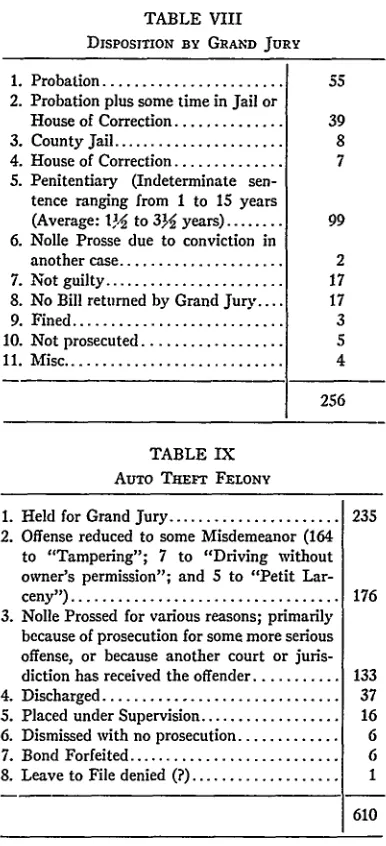
The only intensive study of judicial handling of auto theft cases is by Cosnow (7) of Chicago's Auto Theft Court in 1945. In that year there were 2281 cases brought before the court, with 56 differ-ent types of offenses being charged. The ten major charges are shown in Table VI. There was a total of 2281 offenses charged against 1540 defendents. One must keep in mind that the defendants were not tried jointly, so that if five were accused of one theft, there would be five separate trials. Even ad-mitting that some few offenders were accused of multiple offenses, the number of cases (2281) far exceeded the actual number of offenses (958).
There was great variation in final dispositions of
TABLE VI OFFENSES CHARGED
1. Larceny of car ... 27%
2. Tampering ... 17%
3. Disorderly conduct ... 16%
4. Larceny of tires ... 6%
5. Grand Larceny ... 6%
6. Petit Larceny ... 4%
7. Driving without owner's consent ... 4%
8. Receiving stolen property ... 3%
9. Robbery ... 3%
10. Burglary ... 3%
89% TABLE VII DISPOSITION Discharged ... 404
Nolle Prossed for lack of evidence ... 81
Dismissal without prosecution ... 26
Placed on supervision ... 98
Fined ... 83
Bond Forfeited ... ... ... 12
Held for Grand Jury ... 256
Probation ... 236
Sent to House of Correction ... 205
Nolle Prossed due to direct indictment ... 65
Sent to County Jail ... 57
M isc ... 17
1540 TABLE VIII DISPOSITION BY GRAND JURY 1. Probation ... 2. Probation plus some time in Jail or House of Correction ... 3. County Jail ... 4. House of Correction ... 5. Penitentiary (Indeterminate sen-tence ranging from 1 to 15 years (Average: 1j2 to 3 years) ... 6. Nolle Prosse due to conviction in another case ... 7. Not guilty ... 8. No Bill returned by Grand Jury.... 9. Fined ... 10. Not prosecuted ... 11. M isc ... TABLE IX AuTo THEPT FELONY 1. Held for Grand Jury ... 235
2. Offense reduced to some Misdemeanor (164 to "Tampering"; 7 to "Driving without owner's permission"; and S to "Petit Lar-ceny") ... 176
3. Nolle Prossed for various reasons; primarily because of prosecution for some more serious offense, or because another court or juris-diction has received the offender ... 133
4. Discharged ... 37
5. Placed under Supervision ... 16
6. Dismissed with no prosecution ... 6
7. Bond Forfeited ... 6
8. Leave to File denied (?) ... 1
610
the 1540 defendents as illustrated by Table VII. Cosnow points out that a large percentage (41.4 percent) culminated in what he terms, "non-con-viction dispositions." (This would appear to be items one through six plus some "Misc.")
The ultimate disposition of the 256 held for Grand Jury is revealed by Table VIII.
Finally, an examination of the 610 actually charged with the specific felony of auto theft gives the results shown in Table IX.
SUMMARY
[image:11.505.235.428.64.487.2] [image:11.505.34.225.297.644.2]LEONARD D. SA VITZ
(Whether he is younger or older than other de-linquents is a matter of conjecture.) He is generally an unmarried male who tends to live in a large urban center, and is usually caucasoid. He may have some history of alcoholism. He has, generally, few familial problems, though perhaps the lack of a family car may be of some importance. He "bor-rows" a car with no intention of keeping or selling it. He commits this crime because of his "weak" personality, which takes the form of being overly-responsive to the demands of his peer group. He may be characterized as being inadequately in-culcated with societal norms, but suffering from no real emotional abnormality. He takes advantage of generalized public indifference to the crime and to its prevention. He is very often a recidivist who commits other serious crimes besides car theft, but he receives rather light punishment considering the seriousness of the offense.
There are conflicting views concerning his intel-ligence and social class affiliation. When compared to other delinquents, he is undoubtedly their intel-lectual equal or superior, but when contrasted to the total population, there are varying results. [Berg (4) and Selling (18) show his I.Q. to be con-siderably below the norm of 100.] Concerning the latter problem, Selling (18) concludes that he is from the disorganized (lower class) areas of the city, while Wattenberg and Balistrieri (32) depict him as being from a favored higher-class group.
Almost no concern is given to individual treat-ment. Attention, rather, has focused on technical and legal devices calculated to make either auto theft more difficult or its detection easier.
Further research is needed in the following areas: 1. There should be the development of complete sociological (and psychological) "profiles" of the major types of juvenile auto thief: the "joyrider" and the bona fide thief. They should be differ-entiated from other delinquents and from the non-delinquent universe. (At best, existing studies are rather superficial and many of their conclusions, upon close inspection, are rather dubious.) Data derived from this project should permit the con-struction of a prediction table for potential car thieves in both categories.
2. A somewhat similar analysis should be made of the adult car thief. It would be of great im-portance to determine in what manner his back-ground and history differs from that of the juvenile thief. Almost all the data cited above fails to distinguish between the juvenile and adult
of-fender, though it appears that the juvenile is usually considered a rather trivial offender and is treated leniently by the courts, even though he may often be a recidivist. The adult thief, on the other hand, is deemed a serious criminal, as is indi-cated by the length of his indeterminate sentence (37 percent receive 10 to 99 year maxima), and by his high rate of parole violation.
3. There should be some attempt to distinguish the recidivist from the "one-time-offender." Along these lines, the following items appear to be of major importance in such a differentiation:
a. Age at the time of commission of the first offense;
b. Number of thefts committed before the first arrest;
c. Social class affiliation;
d. Punishment received for the first offense. 4. Additional work should be carried out rele-vant to the role of auto theft in the evolution of the criminal. Questions to be answered include: Does one tend to remain a "joyrider" or is there a tend-ency for him to become, in time, a "real" auto thief? Is the crime of auto theft indicative of a certain level of transition to more serious offenses? 5. There should be a study of the ecological relationship of the offender to the car he takes. This would deal, in part, with the degree of pre-meditation involved in car theft. It is an attempt to get at the major issue of whether auto theft is predominantly a rational or an affectual crime. If, like other crimes against property, it is generally a planned offense, one would suspect it will be carried out in areas somewhat distant from the offender's home; if, however, it is largely a spon-taneous, visceral crime like many crimes against the person, it should be frequently perpetrated in the criminal's own immediate neighborhood.
6. Finally, examination should be made of the various methods of treating the auto thief. Should there be differential punishment for the "joyrider" and the bona fide thief? How effective is probation, imprisonment or psychotherapy for the juvenile or adult auto thief?
BIBLIOGRAPHY
(1) ANONYMOUS, Aspects of Criminal Restraint on Acquisitive Conduct, COLUMBIA LAW RxVIEW, 38: 624 (1938).
(2) ANONYMOUS, Is It a Siolen Aidoinobile? FED. BUR. OF INVESTIOATION LAW ENFORCEMENT BULL., Federal Bureau of Investigation, Washington,
June, 1951.
(3) ANONYMOUS, Some Results of the 1956 Conferences on Auto Theft, F.B.I. LAW ENFORCEMENT BULL.,
A UTOMOBILE THEFT
Federal Bureau of Investigation, Washington, April, 1957.
(4) BERG, I. A., A Comparative Study of Car Thieves, JOUR. OF CRim. L., CRIMINOL. AND POL. SC[. 34: 392-396 (1943).
(5) BEST, H., CRIME AND THE CRIMINAL LAW IN THE
UNITED STATES. Macmillan Co., New York, 1930.
(6) BULGER, J. E., Organized Protection Against
Organized Predatory Crimes: Part II - Auto Theft, JOUR. OF Cams. L. AND CRIMINOLOGY, 23:806-810 (1/33).
(7) COSNow, N., Analysis of Auto Theft Dispositions
in Municipal and Criminal Courts in Chicago: 1945 CRIMNAL JUSTICE, 9 74 (5/47).
(8) CRIME COMISSION OF CHICAGO, A Study of the
Administration of Criminal Justice with Respect to A uto Larceny and Related Cases from 1/2/34 to 3/31/34, Chicago (4/31/34).
(9) FINK, A. E., Parole Supervision: A Case Analysis, FED. PROB. 15: 39 (1951).
(10) GILLIN, J. L., THE WISCONSIN PRISONER. Uni-versity of Wisconsin Press, Madison, Wisconsin, 1946.
(11) GODDARD, C., Motor Car and Crime, Jotm. oF
CRim. L. AND CRIMINOL. 22: 650-651 (1932).
(12) HALL,
J.,
THEFrT, LAW AND SOCIETY, Bobbs-Merrill Co., Indianapolis, 1952.(13) HUDDY, X. P., ENCYCLOPEDIA OF AUTOMOBILE LAW, Volume 9-10. M. Bender and Co., Albany, N. Y., 1931.
(14) LEERT E., AND ROSBERG, J., The Administration of Justice to Minority Groups in Los Angeles
County, UNIVERSITY OF CALIFORNIA
PUBLI-CATIONS IN CULTURE AND SOCIETY, Volume 2,
No. 1, University of California Press, Berkeley, 1948.
(15) LUNDEN, W. A., Automobile Theft, IOWA SHERIFF,
23: 5, j%7, 1951.
(16) RUMNEY, J., AND MURPHY, J. P., PROBATION AND
SOCIAL ADJUSTMENT, Rutgers University Press, New Brunswick, N. J., 1956.
(17) SELLIN, T., THE CRIMINALITY OF YOUTH, American Law Institute, Philadelphia, 10/1/40. (18) SELLING, L. S., Psychopathology Without Functional
Changes as Shown in A Delinquent Group,
JoUR. oF Juv. RESEARCH, 17: 153-162 (1933).
(19) SELLING, L. S., Studies from the Institute of Juvenile Research, Series C, 9 200. (Also read
at the Second, New Orleans, Meeting of the American Association for the Advancement of Science (Medical Sciences) 12/31/31.
(20) SHANNON, L. W., Spatial Distribution of Criminal Offenses by State, JOUR. OF CRIi. L. AND
CRIUMINOL. 45: 264-271 (9/54).
(21) SHELDON, W., VARIETIES OF DELINQUENT YOUTH, Harper and Bros., New York, 1949.
(22) SHERMAN, W. F., Engineers Work Directed at A uto
Theft Prevention, F.B.I. LAW ENFORCEMENT BULL., 7/56.
(23) SHOPPER, W. E., Auto Theft and Its Relation to
Other Crime, PROCEEDINGS OF THE NORTHWEST
ASSOCIATION OF SHERIFFS AND CHIEFS OF POLICE (1936).
(24) SODERmAN H., AND O'CONNEnL, J. J., MODERN CRBnNAL INVESTIGATION, Funk and Wagnalls, New York, 1952.
(25) STEFANOWICZ, S. J., Boys and Auto Theft Court,
CHICAGO BAR RECORD, 37: 227, # 5, 2/56.
(26) SULLIVAN, R. A., How Car Dealers Can Help
Curb Auto Theft, F.B.I. LAW ENFORCEMENT BULL. (9/56).
(27) United States Senate, Committee on the Judiciary, Subcommittee to Investigate Juvenile De-linquency: National, Federal and Youth-Serving Agencies, Part II, January 14, 15, 16, 1954.
(28) United States Senate, Committee on the Judiciary, Subcommittee to Investigate Juvenile De-linquency: Interim Report, Report #61, 84th Congress, 1st Session, 3/14/55.
(29) United States Senate, Committee on the Judiciary, Subcommittee to Investigate Juvenile De-linquency: Chicago, Illinois, October 27, 28, 1954.
(30) United States Senate, Committee on the Judiciary, Subcommittee to Investigate Juvenile De-linquency: Report of the Committee, # 130, 85th Congress, 1st Session, 3/4/57.
(31) VOGEL, J., Reconstructing Youth: Some Case Studies, in VEDDER, C. B., KOENIG, S., AND
CLARK, R. E., CRIMINOLOGY, Dryden Press, New York, 1955.
(32) WATTENBERG, W. W., AND BALISTRIERI, J.,
Auto Theft: A 'Favored Group' Delinquency,
AMER. JOUR. OF SOCIOL., 57: 575-579, 5/53.
SERIALS
(S-1) NATIONAL PRISONER STATISTICS, PRISONERS IN STATE AND FEDERAL PRISONS, 1950. Federal Bureau of Prisons, Washington, D. C. (S-2) NATIONAL PRISONER STATISTICS, PRISONERS
RELEASED FROM STATE AND FEDERAL
INSTI-TUTIONS, 1951, Federal Bureau of Prisons, Washington, D. C.
(S-3) FEDERAL PRISONS: 1955, Federal Bureau of
Prisons, Washington, D. C.
(S-4) UNIFORM CRIME REPORT, Volume XXVII N#1
(1956), Federal Bureau of Investigation, U. S. Department of justice, Washington, D. C.
(S-5) UNIFORM CRIME REPORT, Volume XXVII #2