6
I
January 2018
278
©IJRASET (UGC Approved Journal): All Rights are Reserved
Dynamic Time Based Location Update Strategy in
Cellular Networks
Dr. Kalpesh Popat1, Dr. Divyakant Meva2 1,2
Assistant Professor, Faculty of Computer Applications Marwadi Education Foundation's Group of Institutions, Rajkot, Gujarat, India
Abstract: Managing the location information is the most important aspect in Cellular Networks. This is even more important when the user is in moving condition (mobile). In today's world with the invention of latest mobile devices, the mobile device is not just a medium for communication but it is a replacement of the whole office. A person can read / write mails, do social networking, merchant transactions and a lot more through mobile devices. To handle all this tasks effective Location management in cellular communication is 100% needed. If the location of the user is not known then it will be difficult to perform call / sms / mobile data / other transactions with the cellular phone. Study of various location update strategies also covered in this paper. Algorithm for finding best location update strategy among all available strategies. Algorithm and simulation results given for Dynamic Time Based Location Update Strategy.
Keywords: Cellular Networks, Location Update in Cellular Networks, Location Update Strategies, Dynamic Time Based Location Update.
I. INTRODUCTION
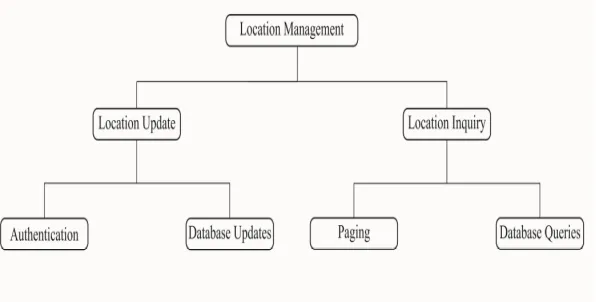
[image:2.612.159.457.375.526.2]In cellular networks the cost factor for location update cost can be defined by the following figure.
Figure 1 : Cost components for Location Management
The total cost will be divided into major two components namely : Location inquiry and Location Update. Location inquiry will be further divided into two components namely : Paging and Database query. Location update will also be further divided into two i.e. Authentication and Database Updates.
From the above cost components following equation can be derived to calculate total cost for particular period at time T. Total cost = C * NLU + NP
Here NLU represents total number of Location Updates during a given period of time. Total number of Paging occurred during given
period of time represented by NP. C represents a constant which we can use for any value. Various location update strategies can be
279
©IJRASET (UGC Approved Journal): All Rights are Reserved
Figure 2: Wireless mobile networks architecture
II. RELATEDWORK
A. Always Update Strategy
When this type of strategy for Location Update has been applied at that time the location of the mobile terminal will get updated as and when it enters into a new cell by changing location from one cell to another. The major benefit of this type of strategy is the location of the mobile terminal is always known and the search operation is not at all required at the time of providing any type of services. This gives a most important benefit and makes the searching or paging cost as zero. On the other hand it creates a problem in which it needs to utilize more number of resources as the location will get updated at each and every cell movement. In other words there is a benefit on one side and loss on other side. Benefit in terms of search / paging cost and loss in terms of Location Update cost. This type of strategy gives benefit under two circumstances i.e. (1) When there is a very low mobility of user and (2) When the cell size is very large.
B. Never Update Strategy
This type of Location Update Strategy is totally reverse or opposite to the Always Update Strategy. In this type of strategy, Mobile terminal's location will never be updated. The major benefit of using this type of strategy is - here the location update cost will be zero because the location would never be updated. There are always two sides of a coin, like that this benefit is only from one side. It creates a problem on second side is here the searching / paging cost would be more because every time mobile object needs to be searched before providing any kind of service. This type of strategy gives benefit under two circumstances i.e. (1) When there is a very high mobility of user and (2) When the cell size is very small.
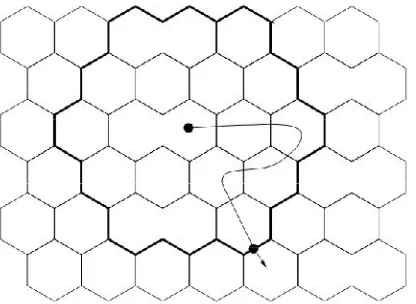
C. Location Update Based on Distance
280
©IJRASET (UGC Approved Journal): All Rights are Reserved
Figure 3 :Location Update based on Distance with value of D=2
D. Location Update based on Time
It is also a very basic and simple location update strategy. In this strategy, the location update initiated by the Base Station. Base station will update the location of mobile node after a specific period of time i.e. T.[1] This type of strategy will be easy to manage as compare to other policies because here the Base Station require to maintain an internal clock at its own level. Here, this time interval i.e. T can also be set with different values for each of the mobile terminal based on the mobile terminal's call arrival pattern and movement pattern. There is also another benefit of using this scheme for location update is its nature of periodic signaling, it can be set-up that the whole network comes to know the details about the mobile node that when a particular mobile node is switch-off or when the mobile node moves outside the coverage area of the Base Station because the Base Station is unable to update the location after a specific period of time. The major drawback of this location update strategy is here, if the mobile node is in non-moving condition then also location update occurs which in turn increases the overall cost for the location update. --- baki Furthermore, mobile users’ location uncertainty cannot be bounded: when a call arrives, the search operation cannot be limited to a set of cells. Similar discussion can be found in [4].
The main advantage of this type of strategy would be that it is not dependant on Location Areas (LA). Another advantage would be lower paging cost because at time t location would definitely update. The main drawback here would be sometimes if the user is stationary at that time unnecessary updates would be performed.[1]
E. Movement Based Location Update Strategy
[image:4.612.206.414.82.234.2]In this strategy the base station needs to keep track of the mobile user for number of cell movements or the number of cell boundary crossing[1]. Here, one counter is managed, it will be set to zero initially, and incremented with 1 each and every time the user crosses the boundary. Now, when the counter becomes>M at that time update is done. Fig. 2.17 shows Movement based location update with M=2. [3] and Fig. 2.18 is an example of the same.
281
©IJRASET (UGC Approved Journal): All Rights are Reserved
F. Profile Based Location Update Strategy
The Profile Based Location Update scheme has been proposed in [5] and [6]. In this scheme each user’s profile would be maintained and from that profile the location of the user would be traced out. The main idea behind this strategy is that the mobility pattern of majority of subscribers could be easily predicted. This type of strategy would be useful when the user is working in same geographical area for maximum hours of his / her daily routines. To find out the probability of the user’s profile location long term statistical data would be useful. To create the profile of each user the following operations could be performed: For each time period (ti, tj), the system maintains a list of location areas, [(a1, p1), (a2, p2), ……., (ak, pk)] here Af is the location area, and Pf is the probability that the subscriber is located in Af. It is assumed that the location areas are ordered by the probability from the highest to the lowest, that is, p1 > p2 > …… > pk. If the subscriber moves within the recorded location areas, a1, a2, …ak, during the corresponding period (ti, tj), the subscriber does not need to perform location update, otherwise the subscriber reports its current location, and the system will track the subscriber as in the classical location area strategy. Therefore location updates could be significantly reduced. Here in this type of scheme the main benefit would be that if we know the user’s location based on its profile and if the user is in that location area only at that time no location update would be required. Sometimes it may happen that user changes his / her daily routine due to some circumstances, at that time we would need to do paging to search the latest location of the user.
G. Hybrid Location Update Strategy
Hybrid Location updates strategy discussed in [7]. In this paper authors have suggested combination of two strategies to reduce the cost. Here they have combined two types of strategies i.e. Time Based and Distance Based. In that they have first used Time Based Location Update and then Distance Based Location Update Separately. After that they have proposed a new scheme i.e. TAN (First T then N) and NAT (First N then T). Through hybrid location update strategy, Location update cost can be saved. TAN means first application of time based and after that application of distance based while in NAT first application of distance based and after that time based.
Another type of Hybrid Location Update discussed in [8]. In this paper authors have suggested combination of two strategies. Here they have combined two type of strategies i.e. Time Based and Movement Based. Through the combination of both the strategies authors have found out optimal sequential paging scheme which will ultimately reduce the location update cost.
III. ALGORITHMFORSELECTINGBESTLOCATIONUPDATESTRATEGY
A. Selection of Best Location Update Strategy
Various existing location update strategies are evaluated with rank based algorithm. Every scenario of a cellular network is evaluated across five parameters: Routing protocol, Number of infrastructure stations, Congestion of Cell, Mobility, Energy and memory saving. Every parameter is a goal and every goal has a support associated with it. If value of a parameter is improved, it can be said that the goal is achieved better. Based on this, all parameters of all scenarios are evaluated for all location update strategies. The location update strategy which has best value of the total goal achievement is ranked 1st. in our results, we have noticed that time based location update strategy performs best as compared to other location update strategies.
B. Parameters for Algorithm
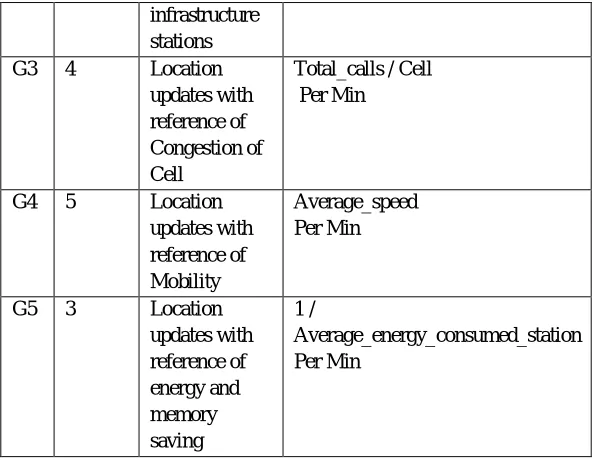
Various parameters which are required to calculate Best Location Update Strategy are given in Table 5.1. These parameters are taken based on the importance of the goal. Each goal has support.
Table 1 : Algorithm Parameters
Id Support Goal Parameters
G1 1 Location
updates with reference of routing protocol
Throughput Per Min
G2 2 Location
updates with reference of Number of
282
©IJRASET (UGC Approved Journal): All Rights are Reserved
infrastructure stations
G3 4 Location
updates with reference of Congestion of Cell
Total_calls / Cell Per Min
G4 5 Location
updates with reference of Mobility
Average_speed Per Min
G5 3 Location
updates with reference of energy and memory saving
1 /
Average_energy_consumed_station Per Min
For each location update strategy L1 to LM with index i Value(Li) = 0
For each scenario S1 to SN with index j Value(LiSj) = 0
For each goal G1 to GP with index k
Value(LiSj) = Value(LiSj)+(Support (Gk)* Value(Gk)) End
Value(Li) = Value(Li) + Value(LiSj) End
End
Note:Here the location update Strategy L, with highest value of Value(L) can be considered as the best location update strategy which has Rank(L) to 1.
[image:6.612.158.455.76.306.2]Various notations used in the above algorithm are explained in below given table.
Table 2 : Notations used in algorithm
Parameter Detail
N Total number of Scenarios
M Total number of Location Update Strategies
P Total number of goals per location update
strategy Support
(Gi)
The Importance of Goal Gi while evaluating a location update strategy
Value (Gi) Value of Goal Gi
Value (LiSj)
Sum value of Li with reference of all goals for a scenario Sj
Value (Li) Sum value of Li with reference of all goals for all scenarios
Rank (Li) Rank of Li location update strategy
283
©IJRASET (UGC Approved Journal): All Rights are Reserved
Table 3 : Results
Scenario id Sj
Policy
Li G1 S1 G2 S2 G3 S3 G4 S4 G5 S5 SjLi
1
Time based
345 1 10 2 5 4 10 5 0.453 3 436.359
2 343 1 20 2 7 4 20 5 0.234 3 511.702
3 278 1 30 2 10 4 30 5 0.123 3 528.369
4 225 1 40 2 18 4 40 5 0.563 3 578.689
5 187 1 50 2 20 4 50 5 0.267 3 617.801
6
Distance based
235 1 10 2 5 4 10 5 0.254 3 325.762
7 233 1 20 2 7 4 20 5 0.111 3 401.333
8 232 1 30 2 10 4 30 5 0.985 3 484.955
9 123 1 40 2 18 4 40 5 0.223 3 475.669
10 232 1 50 2 20 4 50 5 0.137 3 662.411
11
Movement based
234 1 10 2 5 4 10 5 0.647 3 325.941
12 321 1 20 2 7 4 20 5 0.237 3 489.711
13 321 1 30 2 10 4 30 5 0.167 3 571.501
14 126 1 40 2 18 4 40 5 0.753 3 480.259
15 256 1 50 2 20 4 50 5 0.869 3 688.607
From the above calculation, final results are as follows :
Value (Time Based) 2672.92
Value (Distance Based) 2350.13
Value ( Movement Based) 2556.01
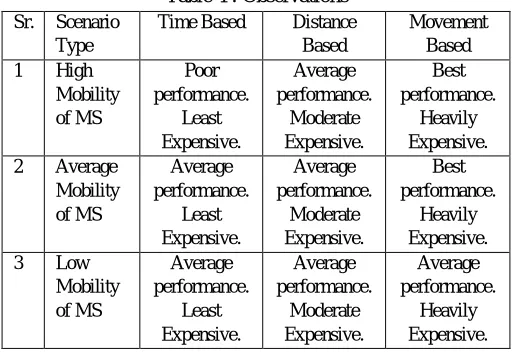
[image:7.612.178.434.481.658.2]From the above values it is easily seen that Value(Time Based Policy) is highest, so we can consider it as best location update strategy in general case. We have tested this algorithm for different 100 scenarios. For simplicity, only 15 different scenarios are considered here. The overall observation has been described in below table.
Table 4 : Observations
Sr. Scenario Type
Time Based Distance
Based
Movement Based
1 High
Mobility of MS Poor performance. Least Expensive. Average performance. Moderate Expensive. Best performance. Heavily Expensive.
2 Average
Mobility of MS Average performance. Least Expensive. Average performance. Moderate Expensive. Best performance. Heavily Expensive.
3 Low
Mobility of MS Average performance. Least Expensive. Average performance. Moderate Expensive. Average performance. Heavily Expensive.
IV. ALGORITHMFORDYNAMICTIMEBASEDLOCATIONUPDATESTRATEGY
A. Dynamic Time-based Location Update Strategy
GSM architecture has various timers to repeat certain events at regular intervals. So far most of the timers have fixed values which don’t change our time as per cellular network situations.
284
©IJRASET (UGC Approved Journal): All Rights are Reserved
Default value of T3210 Timer (Default Gsm Location Update Request Timer) is 10 Seconds Default value of T3211 Timer (Default Gsm Location Update Failure Timer) is 10 Seconds Default value of T3212 Timer (Default Gsm Periodic Location Update Timer) is 360 Seconds
These timers are having static values and they don't change as per cellular network's situations. We are proposing a Dynamic Time-Based Location Update Strategy by calculating values of these timers with reference of the network performance. The main two parameters are used as a part of dynamic timers calculation are, Total No. of Location Updates Attempts– LUA and Total No. of Location Updates Failed – LUF. Based on the Failure Ratio calculated as below various values of Timers are set.
B. Algorithm
To implement dynamic Time Based Location Update Strategy, we have calculated values for the all the three timers dynamically. The proposed algorithm is as follows :
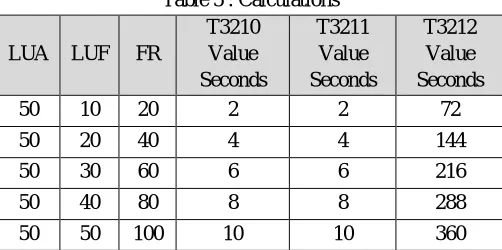
Failure Ratio -FR = (LUF*100)/LUA T3210 = (FR * 10)/100
T3211 = (FR * 10)/100 T3212 = (FR * 360)/100
C. Calculation
[image:8.612.181.432.333.458.2]Following Table explains the calculation for all the above three timers.
Table 5 : Calculations
LUA LUF FR
T3210 Value Seconds
T3211 Value Seconds
T3212 Value Seconds
50 10 20 2 2 72
50 20 40 4 4 144
50 30 60 6 6 216
50 40 80 8 8 288
50 50 100 10 10 360
With all above results we can say that Dynamic Time Based Location Update strategy gives best result and save the network resources. Following table shows the observations taken from various scenarios by applying dynamic time based location update strategy.
Scenario ID Caller1 Caller2
Time Based Location Update Dynamic Time Based Location
Update No. of Location
Update : Caller1
No. of Location Update : Caller2
No. of Location Update : Caller1
No. of Location Update : Caller2
1 7 11 2 2 2 2
2 7 11 2 2 2 3
3 7 11 2 2 2 2
4 7 11 2 2 2 2
5 7 11 2 2 3 3
6 7 11 2 2 2 2
7 7 11 12 5 8 5
8 7 11 6 5 6 5
9 7 11 8 5 8 5
10 7 11 12 6 5 5
285
©IJRASET (UGC Approved Journal): All Rights are Reserved
Scenario ID Caller1 Caller2
Time Based Location Update Dynamic Time Based Location
Update No. of Location
Update : Caller1
No. of Location Update : Caller2
No. of Location Update : Caller1
No. of Location Update : Caller2
11 7 11 6 4 8 6
14 15 2 4 3 4
12 7 11 2 5 3 7
14 15 3 5 3 5
13 7 11 12 6 5 5
14 15 4 4 3 3
8 12 3 3 4 3
14 7 11 6 4 6 4
14 15 10 5 6 5
8 12 4 4 8 4
15 7 11 2 5 8 7
14 15 4 4 4 4
8 12 3 3 3 3
There are the cases where dynamic time based location update scheme performs more location updates than the traditional time based location update scheme. The reason is that in case of good past record of location updates, timers are set to small intervals which facilitate more location updates. Here good past record indicates the cellular network is stable as far as congestion is concerned. This way, we can conclude that dynamic time based location update doesn’t postpone important location updates. There are the cases where dynamic time based location update scheme performs less location updates than the traditional time based location update scheme. The reason is that in case of poor past record of location updates, timers are set to large intervals which facilitate less location updates. Here poor past record indicates the cellular network is not stable as far as congestion is concerned. This way, we can conclude that dynamic time based location update doesn’t increase congestion by sending frequent location updates.
V. CONCLUSION
This research work started with studying the basis of GSM architecture and various associated issues. Various location update schemes like time based location update, movement based location update, distance based location update and profile based location update schemes are studied. Qualnet® simulator is used to simulate GSM scenarios. To identify the best location update strategy so far, research paper and suggestion from the cellular industry is studied. All location update strategies are tested with different scenarios. An algorithm is developed to select best out of all the tested location update strategies. Every scenario of a cellular network is evaluated across five parameters: Routing protocol, Number of infrastructure stations, Congestion of Cell, Mobility, Energy and memory saving. This algorithm shows that in most of the cases, time based location update performs better than rest of the location update schemes. The focus is given to enhance time based location update strategy.
Dynamic time based location update strategy is introduced. GSM architecture has various timers to repeat certain events at regular intervals. So far most of the timers have fixed values which don’t change our time as per cellular network situations. In existing location update strategy, these timers are having static values and they don't change as per cellular network's situations. Dynamic time based location update strategy sets the values of these times as per cellular network’s status. The information about past failures and acceptance of location updates are considered to decide how frequently new location updates should be initiated. There are two main observations are noticed as below.
286
©IJRASET (UGC Approved Journal): All Rights are Reserved
location update scheme. The reason is that in case of poor past record of location updates, timers are set to large intervals which facilitate less location updates. Here poor past record indicates the cellular network is not stable as far as congestion is concerned. . This way, we can conclude that dynamic time based location update doesn’t increase congestion by sending frequent location updates.
The main reason of this research work is to improve overall performance in cellular network by enhancing location update mechanism. The goal is to ensure that only required number of location updates should be done. Very Large number of location updates simply waste network resources and very small numbers of location updates simply skip some important location updates. Dynamic time based location update strategy balances between these two issues.
To efficient testing of this scheme, various real life scenarios are generated as explained in Chapter 4. Scenarios are classified with reference of mobility, congestion and handover. To implement channel limitation, Qualnet®’s built-in channel assignment process is modified so that real life situation can be simulated. Overall it is found that dynamic time based location update strategy is comparatively efficient that the traditional time based location update strategy.
REFERENCES
[1] K. Popat and P. Sharma, "Various Location Update Strategies in Mobile Computing", International Journal of Computer Applications® (IJCA), pp. 34-38, 2014.
[2] J. Zhang and J. Mark, "A local VLR cluster approach to location management for PCS networks", WCNC. 1999 IEEE Wireless Communications and Networking Conference (Cat. No.99TH8466).
[3] M. Ilyas and I. Mahgoub, Mobile computing handbook, 1st ed. Boca Raton: Auerbach Publications, 2005, pp. 200-206.
[4] C. Rose, "Minimizing the average cost of paging and registration: A timer-based method", Wireless Networks, vol. 2, no. 2, pp. 109-116, 1996.
[5] S. Tabbane, "An alternative strategy for location tracking", IEEE Journal on Selected Areas in Communications, vol. 13, no. 5, pp. 880-892, 1995.
[6] G. Pollini and Chih-Lin I, "A profile-based location strategy and its performance", Proceedings of PIMRC '96 - 7th International Symposium on Personal, Indoor, and Mobile Communications.
[7] Goo Yeon Lee, Yong Lee and Z. Haas, "Hybrid Location-Update Scheme for Mobile Networks", IEEE Transactions on Vehicular Technology, vol. 58, no. 1, pp. 338-348, 2009.