Auto-Scale Factor Circuit Realisation for MIMO
Hardware Simulator
Bachir Habib, Gheorghe Zaharia, Ghais El Zein
Institute of Electronics and Telecommunications of Rennes (IETR), Rennes, France Email: [email protected]
Received April 23,2013; revised May 23, 2013; accepted June 1, 2013
Copyright © 2013 Bachir Habib et al. This is an open access article distributed under the Creative Commons Attribution License, which permits unrestricted use, distribution, and reproduction in any medium, provided the original work is properly cited.
ABSTRACT
A hardware simulator reproduces the behavior of the radio propagation channel, thus making it possible to test “on ta-ble” the mobile radio equipments. The simulator can be used for LTE and WLAN 802.11ac applications, in indoor and outdoor environments. In this paper, the input signals parameters and the relative power of the impulse responses are related to the relative error and SNR of the output signals. After analyzing the influence of these parameters on the out-put error and SNR, an algorithm based on an Auto-Scale Factor (ASF) is analyzed in details to improve the precision of the output signals of the hardware simulator digital block architecture. Moreover, the circuit needed for the validation of this algorithm has been introduced, verified and realized. It is shown that this solution increases the output SNR if the relative powers of the impulse responses are attenuated. The new architecture of the digital block is presented and im-plemented on a Xilinx Virtex-IV FPGA. The occupation on the FPGA and the accuracy of the architecture are analyzed.
Keywords: Hardware Simulator; FPGA; MIMO Radio Channel; 802.11ac; LTE
1. Introduction
Tests of a radio communication system, conducted under actual conditions are difficult, because tests taking place on outdoor, for instance, are affected by random move- ments or even by the weather. Thus, to evaluate the per- formance of the recent communication systems, a chan- nel hardware simulator is considered. With hardware simulators, it is possible to very freely simulate desired types of radio channels. Moreover, it provides the neces- sary processing speed and real time performance, as well as the possibility to repeat the tests for any Multi-ple-Input Multiple-Output (MIMO) system.
Over the past few decades, efforts have resulted in several designs and implementation of real time simula- tors. Early efforts were based on analog components [1-4]. The development of real time simulator starts in 1973 when in [1] they developed the first Rayleigh based channel simulator. The simulator used Zener diode to generate Gaussian random variable.
However, with the advent of digital computers, fast Analog-Digital Convertors (ADC) and Digital-Analog Convertors (DAC), the analog components were replaced by digital thereby increasing the reliability and flexibility of simulators. In [5], they first used discrete digital logic in its simulator. With the development of Digital Signal
Processing (DSP), the DSP based simulators were de- veloped. In [6], they used 16 bit fixed point DSP for im- plementation and simulated the Gaussian quadrature components along with the log-normally distributed Line-Of-Sight (LOS) component. In [7], they used DSP chips for the development of a narrow-band simulator. In [8], they reported a frequency selective simulator using DSP and integrated circuits. It had a baseband bandwidth of 10 MHz and maximum Doppler frequency of 100 Hz. In [9], they developed 6 taps wide-band channel simula- tor having maximum signal bandwidth of 20 MHz. It used two 32 bit DSP floating point processors. In [10], they used a hybrid DSP FPGA architecture to build a wide-band channel simulator. It was capable of simulat- ing 12 delay taps and had a baseband bandwidth of 5 MHz. Satellite channel simulator has been developed in [11] using DSP platform. In [12], they developed a nar- row-band fast and accurate simulator. In [13], they de- veloped a 5 MHz 12 taps wide-band simulator using 12 DSPs (1 for each tap) for the generation of complex co-efficients. A narrow-band DSP based channel simulator has also been developed in [14].
capacity, entire baseband systems can be mapped onto faster FPGAs for more efficient prototyping, testing and verification. Larger and faster FPGAs permit the integra- tion of a channel simulator along with the receiver noise simulator and the signal processing blocks for rapid and cost-effective prototyping and design verification. As shown in [15], the FPGAs provide the greatest design flexibility and the visibility of resource utilization. Thus, the FPGA based simulators have also been developed and their implementations have been described [16-23].
Some hardware simulators are proposed by industrial companies like Spirent (VR5) [24] and Elektrobit (Prop- sim F8) [25]. The commercially available channel simu- lators may not offer the user enough flexibility when configuring the wireless channel parameters to test the system under different environmental conditions. More- over, those simulators are often too expensive and there- fore prohibitive for communications laboratory. A low cost channel simulator is therefore required that present different environments and provide the user flexibility to measure the performance of the wireless system under real environmental conditions.
MIMO technology has attracted attention in wireless communications, because it offers significant increases in data throughput and link range without additional band- width or increased transmit power. It achieves this goal by spreading the same total transmitter power over the antennas to achieve an array gain that improves the spec- tral efficiency (more bits per second per hertz of band- width) and/or to achieve a diversity gain that improves the link reliability (reduced fading). Because of these properties, MIMO is an important part of modern wire- less communication standards such as Wireless Local Area Network (WLAN) 802.11ac and Long Term Evolu-tion (LTE). Thus, a 2 × 2 MIMO channel is considered in this paper.
The objective of our work concerns the channel mod- els and the digital block of the simulator. The design of the RF blocks was completed in a previous project [17,26].
The channel models can be obtained from standard channel models, as the TGn IEEE 802.11n [27] and the 3GPP-LTE models [28], or from real measurements conducted with the MIMO channel sounder designed and realized at IETR [29]. In the MIMO context, little ex- perimental results have been obtained regarding time- variations, partly due to limitations in channel sounding equipment [30]. However, theoretical models of impulse responses of time-varying channels can be obtained using Rayleigh fading [31,32].
The MIMO hardware simulator realized at IETR is reconfigurable with sample frequencies not exceeding 200 MHz, which is the maximum value for FPGA Virtex-IV. The 802.11ac signal provides a sample fre-
quency of 200 MHz. Thus, it is compatible with the FPGA Virtex-IV. However, in order to exceed 200 MHz for the sample frequency, more performing FPGA as Virtex-VII can be used [33]. At IETR, several architec- tures of the digital block of a hardware simulator have been studied, in both time and frequency domains [34,35]. Typically, wireless channels are commonly simulated using finite impulse response (FIR) filters, as in [21,36,37]. The FIR filter output signal is a convolu- tion between a channel impulse response and a fed signal in such a manner that the signal delayed by different de- lays is weighted by the channel coefficients, i.e. tap coef- ficients, and the weighted signal components are summed up. The channel coefficients are periodically modified to reflect the behavior of an actual channel. Nowadays, different approaches have been widely used in filtering, such as distributed arithmetic (DA) and ca- nonical signed digits (CSDs) [20].
Using FIR filter in a channel simulator has however a limitation. With a FPGA Virtex-IV, it is impossible to implement a FIR filter with more than 192 multipliers (impulse response with more than 192 taps). To simulate an impulse response with more than 192 taps, the Fast Fourier Transform (FFT) module can be used. With a FPGA Vitrex-IV, the size NF of the FFT module can
reach 65536 samples. Thus, several frequency architec- tures have been considered and tested [20]. However, their disadvantages are high latency and high occupation on FPGA. Moreover, the considered frequency architec- tures operate correctly for signals not exceeding the FFT size. Thus, new frequency architecture avoiding this limitation has been presented and tested in [38]. In this paper, the number of taps is limited to 18 for each SISO channel, thus, to 18 × 4 taps for the 2 × 2 MIMO channel. Therefore, the time domain architecture is considered because the total number of taps does not exceed 192.
on a higher number of bits in order to decrease the error at the output. Moreover, the received signal is divided by the correct ASF to obtain the correct output. Thus, a cir- cuit is introduced which control the input and output signals powers for each sample. The circuit are presented, designed and tested.
Tests are made with input signal that respects the bandwidth chosen between [Ä, B + Ä] and by considering 2 × 2 MIMO architecture. In fact, the channel impulse responses can be presented in baseband with its complex values, or as real signals with limited bandwidth B be- tween fc − B/2 and fc + B/2, where fc is the carrier fre-
quency. In this paper, to eliminate the complex multipli- cation and the fc, the hardware simulation operates be-
tween Ä and B + Ä, where Ä depends on the band-pass filters (RF and IF). The value Ä is introduced to prevent spectrum aliasing. In addition, the use of a real impulse response allows the reduction by 50% of the size of the FIR filters and by 4 the number of multipliers. Thus, within the same FPGA, larger MIMO channels can be simulated.
The rest of this paper is organized as follows. Section 2 presents the channel models used for the test. Section 3 describes the simple and the ASF-based time domain architecture of the simulator digital block. In Section 4, the accuracy of the output signals of the architecture are analyzed in term of occupation on the FPGA and preci- sion of the output signals. Lastly, Section 5 gives con- cluding remarks and prospects.
2. Channel Description
A MIMO propagation channel is composed of several time variant correlated SISO channels. For MIMO 2 × 2 channel, the received signals yj(t,τ) can be calculated
us-ing a convolution :
, 1
1
, 2
2
1, 2j j
y t x h t x h t
j
, ,
j
, ,
j
(1)
The associated spectrum is calculated by the Fourier transform (using FFT modules):
, 1
1
, 2
2
1, 2j j
Y t f X f H t f X f H t f
j
(2)
The development of the digital block of a channel hardware simulator requires a good knowledge of the propagation channel. The different models of channels presented in literature used to apprehend as faithfully as possible the behavior of the channel.
Two channel models are considered to cover indoor and outdoor environments: the TGn channel models (in-door) and the 3GPP-LTE channel models (out(in-door). Moreover, using the channel sounder realized at IETR, measured impulse responses are obtained for specific
environments: shipboard, outdoor-to-indoor.
2.1. TGn Channel Models
TGn channel models [27] have a set of 6 profiles, labeled A to F, which cover all the scenarios. Each model has a number of clusters. For example, model E has four clus- ters. Each cluster corresponds to specific tap delays, which overlaps each other in certain cases. Reference [27] summaries the relative power of the impulse responses for TGn channel model E by taking the LOS impulse response as reference. According to the standard (WLAN 802.11ac) and its bandwidth, the sampling frequency is fs
= 165 MHz and the sampling period is Ts = 1/fs.
2.2. 3GPP-LTE Channel Models
3GPP-LTE channel models are used for mobile wireless applications. A set of 3 channel models is used to simulate the multipath fading propagation conditions. A detailed description is presented in [28]. For LTE signals, fs = 50
MHz.
2.3. Time-Varying Channels
In this section, we present the method used to obtain a model of a time variant channel, using Rayleigh fading [39] and based on Kronecker model [40]. The Doppler frequency fd is equal to:
c d
f v f
c
(3)
where c is the celerity and v is the environmental speed. We have chosen a refresh frequency fref > 2fd to respect
the Nyquist-Shannon sampling theorem.
For an indoor environment (TGn model E for exam- ple), at fc = 5 GHz and v = 4 km/h, fd = 18.51 Hz. Thus,
we have chosen fref = 40 Hz. For an outdoor environment
(3GPP-LTE model EVA for example), at fc = 1.8 GHz
and v = 80 km/h, fd = 133.27 Hz. Thus, we have chosen
fref = 300 Hz.
The MIMO channel matrix H can be characterized by two parameters:
1) The relative power Pc of constant channel com-
ponents which corresponds to the LOS.
2) The relative power Ps of the channel scattering
components which corresponds to the Non-Line-Of-Sight (NLOS).
The ratio Pc/Ps is called Ricean K-factor. Assuming
that all the elements of the MIMO channel matrix H are Rice distributed, it can be expressed for each tap by:
c F s v
H P H P H (4)
where HF and HV are the constant and the scattered
The total relative received power P = Pc + Ps.
There-fore:
1
c
K
P P
K
(5)
1 1
s
P P
K
(6)
If we combine (5) and (6) in (4) we obtain:
1
1 F 1
K
H P H H
K K
V (7)
To obtain a Rayleigh fading channel, K is equal to zero, so H can be written as:
V
H P H (8) P is derived from [27,28] for each tap of the consid-ered impulse response. For 2 transmit and 2 receive an-tennas:
11 12
21 22
X X
H P
X X
(9)
where Xij (i-th receiving and j-th transmitting antenna)
are correlated zero-mean, unit variance, complex Gaus-sian random variables as coefficients of the variable NLOS (Rayleigh) matrix HV.
To obtain correlated Xij elements, a product-based
model is used [40]. This model assumes that the correla-tion coefficients are independently derived at each end of the link:
1/2
1/2
Tr w t
X R H R (10)
Hw is a matrix of independent zero means, unit
vari-ance, complex Gaussian random variables. Rr and Rt are
the receive and transmit correlation matrices. They can be written by:
*
1 1
,
1 1
t r
R R *
(11)
where is the correlation between channels at two receives antennas, but originating from the same transmit antenna (SIMO). In other words, it is the correlation be- tween the received power of channels that have the same Angle of Departure (AoD). is the correlation coeffi- cient between channels at two transmit antennas that have the same receive antenna (MISO).
The use of this model has two conditions:
1) The correlations between channels at two receive (resp. transmit) antennas are independent from the Rx (resp. Tx) antenna.
2) If s1, s2 are the cross-correlation between antennas
of the same side of the link, then:
s1 .
s2 .
For the uniform linear array, the complex correlation coefficients and are expressed by :
xx xy
R D j R D
(12) where D = 2πd/λ, d = 0.5λis the distance between two successive antennas, λ is the wavelength and Rxx and Rxy
are the real and imaginary parts of the cross-correlation function of the considered correlated angles:
π
πcos sin d
xx
R D
D PAS (13)
π
πsin sin d
xy
R D
D PAS (14) The Power Angular Spectrum (PAS) closely matchs the Laplacian distribution [41,42]:
1 2e 2
PAS
(15)
where σ is the standard deviation of the PAS (which cor-responds to the numerical value of AS).
3. Digital Block Architecture
In this section, the architecture of the digital block of the hardware simulator is presented. First, the simple time domain architecture is described, and then the ASF-based architecture is presented and analyzed.
3.1. Simple Time Domain Architecture
We simulate 2 × 2 MIMO channel. Therefore, four FIR filters are considered to present the four SISO channels. For each channel, the FIR width and the number of used multipliers are determined by the taps of each channel. 4 FIR filters with 18 multipliers each are considered. Fig-ure 1 presents two SISO channels of the time domain
architecture based on FIR 147 filter with 18 multipliers. We have developed our own FIR filter instead of using Xilinx MAC FIR filter to make it possible to reload the FIR filter coefficients. The general formula for a FIR filter with 18 multipliers is:
18
1
,
q q k q k
k
y i h i x i i i N
(16)In this relation, the index q suggests the use of quanti- fied samples and hq(ik) is the attenuation of the kth path
with the delay ikTs.
18 of 147
18 of 147
14 bits
16 bits
16 bits
1
2
18
35 bits x1
14 bits 14 bits 14 bits
16 bits
t = Tref
t = 0
01010011001100
N = 14 bits M = 36 bits
y1
14 bits
36 bits
x2
14 bits
35 bits n(i) n(i-1) n(i-2) ---
h11(0) h11 (1) h11 (2) --- h11
h11 (0) h11 (1) h11 (2) --- h11
000001010011001100001…
[image:5.595.137.450.86.391.2]FIR filter with h21
Figure 1. FIR 147 with 23 multipliers for one h11 andh21.
sample. Moreover, 36 − 14 = 22 bits will be eliminated. Thus, instead of an output sample y, we obtain y 2m
,
where is the biggest integer number smaller or equal to u.
u
However, for low voltages, the brutal truncation gen- erates zeros to the input of the DAC. Therefore, a better solution is the sliding truncation (ST) presented in Fig- ure 1 which uses the 14 most significant bits. This solu-
tion modifies the output sample values. Therefore, the use of a reconfigurable amplifier after the DAC must be used to restore the correct output value. It must be di- vided by the corresponding sliding factor.
3.2. ASF-Based Time Domain Architecture
3.2.1. Why Using an ASF-Based Architecture?
To present the cause of using ASF-based time domain architecture, we related the input signals parameters and the relative power of the impulse responses to the relative error and SNR of the output signals. After analyzing the influence of these parameters on the output error and SNR, an improvement algorithm based on an Auto-Scale Factor ASF is proposed and analyzed in details.
In order to determine the accuracy of the digital block, a comparison is made between the theoretical/Xilinx output signals. An input Gaussian signal x(t) is consid-ered for the two inputs of the 2 × 2 MIMO simulator. To
simplify the calculation, we consider x(t) = x1(t) = x2(t):
2 2
2
1 2 e , 0
x
x t m
m t
x t x t x t x t W
(17)
In fact, the FT of a Gaussian signal is also Gaussian signal, and to obtain a signal x(t) that respect the band-width
, B
, the following steps are considered:In frequency domain, the Gaussian input signal
X f FT x t is computed by:
2 π 2 22π
2πe f xe j fmx
m x
X f x (18) with
2 π 2 22πe f x m x
X f x (19)
This signal spectrum is limited between and B
if:
6X B (20)
where X is the standard deviation of X f
.Com-paring the first and the third equation, we obtain:
2π X x 1 (21)
Thus, x that corresponds to the considered band of
the standard used, is obtained:
3
π x
B
To obtain x(t) centered between
, B
, it must be multiplied by:
cos 2π2
B x t x t t
(23)
In our work, we considered x 3 πB. mx is chosen
equal to 20Ts 3x for both WLAN 802.11ac and LTE signals. Moreover, is chosen equal 2 MHz. These values are small enough to show the effect of each tap on the output signal. The
B
ADC and DAC converters of the development board have a full scale [−Vm,Vm],
with Vm = 1 V. For the simulations, we consider xm =
Vm/2.
For WLAN 802.11ac, B = 80 MHz and Ts = 1/fs = 6 ns.
Thus, we obtain x 2 .Ts This signal is named xWLAN(t)
and is presented in Figure 2.
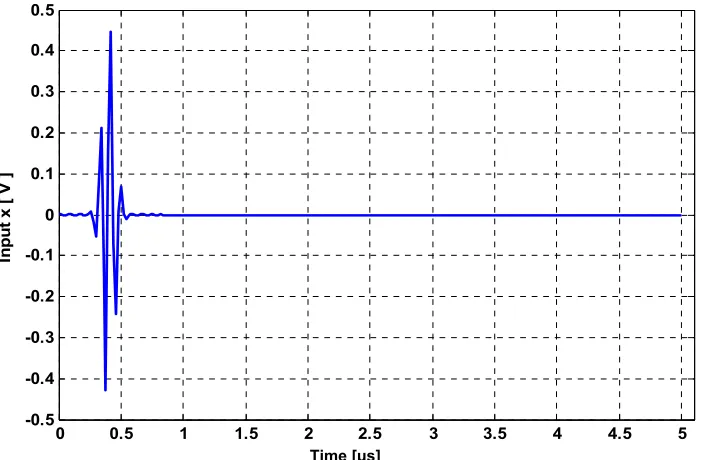
For LTE, B = 20 MHz and Ts = 1/fs = 20 ns. Thus, we
obtain x = 2.5Ts. This signal is named xLTE(t) and is
presented in Figure 3.
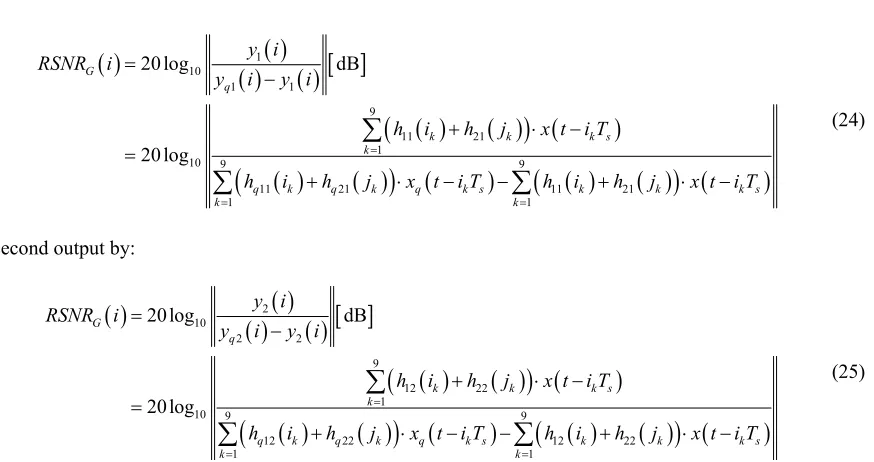
The global output SNR can be affected by the input signal and the impulse response. The output global SNR of the first output is calculated by:
0 0.2 0.4 0.6 0.8 1 1.2 1.4 1.6
-0.4 -0.3 -0.2 -0.1 0 0.1 0.2 0.3 0.4 0.5
In
p
u
t x
[ V
]
[image:6.595.132.468.233.457.2]Time [μs]
Figure 2. Input signal for WLAN 802.11ac for the 2 × 2 time domain architecture.
0 0.5 1 1.5 2 2.5 3 3.5 4 4.5 5
-0.5 -0.4 -0.3 -0.2 -0.1 0 0.1 0.2 0.3 0.4 0.5
In
p
u
t
x [
V
]
Time [μs]
[image:6.595.125.476.485.715.2]
1 10
1 1
9
11 21
1
10 9 9
11 21 11 21
1 1
20 log dB
20 log G
q
k k k s
k
q k q k q k s k k k s
k k
y i RSNR i
y i y i
h i h j x t i T
h i h j x t i T h i h j x t i T
(24)
and for the second output by:
2 10
2 2
9
12 22
1
10 9 9
12 22 12 22
1 1
20log dB
20log G
q
k k k s
k
q k q k q k s k k k s
k k
y i RSNR i
y i y i
h i h j x t i T
h i h j x t i T h i h j x t i T
(25)
where hq and xq are the quantified impulse responses and
input signal respectively.
The parameters of the input signal that have an impact on the output global SNR are: xm, , Wt and nx, where
nx is the number of bits of the input signal. However, nx
is fixed by the ADC by 14 bits. Thus, it won’t be consid-ered in the study.
If xm decreases, then x decreases. Thus, x will be
quantified on lower number of bits. Therefore, the global SNR decreases. Figure 4 presents the global output SNR
versus xm for the TGn model E and for 3GPP-LTE model
EVA respectively.
[image:7.595.106.543.70.301.2]If decreases, then more samples of the input signal x will be quantified on lower number of bits. Therefore, the global SNR decreases. The amount of the low values of x is related to and Wt.
Figure 5 presents the global output SNR versus
for the TGn model E and for 3GPP-LTE model EVA respectively.
After a simple calculation, we notice that and Wt
are linear related, as presented in Figure 6.
Thus, we define a factor Fx equal to the null part of x:
6
x t
F W (26)
If Wt increases or/and decreases, Fx increases
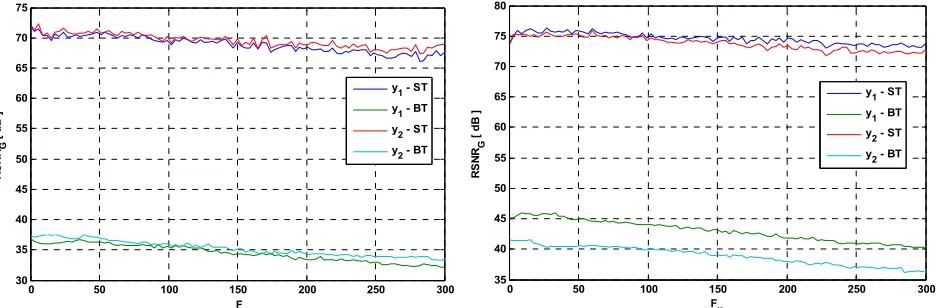
which leads to a large interval of small values of x. Thus, the global SNR decreases. Figure 7 presents the global
output SNR versus Fx.
The number of bits of the impulse response (h) has an impact on the output SNR. In fact, quantifying h on lower number of bits decreases the global output SNR.
Figure 8 presents the output global SNR versus nh,
where nh is the number of bits of h.
3.2.2. ASF-Based Architecture Description
After analyzing the global relative SNR, we conclude that it is high only for high values of the input signals
0 0.1 0.2 0.3 0.4 0.5 0.6 0.7 0.8 0.9 1
0 10 20 30 40 50 60 70 80
xm [ V ]
RS
NR
G
[ d
B ]
y1 - ST y1 - BT y2 - ST y2 - BT
0 0.1 0.2 0.3 0.4 0.5 0.6 0.7 0.8 0.9 1
0 10 20 30 40 50 60 70 80
xm [ V ]
RS
NR
G
[
d
B
]
y1 - ST y1 - BT y2 - ST y2 - BT
[image:7.595.64.539.555.716.2]0 20 40 60 80 100 120 140 160 180 200 20
30 40 50 60 70 80
Sigma [ Tss ]
RS
NR
G
[ d
B
]
y1 - ST y1 - BT y2 - ST y2 - BT
0 20 40 60 80 100 120 140 160 180 200
30 35 40 45 50 55 60 65 70 75 80
Sigma [ Tss ]
RS
NR
G
[
d
B
]
[image:8.595.65.536.85.236.2]y1 - ST y1 - BT y2 - ST y2 - BT
Figure 5. Global SNR versus σ for TGn model E and 3GPP-LTE model EVA respectively.
100 200 300 400 500 600 700 800 900 1000
0 200 400 600 800 1000 1200 1400
Sigma [ Tss ] Wt
[
Ts
[image:8.595.155.437.270.443.2]s ]
Figure 6. Wt versusσfor the input signal.
0 50 100 150 200 250 300
30 35 40 45 50 55 60 65 70 75
Fx
RS
NR
G
[ d
B
]
y1 - ST y1 - BT y2 - ST y2 - BT
0 50 100 150 200 250 300
35 40 45 50 55 60 65 70 75 80
Fx
RS
NR
G
[ d
B
]
y1 - ST y1 - BT y2 - ST y2 - BT
Figure 7. Global output SNR versus Fx for TGn model E and 3GPP-LTE model EVA respectively.
and the impulse response. Therefore, to decrease the er-ror at the simulator output signals, it is better to consider a large number of bits in the architecture for the input signals and for the impulse response.
In the context of mobile radio, the input signals and the impulse response cannot be predicted and they can
[image:8.595.66.534.476.630.2]makes it possible to quantify them on a higher number of bits in order to decrease the error at the output. Moreover, the received signal is divided by the correct ASF to ob- tain the correct output.
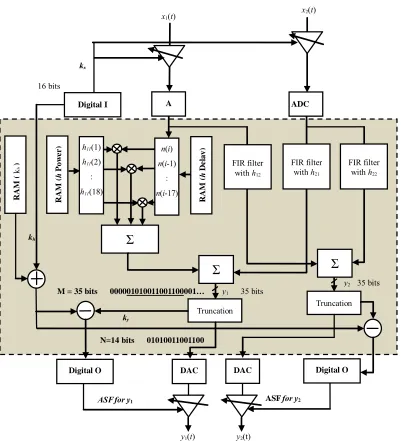
Figure 9 presents the global ASF diagram. This dia-
gram will be described and analyzed in details. The new 2 × 2 MIMO ASF-based architecture is presented in Fig- ure 10.
The two signals x1(t) and x2(t) are the input signals of
the 2 × 2 MIMO channel, and the two signals y1(t) and
y2(t) are the output signals.
The colored large block is the programmable digital part (Virtex-IV) of the hardware simulator. “I” stands for Input and “O” for Output.
The maximum voltage supported by the ADC is 1 V. If x1 < 0.25 V, it is multiplied by 2kx1 where kx1 is the
integer verifying:
1
1
1 2
2
x
k
x
1 (27)
with
1 2
1
1
log 1
x k
x
(28)
In the same way, If x2 < 0.25 V, it is multiplied by
where
2
2kx
2
x
k is the integer verifying:
2
2
1 2 2
x
k
x 1
(29)
with
1 2
2
1
log 1
x k
x
(30)
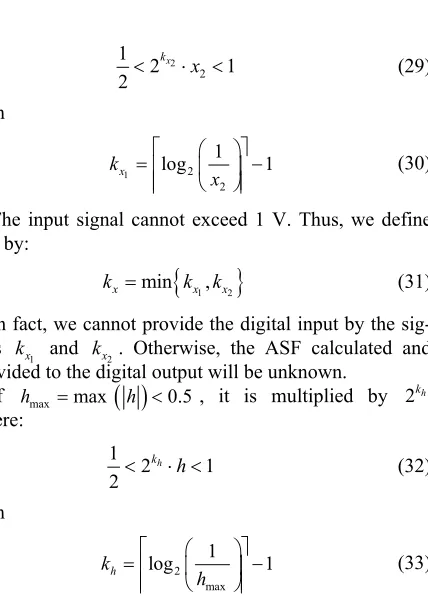
The input signal cannot exceed 1 V. Thus, we define
x k by:
1 2
min ,
x x
k k kx (31) In fact, we cannot provide the digital input by the sig-nals kx1 and kx2. Otherwise, the ASF calculated and provided to the digital output will be unknown.
If hmax max 0.5
h , it is multiplied by where:2kh
1 2 2
h
k h 1
(32)
with
2 max
1
log 1
h k
h
(33)
kh is determined for every MIMO profile and it is
saved in a RAM block in the FPGA. A gain controlled amplifier is placed before the ADC to control the input
0 5 10 15 20 25 30
0 10 20 30 40 50 60 70 80
nh [ bit ]
RS
N
RG
[
d
B
]
y1 - ST y1 - BT y2 - ST y2 - BT
0 5 10 15 20 25 30
0 10 20 30 40 50 60 70 80
nh [ bit ]
RS
NR
G
[ d
B
]
[image:9.595.62.534.416.574.2]y1 - ST y1 - BT y2 - ST y2 - BT
Figure 8. Global output SNR versus nh for TGn model E and 3GPP-LTE model EVA respectively.
kx
ASF for y1
ADC DAC
ASF for y2
FPGA
ADC DAC
[image:9.595.142.457.608.715.2]N=14 bits 01010011001100 16 bits
ASFfor y1 ASFfor y2 y1 35 bits
y2 35 bits
y1(t) y2(t)
x1(t)
ky
kh
M = 35 bits 000001010011001100001…
Truncation
Σ
RA
M
(
h
Pow
e
r
) h11(1)
h11(2)
:
h11(18)
n(i)
n(i-1) :
n(i-17)
RA
M
(
h
De
la
y)
kx
A
RA
M
(
kh
)
Σ
DAC Digital O
Truncation
Σ
Digital O Digital I
DAC
x2(t)
ADC
FIR filter with h12
FIR filter with h21
[image:10.595.99.500.81.522.2]FIR filter with h22
Figure 10. Principle scheme using ASF.
signals by kx before sending it to the FPGA. Also, con-
trolling the power of the input signal at a sampling period smaller than the sampling period of the FPGA is not easy (or realistic). Thus, kx is provided for a package of
input samples.
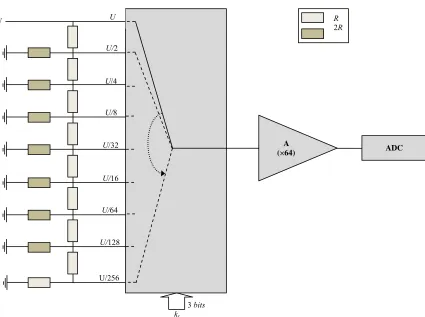
Figure 11 describes the electronic ship that we devel-
oped to control the input signals by kx. The figure pre-
sent one control amplifier for one input signal. U is the initial power of the input signal and R are resistances.
In the case of a brutal truncation, ASFkhkxkb
where b is the fixed brutal truncation equal to 235−14 =
221 (35 bits for the output before truncation and 14 bits
for the output after truncation). Moreover, a better solu-tion is the sliding truncasolu-tion, described previously, that selects the most significant bits. The
k
ADC and the DAC
have a resolution of 14 bits. In this case, if the output signals are presented on more than 14 bits, the sliding factor has to be considered to obtain the correct output signal. Thus,
2ky
x h y, and using just
the ASF on h, h y
k k
k
k A FS
k
ASF . The resulting ASF is sent to a gain controlled amplifier to restore the true value of the output signals, as presented in the figure of the global diagram of the ASF. The first MSB bit defines the multi- plication or the division by 2ASF.
A FPGA Virtex-IV provides 34 pins (digital I/O) Ad- jacent Bus Header on the motherboard of the FPGA. This will provides 28 direct bi-directional connections to the main user FPGA. The remainder of the pins provides a 3.3 V connection, a GND connection and they are o-Connects (NC). Thus, kx provided to the input of the
U/256
U/128
U/64
U/32
U/8
U/4
U/2
R 2R U
U
U/16
ADC
3 bits kx
[image:11.595.90.515.78.395.2]A (×64)
Figure 11. Electronic ship to control the input signal.
FPGA and the two ASF provided to the outputs y1 and y2
are quantified on 9 bits. In fact, as presented in the pre- vious figure, 3 bits for the quantification is sufficient for this work. The input (output resp.) signal can be multi- plied (divided resp.) by 3 which is about 25 dB. Higher than 25 dB, the noise undergoes the ASF process and it will grow significantly.
2
2 256
4. Accuracy Evaluation
4.1. Occupation on FPGA
The Xtreme DSP Virtex-IV board from Xilinx [33] is used for the implementation. The XtremeDSP features dual-channel high performance ADCs (AD6645) and DACs (AD9772A) with 14-bit resolution, a user pro- grammable Virtex-IV FPGA, programmable clocks, support for external clock, host interfacing PCI, two banks of ZBT-SRAM, and JTAG interfaces. The simula- tions and synthesis are made with Xilinx ISE [33] and ModelSim software [43].
The 2 × 2 MIMO architectures are implemented in the FPGA Virtex-IV which has 2 ADC and 2 DAC, it can be connected to only 2 down-conversion and 2 up conver- sion RF units. To test a higher order MIMO array, the use of more performing FPGA as Virtex-VII [33] is recommended.
In the FPGA, the clock is controlled by a Virtex-II which is connected to the Virtex-IV.
As the development board has 2 ADC and 2 DAC, it can be connected to only 2 down-conversion and 2 up- conversion RF units. Four FIR filters are needed to simulate a one-way 2 × 2 MIMO radio channel. The oc- cupancy of the time domain architecture is known after performing operations of synthesis, mapping, place and route from the program written in VHDL.
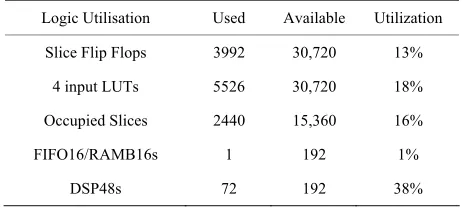
Table 1 shows the device utilization in one Virtex-IV
SX35 for 2 × 2 MIMO channel using the time domain architecture for the TGn channel model E, with their ad- ditional circuits used to dynamically reload the channel coefficients.
Table 2 shows the device utilization in one Virtex-IV
SX35 for 2 × 2 MIMO channel using the time domain architecture for the 3GPP-LTE model EVA.
We notice that the occupation of slice on the FPGA of a 2 × 2 MIMO system is 16% for the TGn channel model E and 16% for the 3GPP-LTE model EVA. In fact, these occupations are equal to the occupations of a SISO channel multiplied by four and with additional slices added because of the two digital adders that operates y11
+ y21 and y12 + y22. Moreover, the 2 × 2 MIMO system
Table 1. Virtex-IV utilization summary for the 2 × 2 MIMO simple time domain architecture, for TGn model E.
Logic Utilisation Used Available Utilization
Slice Flip Flops 3992 30,720 13%
4 input LUTs 5526 30,720 18%
Occupied Slices 2440 15,360 16%
FIFO16/RAMB16s 1 192 1%
[image:12.595.308.538.112.215.2]DSP48s 72 192 38%
Table 2. Virtex-IV utilization summary for the 2 × 2 MIMO simple time domain architecture, for 3GPP-LTE model EVA.
Logic Utilisation Used Available Utilization
Slice Flip Flops 3296 30,720 11%
4 input LUTs 4097 30,720 14%
Occupied Slices 1891 15,360 13%
FIFO16/RAMB16s 1 192 1%
DSP48s 36 192 19%
the 3GPP-LTE model EVA (because for TGn channel model E the number of multiplier is equal to 18 × (4 × 4) = 288 >192). However, we are limited by the 2 ADC and the 2 DAC.
Table 3 shows the device utilization in one Virtex-IV
[image:12.595.309.539.262.366.2]SX35, after performing operations of synthesis, mapping, place and route, for 2 × 2 MIMO channel using the ASF-based time domain architecture for the TGn channel model E.
Table 4 shows the device utilization in one Virtex-IV
SX35 for 2 × 2 MIMO channel using the ASF-based time domain architecture for the 3GPP-LTE model EVA.
We notice that the occupation of slice on the FPGA using the ASF-based architecture increases about just 1%. However, as we will see in the next section, the precision of the output signals increase significantly.
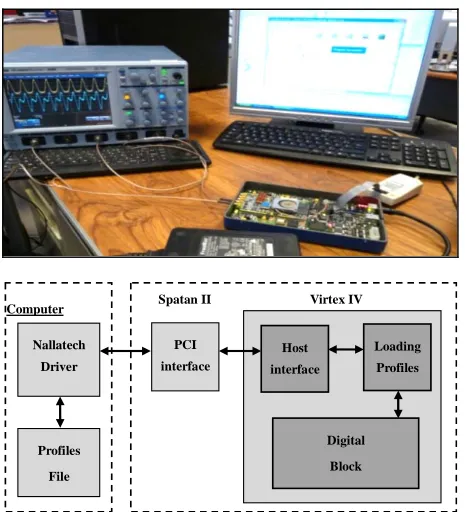
The channel impulse responses are stored on the hard disk of the computer and read via the PCI bus and then stored in the FPGA dual-port RAM. Figure 12 shows the
connection between the computer and the FPGA board to reload the coefficients. The successive profiles are con-sidered for the test of a 2 × 2 MIMO time-varying chan-nel.
The maximum data transfer of the impulse responses is: 18 × 4 = 72 words of 16 bits = 162 bytes to transmit for a MIMO profile, which is: 162 × fref(Bps). fref depends
on the environment.
The MIMO profiles are stored in a text file on the hard disk of a computer. This file is then read to load the memory block which will supply RAM blocks on the
Table 3. Virtex-IV utilization summary for the 2 × 2 MIMO ASF-based time domain architecture, for TGn model E.
Logic Utilisation Used Available Utilization
Slice Flip Flops 4124 30,720 14%
4 input LUTs 5745 30,720 19%
Occupied Slices 2601 15,360 17%
FIFO16/RAMB16s 2 192 2%
[image:12.595.56.287.263.365.2]DSP48s 72 192 38%
Table 4. Virtex-IV utilization summary for the 2 × 2 MIMO ASF-based time domain architecture, for 3GPP-LTE model EVA.
Logic Utilisation Used Available Utilization
Slice Flip Flops 3425 30,720 12%
4 input LUTs 4347 30,720 15%
Occupied Slices 2074 15,360 14%
FIFO16/RAMB16s 2 192 2%
DSP48s 36 192 19%
simulator (one block for each tap of the impulse re- sponse). Each block RAM has a memory of 64 (kB), thus 512 (kbits). The impulse responses are quantified on 16 bits, therefore, up to 32,000 MIMO profiles can be sup- plied in the RAM blocks. Each environment needs 4 blocks RAM for the power of the impulse responses and 4 blocks for the delays, which is a total of 8 blocks RAM. Reading the file can be done either from USB or PCI interfaces, both available on the used prototyping board. The PCI bus is chosen to load the profiles. It has a speed of 30 (MB/s). In addition, this is a bus of 32 (bits). Thus, on each clock pulse two samples of the impulse response are transmitted.
The Nallatech driver in Figure 12 provides an IP sent
directly to the “Host Interface” that reads it from the PCI bus and stores these data in a FIFO memory. The module called “Loading profiles” reads and distributes the im- pulse responses in “RAM” blocks. While a MIMO pro- file is used, the following profile is loaded and will be used after the refresh period.
4.2. Output Signal Precision
In order to determine the accuracy of the digital block, a comparison is made between the theoretical and the Xil-inx output signals.
Spatan II Virtex IV Computer Nallatech Driver Profiles File PCI interface Digital Block Host interface Loading Profiles
Figure 12. Connection between the computer and the XtremeDSP board.
1
1
1
100 % for output1 q
y i y i
RE i
y i
(34)
2
2
2
100 % for output2 q
y i y i
RE i
y i
(35)
where yq1 and yq2 is the vector containing the samples of
the Xilinx output signals, and y1 and y2 are the theory
output signals. i1,L i Final and iFinal is computed by
for the two outputs by:
max11 max 21,
for output1Final
i i i (36)
max12,max 22
for output2Final
i i i (37)
where
imax11 = the index of the last tap ≠ 0 of h11
imax21 = the index of the last tap ≠ 0 of h21
imax12 = the index of the last tap ≠ 0 of h12
imax22 = the index of the last tap ≠ 0 of h22
The relative SNR is computed for the two outputs by:
1
101 1
20 log dB for output1
q y i RSNR i
y i y i
(38)
2
102 2
20 log dB for output2
q y i RSNR i
y i y i
(39)
The global values of the relative error and SNR com-puted for the output signals after the final truncations are necessary to evaluate the accuracy of the architecture.
The global relative error is computed for the two outputs by:
1 1
1
100 % for output1
q G
y i y i
RE
y i
(40)
2 2
2
100 % for output2
q G
y i y i
RE
y i
(41)
The global SNR is computed by:
1
101 1
20 log dB
for output1 G
q y i RSNR i
y i y i
(42)
2
102 2
20 log dB
for output2 G
q y i RSNR i
y i y i
(43)
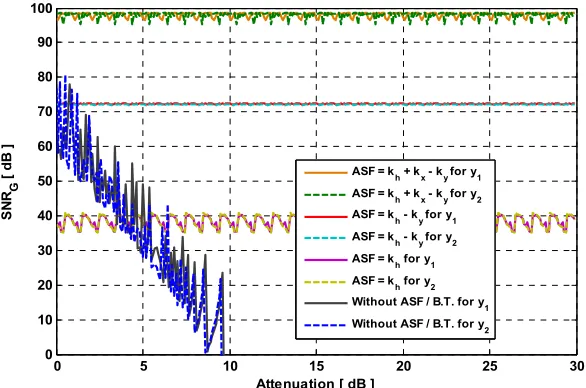
Figure 13 presents the effect of the ASF on the global
output SNR versus the attenuation of the impulse re- sponse h using TGn channel model E. Figure 14 presents
the variation of h and y versus the attenuation of h using
k k
TGn channel model E.
Figure 15 presents the effect of the ASF on the global
output SNR versus the attenuation of h using 3GPP-LTE channel model EVA. Figure 16 presents the variation of
h and ky rsus the attenuation of h using
k ve 3GPP-LTE
channel model EVA.
Using all the coefficient of ASF, the output global SNR achieve 100 dB and it remains above 97 dB for high attenuation of h. Moreover, 80 dB is considered as a high accuracy. Thus, the number of bits in the architecture can be decreased to obtain an output global SNR of 80 dB and a lower occupation on the FPGA to simulate higher order MIMO channels. Also, the result shows the benefit of the ST on the BT.
Table 5 presents the new values of the global output
SNR before and after using ASF.
We notice that after adding ASF, the global output SNR increases significantly.
5. Conclusions
[image:13.595.318.541.115.306.2]0 5 10 15 20 25 30 0
10 20 30 40 50 60 70 80 90 100
Attenuation [ dB ]
SN
RG
[
d
B
]
ASF = kh + kx - ky for y1
ASF = kh + kx - ky for y2 ASF = kh - ky for y1 ASF = kh - ky for y2
ASF = kh for y1
ASF = kh for y2 Without ASF / B.T. for y1
[image:14.595.152.445.86.280.2]Without ASF / B.T. for y2
Figure 13. ASF impact on global SNR versus the attenuation of h using TGn model E.
0 5 10 15 20 25 30
0 2 4 6 8 10
Attenuation [ dB ]
A
S
F p
ara
m
et
ers
v
ari
at
io
n
ky1 before ASF ky2 before ASF ky1 using ASF ky2 using ASF kh
y1
y2
y1
[image:14.595.152.444.312.457.2]y2
Figure 14. ASF parameters impact versus the attenuation of h using TGn model E.
0 5 10 15 20 25 30
0 10 20 30 40 50 60 70 80 90 100
Attenuation [ dB ]
SN
RG
[ d
B
]
ASF = kh + kx - ky for y1 ASF = kh + kx - ky for y2 ASF = kh - ky for y1
ASF = kh - ky for y2 ASF = kh for y1
ASF = kh for y2 Without ASF / B.T. for y
1 Without ASF / B.T. for y2
[image:14.595.152.445.485.714.2]0 5 10 15 20 25 30 0
2 4 6 8 10
Attenuation [ dB ]
A
S
F pa
ra
m
et
er
s v
ar
ia
ti
on
ky1 before ASF ky2 before ASF ky1 using ASF ky2 using ASF kh
y1
y2
y1
[image:15.595.154.444.85.231.2]y2
Figure 16. ASF parameters impact versus the attenuation of h using 3GPP-LTE model EVA. Table 5. Global relative error and SNR, for 2 × 2 MIMO ASF-based time domain architecture.
TGn model E with xWLAN(t) 3GPP-LTE EVA with xLTE(t)
y1 y2 y1 y2
Global Relative Error (%)
With ST 0.0334 0.0328 0.0362 0.0382
With BT 3.9758 3.9435 2.9263 4.1348
With ASF 0.0011 0.0011 0.0011 0.0011
Global Relative SNR (dB)
With ST 69.52 69.68 68.82 68.35
With BT 28.01 28.09 30.67 27.68
With ASF 99.03 99.17 98.55 98.84
multiplying the input signal and the impulse responses by an ASF that increases the output signals and makes it possible to quantify them on a higher number of bits in order to decrease the error at the output. Moreover, the received signal is divided by the correct ASF to obtain the correct output. The new ASF-based architecture has been presented, designed and tested.
For our future work, simulations made using a Virtex-VII [33] XC7V2000T platform will allow us to simulate up to 300 SISO channels. In parallel, measure- ment campaigns will be carried out with the MIMO channel sounder realized by IETR to obtain the impulse responses of the channel for various types of environ-ments. The final objective of these measurements is to obtain realistic MIMO channel models in order to supply the hardware simulator. A graphical user interface will also be designed to allow the user to reconfigure the simulator parameters.
6. Acknowledgements
This work is a part of CEDRE program and PAL-MYRE-II project with the support of “Region Bretagne”.
REFERENCES
[1] A. A. Gaston and W. H. Chriss, “A Multipath Fading Simulator for Mobile Radio,” IEEE Transaction on Ve- hicular Technology, Vol. 22, No. 4, 1973, pp. 241-244. doi:10.1109/T-VT.1973.23560
[2] R. Fitting, “Wideband Troposcatter Radio Channel Simu- lator,” IEEE Transaction Communication Technology, Vol. 15, No. 4, 1975, pp. 565-570.
doi:10.1109/TCOM.1967.1089626
[3] J. R. Ball, “A Real-Time Fading Simulator for Mobile Radio,” Radio and Electronic Engineer, Vol. 52, No. 10, 1982, pp. 475-478.
[4] M. Lecours and F. Marceau, “Design and Implementation of Channel Simulator for Wideband Mobile Radio Trans- mission,” IEEE VTC, San Francisco, 1-3 May 1989, pp. 652-655.
[5] R. A. Comroe and F. Marceau, “All-Digital Fading Simu- lator,” Electron Configuration, Vol. 32, 1978, pp. 136- 139.
[6] R. A. Goubran, H. M. Hafez and A. U. Sheikh, “Real- Time Programmable Land Mobile Channel Simulator,” IEEE VTC, Vol. 36, 1986, pp. 215-218.
[image:15.595.86.511.277.450.2]Simulator,” Fifth International Conference on Radio Re-ceivers and Associated Systems, Cambridge, 23-27 July 1990, pp. 20-24.
[8] P. J. Cullen, P. C. Fannin and A. Garvey, “Real-Time Simulation of Randomly Time-Variant Linear Systems: The Mobile Radio Channel,” IEEE Transaction on In- strumentation and Measurement, Vol. 43, No. 4, 1994, pp. 583-591. doi:10.1109/19.310172
[9] A. K. Salkintzis, “Implementation of a Digital Wide-Band Mobile Channel Simulator,” IEEE Transaction on Broad- casting, Vol. 45, No. 1, 1999, pp. 122-128.
doi:10.1109/11.754991
[10] J. R. Papenfuss and M. A. Wickert, “Implementation of a Real-Time, Frequency Selective, RF Channel Simulator Using a Hybrid DSP-FPGA Architecture,” IEEE Radio Wireless Conference, Denver, 10-13 September 2000, pp. 135-138.
[11] S. Fischer, R. Seeger and K. D. Kammeyer, “Implemen-tation of a Real-Time Satellite Channel Simulator for Laboratory and Teaching Purposes,” The Third European DSP Education & Research Conference, Paris, 20-21 September 2000.
[12] C. Komninakis, “A Fast and Accurate Rayleigh Fading Simulator,” IEEE GLOBECOM, Chicago, 1-5 December 2003, pp. 3306-3310.
[13] M. Khars and C. Zimmer, “Digital Signal Processing in a Real Time Propagation Simulator,” IEEE Transaction on Instrumentation and Measurement, Vol. 55, No. 1, 2006, pp. 197-205. doi:10.1109/TIM.2005.861491
[14] S. Kandeepan and A. D. Jayalath, “Narrow-Band Channel Simulator Based on Statistical Models Implemented on Texas Instruments C6713 DSP and National Instruments PCIE-6259 Hardware,” 10th IEEE Singapore Interna- tional Conference on Communications Systems, Singa- pore City, 30 October-2 November 2006, pp. 846-851. [15] P. Murphy, F. Lou, A. Sabharwal and P. Frantz, “An
FPGA Based Rapid Prototyping Platform for MIMO Systems,” Conference Record of the Thirty-Seventh Asi- lomar Conference on Signals, Systems and Computers, Vol. 1, 2003, pp. 900-904.
[16] S. Buscemi, W. Kritikos and R. Sass, “A Range and Scal-ing Study of an FPGA-Based Digital Wireless Channel Emulator,” IEEE 21st Annual International Symposium on Field-Programmable Custom Computing Machines, Seattle, 28-30 April 2013.
[17] S. Picol, G. Zaharia, D. Houzet and G. El Zein, “Hard-ware Simulator for MIMO Radio Channels: Design and Features of the Digital Block,” IEEE VTC Fall, Calgary, 21-24 September 2008, pp. 1-5.
[18] F. Carames, M. Gonzalez-Lopez and L. Castedo, “FPGA- Based Vehicular Channel Emulator for Evaluation of IEEE 802.11p Transceivers,” Intelligent Transport Sys- tems Telecommunications (ITST), Lille, 20-22 October 2009, pp. 592-597.
[19] K. C. Borries, G. Judd, D. D. Stancil and P. Steenkiste, “FPGA-Based Channel Simulator for a Wireless Network Emulator,” IEEE 69th Vehicular Technology Conference, Barcelona, 26-29 April 2009, pp. 1-5.
[20] H. Eslami, S. V. Tran and A. M. Eltawil, “Design and Implementation of a Scalable Channel Emulator for Wideband MIMO Systems,” IEEE Transaction on Ve- hicular Technology, Vol. 58, No. 9, 2009, pp. 4698-4708. doi:10.1109/TVT.2009.2027439
[21] S. Fouladi Fard, A. Alimohammad, B. Cockburn and C. Schlegel, “A Single FPGA Filter-Based Multipath Fading Emulator,” IEEE GLOBECOM, Honolulu, 30 Novem- ber-4 December 2009, pp. 1-5.
[22] S. Buscemi and R. Sass, “Design of a Scalable Digital Wireless Channel Emulator for Networking Radios,” Military Communications Conference (MILCOM), Char- leston, 2011.
[23] M. I. Akram and A. U. Sheikh, “Design and Implementa- tion of Real Time Wideband Channel Simulator,” EURA- SIP Journal on Wireless Communications and Network- ing, Vol. 2012, 2012, p. 359.
doi:10.1186/1687-1499-2012-359
[24] “Wireless Channel Emulator,” Spirent Communications, 2006.
[25] “Baseband Fading Simulator ABFS, Reduced Costs through Baseband Simulation,” Rohde & Schwarz, 1999. [26] S. Picol, G. Zaharia, D. Houzet and G. El Zein, “Design
of the Digital Block of a Hardware Simulator for MIMO Radio Channels,” IEEE 17th International Symposium on Personal, Indoor and Mobile Radio Communications, Helsinki, 11-14 September 2006, pp. 1-5.
[27] V. Erceg, L. Shumacher, P. Kyritsi, et al., “TGn Channel Models,” IEEE 802.11- 03/940r4, 10 May 2004.
[28] Agilent Technologies, “Advanced Design System—LTE Channel Model—R4-070872 3GPP TR 36.803 v0.3.0,” 2008.
[29] H. Farhat, R. Cosquer, G. Grunfelder, L. Le Coq and G. El Zein, “A Dual Band MIMO Channel Sounder at 2.2 and 3.5 GHz,” Instrumentation and Measurement Tech- nology Conference Proceedings, Victoria, 12-15 May 2008, pp. 1980-1985.
[30] P. Almers, E. Bonek, et al., “Survey of Channel and Ra-dio Propagation Models for Wireless MIMO Systems,” EURASIP Journal on Wireless Communications and Networking, Vol. 2007, 2007, Article ID: 19070.
[31] J. Salz and J. H. Winters, “Effect of Fading Correlation on Adaptive Arrays in Digital Mobile Radio,” IEEE Transactions on Vehicular Technology, Vol. 43, No. 4, 1994, pp. 1049-1057.
[32] L. Schumacher, K. I. Pedersen and P. E. Mogensen, “From Antenna Spacings to Theoretical Capacities— Guidelines for Simulating MIMO Systems,” The 13th IEEE International Symposium on Personal, Indoor and Mobile Radio Communications, Vol. 2, 2002, pp. 587- 592.
[33] “Xilinx: FPGA, CPLD and EPP Solutions,” 2013. www.xilinx.com
[35] B. Habib, G. Zaharia and G. El Zein, “Digital Block De- sign of MIMO Hardware Simulator for LTE Applica- tions,” 2012 IEEE International Conference on Commu-nications, Ottawa, 10-15 June 2012, pp. 4489-4493. [36] D. Umansky and M. Patzold, “Design of Measurement-
Based Stochastic Wideband MIMO Channel Simulators,” IEEE Global Telecommunications Conference, Honolulu, 30 November-4 December 2009, pp. 1-7.
[37] M. Al Mahdi Eshtawie and M. Bin Othma, “An Algo- rithm Proposed for FIR Filter Coefficients Representa- tion,” World Academy of Science, Engineering and Technology, 2007.
[38] B. Habib, G. Zaharia and G. El Zein, “MIMO Hardware Simulator: New Digital Block Design in Frequency Do- main for Streaming Signals,” Journal of Wireless Net- working and Communications, Vol. 2, No. 4, 2012, pp. 55-65.doi:10.5923/j.jwnc.20120204.05
[39] W. C. Jakes, “Microwave Mobile Communications,” Wiley & Sons, New York, 1975.
[40] J. P. Kermoal, L. Schumacher, K. I. Pedersen, P. E. Mo- gensen and F. Frederiksen, “A Stochastic MIMO Radio Channel Model with Experimental Validation,” IEEE Journal on Selected Areas in Communications, Vol. 20, No. 6, 2002, pp. 1211-1226.
doi:10.1109/JSAC.2002.801223
[41] Q. H. Spencer, et al., “Modeling the Statistical Time and Angle of Arrival Characteristics of an Indoor Environ- ment,” IEEE Journal on Selected Areas in Communica- tions, Vol. 18, No. 3, 2000, pp. 347-360.
doi:10.1109/49.840194
[42] C.-C. Chong, D. I. Laurenson and S. McLaughlin, “Sta- tistical Characterization of the 5.2 GHz Wideband Direc- tional Indoor Propagation Channels with Clustering and Correlation Properties,” IEEE 56th Vehicular Technol- ogy Conference, Vol. 1, September 2002, pp. 629-633. [43] “ModelSim-Advanced Simulation and Debugging,” 2011.