Munich Personal RePEc Archive
Instruments of policy analysis. the
impact assessment development by public
authorities in Romania. Case study
Matei, Ani and Dogaru, Tatiana-Camelia
National School of Political Studies and Public Administration
(NSPSPA)
15 April 2011
Online at
https://mpra.ub.uni-muenchen.de/31471/
Instruments of Policy Analysis. The Impact Assessment development by public authorities in Romania. Case Study
Professor Dr. ANI MATEI National School of Political Studies and Public Administration [email protected] PhD. student Tatiana – Camelia DOGARU National School of Political Studies and Public Administration
Abstract
The public authorities are facing real challenges due to the complexity and dynamics of economic and social issues. They must daily assess the available resources and answer to questions such as „is the citizens’ welfare good enough, can it be improved?” „there are the initiatives for the environmental protection adequate?”, „is there a coherent employment system for integrating the graduates on labour market?”, „are the charges pertinent means for improving the social actors’ behaviour?”. These issues as well as many others represent only a part of the problems that must be solved through public intervention.
The economic difficulties often represent the strongest key factor for non-transforming a social issue into the object of a public policy. They are also responsible for imposing to the decision-maker the compulsoriness of choosing to solve certain problems. This choice is never easy and it haggles always a pit of doubt inside the heart of the decision-maker: „is this decision the best choice?”, or „is the selected alternative the best for action?”. Diminishing this dilemma, as well as supporting the decision-maker in order to improve the decision-making process have found their expression in the theorists and practitioners’ efforts to develop the states’ capacity for public policy analysis.
There are quite many definitions for public policy analysis in the field literature; they support its duality, namely the public policy analysis represents an approach as well as a methodology for developing and investigating public policy alternatives. Among the well-know instruments of policy analysis, we enumerate the cost-effectiveness analysis, the cost-benefit analysis, and the impact assessment.
In this paper the attention is focusing on impact assessments. Therefore, the objectives of the paper refer to (a) a brief overview on the instruments of policy analysis with a particular focus on the impact assessment and (b) an investigation of the national practice on the development of the impact assessment. In this paper, we shall analyze how the public institutions are using the impact assessment in view to improve the quality and coherence of the policy development process. Therefore, in order to attain our aims, the paper will comprise a theoretical part based on the study of the field literature and European and domestic regulation concerning the impact assessment and an empirical part, related to the analysis of some impact assessments from educational and regional development areas, drawn up by Romanian public authorities during the public policy process.
The conclusions will reveal the progresses made by Romania to use the impact assessments and the possible inconsistencies between the national model and that proposed by the European Commission.
As research methodology for achieving the aims, we shall use the following: researching the bibliographical sources, comparative analysis between the European and the domestic legislation regarding the impact assessment, analysis and evaluation of the public policy proposals and other important documents.
Beneficiary of the project “Doctoral scholarships supporting research: Competitiveness, quality, and cooperation in
I. INTRODUCTION
Challenges for public policy increased and became complex and more interconnected over the past years; modern states were forced to make important changes into governance process and promotion of citizens’ welfare. Often, these changes involve public expenditures that exceed the available resources of public authorities; reason for that choosing between various public policy alternatives emphasizes the necessity of a rational and systematic approach. Moreover, the fundamental principle that endorses any democratic governance process is or should be the rationality of decision-making process1 and gives the motivation of public intervention. The grounding of public policies comes from the motivation of public policies alternatives, as a guarantee of the fact that such measures are not an arbitrary product, but the result of a decision-making process based on the rational analysis of several options according to various criteria, previously set up and adequately justified.
Nowadays, the objectives of government agenda are much deeper and aim to improve the quality of regulations and development of some coherent public policies, while in 1980, 1990 governmental activities were focused on the reform objectives and management. In this context, the conventional approaches seem to be insufficient to clarify and completely understand some problems caused by the increasing need for state intervention in all economical and social aspects and require in the same time the renewal of research methods. Renewing the methods of research stresses the contribution of public policy analysis for understanding the current reality. The added value of this kind of analysis consists of the used tool kit, richness and relevance of the interpretations allowed by this analysis, as well as of guiding the national and international interest towards the development and use of some instruments of public policy2.
II. PUBLIC POLICY ANALYSIS – THE RATIONALITY OF PUBLIC POLICY MOTIVATION
Public policy analysis is a relatively new field, its appearance being located in the period after the Second World War, at the confluence of four disciplines:
1. management science and systems engineering;
2. economics,
3. administrative and political sciences; 4. empirical research3.
There are quite many definitions of public policy analysis and they support its duality, namely public policy analysis represents an approach, as well as a methodology for developing and investigating public policy alternatives. Public policy analysis started with the study of rational techniques for improving the effectiveness of decision-making process4, and it was outlined and developed in 1960 on the agreement that the rational methods can improve
the decision-making process, in particular the policy-making process. From the public choice perspective, public policy analysis represents “the orderly application of intellect to public problems”. Buchanan has defined this analysis as “attempt to apply the economics methods to public policies study”5.
According to an earlier perspective6, the public policy analysis represents the analysis of policy-making process (description and explanation) or the development of some methods that will be used for structuring the ongoing policies (prescription and recommendation). Wildavsky 7 defines public policy analysis “as an activity for which there is no fixed schedule, because it is synonymous with creativity, which can be stimulated by theory and pointed by practice, which can be learned but not taught”. Bardach, one of the emblematic voices in this field, suggests that public policy analysis is “more an art than science and emphasizes the importance of intuition as a complementary part of the methodology used for its realization”8.
1 Drăgan, Gabriela, and Agnes Nicolescu. 2009.
Impact assessment – tools for a better regulation of public policies in European Union [in Romanian], Collection of European Institute of Romania, no. 24, Bucharest: European Institute of Romania.
2
Lee, Norman, and Colin Kirkpatrick. 2006. Evidence-based policy-making in Europe: an evaluation of EC integrated impact assessments. Impact Assessment and Project Appraisal, no. 24: 23-33.
3
Ulrich, Werner. 2002. Public Policy Analysis, in The Informed Student Guide to Management Science, edited by Daellenbach, Hans, and Robert Flood, Great Britain: Thomson Learning, pp. 213-215.
4 Knoepfel, Peter, Corinne, Larrue, Frédéric, Varone, and Michael, Hill. 2007. Public Policy Analysis, Great Britain:
the Policy Press, p. 3, pp. 111-125.
5
http://ageconsearch.umn.edu/bitstream/17815/1/ar730131.pdf, accessed on 25 March 2011.
6
Lane, Jan-Erik. 2000. The Public Sector. Concepts, Models and Approace, London: Sage, p.13.
7
Geva-May, Iris, and Aaron Wildavsky. 1997. An Oprational Approach to Policy Analyis: The Craft, Boston: Kluwer, p. xxiii.
8
Recent definitions of public policy analysis reinforce the reasoning according to which “the public policy analysis is a policy-oriented approach, a method and a collection for techniques of synthesizing available information at any given time, including the results of research, helping to specify policy alternatives and preferred programmes”9.
II.1. Instruments of Policy Analysis
Based on the interdisciplinary feature of public policy analysis and from the parent disciplines it can mention some of its main instruments, namely: the decision and systems analysis, the cost-benefit analysis, the implementation of research, the reporting tools, and the social, economical, environmental assessment. Project management, social indicators, total quality management, forecasting tools, etc can be found among additional tools.
In this paper, the attention is focused on ex-ante instruments, such as cost-benefit analysis and impact assessment, stressing the development of impact assessment in policy-making process initiated by public authorities from Romania.
II.1.1. Cost-benefit analysis
Achieving objectives with a minimum of public spending is a condition in choosing the programmes funded by public authorities. The cost-benefit analysis is one of the well-known and oldest instruments used in public policy analysis10, and is the first instrument used by economists to determine if a particular public policy or public policy proposal promotes economic efficiency.
The idea of such economical counting belongs to the French engineer, Jules Dupuit and the economist, Alfred Marshall, who formulated some of the concepts that are nowadays the foundation of benefit analysis. The cost-benefit analysis grew in practice over time, and led to the crystallization of its understanding as an “aggregation tool of all impacts and directly or indirectly stakeholders”11. Both negative and positive impacts are transformed into monetary units, while the cost-benefit criterion is quite simple “if the net benefits are positive, then the public policy promotes the economic efficiency”. The cost-benefit analysis developed for public policy analysis differs from the financial analysis found in the private sector, and the main distinction is that in order to assess the net effect of public policy on the welfare of society are not only considered the economic costs and benefits, but also the other social issues12. For this reason, sometime the literature refers to analysis of social costs and benefits.
The main attraction of this analysis consists of the analytical rigor which allows the evaluation of a wide range of public policies effects. The application of cost-benefit analysis involves the following steps13:
1. setting the objectives; 2. debating the alternatives;
3. quantifying the estimated costs and benefits; 4. listing the estimated time of each impact;
5. expressing the amount of impacts in monetary terms, using the standard reduction rate (4%) for future impacts;
6. accounting the net costs and benefits;
7. choosing the optimal alternative. This takes into account the economic efficiency, but its result indicating least costly public policy alternatives at and ensuring the most benefits14.
In order to support the development of cost-benefit analysis, many countries have developed specific guidelines, even have inserted the requirement of its development into legislation. The Government Decision no. 870/2006 regarding the approval of the strategy for improving the system of elaboration, coordination and planning of public policy at central level stipulates that cost-benefit analysis is essential for certain types of public policies, as:
1. various investment projects on environment, transport; 2. public policies with a considerable social impact;
3. public policies with a considerable impact on the state budget; 4. public policies concerning the privatization;
5. public policies that take into account the need for a bank loan; 6. inter-sectorial public policies involving multiple stakeholders.
9
Zomorrodian, Asghar, and Lucica Matei. 2010. Program Evaluation: Its Significance and Priority for Shaping and Modification of Public Policies: A Comparative Analysis, Proceedings of ASBBS, vol. 17, no. 1 available online at http://papers.ssrn.com/sol3/papers. cfm?abstract_id=1715642.
10
Matei, Ani. 2003. Public Economy. Economic Analysis of public decision [in Romanian], Bucharest: Economica Publishing House, pp. 214-220.
11
Kotchen, Matthew. 2010. Cost-Benefit Analysis, in Encyclopedia of Climate and Weather, second edition, edited by Stephen, Schneider, New York: Oxford University Press, forthcoming, p. 75-77.
12
Mishan, Edward, şi Euston Quah. 2007. Cost–Benefit Analysis, 5th edition, London: Routledge, pp. 21-39.
13
Matei, Ani. 2003. Public Economy. Economic Analysis of public decision [in Romanian], Bucharest: Economica Publishing House, p. 216.
14
Although the cost-benefit analysis is one of the most used tools of public policy analysis, this has not got rid of the critical voices that have boosted the investigations towards designing new tools for policy analysis. It is worth to mention that a policy which has passed the test of cost-benefit analysis should not be automatically implemented, because this kind of analysis is not a panacea, but only a tool to help policy makers to prioritize the spending.
II.1.2. The Impact Assessment - graphite or diamond tool of public policy analysis?
This type of instrument has emerged as a reaction to the shortcomings of cost-benefit analysis, particularly in terms of intangible issues and distribution of the costs and benefits (or impacts) on different areas. As a key element of the legislative process and public policy-making the impact assessment has attracted the attention of many international actors.
The introduction of impact assessments in the EU was inspired by the results of projects initiated by the OECD, namely the Recommendation on improving the quality of government regulations, adopted in 1995 which introduced the systematic using of impact assessment as a fundamental element of political and legislative process.
The concern of European Commission for introducing the impact assessment dated since 1986, when the “business impact assessment” system was launched15. This kind of assessment exhibited a strong focus on the impact of the
proposed regulations on business enterprises with no specific mention on social and environmental effects. For this reason, the impact assessment was subject for many criticisms and guided the European Commission steps to a new initiative.
The year 2002 marks the beginning for the concretization of new steps initiated by the European Commission in this area. The integrated impact assessment model (Integrated Impact Assessment), got into force one year later (2003). This model mandated the social and environmental impact assessment of all major new initiatives and in 2005 the European Commission published the updated version of the Guide - the elaboration of impact assessment, it can be found a detailed description of16:
1. the impact assessment procedures and methodologies;
2. questionnaires for verifying the impact of various policy alternatives; 3. recognized criteria for assessing the development of the impact; 4. minimum standards for consultation process.
II.1.2.1. The conceptualization and the role of impact assessment in the policy-making process
From a conceptual point of view, there is no single or general definition of the impact assessment. The specialized studies use to refer to this a variety of expressions like: “estimating the impact”, “the impact analysis”, “the impact study”, or “the impact assessment” and more later “the impact assessment of regulations”.
In this paper, we will use the “impact assessment” concept, focusing our attention on the ex-ante process for evaluating the public policies. The impact Assessment is better understood as the instrument of public policy analysis, contributing to a better selection of public policy alternatives17, and also interpreting as “the formal evaluation of the activities initiated and coordinated by governmental administration during the policy-making process”18.
From the OECD perspective, the impact assessment represents an “analytical approach based on the information in order to evaluate the possible costs, consequences and effects of a planned instrument of public policies19. The impact assessment has been also defined as “a set of logical steps to be followed when one prepares a policy proposal. It is a process that prepares evidences for political decision-makers on the advantages and disadvantages of public policy options by assessing their potential impacts [economical, social and environmental]”20.
The database on the practice of the impact assessment in the EU Member States (DIADEM) defines the impact assessment as follows: “a systematic, mandatory and consistent evaluation of social, economical or environmental
15
Renda, Andrea. 2006. Impact Assessment in the EU- The State of the Art and the Art of the State, Centre for European Policy Studies, Brussels, p. 51.
16
European Commission. 2006. Impact Assessment of European Commission Policies: Achievements And Prospects, Statement of the EEAC Working Group on Governance.
17 Hirkpatrick, Colin, and David Parker. 2007. Regulatory impact assessment: towards better regulations? UK:
Edward Elgar Publishing, pp. 1-7.
18
Klaus, Jacob, Julia, Hertin, Peter, Hjerp, Claudio, Radaelli, Anne, Meuwese, Oliver, Wolf, Carolina, Pacchi, and Kluas Rennings. 2008. Improving the Practice of Impact Assessment, EVIA - Evaluating Integrated Impact Assessment. p. 4.
19
OECD. 2001. Improving Policy Instruments through Impact Assessment, Sigma Papers, no. 31, OECD Publishing, doi: 10.1787/5kml60vnhc6h-en, p. 10.
20
aspects or impacts [such as benefits and/or costs], of the affecting the external interests of governments, of the regulation proposals and of any other kinds of public policy instruments, to:
1. subtend the public policy decisions before adopting;
2. assess external impacts of regulatory and administrative practices; 3. assess the accuracy of an earlier assessment”21.
At a first glance, the role of impact assessment seems straightforward: “to inform the decision-makers about the potential consequences of their policies”. In essence, the role of impact assessment is more complex; it aims to improve decision-making processes by systematically collecting information about the likely impacts of a planned policy and thereby providing the basis for deciding “the best policy”. In this way, the impact assessment is used for analysing empirical data gathered from various sources in order to provide a comprehensive framework on the problems, to asses the possible consequences of identified the public policy alternatives and, not at least to ensure that government intervention is justified and appropriate”22. In other words, the impact assessment is an aid to decision-making, not a substitute for it 23, contributing to a coherent justification of a government intervention, as well as improving the capacity of public policy-making. In many countries, this is strongly related to a “better regulation agenda” that aims to improve the quality of regulation and to reduce the administrative burden.
In a synthetic form, the overall aim of impact assessment is to assist the Governments to make their policies more efficient, and is an important factor in responding to the impact determined by international markets and budgetary constraints on modern economies and the consequences of competing policy demands.
From the aspects mentioned above, we can outline the dual nature of impact assessment, each with its own methodological approaches:
1. as a technical tool for analysis of the consequences of planned governmental interventions, providing information to stakeholders and decision-makers;
2. as a legal and institutional procedure linked to the decision-making process of public interventions.
Additionally to the meanings already mentioned, the impact assessment is considered as a valuable communication tool. The process of consulting the stakeholders often, creates useful debates, bringing valuable information and analyses. Moreover, refining the meanings given by different studies it can stress that the research of impact assessment elaboration and implementation is growing and this shows that learning process of using impact assessment is a cumulative one.
II.1.2.2. Impact Assessment types – impact assessment on sectors or integrated impact assessment?
Watching the history of the concretisation of this kind of analysis, we notice that the countries have chosen to pay attention to different problems, setting priorities related to the objective of public policy and their capacity to assess the socio-economic policy impacts. The impact assessment typology found in the literature field is based either on “the analysis field” criterion, or on “the stage of policy-making process in which the impact assessment is completed”. Taken into consideration the “analysis field” criterion we identify social, economical, environmental impact assessments.
The social impact assessment is an analysis for the distribution of public policy impacts on target group welfare and consists on “the process of analyzing, monitoring, and managing the intended and unintended social consequences, both positive and negative, of the planned interventions (policies, programs, plans)”. While the social impact assessment focuses on the distribution of social impacts, it also addresses issues of sustainability and risks analysis of policy alternatives24.
The International Association for Impact Assessment25 defines the social impact as a change in the following fields: people’s way of life – how they live, work and interact day- to-day;
their culture – their shared beliefs, values, languages or dialects;
their community – its cohesion, stability, character, services and facilities;
their political systems – the way people participate to the decision-making process that affects their life and the level of democratization;
21
Radelli, Claudio, Bruno, Dente, Scott, Jacobs, Colin, Kirkpatrick, Anne, Meuwese, and Andrea Renda. 2006.
ENBR Handbook „How to perform the DIADEM data collection”, www. enbr.org, p. 5.
22
Staronova, Katarina. 2007. Mapping of ex-ante Policy Impact Assessment Experiences and Tools in Europe. Resource Book for Practitioners, Bratislava: UNDP/BRC, p. 12.
23
European Commission. 2005. Impact Assessment Guidelines.
24
http://europeandcis.undp.org/pia/show/D598A880-F203-1EE9-B2CB788F94470CC4, accessed on 28 March 2011.
25
their environment and health – the health is a state of complete physical, mental, social and spiritual well-being;
their personal and property rights – especially when people are economically affected or in the case when their civil liberties are violated;
their aspirations and fears – the perception about their safety, their fears about the future of community. The social impact assessment must not be understood only as the prescriptive activity of the social impacts from an integrated impact, but also as a methodology or an independent tool.
The economic impact assessment involves aspects of micro and macro economic impact regarding the selected option, such as changes regarding the compliance costs, the implementation costs that public authorities have to make and the impact on prospective innovation and technological development. A key element of the impact assessment is the appraisal of potential economical impacts of public policy proposals. The necessity for analysing the economic impact determined by a policy proposal on society is even more important since estimating the net cost of this proposal is an issue with special significance on the study of impact26.
The institution that is responsible for the proposal has to take into consideration all the costs with an impact on public budget [not only the cost from the own budget or from the subordinated agencies] because the public policies in general brings an impact on the overall economy.
The environmental impact assessment consists on the analysis of the implications and levels that a policy alternative can has on the environment27. The quick developments occurring in the last and the present century have intensified the concern of the authorities for analysing the impacts of public interventions on the environment and human health. The roots of environmental impact assessment can be traced far early back in the history of decision-making theory and according to some scholars, “there is nothing new about the idea of incorporating information regarding the environment into planning and design decision, being possible to find examples of using analytical prediction tools in XVI century”28.
The European Commission collected these types of impact assessment into one, namely “the integrated impact assessment”. At a first glance, the new model of integrated impact assessment seems to be designed by taking into account the lessons from international practice and from a theoretically point of view it is more complete and effective.
Depending on the stage of policy-making process in which the impact assessment is completed we can distinguish between 29:
ex-ante impact assessment of public policies – this is an activity conducted at the beginning of policy-making process, when public policy experts and those involved in public policies planning using qualitative and quantitative research methods, trying to make predictions regarding the impact that could be exercised on the society as a result of public policy implementation.
ex-post impact assessment - this is an activity conducted during or after the implementation of public policies. It measures the achieved results and identifies the real deviations from the planned objective, the extra time and the additional costs related to resources and other factors. The aim of ex-post assessment is not only to identify the mistakes, but also to make prescriptions concerning the appropriate solutions for the future activities.
Regarding the above typology, the authors of this paper consider that this can generate some confusion, because the last form can be “read” and interpreted as monitoring and evaluation of public policies, stage of policy-making process. For a better understanding of this issue, the reader is referred to “The Program Evaluation: Its Significance and Priority for Shaping and Modification of Public Policies: A Comparative Analysis” a representative paper where one can find a comparative approach between evaluation and policy analysis.
II. 1.2.3. Procedural aspects regarding the elaboration of impact assessment
Completing an impact assessment is a rational process that should follow a number of phases. The complexity and the depth of the analysis is determined by the importance and the number of the impacts given by the policy issue
26
Matei, Ani. 2003. Public Economy. Economic Analysis of public decision [in Romanian], Bucharest: Economica Publishing House, p.233.
27
Briggs, Sandra, Baiba, Petersone, and Karlis Smits. 2006. Handbook of methods used in planning public policies and impact appraisal [in Romanian], General Secretariat of Government: Romania, pp. 18 - 25.
28
Fischer, Frank, Gerald, Miller, and Mara Sidney. 2007. Handbook of Public Policy Analysis Theory, Politics and Methods, New York: Taylor&Francis Group, p. 481-482.
29
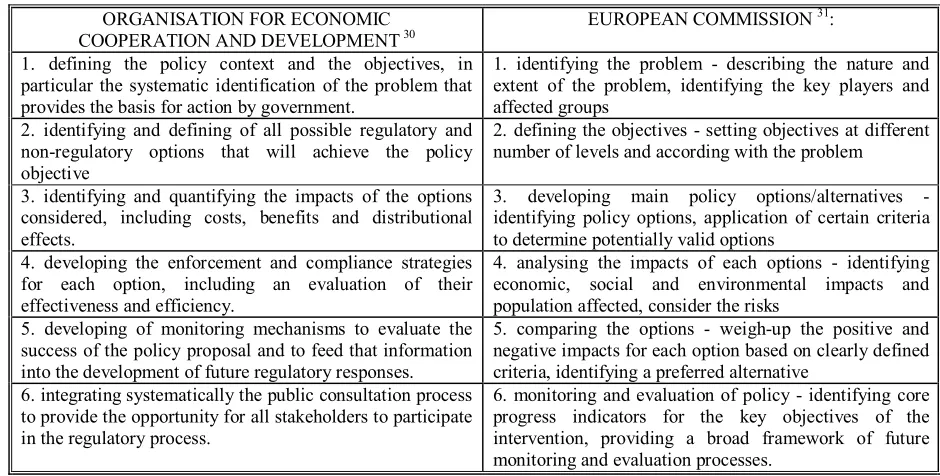
taken into consideration. Nowadays, many guidance documents are available on how to design an impact assessment, and a summary of those emphasis the following standard steps (see Table 1).
Table no. 1: Standard steps of any impact assessment
ORGANISATION FOR ECONOMIC
COOPERATION AND DEVELOPMENT 30
EUROPEAN COMMISSION 31:
1. defining the policy context and the objectives, in particular the systematic identification of the problem that provides the basis for action by government.
1. identifying the problem - describing the nature and extent of the problem, identifying the key players and affected groups
2. identifying and defining of all possible regulatory and non-regulatory options that will achieve the policy objective
2. defining the objectives - setting objectives at different number of levels and according with the problem
3. identifying and quantifying the impacts of the options considered, including costs, benefits and distributional effects.
3. developing main policy options/alternatives - identifying policy options, application of certain criteria to determine potentially valid options
4. developing the enforcement and compliance strategies for each option, including an evaluation of their effectiveness and efficiency.
4. analysing the impacts of each options - identifying economic, social and environmental impacts and population affected, consider the risks
5. developing of monitoring mechanisms to evaluate the success of the policy proposal and to feed that information into the development of future regulatory responses.
5. comparing the options - weigh-up the positive and negative impacts for each option based on clearly defined criteria, identifying a preferred alternative
6. integrating systematically the public consultation process to provide the opportunity for all stakeholders to participate in the regulatory process.
6. monitoring and evaluation of policy - identifying core progress indicators for the key objectives of the intervention, providing a broad framework of future monitoring and evaluation processes.
Analysing the steps mentioned above we can notice that the impact assessment begins with the identification of problem, runs through analysis of options and their impacts respectively and ends with the selection of the “best” policy, being specially designed to carry out a recommendation on public policy.
At the present time, the impact assessment of public policies is stated by the procedural rules of governments from most EU countries, Romania being one of them. As Member State of EU, Romania is trying to comply to the European regulations and practices regarding the public policies. Introducing of the impact assessment into the practice of elaboration and motivation of legal norms and domestic public policies can be found among the requirements.
III. Case study: The Impact Assessment elaboration for the policy proposals from education and regional development area
III.1. Institutional framework
During the last ten years, OECD, European Commission and World Bank carried out a number of studies concerning the evaluation of the public policies management system from Romania. Their evaluating reports indicated deficiencies related to the management of decision-making and policy-making process as well as the scarce using of the impact assessment tool and they have recommended to improve them.
In 2001, the Romanian Government has taken the first step in this direction, by launching “The strategy for accelerating the public administration reform” which stipulated the reform of three important areas, including “the improvement of public policy-making process”32.
30
OECD. 2008. Building an Institutional Framework for Regulatory Impact Analysis (RIA): Guidance for Policy Makers, Regulatory Policy Division Directorate for Public Governance and Territorial Development, available at: http://www.oecd.org/dataoecd/44/15/40984990.pdf.
31 European Commission. 2005. A Handbook for Impact Assessment in the Commission - How to do an Impact
Assessment; Bruxelles: European Commission; European Commission. 2009. Impact Assessment Guidelines, Bruxelles: European Commission; Meuwese, Anne Claartje Margreet. 2008. Impact Assessment in EU lawmaking, Netherlands: Kluwer Law International, p.2.
32
Strategy for accelerating public administration reform (2001-2004), available online at: http://www.gov.ro /upload/articles/100008/reforma-admin-public.pdf, completed by for a better regulation at central level (2008 -
2013) available online at: http://www.sgg.ro/docs/File/UPP/doc/proiecte_finale/Strategia_BR_varianta_
Implementation of the reform strategy has taken into consideration the following aspects in the sphere of public policies33:
1. defining the principles of communication, transparency, efficiency, accountability, participation, consistency, proportionality and subsidiary in the legal text;
2. dividing the responsibilities between the authorities with competence in public policy and the ones with financial attributes and supply of public services;
3. introducing a simple and clear public policy mechanism in order to develop and implement programs, projects, action plans and legislative proposals;
4. separating the policy-making level from the implementation level; 5. monitoring and evaluating the policy-making process.
The results of concretization these aspects started in 2003, with the establishing of the Directorate of Public Policy within the General Secretariat of Government accomplishing the following tasks:
increasing the efficiency of the public policies;
increasing the transparency of decision-making process;
strongly foundation of the policies (for example, the assessment of budgetary, economical, social impact; improving the consulting system between the institutions of the central government;
creating a connection between the planning of public policies and the elaboration of the budget; developing the methodologies used in the evaluation and monitoring of the public policies.
Since the debut of the “Guide for policy making at central level” in 2004 until now, the measures for strengthening the capacity of policy-making process have continuously increased. Regarding the impact assessment, in Romania there is no official document particularly designed to regulate their elaboration at this moment, their mandatory fulfilment devolves from other normative and strategic documents adopted by the Romanian public authorities.
In the content of Government Decision no. 775/2005, regarding the approval of procedures of elaboration, monitoring and assessment of public policies at central level we can find the first requirements for elaborating the impact assessment in order to motivate the public policies. These are not expressly stated but they are derived from art. 9 “the motivation of options involves accomplishing studies and analyses that will provide information on: opportunity to solve the problem; identification of options; the estimated budget for each options; the potential impact of the identified options; the evaluating criteria of options and choosing the option that is recommended for implementation; the action plan for the recommended option” and art. 13, align. 2 “draft for public policy proposal”.
This action was followed by another Government Decision, namely, the Government Decision no. 1361/2006, regarding the content of the instrument for present and motivating the draft legislation submitted for the Government approval, which stipulates the elaboration of impact assessment for all legislative/normative proposals.
Therefore, under the Romanian law there are two main types of impact assessments, impact assessment for public policy alternatives, stated by Government Decision no. 775/2005 and the impact assessment for legislative/normative draft stated by Government Decision no. 1361/2006. The necessity for the impact assessment of legislative/normative proposals arises from the demand of public policy proposal motivation. More legislative acts with different economic, social, legislative consequences, etc. can result from one policy proposal, and this impact must to be evaluating during in the elaboration stage of legislative document.
Some basic provisions of impact assessment have been introduced in the legal acts. Law no. 24/2000, republished in 2010, regarding the legislative technique for elaborating the legal acts, stipulates “the legislative draft is submitted for adoption with an explanatory memorandum, a substation note or a paper for approval, and also with an impact assessment”34. The ex-ante impact assessment assumes the identification and analysis of economical, social,
environmental, legislative and budgetary effects of proposed regulations.
Efforts regarding the insertion of impact assessment in the practice and culture of Romanian public authorities have been undertaken through the “strategy for improving the elaboration, coordination and planning of public policy at central level” (2006-2010), adopted by Government Decision no. 870/2006, as well as through the “strategy for a better regulation at central level (2008-2013). Introduction of full impact analysis for public policy proposal and normative acts is one of the actions proposed in this strategy.
33
Matei, Lucica, 2006, The Romanian Public Administration facing the Challenges of Integration into the European Union, p. 13, http://mpra.ub.uni-muenchen.de/20024/1/MPRA_paper_20024.pdf.
34
III.2. Methodological considerations
The General Secretariat of Government through the Directorate of Public Policy is the responsible public institution for coordinating the efforts in order to design the impact assessment and for evaluating the impact assessment designed by line ministries at this time from Romania.
These tasks are not expressly mentioned into Organization and Functioning Statute of the General Secretariat of Government, but they are resulting from other general attributions, such as: “setting the methodological and organizational framework for the system of planning, elaborating and implementing public policy at ministry levels and by other bodies of central level”, “ensuring the methodological and consultancy support concerning the elaboration of public policy to ministries,”, “strongly motivation of public policies”35.
In this context, methodological issues are sketched and scattered in the normative and strategic documents regarding the public policy field, in general. Thus, the lack of a methodological document for elaborating the impact assessment pushes our research towards the analysis of the availability provisions of certain public policies documents, earlier mentioned. The basic methodological elements for elaborating the impact assessment are firstly identified into the Government Decision no. 775/2005 under the provision of the public policy draft model. According to this model, any public policy proposal should comprises among others, considerations regarding the alternatives for solving, and also states that for each alternatives should be mentioned the economical, social and environmental impact.
According to this act, the impact is concisely specified, the possibility of attaching a detailed analysis according to the complexity of the identified options and their impact. The strategy for improving the system of elaboration, coordination and planning of public policy at central level brings additional methodological elements to the ones outlined by the previous legislative act.
Therefore, the Romanian public authorities should follow for completing the ex-ante impact assessment of public policy the steps mentioned below:
1. defining the resources and the results for the alternatives; 2. analysing the resources and results;
3. analysing the impact for each alternatives; 4. analysing the beneficiaries and stakeholders; 5. identifying the criteria for decision-making; 6. weighting of each criteria;
7. evaluating the alternatives according to the criteria set up; 8. identifying the best alternative.
These procedural steps have to be fulfilled in the initiating process of a policy proposal by the line ministries and other institutions of public administration. In this sense, all line ministries have created public policy units for developing public policy analysis, including impact assessment. Most often, the responsibility of public policy units within line ministries to elaborate the public policy or legislative acts draft is realized by specialized department under their coordination.
The concern of Romanian public authorities for developing the practice of impact assessment design is also reflected by the elaboration of some methodological documents, for in order to enhance the design of impact assessments in healthcare and educational field..
Inside the specific methodology used to complete the ex-ante impact assessment at Education, Research, Youth and Sports Ministry level, the following procedural phases 36 are recommended:
1. setting up the working group;
2. consulting the stakeholders from education area; 3. defining the problem;
4. gathering data;
5. identifying and selecting the public policy alternative; 6. profound analysing the alternatives;
7. fulfilling the cost-benefit analysis;
8. juxtaposition of the alternatives and selection; 9. monitoring and evaluating.
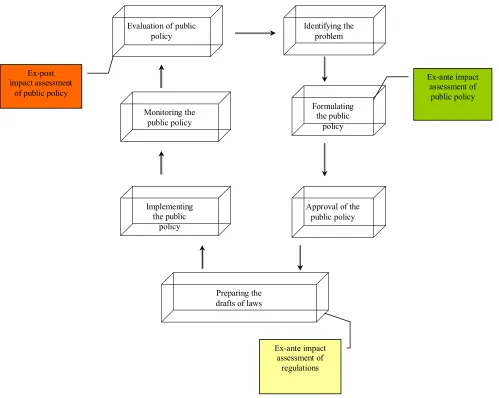
Moreover, the national legislation stipulates that impact assessment can occurs during the policy-making process in three different stages:
1. formulating the public policy;
2. preparing the public policy instruments, more specifically the drafts of law; 3. evaluation of public policy37.
35
http://www.sgg.ro/index.php?politici_publice_upp, accessed on 30 March 2011.
36
Figure no. 1: Policy-making process and the elaboration of impact assessment
Source: Adapted by Government Decision no. 870/2006 regarding the approval of the strategy for improving the elaboration, coordination and planning of public policy at central level”.
The practice imposes the elaboration of the ex-ante impact assessment on at least two stages. The first one, ex-ante impact assessment is carrying out in order to assess the alternatives of public policy. This evaluation is comprised inside the policy draft, as the evaluation of public policy alternatives. Often, after the approval of public policy draft and during the implementation stage, in the preparing draft laws moment, the second impact assessment is carrying out. The draft laws are drawing up when the proposed solution by the policy proposal is linked to the introduction of new regulation in matter, and they should be supported by an impact assessment in order to determine their consequences.
III.3. Impact Assessment Operationalisation
The policy-making process involves in the first stage developing of public policy documents with general character [including both, identification of the main aspects of public policy, and the directions]. Detailed analysis of each sector public policy represents a stage that precedes the public policy proposal/draft. In order to emphasize the using of impact assessment by Romanian public authorities have been selected, the public policy proposals carried out by Education, Research, Youth and Sports Ministry, Regional Development Ministry and Economy, Trade and Business Ministry.
37
Government Decision no. 870/2006 regarding the approval of strategy for improving the elaboration, coordination and planning of public policy at central level.
Ex-ante impact assessment of
public policy
Ex-ante impact assessment of
regulations Ex-post
impact assessment of public policy
Evaluation of public policy
Monitoring the public policy
Implementing the public
policy
Identifying the problem
Formulating the public
policy
Approval of the public policy
Case no. 1: Analysis of certain education policy proposals
The public policy draft regarding the “restructuring the pre-tertiary education on levels” has been selected from Education, Research, Youth and Sports Ministry (ERYSM), first of all because approving such a draft can have a major impact on the education system from Romania.
Developing the impact assessment is the task of direction/department from ERYSM responsible with the implementation of the future public policy. This structure has the necessary technical expertise to formulate the problem and justify the need for governmental intervention.
The aim of the policy “the reorganization of pre-tertiary education system on levels in order to ensure the raising of basic knowledge for training and socio-professional development of children and student into an adequate framework for increasing the absorption rate on labour market and the movement in European Space” has been formulated to facilitate the identification of public policy alternatives starting from identification of the problem regarding “the inadvertence into curriculum structure and framework plans”.
Three public policy alternatives have been identified in order to achieve the public policy objectives and to solve the problem 38:
1. keeping the old structure of pre-tertiary education;
2. changing the structure of pre-tertiary education system, including:
a. earlier education - it will comprise: ante - pre-primary education (0-3 years) and pre-primary education (3-6 years);
b. primary education on first stage of basic education – it will comprises: preparatory classes (6-7 years) and I-IV classes (7-11 years);
c. secondary education – comprises: lower secondary or second stage of basic education: gymnasium – including: V-VIII classes (12-14 years); upper-secondary education - IX-XII/XIII (15-19/20) and vocational education – IX-XI/XII (17-18/19 years);
d. non-tertiary education – comprises the post secondary education. 3. changing the structure of pre-tertiary education system, including:
a. earlier education - it will comprise: ante - pre-primary education (1-3 years) and pre-primary education (3-6 years);
b. primary education on first stage of basic education – it will comprises: preparatory classes (6-7 years) and I-IV classes (7-11 years);
c. secondary education – comprises: lower secondary or second stage of basic education: gymnasium - including: V-IX classes (11-16 years); upper-secondary education - IX-XII/XIII (16-19/20) and vocational education – IX-XI/XII (17-18/19 years);
d. non-tertiary education – comprises the post secondary education.
Analysis of the policy draft emphasizes that for its elaboration, the initiator, namely line ministry has taken into account the mandatory form of policy draft, and in this context it was developed the impact assessment. The impact assessment created for this policy draft has two components: a synthetic impact assessment for each alternative and a detailed impact assessment for the selected alternative.
Regarding the first component, we keep in mind that while under the legal provisions, public authorities should design the impact assessment related to social, economical, environmental effects for each alternative, its concretization in the current situation has some deficiencies, such as:
1. there is no real estimation of impact for the first alternative, but only a summary of weaknesses of the pre-tertiary education system before and at the moment of the draft elaboration;
2. there is no impact assessment analysis for the second alternative, being mentioned only that these are similarly with those for the third alternative.
Impact assessment does not show the estimated budged for each alternative.
Only the third alternative, which is the recommended one after the consulting process of stakeholders, detaches itself from these deficiencies. This is the alternative where the initiator is making an estimation of the possible economical and social impact. Its structure includes a summary analysis of the current situation, the anticipated change and the advantages and risks of approving the alternative. Regarding the anticipated impacts, the initiator is detached by “economical and social rigors” and uses an exhaustive presentation of the impacts of the alternative on the following matters: legislation and application; curriculum, didactic staff, consequences regarding the infrastructure and scholar network; consequences regarding finances and concrete resources; evaluation and certification. The policy draft is accomplished by an annexe where it can find a budgetary estimation and working plan.
38
Comparing the benefits of this alternative with the risks and other alternatives justifies the choosing and transformation the third alternative into the draft policy. The legislative instruments bring their contribution to the implementation of this policy, Law regarding the national education39, incorporating these changes in its content. The impact assessment is incomplete in relation to the performance indicators, and unfortunately it does not mention any indicators, but is limited to indicate the evaluation standards established by Romanian Agency for Quality Assurance in pre-tertiary Education.
Case no. 2: Analysis of certain regional development policy proposals
The practice of the Development Regional and Tourism Ministry (DRTM) related to the elaboration of the impact assessment for policy draft from development regional field is also under research.
At a first look, the Romanian regional development policy is surprising in an unpropitious manner, in sense that its presentation form is out of the legislative requirements; more precisely, it does not respect the standard form for the public policy draft proposed by domestic regulations.
Watching at source of this inadvertence, we remark that the policy for the regional development in Romania began to take shape once the Phare programme starts functioning (in 1996). The legislative framework for its developing has been established two years later, in 1998, by the Law no. 151/1998, abrogated in 2004, at the same time with the approval of a new law regarding the regional development in Romania, Law no. 315/2004. Therefore, the temporal dimension of the development for this policy explains its different form.
The development regional policy has emerged to support a balance development of the country as well as a socio-economic development of different regions and it represents the ensemble of all policies carried out by Government, through the bodies of central level, by local public authorities and specialized regional bodies after consulting the socio-economics stakeholders40. Eight development regions without juridical personality and without the status of administrative-territorial units have been created in Romania.
The main areas that can be targeted by regional development policies are: development of enterprise, employment, reduction of the existing regional disparities focusing on stimulating a balanced development and a revitalization of disadvantaged areas, attracting investment, transfer of technology, development of SME sector, improvement of the infrastructure, the quality of environment, the rural development, the healthcare, the habitation, as well as the improvement of living conditions.
A policy draft on social infrastructure and one regarding the revitalisation of the disadvantaged areas have been chosen for more thoughtful analysis, given that the regional development policy is an “umbrella” under which a variety of public policies live.
Concerning the first dimension the public policy proposal regarding “stimulation of the supply for accessible and decent housing” has been selected.
This proposal complies the requirements and the form stated by the Government Decision no. 775/2005, and in its content it can find three possible public policy alternatives41:
1. coordinating the actions of central and local authorities and public and private actors in order to increase the supply of quality housing. Estimated budget: 667.725 lei.
2. holding on the system stated by Law no. 114/1996 regarding the housing, republished with amended and supplemented. Estimated budget: 600.548 lei.
3. 25% expense increase from the state budget for the government programmes linked to the housing field. 4.
The impact assessment carried out by initiator takes the form of an impact assessment of policy alternatives: the social, economic, environment impacts are estimated for each such alternative. Also, for each of them, we can find the estimated budged necessarily to its implementation. Although from an economic perspective, the third alternative is more convenient in terms of economical and environmental effects, the first alternative is preferred, and has been chosen for implementation after consulting stakeholders. For the selected alternative the impact assessment reflects certain of its benefits and risks, and has a working plan well designed in annex.
39
Title II, Chapter II, Law regarding the national education, republished in Official Journal of Romania no 18/ 10.01.2011
40
Art. 2, align (1), Law no. 315/2004, regarding the regional development in Romania.
41
The impact assessment conducted by DRTM is noted positive comparison to the impact assessment prepared for educational policy draft; this higher grade comes from the existence of budgetary estimations for each alternative as well as from the indicated a set of indicators for performance.
The second policy proposal found under the “umbrella” of regional development policy and chose for analysis is “restructuring and attracting investments in companies in the area of metalliferous ores exploitation”. This proposal is an initiative of the Economy, Trade and Business Ministry (ETBM) and it aims to attract investment in disadvantaged areas from the mining sector.
The proposal complies with the form stated by the Government Decision no. 775/2005, and an impact assessment for each policy alternatives can be found in its content. The broad reach of the project has determined the outlining of five policy alternatives/solutions42:
1. sale of viable assets, accompanied by a requirement for necessary investments to modernize renew the technology or for completing some investments;
2. signing cooperation agreements with Romanian and foreign partners in order reorganize the operations, to exploit and attracting investment;
3. signing agreements with Romanian and foreign partners in order to establish some companies with mix capital/ to establish some subsidiaries followed then by their privatization;
4. signing some joint venture agreements with Romanian and foreign partners; 5. signing some leasing agreements with Romanian and foreign partners.
According to legal provisions, the impact assessment was conducted in economic, social and environment terms for each alternative. The consultation with stakeholders has led to the recommendation of the second alternative. Unfortunately, we can not give a comment regarding this choice since we can only compare the economical, social and environmental impacts among the alternatives; in the content of this assessment, there was no other criteria defined for comparison.
It is worth mentioning that impact assessment excels in terms of form of alternatives designed and proposed to solve the problem, benefits and risks of the selected alternative, the set of indicators for performance, but in the same time we also have to emphasize its negative aspect which comes from the content of financial analysis, meaning that the initiator did not attached the estimated budged to each alternative and not even to the recommended alternative. Like the other two studies, and the last one has also attached the working plan for the implementation of the recommended alternatives. The impact assessment is different from the other two through the references regarding the resources brought by each interested stakeholder.
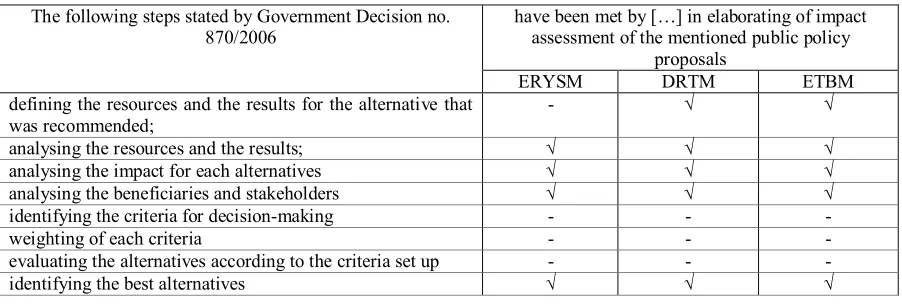
[image:14.612.88.539.490.642.2]Synthesizing the analysis on policy proposals initiated by the three line ministries, we can notice that only certain methodological steps set out by legislative regulations have been met. The table below represents a mirror of this approach (see Table 2).
Table no 2: Methodological steps followed by Romanian public authorities in completing the impact assessment
have been met by […] in elaborating of impact assessment of the mentioned public policy
proposals The following steps stated by Government Decision no.
870/2006
ERYSM DRTM ETBM
defining the resources and the results for the alternative that was recommended;
- √ √
analysing the resources and the results; √ √ √
analysing the impact for each alternatives √ √ √
analysing the beneficiaries and stakeholders √ √ √
identifying the criteria for decision-making - - -
weighting of each criteria - - -
evaluating the alternatives according to the criteria set up - - -
identifying the best alternatives √ √ √
We notice that both the impact assessment on education field, and ones from the development regional policy field are facing gaps in establishing the decision-making criteria, in weighting of each one should have when evaluating and comparing alternatives. A failure to comply them can have negative effects on achieving public policy objectives, meaning that the solution adopted for implementation may not be right solution on long term.
42
Moreover, we remark that the practice of using the impact assessment by responsible public authorities in order to elaborate public policy education still has some deficiencies, although there is a general legislative framework for elaborating impact assessment for the public policy proposals and for some specific methodological documents from education field, namely, Internal Rules of design, notice and approval of public policy documents and legislative acts, Handbook for ex-ante impact assessment of education policy.
IV. CONCLUSIONS
A first conclusion that emerges from the analysis we have made points out stress that important steps have been made during the past few years on the development of some minimum standards for elaborating public policy, as well as of using impact assessment as part of the policy-making and legislative acts. The added value of an impact assessment consist on “improving the quality of available information for the decision makers and that the decision-makers should clearly understanding the costs, benefices and distributive effects of their decision”43. In this sense we notice that the impact assessment represents an aid to decision-making not a substitute for it.
We can find two types of impact assessments inside the practice and the culture of Romanian public authorities: the impact assessment of public policy alternatives and the impact assessment of legislative acts. The impact assessment of public policy alternatives is design to allow knowledge about the potentially economical, social and environmental impacts of public policy. The impact assessments are useful instruments for approving decisions, both to measure the benefits and risks of public intervention, and to review the administrative performance.
Thus, impact assessment contributes to emphasizing the strengths and weaknesses of various public policy alternatives or types of approaches of an action, contributing to a rational, argumentative choice of a policy alternative over others, less justified. The final scope of any impact assessment is to provide accurate and coherent information regarding the impact of different public policy alternatives, as a starting point for comparing the alternatives between them.
Although, we notice the progress in Romania for defining and consolidating a framework inside of which the impact assessment can find more often a place, we must also remark the fact that this key areas of modern governance remain insufficiently explored and exploited.
Also, we have to keep in our minds that after the Government Decision no. 775/2005 was adopted, all public policy proposals/drafts developed in Romania meets the standard form proposed by law, including the following elements: the name of the institution having the initiative, defining the problem, defining the public policy, the general aim of this, general objectives and specific objectives, direct and indirect beneficiaries, alternatives for solving the problem, process of consulting the stakeholders, the recommended alternative for implementation, activities for monitoring and assessment, impact assessment of the public policy.
Better regulation and promoting impact assessment remains a goal, and also a challenge for Romania in its process of attempting to identify solutions for the real problems coming from the economical, financial and social point of view and generated by the evolution of the globalization.
REFERENCES
Bardach, Eugene. 2000. Practical Guide for Policy Analysis: The Eightfold Path to More Effective Problem Solving. New York: Chatham House Publishers.
Briggs, Sandra , Petersone, Baiba, and Smits, Karlis. 2006. Handbook of methods used in planning public policies and impact appraisal [in Romanian], General Secretariat of Government: Romania.
Ciolan, Lucian, Noel, Hibbert, Radu, Munteanu, and Cătălina, Ulrich. 2009. Handbook for ex-ante impact assessment of education policy [in Romanian]. Bucharest: General Secretariat of the Government.
Drăgan, Gabriela, and Agnes Nicolescu. 2009. Impact assessment – tools for a better regulation of public policies in European Union [in Romanian], Collection of European Institute of Romania, no. 24, Bucharest: European Institute of Romania.
European Commission. 2009. Impact Assessment Guidelines, SEC(2009) 92 Bruxelles: European
Commission;
European Commission. 2005. A Handbook for Impact Assessment in the Commission - How to do an Impact Assessment; Bruxelles: European Commission;
European Commission, Impact Assessment of European Commission Policies: Achievements And
Prospects Statement of the EEAC Working Group on Governance.
Fischer, Frank, Gerald, Miller, and Mara, Sidney. 2007. Handbook of Public Policy Analysis Theory, Politics and Methods, New York: Taylor&Francis Group.
Geva-May, Iris, and Aaron, Wildavsky. 1997. An Oprational Approach to Policy Analyis: The Craft, Boston: Kluwer.
43
Hirkpatrick, Colin, and David, Parker. 2007. Regulatory impact assessment: towards better regulations?
UK: Edward Elgar Publishing.
Government Decision no. 870/2006 regarding the approval of strategy for improving the elaboration, coordination and planning of public policy at central level”.
International Association for Impact Assessment. 2003. What Is Impact Assessment? available online at the
website http://www.iaia.org/publicdocuments/special-publications/What%20is%20IA_web.pdf; Social
Impact Assessment International Principles, available online at the website http://www.iaia.org/ publicdocuments/special-publications/SP2 .pdf, accessed on 28 March 2011.
Klaus, Jacob, Julia, Hertin, Peter, Hjerp, Claudio, Radaelli, Anne, Meuwese, Oliver, Wolf, Carolina, Pacchi, and Kluas, Rennings. 2008. Improving the Practice of Impact Assessment, EVIA - Evaluating Integrated Impact Assessment.
Peter, Knoepfel, Corinne, Larrue, Frédéric, Varone, and Michael, Hill. 2007. Public Policy Analysis, Great Britain: The Policy Press.
Kotchen, Matthew. 2010. Cost-Benefit Analysis, Encyclopedia of Climate and Weather, second edition, edited by Stephen, Schneider, New York: Oxford University Press, forthcoming.
Lane, Jan-Erik. 2000. The Public Sector. Concepts, Models and Approace, London: Sage.
Lee, Norman, and Colin Kirkpatrick. 2006. Evidence-based policy-making in Europe: an evaluation of EC integrated impact assessments. Impact Assessment and Project Appraisal, no. 24.
Matei, Ani. 2003. Public Economy. Economic Analysis of public decision [in Romanian], Bucharest: Economica Publishing House.
Matei, Lucica. 2009. Romanian Public Management Reform, Theoretical and Empirical Studies, Volume 1. Administration and Public Services, Bucharest: Economica Publishing House.
Matei, Lucica, 2006, The Romanian Public Administration facing the Challenges of Integration into the European Union, p. 13, http://mpra.ub.uni-muenchen.de/20024/1/MPRA_paper_20024.pdf.
Matei, Lucica. 2004. Strategii de dezvoltare economică locală. Abordare managerială, Bucureşti: Politeia -SNSPA.
Meuwese, Anne Claartje Margreet. 2008. Impact Assessment in EU lawmaking, Netherlands: Kluwer Law
International.
Mishan, Edward, and Euston, Quah. 2007. Cost–Benefit Analysis, a 5-a ediţie, London: Routledge.
OECD. 2008. Building an Institutional Framework for Regulatory Impact Analysis (RIA): Guidance for Policy Makers, Regulatory Policy Division Directorate for Public Governance and Territorial Development, available online on the website http://www.oecd.org/dataoecd/44/15/40984990.pdf.
OECD. 2001. Improving Policy Instruments through Impact Assessment, Sigma Papers, no. 31, OECD Publishing, doi: 10.1787/5kml60vnhc6h-en.
Radelli, Claudio, Bruno, Dente, Jacobs, Scott, Colin, Kirkpatrick, Anne, Meuwese, and Andrea, Renda. 2006. ENBR Handbook „How to perform the DIADEM data collection” www.enbr.org, p. 5.
Renda, Andrea. 2006. Impact Assessment in the EU- The State of the Art and the Art of the State, Centre for European Policy Studies, Brussels.
Staronova, Katarina. 2007. Mapping of ex-ante Policy Impact Assessment Experiences and Tools in Europe. Resource Book for Practitioners, Bratislava: UNDP/BRC.
The strategy for accelerating public administration reform (2001 - 2004), available online at the website: http://www.gov.ro/upload/articles/100008/reforma-admin-public.pdf, completed by strategy for a better
regulation at central level (2008 - 2013) available online at the website:
http://www.sgg.ro/docs/File/UPP/doc/proiecte_finale/Strategia_BR_varianta_finala_aprobata_de_Guvern.p df, accessed on 29 March 2011.
Law regarding the national education, republished in Official Journal of Romania no 18/ 10.01.2011. Law no. 24/2000, regarding the legislative technique for elaborating the legal acts, republished in O.J. of
Romania no. 390/9. 06. 2009
Law no. 315/2004, regarding the regional development in Romania.
Ulrich, Werner. 2002. Public Policy Analysis, in The Informed Student Guide to Management Science, edited by Daellenbach, Hans, and Robert Flood, great Britain: Ed. Thomson Learning, pp. 213-215. Zomorrodian, Asghar, and Lucica, Matei. 2010. Program Evaluation: Its Significance and Priority for
Shaping and Modification of Public Policies: A Comparative Analysis, Proceedings of ASBBS, vol. 17, no. 1 available online at the website http://papers.ssrn.com/sol3/papers. cfm?abstract_id=1715642.
Websites
http://europeandcis.undp.org/pia/show/D598A880-F203-1EE9-B2CB788F94470CC4.
http://www.sgg.ro/index.php?politici_publice_upp.
http://ageconsearch.umn.edu/bitstream/17815/1/ar730131.pdf.
http://www.mcsi.ro/Minister/Despre-MCSI/Unitatea-de-Politici-Publice/Cadrul-juridic/HG-nr-870_2006.
http://www.sgg.ro/docs/File/UPP/doc/manual%20pentru%20evaluarea%20exante%20a%20impactului%20