Munich Personal RePEc Archive
Foreign subsidiaries and technology
sourcing in Spain
Holl, Adelheid and Rama, Ruth
CSIC - Institute of Public Goods and Policies, CSIC- Institute of
Economics, Geography and Demography
30 October 2012
Foreign subsidiaries and technology sourcing in Spain
1Adelheid Holl
‡and Ruth Rama
§This version: October 2013
Abstract. Firms acquire external technological knowledge via different channels. In this paper we compare the technology sourcing of foreign subsidiaries and domestic firms looking
at domestic R&D outsourcing, international R&D outsourcing, domestic cooperation for
innovation and international cooperation for innovation. We use data from the Spanish
Technological Innovation Panel (PITEC) for the years 2005-2009 for 10,206 innovative firms
operating in Spain. We apply a multivariate probit specification which allows for systematic
correlations among the different choices. The results show that the different technology
sourcing choices are interdependent and that foreign subsidiaries show a different pattern of
external technology sourcing. Compared to affiliated domestic companies, foreign
subsidiaries show a smaller propensity for external technology sourcing via R&D outsourcing
from independent firms in the host country, for international R&D outsourcing, and for
international cooperation for innovation. In contrast, foreign subsidiaries show a greater
propensity for domestic cooperation for innovation. However, foreign subsidiaries are not a
homogenous group in this respect.
Keywords: Multinational enterprises, foreign subsidiaries, R&D outsourcing, cooperation for innovation.
1We gratefully acknowledge the financial support of the Spanish Ministry of Science and Innovation (ECO2010-17485). We are also grateful to anonymous referees for their helpful comments and suggestions on an earlier version of this paper.
‡
Institute of Public Goods and Policies (IPP), CSIC - Consejo Superior de Investigaciones Científicas. C/ Albasanz, 26-28; 28037 Madrid, Spain. e.mail: [email protected]
§
1. Introduction
In today’s fast-paced, knowledge-intensive innovation is rarely the outcome of firms' own
internal R&D efforts. Innovation is increasingly the outcome of interactions among multiple
actors, and both R&D outsourcing as well as R&D cooperation have become significant
features in current innovation management as ways to develop and gain access to new
technologies. At the same time, the technology necessary for global competitiveness is often
dispersed internationally. In this context, international R&D networks can provide firms with
access to country-specific advantages and allow them to tap into the comparative advantages
of foreign countries. While technology transfer is now recognized among economists and
policymakers as key to economic growth, there is still relatively little knowledge on the
patterns of technology sourcing and the mechanisms underlying technology transfer at the
firm level.
There is now a growing body of literature that focuses on the determinants of cooperation
for innovation (see, for example Veugelers & Cassiman, 2004; Knell & Shrolec, 2006; Shrolec,
2009 and 2011). There is also some literature on the external sourcing of R&D services (see,
for example, García-Vega and Huergo, 2011; Veugelers and Cassiman, 2004; Veugelers and
Cassiman, 1999; Jabbour and Zuniga, 2009). These two bodies of literature have, however,
largely developed separately. Recent exceptions in this regard are studies that analyse both
cooperation for innovation as well as the external sourcing of R&D (Dhont-Peltrault &
Pfister, 2011; Ebersberger et al., 2011; Schmiedeberg, 2008; Vega-Jurado et al., 2009). But
with the exception of the pan-European study by Ebersberger et al. (2011), they do not
distinguish between domestic and international open innovation. More importantly, these
studies do not analyse the simultaneous decisions of the firm to engage in different types of
technology sourcing. To the best of our knowledge, there are no studies that jointly analyse
domestic and international markets. We will argue that there may be important
complementarities between these sources of technology.
We aim particularly at understanding how foreign subsidiary status may be related to different
patterns of technology sourcing. MNEs play an important role in international technology
transfer because of their global production networks and because they are often
technologically superior to domestic firms (Veugelers & Cassiman, 2004). Consequently,
many countries attempt to attract foreign direct investment (FDI), with the expectation that
foreign multinational enterprises will provide skills and new technology that will ultimately
enhance the competitiveness of domestic firms. However, foreign MNEs may become
enclaves within a host-country economy, rarely establishing external ties with domestic firms
or the rest of the national innovation system (UNCTAD, 2001). This may cause a “branch
plant syndrome” (Phelps, 1993).
A variety of reasons may explain why foreign subsidiaries do or do not establish local R&D
linkages in a specific host country. Multiple embeddedness implies that companies balance
embeddedness in the host-country and embeddedness in the multinational network (Meyer et
al., 2011). As a MNE pursues globally integrated strategies, its subsidiaries are more likely to
exploit the location advantages of host-countries in order to complement the existing
advantages of the firm (Cantwell, 2004). However, building relationships with partners who
are willing to transmit knowledge requires the development of mutual trust (Hitt et al., 2002).
According to the transaction cost school, certain forms of entry may help firms minimise net
transaction costs in a new market. The specific mandate of a foreign subsidiary in a host
country may also affect its level of local embeddedness (Cantwell & Mudambi, 2005).
Understanding the patterns of technology sourcing of foreign subsidiaries in the host-country
is a particularly pressing task for those countries which are not at the forefront of sciences
further contend that foreign subsidiaries may behave differently according to the specific
channel of technology sourcing; hence, the need to study their patterns of R&D service
outsourcing and their patterns of cooperation for innovation in the domestic and
international market simultaneously.
Most evidence on the R&D behaviour of MNEs is based on results for highly industrialised
countries, a circumstance which may limit our understanding of these firms’ technology
sourcing (Boehe, 2007). Models dealing with differences in the cooperative behaviour of
foreign subsidiaries and domestic firms chiefly analyse technology leader countries (see, for
instance, Ebersberger & Herstad, 2012; Schmiedeberg, 2008); thus, their results may not be
generalisable to other countries. The pan European study by Ebersberger et al. (2011) actually
finds that foreign subsidiaries adopt a different cooperative behaviour in different host
countries, for instance, in technology leader countries, such as the Scandinavian countries,
and in high income, low R&D countries, such as Spain. Therefore, detailed studies on a non
technology leader country, such as Spain, can help to complement the picture. In addition,
Spain is also one of the largest receivers of FDI in the European Union (EU)(UNCTAD,
2011).
The rest of this paper is organized as follows. Section 2 presents the literature which
informed our research. In Section 3, we describe the data set we use and present some
descriptive results. Section 4 presents the econometric model. A discussion of the main
results follows in Section 5. Section 6 concludes.
2. Literature review and research questions
Technology is becoming increasingly complex, multi-disciplinary and dynamic. This means
that developing all necessary technological know-how internally is increasingly costly. To
institutions and other firms. Hagedoorn and Narula (1996) and Hagedoorn (2002) provide
evidence on the rise of technology sourcing cooperation over the past decades. Herstad et al.
(2010) observe the rise of “globally distributed knowledge networks” (p. 116). This has also
brought with it a rise in international R&D sourcing and international collaboration for
innovation (Abramovsky et al., 2008).
Innovation in multinationals has traditionally been concentrated in their headquarters, but is
now increasingly dispersed among their subsidiaries (Dunning & Lundan, 2009). MNEs
source technology in a host-country for a variety of reasons, such as adapting their products
to national tastes and regulations, getting access to skilled researchers or taking advantage of
the technology development of the national innovation system (Edler, 2008). However, the
technology sourcing behaviour of foreign subsidiaries, and especially the degree of their local
embeddedness in a host country could be negatively influenced by the degree of
embeddedness in their corporate network.2 Foreign subsidiaries might find the resources they
need within the multinational network, limiting their local involvement. Pointing to double
embeddedness, however, other authors argue that a trade-off between both types of
embeddedness is not necessarily the norm (Almeida, 2004; Andersson et al., 2002; Boehe,
2007). The different levels of capabilities at home and in the host country seem to play some
role in the internationalisation of corporate R&D. Patterns of technological specialisation
within industries across countries may explain FDI R&D (Cantwell & Kosmopoulou, 2009),
eventually contributing to the presence of local R&D linkages in certain countries and not in
others.
Foreign subsidiaries, however, may find it difficult to cooperate for innovation with domestic
partners. High transaction costs in the host-country could limit their ability to network
(Nachum & Keeble, 2003), since they may lack the social capital which facilitates networking
and joint-innovation (Hitt et al., 2002). These analyses suggest that the transaction costs of
establishing external relationships may be higher for foreign subsidiaries than for domestic
firms, limiting their willingness to source locally. As stated, the form of entry selected by the
MNE may mitigate those problems. The acquisition of a well linked domestic firm or a
joint-venture with a local partner may help the foreign subsidiary to expand its social capital and
engage in local collaboration.
Empirical research has not yet provided a clear answer to the question of whether foreign
subsidiaries are able to source technology through local linkages similar to those of domestic
firms. Some studies use patent analysis to proxy foreign subsidiaries’ local sourcing (see, for
instance, Almeida, 2004;Álvarez & Cantwell, 2011). With the publication of the Community
Innovation Surveys (CIS) of the EU, other studies have been able to focus more specifically
on foreign subsidiaries’ patterns of cooperation for innovation (Cassiman & Veugelers, 2006;
Ebersberger et al., 2011; Lööf, 2009; Molero et al., 2009; Veugelers & Cassiman, 2004). Most
of them find that cooperation for innovation with external partners is positively related to
foreign status. However, the evidence is not conclusive. In Southern Europe or transition
European countries, foreign subsidiaries may be less likely to engage in external cooperation
than domestic firms or, at least, than domestic unaffiliated firms (Molero & Heijs, 2002;
Srholec, 2011). In other cases, foreign subsidiaries are less likely than domestic firms to
engage in local cooperation for innovation (Knell & Srholec, 2006). Ebersberger and Herstad
(2012), comparing Norwegian MNEs and foreign subsidiaries operating in Norway, find that
the latter are less likely to engage in local cooperation for innovation. They conclude that
eventual “branch plant syndrome” in host-countries may be attributable to foreign status
rather than to multinationality “per se”. Ebersberger et al. (2011), in their pan European
study, find a positive effect of foreign ownership status on international cooperation for
innovation but a negative effect on domestic cooperation. This suggests that in foreign
embeddedness. Regarding the external sourcing of R&D by foreign subsidiaries, Ebersberger
et al. (2011) find a positive effect of foreign subsidiary status. Veugelers and Cassiman (2004)
and García-Vega & Huergo (2011) show that foreign subsidiaries have a greater propensity
for international R&D outsourcing. Jabbour & Zuniga (2009) find that foreign subsidiaries
source R&D less domestically and more internationally compared to domestic firms.
Previous studies have shown mixed results regarding the role of foreign subsidiary status in
technology sourcing patterns. This is mainly due to differences in the main focus or purpose
of the studies and how subsidiary status has been controlled for; specifically to what control
group foreign subsidiaries are compared to. Because our key objective is to investigate
whether foreign subsidiaries show different traits in their technology sourcing behaviour, we
compare them not only to domestic firms but specifically to domestic firms that also belong
to a group – while controlling for other firm specific characteristics. Group affiliation is an
important organisational attribute that could account for differences in technology sourcing
even though we focus on technology sourcing from partners outside the own group (see, for
example, Molero & Heijs, 2002; Dach & Ebersberger, 2009). Belonging to a company group
may facilitate the search for partners for external technology sourcing. Firms belonging to a
company group may have greater organizational resources as well as experience, and therefore
may be better able to establish and maintain contacts with potential partners even outside the
own company group. At the same time, the spatial network of the group can be important in
overcoming the friction costs of geographical distance in the search for partners in other
locations. Some evidence suggests that firms pertaining to a group are more likely to
cooperate for innovation or outsource R&D because they may be able to use their internal
networks to recruit and supervise external R&D partners or providers of technology (Molero
& Heijs, 2002; Segarra-Blasco & Arauzo-Carod, 2008; Teirlinck et al., 2010).
Comparisons between foreign subsidiaries and domestic firms may also be distorted given the
technological leadership of foreign subsidiaries in the host country is controversial. MNEs
which are technological laggards in a specific sector may seek to augment their capabilities by
internationalising their R&D (Cantwell & Janne, 1999). In contrast, Berry (2006) finds that
Japanese MNEs investing in foreign R&D laboratories tend to be technologically leading
firms compared to their domestic competitors. On the other hand, in some countries,
technologically leading domestic firms may secure the most suitable domestic partners for
R&D collaboration (Álvarez & Cantwell, 2011; Cantwell & Mudambi, 2011). According to
these studies, this may indirectly limit the possibilities of local partnerships for foreign
subsidiaries and, hence, reduce their embeddedness in the host country. However, in less
advanced host-countries foreign subsidiaries may tend to be technological leaders and
domestic firms may tend to be technological laggards. Therefore, technological leadership in
the local industry needs to be taken into account when comparing foreign subsidiaries and
domestic firms.
In this paper we study two mechanisms that firms can use to acquire knowledge externally.3
First, we study R&D outsourcing, which includes either the acquisition of R&D services
through arm's length contracts or through subcontracting relationships, meaning that tasks
and processes are contracted to a third party company. Second, we study cooperative
arrangements, defined as two or more separate organisations joining forces to share and
develop knowledge in order to enhance their innovative performance. Dhont-Peltrault and
Pfister (2011), for example, find that French firms may use each of these mechanisms for a
different technological purpose. We argue that these different channels of technology
sourcing do not exclude each other, since firms are likely to make joint decisions regarding
their adoption. Our main research questions are: 1) Do foreign subsidiaries show a different
pattern of external technology sourcing than comparable domestic firms? 2) Are foreign
subsidiaries able to build local cooperation networks similar to those of comparable domestic
firms? The above discussion also suggests that within the host-country foreign subsidiaries
are not a homogeneous group. Therefore, we will also inquire whether the mandate from or
the relationships of these firms with their respective multinational networks affect their
technology sourcing patterns.
3. Data and some descriptive results
Our data come from the Spanish Technological Innovation Panel (Panel de Innovación
Tecnológica, PITEC) collected by the Spanish National Statistics Institute (INE). The PITEC
survey includes information on the technological innovation activities of all the main sectors
in the Spanish economy, including services and manufacturing. We use data for 2005-2009.4
Note, however, that only innovation active firms were asked questions related to their
cooperation behaviour. Thus, the sample for our empirical analysis is restricted to innovative
active firms. These are firms that have introduced new products or new processes or that
have ongoing innovative activities or that have abandoned innovative activities during the two
years prior to the survey date. In total, we have over 41,000 observations for 10,206 private
companies.
We define foreign subsidiaries as firms belonging to a company group with its headquarters
outside the host country and domestic affiliated firms as those firms which belong to a
company group with its headquarters in the host country. The remaining firms are those
which do not belong to any company group. In our sample, 11.7% of all companies are
foreign subsidiaries. The data do not allow us to identify their modes of entry or to correctly
identify native MNEs. It should be stressed that our inquiry is thus about foreign status, not
multinationality.
4
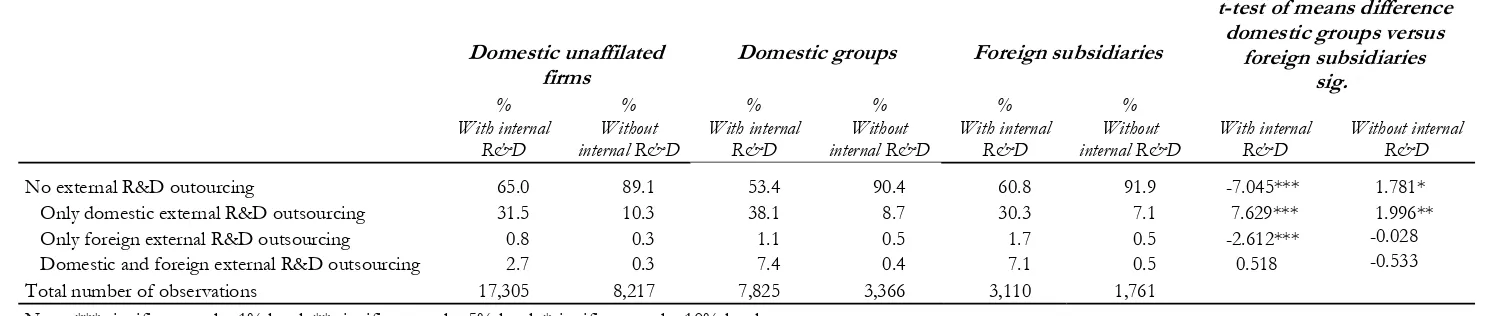
Table 1 shows the percentage of firms that report R&D outsourcing from partners outside
the own group among domestic unaffiliated companies, domestic affiliated firms, and foreign
subsidiaries. We distinguish between those firms with internal R&D expenditure and those
firms that have no internal R&D, two groups displaying different behaviour. As shown by
Table 1 and Table 2, the latter are more frequently engaged in external R&D sourcing,
whatever the type of company. However, the percentage of foreign subsidiaries with external
R&D outsourcing is below 40%, which is lower than the percentage for domestic affiliated
companies, with about 47% reporting R&D outsourcing from independent companies. Table
1 also shows that domestic firms rely to a greater extent on domestic R&D outsourcing.
Table 2 shows the respective numbers for cooperation for innovation. About 45% of the
sample foreign subsidiaries as well as the domestic groups with internal R&D engage in
external cooperation for innovation. However, foreign subsidiaries engage to a greater degree
in domestic cooperation compared to both domestic groups and domestic unaffiliated firms.
In our sample, we also observe that firms combine the different technology sourcing
channels. Approximately 40% of domestic unaffiliated firms and approximately 53% of
domestic affiliated and foreign subsidiary firms that are engaged in some form of technology
sourcing actually report using more than one channel.
4. Econometric model
We are interested in whether foreign subsidiaries in their host country show differences in
their technology sourcing behaviour in comparison to “comparable” domestic firms. The
simple comparisons in Tables 1 and 2 indicate some differences. These observed differences
could, however, be due to differences in other firm characteristics apart from foreign
status in a multivariate probit regression which includes the most important control variables
suggested by the literature.
We construct the following four dependent variables:
Coopdom = Dummy variable with value 1 if the firm had a cooperation arrangement
on innovation with a non-affiliated partner in Spain.
Coopint = Dummy variable with value 1 if the firm had a cooperation arrangement on
innovation with a non-affiliated partner in another country.
Outdom = Dummy variable with value 1 if the firm had acquired R&D services from a
non-affiliated partner in Spain.
Outint = Dummy variable with value 1 if the firm had acquired R&D services from a
non-affiliated partner in another country.
Firms may consider the different technology sourcing choices simultaneously since there may
be complementarities or substitutabilities between the different choices. We use a multivariate
probit (MV) specification to identify specific drivers of each type of technology sourcing.
This approach takes into account the potential interdependence in technology sourcing
choices and the possible correlations among the error terms due to unobservable
characteristics influencing the different sourcing choices (Chib and Greenberg, 1998). The
MV approach allows us to test for the possibility of complementarities regarding the adoption
of the four different channels of external technology sourcing.
Channels can be considered as complementary when the equations defining them are
significantly and positively associated. This is in line with the adoption approach as, for
example, in Cassiman and Veugelers (2006).
The probability of choosing a particular mechanism of technology sourcing is estimated
conditional on the choice of any other related sourcing choice.5
5
The estimation equations have the following form:
4
,
3
,
2
,
1
c
x
u
k
y
k
k k (1)where yk corresponds to the sourcing of technology via channel k, and takes values of one if
the firm sources technology via channel k , otherwise the value is zero. The errors uk have an
assumed multivariate normal distribution. The independent variables are denoted by vector X
and are described below.
Our independent variable of interest is the dummy FSUB taking the value 1 if the firm
belongs to a foreign subsidiary and 0 otherwise.
In what follows, we describe the selection of control variables which could influence the
technology sourcing behaviour of firms apart from belonging to a foreign multinational
company.
Group. A different technology sourcing behaviour of foreign subsidiaries might not be due to
foreign ownership per se, but rather to the fact that these firms operate within a company
network (Pfaffermayr and Bellak, 2002). In this respect, foreign subsidiaries could follow
patterns of technology sourcing similar to domestic firms belonging to a company group. In
our specification we include a dummy for unaffiliated companies and use domestic affiliated
companies as our reference group. As stated, with the available data we do not know whether
the domestic group network is national or international. However, it should be noted that
Spain has very few native MNEs (12 in Fortune Global 500 as compared to 140 US MNEs).
Other studies have compared multinational subsidiaries to domestic unaffiliated companies
while controlling for belonging to a domestic group, as, for example, Belderbos et al. (2004),
Faria and Schmidt (2012), or Srholec (2011).
Leaders and laggards. Since firms commonly engage in networking to gain access to new
worthwhile partners (Pittaway et al., 2004). Consequently, laggard firms may find fewer
opportunities to engage in R&D networks. Foreign subsidiaries may be more likely to be
leaders, and domestic firms, laggards – at least in some home countries. In this case, the
distinction between foreign subsidiaries and domestic firms may be picking-up a
leader-laggard distinction and not a foreign-domestic one. Therefore, we control for leader and
laggard status at sector level. We operationalise this control variable following Berry’s (2006)
methodology.
Other control variables: We control for firm size (number of employees and in squared terms to
allow for possible non-linearities). We also include the number of patents granted to a firm.
The use of formal means of protection was, for example, associated with cooperation in
Finland but not in Austria (Dachs et al., 2008). Further, we include a dummy for exporters.
Exporters may need to tap into different sources of knowledge in order to stay competitive in
international markets. Their presence in those markets may also facilitate their access to
international sources of technology. In the case of Spain, exporters seem more likely than
non exporters to engage in international R&D outsourcing (García-Vega & Huergo, 2011).
Firms may need some time to create reliable and effective collaborative linkages with external
partners. PITEC provides information on whether or not a company was newly created
during the year of the survey or the two years previous. With this information we create a
dummy variable indicating whether the firm was newly created between 2003 and 2009.6
Finally, all estimations include controls for location, sector, and year dummies. We include
regional dummies for the four main industrial areas in Spain: Madrid, Catalonia, the Basque
Country and Valencia, the remaining areas serving as reference group. The regional dummies
are based on the location of the firms' R&D facilities. In addition, we include industry
dummies based on the sector aggregation provided in PITEC, which is an aggregation of the
CNAE (the Spanish acronym for National Classification of Economic Activities)
classification of 44 sectors.
Appendix Table A1 provides a summary description of our variables and summary statistics.
Appendix Table A2 shows the correlation matrix.
5. Results
5.1. Main results
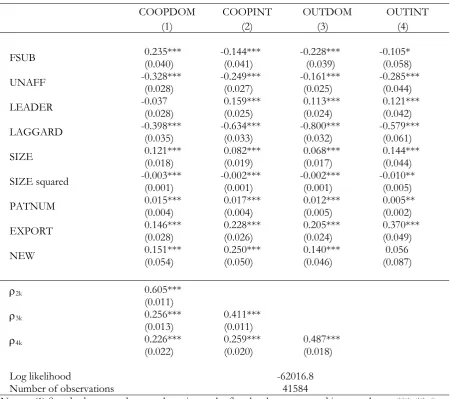
Table 3 shows the results of the multivariate probit estimation. Estimations are reported with
standard errors robust to clustering at the firm-level because we have pooled cross section
data and thus repeated observations on individual firms.7
The data shows the presence of interdependence between the different types of technology
sourcing strategies. Rho, the correlation coefficient between the residuals of each of the
probits, is significantly different from zero (bottom of the table) indicating that the
multivariate probit model is more appropriate than separate univariate probits. For
comparison we have also estimated individual univariate probits. Coefficient estimates are
very similar. Logically enough, calculation of separate univariate probits do not provide
information on the possible statistical association of different channels. As mentioned, a
substantial proportion of the sample firms combine more than one channel. Whatever the
location of partners, cooperation and outsourcing are always positively and significantly
associated, indicating complementarities.8 Our results suggest that firms operating in Spain
use the four types of external technology sourcing analysed in this article and that these
7 Alternatively, we have also estimated the multivariate probits for separate waves of the survey. Results are qualitatively unchanged and available upon request.
mechanisms are not mutually exclusive. Instead, these practices are clearly interdependent at
the company level.
In the domestic market, we find that foreign subsidiaries show a greater propensity for
cooperation for innovation and a smaller propensity for R&D outsourcing compared to
domestic affiliated firms. If we look at the coefficients for domestic unaffiliated firms, we also
see that foreign subsidiaries are even more likely than both kinds of domestic firms to engage
in cooperation for innovation in the domestic market. What is also noteworthy is that,
compared to affiliated domestic companies, foreign subsidiaries have a lower propensity for
both forms of international sourcing of technology.
Confirming findings of the organisation and network literature, laggards are always less able
to engage in open innovation than other firms operating in the same sector (Ahuja, 2000;
Pittaway et al., 2004). Leadership, by contrast, seems to facilitate involvement in domestic
and international networks. Only in the case of domestic cooperation for innovation do we
find no significantly higher propensity to cooperate for leaders. Here we observe a similar
propensity for firms in the middle ranges.
As for our other control variables, we find that larger firms show a higher propensity to
engage in each of the four forms of external technology sourcing analysed here. These results
support those of previous studies (Carboni, 2013; Chun & Mun, 2011; Ebersberger et al.,
2011; Lopez, 2008; Schmiedeberg, 2008; Segarra-Blasco & Arauzo-Carod, 2008), in that a
large size predicts cooperation for innovation, but not those of Hsuan and Mahnke (2011),
who find that small size predicts the adoption of R&D outsourcing. Moreover, both the
number of patented inventions and exporting are also positively related to the propensity for
each type of technology sourcing. Exporting seems to relate specifically to greater
are also more likely to engage in all forms of external technology sourcing, except
international R&D outsoucing.
Our finding regarding foreign subsidiary status is different from that of Veugelers and
Cassiman (2004) and Knell and Srholec (2006), who find a negative association between
foreign status and domestic cooperation for innovation. Ebersberger et al (2011) also find a
negative effect of foreign status in “high income, low R&D countries”; a category including
Spain. Srholec (2009), in contrast, does find a positive association. Note, however, that the
estimations in these studies compare foreign subsidiaries with all domestic firms regardless of
whether they are affiliated or not.9
As for external technology sourcing from abroad, these studies find a positive association, but
our results show that foreign subsidiaries cooperate and source R&D less in the international
market compared to domestic groups and have only a higher propensity compared to
unaffiliated firms. Our results also differ from Faria and Schmidt (2012) and Shrolec (2011),
who control for domestic group status and foreign subsidiary group status and use domestic
unaffiliated firms as control groups. Their results indicate that foreign subsidiaries cooperate
more than domestic firms in the international market but in the host market they cooperate
less than domestic affiliated firms.
A possible explanation for the willingness of foreign subsidiaries to establish greater
cooperation for innovation with local partners compared to domestic affiliated firms in Spain
and not in some of the countries previously studied may depend on the production structure
of the host-countries. Spain has one of the most important subcontracting industries in the
EU and foreign subsidiaries seem to often be involved in product subcontracting with local
partners (Cámaras de Comercio, 2008; EUROSTAT, 2008; Holl et al., 2012). In R&D
cooperation, each partner may act as a free rider (Dhont-Peltrault & Pfister, 2011), hence, the
9 Ebersberger et al. (2011) study the effect of domestic multinationality in separate estimations and
importance of a framework such as production subcontracting relationships for
joint-innovation, especially for foreign subsidiaries lacking social capital in the host-country. Other
authors also point to a relationship between national industries characterised by
subcontracting relationships and the potential for technological collaboration between
partners (Love & Roper, 2009). In our sample, foreign subsidiaries seem to especially value
cooperation for innovation with local suppliers. Twenty percent of them declare that they
cooperate with this type of partner versus only 3.3% of domestic firms (significant at 1%).
Foreign subsidiaries also cooperate more with local clients, compared to domestic firms
(4.9% of foreign subsidiaries versus 0.8% of domestic firms, significant at 1%). In contrast,
they cooperate with local private R&D laboratories to a lesser extent than domestic firms do
(14.8% versus 17.4, significant at 1%). Though we cannot put this proposition to test with the
available data, the positive association of foreign status and local cooperation for innovation
may be related, in our sample, to the engagement of foreign subsidiaries in subcontracting
production networks with local suppliers.
In contrast, in our sample, foreign subsidiary status is negatively associated with local R&D
outsourcing. In other words, following Dhont -Peltrault and Pfister (2011), the foreign
subsidiaries of our sample are relatively more willing than domestic groups to develop a
technology or product with local partners. However, they seem less willing than domestic
firms to delegate these tasks to local partners. These preferences may be related to the
respective characteristics of those arrangements. Cooperation for innovation is more likely to
be selected when the firm enters a new market, since products need to be adapted to local
tastes, a process often involving repeated interactions between firms. Since foreign
subsidiaries often need to adapt their products to the host-country, they may be more
interested in local cooperation for innovation than domestic firms. In contrast, companies are
more likely to use R&D outsourcing for incremental innovation and standardized tasks
Regarding our main research questions, we find that foreign subsidiaries use local knowledge
basically by implementing cooperation mechanisms with domestic partners. Yet, their
connections via local R&D outsourcing seem weaker than those of comparable domestic
firms.
5.2. Heterogeneity in foreign subsidiary technology sourcing
So far we have compared foreign subsidiaries to domestic affiliated and unaffiliated firms.
Foreign subsidiaries are, however, themselves not a homogeneous group. Their respective
mandates may affect their sourcing behaviour (Álvarez & Cantwell, 2011)10 The literature
characterises the activities of foreign MNEs aimed at adapting products to local markets as
knowledge exploiting and those aimed at acquiring new knowledge, for instance through
access of the public research base of the host-country, as knowledge augmenting (Edler,
2008; Kuemmerle, 1999). The local embeddedness of foreign subsidiaries may therefore
depend on their specific mandate in the host country (Cantwell & Mudambi, 2005). Previous
studies have found that the type of R&D in which the firm is engaged may point to the
nature of its mandate and, in turn, to its technology sourcing strategy. According to Cantwell
and Mudambi (2005), knowledge augmenting activities, which are more complex, are mainly
driven by needs of technological creativity, while knowledge exploiting activities are mainly
driven by needs of technological adaptation to local tastes. In the UK, they contend, foreign
subsidiaries with a knowledge augmenting mandate are more likely to be locally embedded.
On the other hand, the division of labour between parents and subsidiaries “has been
frequently described as basic research being pursued in the former and applied research or
adaptation in the latter” (Bellak, 2004 , p 500). We interpret this as suggestive that basic
research is not among the usual roles of most foreign subsidiaries; an emphasis on it, as
compared to other firms operating in the same sector, may point to the presence of
knowledge augmenting activities in the foreign subsidiaries. By the same token, an emphasis
on technological development may point to knowledge exploiting activities.
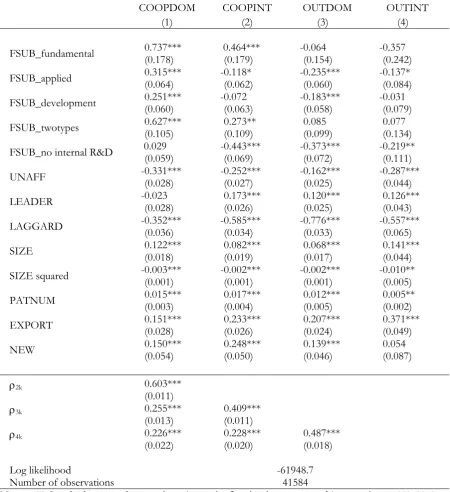
In Table 4 we present estimation results where we have subdivided the group of foreign
subsidiaries according to the characteristics of their internal R&D expenditure. The dummy
variables indicate whether, as compared to the mean of its OECD sector11, a given foreign
subsidiary carries out a larger percentage of its R&D in fundamental research, applied
research, technology development, in two of the R&D types, or if it has no internal R&D
expenses (see Table A1 for variable definition). Our result that foreign subsidiaries have a
greater propensity to cooperate in the domestic market is confirmed for all types of foreign
subsidiaries, with the only exception being those subsidiaries with no internal R&D. These
subsidiaries, which account for slightly over a third of all subsidiaries in our sample, are not
significantly different from affiliated domestic firms regarding domestic cooperation (Table
4). In contrast, our results indicate that the foreign subsidiaries which are more willing to
cooperate for innovation with local partners are competence creating foreign subsidiaries.
However, this is a small group, accounting for only approximately 2% of foreign subsidiaries
in our sample. Our results provide support to Álvarez & Cantwell‘s (2011) findings in that
competence creating foreign subsidiaries that operate in Spain seem especially prone to
cooperate with external agents. This is also reflected in their greater propensity for
international cooperation compared to domestic firms. In general, it seems that the lower
propensity of foreign subsidiaries to engage in international cooperation, as well as domestic
and international outsourcing of R&D, as observed in Table 3, is mainly driven by those
foreign subsidiaries with no internal R&D expenditure and, to a lesser degree, by those which
11
are knowledge exploiting ones. Only a minority of the foreign subsidiaries, notably
competence creating subsidiaries, has a greater propensity to establish cooperation linkages
with external international partners compared to domestic firms. This is an important
consideration since policy makers often have in mind the alleged potential of foreign
subsidiaries for connecting the host-country to international networks of knowledge.
As stated, some authors claim that there may be a trade-off between the local embeddedness
of the subsidiary and its embeddedness in the corporate network.
In some unreported estimations we have proxied the embeddedness of the subsidiary in the
corporate network by the importance attributed to the own company and company group in
the innovation process. These estimations confirm our main result that foreign subsidiaries
cooperate more than domestic firms in the domestic market, but also indicate that local
embeddedness is stronger for those subsidiaries that rely only weakly on the corporate
network in their innovation process. However, PITEC displays clear limitations to
operationalise embeddedness in the multinational network, as the questionnaire does not
distinguish between the importance of the own company and the importance of the corporate
network in the innovation process. Moreover, the degree of embeddedness of a subsidiary
may also depend to some extent on the nature of the embeddedness of all other subsidiaries
in the MNE network. Unfortunately, the PITEC data does not provide information on other
than Spanish host locations. Thus, we cannot explore this concept of multiple embeddedness
and the trade-off’s that multinationals might seek in local sourcing in different host countries
(Meyer et al., 2011).
6. Conclusions
In this paper we draw on a large survey of companies in Spain to examine whether foreign
Firms use different ways of incorporating technology and we distinguish in our analysis the
sourcing of technology via R&D outsourcing and via cooperation for innovation both in the
domestic and international markets. Our results indicate that there are significant
interdependencies between these different technology sourcing choices. Cooperation for
innovation and R&D service outsourcing are both important instruments to acquire external
technological knowledge, and firms simultaneously combine knowledge from these different
external sources in their innovation strategy. The joint empirical consideration of these
different sources is a contribution of our study.
Regarding our main variable of interest, we find that foreign subsidiaries engage in a different
pattern of technology sourcing. Specifically, we find that they show a smaller propensity for
external technology sourcing via R&D outsourcing from independent firms in the domestic
and international market compared to domestic affiliated firms. This is in contrast to their
cooperation pattern. Here, they engage in greater domestic cooperation than both unaffiliated
and affiliated domestic firms and less international cooperation than domestic affiliated firms.
This is an interesting finding since the linkages of foreign subsidiaries with the national
innovation system of the host-county are often analysed exclusively from the perspective of
cooperation for innovation. This approach, however, may overvalue the embeddedness of
foreign subsidiaries and their potential to transfer technology to the local economy.
Our results also suggest the need to investigate differences within the group of foreign
subsidiaries concerning their propensities to source technology locally. This is another
contribution of our article, as most previous studies do not discriminate between different
types of foreign subsidiaries when comparing them to domestic firms; this is an important
consideration given the current competition between host-countries to attract high quality
FDI. Further research should provide more evidence on technology sourcing patterns of
However, our research is not without limitations. The available data did not allow us to
consider licensing, an important form of technology sourcing (Contractor, 1981), nor the
forms of entry selected by foreign subsidiaries or the multiple embeddedness of these firms at
the international level. All are potentially important determinants of the technology sourcing
pattern of these companies.
Further research also needs to pay attention to the emergence and growth of global value
chains and the leading role of multinationals in them. Our preliminary results about the
importance of relationships within the value chain for foreign subsidiaries engaged in local
technology sourcing point in this direction.
From a policy point of view it would be important to stimulate the incorporation of foreign
subsidiaries into the national system of innovation as multinational networks may provide a
way to access international knowledge bases. However, affiliated domestic firms seem as
capable as foreign subsidiaries in linking the host country to external international partners.
This finding seems to suggest different possibilities for policies pursuing an opening of the
host country to international networks of knowledge. Policies also need to value the presence
of competent domestic suppliers as a major factor of attraction for foreign subsidiaries which
are willing to network for innovation.
Finally, in this study we have only analysed the incidence of technology sourcing but not the
intensity of different sourcing relations. Better knowledge on those issues would also be
References
Abramovsky, L., R. Griffith, G. Macartney, & H. Miller. 2008. The location of innovative activity in Europe: The Institute for Fiscal Studies WP08/10
Ahuja, G. 2000. The duality of collaboration: inducements and opportunities in the formation of interfirm linkages. Strategic Management Journal, 21: 317-43.
Almeida, P. 2004. Subsidiaries and knowledge creation: The influence of the MNC and host country on innovation. Strategic Management Journal, 25: 847-64.
Álvarez, I. & J. Cantwell. 2011. International integration and mandates of innovative subsidiaries in Spain. International Journal of Institutions and Economies, 3: 415-44.
Andersson, U., M. Forsgren, & U. Holm. 2002. The strategic impact of external networks: Subsidiary performance and competence development in the multinational corporation.
Strategic Management Journal, 23: 979-96.
Belderbos, R., M. Carree, B. Diederen, B Lokshin, & R. Veugelers. 2004. Heterogeneity in R&D cooperation strategies. International Journal of Industrial Organization, 22: 1237– 63. Bellak, C. 2004. How domestic and foreign firms differ and why does it matter? . Journal of
Economic Surveys, 18(4): 483-514.
Beneito, P. 2006. The innovative performance of in-house and contracted R&D in terms of patents and utility models. Research Policy, 35: 502-17.
Berry, H. 2006. Leaders, laggards, and the pursuit of foreign knowledge. Strategic Management Journal, 27: 151-68.
Boehe, D.M. 2007. Product development in MNC subsidiaries: Local linkages and global interdependencies. Journal of International Management, 13: 488-512.
Cámaras de Comercio. 2008. La subcontratación industrial en España. Tecnología y competitividad. Madrid.
Cantwell, J. & O. Janne. 1999. Technological globalization and innovative centres: the role of corporate technological leadership and locational hierarchy. Research Policy, 28(2-3): 119-44.
Cantwell, J. & E. Kosmopoulou. 2009. Path dependency and coherence in international networks of technological innovation.In Cantwell, J. & J. Molero, editors, Multinational enterprises, innovative strategies and systems of innovation. Cheltenham, UK and Northampton, MA, USA: Edward Elgar 47-80
Cantwell, J. & R. Mudambi. 2005. MNE competence-creating subsidiary mandates. Strategic Management Journal, 26: 1109-28.
Cantwell, J. & R. Mudambi. 2011. Physical attraction and the geography of knowledge sourcing in multinational enterprises: . Global Strategy Journal, 1(3-4): 206–32.
Cantwell, J.A. 2004. Towards a technology-seeking explanation of US direct investment in the United Kingdom. Journal of International Management, 10: 5-20.
Cappellari, L., & S. P. Jenkins. 2003. Multivariate Probit Regression using Simulated Maximum Likelihood. Stata Journal, 3(3), 278-294.
Carboni, O.A. 2013. Heterogeneity in R&D cooperation: an empirical investigation Structural Change and Economic Dynamics, 25: 48-59.
Cassiman, B. & R. Veugelers. 2006. In Search of Complementarity in the Innovation Strategy: Internal R&D and External Knowledge Acquisition. Management Science, 52(1): 68-82. Contractor, F. J. 1981. The role of licensing in international strategy. Columbia Journal of World
Business, 16(4): 73-83.
Chib S & Greenberg E. 1998. Analysis of multivariate probit models. Biometrika 85:347–361. Chun, H. & S.-B. Mun. 2011. Determinants of R&D cooperation in small and medium sized
enterprises. Small Business Economics, DOI 10.1007/s11187-010-9312-5.
Dachs, B., B. Ebersberger, & H. Lööf. 2008. The innovative performance of foreign-owned enterprises in small open economies. Journal of Technology Transfer, 33: 393-406.
Dhont-Peltrault, E. & E. Pfister. 2011. R&D cooperation versus R&D subcontracting: empirical evidence from French survey data. Econ. Innov. New Techn., 20(4): 309-41.
Dunning, J.H. & S.M. Lundan. 2009. The internationalization of corporate R&D: A review of the evidence and some policy implications for home countries. Review of Policy Research, 26(1-2): 13-34.
Ebersberger, B. & S.J. Herstad. 2012. Go abroad or have strangers visit? On organizational search spaces and local linkages. Journal of Economic Geography, 12: 273-95.
Ebersberger, B., S.J. Herstad, E. Iversen, E. Kirner, & O. Som. 2011. Analysis of innovation drivers and barriers in support of better policies. Economic and market intelligence on innovation. Open innovation in Europe: effects, determinants and policy. Oslo: European Commission. Enterprise and Industry.
Edler, J. 2008. Creative internationalization: widening the perspectives on analysis and policy regarding international R&D activities. Journal of Technology Transfer, 33: 337-52.
EUROSTAT. 2008. Europe in figures.In Eurostat, editor, Eurostat yearbook Luxembourg: European Comission.
Faria, P. & T. Schmidt. 2012. International cooperation on innovation: firm-level evidence from two European countries. Innovation: Management, Policy & Practice 14 (3): 304 - 324. García-Vega, M. & E. Huergo. 2011. Determinants of international R&D outsourcing: the
role of trade. Review of Development Economics, 15(1): 93-107.
Hagedoorn, J. & R. Narula. 1996. Choosing organizational modes of strategic technology partnering: International and sectorial differences. Journal of International Business Studies, 27(2): 265-84.
Hagedoorn, J. 2002. Inter-firm R&D partnerships: an overview of major trends and patterns since 1960. Research Policy, 31: 477–492.
Herstad, S.J., C. Bloch, Ebersberger. B., & E. van de Velde. 2010. National innovation policy and global open innovation: exploring balances, tradeoffs and complementarities. Science and Public Policy, 37(2): 113-24.
Hitt, M.A., H. Lee, & E. Tucel. 2002. The importance of social capital to the management of multinational enterprises: Relational networks among Asian and Western firms. Asia Pacific J Management, 19: 353-72.
Holl, A., R. Pardo, & R. Rama. 2012. Comparing outsourcing patterns in domestic and FDI manufacturing plants: empirical evidence from Spain. European Planning Studies, 20(8): 1335-57.
Hsuan, J. & V. Mahnke. 2011. Outsourcing R&D: a review, model and research agenda.
R&D Management, 41(1): 1-7.
Jabbour, L. & M.P. Zuniga. 2009. Drivers of the offshore outsourcing of R&D: empirical evidence from French manufacturers, Research Paper Series. Globalisation, Productivity and Technology, The University of Nottinhgham. Leverhulme Centre Research Paper 2009/04, p.26. Knell, M. & M. Srholec. 2006. Innovation cooperation and foreign ownership in the Czech
Republic. Paper presented at The Online Proceedings of The First Conference on Micro Evidence on Innovation and Development (MEIDE).
Kuemmerle, W. 1999. Foreign direct investment in industrial research in the pharmaceutical and electronics industries- results from a survey of multinationals. Research Policy, 28: 179-93.
Lenz-Cesar, F. & Heshmati, A. 2012. An econometric approach to identify determinants of cooperation for innovation among firms. Applied Economics Letters, 19:3, 227-235
Lopez, A. 2008. Determinants of R&D cooperation: Evidence from Spanish manufacturing firms. International Journal of Industrial Organization, 26: 113-36.
López, A. 2011. The effect of microaggregation on regression results: an application to Spanish innovation data. MPRA Munich paper no. 30403
Love, J.H. & S. Roper. 2009. Organizing the innovation process: Complementarities in innovation networking. Industry and Innovation, 16(3): 273-90.
Meyer, K.E., R. Mudambi, & R. Narula. 2011. Multinational enterprises and local context: the opportunities and challenges of multiple embeddedness. Journal of Management Studies, 48(2).
Molero, J. & J. Heijs. 2002. Differences of innovative behaviour between national and foreign firms: measuring the impact of foreign firms on national innovation systems.
Int.J.Entrepreneurship and Innovation Management, 2(2/3): 122-45.
Molero, J., J. Portela, & I. Álvarez. 2009. Innovative MNEs' subsidiaries in different domestic environments. ICEI. Madrid( WP01/09): 7-20.
Nachum, L. & D. Keeble. 2003. MNE linkages and localised clusters: foreign and indigenous firms in the media cluster of Central London. Journal of International Management, 9: 171-912.
Pfaffermayr, M., & C. Bellak. 2002. Why foreign-owned firms are different: a conceptual framework and empirical evidence for Austria, in: Jungnickel, R. (ed.). Foreign-Owned Firms - Are They Different?, Palgrave Macmillan, Houndmills, pp13-57.
Phelps, N.A. 1993. Branch plant and the evolving spatial division of labour: a study of material linkage change in the Norther Region of England. Regional Studies, 27(2): 87-101. Pittaway, L., M. Robertson, K. Munir, D. Denyer, & A. Neely. 2004. Networking and
innovation: a systematic review of the evidence. International Journal of Management Reviews, 5/6(384): 137-38.
Schmidt, T. 2008. Motives for innovation cooperation? Evidence from the Canadian Survey of Innovation. http://hdl.handle.net/10419/24570, ZEW Discussion Papers no.08-018 Schmiedeberg, C. 2008. Complementarities of innovation activities: an empirial analysis of the
German manufacturing sector. Research Policy, 37: 1492-503.
Segarra-Blasco, A. & J.M. Arauzo-Carod. 2008. Sources of innovation and industry-university interaction: evidence from Spanish firms. Research Policy, 37(8): 1283-95.
Srholec, M. 2011. Understanding the heterogeneity of cooperation on innovation: Firm-level evidence from Europe, Working Papers on Innovation Studies 2011/1201Centre for Technology, Innovation and Culture: University of Oslo.
Srholec, M. . 2009. Does Foreign Ownership Facilitate Cooperation on Innovation? Firm-level Evidence from the Enlarged European Union European Journal of Development Research, 21: 47-62.
Teirlinck, P., M. Dumont, & A. Spithoven. 2010. Corporate decision-making in R&D outsourcing and the impact on internal R&D employment intensity. Industrial and Corporate Change, 19(6): 1741-68.
UNCTAD, editor. 2001. World Investment Report 2001. Promoting Linkages. New York and Geneva: United Nations Conference on Trade and Development.
UNCTAD. 2011. World Investment Report 2011. New York and Geneva.
Vega-Jurado, J., A. Gutiérrez-Garcia, & I. Fernández-de-Lucio. 2009. Does external knowledge sourcing matter for innovation? Evidence from the Spanish manufacturing industry. Industrial and Corporate Change, 18(4): 637-70.
Table 1. External technology sourcing via R&D outsourcing (1)
Domestic unaffilated firms
Domestic groups Foreign subsidiaries
t-test of means difference domestic groups versus
foreign subsidiaries sig.
% With internal
R&D
% Without internal R&D
% With internal
R&D
% Without internal R&D
% With internal
R&D
% Without internal R&D
With internal R&D
Without internal R&D
No external R&D outourcing 65.0 89.1 53.4 90.4 60.8 91.9 -7.045*** 1.781* Only domestic external R&D outsourcing 31.5 10.3 38.1 8.7 30.3 7.1 7.629*** 1.996** Only foreign external R&D outsourcing 0.8 0.3 1.1 0.5 1.7 0.5 -2.612*** -0.028 Domestic and foreign external R&D outsourcing 2.7 0.3 7.4 0.4 7.1 0.5 0.518 -0.533 Total number of observations 17,305 8,217 7,825 3,366 3,110 1,761 Note: *** significant at the 1% level; ** significant at the 5% level; *significant at the 10% level
Table 2.External technology sourcing via cooperation for innovation (1)
Domestic unaffilated firms
Domestic groups Foreign subsidiaries
t-test of means difference domestic groups versus
foreign subsidiaries sig.
% With internal
R&D
% Without internal R&D
% With internal
R&D
% Without internal R&D
% With internal
R&D
% Without internal R&D
With internal R&D
Without internal R&D
No external cooperation for innovation 68.9 85.2 54.8 80.0 54.8 81.1 0.041 0.954 Only external domestic cooperation for innovation 4.5 5.6 6.2 9.5 11.4 12.3 -9.301*** -3.057*** Only external foreign cooperation for innovation 18.3 7.4 19.1 6.7 8.8 2.3 13.284*** 6.807***
Domestic and foreign external cooperation for innovation 8.3 1.8 19.9 3.8 25.0 4.3 -5.754*** -0.946 Total number of observations 17,305 8,217 7,825 3,366 3,110 1,761 Note: *** significant at the 1% level; ** significant at the 5% level; *significant at the 10% level
Table 3: Drivers of technology sourcing: multivariate probit regression. COOPDOM (1) COOPINT (2) OUTDOM (3) OUTINT (4)
FSUB 0.235***
(0.040) -0.144*** (0.041) -0.228*** (0.039) -0.105* (0.058)
UNAFF -0.328*** (0.028) -0.249*** (0.027) -0.161*** (0.025) -0.285*** (0.044)
LEADER -0.037 (0.028) 0.159*** (0.025) 0.113*** (0.024) 0.121*** (0.042)
LAGGARD -0.398*** (0.035) -0.634*** (0.033) -0.800*** (0.032) -0.579*** (0.061)
SIZE 0.121***
(0.018) 0.082*** (0.019) 0.068*** (0.017) 0.144*** (0.044)
SIZE squared -0.003*** (0.001) -0.002*** (0.001) -0.002*** (0.001) -0.010** (0.005)
PATNUM 0.015*** (0.004) 0.017*** (0.004) 0.012*** (0.005) 0.005** (0.002)
EXPORT 0.146*** (0.028) 0.228*** (0.026) 0.205*** (0.024) 0.370*** (0.049)
NEW 0.151***
(0.054) 0.250*** (0.050) 0.140*** (0.046) 0.056 (0.087)
2k 0.605***
(0.011)
3k 0.256***
(0.013)
0.411*** (0.011)
4k 0.226***
(0.022)
0.259*** (0.020)
0.487*** (0.018)
Log likelihood -62016.8
Number of observations 41584
Table 4: Foreign subsidiaries’ mandate and technology sourcing COOPDOM (1) COOPINT (2) OUTDOM (3) OUTINT (4)
FSUB_fundamental 0.737*** (0.178) 0.464*** (0.179) -0.064 (0.154) -0.357 (0.242)
FSUB_applied 0.315*** (0.064) -0.118* (0.062) -0.235*** (0.060) -0.137* (0.084)
FSUB_development 0.251*** (0.060) -0.072 (0.063) -0.183*** (0.058) -0.031 (0.079)
FSUB_twotypes 0.627*** (0.105) 0.273** (0.109) 0.085 (0.099) 0.077 (0.134)
FSUB_no internal R&D 0.029 (0.059) -0.443*** (0.069) -0.373*** (0.072) -0.219** (0.111)
UNAFF -0.331*** (0.028) -0.252*** (0.027) -0.162*** (0.025) -0.287*** (0.044)
LEADER -0.023 (0.028) 0.173*** (0.026) 0.120*** (0.025) 0.126*** (0.043)
LAGGARD -0.352*** (0.036) -0.585*** (0.034) -0.776*** (0.033) -0.557*** (0.065)
SIZE 0.122***
(0.018) 0.082*** (0.019) 0.068*** (0.017) 0.141*** (0.044)
SIZE squared -0.003*** (0.001) -0.002*** (0.001) -0.002*** (0.001) -0.010** (0.005)
PATNUM 0.015*** (0.003) 0.017*** (0.004) 0.012*** (0.005) 0.005** (0.002)
EXPORT 0.151*** (0.028) 0.233*** (0.026) 0.207*** (0.024) 0.371*** (0.049)
NEW 0.150***
(0.054) 0.248*** (0.050) 0.139*** (0.046) 0.054 (0.087)
2k 0.603***
(0.011)
3k 0.255***
(0.013)
0.409*** (0.011)
4k 0.226***
(0.022)
0.228*** (0.020)
0.487*** (0.018)
Log likelihood -61948.7
Number of observations 41584
Appendix Table A1. Survey variable description
Variable Definition Mean Stdv.
FSUB Dummy variable taking on 1 if the company belongs to a group with its headquarters outside Spain.
0.117 0.322
UNAFF Dummy variable taking on 1 if the company does not belong to a company group.
0.614 0.487
DGROUP Dummy variable taking on 1 if the company belongs to a group with its headquarters in Spain (=reference group).
0.269 0.444
LEADER Dummy variable taking on 1 if the company is in the top quartile in terms of the number of R&D employees per total sales in its respective technology sector* and year.
0.319 0.466
LAGGARD Dummy variable taking on 1 if the company is in the bottom quartile in terms of the number of R&D employees per total sales in its respective technology sector* and year.
0.324 0.468
SIZE Total number of employees (in thousands) 0.263 1.304 SIZE squared Total number of employees squared 1.769 35.686
PATNUM Number of patents 0.619 6.706
EXPORT Dummy variable taking on 1 if the company reports sales in international markets and 0 otherwise.
0.657 0.475
NEW Dummy variable taking on 1 if the company was newly created between 2003-2009.
0.052 0.221
FSUB_fundamental Dummy variable taking on 1 if the company belongs to a group with its headquarters outside Spain and dedicates a greater percentage of its internal R&D expenditures to fundamental research compared to its technology sector* mean.
0.002 0.045
FSUB_applied Dummy variable taking on 1 if the company belongs to a group with its headquarters outside Spain and dedicates a greater percentage of its internal R&D expenditures to applied research compared to its technology sector* mean.
0.031 0.174
FSUB_development Dummy variable taking on 1 if the company belongs to a group with its headquarters outside Spain and dedicates a greater percentage of its internal R&D expenditures to technological development compared to its technology sector* mean.
0.034 0.182
FSUB_twotypes Dummy variable taking on 1 if the company belongs to a group with its headquarters outside Spain and dedicates a greater percentage of its internal R&D expenditures in two of the above groups compared to its technology sector* mean.
0.007 0.084
FSUB_no internal R&D
Dummy variable taking on 1 if the company belongs to a group with its headquarters outside Spain and reports no internal R&D expenditure.
0.042 0.201
Appendix Table A2. Correlation matrix
FSUB UNAFF DGROUP LEADER LAGGARD SIZE SIZE
Squared PATNUM EXPORT NEW
FSUB_ fundamental
FSUB_ applied
FSUB_ development
FSUB_ twotypes
FSUB_no internal R&D
FSUB 1
UNAFF -0.459 1
DGROUP -0.221 -0.765 1
LEADER -0.152 0.177 -0.084 1
LAGGARD 0.040 -0.003 -0.026 -0.474 1
SIZE 0.101 -0.175 0.120 -0.068 0.020 1
SIZEsquared 0.029 -0.058 0.043 -0.008 0.007 0.860 1
PATNUM 0.034 -0.050 0.030 0.004 -0.052 0.042 0.007 1
EXPORT 0.153 -0.118 0.019 -0.028 -0.152 -0.014 -0.015 0.045 1
NEW -0.057 0.053 -0.017 0.150 -0.057 -0.039 -0.011 0.002 -0.109 1
FSUB_fundamental 0.124 -0.057 -0.027 -0.006 -0.030 0.002 -0.002 0.003 0.025 -0.006 1
FSUB_applied 0.494 -0.227 -0.109 -0.042 -0.116 0.026 -0.003 0.019 0.093 -0.026 -0.008 1
FSUB_development 0.518 -0.238 -0.115 -0.052 -0.122 0.059 0.016 0.053 0.099 -0.025 -0.009 -0.034 1
FSUB_twotypes 0.231 -0.106 -0.051 -0.034 -0.055 0.020 -0.002 0.017 0.047 -0.011 -0.004 -0.015 -0.016 1