ι 'fi "FSr :'
A PRECISE DETERMINATION
OF THE TERMAL NEUTRON ABSORPTION
CROSS SECTION OF B
10
AND a S M r ø H f
NATURAL BORON BY TIME OF FLIGHT
A. J. DERUYTTER (C.E.N.-S.C.K.)
A. PROSDOCIMI (EURATOM)
This document was prepared under the sponsorship of t h e Commission oi Atomic Energy Community (EURATOM).
Neither the E U R A T O M Commission, its contractors nor any person acting on their behalf , t T T i í f ^ í ¿iJtr^
io Make a n y w a r r a n t y or representation, express or implied, with respect t o t h e accuracy, completeness or usefulness of the information contained in this document, or t h a t the use of any information, apparatus, method, or process disclosed in this document m a y n o t infringe privately owned rights; or
s5S=~
2o _ Assume any liability with respect to t h e use of, or for damages resulting from t h e use of anv information, apparatus, method or process disclosed in this document.
M S MlUtCt
igg^jgji rrv A¿=&
ss¡&
This reprint is intended for restricted distribution only. It reproduces,
. by kind permission of the publisher, an article from „REACTOR SCIENCE AND TECHNOLOGY" {Journal of Nuclear Energy Parts AjB), Vol. 17 1963, 8387. For further copies please apply to Pergamon Press Ltd., 4 Fitzroy Square — London W. 1, England.
Dieser Sonderdruck ist für eine beschränkte Verteilung bestimmt. Die Wiedergabe des vorliegenden in „REACTOR SCIENCE AND TECHNOLOGY" {Journal of Nuclear Energy Parts A[B), Vol. 17 1963, 8387. erschienenen Aufsatzes erfolgt mit freundlicher Genehmi gung des Herausgebers. Bestellungen weiterer Exemplare sind an Pergamon Press Ltd., 4 Fitzroy Square London W. 1, England,
zu richten. »âf·««».»
ιαυη ry . ι,
Ce tiréàpart est exclusivement destine à une diffusion restreinte. Il reprend, avec l'aimable autorisation de l'éditeur, un article publié dans «REACTOR SCIENCE AND TECHNOLOGY» {Journal of Nuclear Energy Parts A/B), Vol. 17 1963, 8387. Tout autre exemplaire de cet article, doit être demandé à Pergamon Press Ltd., 4 Fitzroy Square
.ifc-.m« »...
g Ê g ^ g H f S a i g g
London W. 1, England.
Questo estratto è destinato esclusivamente ad una diffusione limitata. Esso è stato riprodotto, per gentile concessione dell'Editore, da «REAC TOR SCIENCE AND TECHNOLOGY» {Journal of Nuclear Energy Parts AjB), Voi. 17 1963, 8387. Ulteriori copie dell'articolo debbono essere richieste a Pergamon Press Ltd., 4 Fitzroy Square
England.
London W. 1,
Deze overdruk is slechts voor beperkte verspreiding bestemd. Het artikel is met welwillende toestemming van de uitgever overgenomen uit „REAC
TOR SCIENCE AND TECHNOLOGY" {Journal of Nuclear Energy Parts A¡B) Vol. 17 1963, 8387. Meer exemplaren kunnen besteld worden bij Pergamon Press Ltd., 4 Fitzroy Square, London W. 1, England.
EU R 3 2 3 . e R E P R I N T
A P R E C I S E D E T E R M I N A T I O N O F T H E T H E R M A L N E U T R O N ABSORP T I O N CROSS SECTION O F Β1 0 AND N A T U R A L BORON BY T I M E O F
F L I G H T by (in alphabetical order) A.J. D E R U Y T T E R (C.E.N.S.C.K.) and A. PROSDOCIMI (EURATOM).
European Atomic Energy Community EURATOM.
Reprinted from „Reactor Science and Technology" (Journal of Nuclear Energy P a r t s A/B), Vol. 17 1963, pages 8387.
The total cross section of B203 has been measured from 0 0 0 6 eV to 0 0 8 2 eV
with the BR1 slowchopper. Samples of natural boron with an isotopie abundance of (1981 ± 002) per cent B1 0 atoms, and boron enriched up to (96515 ± 0013)
per cent were used for these measurements. From t h e accurate total cross section values obtained, t h e ratio of the boron absorption cross section to t h e reciprocal of neutron velocity was calculated. This q u a n t i t y remains a constant over the entire energy range covered and its mean value for natural boron is κ = (1674 +_ 00041) barns m/^s and for the enriched boron κ = (815 —
E U R 3 2 3 . e
R E P R I N T
A P R E C I S E D E T E R M I N A T I O N O F T H E T H E R M A L N E U T R O N ABSORP T I O N CROSS SECTION O F B1 0 AND N A T U R A L BORON BY T I M E OF
F L I G H T by (in alphabetical order) A.J. D E R U Y T T E R (C.E.N.S.C.K.) and A. PROSDOCIMI (EURATOM).
European Atomic Energy Community EURATOM.
Reprinted from „Reactor Science and Technology" (Journal of Nuclear Energy P a r t s A/B), Vol. 17 1963, pages 8387. ■
The total cross section of B203 has been measured from 0Ό06 eV to 0Ό82 eV
with the BR-1 slowchopper. Samples of natural boron with an isotopie abundance of (19-81 ± 0-02) per cent B1 0 atoms, and boron enriched up to (96515 ± 0-013)
per cent were used for these measurements. From the accurate total cross-section values obtained, the ratio of the boron absorption cross cross-section to the reciprocal of neutron velocity was calculated. This quantity remains a constant over the entire energy range covered and its mean value for natural boron is κ = (1674 +_ 00041) barns m/^s and for the enriched boron κ = (8Ί5 +
E U R 3 2 3 . e R E P R I N T
A PRECISE DETERMINATION O F T H E THERMAL NEUTRON ABSORP
TION CROSS SECTION OF B1 0 AND NATURAL BORON BY TIME OF
FLIGHT by (in alphabetical order) A.J. D E R U Y T T E R (C.E.N.-S.C.K.) and A. PROSDOCIMI (EURATOM).
European Atomic Energy Community - EURATOM.
Reprinted from „Reactor Science and Technology" (Journal of Nuclear Energy Parts A/B), Vol. 17 - 1963, pages 83-87.
The total cross section of B203 has been measured from 0Ό06 eV to 0082 eV
with the BR-1 slowchopper. Samples of natural boron with an isotopie abundance of (19-81 ± 0-02) per cent B1 0 atoms, and boron enriched up to (96-515+ 0-013)
0019) barns m//¿s. The deduced values for the boron absorption cross section at the reference neutron velocity of 2200 m/s are for natural boron σ„ = 7608 ± 19 barns and for t h e enriched boron <sa = 3703 ± 8'9 barns. These values yield for the absorption cross section of the B1 0 isotope at the reference velocity
3840 ± 1 1 barns as deduced from the natural boron results, and 3S37 ± 9 barns from the enriched sample.
0019) barns m/^s. The deduced values for t h e boron absorption cross section at the reference neutron velocity of 2200 m/s are for natural boron aa = 7608 ± 1 9 barns and for the enriched boron aa = 3703 ± 8 9 barns. These values yield for the absorption cross section of the B1 0 isotope a t the reference velocity
3840 ± 1 1 barns as deduced from the natural boron results, and 3S37 ± 9 barns from the enriched sample.
0019) barns m/#s. The deduced values for the boron absorption cross section at the reference neutron velocity of 2200 m/s are for natural boron a„ = 7608 ± 1'9 barns and for the enriched boron aa — 3703 ± 81) barns. These values yield for the absorption cross section of the Β1 ϋ isotope at the reference velocity
Reprinted from
REACTOR SCIENCE
AND TECHNOLOGY
Journal of Nuclear Energy Parts A & Β
P E R G A M O N PRESS
Reactor Science and Technology (Journal of Nuclear Energy Parts A/B) 1963, Vol. 17, pp. 83 to 87. Pergamon Press Ltd. Printed in Northern Ireland
A PRECISE DETERMINATION OF THE THERMAL NEUTRON ABSORPTION
CROSS SECTION OF B
10AND NATURAL BORON BY TIME OF FLIGHT*
A. PROSDOCIMI
Central Bureau for Nuclear Measurements, Euratom, Geel, Belgium A. J. DERUYTTER
CEN-SCK, Mol, Belgium
(Received! July 1962)
Abstract—The total cross section of B203 has been measured from 0-006 eV to 0-082 eV with the BR-1 slow-chopper. Samples of natural boron with an isotopie abundance of (19-81 ± 0-02) per cent B10 atoms, and boron enriched up to (96-515 ± 0-013) per cent were used for these measurements. From the accurate total cross-section values obtained, the ratio of the boron absorption cross section to the reciprocal of neutron velocity was calculated. This quantity remains a constant over the entire energy range covered and its mean value for natural boron is R = (1-674 ± 0-0041) barns m/^s and for the enriched boron K = (8-15 ± 0019) barns m/^s. The deduced values for the boron absorption cross section at the reference neutron velocity of 2200 m/s are for natural boron σα = 760-8 ±1-9 barns and for the enriched boron σ„ = 3703 ± 8-9 barns. These values yield for the absorption cross section of the B10 isotope at the reference velocity 3840 ± 11 barns as deduced from the natural boron results, and 3837 ± 9 barns from the enriched sample.
1. I N T R O D U C T I O N
THE need for reducing the uncertainties in the boron cross section arises from its widespread use as a reference absorber for measurements of other cross sections, and from its use in boron loading specifica tions for reactors and in reactor physics calculations.
This widespread use is due to the high absorption cross section of the B10-isotope, almost entirely due to
the B10(n, a)Li7 reaction, which shows a rigorous
1/V.E-behaviour in an extensive energy range. In order to remove some discrepancies shown by previous determinations (DEBUS et al, 1962) neutron transmission measurements of natural and enriched boron samples have been made with a high degree of precision in an energy range around 0Ό253 eV. Special care was used in the mass-spectrometric determinations of the isotopie abundances of B10 in
the samples, as this was the main reason of deviations in the absorption cross section of B10, deduced from
natural boron cross section measurements in the past. All other associate problems such as the determination of the number of B10 atoms/cm2 in the cells, the
exclusion of any trace of light hydrogen from the cells and chemical purity of the solutions were extensively investigated.
The use of highly enriched boron samples minimizes the influence of other cross sections used in the calcu lation of <Tn(B10) from the measured total cross section
of B203 and this reduces the error.
* Work done by a joint Euratom-CEN group.
The use of 'natural boron' is not adequate to define a standard of neutron absorption with precision. As mass-spectrometric measurements of isotopie abundances seem now more reliable, we have con sidered as the fundamental value the absorption cross section of the B10-isotope at 2200 m/s. From this
value one easily calculates the absorption cross section of any boron standard, from a precise mass-spectro metric determination of the isotopie ratio.
2. SAMPLES
Two solutions of deuterated boric acid in heavy water have been prepared, one containing natural, the other highly enriched boron. The use of quartz con tainers eliminated any exchange of boron atoms with other materials. A preliminary analysis checked the chemical purity of the boron. No traces of other ele ments with high neutron cross sections were detected, which could necessitate a correction to the measured total cross section of B,03.
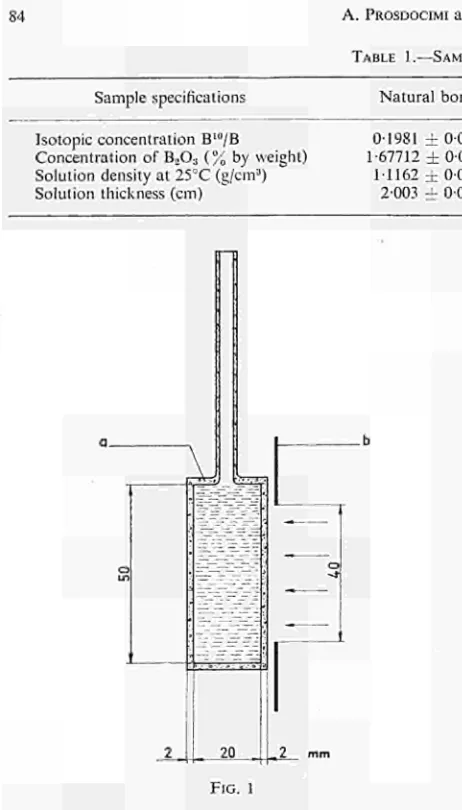
Two identical planeparallel cells (Fig. 1) made of optically polished quartz were filled with these solu tions. The use of D3B03 and handling of the samples
in a dry atmosphere avoided any trace of light hydrogen in the cells. It is estimated that the hydrogen contamination was less than 0-1 per cent.
Two identical cells were filled respectively with pure heavy water (99-9 per cent) and helium to serve as blanks.
84 A. PROSDOCIMI and A. J. DERUYTTER
TABLE 1.—SAMPLE SPECIFICATIONS
Sample specifications Natural boron Enriched boron Heavy water
Isotopie concentration B10/B
Concentration of B203 (% by weight)
Solution density at 25°C (g/cm3)
Solution thickness (cm)
0-1981 ± 00002 1-67712 ± 0-00018
1-1162 ± 00001 2003 ± 0001
0-96515 ± 0-00013 0-38591 ±0-00011 1-1072 ±0-0001
2-005 ± 0-001 1-104485 ± 0000001 2-004 ± 0-001
20
FIG. 1
value of 92-5 per cent. Relative differences of 0-2 per cent were minimized by a suitable choice of the cells to be filled with the four samples, moreover their influence on the final error is still less.
The neutron transmission of the boron samples varied from 30 to 70 per cent, i.e. suitable values to reduce both background and statistical effects.
The specifications of the samples are shown in Table 1. The quoted errors are standard deviations. Details about the measurements are given by DEBUS et al. (1962) for isotopie concentration, by LAUER et ai. (1961) for chemical analysis, by MORET (1962) for thickness determination.
3. EXPERIMENTAL PROCEDURE AND APPARATUS
The total cross section of B203 has been calculated
from the transmission of the samples measured by neutron time-of-flight spectrometry in the energy range 0-006 eV to 0-082 eV. (In this calculation the transmission of the D20 cell was used to account for
the density variation of the boron solutions.) The He cell simulated the empty cell.
The neutron beam of the thermal column of the BR-1 reactor at Mol, pulsed by a slow chopper (CEULEMANS et al., 1962), was transmitted through the samples toward a bank of BF3-detectors, with their
axis perpendicular to the beam direction. Then the BF3-pulses were fed into a multichannel
time-of-flight analyser. The 1/v-behaviour of the measured cross section allowed the use of low resolution : 42 to 56 /¿sec/m, yielding higher intensity and statistical accuracy per channel.
The four samples were placed in the neutron beam by means of a precise positioning device. Cadmium diaphragms of 4 cm dia. and relative transmissions identical within 0-1 per cent, collimated the beam. Any long-term drifts of the experimental conditions were minimized by means of the successive exposure of the four samples in the beam during a time cycle of 103 sec.
Both the multichannel time-of-flight analyser and the sample holder were driven automatically according to a pre-set programme.
Suitable monitoring of the neutron beam eliminated the influence of power-level fluctuations of the reactor. For this purpose a parallel-plate fission flow counter with a low efficiency 235U layer (DERUYTTER, 1960), was placed in the direct beam before the rotor. The diameter of the sensitive volume of the counter was made larger than the diameter of the neutron beam and the axis of the counter coincided with the axis of the beam. Statistical errors on the monitor counts were kept low by making its counting rate at least two orders of magnitude higher than that of each in-dividual channel.
In this way all the partial countings could be norma-lized to their respective monitor counting, printed out by the multichannel analyser at the end of each cycle. Similar measurements were made with Cd filters to correct for the epicadmium and background neutrons.
4. TREATMENT OF THE DATA
[image:8.573.61.292.39.444.2]Determination of the thermal neutron absorption cross section of B10 and natural boron by time of flight 85
I *
S-*-. - ♦ - · •
Naturol τ • 1 • boron E
"CT 9
I *
A a o ü t ^ r ° ° ° φ—^.¡¡.¿03.
Enriched boron
r, ^ sec/m
FIG. 2
the background and epicadmium neutrons, and normalized to the monitor counting. The data thus selected were then totalized to deduce the transmission
Τ of the B203 solutions, both natural and enriched,
and the transmission T0 of the heavy water.
The total cross section of the B203 molecule is given
by: .dep σ((β203) NA ' ( - : doPo
In (1/Γ0) (1)
and c is the concentration of B203 in the solution; ρ
o0 are respectively the densities of the solution and the
heavy water ; d and d0 are respectively the solution and
the D20 thickness; M is the molecular mass of B203
and NA is Avogadro's number.
The contribution to the total cross section of B303
by other cross sections than the boron absorption cross section is assumed 21 barns (HUGHES et al.,
1958; EGELSTAFF, 1957; TITMAN et al., 1951). The uncertainty of this value, about 5 per cent, does not affect the results appreciably.
Indeed its contribution to σ((Β203) at 00253 eV is
13 per cent for natural boron and only 03 per cent for the enriched sample; and it remains less than 25 per cent for the highest energy covered in this experiment. The quantity:
σα(Β) σ,(Β203) 21
Κ (2)
should be a constant, independent of τ, if σ„(Β) is proportional to 1/v. τ represents the flight time reduced to /¿s/m.
In Fig. 2, Κ is plotted as a function of τ for natural and enriched boron, and the 1/vbshaviour is seen to be valid in the energy range covered. This verification allowed a calculation of the weighted mean value by least squares treatment of the 50 experimental K
values by the timeofflight analysis. From (2) it is seen directly that
σ(1(Β10)2200 = (3)
where r0 is the velocity in m/^s of 00253 eV neutrons
and r is the isotopie ratio B10/(B10 + B11) of the sample,
neglecting σ„(Βη) = 0005 barn (HUGHES et al, 1958).
5. E R R O R ANALYSIS
Several directly measured quantities are involved in the calculation of σ,(Β203) according to (1) of Section
4. Their partial errors contribute with different weights to build up the total error of each single value deduced from the different energy channels.
Nevertheless it could be realized that the highest contribution to the error of each at is due to the
random distribution of the detector counts in such a way that the errors of other quantities are scarcely appreciable in comparison.
86 A. PROSDOCIMI and A. J. DERUYTTER
TABLE 2
Sample
Natural boron Enriched boron
Mole per cent B10
1981 ± 002 96515 ± 0013
K, barn m//ísec
1674 ± 00041 815 + 0019
σο(Β),20„ barns
7608 ± 19 3703 ± 89
σο(Β1ϋ)220ϋ barns
3840 ± 11 3837 ± 9
TABLE 3
Reference
SCHMITT et al. (1960) SCHMITT el al. (I960) SAFFORD et al. (I960) S AFFORD et al. (I960) DEBUS et al. (1962) DEBUS et al. (1962)
Experimenter ORNL ORNL Columbia Univ. Columbia Univ. Euratom-CEN Euratom-CEN Year 1960 1960 1960 1960 1961 1961 Energy (eV) 0-018-0-4 0-022-0-042 0-003-0-1 0-006-0-082 0006-0-082 Apparatus Fast chopper Fast chopper Crystal spectr. Crystal spectr. Slow chopper Slow chopper
σ„(Β10)220ο barns
3848 ± 38 3803 ± 48 3838 ± 11 3858 ± 25 3840 ± 11 3837 ± 9
This error originates from uncertainties on the flight-path length and on the flight time. The former arises essentially from the finite thickness of the sensitive volume of the neutron detectors, the latter from the definition of the zero of the flight time.
The flight path, defined as the distance between the reaction centre of the BF3-counters and the chopper is
measurable to 0-01 per cent. The paths of the detected neutrons, however, have a spread of 0-3 per cent around this nominal value.
The calibration of the time-scale was achieved throughout the determination of the Bragg cut-off of the total cross section for a polycrystalline sample of α-iron. Its error affects the single ^-values with uncertainties ranging from 0-2 to 0-6 per cent; in Fig. 2 the total errors of Κ are displayed for some
typical points.
Furthermore the correction for multiple scattering was estimated to be much less than 0-1 per cent and has therefore been neglected.
Finally, upon calculation of the mean Κ of the series of the ΑΓ-values, its standard error, as quoted in Table 2, is evaluated according to the weighted least-squares method. At this point the interpretation of the errors displayed for σα(Β)2200 is straightforward.
Systematic errors on τ have not been accounted for, but an analysis on possible sources has been carried
out (DERUYTTER et ai, 1961) showing that the arith
metic sum could yield no more than 0-13 per cent on the single τ-values. The error given in Table 2 for the isotopie concentration of B10 represents only the
statistical fluctuations in the mass-spectrometric determinations. Systematic errors (mass discrimina tion) are under investigation. However, there are reasons to believe that mass discrimination is small. There is, in fact, good agreement between measure ments of the same sample on mass spectrometers of different design. The value of 19-81 per cent B10 is in
good agreement with results of other laboratories
(DEBUS, 1962; private discussion at K APL and
ORNL), where mass discrimination has been meas ured. Furthermore, mass discrimination would have a very different effect on natural and enriched boron; the good agreement between the cross-section values for B10 obtained on both samples indicates that mass
discrimination is practically non-existing. In any case the results of the investigation on mass discrimination will be published as soon as possible.
6. R E S U L T S A N D C O N C L U S I O N S
The results for Κ, σα(Β) and σα(Β10) are summarized
in Table 2.
The errors quoted are standard deviations. The agreement between the values of the absorption cross section of the B10-isotope calculated from the natural
and the enriched sample is exceedingly good.
Table 3 shows a comparison of the most recent results for σο(Β10)2200. The table is limited to recent
measurements either taken with enriched boron, or those giving a defined isotopie ratio when natural boron was used.
The agreement is satisfactory within the quoted errors.
The mean value for the two determinations of the present report is σα(Β10) = 3838 ± 7 barns. Moreover
a weighted mean deduced from all the data mentioned in Table 3 yields σα(Β10) = 3839 ± 9 barns.
Acknowledgments—The authors wish to acknowledge gratefully
M. NEVE DE MÉVERGNIES and M. J. SPAEPEN for their advice and
guidance, and to express their appreciation to Messrs. G. DEBUS, K. LAUER and H. MORET for preparation and careful analysis of the boron samples respectively by mass spectrometric, chemical and metrological measurements. We like to thank also Mrs. G. D E CORTE and Mr. G. GONANO for their assistance. Further-more thanks are due to Mr. H. CEULEMANS for the design of the
slow chopper, Mr. J. RAVOET and Mr. L. VAN STEELANDT for its
Determination of the thermal neutron absorption cross section of B10 and natural boron by time of flight 87
R E F E R E N C E S
CEULEMANS H. et al. (1962) Pile Neutron Research in Physics,
p. 195, I.A.E.A., Vienna.
DEBUS G., DERUYTTER Α., LAUER Κ. J., MORET Η. and
PROSDOCIMI Α. (1962) Report EUR-12e.
DERUYTTER A. J. (1960) Nucl. instrum. Meth. 7, 145. DERUYTTER A. J. et al. (1961) Proceedings of the EANDC Sym
posium on Neutron Time-of-Flight Methods, pp. 275-282, Euratom.
EGELSTAFF P. A. (1957) / . Nucl. Energy 5, 41.
HUGHES D . J. and SCHWARTZ R. B. Neutron Cross Sections,
USAEC Report, BNL-325, 2nd ed. and Suppl.
LAUER Κ. and LE DUIGOU Y. (1961) Z. Anal. Chem. 184, 4. MORET Η. (1962) Rev. sci. Instrum. 33, 241.
SAFFORD G. J. et al. (1960) Phys. Rev. 119, 1291. SCHMITT Η. W. et al. (1960) Nucl. Phys. 17, 109.