http://dx.doi.org/10.4236/ajac.2016.77048
How to cite this paper: Schwarz, J., Trommer, K. and Mertig, M. (2016) Novel Screen-Printed All-Solid-State Copper(II)-Se- lective Electrode for Mobile Environmental Analysis. American Journal of Analytical Chemistry, 7, 525-532.
http://dx.doi.org/10.4236/ajac.2016.77048
Novel Screen-Printed All-Solid-State
Copper(II)-Selective Electrode for
Mobile Environmental Analysis
Johannes Schwarz
1*, Kathrin Trommer
1, Michael Mertig
1,21Kurt-Schwabe Institut für Mess- und Sensortechnik e.V. Meinsberg, Waldheim, Germany 2Institut für Physikalische Chemie, Technische Universität Dresden, Dresden, Germany
Received 8 March 2016; accepted 27 June 2016; published 30 June 2016
Copyright © 2016 by authors and Scientific Research Publishing Inc.
This work is licensed under the Creative Commons Attribution-NonCommercial International License (CC BY-NC).
http://creativecommons.org/licenses/by-nc/4.0/
Abstract
Based on poly(vinyl chloride) membranes, a novel miniaturized screen-printed all-solid-state cop-per(II)-selective electrode has been developed for applications in environmental monitoring. Per- formance and applicability of the ion-selective electrode (ISE) have been proved by potentiome-tric investigations. Conducting polymers were used as intermediate layers and as solid contacts between the ion-selective membrane and the graphite transducer. The ion-complexing reagent 2-mercapto-benzoxazole was incorporated into poly(vinyl chloride) membranes. In the concen-tration range 10−6 - 10−2 mol/L, the ISE exhibited a linear Nernstian potential response to cop-per(II) with an average slope value of 28 mV/decade. The detection limit was 3 × 10⁻⁷ mol/L. The electrode exhibits a short response time (<10 s) and can be used in the range of pH = 3 - 7. Selec-tivity coefficents against certain interfering ions are investigated. The life time of the electrode under laboratory conditions was approximately 12-month. The electrode was applied in the in-vestigation of different aqueous environmental samples and the electrode characteristics were described. The copper(II) ASSelectrode has also successfully been used in potentiometric, com-plexometric titrations with ethylenediaminetetraacetic acid.
Keywords
All-Solid-State Copper(II)-Selective Electrode, Conducting Polymers, Potentiometric Titration, Environmental Samples
1. Introduction
Contamination of ecosystems by heavy metals is of worldwide concern and represents a major problem in envi-ronmental pollution of today. Heavy metals are non-biodegradable and can accumulate in human organism. Copper is one of the most widely distributed and essential trace elements. It is of great importance for industrial applications and plays a central role in many biochemical processes. Its determination in various media is, therefore, of great interest. According to the German Drinking Water Act, the concentration of copper in drink-ing water has to be lower than 2 mg/L [1]. According to the United States Environmental Agency (EPA) and the World Health Organization (WHO), the maximum containment level (MCL) of copper is even lower: 1.3 mg/L
[2][3].
Many instrumental analytical methods such as atomic absorption spectrometry (AAS), inductively-coupled- plasma optical emission spectrometry (ICP-OES) and inductively-coupled-plasma mass spectrometry (ICP-MS) are used routinely for copper analysis [4]-[6]. These laboratory-based methods have good precision, high sensi-tivity and low detection limits. Disadvantages of these methods are complex analytical operations as well as the need of qualified personnel and high cost equipment. They are also not suitable for field analysis.
Therefore, new analytical tools are required for economical real-time monitoring of environmental pollutants. During the last years, there has been an increasing demand and a high interest for miniaturized electrochemical devices for field investigations of heavy metals. Due to their portability, low cost, compactness, simplicity, easy- to-use capability and robustness, electrochemical devices are promising alternatives compared to costly instru-mental laboratory equipment [7]-[12]. The search for rapid, sensitive, simple, easy-to-handle and robust analyz-ers is still going on.
Ion-selective electrodes (ISEs) are a class of electrochemical sensors with increasing importance for on-site analysis of environmentally relevant ions. Potentiometric ion detection with ion-selective all-solid-state (ASS) electrodes has been widely developed in recent years and will be broadly applicable due to their simplicity and fast analysis. Potentiometric detection requires minimum sample pretreatment and preparation and has great po-tential for field analysis. In literature, the use of different ion-complexing compounds like calixarenes, Schiff′s bases and thiocrown ethers is described for potentiometric copper(II) detection applying ISEs of different con-struction forms [13]-[25].
There are recent reports on ASS copper(II) electrodes [26]-[29]. These electrodes are mainly based on gra-phite pastes and expensive nanomaterials. Furthermore, the use of new synthesized ionophores is often required which results in time-consuming electrode preparation steps.
Conducting polymers (CPs) have been used as solid contact materials and intermediate layers in ASS ion-se- lective electrodes [30]-[36]. They are of interest because of their mixed ionic and electronic conductivity which allows a definite transfer of ion to electrical charge without using an internal liquid electrolyte. The incorpora-tion of conducting polymers as solid contact offers new possibilities for simple and reproducible electrode con-struction. The internal electrolyte can therefore be replaced.
Screen-printing is a well-established technique for manufacturing of portable and disposable electrochemical electrodes. It allows the design of electrodes with small dimensions, good reproducibility and variable electrode arrangements [9][37].
Here we report on the design, preparation, potentiometric characterization and analytical application of screen- printed, solid-contacted ASS copper(II)-selective electrodes consisting of different functional polymeric layers. As neutral carrier and chelating agent, 2-mercapto-benzoxazole (2-MBA) has been used for the first time in ASS ion-selective electrodes. 2-MBA forms stable complexes with copper(II) ions [38].
2. Experimental
2.1. Reagents
2.2. Apparatus and Electrodes
Potentiometric measurements were carried out at room temperature, using the pH/ion analyzers pMX 3000 (WTW Weilheim, Germany) and LM 2000 (Sensortechnik Meinsberg GmbH, Germany). Ag/AgCl reference electrodes with aqueous saturated KCl as the electrolyte solution have been used.
A half-automatic screen printer (EKRA, FEI Germany) has been used to manufacture the screen-printed ASS electrodes.
Atomic adsorption spectrometry (novAA®, Analytik Jena, Germany) was used as reference method.
3. Electrode Preparation
Copper(II)-selective electrodes were fabricated with different functional layers on screen-printed graphite elec-trodes based on Al2O3-ceramic substrates. The manufacture of the electrodes consists of 3 steps:
• Screen-printing of graphite on a ceramic substrate (layer 1),
• Application of CP (layer 2),
• Drop-casting of ion-selective membrane cocktails (layer 3).
Reproducible layer configurations were obtained. Commercially available graphite ink is screen-printed on ceramic substrates within an area of 5 mm × 30 mm. The thickness of the graphite layer is ~500 μm. The gra-phite discs have diameters of 2.5 mm. Polypyrrole (PPy) was prepared by in-situ electropolymerization of 0.1 mol/L pyrrole in KCl-containing solution. PEDOT:PSS was applied by drop casting of an aqueous solution of the polymer directly onto the graphite layer. Both polymers form stable layers and show good adhesion to the graphite substrates. After applying the CP on the graphite surface, the electrodes were rinsed with H2O and air dried overnight. The thickness of the polymer layer is between 5 μm and 10 μm.
The mixture of the membrane components was dissolved in 2 ml THF and allowed to evaporate at room tem-perature till a viscous concentrate was obtained. After the deposition of the CPs, the ion-selective cocktail was drop casted by pipetting about 5 μl onto the CP. The thickness of the resulting membrane is about 100 μm. The composition of the ion-selective membrane components has been optimized. Best results with average slopes of >28 mV/decade were obtained using the following membrane composition:
• PVC (32 wt.%),
• 2-nitrophenyl octyl ether (65 wt.%),
• 2-MBA (3 wt.%).
Before the first measurement, the electrodes were conditioned in 10−3 mol/L copper(II) salt solutions for at least 5 hours.
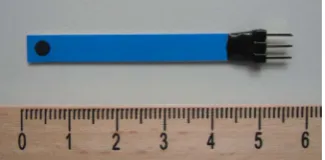
[image:3.595.258.371.502.552.2]In Figure 1, the chemical structure of the 2-MBA is shown. Figure 2 shows a schematic representation of the ASS electrodes. A photograph of the ASS electrode is shown in Figure 3.
Figure 1. Chemical structure of the neutral ion-carrier 2-mercapto-benzoxazole (2-MBA).
[image:3.595.172.456.580.707.2]4. Result and Discussion
4.1. Potentiometric Investigations
The PVC-based membrane electrodes, containing 2-MBA as neutral ion carrier, generated stable responses in Cu-SO4 solutions. The dynamic response behaviour of a PEDOT: PSS-modified ASS electrode and the corresponding calibration plot are shown in Figure 4. The linear dynamic range extends from 10−6 mol/L to 10−1 mol/L.
[image:4.595.233.396.193.273.2]To evaluate the high reversibility and the fast response of the electrode, high-to-low repetitive sample con-centrations were tested as shown in Figure 5. The response behaviour confirms the reversibility of the measured
Figure 3. Photograph of a screen-printed ASS ion-selective electrode.
[image:4.595.87.538.299.461.2]
Figure 4. Dynamic potentiometric response behaviour (I) and calibration plot (II) of a PEDOT:PSS-modified ASS cop-per(II)-selective electrode. CuSO4 concentrations—a: 10−5 mol/L, b: 10−4 mol/L, c: 10−3 mol/L, d: 10−2 mol/L, e: 10−1 mol/L, f: 1 mol/L.
[image:4.595.181.446.506.694.2]potentials and the fast response.The response time is <10 s. The calculated slope is on average 28 mV/decade. The value of the regression coefficient is R2 = 0.99. The relative standard deviations of the potentials for 10−4 mol/L and 10−3 mol/L copper(II) salt solutions are in both cases less than 4% of 10 replicate measurements in-dicating good reproducibility of measurements. The working pH-range of the electrode is between 3 and 7 and remained constant in this range. Over 12 month the electrodes showed no significant divergence in slope poten-tial and response time. During non-usage, the electrodes were stored in air and before use they were conditioned by dipping into 10−3 mol/L copper(II) salt solutions for 2 - 3 hours. Consequently, the electrodes generate stable potentials when in contact with copper(II) containing solutions.
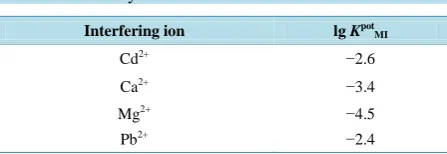
The potentiometric selectivity coefficients Kpot have been evaluated after the separate solution method. The resulting selectivity-coefficients are given in Table 1, indicating that the proposed electrodes are selective to-wards the tested interfering ions.
The advantages of the new electrode, compared to other known ISEs, are the short response time, as well as a reasonable long-term stability with life times of about one year [13][17][20]. Due to the thin functional layer configuration, only few chemicals and materials in relatively small amounts are needed for a reproducible elec-trode fabrication. This allows the fabrication of low-cost elecelec-trodes in large quantities. All used chemicals, in-cluding the ion-complexing compound, are commercially available. Therefore, no time-consuming synthesis steps are necessary as described for most solid-contacted copper(II)-selective electrodes [21]-[23]. The use of screen-printing technology for the manufacture of the graphite transducers is also advantageous with regard to a possible mass production compared to devices produced by conventional methods.
4.2. Analytical Applications
The disposable ISEs were successfully applied as indicator electrodes in combination with Ag/AgCl-reference electrodes for complexometric titrations of copper(II) ions with EDTA solutions as titrant in standard and in spiked environmental samples. The results show that the amount of copper(II) ions can be accurately determined by potentiometric titrations using the electrodes described here. The titration plots including the first derivatives with respect to the added volume of the EDTA solution are shown in Figure 6 (standard solution) and Figure 7
(spiked river sample). PPy-modified ASS electrodes are used. The inflection point on the graph agreed well with the calculated equivalent point. The samples were prepared as follows: 40 ml solutions of copper(II) (10−3 mol/L) (Figure 6) and 50 ml of a spiked real water sample from the Zschopau River, Germany (Figure 7) were titrated with 10−2 mol/L EDTA solution. The pH was adjusted to pH 5. Comparative analyses by colorimetric titrations were carried out using the color indicators 1-(2-Pyridylazo)-2-naphthole and 4-(2-Pyridylazo) resorcinole and by AAS as a routinely used copper detection method. The results of all three methods agree well.
The titration curves are characterized by sharp equivalent points. The copper(II) content can be analyzed with high accuracy in spiked and standard samples. The potential jump near the equivalent point is nearly 50 mV. The copper(II) content in environmental samples can be evaluated with high precision as has been demonstrated in potentiometric titrations using the novel electrode. The good accordance with the colorimetric titration must be emphasized and proves the practical utility and applicability of the novel copper(II) ASS electrode.
Environmental samples spiked with defined amounts of copper(II) have been analyzed by potentiometry using the novel electrodes and compared with AAS. The results are shown in Table 2.
5. Conclusion
[image:5.595.202.426.645.722.2]A novel liquid-free copper(II)-selective electrode was developed and tested in standard and real samples. The electrode is based on an intermediate layer of conducting polymer deposited between the graphite substrate and the ion selective membrane. The solid contact realized by conducting polymer ensures stable and reproducible
Table 1. Selectivity coefficients.
Interfering ion lg Kpot MI
Cd2+ −2.6
Ca2+ −3.4
Mg2+ −4.5
Figure 6. Potentiometric titration curve of copper(II) with EDTA using a PPy-modified ASS electrode. (I) Titration plot. (II) First derivative of the potential with respect to the added volume of the EDTA solution (ΔE/ΔV). Sample concentration: 10−3 mol/L Cu(NO3)2.
[image:6.595.95.539.288.450.2]
Figure 7. Potentiometric titration curve of copper(II) with EDTA using a PPy-modified ASS electrode. (I) Titration plot. (II) First derivative of the potential with respect to the added volume of the EDTA solution (ΔE/ΔV). Sample: spiked river water (Zschopau River, Germany).
Table 2. Determination of copper(II) ions in real water samples.
Spiked real samples Copper(II) concentration
of spiked sample [mg/L] determined by ISE [mg/L] determined by AAS [mg/L]
River water (Zschopau, Germany) 6.4 7.7 5.8
Sea water (Baltic sea, Kolobrzeg, Poland) 63.5 66.1 57.1
River water (Rhein, Germany) 63.5 62.7 53.1
Sea water (Baltic sea, Glowe, Germany) 63.5 57.5 53.9
potentials. Thus, the integration of different functional polymer layers on screen-printed graphite substrates enables reproducible electrode constructs. The developed ASS copper(II)-selective electrode has a simple and stable de-sign, can be simply prepared, provides easy handling and exhibits a long life-time. The developed electrode has good operating characteristics (sensitivity, response time, detection limit, linear range, selectivity) and high me-chanical stability. Successful applications and good performance have been shown by complexometric titrations and by direct potentiometric analysis. The results confirm the analytical utility and applicability of the devel-oped electrodes. The electrode can be successfully employed for copper(II) detection in water samples. It re-quires no extensive, cost intensive equipment or time consuming sample preparation, and it allows a real-time
[image:6.595.86.539.511.600.2]availa-ble electrodes enabling sensitive mobile and decentralized copper(II) analysis. The presented screen-printed electrodes are small and easy to handle, and thus, attractive for field studies and environmental monitoring.
Acknowledgements
The authors gratefully thank the Bundesministerium für Bildung und Forschung in the context with the project BioNEWS (project number 03WKCL03G) for financial support. We also thank F. Gerlach for preparing the screen-printed electrodes and for helpful discussions in optimizing electrode layout and arrangement.
References
[1] TrinkwV (2001) Deutsche Trinkwasserverordnung.
[2] National Primary Drinking Water Standards, Water Research Center. www.water-research.net/standards.htm [3] US Environmental Protection Agency (EPA) (2003) National Primary Drinking Water Standards.
www.epa.gov/safewater
[4] Gong, R., Zhang, D., Zhong, K., Feng, M. and Liu, X. (2008) Determination of Trace Copper in Water Samples by Flame Atomic Absorption Spectrometry after Preconcentration on a Phosphoric Acid Functionaliced Cotton Chelator.
Journal of the Serbian Chemical Society, 73, 249-258. http://dx.doi.org/10.2298/JSC0802249G
[5] Chwastowska, J., Skwara, W., Sterbinska, E., Dudek, J., Dubrowska, M. and Pszonicki, L. (2008) GF AAS Determina-tion of Cadmium, Lead and Copper in Environmental Materials and Food Products after SeparaDetermina-tion on Dithizone Sor-bent. Chemia Analityczna (Warsaw), 53, 887-894.
[6] Townsend, A.T., Miller, K.A., Mclean, S. and Aldrous, S. (1998) The Determination of Copper, Zinc, Cadmium and Lead in Urine by High Resolution ICP-MS. Journal of Analytical Atomic Spectrometry, 13, 1213-1219.
http://dx.doi.org/10.1039/a805021j
[7] Pujol, L., Evrard, D., Groenene-Serrano, K., Freyssinier, M., Ruffien-Cizsak, A. and Gros, P. (2014) Electrochemical Sensors and Devices for Heavy Metals Assay in Water: The French Groups Contribution. Frontiers in Electrochemi-stry, 19, 1-14. http://dx.doi.org/10.3389/fchem.2014.00019
[8] Bobacka, J., Ivaska, A. and Lewenstam, A. (2008) Potentiometric Ion Sensors. Chemical Reviews, 108, 329-351. http://dx.doi.org/10.1021/cr068100w
[9] Tymecki, L., Glab, S. and Koncki, R. (2006) Miniaturized, Planar Ion-Selective Electrodes Fabricated by Means of Thick-Film Technology. Sensors, 6, 390-396. http://dx.doi.org/10.3390/s6040390
[10] Honeychurch, K.C. (2012) Screen-Printed Electrochemical Sensors and Biosensors for Monitoring Metal Pollutants.
Insciences Journal, 2, 1-51.
[11] Hayat, A. and Marty, J.-L. (2014) Disposable Screen Printed Electrochemical Sensors: Tools for Environmental Moni-toring. Sensors, 14, 10432-10453. http://dx.doi.org/10.3390/s140610432
[12] Renedo, O.D., Alonso-Lomillo, M.A. and Arcos Martinez, M.J. (2007) Recent Developments in the Field of Screen- Printed Electrodes and Their Related Applications. Talanta, 73, 202-219.
http://dx.doi.org/10.1016/j.talanta.2007.03.050
[13] Emadi, D., Yaftian, M.R. and Rayati, S. (2007) N,N-bis(1-hydrooxy-2-acetonaphthone) Propylenediamine: Synthesis, Extractive Properties and Use as an Ionophore in a Cu(II)-Selective Potentiometric Sensor. Turkish Journal of Chemi-stry, 31, 423-433.
[14] Ansari, R., Mosayebzadeh, Z., Arvand, M. and Mohammad-Khah, A. (2013) A Potentiometric Solid State Copper Electrode Based on Nanostructure Polypyrrole Conducting Polymer Film Doped with 5-Sulfosalicyl Acid. Journal of Nanostructure in Chemistry, 3, 33-42. http://dx.doi.org/10.1186/2193-8865-3-33
[15] Ganjali, M.R., Poursaberi, T., Babaei, L.H., Rouhani, S., Yousefi, M., Kargar-Razi, M., Moghimi, A., Aghabozorg, H. and Shamsipur, M. (2001) Highly Selective and Sensitive Copper(II) Membrane Coated Graphite Electrode Based on a Recently Synthesized Schiff’s Base. Analytica Chimica Acta, 440, 81-87.
http://dx.doi.org/10.1016/S0003-2670(01)01051-0
[16] Mahajan, R.K. and Sood, P. (2007) Novel Copper(II)-Selective Electrode Based on 2,2’:5’,2”-Terthiophene in PVC- Matrix. International Journal of Electrochemical Science, 2, 832-847.
[17] Ardakani, M.M., Mirhoseini, S.H. and Salavati-Niasari, M. (2006) Copper Selective Electrode Based on 1,8-bis(2-Hy- droxynaphthaldiminato)3,6-Dioxaoctane. Acta Chimica Slovenica, 53, 197-303.
[18] Firooz, A.R., Mazloum, M., Safari, J. and Amini, M.K. (2002) Coated-Wire Copper(II)-Selective Electrode Based on Phenylglyoxal-α-Monoxime Ionophore. Analytical and Bioanalytical Chemistry, 372, 718-722.
[19] Isa, I.M., Saidin, M.I., Ahmad, M., Hashim, N., Ghani, S.A. and Si, S.M. (2013) Development of New Copper(II) Ion-Selective Poly(vinyl chloride) Membrane Electrode Based on 2,6-Diacetylpyridine-(1R)-(-)-Fenchone Diazine Li-gand. International Journal of Electrochemical Science, 8, 11175-11185.
[20] Ganjali, M.R., Ghafarloo, A., Faridbod, F. and Norouzi, P. (2012) Copper-Selective PVC Membrane Sensor. Interna-tional Journal of Electrochemical Science, 7, 3706-3726.
[21] Yoshimoto, S., Mukai, H., Kitano, T. and Sohrin, Y. (2003) Copper(II)-Selective Membrane Electrode Based on Hy-drotris(3-isopropylpyrazolyl)methane in a Poly(vinyl chloride) Matrix. Analytica Chimica Acta, 494, 207-213. http://dx.doi.org/10.1016/S0003-2670(03)01012-2
[22] Vlascici, D., Popa, J., Fagadar-Cosma, G., Popvici, H. and Fagadar-Cosma, E. (2013) Potentiometric Detection and Removal of Copper Using Porphyrins. Chemistry Central Journal, 7, 111-117.
http://dx.doi.org/10.1186/1752-153X-7-111
[23] Norouzi, P., Ganjali, M.R., Faridbod, F. and Salavati-Nisari, M. (2006) Determination of Copper in Black, Red Pepper and the Waste Water Samples by a Highly Selective Sensitive Cu(II) Microelectrode Based on a New Hexadentates Schiff’s Base. Bulletin of the Korean Chemical Society, 27, 1439-1444. http://dx.doi.org/10.5012/bkcs.2006.27.9.1439 [24] Ganjali, M.R., Emani, M. and Salavati-Niasari, M. (2002) Novel Copper(II)-Selective Sensor Based on a New
Hex-adentates Schiff’s Base. Bulletin of the Korean Chemical Society, 23, 1393-1398.
[25] Yu, S.-Y., Li, Y.-C., Xiong, T., Yuan, Q., Liu, Y.-M., Yuan, Z.-Y. and Xiao, Y. (2014) A Ladder Conjugated Polymer Transducer for Solid-Contact Cu2+-Selective Electrodes. Chinese Chemical Letters, 25, 364-366.
http://dx.doi.org/10.1016/j.cclet.2013.11.015
[26] Liang, R., Yin, T. and Qin, W. (2015) A Simple Approach for Fabricating Solid-Contact Ion-Selective Electrodes Us-ing Nanomaterials as Transducers. Analytica Chimica Acta, 853, 291-296. http://dx.doi.org/10.1016/j.aca.2014.10.033 [27] Tutulea-Anastasiu, M.D., Wilson, D., del Valle, M., Schreiner, C.M. and Cretescu, I. (2013) A Solid-Contact Ion
Se-lective Electrode for Copper(II) Using a Succinimide Derivative as Ionophore. Sensors, 13, 4367-4377. http://dx.doi.org/10.3390/s130404367
[28] Ganjali, M.R., Rezapour, M., Pirali-Hamedani, M. and Rashedi, H. (2015) Cu(II)-All Solid State Sensor Ion Selective Electrode (ASS-ISE) with a Nano-Molar Detection Limit and Its Use for the Analysis of Waste Water Samples. Inter-national Journal of Electrochemical Science, 10, 6924-6934.
[29] Ali, T.A., Mohamed, G.G. and Othman, A.R. (2015) Design and Construction of New Potentiometric Sensors for De-termination of Copper(II) Ion Based on Copper Oxide Nanoparticles. International Journal of Electrochemical Science, 10, 8041-8057.
[30] Faridbod, F., Ganjali, M.R., Dinarvand, R. and Norouzi, P. (2008) Development in the Field of Conducting and Non- Conducting Polymer Based Potentiometric Membrane Sensors for Ions over the Past Decade. Sensors, 8, 2331-2412. http://dx.doi.org/10.3390/s8042331
[31] Zachara, J.E., Toczylowska, R., Prokrop, R., Zagorska, M., Dybko, A. and Wroblewski, W. (2004) Miniaturized All-Solid-State Potentiometric Ion Sensors Based on PVC-Membranes Containing Conducting Polymers. Sensors and Actuators B: Chemical, 101, 207-212. http://dx.doi.org/10.1016/j.snb.2004.02.052
[32] Bobacka, J. (2005) Conducting Polymer-Based Solid-State-Ion-Selective Electrodes. Electroanalysis, 18, 7-18. http://dx.doi.org/10.1002/elan.200503384
[33] Rahman, M.A., Kumar, P., Park, D.-S. and Shim, Y.-B. (2008) Electrochemical Sensors Based on Organic Conjugated Polymers. Sensors, 8, 118-141. http://dx.doi.org/10.3390/s8010118
[34] Ramanavicius, A., Ramanaviciene, A. and Malinauskas, A. (2006) Electrochemical Sensors Based on Conducting Po-lymer—Polypyrrole. Electrochimica Acta, 51, 6025-6037. http://dx.doi.org/10.1016/j.electacta.2005.11.052
[35] Gupta, N., Sharma, S. and Mir, I.A. (2006) Advances in Sensors Based on Conducting Polymers. Journal of Scientific & Industrial Research, 65, 549-557.
[36] Kirchmeyer, S. and Reuter, K. (2005) Scientific Importance, Properties and Growing Applications of Poly(3,4-ethy- lenedioxythiophene). Journal of Materials Chemistry, 15, 2077-2088. http://dx.doi.org/10.1039/b417803n
[37] Menil, F., Debeda, H. and Lucat, C. (2005) Screen-Printed Thick-Films: From Materials to Functional Devices. Jour-nal of the European Ceramic Society, 25, 2105-2113. http://dx.doi.org/10.1016/j.jeurceramsoc.2005.03.017