ARTIFICIAL IMMUNE SYSTEM BASED OPTIMAL LINEAR
CAPACITY MAXIMIZATION PRECODER FOR MIMO-OFDM
WIRELESS COMMUNICATIONS
1RAMESH.S,2 Dr. R. SESHASAYANAN
1Research Scholar., Sathyabama university, Chennai, India
2Associate Professor,. Department of ECE,Anna university., Chennai
E-mail: [email protected] , [email protected] ,
ABSTRACT
At present different enhancement calculations is utilized within different provisions in diverse fields. Late days Artificial Immune framework is utilized within the streamlining of multi client in MIMO – [MU-MIMO] correspondence framework for enhancing the execution of the channel usage, slip remedies. Direct Precoding is utilized in MU-MIMO correspondence framework to enhance the limit of the framework and to decrease the intricacy in the beneficiary side. The prior investigates takes a shot at enhancement calculation, the PSO proposed to build the framework limit and appraisal the channel slip. In this paper, the Artificial Immune System– [AIS] is utilized to discover the upgraded Precoding lattice, with that, the Precoder intended to amplify the limit of the framework by considering the channel estimation failure. The recreation results indicate that the framework limit execution of the proposed Precoder which considers channel estimation blunder outflanks the long ago proposed Precoder.
Keywords: MIMO; AIS; MMSE; SNR; BER; Optimization; Channel Communication; Artificial Immune
System.
1. INTRODUCTION
In multi-client MIMO, space division different access (SDMA) uses multi-Antenna wire transmitter with numerous beneficiaries that speaks at the same time with one another (each
one having one or various reception
apparatuses).
From a usage point of view, Precoding calculation for SDMA frameworks might be sub-partitioned into straight and nonlinear Precoding sorts. The limit attaining calculation is nonlinear,
however direct Precoding methodologies
normally accomplish sensible execution with
much lower intricacy. Direct Precoding
methodologies incorporate MMSE Precoding and the rearranged zero-compelling (ZF) Precoding. There are additionally Precoding procedures custom-made for low-rate criticism of channel state data, for instance irregular shaft shaping. Nonlinear Precoding is planned focused around the idea of filthy paper coding (DPC), which demonstrates that any known obstruction at the transmitter might be subtracted without the
punishment of radio assets if the ideal Precoding plan could be connected on the transmit sign. While the execution boost has an acceptable understanding in point-to-point MIMO, a multiuser framework can't at the same time expand the execution for all clients. In this manner to expand the weighted entirety limit of the framework the weights relate to client necessities. What's more, there may be some a larger number of clients than information streams, obliging a planning calculation to choose which clients to serve at a given time moment.
ISSN: 1992-8645 www.jatit.org E-ISSN: 1817-3195
methodologies intended for having full channel
information with minor execution corruption. Zero-driving Precoding may even attain the full multiplexing addition, yet just gave that the exactness of the channel sentiment builds straightly with sign to-clamor degree (in db). Quantization and reaction of channel state data is
focused around vector quantization, and
codebooks focused around Grassmannian line pressing have demonstrated great execution. The whole limit in a multiuser MIMO show channel
is characterized as the most extreme
accumulation of every last one of clients' information rates. The ideal Precoding of multiuser MIMO is focused around messy paper coding (dpc) theory with nonlinear Precoding strategy. The popular Tomlinson-Harashima Precoding (THP) is then on direct Precoding focused around DPC hypothesis.
Despite the fact that THP performs well in a multiuser MIMO situation, sending it continuously frameworks is troublesome in light of its high intricacy of the Precoding at the transmitter. Numerous suboptimal MU-MIMO direct Precoding procedures have risen as of late, for example, the channel reversal technique and the square digonolization (BD) system. Channel reversal strategy utilizes some conventional MIMO discovery measures, for example, the Zero-driving (ZF) and the MMSE; Precoding can be applied at transmitter to stifle the co-station obstruction (CCI). Channel reversal system focused around ZF can smother CCI totally; then again it may prompt commotion enhancement since the Precoding vectors are not standardized. Channel reversal system focused around MMSE bargains the clamor and the CCI, and beats ZF calculation yet it can't get great execution. BD strategy disintegrates a multiuser MIMO channel into various single client MIMO diverts in parallel to totally cross out the CCI by making utilization of the invalid space. With BD, every client Precoding grid lies in the invalid space of all different clients' channels, and the CCI could be totally drop. The produced invalid space vectors are standardized vectors, which could stay away from the clamor intensification issue effectively. So BD system performs much
superior to channel reversal strategy.
Nonetheless, since BD system simply means to cross out the CCI and stifle the commotion, its Precoding increase is not improved.
The principle commitment of this paper is to plan a straight Precoder to augment
framework limit by considering channel
estimation slip utilizing AIS calculation.
2. RELATED WORKS
An enhanced pilot-supported channel estimation plan is proposed to upgrade the channel estimation correctness of numerous info various yield orthogonal recurrence division multiplexing (MIMO-OFDM) blurring channels. Taking into account the versatile way number choice component, the amount of ways might be adaptable and adaptively changed with the attributes of MIMO-OFDM blurring channels. The fine channel estimation recipes for all information subcarriers are inferred. The 2 × 2 space-recurrence square code-OFDM (SFBC-OFDM) framework and a six-way blurring channel model are considered as a sample of the
high versatility MIMO-OFDM remote
correspondences framework. Through
channel and clamor difference, however the computational intricacy is high, owing to the synchronous identification and estimation for all receiving wires.
In MIMO correspondence framework V-BLAST, D-BLAST and Alamouti strategies are accustomed to enhancing bit failure rate and sign to commotion proportion [4]. So In this I am utilizing V-BLAST and D-BLAST calculations and create code utilizing BPSK adjustment
framework. For V-BLAST transforming
calculations and CCI scratch-off has two sorts of equalizers zero driving (ZF) and Minimum Mean Square Error (MMSE). For undertaking we utilize MMSE equalizer utilizing Rayleigh channel. In MIMO-OFDM plan, [5] the investigation of base station incorporates the upgraded bit stacking, subcarrier distribution and receiving wire choice, which are all focused around channel state data (CSI) in the framework. Moreover, a considerable measure of exploration about subcarrier portion primarily concentrates on the transmit force and framework limit, while less attention is assumed the viability of framework in a tolerance interim. This paper exhibits an advanced subcarrier designation calculation, which uses channel distinction to get enough subcarriers for every client in multiuser MIMOOFDM framework.
In [6], the filter-and-forward (FF) hand-off configuration for numerous data various yield
(MIMO) orthogonal recurrence division
multiplexing (OFDM) frameworks is considered. Because of the considered MIMO structure, the issue of joint configuration of the straight MIMO transceiver at the source and the goal and the FF transfer at the hand-off is considered. As the outline standard, the minimization of weighted total mean-square-failure (MSE) is considered first, and the joint plan for this situation is
approached focused around substituting
advancement that emphasizes between ideal configuration of the FF transfer for a given set of MIMO Precoder and decoder and ideal outline of the MIMO Precoder and decoder for a given FF hand-off filter. In [7], MIMO is matched up with OFDM enhance the execution of remote transmission frameworks. Numerous receiving wires square measure utilized each at the transmission additionally as getting closures. The execution of copartner OFDM framework is measured, considering multipath postponement unfold, channel commotion, Lord Rayleigh constriction channel and contortion. In this paper, bits square measure created so mapped
with balance plans like QPSK, 8psk, and QAM. At that point, the mapped learning is part into squares of a hundred and twenty adjusted information wherever an instructing grouping of the insight is embedded each at the begin and consummation components of the piece. In [8] versatile bit stacking is connected to MIMO-OFDM, to acquire a bit and force assignment for every subcarrier expecting momentary channel information. Depending on the accessible halfway CSI at the transmitter, significantly
enhanced correspondence is conceivable.
Versatile Bit Loading in MIMO-OFDM is utilized to boost the transmission rate, alongside wanted Bit Error Rate (BER) execution in remote frameworks under the imperative of altered transmit power. A principle challenge in remote correspondence is recovery of the channel state data and ICI scratch-off. The channel estimation and ICI wiping out is evaluated with the assistance of Iterative turbo channel estimation, Iterative pilot supported channel estimation and ICI Cancelation systems [9]. Paper [10] explores the issue of asset designation in a numerous data various yield (MIMO) OFDM-based framework, wherein different multicast gatherings exist. Multicasting is a transmission method which empowers a transmitter to impart by means of a solitary remote connection with different recipients all the while. Besides, the vicinity of various reception apparatuses in both transmitter and
beneficiary improves fundamentally the
framework phantom effectiveness. MIMO
engineering alongside multicasting offers
significant focal points to wireless system.
The recurrence specific
channel-estimation issue in multi-info multi-yield orthogonal recurrence division multiplexing (MIMO-OFDM) [11] frameworks is researched from the viewpoint of layered sensing (CS). By minimizing the common soundness of the estimation network in CS hypothesis, two pilot allotment routines for the CS-based divert estimation in MIMO-OFDM frameworks are proposed. In paper [12], it is proposed an
adaptable asset assignment structure for
streaming versatile features over multiuser
various data different yield orthogonal
recurrence division multiplexing
ISSN: 1992-8645 www.jatit.org E-ISSN: 1817-3195
creator proposed a cross-layer outline system for
productive TV adaptable H.264 features over the downlink numerous info various yield (MIMO) orthogonal recurrence division multiplexing frameworks, where it expand the normal top sign to clamor proportion of the accepted feature streams. It is additionally conceivable to demonstrate to plan ideal pilot-image designs by expanding an upper bound of a compelled limit that considers channel estimation failures and Inter Carrier Interference talked about in [14]. Various existing paper are concentrated on and investigated the issue of joint distribution of sub channel, transmission power, and stage length of time in hand-off improved bidirectional various info different yield orthogonal recurrence division multiplexing (MIMO-OFDM) systems. The objective of asset portion is to minimize transmission vitality utilization in systems with various unravel and-forward hand-off stations (Rss) under the information rate stipulations of client supplies (UE) in [15].
In this review, we clarify multicast bunch development and different types of gathering rate determination approaches. We additionally give a deliberate audit of late channel-mindful multicast booking and asset allotment (MSRA) [16] procedures proposed for downlink multicast benefits in OFDMA based frameworks. We examine these empowering calculations, assess their center qualities,
constraints and order them utilizing
multidimensional network. We strongly survey the calculations regarding their throughput amplification, reasonableness contemplations,
execution complexities, multi-reception
apparatus help, optimality and streamlining suspicions. We examine existing principles utilizing multicasting and further highlight some potential exploration open doors in multicast frameworks.
3. PROPOSED APPROACH
The fundamental commitment of this paper is to plan a straight Precoder to augment
framework limit by considering channel
estimation slip utilizing AIS calculation. This paper is sorted out as takes after, the framework model is clarified in area III, ideal MUMIMO direct Precoding with channel estimation mistake is clarified in segment IV and PSO calculation is clarified in area V. In segment VI recreation results are given. In last area, Conclusions are given.
This paper, considers a MU-MIMO framework comprises with a BS, K number of MS, where the BS outfitted with M radio wires and each MS with N reception apparatuses. The MU-MIMO framework's correspondence point is utilized in downlink transmission. It is accepted that the channel is an even blurring, Rayleigh conveyed MIMO channel.
In this MU-MIMO, the K number of multi-users, the system will seek the Precoding vectors according to the above conditions for each user as depicted in Figure-1. Assuming that the transmitted signal is linearly pre-coded at the BS, the vector of the received signals at the K receivers can be obtained by
Where
→
! " # Independent flow
of data with zero mean and normalized variance and n is additive white Gaussian noise vector.
The real channel response can be denoted by $
because of the errors introduced by reciprocity mismatch, delay and channel estimation. The channel estimation is considered as
$ $
For the estimated channel matrix$$, the
estimation error matrix can be assumed as %
have & ' independent elements with zero
mean and estimation error variance denoted by
(. Also it can be assumed that % is independent
of the data vector and the Gaussian noise
vector n.
) **… … . .
./0/0/0 … … … . . … . /01
where s is the transmitted sign [symbol] vector with K information streams, W is the Precoding
grid with K Precoding vectors, and 〖) ∙-
indicates the 34!5 !46 .
%
The channel squared matrix % might be
accepted as the virtual channel matrix of client 7
in the wake of precoding. At the receiver-end, a linear recipient 89 is misused to recognize the
transmit sign for the client 7. the detected signal
of the 7 user is
The linear recipient 89 can be planned by ZF or MMSE criterion, and linear MMSE will achieve improved performance. In sort to make simpler the analysis, the power allotment is implicit as
; 6/7/=0 and linear MMSE MIMO finding is used in this paper is
89 ? $@) ?@ & (A 1 ; . A-
Where I is the N x N identity matrix:
*
A=C D?$ %@*D
∑,D?$ %@*D
4.1 Optimal Multi User Mimo Linear Precoding With Channel Estimation Error
The channel could be adjusted as $ %
and the independent quality disintegration (SVD)
of the channel F GHI ∗ , which would
diagonalizable the MIMO channel if the channel
estimation were right. However with $ not the
same as , the channel is not completely
disintegrated into free SISO joins.
To discover this, K L ∗ KM and we can have
$ N G OH N%PI∗ . Accordingly,
transmits Precoding and beneficiary molding by
I and G ∗ will transform a comparable channel
matrix Q KR. It could be effectively checked
that KR is zero mean with uncorrelated passages
with variance S . Consequently the
disintegrated channel Q KR is not corner to
corner. When its all said and done, as an
aftereffect of utilizing blemished channel data $
to build a Precoding, where D might be deciphered as an expected sub channel increase and E as its channel estimation.
A=C DO$ %P*D
∑,D?$ %@*D
Once we apply SVD,
L)T %-M
L)T L%M-M
LT M L . L%M . M
Let assume that L . L 1, M . M 1 . so
that it can be rewritten as
O$ %P* LT M* %*
LT M)
%)M
V %)M- ---- Equation [1].
Where ‖*‖ V
From Equation [1],
DO$ %P*D XOV %)M-POV %)M-PY
V V
. %
)M- V%)M- %)M- . )M-% --- Equation [2]
From Equation [2],
K XDO$ %P*DY V K.V%)M-1
K.V %)M-1 K.% . %1 --Equation [3] 1
2 ? ?@@ C ?@
From ; ⇒ &= = and using .
Where .
A.
% → "4\ ]6] ? % @ & ( A
From [3]
89^? @ & ( A ; . A_ ? 1 $ `@
89 ? $ `@^? @ & ( A 1; . A_
A=C
;DVO$ %P*D
∑,;DV O$ %P*D / |V| 1
A=C V (
∑ V (
,
In the event of Experiment, the examination case is that the transmitting client's channels are not
orthogonal or sick. Then M. )M- b
ISSN: 1992-8645 www.jatit.org E-ISSN: 1817-3195
A=C !"#$
% ' "#$ ( )∑ !"#$ % '
"#$
, +%
--- [1]
4.2 Optimal Linear Precoding Multi-User Mimo With Lmmse Detection Based On Ais Algorithm With Mismatch Csi
With the appropriation of AIS calculation and the improved capacity [1], the ideal straight
Precoding vector ?*1, … . &@ could be
effectively sought. The extent of antigen and the length of inquiry space are C and D separately.
Every counter acting agent is ?
1,2, … . , c@ are spoken to as the decision vector
d O5, , 5, , … , 5,, P and M ., , , , … . . , ,, 1 . The proposed optimal
MU-MIMO linear Precoding scheme based on AIS algorithm will search the optimal Precoding vector for each user following 6 steps.
The proposed ideal MU-MIMO direct Precoding plan focused around AIS calculation will hunt the ideal Precoding vector down every client succeeding
Initialize the population size P
Set the OFV and OFV function
Compute OFV for each P
Reduce the irrelevant P and regenerate P
The similarity is evaluated by measuring it for each individual ai
5. Due to the similarity measurement sm, elect the best set X, V
4.
,
individuals of P, should be proportional to the Election rate and it should be unique string combine X1, X2, X3 and V1, V2, and V3.
The size of the E is proportional to the similarity measure sm. 7. change the similairy of each E, to
generate a matured antibody of the X and V. 8. K\34 ]] 4\ `
\ ` 3 "!4 ` 64!43! d1, d2 4] d3.
9. * \ ` 3 \\ 4 !6\4] "! 4\ .
10. Repeat the above steps until reach the best set of x1, x2 and x3with the optimal
values of the CSI.
5. SIMULATION SETTINGS
[image:6.595.322.492.385.517.2]
The simulation results are acquired for MIMO framework with perfect channel and for the proposed defective CSI, with M = 4, N = 4 , SNR= 5 db with equivalent force allotment and MMSE discovery at the beneficiary. The BS transmits 4 information streams and 4 clients all the while with 1 information stream for every client. The PSO parameters with the molecule number C = 20 and the cycle number I = 20. It could be seen that the proposed MU-MIMO plan can viably expand the framework limit contrasted with the BD calculation and the at one time proposed plan which considers perfect CSI.
Figure-2: CDF Performance Comparison MUMIMO –PSO With Ideal Channel And Imperfect CSI [111].
Figure 2 is the framework limit examination of the combined conveyance capacity (CDF) of the PSO calculation with Ideal channel and with defective CSI.
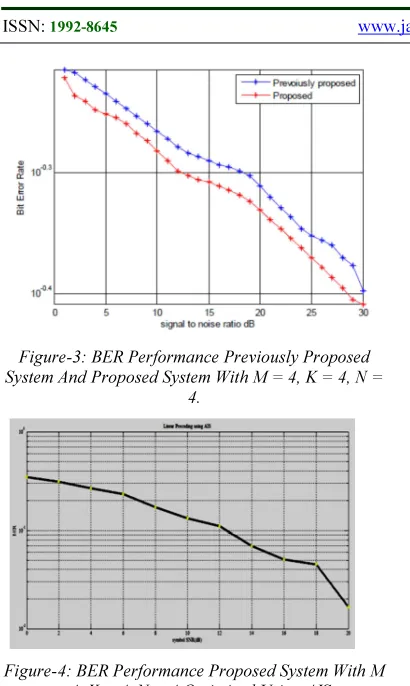
Figure-3: BER Performance Previously Proposed System And Proposed System With M = 4, K = 4, N =
4.
Figure-4: BER Performance Proposed System With M = 4, K = 4, N = 4 Optimized Using AIS.
Figure 3 and Figure-4 shows the normal BER execution of the beforehand proposed MU-MIMO plan with perfect channel and proposed plan for blemished CSI with M = 4, K = 4, N = 4. This result indicates that proposed plan for blemished CSI outflanks the formerly proposed MU-MIMO plan with perfect channel.
6. CONCLUSION
This paper dissects the ideal straight Precoding issue with LMMSE identification and with blemished CSI for MU-MIMO framework in downlink transmission. A rearranged ideal SINR capacity is determined. With the selection of the molecule swarm enhancement calculation, the ideal direct Precoding vector with LMMSE identification to amplify the framework limit for every client could be sought. The proposed plan can get critical framework limit change contrasted with the multi-client MIMO plan focused around PSO and channel square digonolization. The work could be reached out to consider the reaction postpone in the Precoder design.
7. FUTURE WORK
New LDPC codes are constantly considered and developed attempting to adjust hypothetical execution and reasonable fittings acknowledgment. In any case, code scholars by and large are not concerned with transistor force and range. 32nm engineering and beneath present expanded limitations on the flexibility of the backend planner, while wire postponement is as of now expanding. Must decrease outline
reliance on low-level advancements for
achievement. The Split-Row strategy introduces an algorithmic and building result that could be good with both future LDPC codes and submicron CMOS engineering.
REFERENCES:
[1]. J. Mar,1,2 Chi-Cheng Kuo,1 andM. B. Basnet1, “Improved Pilot-Aided Channel
Estimation forMIMO-OFDM Fading
Channels”, International Journal of
Antennas and Propagation Volume 2013
[2]. Ibrahim Y. Abualhaol and Mustafa M. Matalgah, “Resource Allocation for a Cooperative Broadband MIMO-OFDM System”, DOI: 10.4018/978-1-60566-665-5.ch014 Copyright © 2010
[3]. KeZhong, Xia Lei and Shaoqian Li, “Iterative channel estimation and data detection for MIMO-OFDM systems operating in time-frequency dispersive channels under unknown background noise”, EURASIP Journal on Wireless Communications and Networking 2013, 2013:182
[4]. Mr. A.D Borkar1, Prof S.G.Shinde2, “MIMO-OFDM High Data Rate Wireless System
Using V-BLAST Method”, International Journal
of Application or Innovation in
Engineering & Management (IJAIEM), Volume 2, Issue 7, July 2013
[5]. LiyaoWANG,Jianping LI, Chaoshi CAI, “An Optimized Adaptive Subcarrier Allocation for Multiuser MIMO-OFDM
System”, Journal of Computational
Information Systems 9: 22 (2013)
[6]. Donggun Kim, Youngchul Sung† and Jihoon
Chung, “Filter-And-Forward Relay
Design for MIMO-OFDM Systems”,
IEEE TRANSACTIONS ON
ISSN: 1992-8645 www.jatit.org E-ISSN: 1817-3195
[7]. 1K.Hariprasad reddy, 2M.Anusha,
“MIMO-OFDM USING POWER ALLOCATION IN WATERFILLING ALGORITHAM BASED ON SVD PROCESS”, [IJESAT] [International Journal of Engineering
Science & Advanced Technology]
Volume-3, Issue-5, 197-204
[8]. C.V.Umamaheswari1, R.Loganathan2, “Bit Loading of OFDM with High Spectral Efficiency for MIMO”, International Journal of Computer Applications in Engineering Sciences, Volume III, Special Issue, August 2013
[9]. Ragam.Gouthami, K.Ragini, Ch. Ganapathy Reddy, “Iterative Channel Estimation and ICI Cancellation Techniques in
MIMO-OFDM Wireless Communication
Systems”, International Journal of
Engineering and Advanced Technology (IJEAT) Volume-2, Issue-6, August 2013
[10]. Ioannis G. Fraimis, Stavros A.
Kotsopoulos, “Fair Radio Resource
Allocation for MIMO OFDM-based Multicast Systems”, Wireless Personal
CommunicationsJune 2013, Volume
70, Issue 4, pp 1811-1825
[11]. Xueyun He ; Rongfang Song ; Wei-Ping Zhu, “Pilot Allocation for Sparse Channel Estimation in MIMO-OFDM Systems”, Circuits and Systems II: Express Briefs,
IEEE Transactions on (Volume:60
, Issue: 9 ), Sept. 2013
[12]. Maodong Li ; Zhenzhong Chen ; Yap-Peng Tan, “Scalable Resource Allocation for SVC Video Streaming Over Multiuser MIMO-OFDM Networks”, Multimedia,
IEEE Transactions on (Volume:15
, Issue: 7 ), Nov. 2013
[13]. Zan Yang ; Xiaodong Wang, “Scalable Video Broadcast Over Downlink MIMO– OFDM Systems”, Circuits and Systems for Video Technology, IEEE Transactions on (Volume:23 , Issue: 2 ), Feb. 2013
[14]. Simko, M. ; Diniz, P.S.R. ; Qi
Wang ; Rupp, M., “Adaptive
Pilot-Symbol Patterns for MIMO OFDM
Systems”, Wireless Communications,
IEEE Transactions on (Volume:12
, Issue: 9 ), September 2013
[15]. Tain-Sao Chang ; Kai-Ten Feng ; Jia-Shi Lin ; Li-Chun Wang, “Green Resource Allocation Schemes for Relay-Enhanced
MIMO-OFDM Networks”, Vehicular
Technology, IEEE Transactions
on (Volume:62 , Issue: 9 ), Nov. 2013
![Figure-2: CDF Performance Comparison MUMIMO –PSO With Ideal Channel And Imperfect CSI [111]](https://thumb-us.123doks.com/thumbv2/123dok_us/8912003.959797/6.595.322.492.385.517/figure-cdf-performance-comparison-mumimo-ideal-channel-imperfect.webp)