THE IMPACT OF REQUEST TRACKER APPLICATION AS
KNOWLEDGE MANAGEMENT SYSTEM ON EMPLOYEE
PERFORMANCE
1
BACHTIAR H. SIMAMORA
1Head of Performance Excellence Research Group, Bina Nusantara University, Jakarta, Indonesia..
E-mail: [email protected]; [email protected]
ABSTRACT
Knowledge increasingly well known as a foundation for creating a competitive advantage for the company, so that Knowledge Management (KM) is very important for organizations to improve process performance and hence service to customers. This research aims to determine the application and use of the Request Tracker application as a KMS in handling Customer Request (CR) at one of IT Company in Indonesia based on people, process and technology factors, and its influence on employee performance. Data is processed and analyzed using reliabilities testing, validity testing and linier regression. The result shows that request tracker application able to assist employees in CR handling process, and have a positive effect on employee performance. The result of this case study may be used as recommendation for the improvement of the application from people, process and technology aspect.
Keywords: Knowledge Management System, Request Tracker, Employee Performance, Customer Request,
Customer Relationship Management
1.
INTRODUCTIONConsidering the competition in similar end-to-end businesses getting tight, we need a paradigm shift which was originally resource oriented (resource-based) to be organizational knowledge
oriented (knowledge-based). Knowledge
Management expected to support organizations in improving competitiveness, by utilizing a variety of resources exist, including the written knowledge (explicit) and hidden knowledge possessed by few people (tacit).If knowledge were developed, deployed and used together, eventually will support the creation of innovation within the organization, and to achieve it requires transfer of knowledge (knowledge sharing) process supported by adequate use of appropriate information systems needs of the organization. Knowledge is a fluid mix of framed experiences, values, contextual information and expert insight that provides a framework for evaluating and incorporating new experiences and information. It originates and is applied in the minds of knower's. In Organizations, it often becomes embedded not only in documents or repositories but also in organizational routines, processes, practices, and norms (Davenport and Prusak 1998).
By using the approach of Customer
Relationship Management (CRM), which focuses
on sustainable services to consumers and provide value-added, also serves as customer services and support, then the writing purpose of this paper aims to determine the relationship between the KMS (using a factor of People, Process and Technology) to employee performance (measured by CRM indicators).Then the performance improvement plan for future applications based on the concept of critical success factors to support services that are more responsive, faster, and in a timely manner against the incoming request from the customer.
2.
LITERATURE REVIEWand experience can easily be divided and also
facilitated in getting information and knowledge as well as the process flow to the right people at the right time, so that employees can work more efficiently and effectively (Smith, 2001).
Things that underlie why an organization needs to implement KM as proposed by Grey, D. (1996) is to improve services to customers and business enterprises to consider how it should be:
1. Reducing cycle time job.
2. Operating costs with fixed assets and overhead
(human resources, inventory and facilities) are minimum.
3. Shortening the product development time.
4. Improving Customer service.
5. Improving employees' ability to innovate
constantly.
Some factors of KM, categorized into (Rasula et al., 2012):
1. Organization (people), organizational culture has a major contribution in the implementation of KM. Influential elements include: human resources (people) and the corporate climate, where the success of KM depends on the principle of trust, motivation, cooperation and collaboration between employees, and process: the integration between KM activities with the process.
2. Knowledge (process), KM success depends on:
• Knowledge Accumulation. The higher
effectiveness of the accumulation process, the higher the impact of the KM.
• Knowledge utilization. The higher use of knowledge in the organization, the higher result.
• Knowledge Sharing. The higher the
knowledge-sharing activities undertaken, will positively affect the KM.
• Ownership of Knowledge. KM will be
increasingly managed in line with the increasing ease in accessing knowledge and knowing who the person in charge of the knowledge created.
3. Information Technology (IT), technological
ability to store knowledge and use of the information system. Two elements of the IT component is the ability to store knowledge
element, include knowledge Formalizing
processes and storing knowledge, as well as the use of elements and the quality of IT Tools, includes the quality of tools, quality of information, usage and accessibility and user satisfaction.
According to Dili Bhatt Knowledge
Management consultant, there are three
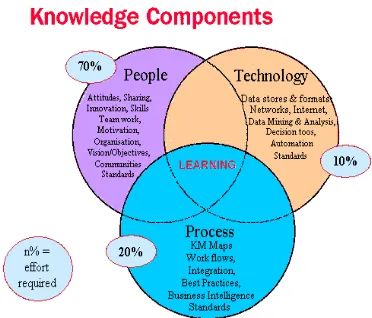
[image:2.595.312.498.215.374.2]components in the application of knowledge management which consists of the People, Process, and Technology (Bhatt, 2000). As shown in Figure 1, which Technology is 10% of the effort required; Process is 20% and 70% People or cultural issues.
Figure 1: KM Components (Dilip Bhatt, 2000)
Knowledge Management System (KMS)
KM aims to capture, transfer and reusing knowledge (Berkani, L., Chikh, A. 2010). Technology in KMS format is a key enabler for KM initiatives, where technology has the function
to capture,store,update, search and reuse
knowledge. KMS process consists of filtering, indexing, classifying, storing, and retrieving capabilities, with the function of communication and collaboration (Alavi & Leidner, 2001). Technology and tools that can be used for KM is as follows (Gupta, N., D., & Sharma, S., K., 2004, p 18):
a. Expert systems
Is a computer-based program that is designed to record the skills (knowledge) a person and then this knowledge is applied to an application in a particular domain.
b. Distributed hypertext systems
This tool has been used in organizational knowledge for more than twelve years. Distributed hypertext systems useful to organize information and knowledge in the application of knowledge management efforts.
c. Document Management systems
documents.
d. Geographic information systems
Used as a graphical tool for knowledge mapping. This technology includes digital maps, computers and software that is very sophisticated and allows for manipulation of a variety of demographic and corporate data in the map.
e. Helpdesk technology
Associated with the system that serves as routing requests to assist employees in an organization to gain business and technical solutions in accordance with where the customer request coming from.
f. Intranets
Is a private network that uses standard Internet protocols (TCP/IP), which through intranets not only serves to share information, but also can view information organizations (such as databases) through a web browser such as Internet Explorer or others browser. Examples of web-based applications that leverage technology and the Internet is the corporate intranet portal, where all the information is there and the company is continuously manage and update the portal page.
g. Concept mapping
Is a tool used for writing, where the concept is a map that describes a topic or idea in a topic or idea where the information is related to one another This tool is a visual summary that describes the structure of a material knowledge described by the author.
h. Semantic networks
Usually associated with the detailed analysis of a text link or an idea. The difference of hypertext systems is the semantic typing of links. Semantic networks are a technique to describe knowledge.
Customer Relationship Management (CRM) CRM is a customer care approach that focuses on building long-term and sustainable customer relationships that can provide added value to the customer and the company. CRM is a model to manage the interaction between the company and customers (current or future), which includes the use of technology to organize, automate, and synchronize the sales, marketing, customer service, and technical support (Shaw, Robert, 1991).
Based on the above definition it can be concluded that CRM is a business strategy that consists of software and services designed to increase profits, revenues and customer satisfaction. The trick is to assist customers in handling requests
(request) that precise, responsive and faster in order to maintain customer loyalty.
One of the types of existing CRMs are able to serve as tool for marketing, appointments, social media, non-profit and membership-based, and customer service and support, which CRMs can be used to create, assign and manage requests made by customers, such as call center software, which can help to complete the request. CRM indicator is as follows: service, ease, handling complaints, ability to solve problems, agility, politeness, hospitality, and security. CRM is expected to improve profitability by reducing costs and increasing revenue (revenue) through increased customer satisfaction and loyalty.
KMS and Request Tracker
Request tracker is as IT support services, which is a concept and pretty much tracking system used by the organization to do bug tracking, help desk ticketing, customer service, work flow
processes, change management, network
operations, and others. One of the functions contained in the request tracker system is a ticketing system (numbering system). According to Best Practical (2008) in Mvungi & Jay (2009), the ticketing system is typically used for incident and problem management. Ticketing system provides a knowledge base for support personnel in finding solutions quickly by looking for a similar incident that had happened before, and know who is involved in the development of the incident solution. Software request tracker, can facilitate a group consisting of several individuals to perform setup tasks efficiently, issues and submit request by a group of users via the web or portal, and email. The technology used in the application of Request Tracker application as KMS is a Document Management System (DMS), a technology that is used in an attempt to create paperless work through the conversion of hard copy information from paper documents into electronic format that is easier to transfer and to search (Tiwana, A. 2001). The other
thing is integrated with DMS Workflow
Figure 2: KM Model for IT Support Services Nonaka & Takeuchi (1995) in Mvungi& Jay (2009)
Overview of Request Tracker application Request Tracker application is used to track the process of handling Customer Request (CR) that comes from the customer. Application made by the company, with specifications:
a. Web Programming: ASP (Active Server
Page)
b. Engine: Visual Basic (VB)
c. Database: SQL Server
This web-based application (portal), making it easier for all users to access to the system either from the office or from the environment outside the office environment. CR handling process flow diagram begins with a CR received from customers until the CR is completed (closed), as shown in figure 3.
Figure 3: Flow Chart of CR Handling
3.
RESEARCH DESIGN ANDMETHODOLOGY
All independent variables (X) and dependent (Y) was adopted from some supporters of the theory, namely the merger between the indicators of KM factors, and the CRM application itself (the request tracker as an IT support service), but not all of the components used as it was adjusted to actual conditions. The indicator is presented in the form of a questionnaire with statements. Below is the hypothesis of the research:
1. H0: There is no significant impact between people and employee performance.
H1: There is a significant impact between people and employee performance.
2. H0: There is no significant impact between process and employee performance.
H1: There is a significant impact between process and employee performance.
3. H0: There is no significant impact between Technology and employee performance. H1: There is a significant impact between Technology and employee performance.
Figure 4: Research Design
Research Instrument
Using a questionnaire, which is the primary method of data collection by providing questions to the individual respondent (Sugiyono. 2008, p19). On questionnaires given answer choice of Likert scale weight from 1 to 5, with the following provisions:
1 = Strongly Disagree (SD) 2 = Not Agree (NA) 3 = Neutral (NB) 4 = Agree (A)
5 = Strongly Agree (SA)
Subsequent answers is processed using SPSS 18 and statistical analysis.
Data Collection and sample characteristics
• Interviews
Is a two-way communication to get the data from the respondent.
• Company Documentations
Is all the documentation about the company, especially the data associated with applications
PEOPLE (X1)
PROCESS (X2)
TECHNOLOGY (X3)
Employee Performance
that can be found on web applications as well
as on the company’s website.
• Literature study
Research by reading books, journals or articles related to the can via the internet. Literary sources should be related to the topics to be addressed in this case study.
• Population and sample
The population in this study is intended user of Request Tracker application. Based on the formula used is the formula of Taro Yamame or Slovin (Riduwan, Kuncoro, 2007), obtained the minimum number of samples taken by the user of respondents was 58. The numbers of
questionnaires distributed were 58
questionnaires.
4. DATA ANALYSIS AND RESULT
Validity and Reliability test
The exercise test reliability with techniques Cronbach's Alpha to determine the consistency of measuring and analyzing Corrected Item Total Correlation (r count) to determine each of the questions are valid, i.e. if the coefficient correlation is smaller than the value of the table, then the questions are not valid and should be removed for further analysis. Calculation results for Cronbach’s Alpha obtained is > 0.8 in each variable, and then each variable is declared reliable. It can be concluded that each respondent had to answer consistently on employee performance variables.
• Hypothesis testing (F-Test_Anova)
1. Regression analysis component People
[image:5.595.311.509.179.303.2](X1)
Table 5: People to Employee Performance
From the above table it can be seen the relationship variables People with employee performance improvement is the R Square = 0.182, meaning that the effect is strong enough variables People (R = 0.426) to variable employee performance improvement of 18.2% and the remaining 81.8% is influenced by other factors.
2. Regression analysis component Process
(X2)
Table 6: Proses to Employee Performance
From the above table it can be seen the magnitude of Process variable relationship with employee performance improvement is the R Square = 0.145, meaning that the effect is strong enough Process variables (R = 0.381) to variable employee performance improvement by 14.5% and the remaining 85.5% is influenced by other factors.
3. Regression analysis component
[image:5.595.308.508.405.542.2]Technology (X3)
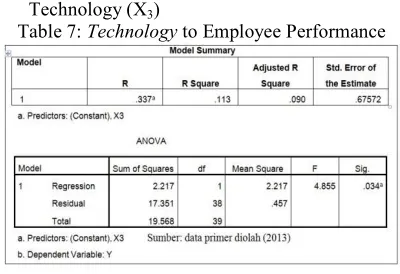
Table 7: Technology to Employee Performance
From the above table it can be seen the magnitude of the variable relationship with employee performance improvement Technology is R Square = 0.113, meaning that the variable effect is strong enough Technology (R = 0.337) to variable employee performance improvement by 11.3% and the remaining 88.7% is influenced by other factors.
4. Regression analysis application Request Tracker as KMS
[image:5.595.89.289.484.656.2]
From the above table it can be seen the relationship
KMS applications to increase employee
performance is the R Square = 0.211. It means that the application is sufficiently strong effect (R = 0.459) to variable performance improvement, and accounted for 21% and the remaining 89% is influenced by other factors that are not discussed here.
5. DISCUSSION
After conducting analysis, it was concluded that this application influence is strong enough to increase employees performance, hence some lessons learned gained from the interviews with leaders Request Tracker application users for future improvement are:
• Knowledge Strategy.
To implement an application must first define strategy implementation. In the case of this study, for example, prior to the implementation of Request Tracker application, it must be decided which team will implement it. Then,
make piloting an evaluation prior to
implementation, then after doing the repair feature is evaluated as needed. Furthermore, it is needed for: determining user and privilege, admin and admin applications for supporting technical and process flow adjustments to existing procedures.
• Training programs
Training should be done to all the users who use the app, the rise procedure training about the work process, in this case the CR handling procedures, as well as the applications that will be used for the tracking process. After the
training, should also be held Training
Evaluation, to ensure that participants truly understand the training, and also whether the training materials used in the process of their work.
• Leader support and commitment
It is not less important to the success of the program or the application to support the
implementation of the use of CR handling process. Support and commitment consisted of either direction or appeal such per - semester from user management to all users of the application of the level up to the level of staff. In addition to the support that can be given is if there are issues related to the application and operation, follow-up is expected to be fully supported by management.
• Business Process Reengineering
Doing design customized applications to flow processes already agreed , so even if the user still required to use the application and leave the old habits ( which were previously done manually tracking process , and the procedure is automated now) , but the process works has not changed , making it easier to adjustment .
• Network experts
Must be the expert in the use of this application. Given the Request Tracker application is made yourself, then that should be prepared is the technical admins really understand about the Request Tracker application and about other things that could support the use of the application.
• Knowledge Sharing
Namely the holding of meetings on the team that was already done by the company to discuss the issues surrounding the handling of CR. Going forward, the meeting may be done periodically, not when the issues are going to discuss it.
• Organizational culture
Because the most important factor in the successful implementation of an application is the people factor, then the user should always be grown motivation for using Request Tracker applications. One of them is to include measurements based on the data in the application to be one of the items in the assessment of employee performance, so that they would feel "worth" to perform input process etc. (process tracking) using Request Tracker application.
• Knowledge Storage
Through the use of the application all data and information (knowledge) to be centralized and change strategies tacit knowledge into explicit becomes real.
• Knowledge Audit
identify the cause and immediate solutions, such
as immediately update the data as well as information on the application in accordance with the actual conditions.
• Knowledge Architecture
Include the determination of architectural design that will be used in the application, considering application will store data that is not small and
accessed by many people simultaneously.
Therefore, it must be ensured architecture capable enough to guarantee a smooth user in use.
KMS success models that focus on factors other than the quality and function of the technology are: (Arntzen Bechina, A. A, and Nkosi Ndlela, M. 2007)
• Communication
It is very important, because although the work process is automated handling of CR into the application, it does not mean eliminating
communication that should exist. This
communication should always be done especially to resolve issues that occur.
• Leadership
One way is for a running process management should always be involved in monitoring
progress and be a driving force in
implementation of Request Tracker
application.
• Organizational structure
Important to the structure of the organization that clearly to define user or role and privilege in the use of Request Tracker application. Considering this is a work flow application base, within the meaning of the user’s involvement in filing the application, as well as the clarity of their role, a thing that can not be ruled out
• Alignment of the ICT with the business
goals
It is important that the Request Tracker application providing this is to answer one of the company's business goals, which is to provide responsive customer service, faster and better, so that its use be highly prioritized, and its impact should any issues that occur in it should be resolved as soon as possible in order application is running normally again and can be optimized usage.
• User friendliness
This app is quite user friendly, with the format and display screen that is easy to understand and accessible at all times from internal office. Needs to be improved is the ease of access, web browser options be propagated, and can be
accessed from outside the office. So that the application can be used as it should, and is able to assist users who are involved in the handling of CR to work more effectively and efficiently.
6. CONCLUSION
Several conclusions from this study, namely: 1. Request Tracker overall application as a KMS
in the process of handling Customer Request (CR), by a factor of People, Process and Technology has its own correlation values to increase employee performance by 0.459, means strong relationship exists between the factors People, Process and Technology use applications to increase employee performance. 2. People variable, in this case the involvement of the users of the application, have a significant
influence on employee performance
improvement with the highest correlation with r = 0.426, this indicates that the relationship is strong enough and has the effect of 18.2% to the increase in employee performance.
3. Process variable, has a significant influence on employee performance improvement with a value of = 0.381, this indicates that the relationship is strong enough and has the effect of 14.5% to the increase in employee performance.
4. Technology variable has a significant influence on employee performance improvement with the smallest value compared to other variable that is equal to = 0.337, this indicates that the relationship is strong enough and has the effect of 11.3% to the increase in employee performance.
From the results of this study, it is suggested that it is very important to provide a more comprehensive and accurate information to management and employees can improve their performance. It is also expected that the performance will further improved significantly with the applications provided that company do more training or socialization of CR and its procedures for handling applications that use IT service support.
REFERENCES
[1] Davenport, T H and Prusak, L (1998) Working
Knowledge: How Organizations Manage What They Know, Harvard Business School Press,
http://wang.ist.psu.edu/course/05/IST597/paper
s/Davenport_know.pdf
[2] Alavi, M., Leidner, D.E. (2001). Review:
Knowledge Management and Knowledge
Management Systems: Conceptual
Foundations and Research Issues, MIS Quarterly, 25(1), pp.107-136. Retrieve from http://mgmt.iisc.ernet.in/~piyer/Knowledge_M anagement/KM%20and%20KMS%20Concept ual%20Foundations%20and%20Research%20I ssues%20MIS%20Quarterly%2025%201%20 March%20201.pdf
[3]Smith, R. (2001), “A roadmap for knowledge
management”. Retrieved from:
www2.gca.org/knowledgetechnologies/2001/pr oceedings
[4] Grey, D. (1996). “What is knowledge
management”, The Knowledge Management
Forum. Retrieved form
http://www.3-cities.com/~bonewman/what-is.htm
[5] Rasula, J., Bosilj, V., Indihar, M. (2012). The
Impact of Knowledge Management on
Organizational Performance. Economic and
Business Review. 14(2), 147-168.
[6] Bhatt, D. (2000). EFQM Excellence Model and
Knowledge Management Implications. From: http://www.eknowledgecenter.com/articles/101 0/100.htm. [2010, Juni 3]
[7] Berkani, L., Chikh, A. (2010). A Process for Knowledge Reuse in Communities of Practice of E-learning. Procedia Social and Behavioral
Sciences 2. Published by Elsevier Ltd. 4436–
4443. doi:10.1016.Retrievedfrom
http://ipac.kacst.edu.sa/edoc/2011/195510_1.p df
[8] Gupta, J., Sharma, K. (2004).Creating
Knowledge Based Organizations. Pp.18.
Boston: Idea Group Publishing.
ISBN1-59140-163-1. Retrieved from
http://books.google.co.id/books?id=l3smT7mJ RYsC&printsec=frontcover&hl=id&source=gb s_ge_summary_r&cad=0#v=onepage&q&f=tru e
[9] Mvungi, M., & Jay, I. (2009). Knowledge Management Model for Information Teknologi
Support Service. Electronic Journal of
Knowledge Management, 7 (3), pp.353-366.
[10]Tiwana, A, (2001). The Essential Guide to
Knowledge Management. Pp. 185-186. USA:
Prentice Hall-inc.
[11]Sugiyono. (2008). Metode penelitian bisnis : (pendekatan kuantitatif, kualitatif dan R&D). Alfabeta, Bandung
[12]Shaw, R. (1991). Computer-Aided Marketing & Selling. Information Asset Management. ISBN 0 7506 0070 5
[13]Kuncoro, E. A. Riduwan. (2007). Cara
Menggunakan dan Memaknai Analisis Jalur
(Path Analysis).
[14]Arntzen, A. A. B., & Ndlela, M. N. (2009). Success factors in implementing knowledge
based systems. Academic Conferences
Limited.
[15]Nonaka, I., & Takeuchi, H. (1995). The knowledge-creating company: How Japanese
companies create the dynamics of innovation.
Oxford university press.
[16]Shaw, R. B., & Perkins, D. N. (1991). Teaching organizations to learn. Organization