S T U D Y P R O T O C O L
Open Access
Efficacy and safety of a balanced salt
solution versus a 0.9% saline infusion for
the prevention of contrast-induced acute
kidney injury (BASIC trial): a study protocol
for a randomized controlled trial
Hyung Ah Jo
1†, Sehoon Park
2†, Chan-Duck Kim
3, Hee-Yeon Jung
3, Jang-Hee Cho
3, Ran-hui Cha
4, Ea Wha Kang
5,
Tae Ik Chang
5, Sejoong Kim
6, Hyung-Jong Kim
7, Byung Ha Chung
8, Jung Pyo Lee
9, Jung Tak Park
10,
Seung Hyeok Han
10, Tae-Hyun Yoo
10, Dong-Ryeol Ryu
11, Sung Jin Moon
12, Jae Hyun Chang
13, Dong Ki Kim
1and Kwon Wook Joo
1*Abstract
Background:Contrast-induced acute kidney injury (CI-AKI) is one of the most common causes of iatrogenic kidney injury and, therefore, its prevention is an important issue. However, whether the administration of 0.9% saline is the optimal prophylaxis method remains uncertain due to its supra-physiologic chloride component. In particular, recent studies suggest that chloride-restricted solutions showed superiority over 0.9% saline in several clinical settings.
Methods/design:The investigators designed a multicenter randomized controlled trial to compare the efficacy of a balanced salt solution and 0.9% saline in CI-AKI prophylaxis. This study will recruit patients who are scheduled for contrast-enhanced computed tomography (CT) scans with CI-AKI prophylaxis. In this study, participants will be randomized into two study arms; the study group will receive a balanced salt solution, and the control group will receive 0.9% saline. Fluids will be administered as designated in the protocol before and after the CT scan, and an evaluation of baseline clinical status will be performed by obtaining blood and urine samples. During the follow-up visits, the incidence of CI-AKI and long-term outcomes, including the start of renal replacement therapy or all-cause mortality, will be assessed.
Discussion:To our knowledge, this study will be the first study assessing the preventive value of a balanced salt solution over 0.9% saline for CI-AKI. If the trial shows that the balanced salt solution is as effective for CI-AKI prophylaxis as 0.9% saline, the use of the balanced salt solution could be promoted due to the reduced possibility of consequent metabolic acidosis compared to 0.9% saline.
Trials registration:ClinicalTrials.gov, ID: NCT02799368. Registered on 14 June 2016.
Keywords:Contrast-induced acute kidney injury, Computed tomography, Balanced salt solution
* Correspondence:[email protected] †Equal contributors
1Department of Internal Medicine, Seoul National University College of
Medicine, Seoul, South Korea
Full list of author information is available at the end of the article
Background
Because iodinated contrast media is widely used in current medicine [1, 2], its well-known side effect, contrast-induced acute kidney injury (CI-AKI), has be-come one of the most common causes of iatrogenic kid-ney injury [3, 4]. CI-AKI has been related to increased mortality, longer hospital stays and renal failure in pa-tients with chronic kidney disease (CKD) [3, 5–9]. Hence, preventing CI-AKI has been regarded as an import-ant medical issue [7, 10, 11], and the use of 0.9% saline has been an essential part of CI-AKI prophylaxis [10, 12]. How-ever, 0.9% saline has a pH of approximately 5.5 and con-tains a supra-physiologic chloride level. Therefore, the use of saline could cause metabolic acidosis, which contributes to renal vasoconstriction [13, 14]. From this clinical point of view, a few trials have tested the efficacy of a sodium bi-carbonate fluid solution for CI-AKI prophylaxis, but the re-sults failed to show consistent superiority over 0.9% saline [15]. From another aspect, a recent clinical trial compared the use of 0.9% saline and no prophylaxis for patients with reduced kidney function, and showed no certain benefits with 0.9% saline prophylaxis. However, the effect of CI-AKI prophylaxis may be necessary to be tested in higher-risk pa-tients, such as patients with other risk factors or even lower baseline estimated glomerular filtration rate (eGFR) [16].
Recently, several human studies reported that meta-bolic acidosis and vasoconstriction are less pronounced when using a balanced salt solution, which has a physio-logic level of chloride and a neutral pH, compared to using 0.9% saline [17, 18]. Additionally, there were
prospective studies suggesting that using chloride-restrictive solutions, rather than using chloride-rich solutions, for fluid resuscitation can reduce acute kidney injury (AKI) in critically ill patients [19, 20]. In accord-ance with these findings, a large-scale cohort study was reported, demonstrating the preventive effect of a bal-anced salt solution for AKI over 0.9% saline [21]. Additionally, one clinical trial is currently recruiting par-ticipants to prove the benefit of chloride-restrictive fluids in cardiac surgery [22]. However, to the investiga-tors’ knowledge, there are no ongoing trials regarding the effectiveness of a balanced salt solution for CI-AKI prophylaxis.
This multicenter randomized controlled trial is de-signed to verify the effectiveness of a balanced salt solution for CI-AKI prophylaxis. After randomization, the study group will receive the balanced salt solution, and the control group will receive 0.9% saline. In this trial, the investigators will address whether the balanced salt solution could be a potential standard solution for CI-AKI prophylaxis.
Methods/design
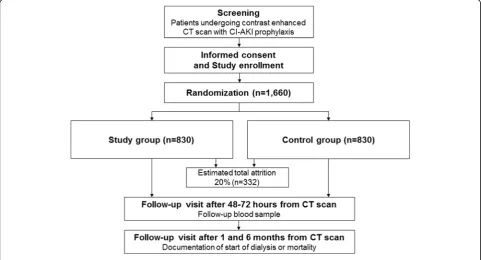
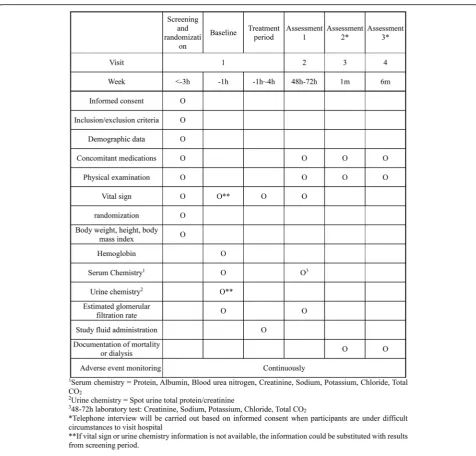
The study is a randomized, open-label, active-control, two-parallel-group, multicenter, phase-III study. The study protocol is summarized in Figs. 1 and 2, the latter showing the study timeline which accords with the Standard Protocol Items: Recommendations for Interventional Trials (SPIRIT) Figure. The main goal is to evaluate whether using a balanced salt solution
[image:2.595.57.539.459.719.2]is non-inferior to the use of 0.9% saline for CI-AKI prophylaxis. In current medicine, many clinics provide CI-AKI prophylaxis for patients with decreased kidney function, and this study will recruit these patients who are scheduled for contrast-enhanced computed tomography (CT) scans. After participants are en-rolled in the study with informed consent, they will be randomized into the two study arms; the study group will receive a balanced salt solution, and the control group will receive 0.9% saline. The fluids for CI-AKI prophylaxis will be administered as designated in the protocol in the daycare center before and after the CT scan. The baseline clinical status will be eval-uated by obtaining blood and urine samples. Next,
the participants will be scheduled for a follow-up visit, and their incidence of CI-AKI and further prognosis will be evaluated. The protocol has been designed according to the SPIRIT guidelines (see Additional file 1.)
Study participants
The study will recruit participants from the following 12 tertiary hospitals in Korea: Seoul National University Hospital, Kyungpook National University Hospital, National Medical Center, National Health Insurance Service Ilsan Hospital, Seoul National University Bundang Hospital, Bundang CHA Medical Center, Seoul St. Mary’s Hospital, Seoul National University Boramae Medical Center, Severance Hospital, Ewha Womans University Mokdong
[image:3.595.59.536.84.540.2]Hospital, Catholic Kwandong University International St. Mary’s Hospital, and Gachon University Gil Medical Center. The planned duration for the study enrollment completion is 2 years. Below, we describe the inclusion and exclusion criteria for the study participants, and the age or eGFR cut-off values are based on a current clinical guideline [11].
Participants’inclusion criteria are as follows:
1. Adult patients (age 18 years or older) who undergo iodinated contrast-enhanced CT scans
2. Patients with a baseline eGFR, which is measured within 3 months, of less than 45 mL/min/1.73 m2or both having a baseline eGFR less than 60 mL/min/ 1.73 m2and either one of the following risk factors: (a) diabetes mellitus, or
(b)age 60 years or older
3. Patients who are able to provide informed consent and give adequate information for the endpoint assessment
Participants’exclusion criteria are as follow:
1. Patients with a baseline eGFR of less than 15 mL/ min/1.73 m2or who are on dialysis
2. Heart failure with a left ventricular ejection fraction < 45% or severe symptoms (New York Heart Association functional classification III or IV) 3. Co-existing acute pulmonary edema or
decompensated heart failure requiring the following medications: dobutamine, dopamine, milrinone, amrinone, or nesiritide
4. Patients with last measured serum potassium level > 5.5 mEq/L or serum sodium level > 145 mEq/L at the screening period or within 3 months before the CT scan
5. History of intravenous or intra-arterial administra-tion of contrast agent within 1 week
6. Previous history of hypersensitivity reaction to the iodinated contrast agent
7. History of multiple myeloma
8. Women who are currently pregnant/breastfeeding or planning pregnancy
9. Patients with an expected survival duration of less than 6 months
10.Patients who are already enrolled in another clinical trial
Intervention protocols and fluids
The main intervention is the intravenous administration of fluids for CI-AKI prophylaxis. The two types of fluid used in our study are plasma solution A and 0.9% saline. The study fluid, plasma solution A, will be manufactured by CJ HealthCare Corporation, Seoul, South Korea and in facilities following standards of Good Manufacturing
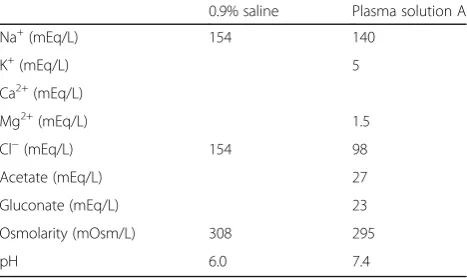
Practice. The provided product volume will be 1000 mL, and plasma solution A will contain 5.26 g of sodium chloride, 5.02 g of sodium gluconate, 3.68 g of sodium acetate hydrate, 0.37 g of potassium chloride and 0.3 g of magnesium chloride. In contrast, 0.9% saline will have 9.0 g of sodium chloride with a volume of 1000 mL. The concentrations of each component of the two fluids are summarized in Table 1. Plasma solution A, with 98 mEq/L of chloride, is the balanced salt solution used in this study and will be administered to the study group. Meanwhile, 0.9% saline, which is the standard fluid for CI-AKI prophylaxis and contains 154 mEq/L of chloride, will be used in the control group for CI-AKI prophylaxis. Both fluids will be administered by the designated rate, i.e., 3 mL/kg/h for 1 h before and 1.5 mL/kg/h for 4 h after the CT scans. Participants will remain fasting during the fluid administration. All CT scans will use iso- or low-osmolar contrast agents. N -acetylcysteine will not be administered to the partici-pants in this study as this medication lacks a definite benefit for CI-AKI prophylaxis [23]. Other medication use will not be restricted in the study.
Study endpoint
[image:4.595.305.539.593.732.2]The primary endpoint of the study is the incidence of CI-AKI. The event of CI-AKI will be defined as an in-crease in the serum creatinine level≥0.5 mg/dl or≥25% from baseline at 48–72 h after the CT scan [24]. For the assessment of the primary endpoint, the patients will visit the study hospital and a follow-up blood sample will be drawn; along with other tests, serum creatinine will be measured by the method that has been standardized to isotope dilution mass spectrometry. Next, two sec-ondary endpoints will be evaluated in the study; one is the eGFR decrement at 48–72 h after the CT scan, and the other is the start of dialysis, or mortality, which will be assessed at 1 and 6 months, respectively. The eGFR decrement will be assessed by the baseline and follow-up eGFR values calculated by the serum creatinine as mea-sured in the primary endpoint assessment. The eGFR will
Table 1Components of the two fluids used in the study
0.9% saline Plasma solution A Na+(mEq/L) 154 140
K+(mEq/L) 5 Ca2+(mEq/L)
Mg2+(mEq/L) 1.5 Cl−(mEq/L) 154 98 Acetate (mEq/L) 27 Gluconate (mEq/L) 23 Osmolarity (mOsm/L) 308 295
be calculated using the Modification of Diet in Renal Disease (MDRD) equation [25]. For documentation of mortality and the beginning of dialysis, the study partici-pants will be questioned via a direct visit or phone poll.
Sample size
The incidence of CI-AKI when using 0.9% saline for prophylaxis was predicted according to the previous pro-spective study (11.5%) [26]. In contrast, there was no study regarding the incidence of CI-AKI after the use of a balanced salt solution; therefore, the expected inci-dence of CI-AKI in the study group was derived from the prospective study, which compared the incidence of AKI in an intensive care unit population according to the resuscitation fluid use (8.4%) [20]. With a non-inferiority limit of 1.5%, a total of 1660 study partici-pants (830 in each group) would result in a power of at least 80% with a one-sided type-1 error rate (α) of 2.5%, allowing a 20% withdrawal rate in each group.
Blinding and randomization
The study is an open-label study; therefore, the type of administered fluid will be disclosed both to the investi-gators and the participants. The participants and their information will be assigned a unique identifier number at the time of initial enrollment and stored in a web-based data collection system. The group allocation will be performed after randomization in a 1:1 manner, at least 3 h before contrast material administration. The randomization scheme will be generated by using the on-line randomization service developed by Sealed Enve-lope Ltd. (www.sealedenveEnve-lope.com).
Statistical analysis
All primary and secondary endpoints and serious adverse effects will be analyzed by the investigators at the partici-pating hospitals. The final analysis will be completed at 6 months after the last participant’s trial. The primary endpoint, i.e., the incidence of CI-AKI in the study and control groups will be compared by a non-inferiority test with 1.5% as the non-inferiority margin. The eGFR decre-ment, one of the secondary endpoints in our study, will be evaluated by chi-squared test. End-stage renal disease (ESRD) progression and mortality will be assessed by Kaplan-Meier survival curve with a log-rank test.
Data management
All participants’information related to the study will be recorded in the Case Reporting Format (CRF) and re-corded in an electronic, password-protected database. Study participants will only be recognized by their study ID, and their personal identifier will not be recorded and stored. All records will be accessed by the investigators and authorized personnel only to secure confidentiality.
The investigators at each participating hospital will monitor the completeness of the CRF. The database will be locked and maintained for 10 years only for the pur-pose of a secondary analysis or investigations by the at-tending Institutional Review Boards (IRBs) and the Korean Ministry of Food and Drug Safety (MFDS).
Adverse events
During the entire study period and after 30 days from the end of the trial, adverse events (AE) will be reported and recorded in the participants’ CRF. The severity of AEs will be graded as mild, moderate and severe, and their relationship between the study groups will also be assessed by clinical judgement. If an AE requiring hospitalization or causing a medically critical situation occurs, the event will be recorded as a severe adverse event (SAE). All SAEs will be reported to the investiga-tor of the attending hospital and the IRB of reference within 24 h after the information has been collected. AEs that cannot deny a relationship to the study must be followed until the AEs have been resolved. Whenever AEs progress to the level of SAEs, the events must also be reported according to the above protocol. At the time of the study result submission, AEs and their relation-ship to the study will be documented in a table and submitted.
Discussion
Prophylaxis for CI-AKI is an important clinical issue be-cause CI-AKI is common and worsens patient prognosis. Although the use of 0.9% saline has been the standard method for CI-AKI prophylaxis, its potentially harmful effect was addressed in previous studies. There were sev-eral efforts to find a more appropriate infusion fluid for CI-AKI prophylaxis, but trials with sodium bicarbonate fluid failed to demonstrate prophylactic efficacy. The investigators considered the balanced salt solution to be a potential fluid, which can replace 0.9% saline, due to the balanced salt solution’s physiologic components and evi-dence from recent study results. To our knowledge, the study will be the first study assessing the preventive value of a balanced salt solution over 0.9% saline for CI-AKI. If the proposed trial demonstrates that the balanced salt so-lution is effective for CI-AKI prophylaxis, the use of the fluid could be promoted due to its reduced likelihood of inducing metabolic acidosis. Therefore, the results of this trial could be useful to improve the prophylaxis method and, consequently, decrease the incidence of CI-AKI and its adverse outcomes.
Trial status
ClinicalTrials.gov (NCT02799368). The trial started re-cruitment in November, 2016.
Additional file
Additional file 1:SPIRIT Checklist for the present study protocol. (DOC 113 kb)
Abbreviations
AE:Adverse event; AKI: Acute kidney injury; CI-AKI: Contrast-induced acute kidney injury; CKD: Chronic kidney disease; CRF: Case Reporting Format; CT: Computed tomography; eGFR: Estimated glomerular filtration rate; IRB: Institutional Review Board; MFDS: Ministry of Food and Drug Safety; SAE: Severe adverse event
Acknowledgements
None
Funding
This study is funded by CJ HealthCare Corporation (CS2015_0046), Seoul, Korea.
Availability of data and materials
The final trial dataset will only be accessible to the study investigators.
Authors’contributions
KWJ is the principal investigator and supervised the overall project. DKK gave the research idea and helped in the manuscript correction, provided statistical knowledge and recruiting study participants from Seoul National University Hospital. SP participated in the study design and wrote the original manuscript. HAJ assisted in the study design, revised the manuscript, reviewed the ethical aspects of the study and acquired IRB/government approval. CDK is leading the study at Kyunpook University Hospital and reviewed the study protocol. HYJ helped in study design and participating in patient recruitment. JHC helped in revising the study protocol and participating in patient recruitment. RHC is leading the study in the National Medical Center and helped in statistical design. EWK provided statistical knowledge for revising the study protocol and participated in patient recruitment. TIC is leading the study in the National Health Insurance Service Ilsan Hospital. SJK is leading the study at Seoul National University Bundang Hospital and provided background knowledge of the study. HJK is leading the study at Bundang CHA hospital and participated in the study design. BHC is leading the study at St. Mary’s hospital and contributed to the study concept. JPL is leading the study at Seoul National University Boramae Hospital. JTP is recruiting study participants at Severance Hospital and helped in correcting the study protocol. SHH participated in study design and provided study concepts. THY is leading the study at Severance Hospital and helped in writing the study protocol. DRR is leading the study at Ewha Womans University Mokdong Hospital and participated in revising the study protocol. SJM participated in the study initiation at Incheon St. Mary’s Hospital. JHC is leading the study at Gachon University Gil Medical Center. All authors read and approved the final manuscript.
Ethics approval and consent to participate
The study will be performed according to the following common guidelines for clinical trial: the principles of the Declaration of Helsinki–Ethical Principles for Medical Research Involving Human Subjects in 2013 and Good Clinical Practice Guidelines in 2015. The study protocol has been designed and will report results according to current Consolidated Standards of Reporting Trials (CONSORT) guidelines and is registered at ClinicalTrials.gov (NCT02799368). The protocol design has been approved by the Institutional Review Board (IRB) of Seoul National University Hospital (H-1605-156-768) and the Ministry of Food and Drug Safety of Korea (MFDS). All study participants will be informed about the purpose, intervention and risk/ benefit of the study, and only those who provide written consent will be registered to the study.
Kyungpook National University Hospital: KNUH 2016-09-007 National Medical Center: H-1608-069-004
National Health Insurance Service Ilsan Hospital: NHIMC 2016-10-010-002
Seoul National University Bundang Hospital: B-1609/363-401 Bundang CHA Hospital: 2016-09-011-002
Seoul St. Mary’s Hospital: KC16MIMT0741
Seoul National University Boramae Hospital: 16-2016-126 Severance Hospital: 4-2016-0691
Ewha Womans University Mokdong Hospital: 2016-10-014 Incheon St. Mary’s Hospital: IS16MIMT0033
Gachon University Gil Medical Center: GAIRB2016-322
Consent for publication
Not applicable.
Competing interests
The authors declare that they have no competing interests.
Publisher’s Note
Springer Nature remains neutral with regard to jurisdictional claims in published maps and institutional affiliations.
Author details
1Department of Internal Medicine, Seoul National University College of
Medicine, Seoul, South Korea.2Department of Biomedical Sciences, Seoul
National University College of Medicine, Seoul, South Korea.3Department of
Internal Medicine, Kyungpook National University Hospital, Daegu, South Korea.4Department of Internal Medicine, National Medical Center, Seoul,
South Korea.5Department of Internal Medicine, National Health Insurance
Service Ilsan Hospital, Goyang, South Korea.6Department of Internal
Medicine, Seoul National University Bundang Hospital, Gyeonggi-do, South Korea.7Department of Internal Medicine, Bundang CHA Medical Center, CHA
University, Gyeonggi-do, South Korea.8Department of Internal Medicine,
Seoul St. Mary’s Hospital, The Catholic University of Korea, Seoul, South Korea.9Department of Internal Medicine, Seoul National University Boramae Medical Center, Seoul, South Korea.10Department of Internal Medicine,
Yonsei University College of Medicine, Seoul, South Korea.11Department of
Internal Medicine, Ewha Womans University Mokdong Hospital, Seoul, South Korea.12Department of Internal Medicine, Catholic Kwandong University International St. Mary’s Hospital, Incheon, South Korea.13Department of
Internal Medicine, Gachon University Gil Medical Center, Incheon, South Korea.
Received: 18 November 2016 Accepted: 13 September 2017
References
1. Go AS, et al. Heart disease and stroke statistics—2013 update: a report from the American Heart Association. Circulation. 2013;127(1):e6–e245. 2. Ludwig U, Keller F. Prophylaxis of contrast-induced nephrotoxicity. Biomed
Res Int. 2014;2014:308316.
3. Rihal CS, et al. Incidence and prognostic importance of acute renal failure after percutaneous coronary intervention. Circulation. 2002;105(19):2259–64. 4. Nash K, Hafeez A, Hou S. Hospital-acquired renal insufficiency. Am J Kidney
Dis. 2002;39(5):930–6.
5. McCullough PA, et al. Acute renal failure after coronary intervention: incidence, risk factors, and relationship to mortality. Am J Med. 1997;103(5):368–75. 6. Weisbord SD, et al. Incidence and outcomes of contrast-induced AKI following
computed tomography. Clin J Am Soc Nephrol. 2008;3(5):1274–81. 7. James MT, et al. Acute kidney injury following coronary angiography is
associated with a long-term decline in kidney function. Kidney Int. 2010; 78(8):803–9.
8. Park S, et al. Contrast-induced nephropathy after computed tomography in stable CKD patients with proper prophylaxis: 8-year experience of outpatient prophylaxis program. Medicine (Baltimore). 2016;95(18):e3560. 9. Kim SM, et al. Incidence and outcomes of contrast-induced nephropathy after computed tomography in patients with CKD: a quality improvement report. Am J Kidney Dis. 2010;55(6):1018–25.
10. Barrett BJ, Parfrey PS. Preventing nephropathy induced by contrast medium. N Engl J Med. 2006;354(4):379–86.
12. Mueller C. Prevention of contrast-induced nephropathy with volume supplementation. Kidney Int Suppl. 2006;100:S16–19.
13. Yunos NM, et al. Bench-to-bedside review: chloride in critical illness. Crit Care. 2010;14(4):226.
14. Wilcox CS. Regulation of renal blood flow by plasma chloride. J Clin Invest. 1983;71(3):726–35.
15. Zoungas S, et al. Systematic review: sodium bicarbonate treatment regimens for the prevention of contrast-induced nephropathy. Ann Intern Med. 2009;151(9):631–8.
16. Nijssen EC, et al. Prophylactic hydration to protect renal function from intravascular iodinated contrast material in patients at high risk of contrast-induced nephropathy (AMACING): a prospective, randomised, phase 3, controlled, open-label, non-inferiority trial. Lancet. 2017;389(10076):1312–22. 17. Chowdhury AH, et al. A randomized, controlled, double-blind crossover
study on the effects of 1-L infusions of 6% hydroxyethyl starch suspended in 0.9% saline (Voluven) and a balanced solution (Plasma Volume Redibag) on blood volume, renal blood flow velocity, and renal cortical tissue perfusion in healthy volunteers. Ann Surg. 2014;259(5):881–7. 18. Chowdhury AH, et al. A randomized, controlled, double-blind crossover
study on the effects of 2-L infusions of 0.9% saline and plasma-lyte(R) 148 on renal blood flow velocity and renal cortical tissue perfusion in healthy volunteers. Ann Surg. 2012;256(1):18–24.
19. Yunos NM, et al. Chloride-liberal vs. chloride-restrictive intravenous fluid administration and acute kidney injury: an extended analysis. Intensive Care Med. 2015;41(2):257–64.
20. Yunos NM, et al. Association between a liberal vs chloride-restrictive intravenous fluid administration strategy and kidney injury in critically ill adults. JAMA. 2012;308(15):1566–72.
21. Shaw AD, et al. Impact of intravenous fluid composition on outcomes in patients with systemic inflammatory response syndrome. Crit Care. 2015;19:334. 22. ClinicalTrials.gov [Internet]. Bethesda (MD): National Library of Medicine (US).
Identifier NCT02020538, Limiting IV Chloride to Reduce AKI After cardiac surgery (LICRA). 2013. [cited 2017 Sep 7]. Available from: https://clinicaltrials. gov/ct2/show/NCT02020538.
23. Birck R, et al. Acetylcysteine for prevention of contrast nephropathy: meta-analysis. Lancet. 2003;362(9384):598–603.
24. KIDGO. Clinical practice guideline for acute kidney injury. Kidney Int Suppl. 2012;2:116–21.
25. Levey AS, et al. National Kidney Foundation practice guidelines for chronic kidney disease: evaluation, classification, and stratification. Ann Intern Med. 2003;139(2):137–47.
26. Brar SS, et al. Sodium bicarbonate vs sodium chloride for the prevention of contrast medium-induced nephropathy in patients undergoing coronary angiography: a randomized trial. JAMA. 2008;300(9):1038–46.
• We accept pre-submission inquiries
• Our selector tool helps you to find the most relevant journal
• We provide round the clock customer support
• Convenient online submission
• Thorough peer review
• Inclusion in PubMed and all major indexing services
• Maximum visibility for your research
Submit your manuscript at www.biomedcentral.com/submit