Four-body Interaction and Equation of State for Solid
Neon from
Ab Initio
Calculation
Zheng Xingrong
Department of Physics, College of Electrical Engineering, Longdong University, China
Copyright ©2019 by authors, all rights reserved. Authors agree that this article remains permanently open access under the terms of the Creative Commons Attribution License 4.0 International License.
Abstract
Using ab initio Hartree-Fock self-consistent field method combined with many-body expansion method, the investigation is based on the first-principles. We have considered two-, three- and four-body potential energies of face-centered cubic (fcc) solid neon of which the atomic distance R ranges from 1.6Å to 3.0Å. By discussing the truncation and convergence of many-body potential of solid neon, we obtain the cohesive energy, the zero-point vibration energy and equation of state (EOS). The results show that, when the number of neighboring atoms increases, two-body, three-body, and four-body potential energy tend to a saturation value for a certain atomic distance (R). The even many-body contributions to the cohesive energy, such as two-, four-body terms and so on, are positive, whereas the odd many-body contributions to the cohesive energy, such as three-, five-body terms and so on, are negative. The zero-point vibration energy of solid neon is only 6% of the total atomic interaction energy, but should not be neglected. Compared with the experimental data, the importance of the four-body interactions in compressed solid neon is emphasized. Only taking into account the two-body term, the pressure is overestimated, and our calculated results are in good agreement with the experimental values at the low-pressure regions (<15GPa). Adding three-body term up to 55GPa, considering the four-body term, it has a good consistency at the experimentally studied pressure range of 0~237GPa, and maybe helpful to accurately explain the phenomenon of the experiment above 237GPa when the higher many-body effects are considered.Keywords
Solid Neon, Ab Initio Hartree-fock SCF Method, Many-body Expansion Method, Truncation, Convergence, Zero-point Vibration Energy, Many-body Potential Energy, Equations of State1. Introduction
The condensed matters of solid Neon (Ne) have been one of the widely studied materials both theoretically and experimentally [1-6]. Ne has a relatively simple full-shell structure, and then its crystal and electronic structures remain simple at very high pressures, making it is an ideal candidate to test quantum many-body theory under high pressures [1-3]. Due to the weakness of van der Waals interactions between atoms, the density-functional theory (DFT) is not enough accurate to account for both the long-range dispersive interactions and the short-range overlap effects. Therefore, the importance of these systems lies in the fact that they are relatively simple to study due to their closed-shell electronic structure.
The study suggests the stability of the fcc phase when
Ne at a high pressure and Ne is therefore used as a quasi-hydrostatic pressure-transmitting medium [4]. Powder X-ray diffraction experiments on Ne have shown that it still remains the fcc phase at the extremely high pressure of 237GPa at room temperature [5, 6]. Therefore, the many-body potential energy and equation of state for solid Ne have attracted many significant attentions theoretically and experimentally [8-13]. And these studies mainly contain research work of two-body potential and three-body potential. The results show that the two-body and three-body potentials can only accurately describe the compression properties of solid Ne at low pressure, however the compression properties at high pressures can not been described precisely. As a result, the higher-body interactions need to be considered.
energy, the zero-point vibration energy and equation of state of solid Ne are obtained.
2. Theoretical Model and Calculation
Method
In a given (Ne)n clusters, the potential energy (Vn(M))
between the central atom M and its neighbours in the crystal lattice can be expressed as [16]
1 2 1 0
( ,1,2,3,..., 1) ( , , ,..., )
n M n
V M n− =E r r r r− −nE (1) where E0 is the ground state energy of the isolated atom, E(rM, r1, r2, …, rn-1) represents the total ground state
energy of (Ne)n clusters, and it not only can be calculated
by ab initio Hartree-FockSCF method based on GAMESS Programme [17], but also is obtained by solving the Schrödinger equation [16].
ˆ
H
ϕ
=Eϕ
(2) where the Hamilton operator of the clusters (Ĥ), which are composed of n atoms, is expressed by,
1 1 1
ˆ
2 I 2 i I J I
I I i I J IJ i j ij I j Ij
Z Z Z
H
M < r < r r
= −
∑
∇ −∑
∇ +∑
+∑
−∑
(3)Using many-body expansion method, Vn(M) can be also
developed into a many-body expansion:
1 1 1
2 3 4
1 1 1
2 3 4
( ) ( , ) ( , , ) ( , , , )
( ) ( ) ( )
n n n
n
i i j i j k
V M u M i u M i j u M i j k
U M U M U M
− − −
= = < = < <
= + + + ⋅⋅⋅
= + + + ⋅⋅⋅
∑
∑
∑
(4)
where i, j and k denote different neighbours of the central atom M, (n-1) is the total number of considered neighbours. U2(M), U3(M) and U4(M) represent the total
two-, three- and four-body interaction energy between atom M and its neighbours, respectively. The two-, three- and four-body potential can be expressed as
(
)
(
)
2 , M, i 2 0
u M i =E r r − E (5)
(
)
(
)
3(
)
3 0 2
1
, , M, ,i j 3 ,
i j
u M i j E r r r E u M i
= <
= − −
∑
(6)(
)
(
)
(
)
(
)
4 0 4 4 3 2 1 1, , , , , , 4
( , , , )
= < < = <
= −
−
∑
+∑
M i j k
i j k i j
u M i j k E r r r r E
u M i j u M i (7) Therefore, the cohesive energy E(V) of each atom is a function of volume (V), which can be expanded to a series of many-body contributions.
2 3 4 2 3 4
1 1 1
( ) ( ) ( ) ( ) ( ) ( ) ( )
2 3 4
E V = U o + U o + U o =E V +E V +E V (8)
The pressure (P) is a function of volume (V) and temperature (T), and it is consisted of the many-body pressure, zero-point vibrational pressures and thermal pressures [15].
2 3 4
( , ) ( ) ( ) ( ) zp( ) th( , )
P V T =P V +P V +P V +P V +P V T (9)
in which Pzp represents the zero-point vibrational pressure, Pth represents the thermal pressure. And the many-body
pressure (Pn) can be expressed by the cohesive energy
curves
( )
( )
nn
E V
P V
V
∂
= −
∂
, (n
=
2,3,4
) (10)In fact, the zero-point vibrational pressure and the thermal pressure are small, therefore, in this paper, we omit these two parts, and only consider the many-body pressure term.
3. The Results and Discussion
3.1. The Select of Neighboring Atoms
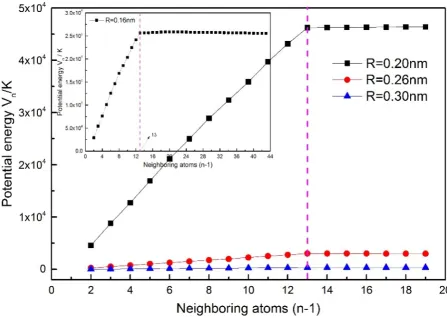
Using many-body expansion method, we calculate the total atomic potential energy and many-body potential energy of fcc solid Ne. The results show that the faster many-body expansion converge, the more the time for the calculation is saved. In addition, the calculated change of the total atomic potential energy with the increase of the neighboring atoms is shown in Fig.1. As evident from the figure, as long as the number of the neighboring atoms is enough, the total potential energy of solid Ne tends to a convergence value. The main contribution to the total potential energy comes from the potential energy between the central atom and 12 atoms of the first neighboring shell. When the atomic distance (R) decreases, we have to consider the effects of neighboring atoms of the second, third shells and higher shells. Taking the interaction between the central atom and 12 atoms of the first neighboring shell into account, we obtain accurate atomic potential at R=3.0Å, 2.6Å, 2.0Å. When R=1.6Å, the 6 atoms are needed to add to the second neighboring shell, the potential energy (Vn(M)) generally tends to a
Figure 1. The relation between potential energy and the number of neighboring atoms.
3.2. The Truncation and Convergence of Many-body Potential
The shortage of the expansion of the many-body potential is that it closely relates to the spatial location distribution of the central atom and its neighboring atoms. Considering the neighboring atoms of the first (n-1=12), second (n-1=6), and third shell (n-1=24), taking the atomic distance R=1.45 Å as an example, the total potential energy Vn(M) and each many-body potential
energy U2(M), U3(M), U4(M) of fcc solid Ne are listed in
Table 1. We obtain that the atomic distance becomes smaller as the increasing many-body terms for face-centered cubic (fcc) solid neon.
The potential energy of fcc solid neon tends to a certain value as the number of neighboring atoms increases. For a certain atomic distance R, with the
increasing number of the neighboring atoms, this is to say, the effects of the neighboring atoms of the second, third and higher shells are considered, the total atomic potential energy Vn(M) and many-body potential energy Un(M) of
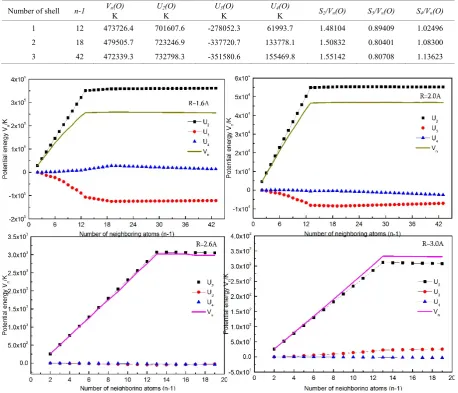
fcc solid Ne tend to a convergence value, as shown in Fig.2. We can see from the figure that, taking into account the interaction between the central atom and 12 atoms of the first neighboring shell, it can get an accurate atomic potential at R=2.6, 3.0Å, and Vn(M) and Un(M) tend to a
convergence value. While R=2.0Å, 6 atoms are added to the second neighboring shell and the potential energy
Vn(M) generally tend to a saturation value. When R=1.6Å,
42 atoms including 24 atoms of the third neighboring shell are considered, the four-body potential energy U4(M) and
[image:3.595.74.522.78.396.2]Table 1. The calculated total potential energy Vn(M)and each many-body potential energy U2(M), U3(M), U4(M)of fcc solid Ne at R=1.45Å, considering
the neighboring atoms (n-1) of the first, second, and third shells. Sk represent the sum of two- to k-body term in the series of many-body expansion (Sk=
U2+U3+U4+┄+Uk+┄).
Number of shell n-1 Vn(O)
K U2K (O) U3K (O) U4K (O) S2/Vn(O) S3/Vn(O) S4/Vn(O)
1 12 473726.4 701607.6 -278052.3 61993.7 1.48104 0.89409 1.02496 2 18 479505.7 723246.9 -337720.7 133778.1 1.50832 0.80401 1.08300 3 42 472339.3 732798.3 -351580.6 155469.8 1.55142 0.80708 1.13623
Figure 2. The variations of the atomic potential energy (Vn(M)) and its many-body potential energy (Un(M)) with the number of neighbouring atoms at
R=1.6, 2.0, 2.6, 3.0Å in fcc phase.
3.3. Many-body Contributions to the Cohesive Energy
Using ab initio Hartree-Fock self-consistent field method and Eq. (8), we calculate the two-, three- and four-body contributions to the cohesive energy of fcc solid
Ne as the atomic distance (R) in the range of 1.6Å to 3.0Å, as shown in Fig.3. The numerical results show that the even many-body contributions to the cohesive energy, such as two-, four-body terms and so on, are positive, whereas the odd many-body contributions to the cohesive energy, such as three-, five-body terms and so on, are negative. Only considering the two-body term, the curve of the two-body contribution to the cohesive energy E2
and the curve of the total cohesive energy E234 are not almost coincident at the larger range of R. When the three-body contribution to the cohesive energy E3 is
considered, the curve of the two- and three-body
contribution to the cohesive energy E23 and the curve of
the total cohesive energy E234 are almost coincident at the atomic distance R>1.8Å. This is to say, the three-body contribution to the cohesive energy E3 is very slight and it
can be ignored at the atomic distance R>1.8Å, but E3
plays an important role when R<1.8Å, and it can not be neglected in this range. Over a distance range of 1.60 to 1.80Å, the four-body contribution has to be included. In this work, the zero-point vibration energy Ezp [19] of solid
neon is very small which only is 6% of the many-body interaction energy, but should not be neglected.
3.4. Equation of State
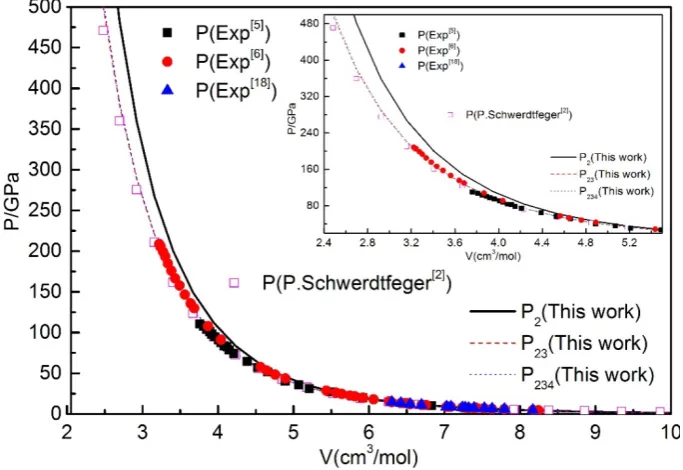
the experimental results [5, 6, 18], as shown in Fig.4. The results show that only taking the two-body term into account, our calculated results and the previous results [2, 5, 6, 18] are in good agreement with the experimental values at P<10GPa. Considering the two- and three-body terms, the calculated results and the experimental results have a good consistency at the high pressure range of
10-55GPa. Considering to the four-body term, it exhibits a good consistency at the experimentally studied pressure range of 0~237GPa. When P>237GPa, it needs to consider the effect of five- and higher-body terms, and maybe helpful to accurately explain the phenomenon of the experiment above 237GPa when the effect of five-body, six-body potential pressure are considered.
Figure 3. The two-, three- and four-body contributions to the cohesive energy in fcc solid Ne.
[image:5.595.105.491.173.438.2] [image:5.595.127.469.473.708.2]Acknowledgements
The research was sponsored by Chinese National Natural Science Foundation (11565018), Gansu province Department of Education fund item (2015B-109) and the Doctoral Scientific Fund Project of Longdong University (XYBY1601).
REFERENCES
[1] Pechenik E, Kelson I, Makov G. Phys Rev B., 2008, 78(13): 134109.
[2] Schwerdtfeger P, Hermann A. Phys Rev B., 2009, 80(6): 064106.
[3] Drummond N D, Needs R J. Phys Rev B., 2006, 73(2): 024107.
[4] Tsuchiya T, Kawamura K. J. Chem. Phys., 2002, 117: 1030.
[5] Hemley R J, et al. Phys Rev B., 1989, 39: 11820. [6] Dewaele A, et al. Phys Rev B., 2008, 77(9): 094106. [7] Takemura K, Watanuki T, Ohwada K, et al. Journal of
Physics., 2010, 215: 01201.
[8] Wu N, et al. Chinese Journal of High Physics., 2012, 26(1): 41-47.
[9] Aziz R A. High Temp High Press., 1980, 12: 565-577. [10]Aziz R A and Slaman M J.Chem. Phys.,1989, 130: 187. [11]Stawomir M. Cybulski, Rafal R. Toczylowski.J.Chem. Phys.,
1999, 111: 10520.
[12]Freiman Y A, Tretyak S M. Low Temp Phys., 2007, 33(6): 545-557.
[13]Loubeyre P. Phys Rev B.,1987, 37(10): 5432-5439. [14]CaiJ, HuXand ChenN.J. Phys. Chem., 2005,
66:1256-1263.
[15]Tian C L, et al. J. Phys.: Condens. Matter, 2006, 18: 8103.
[16]http://www.msg.ameslab.gov/gamess/.
[17]Tian C L, et al. Chin. Phys. Lett., 2003, 20: 706.
[18]Finger L W, et al. Appl Phys Lett., 1981, 39(11), 892-894.