Grey-correlation Multi-attribute Decision-making
Method Based on Intuitionistic Trapezoidal
Fuzzy Numbers
Ye-zhi Xiao
1,*, Sha Fu
21Department of Foreign Language, Hunan University of Finance and Economics, China 2Department of Information Management, Hunan University of Finance and Economics, China
Copyright © 2015 by authors, all rights reserved. Authors agree that this article remains permanently open access under the terms of the Creative Commons Attribution License 4.0 International License
Abstract
This study proposes a grey-correlation multi-attribute decision-making method based on intuitionistic trapezoidal fuzzy numbers to solve the problem that the attribute weight depends on the various statuses and the attribute values offer multi-attribute decision making in the form of intuitionistic trapezoidal fuzzy numbers. Firstly, this paper gives the definitions of intuitionistic trapezoidal fuzzy numbers, and the distance formula. Then, the grey-correlation coefficient about the intuitionistic trapezoidal fuzzy numbers is obtained through grey-correlation analysis. The correlation degree between different options is obtained through calculation based on the correlation coefficient. With that, the options are ranked based on the values to identify the optimal option. Finally, the result of analysis of examples demonstrates the feasibility and effectiveness of the proposed method.Keywords
Intuitionistic Trapezoidal Fuzzy Numbers, Grey-correlation Analysis, Multi-attribute Decision Making, Hamming Distance, Grey-correlation Coefficient1. Introduction
Since the fuzzy set theory was proposed by Zadeh [1] and applied to the multi-attribute decision making, related researches have seen rapid development. In 1986, K.T.Atanassov [2] proposed the concept of intuitionistic fuzzy sets based on the fuzzy set theory. This concept was mainly characterized by consideration of degree of membership, degree of non-membership and hesitancy degree at the same time, which could better reflect the information on three statuses of the participants, such as the certainty, denying degree and hesitancy degree. It can be more expressive than traditional fuzzy sets when it comes to processing of uncertain information. In recent years, the intuitionistic fuzzy set theory has been drawing great
attention in the academic circle and the engineering technical field. Its extended forms mainly include the interval-valued intuitionistic fuzzy sets (IVIFSs), triangular intuitionistic fuzzy numbers (TIFN) and intuitionistic trapezoidal fuzzy numbers (ITFN).
method enriches and develops theory and methods in the multi-attribute decision making problems, and provides a new path to solve the problems with intuitionistic trapezoidal fuzzy multi-attribute decision making that the attribute weights are in different decision-making statuses.
2. Preliminaries
2.1. Intuitionistic Trapezoidal Fuzzy Numbers
Definition 1: Assume the intuitionistic trapezoidal fuzzy numbers on the real number set are
a
~
=<
([
a
,
b
,
c
,
d
];
µ
~a),
([
a
′
,
b
,
c
,
d
′
];
ν
a~)
>
, and thenits membership degree function can be expressed as follows [12]:
≤
<
−
−
≤
≤
<
≤
−
−
=
otherwise
d
x
c
c
d
x
d
b
x
c
b
x
a
a
b
a
x
x
a a a a0
)
(
~ ~ ~ ~µ
µ
µ
µ
(1)The non-membership degree function should be:
′
≤
<
−
′
−
′
+
−
≤
≤
<
≤
′
′
−
′
−
+
−
=
otherwise
d
x
c
c
d
x
d
c
x
b
x
c
b
x
a
a
b
a
x
x
b
x
a a a a0
)
(
)
(
)
(
~ ~ ~~
ν
ν
ν
ν
(2)Fuzzy set [1] is treated as a generalization of the classical set theory where the membership functions are only treated by their belongings or not. In fuzzy set theory, this relaxation is overlapped with the condition that it allows the partial membership between 0 and 1 also. Where,
0
≤
µ
~a≤
1
,1
0
≤
ν
a~≤
,µ
a~+
ν
a~≤
1
. Whenb
=
c
, the intuitionistic trapezoidal fuzzy numbers are degraded into intuitionistic triangular fuzzy numbers; whena
=
a
′
andd
d
=
′
, the above intuitionistic trapezoidal fuzzy numbers can be written asa
~
=
([
a
,
b
,
c
,
d
];
µ
a~,
ν
a~)
. All numbers in this paper refer to such kind of fuzzy numbers.µ
a~ anda
~
ν
are respectively the maximum membership degree and the minimum non-membership degree.)
(
)
(
1
)
(
~ ~~
x
ax
ax
a
=
−
µ
−
ν
π
is the hesitancy function ofa
~
. A smaller value indicates a more ascertained fuzzynumber.
Definition 2: Assume
a
~
1=
([
a
1,
b
1,
c
1,
d
1];
µ
~a1,
ν
~a1)
anda
~
2=
([
a
2,
b
2,
c
2,
d
2];
µ
a~2,
ν
~a2)
are two intuitionistic trapezoidal fuzzy numbers, then [13]:1)
)
,
];
,
,
,
([
~
~
2 1 21 ~ ~ ~
~ 2 1 2 1 2 1 2 1 2 1 a a a a
d
d
c
c
b
b
a
a
a
a
ν
ν
µ
µ
∧
∨
+
+
+
+
=
+
, where, symbols∧
and∨
respectively indicate the operation of taking the smaller value or the greater value through comparison between two.2)
a
~
1a
~
2=
([
a
1a
2,
b
1b
2,
c
1c
2,
d
1d
2];
µ
~a1∧
µ
~a2,
ν
a~1∨
ν
a~2)
;3) If
λ
≥
0
, λa~1=([λa1,λb1,λc1,λd1];µa~1,νa~1); Ifλ
<
0
,λ
a
~
1=
([
λ
d
1,
λ
c
1,
λ
b
1,
λ
a
1];
µ
a~1,
ν
a~1)
;4)
a
~
1λ=
([
a
1λ,
b
1λ,
c
1λ,
d
1λ];
µ
a~1,
ν
a~1)
,λ
≥
0
Definition 3: Assume
a
~
1=
([
a
1,
b
1,
c
1,
d
1];
µ
~a1,
ν
~a1)
anda
~
2=
([
a
2,
b
2,
c
2,
d
2];
µ
a~2,
ν
~a2)
are two intuitionistic trapezoidal fuzzy numbers. The Hamming distance and Euclidean distance of fuzzy numbers~
a
1 anda
~
2 are respectively as follows based on definition of Hausdorff distance [14]:|}
|
|,
max{|
|)
|
|
|
|
|
|
(|
4
1
)
~
,
~
(
2 1 21 ~ ~ ~
~ 2 1 2 1 2 1 2 1 2 1 a a a a h
d
d
c
c
b
b
a
a
a
a
d
ν
ν
µ
µ
−
−
+
+
−
+
−
+
−
+
−
=
(3) 2 1 2 ~ ~ 2 ~ ~ 2 2 1 2 2 1 2 2 1 2 2 1 2 1 }) | |, | max{| ) ( ) ( ) ( ) (( 2 1 ) ~ , ~ ( 2 1 21 a a a
a e d d c c b b a a a a d
ν
ν
µ
µ
− −+ + − + − + − + − = (4)
If
µ
1=
µ
2=
1
,ν
1=ν
2=
0
, then the intuitionistic trapezoidal fuzzy numbersa
~
1anda
~
2 are degraded into trapezoidal fuzzy numbers. Therefore, Formulas (3) and (4) are both degraded into the Hamming distance and Euclidean distance of trapezoidal fuzzy numbers.2.2. Grey-correlation Analysis Method
3. Decision Making Methods
3.1. Problem Description
For a certain fuzzy multi-attribute decision making problem, assume the scheme set is
A
=
{
A
1,
A
2,
,
A
m}
, the attribute set isC
=
{
C
1,
C
2,
,
C
n}
, the weight sector of attributes isw
=
{
w
1,
w
2,
,
w
n}
andw
j≥
0
and1
1
=
∑
= n
j j
w
. The attribute value of SchemeA
i underAttribute
C
j can be expressed using the intuitionistictrapezoidal fuzzy numbers as follows:
)) ( ), ( )]; ( ), ( ), ( ), ( ([ ~
4 3 2
1j i j i j i j i j i j i
ij h a h a h a h a a a
a = µ ν . In
particular,
µ
j(
a
i)
andν
j(
a
i)
respectively indicate the satisfaction degree or dissatisfaction degreea
~
ij about the evaluation values of SchemeA
i under AttributeC
j, and1 ) (
0≤µj ai ≤ , 0≤νj(ai)≤1 and µj(ai)+νj(ai)≤1.
3.2. Steps of Algorithm
The discussion in this study is based on the grey-correlation analysis method based on ITFN multi-attribute decision making problems. The specific steps are as follows:
Step 1 Offer the intuitionistic trapezoidal fuzzy number evaluation value of each scheme under each attribute, and build its decision making matrix
A
~
=
(
a
~
ij)
m×n.Step 2 Standardized processing of the decision making matrix: To remove the impact of different dimensions on the result of decision making between attributes, the calculating formula of standardized fuzzy decision making matrix can be used to convert the intuitionistic trapezoidal fuzzy number decision making matrix
A
~
into a standardized decision making matrixR
~
=
(
r
~
ij)
m×n , where)) ( ), ( )]; ( ), ( ), ( ), ( ([ ~
4 3 2
1j i j i j i j i j i j i
ij r a r a r a r a a a
r = µ ν .
When it comes to multi-attribute decision making, the common attribute types include the benefit type and the cost type. A greater benefit type attribute value indicates a better condition; and a smaller cost type attribute value also indicates a better condition. The method to build a standardized intuitionistic trapezoidal fuzzy number decision making matrix is as follows:
For benefit type attributes:
))
(
(
min
))
(
(
max
))
(
(
min
)
(
)
(
1 4
1
i j j i j j
i j j i lj i
lj
h
a
h
a
a
h
a
h
a
r
=
−
−
(5)For cost type attributes:
))
(
(
min
))
(
(
max
)
(
))
(
(
max
)
(
1 4
4
i j j i j j
i lj i j j i
lj
h
a
h
a
a
h
a
h
a
r
−
−
=
(6)Where,
i
=
1
,
2
,
,
m
;j
=
1
,
2
,
,
n
;l
=
1
,
2
,
,
4
.Step 3 Determine the reference number series and define the reference number series as follows:
)
,
,
,
(
01 02 00
r
r
r
nR
=
(7)Where,
r
0j=
([
1
1,
1,
1,
];
1
,
0
)
Step 4 Calculate the Hamming distance
σ
ij between two related elements of standardized attribute value number series and reference number series based on Definition 3.|}
0
)
(
|
|,
1
)
(
max{|
|)
1
)
(
|
|
1
)
(
|
|
1
)
(
|
|
1
)
(
(|
4
1
4
3 2
1
−
−
+
−
+
+
−
+
−
+
−
=
i j i
j i
j
i j i
j i
j ij
a
a
a
r
a
r
a
r
a
r
ν
µ
σ
(8)Step 5 Calculate the maximum value
σ
max and minimum valueσ
min of Hamming distance.ij j
i
σ
σ
,
max
=
max
,σ
min=
min
i,jσ
ij (9)Step 6 Calculate the grey correlation coefficient
ε
ij between the reference number series and each optional scheme attribute value number series. Obtain the grey-correlation coefficient matrix(
ε
ij)
m×n.max max min
λσ
σ
λσ
σ
ε
+
+
=
ij
ij (10)
Where,
λ
is the resolution factor; a smaller value ofλ
indicates a greater resolution capacity. The value ofλ
is generally 0.5.Step 7 Calculate the correlation degree
r
i between the reference number series and each optional scheme attribute value number series under different decision making statuses.m
i ij j
i 1 r = ε •w
=
∑
(11) In the Formula, considering the variable-weight multi-attribute decision making theory of the correlated intuitionistic trapezoidal fuzzy numbers, the weight vectorj
Step 8 Rank the optional schemes based on the correlation degree values under different decision making statuses. A greater correlation degree value indicates a better scheme. This way, the optimal scheme can be identified.
4. Analysis of Examples
A company selects 3 enterprises in the same industry }
, ,
{A1 A2 A3 to improve its market competitiveness by
partnering with the optimal enterprise. The company hired experts to evaluate those 3 enterprises in terms of 3 index attributes, namely, production capacity
C
1, R&D capacity2
C
and capital turnover capacityC
3, with all attributes being of the benefit type [16]. The intuitionistic trapezoidalfuzzy numbers decision making matrix of the schemes provided by the experts is shown in Table 1. Please find out the optimal partner enterprise. During determination of the optimal partner enterprise, the decision making method proposed in this study can be used as follows:
Table 1. Intuitionistic Trapezoidal Fuzzy Number Decision-making Matrix ) 2 . 0 , 7 . 0 ]; 6 , 4 , 2 ,1 ([ ) 2 . 0 , 6 . 0 ]; 8 , 5 ,3 ,1 ([ ) 2 . 0 , 7 . 0 ]; 6 , 4 ,3 , 2 ([ ) 2 . 0 , 7 . 0 ]; 7 , 6 , 4 ,3 ([ ) 4 . 0 , 5 . 0 ]; 8 , 6 , 4 ,3 ([ ) 0 . 0 , 8 . 0 ]; 4 ,3 , 2 ,1 ([ ) 1 . 0 , 7 . 0 ]; 7 , 5 , 4 , 2 ([ ) 2 . 0 , 8 . 0 ]; 5 , 4 ,3 , 2 ([ ) 4 . 0 , 5 . 0 ]; 8 , 6 , 5 ,3 ([ Scheme 3 2 1 3 2 1 A A A C C C
1) Based on Step 2, standardize Table 1. The result is shown in Table 2.
Table 2. Standardized Decision-making Matrix
) 2 . 0 , 7 . 0 ]; 833 . 0 , 500 . 0 , 167 . 0 , 000 . 0 ([ ) 2 . 0 , 6 . 0 ]; 000 . 1 , 571 . 0 , 286 . 0 , 000 . 0 ([ ) 2 . 0 , 7 . 0 ]; 714 . 0 , 429 . 0 , 286 . 0 , 143 . 0 ([ ) 2 . 0 , 7 . 0 ]; 000 . 1 , 833 . 0 , 500 . 0 , 333 . 0 ([ ) 4 . 0 , 5 . 0 ]; 000 . 1 , 714 . 0 , 429 . 0 , 286 . 0 ([ ) 0 . 0 , 8 . 0 ]; 429 . 0 , 286 . 0 , 143 . 0 , 000 . 0 ([ ) 1 . 0 , 7 . 0 ]; 000 . 1 , 667 . 0 , 500 . 0 , 167 . 0 ([ ) 2 . 0 , 8 . 0 ]; 571 . 0 , 429 . 0 , 286 . 0 , 143 . 0 ([ ) 4 . 0 , 5 . 0 ]; 000 . 1 , 714 . 0 , 571 . 0 , 286 . 0 ([ Scheme 3 2 1 3 2 1 A A A C C C
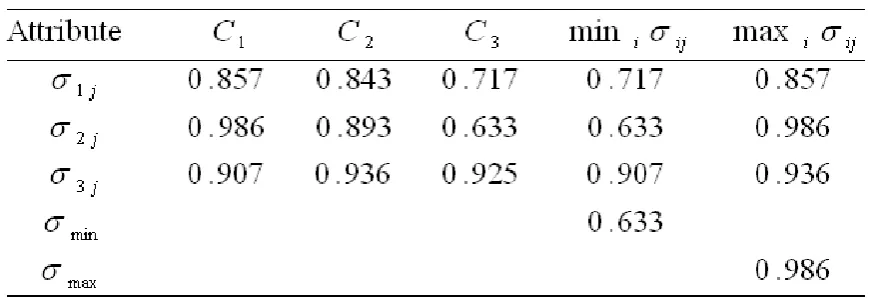
[image:4.595.87.522.413.562.2]2) Calculate the Hamming distance between the optional schemes and reference number series based on Step 4. The results are shown in Table 3.
Table 3. Distances between Each Scheme and Reference Number Series
[image:4.595.89.521.620.740.2]3) Calculate the grey correlation coefficient according to Step 6 to obtain the grey correlation coefficient matrix as shown in Table 4.
4) Take a proper coefficient of balance using the solution to the single-object optimal model based on data in analysis of examples in Reference [16], with the fact that the 3 objective functions are in a fair competition, so as to obtain the weight of each attribute under different decision making statuses as shown in Table 5.
Table 5. Weight of Each Attribute under Different Decision Making Statuses
336
.
0
420
.
0
173
.
0
376
.
0
472
.
0
359
.
0
233
.
0
209
.
0
346
.
0
3
2
1
3
2
1
α
α
α
C
C
C
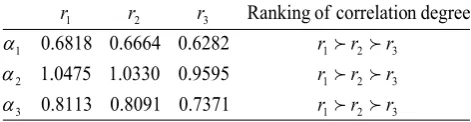
5) Calculate the correlation degree of each scheme under different decision making statuses based on Step 7. The result is shown in Table 6.
Table 6. Correlation Degree under Different Decision Making Statuses and the Ranking Results
3 2 1 3
3 2 1 2
3 2 1 1
3 2
1
7371 . 0 8091 . 0 8113 . 0
9595 . 0 0330 . 1 0475 . 1
6282 . 0 6664 . 0 6818 . 0
degree n correlatio of
Ranking
r r r
r r r
r r r r
r r
α α α
With that, the ranking result of the schemes is as follows 3
2
1
A
A
A
. Therefore, the optimal partner enterprise should beA
1. Based on the specific steps and process, the method proposed in this study takes the attribute weight in different decision-making statuses into consideration. In practical application, for many complicated decision making problems, decision-making information in different statuses is really exist, it is consistent with the reality. References [7-8] does not take the change or different of decision-making information in different decision-making statuses into consideration, does not comply with the fact. Furthermore, the proposed method is practical and has good operability, it is worth to promote in multi-attribute decision making fields.5. Conclusions
This study proposed a grey-correlation multi-decision making method based on intuitionistic trapezoidal fuzzy numbers through probing into the multi-attribute decision making problems with the evaluation information being the intuitionistic trapezoidal fuzzy numbers. In addition, it also described the realization steps in details and demonstrated the reasonability of this method via analysis of examples.
The decision making method proposed in this study boasts advantages such as clear logic, simple calculating process and reader friendliness. In addition, this method also enjoys high application, promotion and practical decision making values, and can be applied to related decision making fields such as selection of supply chains, project evaluation, investment decision making and assessment of economic benefit.
Acknowledgements
This study was supported by the Scientific Research Fund of Hunan Provincial Education Department (No. 14C0184), by the Hunan Province Philosophy and Social Science Foundation (No. 14YBA065).
REFERENCES
[1] Zadeh L A, “Fuzzy sets”, Information and Control, vol. 8, no. 3, pp. 338-356, 1965.
[2] Atanassov K T, “Intuitionistic fuzzy sets”, Fuzzy Sets and Systems, vol. 20, no. 1, pp. 87-96, August 1986.
[3] Atanassov K T, “More on intuitionistic fuzzy sets”, Fuzzy Sets and Systems, vol. 33, no. 1, pp. 37-45, October 1989. [4] Atanassov K T, “Operators over interval-valued
intuitionistic fuzzy sets”, Fuzzy Sets and Systems, vol. 64, no. 2, pp. 159-174, June 1994.
[5] Xu Z S, “Models for multiple attribute decision-making with intuitionistic fuzzy information”, Int J of Uncertainty, Fuzziness and Knowledge-Based Systems, vol. 15, no. 3, pp. 285-297, 2007.
[6] P. Jayagowri, G. Geetharamani, "A Critical Path Problem Using Intuitionistic Trapezoidal Fuzzy Number", Applied Mathematical Sciences, vol. 8, no. 52, pp. 2555-2562, 2014. [7] Wan Shu-ping, Dong Jiu-ying, “Method of intuitionistic
trapezoidal fuzzy number for multi-attribute group decision”, Control and Decision, vol. 25, no. 5, pp. 773-776, May 2010.
[8] Wang Jian-qiang, Zhang Zhong, "Multi-criteria decision-making method with incomplete certain information based on intuitionistic fuzzy number", Control and Decision, vol. 24, no. 2, pp. 226-230, February 2009. [9] Wang Jian-qiang, Zhang Zhong, “Aggregation operators on
intuitionistic trapezoidal fuzzy number and its application to multi-criteria decision making problems”. Journal of Systems Engineering and Electronics, vol. 20, no. 2, pp. 321-326, April 2009.
[10] Wang Jian-qiang, Nie Rong-rong, “Multi-criteria group decision-making method based on intuitionistic trapezoidal fuzzy information”, Systems Engineering-Theory & Practice, vol. 32, no. 8, pp. 1747-1753, August 2012. [11] Wan Shu-ping, Zhang Xiao-lu, “Method based on weighted
[image:5.595.59.295.393.454.2]intuitionistic trapezoidal fuzzy numbers”, Control and Decision, vol. 27, no. 8, pp. 1121-1126,1132, August 2012. [12] A.K. Shaw, T.K. Roy, "Trapezoidal intuitionistic fuzzy
number with some arithmetic operations and its application on reliability evaluation", International Journal of Mathematics in Operational Research, vol. 5, no. 1, pp. 55-73, January 2013.
[13] Wan Shu-ping, Zhang Xiao-lu, Li Deng-feng, “Possibility mean-variance based method for intuitionistic trapezoidal fuzzy group decision making”, Journal of Systems Engineering, vol. 27, no. 6, pp. 782-788, December 2012. [14] Przemysław Grzegorzewski, “Distances between
intuitionistic fuzzy sets and/or interval-valued fuzzy sets based on the Hausdorff metric”, Fuzzy Sets and Systems, vol. 148, no. 2, pp. 319-328, December 2004.
[15] Liu Si-feng, Dang Yao-guo, Fang Zhi-geng. Grey System Theory and its Applications, Beijing: Science Press, 2008 [16] Gao Yan, Zhou De-qun, Zhang Ling, “Multi-attribute
Decision Making with Variable Weight Relationship Based on Intuitionistic Trapezoidal Fuzzy Number”, Systems Engineering, vol. 29, no. 5, pp. 102-107, May 2011. [17] Harish Garg, Nikunj Agarwal, Alka Choubey, “Entropy
Based Multi-criteria Decision Making Method under Fuzzy Environment and Unknown Attribute Weights”, Global Journal of Technology and Optimization, vol. 6, no. 3, pp. 13-20, 2015.