Transformational changes and
sustainability : from the perspective of
identity, trust, commitment, and
withdrawal
Malik, A, Akhtar, MN, Talat, U and Chang, K
http://dx.doi.org/10.3390/su11113159
Title
Transformational changes and sustainability : from the perspective of
identity, trust, commitment, and withdrawal
Authors
Malik, A, Akhtar, MN, Talat, U and Chang, K
Type
Article
URL
This version is available at: http://usir.salford.ac.uk/id/eprint/51463/
Published Date
2019
USIR is a digital collection of the research output of the University of Salford. Where copyright
permits, full text material held in the repository is made freely available online and can be read,
downloaded and copied for noncommercial private study or research purposes. Please check the
manuscript for any further copyright restrictions.
Article
Transformational Changes and Sustainability:
From the Perspective of Identity, Trust, Commitment,
and Withdrawal
Ambreen Malik1 , Muhammad Naseer Akhtar1,* , Usman Talat2and Kirk Chang3,4
1 NUST Business School, National University of Sciences & Technology, Islamabad 44000, Pakistan;
2 Warwick Business School, University of Warwick, Coventry CV4 7AL, UK; [email protected]
3 Salford Business School, University of Salford, Manchester M5 4WT, UK; [email protected]
4 Fudan Development Institute, Fudan University, Shanghai 200086, China
* Correspondence: [email protected]
Received: 25 March 2019; Accepted: 31 May 2019; Published: 5 June 2019
Abstract:Drawing upon the psychology of sustainability, effective organizations can create a sense of belongingness for people, and successfully facilitate growth and development activities for both individuals as well as the organization itself. Extending the recommendations of Zappala, Toscano, and Licciardello, the current study considers a range of variables. The role of overall justice judgements and change favorableness are taken as predictors of affective commitment to change and exit-based withdrawal. The relationship is mediated by organizational identification and moderated by trust in organization. Overall, the results support the hypothesized relationships. Specifically, findings showed that both change favorableness and overall justice judgements are positively related to affective commitment to change and negatively related to exit-based withdrawal. Organizational identification mediates the relationships between overall justice judgements–affective commitment to change, change favorableness–affective commitment to change, and change favorableness–exit-based withdrawal, whilst trust in organizations moderated the direct relationship between overall justice judgements–affective commitment to change, and change favorableness–exit-based withdrawal. Furthermore, the indirect effect of trust in organizations positively moderated the relationship of overall justice judgements and change favorableness with affective commitment to change, and at the same time, it negatively moderated the relationship between change favorableness and exit-based withdrawal via organizational identification. Crucially, for practitioners, this brings trust of employees as a key factor that should be managed to ensure sustainable change. Both trust and identity appear important in improving commitment and lowering the exit-based withdrawal behavior of employees. Future recommendations, implications, and limitations are discussed.
Keywords: affective commitment to change; exit-based withdrawal; overall justice judgements; trust in organization; organizational identification; change favorableness; transformational changes
1. Introduction
In the past decade, globalization has exerted considerable influence over financial markets and their international growth. This has created pressure, volatility, and competition across markets [1]. In parallel, the ensuing dynamics of decentralization, digitization, and diversity of financial markets, as well as the intensification of competitive forces, have characterized international banking and trade [2]. Amidst financial crisis, including the 2008 downturn as well as more recent Brexit plans involving the U.K. and EU, banks and other financial institutions have become insecure and have begun re-evaluating their strategy for their corporate sustainability. In doing so, organizations have to play a positive
role in their contribution towards the important factors of the society, i.e., economy, environment, and the social actors (people). Over the past two decades, scholars have paid considerable focus on the significance of sustainable change interventions. Many are considering the prospect of forging alliances with industry partners internationally through adaptive change.
Crucially, over this period, we have seen a surge in major organizational changes, such as merger and acquisitions, change in leadership, change in (HR) human resource policies, cultural changes, and the introduction of advanced technologies [3]. At their core, what major/transformational organizational changes represent are sets of organization-wide modifications aimed at improving capability [4]. This includes people’s commitment for sustainable changes in the face of ecology, equity, and economy [5]. However, most transformational changes are not sustainable and tend to fail.
Often major changes are not satisfactorily understood by key actors and therefore they fail to garner enough support, both politically and socio-economically [6,7]. Studies conclude that as a type of significant change that influences the diversity of social actors in the marketplace, the dynamics of major changes should be sensitive to employee commitment, such that projects earn the support and are completed in a timely manner. It follows that without committed employees, major organizational changes tend to fail [8]. Modern organizations have started paying more attention to the employees’ subjective reasons for commitment to the organization [9]. Alongside economic and environmental dimensions, strategic management for better social dynamics has become a pivotal part of organizational sustainability [10]. Specifically, scholars have pointed out affective commitment to change as a key driver in achieving sustainability through major changes. Affective commitment to change is defined as “a process of binding the employees’ mindset with a particular course of action deemed central for the implementation and success of change projects” [11].
Change management scholars have discussed a host of important predictors related to commitment [12]. Amongst these, in the context of transformational changes, a significant role is played by justice judgements [13–15], organizational identification [16,17], and trust in organization [18]. From a macro perspective, these predictors emerge when organizations attempt to cope with intensifying and threatening market conditions. Coping is mobilized by internal structural changes, including downsizing, job re-design, moderations in HR policy, the adoption of new technologies, and the crucial use of merger and acquisitions [19]. Such internal rearrangements are known as transformational changes, with the potential to impact affective commitment to change. The current study builds on the group engagement model (GEM) [13] which posits a framework whereby overall justice judgements and change favorableness are antecedents to affective commitment to change. This is mediated by organizational identification reflected in a study by Soenen et al. [7].
The present study is important in several ways. In terms of theoretical contribution, it provides a new perspective by adding the constructs oftrust in organizationsandexit-based withdrawalto the debate, offered by the integrative framework of Soenen et al. [7]. In capitalizing upon the psychology of sustainability, the repercussions for major organizational changes are studied at the micro level, i.e., ‘employee’ [5]. Extending this, we argue that employees with better overall justice judgments and change favorableness are affectively committed to change. They also have lower exit-based withdrawal intentions when they identify themselves with the organization. Furthermore, we analyze the moderating role of trust in organization, i.e., how trust in the integrity of organization acts as a situational factor in promoting affective commitment to change and curbing exit-based withdrawal behavior of employees.
1.1. Organizational Identification, and Affective Commitment to Change
Employees who commit to change endorse a particular logic and worldview. The greater the employee’s endorsement, the higher the likelihood that concerned actions are internalized and implemented [20]. In this process, affect can positively or negatively strengthen commitment to change, with implications for how well employees work together.
Affect associated with commitment enables identification with the organization and in certain scenarios correlates positively with performance. In the milieu of major organizational changes, little remains are known about the driving psychological forces underpinning the employees’ affective commitment [7,21]. Following the group engagement model (GEM), we theorize that affective commitment to change depends on a sense of justice being delivered and change favorableness—mediated by the notion of organizational identification and moderated by trust in the organization. Our review of the field supports the hypothesis that organizational identification is positively related to affective commitment to change. Historically, the notion of organizational identification has been studied for decades [22,23]. The concept of organizational identification is defined by Conroy et al. [24] as “an individual’s perception of oneness with his or her organization”. Studies associate positive outcomes with organizational identification, such as reduced turnover intention [25] and greater job satisfaction [26].
Studies also associate negative outcomes with organizational identification, such as the tendency to over-work [27], as well as to partake in unethical behavior [28], and resistance to change [29]. Though studies have linked organizational identification with affective commitment to change [30], little attention is given to causality between these two variables [31,32]. The rationale we explore is that a greater organizational identification will lead to greater affective commitment to change. Both psychological processes draw the individual to the organization [33]. Thus, a context that changes the organization is likely to influence these variables in terms of their relationship. Therefore, we propose the following hypothesis:
Hypothesis 1.Organizational identification is positively related to affective commitment to change.
1.2. Organizational Identification and Exit-Based Withdrawal
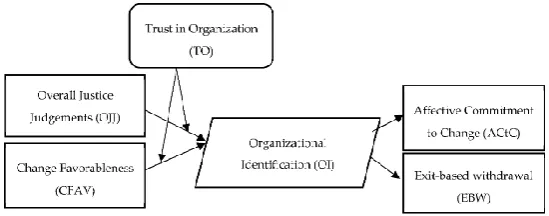
In the context of transformational change, our study adds the outcome of exit-based withdrawal following organizational identification. This stands alongside affective commitment to change (Figure1). Research has identified links between the two constructs. Specifically, Van Knippenberg et al. [26] found a negative relationship between organizational identification and withdrawal from the job. However, this was conducted with an emphasis on poverty as a barrier. Prior to this, a few decades earlier, the notion of exit-based withdrawal was suggested by Hirschmann [34] and Farrell [35]. Exit is one of four theoretical categories underpinning diverse organizational behaviors, including turnover intention, requesting a transfer, and absenteeism, amongst others [35,36]. Thus, it constitutes a threat to the sustainability of major organizational changes. Exit is defined as “equivalent to voluntary separation or turnover from the job” [35].
Sustainability 2019, 11, x FOR PEER REVIEW 3 of 21
1.1. Organizational Identification, and Affective Commitment to Change
Employees who commit to change endorse a particular logic and worldview. The greater the employee’s endorsement, the higher the likelihood that concerned actions are internalized and implemented [20]. In this process, affect can positively or negatively strengthen commitment to change, with implications for how well employees work together.
Affect associated with commitment enables identification with the organization and in certain scenarios correlates positively with performance. In the milieu of major organizational changes, little remains are known about the driving psychological forces underpinning the employees’ affective commitment [7,21]. Following the group engagement model (GEM), we theorize that affective commitment to change depends on a sense of justice being delivered and change favorableness— mediated by the notion of organizational identification and moderated by trust in the organization. Our review of the field supports the hypothesis that organizational identification is positively related to affective commitment to change. Historically, the notion of organizational identification has been studied for decades [22,23]. The concept of organizational identification is defined by Conroy et al. [24] as “an individual’s perception of oneness with his or her organization”. Studies associate positive outcomes with organizational identification, such as reduced turnover intention [25] and greater job satisfaction [26].
Studies also associate negative outcomes with organizational identification, such as the tendency to over-work [27], as well as to partake in unethical behavior [28], and resistance to change [29]. Though studies have linked organizational identification with affective commitment to change [30], little attention is given to causality between these two variables [31,32]. The rationale we explore is that a greater organizational identification will lead to greater affective commitment to change. Both psychological processes draw the individual to the organization [33]. Thus, a context that changes the organization is likely to influence these variables in terms of their relationship. Therefore, we propose the following hypothesis:
Hypothesis 1. Organizational identification is positively related to affective commitment to change.
1.2. Organizational Identification and Exit-Based Withdrawal
[image:4.595.160.435.634.742.2]In the context of transformational change, our study adds the outcome of exit-based withdrawal following organizational identification. This stands alongside affective commitment to change (Figure 1). Research has identified links between the two constructs. Specifically, Van Knippenberg et al. [26] found a negative relationship between organizational identification and withdrawal from the job. However, this was conducted with an emphasis on poverty as a barrier. Prior to this, a few decades earlier, the notion of exit-based withdrawal was suggested by Hirschmann [34] and Farrell [35]. Exit is one of four theoretical categories underpinning diverse organizational behaviors, including turnover intention, requesting a transfer, and absenteeism, amongst others [35,36]. Thus, it constitutes a threat to the sustainability of major organizational changes. Exit is defined as “equivalent to voluntary separation or turnover from the job” [35].
Figure 1. Theoretical framework.
It is argued that greater identification with one’s workplace will lead to an attachment that would reduce the chances of exit-based withdrawal. This enables the retention of potentially valuable human capital for the purpose of competitive advantage [33]. The notion of exit has also been applied at macro scales to organizations and their withdrawal from, for instance, a supplier [37]. In the developing country context, Fennell and Malik [38] examined exit and voice options for poor households as customers in the education sector and with little option to withdraw from a deteriorating public good. This suggests that in such markets the behavior of organizational actors remains susceptible to barriers, for example, inability to withdraw from a position in the context of poverty and therefore having limited alternative options [28]. This also suggests that in studying organizational identification behavior, poverty might be a barrier for an inverse relationship with exit-based withdrawal. Specifically, an organizational actor who poorly identifies with the organization may not be able to exit because of economic hardships and social stigma. Nasir and Bashir [39] recognize the financial pressures that Pakistani workers face. We contend that the inverse relationship between organizational identification and exit-based withdrawal may not be straightforward in the case of Pakistan and its context of poverty. We conclude the following hypothesis:
Hypothesis 2.Organizational identification is negatively related to exit-based withdrawal.
1.3. The Mediating Role of Organizational Identification
Our review and theoretical model places organizational identification at the center of the organizational actor’s behavior during major organizational changes. Studies have tested a variety of organizational behaviors in terms of the mediating power of organizational identification. De Cremer [40] shows that procedural justice and counterproductive feelings of disappointment are mediated by identification with the organization. Umphress et al. [28] found the mediating influence of organizational identification between transformational leadership and unethical pro-organization behavior.
Our review below found that overall justice judgements and change favorableness relate with affective commitment to change through the mediating influence of organizational identification. Soenen et al. [7] noted that whilst literature associated with group engagement model offers different types of justice constructs—including distributive, procedural, informational, and interpersonal—comparatively less is known about overall justice judgements. This latter construct is defined as the individuals’ overall perceptions about the fairness of an entity (such as that of their organization). It includes personal experiences and knowledge of how others have been treated [7,41–43]. We asked whether participants in these overall justice judgements studies were from developing countries. Asking this acted as motivation for our study into the dynamics and applicability of these notions in the developing-country context, i.e., in Pakistan.
Hypothesis 3a.Overall justice judgements predicts affective commitment to change mediated by organizational identification.
In research circles, Soenen et al. [7] have examined the poorly researched concept of overall justice judgements in association with organizational identification. Adding to this, we found that during major organizational changes, such as merger and acquisitions, employees riddled with identity concerns can choose to exit their organization. Research implies the role of justice at work, which is associated with the choices to stay at the organization or exit it. Dissatisfactory feelings regarding fair treatment associated with a sense of hardship can induce an employee’s intention to leave [35]. The model by Hirschman [34] suggests that employees, who have no voice in major organizational change projects exit the organization. Concurrently, evaluations of unjust treatment that involves dis-identification with the organization may thus culminate into exit-based withdrawal behavior, along with affective responses about change projects, processes, and discursive practices [49]. Given Pakistan’s developing country context, economic hardships and limitations, variables of overall justice judgements, change favorableness, and organizational identification may not necessarily culminate into exit-based withdrawal. Thus, we propose the following hypothesis:
Hypothesis 3b.Overall justice judgements predict exit-based withdrawal mediated by organizational identification. Our fourth hypothesis introduces change favorableness. Specifically, based on our review, we propose two sub-hypotheses that examine the impact of change favorableness on both affective commitments to change and exit-based withdrawal mediated by organizational identification in a change context. In addition to overall justice judgements, our study included change favorableness as an antecedent variable. The change favorableness construct is identified through the group engagement model as a positive perception of organizational change [13]. This is predicated on the extent to which the employee feels that there is a gain or economic benefit following from change projects [7]. Similarly, the concept of change favorableness is identified as “the degree to which individuals see themselves as better offas a result of change” [50]. They point out that valence, the positivity or negativity associated with change, dictates the extent to which the individual takes favor with change projects. We adopt the notion of change favorableness as an attitude, manifest in behavior, which to an extent favors change.
Insofar as change favorableness involves an attitude to respond to change, the employee is moved in affective ways to commit or deny encountered projects [51]. In developing an attitude towards change projects, the individual emotionally identifies with aspects of the project that warrant the commitment to act. This signals an emotional contagion that binds employees to either favor or to reject the change insofar as one identifies and thus commits to the environmental demands [52]. Overall, change favorableness seems to influence affective commitments to change with a role for identification with the organization. Studies that research merger and acquisitions activity place organizational identification as a significant variable in driving attitudes about change, as well as correlating reactions such as the decision to support a change project [26]. Therefore, we hypothesize that
Hypothesis 4a.Change favorableness predicts affective commitment to change through the mediating role of organizational identification.
one’s organization and its evolving dynamic during change activity can alienate employees who feel a sense of silence and disappointment, only to subsequently leave the organization [34]. Hence, we propose the following hypothesis:
Hypothesis 4b.Change favorableness predicts exit-based withdrawal through the mediating role of organizational identification.
Thus far, our review has demonstrated a case for a range of hypotheses that configure into a model (see Figure1).
1.4. The Moderating Effect of Trust
The last hypothesis we propose draws on debates that discuss the construct of trust. The notion of trust is crucial in the context of different types of organizational change projects. We locate trust as a moderator between independent variables overall justice judgements and change favorableness, and the mediating variable organizational identification. This provides a bridge to the outcome variables of affective commitment to change and exit-based withdrawal. Historically, trust is a widely researched construct that still remains contentious [53,54]. Thus, an explicit definition is important. Kong et al. [55] draw on Rousseau et al. [56] to define trust as “the intention to accept vulnerability based upon positive expectations of the intentions or behavior of another”.
Whilst overall, links between justice and trust are scarcely researched [57], some studies have recently investigated this. Kaltiainen et al. [58] examined employee perceptions of justice and cognitive trust in top management during organizational change. They found that perceptions of justice positively correlate with employee feelings of trust in others. This influence was bi-directional and reciprocal. Studies also suggest that trust is crucial because it is a relational mechanism, which organizational change projects tend to disturb [59]. As change initiatives dismantle legacy systems and routines, employees who identify with such systems can experience varying levels of trust in senior management. In this context, a sense of injustice can settle in and affect feelings of commitment.
During organizational change, an employee’s sense of justice can depend on trust in authority figures, as well as the degree to which they identify with the organization [59–62]. Positively correlating outcomes may include affective commitment to change and exit-based withdrawal; however, this case in the developing country context of Pakistan remains unknown. We have limited knowledge in this regard. For instance, Iqbal and Ahmad [63] advanced the argument that organizational justice—a tripartite construct of distributive, interactional, and procedural justice—correlates significantly with organizational commitment through the mediating role of trust. This takes a looser viewpoint compared with our study that specifically looks at overall justice judgment studied by Soenen et al. [7]. That is, Iqbal and Ahmad [63] suggest a generic-level confirmation about the presence and influence of trust in relation to commitment. More broadly, in the larger spectrum of eastern countries, a study that involved hotel stafffrom Turkey reported the significant and positive influence of justice and trust on affective commitment [64]. Another study that involved employees from Hong Kong reported that justice (procedural and distributive) contributed to the employee’s commitment [65]. However, the construct of overall justice judgements remains scarcely understood.
one’s organization during change may be correlated with the strength of identification with one’s organization. However, given the developing country context of Pakistan and economic hardships faced by employees, exit-based withdrawal may be contingent on more than just non-pecuniary considerations such as organizational identification. The employee may value trust as a safety net for securing employment prospects. Thus, we propose the following hypothesis to account for the moderating influence of trust:
Hypothesis 5. The relationships of overall justice judgements and change favorableness with affective commitment to change and exit-based withdrawal via organizational identification is moderated by trust in organization. The higher the trust, the higher the affective commitment to change will be and the lower the exit-based withdrawal behavior of employees.
Overall, the current study takes a relatively fine-grained approach by testing a meticulous model that hitherto has not been tested in a developing country context (i.e., specifically that of Pakistan). We build on the ideas of a group engagement model, Soenen et al. [7], the psychology of sustainability [5], as well as the arguments reviewed above, and test a new model that provides a novel perspective on employee behavior for a sustainable organizational change.
2. Methods
2.1. Measures
To collect data, we designed our survey questionnaire based on existing scales (relevant to the constructs in our study) published previously. All variables were measured using a five-point Likert-type scale (ranging from ‘strongly disagree=1; disagree=2; neutral=3; agree=4; strongly agree=5).
Overall justice judgements: This was measured by a six-item measure (two items were reverse coded) adopted from the study of Ambrose and Schminke [41], with anαvalue of 0.93. Organizational justice is usually measured in terms of procedural, interactional, and distributional justice. Keeping in consideration that employees would be expecting justice in all facets in a post-change scenario, we asked the respondents to reply on these items of overall justice. A sample item was “Overall, I’m treated fairly by my organization”. The Cronbach’s alpha value of 0.78 was achieved for the current study.
Change favorableness: A three-item scale was adopted from the study of Fedor et al. [50], with an αvalue of 0.72. The outcomes of change are critical for both individual and collective capacity that lead to the success of the change process. Change favorableness is an estimate of benefit that employees perceive to be achieved. Here, we have used change favorableness as a perceived collective outcome of change because organizational identification gives the gesture of ‘we’ instead of ‘I’ or ‘they’. A sample item was “People in this organization find their work more interesting (post-change)”. The Cronbach’s alpha for this study came out to be 0.77.
Organizational identification: A six-item scale adapted from the study of Jones and Volpe [67] (α = 0.79), to access the extent of employees’ social identification in terms of perceived prestige associated with organization’s name after the organizational change. A sample item was “This organization’s successes are my successes”. In this study, the Cronbach’s alpha for this measure was α=0.86.
Trust in organization: A two-item scale was adopted from the study of Thau et al. [68] (α=0.82). A sample item was “I believe my employer has higher integrity”. The Cronbach’s alpha for this measure wasα=0.71.
respondents in a post-change period. The Cronbach’s alpha for this measure wasα=0.76. A sample item was “I believe in the value of this change”.
Exit-based withdrawal: Employees’ exit-based withdrawal behavior was measured with a two-item scale adapted from the study of Boswell and Olson-Buchanan [70] (α=0.84) to assess the quitting intentions of respondents from the current organization that has undergone transformational changes. Kopelman et al. [71] identified that job search behavior is likely to turn intentions into action. A sample item was “I am seriously considering quitting this job for an alternative employer”. The Cronbach’s alpha value of 0.88 was achieved for the present study.
The measures were designed following approval by the ethics committee of the department at the university (items for each measure in AppendixA). While distributing questionnaires, respondents’ anonymity was maintained.
2.2. Sample and Procedure
The following criteria were used to select respondents for the present study. Firstly, to avoid any influence of country differences, the present study focuses on a single country context, i.e., Pakistan, where industry is flourishing and evolving rigorously because of foreign investment and decentralization in the services sector. The majority of the past studies were conducted in the developed world [7,15,72], whereas the developing country context offers more insight and understanding towards organizational changes in a cross-cultural setting. Secondly, we focused on larger organizations (having more than 500 employees) with a view to avoid any potential firm size dynamics with respect to major organizational changes, such as merger and acquisitions, downsizing, major restructuring, and changes in culture, HR policies, as well as in leadership [36,73]. Thirdly, organizations from the banking sector who underwent major organizational changes over the past two years were selected. It was made sure to select only those employees (for the survey) who have experienced major organizational changes within the same organization in the past.
Researchers contacted HR offices of the organizations selected on the above criteria and, after getting permission, distributed the survey questionnaire to officer-level employees (who have confronted one or more types of major organizational changes in the past two years) from private commercial banks in Pakistan. The questionnaire was designed in English, keeping in view that participants are white-collar employees with at least 16 years of education, and the English language being the medium of instruction after high school in the country. Respondents were given a time of one week to fill the survey questionnaire. A total of 800 questionnaires were distributed with return postal envelopes. 401 completed questionnaires were received. Male respondents were 68.6%, whereas female respondents were 31.2%, and others, 0.2%. The majority of the respondents were in the age group of 20–29 years old i.e. 48.1%, whereas 30–39 years were 38.4%, 40–49 years were 10%, 50–59 years were 3.2%, and above 60 years were approximately 0.2%. In terms of education, approximately half of the respondents, i.e., 56.9% had a master’s degree, MPhil/MS (postgraduate) were 21.4%, bachelors (four years) were 19.5%, and rest were with other professional banking and finance certifications equivalent to sixteen years of education. The demographical details established the notion that most of the employees have a sophisticated educational background according to a Pakistani context and are in the growing stage of their career.
3. Results
3.1. Initial Analyses
comparative fit index (CFI)=0.60, goodness fit index (GFI)=0.68, non-normed fit index (NNFI)=0.57). We adopted Pavlou et al.’s [75] formula to examine the correlation coefficients of research variables, and results suggested that CMV influence was relatively low (Spearmanrs=−0.14−0.59), all lower
than the threshold level of 0.90. We also adopted an unmeasured latent construct method (ULCM) to examine the potential influence of CMV, and it indicated no change in any of the correlative path coefficients or significance levels, and the chi-square difference test was significant (∆χ2(12)=407.86,
p<0.001). In sum, the influence of common method variance bias was carefully examined via three tests and the results affirmed a very slim probability of common method variance influence [76,77].
3.2. Analytical Procedure
A series of confirmatory factor analysis models were run to find the distinctiveness among variables by utilizing AMOS v.23. First, we tested the theorized, six-factor model which was then compared with other alternative models to identify the threats that could be present in the original model because of common method variance [78]. Hypotheses 1 and 2 were tested through simple linear regression. We tested mediation and moderation hypotheses through PROCESS Macro as recommended by Preacher et al. [79]. These tests gave the complete estimates of the predictors on outcomes variables along with mediation and moderation estimates. The mediation direct effects estimated and displayed the mediating effect of organizational identification between predictor and the outcome variables (Hypotheses 3a,b and 4a,b). The moderating effect for Hypothesis 5 was estimated with a bootstrapped size of 10,000. The indirect moderating effect size of trust in organization through organization identification on the outcome variables, affective commitment to change and exit-based withdrawal, was also measured with an accelerated 10,000 bootstrap size and a 95% confidence interval [79]. To avoid multicollinearity, predictors were mean-centered [80]. Age, gender, and qualification were used as control variables in these tests.
3.3. Confirmatory Factor Analysis
[image:10.595.85.510.650.709.2]Table1shows the results of confirmatory factor analysis, which confirmed the distinctiveness of all the variables and their items in the hypothesized research model. First, the overall model fitness was checked through the six-factor baseline model and then compared with other alternative models. The CFI results predicted that the six-factor model showed the best model fit as compared with all other alternative models. Traditionally, the limit for RMSEA (root mean square error of approximation) value is set up to 0.06, and CFI close to 0.90 [81]. Our baseline model (six-factor model) showed these estimates very close to the cut offvalues as compared to five, three, and one factor-models (Table1). For example, the six-factor model predicted the good model fitness as goodness fit index (GFI)=0.92, comparative fit index (CFI)=0.95, non-normed fit index (NNFI)=0.90, and root mean square error of approximation (RMSEA)=0.04, as compared with the three-factor model estimates (RMSEA 0.10; CFI 0.73; NNFI 0.57; GFI 0.68). These values showed the validity of variables which does not hold any significant common method variance issues with respect to the validity of items for each factor. Thus, our baseline model was accepted for further hypotheses testing.
Table 1.Results of confirmatory factor analysis.
Model x2 df GFI RMSEA CFI NNFI ∆x2 ∆df
One-factor model 1933.510 *** 275 0.69 0.12 0.60 0.57 533.787 3 Three-factor model 1399.723 *** 272 0.73 0.10 0.73 0.68 331.566 7 Five-factor model 1068.157 *** 265 0.80 0.08 0.80 0.76 639.9 13
3.4. Correlation Coefficients
Table2shows the means, standard deviation, and correlation coefficient values of all the variables in the present study. Reliability scores, i.e., Cronbach’s alpha (α), all fell within the acceptable range (0.7 to 0.99). Overall justice judgements was positively correlated to trust in organization (r=0.54,
p<0.01), organizational identification (r=0.45,p<0.01), and affective commitment to change (r=0.38,
[image:11.595.75.520.286.374.2]p<0.01), whereas it was negatively correlated with exit-based withdrawal (r=−0.29,p<0.01). Change favorableness was positively correlated to trust in organization (r=0.58, p<0.01), organizational identification (r=0.44,p<0.01), affective commitment to change (r=0.45,p<0.01), and negatively correlated with exit-based withdrawal (r=−0.14,p<0.01). Organizational identification was positively correlated to affective commitment to change (r=0.43,p<0.01), and organizational identification was negatively correlated with exit-based withdrawal (r=−0.20,p<0.01). In conclusion, the results of correlation coefficients were inline as expected.
Table 2.Descriptive statistics of research variables.
Mean SD 1 2 3 4 5 6
OJJ 3.49 0.67 (0.78)
CFAV 3.42 0.79 0.49 ** (0.77)
TO 3.53 0.83 0.54 ** 0.58 ** (0.71)
OI 3.72 0.73 0.45 ** 0.44 ** 0.53 ** (0.86)
ACtC 3.47 0.65 0.38 ** 0.45 ** 0.42 ** 0.43 ** (0.76)
EBW 2.98 1.12 −0.29 ** −0.14 ** −0.19 ** −0.20 ** −0.26 ** (0.88)
Notes: N=401; (**p<0.01). OJJ=overall justice judgements; CFAV=change favorableness; TO=trust in organization; OI=organizational identification; ACtC=affective commitment to change; EBW=exit-based withdrawal. Cronbach’sαvalue of each variable is presented in italic font.
3.5. Regression Analysis
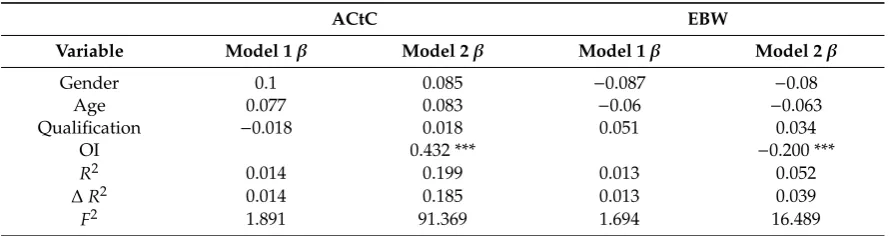
[image:11.595.76.521.534.652.2]Table3shows the regression results of organizational identification with affective commitment to change and exit-based withdrawal behavior. Organizational identification was observed to have a significant positive relationship with affective commitment to change (β=0.432,p<0.001), thus confirming Hypothesis 1. Organizational identification showed a significant negative relationship with exit-based withdrawal behavior (β=−0.200,p<0.001). Thus, Hypothesis 2 was also accepted.
Table 3.Summary of regression analysis.
ACtC EBW
Variable Model 1β Model 2β Model 1β Model 2β
Gender 0.1 0.085 −0.087 −0.08
Age 0.077 0.083 −0.06 −0.063
Qualification −0.018 0.018 0.051 0.034
OI 0.432 *** −0.200 ***
R2 0.014 0.199 0.013 0.052
∆R2 0.014 0.185 0.013 0.039
F2 1.891 91.369 1.694 16.489
Notes: N = 401; (*** p < 0.001). ACtC = affective comment to change, EBW = exit-based withdrawal, OI=organizational identification. The regression coefficients shown are standardized regression coefficients (β).
3.6. Mediation Analysis
Tables4and5present the mediation results of organizational identification between overall justice judgements and change favorableness with affective commitment to change and exit-based withdrawal behavior. Table4shows that overall justice judgements was significant and positively related to organizational identification (β=0.4960,p<0.001) and affective commitment to change
p<0.001). Organizational identification was significantly positively related to affective commitment to
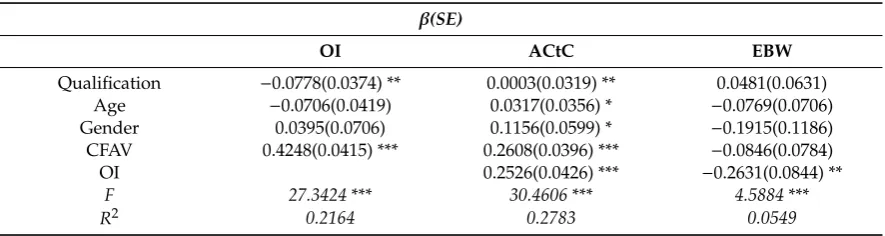
change (β=0.2842,p<0.001), and organizational identification was negatively related to exit-based withdrawal (β=−0.1288,p=not significant). Thus, we have found that there exists partial mediation of organizational identification between overall justice judgements and affective commitment to change, confirming Hypothesis 3a. On the other hand, organizational identification did not mediate between overall justice judgements and exit-based withdrawal, which rejects Hypothesis 3b. Table5shows that change favorableness was significantly positively related to organizational identification (β=0.4248,
[image:12.595.76.520.332.451.2]p=0.001) and with affective commitment to change (β=0.2608,p<0.001), whereas change favorableness had a non-significant negative relationship with exit-based withdrawal (β=−0.0846,p=ns). However, organizational identification was significantly positively related to affective commitment to change (β=0.2526,p<0.001), and organizational identification was significantly negatively related to exit-based withdrawal (β=−0.2631,p<0.05). Results showed that organizational identification played a partial mediation role between change favorableness and affective commitment to change (Hypothesis 4a) whereas organizational identification played a full mediation role between change favorableness and exit-based withdrawal (Hypothesis 4b).
Table 4.Results of bootstrapped mediation analysis examining the relations of overall justice judgements, organizational identification on affective commitment to change, and exit-based withdrawal.
β(SE)
OI ACtC EBW
Qualification −0.0658(0.0374) 0.0092(0.0326) 0.0159(0.0614)
Age −0.0208(0.0416) 0.0636(0.0360) −0.0808(0.0680)
Gender 0.0537(0.0706) 0.1226(0.0613) * −0.2015(0.1156)
OJJ 0.4960(0.0486) *** 0.2309(0.0474) *** −0.4194(0.0894) ***
OI 0.2842(0.0436) *** −0.1288(0.0822)
F 27.1603*** 25.5498*** 8.9888***
R2 0.2153 0.2444 0.1022
[image:12.595.77.520.516.634.2]Notes: N=401; (***p<0.001; *p<0.05). OJJ=overall justice judgements, OI=organizational identification, ACtC=affective comment to change, EBW=exit-based withdrawal. Bootstrap sample size=10,000.
Table 5.Results of bootstrapped mediation analysis examining the relations of change favorableness and organizational identification on affective commitment to change and exit-based withdrawal.
β(SE)
OI ACtC EBW
Qualification −0.0778(0.0374) ** 0.0003(0.0319) ** 0.0481(0.0631)
Age −0.0706(0.0419) 0.0317(0.0356) * −0.0769(0.0706)
Gender 0.0395(0.0706) 0.1156(0.0599) * −0.1915(0.1186)
CFAV 0.4248(0.0415) *** 0.2608(0.0396) *** −0.0846(0.0784)
OI 0.2526(0.0426) *** −0.2631(0.0844) **
F 27.3424*** 30.4606*** 4.5884***
R2 0.2164 0.2783 0.0549
Notes: N=401; (***p<0.001; **p<0.01; *p<0.05). CFAV=change favorableness; OI=organizational identification; ACtC=affective commitment to change; EBW=exit-based withdrawal. Bootstrap sample size=10,000.
3.7. Moderated Mediation Analysis
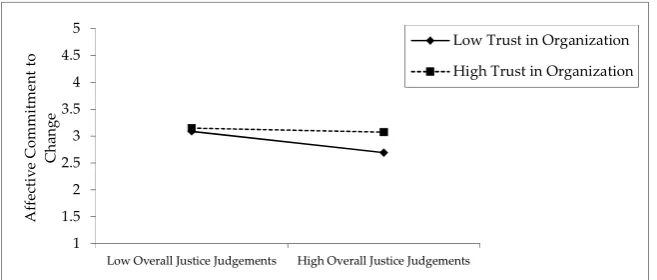
relationship with organizational identification and exit-based withdrawal, and a significant relationship with affective commitment to change (β=0.0801,p<0.05) (Figure2). Table7shows that the interaction between change favorableness and trust in organization had a significant direct relationship with exit-based withdrawal (β= 0.1984, p< 0.01) (Figure 3) and had no significant relationship with organizational identification and affective commitment to change.
Table 6. Results of bootstrapped moderated mediation analysis examining the relations of overall justice judgements and organizational identification on affective commitment to change and exit-based withdrawal.
β(SE)
OI ACtC EBW
Qualification −0.0761(0.0346) * 0.0007(0.0320) 0.0551(0.0617)
Age −0.0081(0.0384) 0.0668(0.0354) * −0.0834(0.0681)
Gender 0.0422(0.0653) 0.1256(0.0602) * −0.1946(0.1159)
OJJ 0.0774(0.1654) −0.1177(0.1524) −0.6654(0.2936) *
TO 0.1850(0.1626) −0.1110(0.1500) −0.3023(0.2890)
OJJ×TO 0.0515(0.0457) 0.0801(0.0421) * 0.0773(0.0811)
OI 0.2121(0.0464) *** −0.1177(0.0894)
F 33.0531 21.4872 6.5666***
R2 0.3348 0.2768 0.1047
[image:13.595.98.497.417.541.2]Notes: N=401; (***p<0.001; *p<0.05). OJJ=overall justice judgements; OI=organizational identification; ACtC=affective comment to change; EBW=exit-based withdrawal. Bootstrap sample size=10,000.
Table 7. Results of bootstrapped moderated mediation analysis examining the relations of overall justice judgements and organizational identification on affective commitment to change and exit-based withdrawal.
β(SE)
OI ACtC EBW
Qualification −0.0836(0.0348) ** −0.0060(0.0316) 0.0510(0.0624)
Age −0.0293(0.0393) 0.0424(0.0355) −0.0897(0.0701)
Gender 0.0271(0.0657) 0.1100(0.0594) −0.2086(0.1172)
CFAV 0.0319(0.1394) 0.0244(0.1256) −0.6844(0.2484) **
TO 0.2029(0.1336) −0.0542(0.1210) −0.8241(0.2388) ***
CFAV×TO 0.480(0.0379) 0.0527(0.0343) 0.1984(0.0677) **
OI 0.2035(0.0455) *** −0.2144(0.0898) **
F 31.7617*** 23.5197*** 5.1488***
R2 0.3260 0.2952 0.0840
Notes: N= 401; (*** p <0.001; ** p< 0.01). CFAV= change favorableness; TO= trust in organization; OI=organizational identification; ACtC =affective commitment to change; EBW=exit-based withdrawal. Bootstrap sample size=10,000.
Sustainability 2019, 11, x FOR PEER REVIEW 13 of 21
Figure 2. Two-way interaction plot (overall justice judgements × trust in organization)–affective commitment to change.
Figure 3. Two-way interaction plot (change favorableness × trust in organization)–exit-based withdrawal behavior.
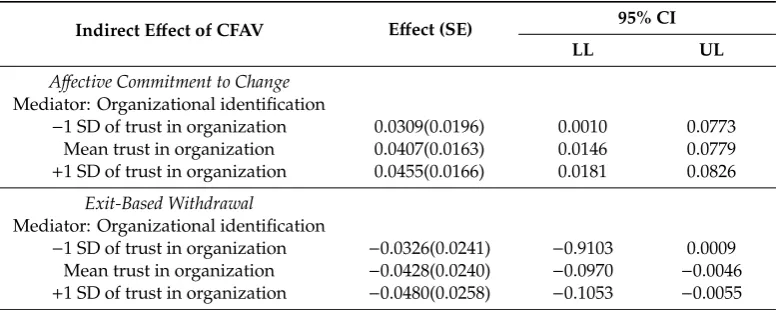
We also examined the indirect effects of trust in organization. Table 8 shows that overall justice judgements were positively and significantly related via organizational identification to affective commitment to change (β = 0.0438), and negatively related with exit-based withdrawal behavior (β = −0.0243) when trust in organization was low. Similarly, overall justice judgements via organizational identification was significant and positively related to affective commitment to change (β = 0.0601), and negatively related with exit-based withdrawal (β = −0.0334) when trust in organization was high. Table 9 shows that change favorableness via organizational identification was significant and positively related to affective commitment to change (β = 0.0309), and negatively related with exit-based withdrawal (β = −0.0326) when trust in organization was low. However, change favorableness via organizational identification was significant and positively related to affective commitment to change (β = 0.0455), and negatively related with exit-based withdrawal behavior of employees (β = −0.0480) when trust in organization was high. The results support the notion that when trust in organization was high, it provides a cushion against the negative outcomes, i.e., exit-based withdrawal behavior in case of change favorableness, whereas trust in organization acted as an intensifier in case of affective commitment to change for both organizational justice judgements and change favorableness, as proposed in hypothesis 5.
1 1.5 2 2.5 3 3.5 4 4.5 5
Low Overall Justice Judgements High Overall Justice Judgements
A ff ecti v e Commi tme n t to Cha ng e
Low Trust in Organization
High Trust in Organization
1 1.5 2 2.5 3 3.5 4 4.5 5
Low Change Favorableness High Change Favorableness
Ex it -ba se d w ithdra wa
l Low Trust in organization
[image:13.595.135.464.587.727.2]High Trust in organization
Figure 2. Two-way interaction plot (overall justice judgements×trust in organization)–affective
Sustainability2019,11Figure 2. , 3159 Two-way interaction plot (overall justice judgements × trust in organization)–affective 13 of 21
commitment to change.
Figure 3. Two-way interaction plot (change favorableness × trust in organization)–exit-based withdrawal behavior.
We also examined the indirect effects of trust in organization. Table 8 shows that overall justice judgements were positively and significantly related via organizational identification to affective commitment to change (β = 0.0438), and negatively related with exit-based withdrawal behavior (β = −0.0243) when trust in organization was low. Similarly, overall justice judgements via organizational identification was significant and positively related to affective commitment to change (β = 0.0601), and negatively related with exit-based withdrawal (β = −0.0334) when trust in organization was high. Table 9 shows that change favorableness via organizational identification was significant and positively related to affective commitment to change (β = 0.0309), and negatively related with exit-based withdrawal (β = −0.0326) when trust in organization was low. However, change favorableness via organizational identification was significant and positively related to affective commitment to change (β = 0.0455), and negatively related with exit-based withdrawal behavior of employees (β = −0.0480) when trust in organization was high. The results support the notion that when trust in organization was high, it provides a cushion against the negative outcomes, i.e., exit-based withdrawal behavior in case of change favorableness, whereas trust in organization acted as an intensifier in case of affective commitment to change for both organizational justice judgements and change favorableness, as proposed in hypothesis 5.
1 1.5 2 2.5 3 3.5 4 4.5 5
Low Overall Justice Judgements High Overall Justice Judgements
A ff ecti v e Commi tme n t to Cha ng e
Low Trust in Organization
High Trust in Organization
1 1.5 2 2.5 3 3.5 4 4.5 5
Low Change Favorableness High Change Favorableness
Ex it -ba se d w ithdra wa
l Low Trust in organization
[image:14.595.137.461.87.228.2]High Trust in organization
Figure 3. Two-way interaction plot (change favorableness × trust in organization)–exit-based
withdrawal behavior.
We also examined the indirect effects of trust in organization. Table8shows that overall justice judgements were positively and significantly related via organizational identification to affective commitment to change (β=0.0438), and negatively related with exit-based withdrawal behavior (β=−0.0243) when trust in organization was low. Similarly, overall justice judgements via organizational identification was significant and positively related to affective commitment to change (β=0.0601), and negatively related with exit-based withdrawal (β= −0.0334) when trust in organization was high. Table9shows that change favorableness via organizational identification was significant and positively related to affective commitment to change (β=0.0309), and negatively related with exit-based withdrawal (β=−0.0326) when trust in organization was low. However, change favorableness via organizational identification was significant and positively related to affective commitment to change (β=0.0455), and negatively related with exit-based withdrawal behavior of employees (β=−0.0480) when trust in organization was high. The results support the notion that when trust in organization was high, it provides a cushion against the negative outcomes, i.e., exit-based withdrawal behavior in case of change favorableness, whereas trust in organization acted as an intensifier in case of affective commitment to change for both organizational justice judgements and change favorableness, as proposed in Hypothesis 5.
Table 8. Indirect effects of overall justice judgements on affective commitment to change and exit-based withdrawal.
Indirect Effect of OJJ Effect (SE) 95% CI
LL UL
Affective Commitment to Change
Mediator: Organizational identification
−1 SD of trust in organization 0.0438(0.0217) 0.0081 0.0924
Mean trust in organization 0.0547(0.0181) 0.0234 0.0928
+1 SD of trust in organization 0.0601(0.0191) 0.0261 0.0996
Exit-Based Withdrawal
Mediator: Organizational identification
−1 SD of trust in organization −0.0243(0.0248) −0.0847 0.0127
Mean trust in organization −0.0303(0.0273) −0.0922 0.0162
+1 SD of trust in organization −0.0334(0.0295) −0.0992 0.0173
[image:14.595.104.492.535.688.2]Table 9. Indirect effects of change favorableness on affective commitment to change and exit-based withdrawal.
Indirect Effect of CFAV Effect (SE) 95% CI
LL UL
Affective Commitment to Change
Mediator: Organizational identification
−1 SD of trust in organization 0.0309(0.0196) 0.0010 0.0773
Mean trust in organization 0.0407(0.0163) 0.0146 0.0779
+1 SD of trust in organization 0.0455(0.0166) 0.0181 0.0826
Exit-Based Withdrawal
Mediator: Organizational identification
−1 SD of trust in organization −0.0326(0.0241) −0.9103 0.0009
Mean trust in organization −0.0428(0.0240) −0.0970 −0.0046
+1 SD of trust in organization −0.0480(0.0258) −0.1053 −0.0055
Notes: CFAV=change favorableness; LL=Lower limit; UL=upper limit; CI=confidence interval. Bootstrap size=10,000.
4. Discussion
The current paper focused on developing and testing the proposed hypotheses. The hypotheses were based on research conducted by Soenen et al. [7] inspired by the group engagement model and psychology of sustainability [5]. It centers on organizational identification in the context of workplace change conditions and commitment of employees for organizational sustainability. Specifically, in recent years, given the global context of market forces and constraints, companies have undertaken transformational change activities to consolidate their goals and secure a sustainable position in markets [7]. At the heart of it, merger and acquisitions as a form of organizational change are crucial for seeking enhanced capability and sustaining a competitive edge in the marketplace. However, such environments can induce identity problems for individuals involved with and implementing change [17,82]. This may include a sense of identity loss, but conversely, also over-identification behavior [24], both posing harms to change processes.
Overall, our study addresses Soenen et al.’s [7] argument that “future research on major organizational changes integration may benefit from using the group engagement model as a theoretical framework”. In doing so, our hypothesized model was tested in the developing country context of Pakistan. Transformational changes in such contexts face sustainability challenges. As such, little research has been done along these lines. Studies have found that change projects tend to influence the degree to which employees identify with their organizations [83,84].
In line with previous studies, we found that greater identification correlated with an increased commitment to the organization. This provides some causality between organizational identification and affective commitment to change, which has been lacking in the field [32] (Hypothesis 1), whilst the association of organizational identification and exit-based withdrawal of employees has been somewhat established [26] (Hypothesis 2). We provide evidence in the major organizational changes in the context of Pakistan and its third-world conditions.
Concerning Hypothesis 3a,b, the data confirmed the partial mediating role of organizational identification, specifically with regard to overall justice judgements, which remain poorly established in the transformational change context [7]. Whilst organizational identification was partially mediated between overall justice judgements and affective commitment to change (Hypothesis 3a), it did not mediate between overall justice judgements and exit-based withdrawal (Hypothesis 3b). This suggests that identifying with one’s organization during change is not enough in countering the impact of overall justice judgements on exit-based withdrawal. Disengagement is often followed by withdrawal from the job.
identification plays a full mediation role between change favorableness and exit-based withdrawal (Hypothesis 4b). Thus, Hypothesis 4a,b are accepted. Research supports the view that favoring change works insofar as it involves identifying with the organization’s positively communicated core values that influence exit choices [51,85].
Finally, the centrality of trust is suggested in Hypothesis 5. Trust moderated overall justice judgements—change favorableness in relation to affective commitment to change via organizational identification. That is, trust is significant in how people identify with the organization based on judgements of fair treatment. Higher trust levels also moderated the negative relationship of change favorableness and exit-based withdrawal via the mediating role of organizational identification. Given the latter predilections, employees are likely to favor change as fair and affectively committed with the organization. This happens only if trust exists when identifying with the changing landscape. Managerial practices aimed towards greater trust-based engagement with change and healthy communication has been found to work [86]. Thus, this adds to the positive psychology of sustainability that, with change favorableness and overall justice judgements, it is trust that accentuates the long term stickability and commitment of employee with the changing organization.
The variable overall justice judgements under the influence of trust was not significantly related to organizational identification and exit-based withdrawal. However, it was significantly related to affective commitment to change. Likewise, change favorableness under the influence of trust in organization produced a significant direct relationship with exit-based withdrawal and no correlation with affective commitment to change. Thus, a sense of justice combined with trust in the firm, to some degree, shapes how employee sees change projects. Our study uniquely introduces the variable trust to a family of models [7,50,87,88] proposed by past studies on major organizational change dynamics.
We found that in the context of transformational changes, the effects of organizational identification and trust in organization may produce some unexpected behavior, such as positive exit-based withdrawal due to opportunities available in the market for trained employees, thus posing a threat to the sustainability of the change. As we have seen from the empirical results, though exit-based withdrawal is slightly lower than the average rate with a mean score value of 2.98 (Table2), the tendency to stay with the organization is still not very appreciative. That should be lower provided with the existence of overall justice judgements, change favorableness, trust in organization, and organizational identification. For the organization, it is an alarming situation, as they may be required to hire and train new human resources whilst managing to sustain a large-scale change. Hence, to achieve sustainability, organizations are required to bring forth more favorable outcomes of change for employees in terms of economic gains that can reduce their exit-based withdrawal tendency further. We anticipate this will present challenges for human resource management, particularly with respect to the turbulent and uncertain markets in Pakistan.
Following the recommendations by Soenen et al. [7] which is based on the group engagement model, our study introduced ‘trust in organization’ and ‘exit-based withdrawal’ as two crucial variables. These latter variables have not been tested, particularly in the developing country context of Pakistan. Our study opens space for further research to test similar models, aimed at improving the sustainability of change. For practitioners in Pakistan, this means a greater focus on human resource development. One approach is to adopt the lens of the three Es of sustainability (economy, equity, and ecology [5]), with a particular focus on inclusion and fair treatment that builds trust. Employees who trust change projects may better identify with the organization’s efforts. This adds to collective wellbeing of employees, employers, and organizations in developing countries.
only current scenarios of employee behavior. Furthermore, the inclusion of multilevel data would have validated this theoretical framework from both the employer and employees’ perspective.
Without the sense of belongingness within the organization, employees cannot sustain the turbulence associated with change and are inclined towards switching to a more secure place. This is a common problem in developing countries, where vigorous evolution of organizations creates unrest amongst employees. However, if provided with favorable change outcomes for the employees, this can enhance their intrinsic motivation to stay with the same organization. This can be explored further in other sectors with special attention paid to contextual factors, i.e., salary, job security, and emotional wellbeing of employees, among other factors. Future research may investigate models based on the group engagement model, sustainable development, and psychology of sustainability at multiple levels—both micro and macro. For instance, variables including predictors with respect to leadership, stakeholders’ self-choices and individual dimensions of justice can contribute to the sustainability of organizations who underwent major organizational changes. Such studies will provide a habitat to analyze diverse employee behavioral outcomes in developed or developing country contexts. On this front, in methodological terms, a multi-level analysis has the potential to provide a holistic picture of major organizational changes and employee propensities. For practitioners and policymakers, we have opened the niche of psychological sustainability from people’s perspective. There is a dire need to care for psychological capital of employees, such as justice and equity rights in a changing organization. Only then employees will own the major change activities, and their sustainability can be ensured for both public and private organizations.
5. Conclusions
Broadly, our study shows that in the context of sustainable change, variables that reflect identity concerns, trust in organizations, affective commitment, and exit behaviors of employees constitute crucial factors that require attention. Emphasizing this, our study brings a focus on the psychology of sustainable change in the context of developing countries. Up until now, organizations in developing countries have mostly addressed the economic benefits of change, rather than the psychological concerns of employees. Hence, the employees’ perspective during change has largely been marginalized.
In other words, a change that may seem to be economically favorable right now may not be sustainable over a longer period. In particular, our study highlights trust as a major factor in retaining employees and in improving commitment, as well as a sustainable attitude predicated on the extent to which one identifies with change projects and conditions. This implies that in such situations change is not sustainable and difficult to manage. Our study also found the presence of exit behaviors, despite high levels of justice judgements, trust, organizational identification, and affective commitment to change. This provides a new direction in sustainable change research.
Author Contributions:Conceptualization, A.M.; data curation, A.M.; formal analysis, A.M., M.N.A., and K.C.; methodology, A.M. and M.N.A.; project administration, M.N.A.; supervision, M.N.A.; validation, M.N.A.; visualization, A.M. and M.N.A.; writing—original draft, U.T.; writing—review and editing, M.N.A.
Funding:This research received no external funding.
Conflicts of Interest:The authors declare no conflict of interest.
Appendix A
Overall justice judgements
Overall, I’m treated fairly by my organization.
Usually, the way things work in this organization are not fair. In general, I can count on this organization to be fair.
In general, the treatment I receive around here is fair.
For the most part, this organization treats its employees fairly.
Change favorableness
People in this organization find their work more interesting. Most people in this unit are better off.
People’s quality of life at work has improved.
Trust in organization
I believe my employer has high integrity.
My employer is open and upfront with me.
Organizational identification
When someone criticizes my organization, it feels like a personal insult. I am very interested in what others think about my current organization. When I talk about my organization I usually say “we” rather than “they.”
This organization’s successes are my successes.
When someone praises my organization, it feels like a personal compliment. If a story in the media criticized my organization, I would feel embarrassed.
Affective commitment to change
I believe in the value of this change.
This change is a good strategy for this organization.
I think that management has made a mistake by introducing this change.
This change serves an important purpose.
Things would be better without this change.
This change was not necessary.
Exit-based withdrawal
I am seriously considering quitting this job for an alternative employer. During the next year, I will probably look for a new job outside this company.
References
1. Johnson, K.J. The dimensions and effects of excessive change. J. Organ. Chang. Manag.2016,29, 445–459. [CrossRef]
2. Bozdo, A.; Kripa, E. The impact of macro-economic factors on non-performing loans in albania. Acad. J. Interdiscip. Stud.2015,4, 534. [CrossRef]
3. van der Smissen, S.; Schalk, R.; Freese, C. Organizational change and the psychological contract: How change influences the perceived fulfillment of obligations.J. Organ. Chang. Manag.2013,26, 1071–1090. [CrossRef] 4. Meyer, J.P.; Srinivas, E.; Lal, J.B.; Topolnytsky, L. Employee commitment and support for an organizational change: Test of the three-component model in two cultures. J. Occup. Organ. Psychol. 2007,80, 185–211. [CrossRef]
5. Di Fabio, A. The psychology of sustainability and sustainable development for well-being in organizations.
Front. Psychol.2017,8, 1534. [CrossRef] [PubMed]
6. Cartwright, S.; Cooper, C.L.Mergers and Acquisitions: The Human Factor; Butterworth-Heinemann: Oxford, UK, 2014.
7. Soenen, G.; Melkonian, T. Fairness and commitment to change in M&As: The mediating role of organizational identification.Eur. Manag. J.2017,35, 486–492. [CrossRef]
9. Manuti, A.; Giancaspro, M.L. People make the difference: An explorative study on the relationship between organizational practices, employees’ resources, and organizational behavior enhancing the psychology of sustainability and sustainable development.Sustainability2019,11, 1499. [CrossRef]
10. Batista, A.A.S.; Francisco, A.C. Organizational sustainability practices: A study of the firms listed by the corporate sustainability index.Sustainability2018,10, 226. [CrossRef]
11. Herscovitch, L.; Meyer, J.P. Commitment to organizational change: Extension of a three-component model.J. Appl. Psychol.2002,87, 474. [CrossRef]
12. Choi, M. Employees’ attitudes toward organizational change: A literature review.Hum. Resour. Manag.2011,
50, 479–500. [CrossRef]
13. Tyler, T.R.; Blader, S.L. The group engagement model: Procedural justice, social identity, and cooperative behavior.Pers. Soc. Psychol. Rev.2003,7, 349–361. [CrossRef] [PubMed]
14. Lipponen, J.; Olkkonen, M.E.; Moilanen, M. Perceived procedural justice and employee responses to an organizational merger.Eur. J. Work Organ. Psychol.2004,13, 391–413. [CrossRef]
15. Melkonian, T.; Monin, P.; Noorderhaven, N.G. Distributive justice, procedural justice, exemplarity, and employees’ willingness to cooperate in M&A integration processes: An analysis of the Air France-KLM merger.Hum. Resour. Manag.2011,50, 809–837. [CrossRef]
16. Bergami, M.; Bagozzi, R.P. Self-categorization, affective commitment and group self-esteem as distinct aspects of social identity in the organization.Br. J. Soc. Psychol.2000,39, 555–577. [CrossRef] [PubMed]
17. Hogg, M.A.; Terry, D.I. Social identity and self-categorization processes in organizational contexts.Acad. Manag. Rev.2000,25, 121–140. [CrossRef]
18. Croonen, E. Trust and fairness during strategic change processes in franchise systems.J. Bus. Ethics2010,95, 191–209. [CrossRef]
19. Tomprou, M.; Nikolaou, I.; Vakola, M. Experiencing organizational change in Greece: The framework of psychological contract.Int. J. Hum. Resour. Manag.2012,23, 385–405. [CrossRef]
20. Greve, H.R.; Man Zhang, C. Institutional logics and power sources: Merger and acquisition decisions.Acad. Manag. J.2017,60, 671–694. [CrossRef]
21. Weber, Y.; Fried, Y. Guest editors’ note: The dynamic of employees’ reactions during postmerger integration process.Hum. Resour. Manag.2011,50, 777–781. [CrossRef]
22. Ashforth, B.E.; Mael, F. Social identity theory and the organization. Acad. Manag. Rev. 1989,14, 20–39. [CrossRef]
23. Hatch, M.J.; Schultz, M.Organizational Identity: A Reader; Oxford University Press: New York, NY, USA, 2004. 24. Conroy, S.; Henle, C.A.; Shore, L.; Stelman, S. Where there is light, there is dark: A review of the detrimental
outcomes of high organizational identification.J. Organ. Behav.2017,38, 184–203. [CrossRef]
25. Belkin, L.Y.; Becker, W.J.; Conroy, S.A. Exhausted, but unable to disconnect: After-hours email, work-family balance and identification. InAcademy of Management Proceedings; Academy of Management: BriarcliffManor, NY, USA, 2016; Volume 2016, Number 1, p. 10353. [CrossRef]
26. Van Knippenberg, D.; Van Dick, R.; Tavares, S. Social identity and social exchange: Identification, support, and withdrawal from the job.J. Appl. Soc. Psychol.2007,37, 457–477. [CrossRef]
27. Dukerich Janet, M.; Kramer, R.; Parks, J.M.; Whetton, D.The Dark Side of Organizational Identification; Stanford Business: Stanford, CA, USA, 1998.
28. Umphress, E.E.; Bingham, J.B.; Mitchell, M.S. Unethical behavior in the name of the company: The moderating effect of organizational identification and positive reciprocity beliefs on unethical pro-organizational behavior.
J. Appl. Psychol.2010,95, 769. [CrossRef]
29. Van Dijk, R.; Van Dick, R. Navigating organizational change: Change leaders, employee resistance and work-based identities.J. Chang. Manag.2009,9, 143–163. [CrossRef]
30. Zappalà, S.; Toscano, F.; Licciardello, S.A. Towards Sustainable Organizations: Supervisor Support, Commitment to Change and the Mediating Role of Organizational Identification. Sustainability2019,
11, 805. [CrossRef]
31. Edwards, M.R.; Peccei, R. Perceived organizational support, organizational identification, and employee outcomes.J. Pers. Psychol.2010,9, 17–26. [CrossRef]