International Journal of Emerging Technology and Advanced Engineering
Website: www.ijetae.com (ISSN 2250-2459,ISO 9001:2008 Certified Journal, Volume 4, Issue 10, October 2014)
622
Perceptions of Contractor Development Programmes in Some
Developing Countries
Ambrose Dapaah
1, Innocent Musonda
21
Student, 2Senior Lecturer, Department of the Quantity Surveying & Construction Management, University of Johannesburg, South Africa
Abstract— The prime objective of most contractor development programmes (CDP) is to assist Small Medium and Micro Enterprises (SMMEs) to improve their managerial skills and performance levels to that of established firms. However literature informs that even though some of these programmes have achieved their intended objectives, there are still some issues that constraint the successful implementation of CPDs in Developing Countries (DC). A review of Contractors’ expectations of some CDPs and their gaps are presented in this study.
A desktop study was conducted on the objectives of some CDPs in three developing countries namely Tanzania, Palestine and Lesotho. The perceived gaps of these CDPs compared and ranked according to their occurrence in each country.
The study revealed that the CDPs are beneficial to contractor development however there are some gaps that need to be addressed for the successful implementation of the CDPs.
The study will enable training stakeholders improve the quality of the CDPs for their successful implementation.
Keywords—Contractor development programme, Small Medium and Micro Enterprises, perceptions, gaps, developing countries.
I. INTRODUCTION
Contractor Development Programmes (CDPs) are some of the tools used to empower local contractors in most Developing Countries [8];[11];[16];[17]. CDPs in South Africa can be traced back to 1995 when the National Department of Public Works (NDPW) introduced programmes aimed at assisting contracting organisations owned by Previously Disadvantaged Individuals (PDI) to develop their technical and managerial skills to enable them compete with established construction firms [6].
Subsequently, most provincial governments and other stakeholders established CDPs with the same objectives as that of the NDPW.
The configuration and the implementation of some of these programmes have been widely researched and documented such as the various Expanded Public Works Programmes (EPWP) [2], South African Construction Excellence Model (SACEM) [7], Integrated Emerging Contractor Development Model (IECDM) [10].
However there seem not to be enough reports on the effectiveness of these CDPs and whether they are beneficial to the end users. And as [11] observed: ―the greatest challenge that exist today in South Africa lies at the fact that no data is available on how effective interventions are, whether they are achieving successes, and which sector require most assistance‖.
The Construction Industry Development Board (CIDB) of South Africa concurs with this assertion by recommending that the CPDs must be evaluated to seek ―the perceptions of the programme beneficiaries on the direct effects of the programme in addressing their needs‖. [1].
This study therefore seeks to investigate contractors’ expectations of these CDPs, their gaps and try to recommend a solution for their better implementation in an empirical research to be undertaken on South Africa’s CDPs.
II.THE STUDY
This is a desktop study conducted through literature reviewed as the first phase of an empirical research to be conducted in South Africa on contractors’ perceptions of the benefits of contractor development programmes in developing countries (DC), the three DCs (Tanzania, Palestine and Lesotho) were chosen primarily because of the availability of literature. Four different CDPs initiated by different agencies in these DCs were reviewed, the
CDPs were unique because they had different
International Journal of Emerging Technology and Advanced Engineering
Website: www.ijetae.com (ISSN 2250-2459,ISO 9001:2008 Certified Journal, Volume 4, Issue 10, October 2014)
623
The expectations of these CDPs and their associated gaps in their implementation were identified and compared based on their occurrence in the various case studies. The findings of this study will be compared with the findings of an empirical study the researchers are conducting on contractors’ expectations of CDPs and to find out if there are some of these gaps in the implementation of CDPs in South Africa.III. CONTRACTOR DEVELOPMENT PROGRAMME
The current concept of contractor development according [15] can be traced to 1969 when the ILO initiated World Employment Programme (WEP) in Geneva, with the main objective being to try and define an employment-oriented development strategy.
As posited by [4], this employment oriented
development transformed into small contractor
development programmes in Sub-Saharan- Africa in the 1970s due to the lack of local, indigenous contractors to implement the policy and overriding presence of large foreign contractors. There are evidence of some of the successes of small contractor development programmes in some sub-Saharan countries such as Ghana, Kenya, Lesotho and Malawi [9] [13].
The background of the current contractor development programmes in South Africa however started around 1995 when the National Department of Public Works (NDPW) introduced programmes aimed at assisting contracting
organisations owned by Previously Disadvantaged
Individuals (PDI) develop their technical and managerial skills to enable them compete with established construction firms [6].
Historically most developing countries have developed their local contractors to withstand challenges and adversities caused to them by globalization, the effort to create employment for the local economy and in some cases such in South Africa, the marginalization caused by historical events [14] [16].
The challenges facing Small Micro and Medium Enterprises (SMME) contractors in developing countries are exacerbated by issues such as globalization, demographic changes, demand for green and sustainable construction, technological advancement and threats from other emerging economies [5], hence it is practical for all contractor development stakeholders to keep track of the charges and requirements of the industry to enable them be abreast with these changes.
Literature posits that contractor development
programmes are able to influence contractors’ human resource development; materials development; technology development; company development; development of documentation, procedures and operating environment; institution building and development of operating environment [16].
A. Challenges facing SMME contractors
SMMEs in the construction industry still face several challenges in their pursuit for survival and sustainability in the open market. CIDB South Africa [2] identified a number of challenges impacting on SMME contractors which include inter alia:
• Lack of business and financial skills.
• Financial constraints and limited access to funding, trade credit and performance bonds.
• Late payment by clients impacting on contractors’
cash-flows, causing delays in the completion of projects and eroding their profits margins. This also ties up working capital, and encourages corruption.
• High turnover among skilled workers owing to
uncertainties in job opportunities.
• The fragmentation of the construction process has an adverse effect on the overall performance of the industry.
• Short term nature of the work which makes it hard to develop and implement long-term strategies and growth plans.
• Officious or overly complicated contract award and contract administration procedures.
• Intense competition, especially in lower scales of construction enterprise, and difficulty in competing with larger construction firms.
• Insufficient resources to provide a safe and decent working environment such as protection, equipment and attire.
• Lack of professional advisors and consultants, and where these were available the reluctance to use them due to perceived expensive fees, a lack of finance or awareness. • Lack of capital equipment such as vehicles, heavy
machinery or scaffolding.
• Uncertainties in supplies and prices of materials, allied with generally non-existent or poor relationships with suppliers.
International Journal of Emerging Technology and Advanced Engineering
Website: www.ijetae.com (ISSN 2250-2459,ISO 9001:2008 Certified Journal, Volume 4, Issue 10, October 2014)
624
B. Objectives of development programmesLiterature postulates that different countries have different objectives for the design and implementation of
their development programmes. Some countries’
development programme according to [16] were to develop the country’s construction industry into a world-class, innovative, knowledgeable global solution provider. Other CDP initiatives were designed to improve the productivity of the industry by reinventing its processes, procedures and practises [16].
Whereas others were designed for the improvement of the contractors’ overall performance in the economy, to empower local contracting firms to compete with their international counterparts, to provide opportunity for emerging contractors to develop their firms, to sustain the performance of rural contractors and to encourage and empower contracting firms owned by people with disabilities, women and youth [2].
The development programme designed by the
Contractors Registration Board (CRB) in Tanzania was targeted at curbing the skills and knowledge gap between local and international contracting firms and also to improve the ability of local contractors to perform at optimum levels [18].
The aim of the Palestine programme was to assist smaller construction firms to improve their managerial skills in areas such as pricing, submitting tenders, financial management, contract administration and marketing of construction work [8].
And the objective of the Lesotho programmes was to promote labour based work methods, create a sustainable road maintenance system and to enhance the institutional ability of the roads department [17].
IV. FINDINGS
Below is a review of four case studies of CDPs in three developing countries to identify their objectives, outcomes and gaps.
C. Development Programme – Tanzania
The Tanzanian Construction Registration Boards (CRB) as stated by [18], introduced a Sustainable Structured Training Programme (SSTP) in 2001 with the aim of assisting local contractors to bridge the skills and knowledge gap and to increase the capacity of local contractors participating in infrastructure development, refurbishment and maintenance [18]. The programme was initiated when 38% of potential clients and 42% of contractors surveyed requested for training programmes [18].
The training objectives were to address contractors’ low technical and managerial capabilities, their inability to breakthrough into high grades, their failure to acquire modern tools, and their inability to access credit facilities.
[18] further explained that the training comprised of a 5 day period modules covering, pre-contract practise, contract management, construction planning, plant and equipment maintenance and health and safety where contractors were required to complete six modules per year. The cost of training was highly subsidised with the CRB taking about 70% and the participating contractor paying about 30%.
1)Outcome of the programme:
Assessing the outputs of the SSTP, [18] noted that, within 7 years of its inception, 2,071 contractors were trained as compared to the budgeted 1,620 contractors.
Further, the annual client feedback report indicated a decline in complaints of contractors’ lack of knowledge and skills within the period of the SSTP and there was also a reduction in the complaints related to the use of unqualified persons on projects.
The contractors generally perceived the training as a success. However they noted some shortfalls of the programme which needed to be addressed [18].
2)Perceived gaps of the programme:
The following were the gaps that contractors suggested to be attended to; (i) that the training be made mandatory to all contractors, (ii) contractors must go through Continuous Professional Development (CPD) - (continuous mentoring), (iii) there should be more emphasis on addressing artisans and technicians skills gap, (iv) training should be relevant and responsive to industrial needs, (v) contractors require more training in Rate-build-up, (vi) mentorship and apprenticeship must be encouraged to enhance competency (vii) continuous monitoring of programmes to ensure effectiveness, (viii) there must be different training programmes for different levels of firms and (ix) there must be a sufficient pool of resource persons to sustain knowledge transfer, [18].
D. Development Programme - Palestine
International Journal of Emerging Technology and Advanced Engineering
Website: www.ijetae.com (ISSN 2250-2459,ISO 9001:2008 Certified Journal, Volume 4, Issue 10, October 2014)
625
The IYCB programme consisted of three handbooks and workshop series that tackled topics such as (i) pricing andbidding (ii) site management and (iii) business
management.
The implementation was in two phases; with phase one being the training of the Trainers (TOT) and phase 2 the training of selected construction companies’ managers and owners, with each training model lasting for about three months.
3)Outcome of the programme:
[8] observed that majority of the contractors have benefitted greatly from the IYCB handbooks and workshops and were content with the models as they were able to implement some of the new methods taught.
4)Perceived gaps of the programme :
The contractors noticed some of the following as the gaps of the programme that needed the attention of the implementing stakeholders; (i) that the duration of the training programme was too long and must be shorten, (ii) that the Arabic translation needed to be reviewed (iii) that the books be made more practical than theoretical (iv) there should be different training programmes for different levels of contractors (v) that the books be adjusted to suit the conditions of the Gaza Strip and the West Bank.
E. Development Programme - Lesotho
According to [17], the Department of Rural Roads (DRR) in Lesotho launch the Contractor Training Programme (CTP) with the objectives being among others; promoting labour based work methods, creating a sustainable road maintenance system for DRR, enhancing the institutional ability of the DRR to manage the CTP effectively. The CTP was supported both nationally by the Basotho government and internationally by organisations such as International Development Association (IDA) who provided financial support while the International Labour Organisation’s (ILO) provided technical assistance.
The technical assistance provided includes as [17] listed, (i) selection of new entrepreneurs to the programme, (ii) preparation of bidding documents, (iii) planning and implementation of trial contracts, (iv) observing of contractors performance (v) training of DRR staff to implement the CTPs and (vi) advice on preparation of training materials, technical handbooks and a trainer’s manual.
The training was in two phases, with phase one being a 9 month Road Maintenance and Rehabilitation (ROMAR) programme and phase two of a 12 month Road Construction and Upgrade (ROCAU) programme.
Applicants were screened and selected into the programme based on their educational background and previous experience on labour-based work methods after they have responded to advertisements placed in local newspapers for candidates to apply. Secondly a written proficiency test was conducted to evaluate the applicants’ knowledge in English language and mathematics. Successful candidates were invited into the training
programme after attending a one-day orientation
programme [17].
[17] further stated that, contractors underwent the ROMAR training first and upon successful completion, they are capacitated to undertake a ―no-bid‖ routine maintenance contract which is valued less than US$10,000.00. Depending on their size and quality of their workmanship, trained contractors were allowed to undertake more than one routine maintenance work and subsequently, they are upgraded to undertake rehabilitation works which were valued under US$100,000.00. Only candidates who have been successful in the rehabilitation work are allowed to proceed to the ROCAU training.
The ROCAU training was elaborated by [17] as including; (i) Classroom work (ii) site demonstration (iii) trail contract in routine maintenance and (iv) trail contract in periodic maintenance. The classroom work covers technical and business administration topics such road
materials, technical specifications, bid preparation,
estimating, contract administration, site management and book-keeping.
The work for trail contracts were awarded to contractors without any competitive bidding and the contractor was allowed to add a 10% profit to the contract amount derived on the basis of negotiated rates based on engineers’ estimate.
5)Outcome of the programme:
International Journal of Emerging Technology and Advanced Engineering
Website: www.ijetae.com (ISSN 2250-2459,ISO 9001:2008 Certified Journal, Volume 4, Issue 10, October 2014)
626
6)Perceived gaps of the programme:Some of the constraints in implementing the programme were said to include; (i) the contractors’ scarce ability to handle site management, (ii) the unwillingness of private banks to give credit facilities to contractors without collateral (iii) the contractors inability to secure sureties, guarantees from financial institutions (iv) new contractors found bidding documents to be too complex (v) multipart bureaucratic payment procedures which sometimes delay contractors payments for months [17].
F. Development Programme - Tanzania 2
The National Construction Council (NCC) of Tanzanian
embarked on various training and development
programmes when it was realized that there were not enough local contractors to undertake the road maintenance and rehabilitation projects created by the government’s Sixth Highway Rehabilitation Programme and the Integrated Road Projects (IRP). The training programmes were tailor made and conducted on the basis of clients’ needs [12]. The training according to [12] took place in six centres namely;
Kilimanjaro Centre – 29 contractors were trained at this centre in the Labour Based Contractor Training to Road Rehabilitation and Maintenance Programmes, the training was done in three phases comprising of classroom work, field work and trial contracts.
Morogoro Centre – This centre had the Gravel and Bituminous Road and Bridges Maintenance Contractors Programme. This programme as elaborated by [12] was financed by the Swiss Agency for Development Corporation and was conducted in three phases namely, classroom work, filed work and trial contracts. 27 contractors were trained under this programme with 17 contractors being on gravel and bituminous road rehabilitation and maintenance and 10 contractors on rehabilitation and maintenance of bridges.
Mwanza Centre – This centre trained contractors in Labour Based Contractor Training on Road Rehabilitation and Maintenance. The implementing methodology was classroom work, field work and trial contracts, however the trial contracts were delayed due to lack of funds, until funds were obtained from the United Nations Capital Development Funds (UNCDF) for the trained contractors to undergo the trial contracts in phases. A total of 12 contractors were trained under this programme.
Nachingwea Centre – Training of Petty contractors in Lindi and Mtwara Regions in Labour Based Technology. The aim of this programme was to train petty contractors to undertake spot improvement and maintenance of roads [12]. The Finnish government through its FINIDA development agency provided both technical and financial support for this programme. A total of 22 contractors were trained in classroom training, field work and trail contracts. Dodoma and Dar es Salaam Centres – Tanzania Civil
Engineering Contractors Association (TACECA)
Contractors Development Programmes. The Swiss Agency for Development and corporation (SDC) financed contractors who were members of the TACECA to undergo training on road maintenance and rehabilitation. The training comprised of classroom work and trail contracts. A total of 78 contractors were trained in Dodoma and 61 contractors were trained in the Dar es Salaam regions [12].
7)Outcome of the programme:
[12] stated some of the outputs of the various programmes as including the completion of 70kms of road and rehabilitation of 235 culverts and drift in the Kilimanjaro Region, 10kms of road and rehabilitation of 82 culverts in the Shinyanga Region.
The Morogoro centre programme completed a total of 276kms of road and rehabilitated 24 culverts while in Mwanza a total of 26km of road and 79 culverts rehabilitated.
The Nachingwea centre programme also rehabilitated about 72kms of road while a total of 230kms of road and 3 bridges were rehabilitated under the Dodoma and Dar es Salaam programmes [12].
8)Perceived gaps of the programme:
Some of the constraints in implementing the training programmes as noted by [12] are; (i) inadequate workload for contractors after the training, (ii) insufficient financial support to contractors after graduation, (iii) Lack of financial assistance for the programmes, (iv) inability to source plant and equipment for work after training, (v) conflict between trained contractors and employers as some contractors were thought to ―know‖ more than their employers. [12].
V. ANALYSIS
International Journal of Emerging Technology and Advanced Engineering
Website: www.ijetae.com (ISSN 2250-2459,ISO 9001:2008 Certified Journal, Volume 4, Issue 10, October 2014)
627
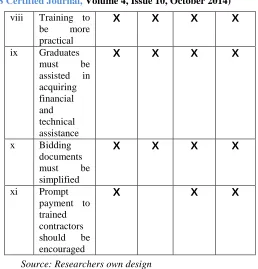
TABLEIANALYSES OF THE PERCEIVED GAPS WITHIN THE DIFFERENT TRAINING PROGRAMMES
Ite m
Contractor s’ perceived Gaps
Tanza nia 1
Pales tine
Lesoth o
Tanza nia 2
i Continuous
Professional Developmen t (CPD) – Mentoring of
contractors after graduation
X
X
X
X
ii Bridging the
skill
shortage gap between start-ups and
X
X
X
X
iii.
Training to be adopted to specific areaX
X
X
X
iv Different
training requirement
s to be
adopted to
different
levels of
contractors
X
X
X
X
v Training
cost must
reasonable
X
X
X
vi Training
should be
relevant and responsive to industrial needs
X
X
X
X
vii Duration of
the training programme
should not
be too long
X
X
X
X
viii Training to
be more
practical
X
X
X
X
ix Graduates
must be
assisted in acquiring financial and technical assistance
X
X
X
X
x Bidding
documents
must be
simplified
X
X
X
X
xi Prompt
payment to trained contractors
should be
encouraged
X
X
X
Source: Researchers own design
Table 1 shows that the four cases have some identical gaps, these gaps includes the need for continuous contractor development programmes, the table also posited that, the training be designed based on the contractors’ area of business as it becomes difficult for contractors to travel to other areas to undergo these CDPs. The CDPs must be aimed at addressing specific contractor needs to avoid ―one size fits all‖ programmes. Again, Table 1 depicted that trainees wanted the CDPs to be designed with the aim of bridging the skills shortage gap between contractors by targeting the training on contractors’ level of competencies. The trainees also believed that the CDPs must be more practical oriented, must have shorter durations, cost of training must be highly subsidies or preferably free and must have easy to understand bidding documents. The lack of prompt payment and assistance from clients and financial institutions during and after training were also identified as some of the gaps of the CDPs.
VI. CONCLUSION
[image:6.612.314.572.124.393.2] [image:6.612.41.297.171.695.2]International Journal of Emerging Technology and Advanced Engineering
Website: www.ijetae.com (ISSN 2250-2459,ISO 9001:2008 Certified Journal, Volume 4, Issue 10, October 2014)
628
However, there seem to be some gaps or constraints that impede the successful implementation of these CDPs.The case studies showed that contractors or trainees do not see these CDPs as waste of time but as beneficial to their businesses’ sustainability. However there still remain certain hindering factors as cited in all four studied areas and depicted in Table 1 which if properly resolved may addressed some of the perennial contractor issues such as their inability to acquire financial assistance from financial institutions, their lack of technical and managerial competences, their inability to use labour-based work methods profitably and their inability to solicit credit from suppliers of materials.
It is recommended that evaluation of these CDPs be conducted regularly to ascertain the extent to which they are benefiting the contractors, whether the contractors have assimilated what the training was set out to achieve and the contractors’ overall perception of the CDPs to enable their successful implementation.
Finally, it should be noted that this study is only a desktop study which constitutes the first part of an empirical research the writers are conducting on contractors’ perceptions of contractor development programmes in South Africa.
REFERENCES
[1] CIDB (2011). Baseline Study of Provincial Contractor Development Programmes: Review of the contractor development programmes: Towards an NCDP monitoring and evaluation system. Pretoria: CIDB. p. 93.
[2] CIDB (2011). National contractor development programme framework. Pretoria: DPW - Construction Industry Development Board.
[3] CIDB (2009). Status quo report, SA contractor development programmes. Pretoria: DPW - CIDB
[4] Croswell, J. and McCutcheon, R. (2001). Small Contractor Development and Employment – A brief survey of Sub-Saharan Experience in relation to Civil construction, WORK2001 First International Conference on Employment Creation in Development. Conference proceedings of conference held on 2-5 April 2001 in Johannesburg, South Africa: University of the Witwatersrand. [5] DBIS. (2013). UK Construction, an economic analysis of the sector.
Available at https://www.gov.uk/.../bis-13-958-uk-construction-an-economic-analysis.pdf, (Accessed 4 February 2014).
[6] Department of Public Works (2004), Contractor incubator programme - plan. Pretoria: National Department of Public Works.
[7] Dlungwana, W.S., Nxumalo, X.H., Huysteen, S.V., Rwelamila, P.D. & Noyama, C. (2002), ―Development and implementation of the South African Construction Excellence Model (SACEM)‖. International Conference on Construction in the 21st Century. Challenges and opportunity in Management and Technology. Miami, Florida. : 1-8.
[8] Enshassi, A. & Shaath, K. (2007), ―Training assessment of Palestinian contractors‖. Journal of construction in developing countries, 12(1):39-57.
[9] Eyiah, A. (2004). Regulation and Small Contractor Development, A case of Ghana. Centre on Regulation and Competition working paper series, University of Manchester. 2-22
[10] Hauptfleisch, D., Lazarus, S., Knoetze, T., & Liebenberg, S. (2007). An integrated emerging contractor development model for the construction industry: Practical implementation and statistical quantification: 1-3.
[11] Jacquet, A. (2002), ―Sustainable contractor development through coordinated and focused interventions‖. Paper presented at the build environment profession convention, 112
[12] Joseph, H. and John, H. (No Date), Challenges and opportunities in the development of the construction industry personnel: The NCC experience. Available from: http://www.ncc.or.tz/cod.pdf. (Accessed 21 November 2013).
[13] Larcher, P. (1998). Privatizing road maintenance in developing countries. International Journal of Public Sector Management, 11(2/3): 116-129.
[14] McCutcheon, R. (2008). The generation of productive employment opportunities for the unskilled: principles, potential and pitfalls of labor-intensive construction. 10th Path to Full Employment Conference / 15th National Unemployment Conference 4-5 December 2008, Centre of Full Employment and Equity (CofFEE) University of Newcastle, Australia
[15] McCutcheon, R.T. and Parkins, F.L.M.T. (2002). Capacity building in the transport and development engineering at WITS University. Innovative Research and Education at the Research Centre for Employment Creation in Construction. Towards Building Capacity and Accelerating Delivery’, 21st Annual South African Transport Conference held on 15 - 18 July 2002 in South Africa.
[16] Ofori, G. (2012), Developing the construction industry in Ghana: The case for a central agency. Singapore.
[17] Seth, C.S. (2004), Training of Small Scale Contractors for Rural Road Maintenance in Lesotho, Some lessons from Experience.
Available from:
http://www.ssatp.org/sites/ssatp/files/publications/SSATP-TechnicalNotes/ATTN36.pdf. (Accessed 23 December 2013). [18] Uriyo, G. A. and Jere, D. (No Date), Contractor Training in the