P r o t e c t E D C o d e of P r a c ti c e :
I n t r o d u c ti o n & Ov e r vi e w
Woo t t o n , AB, M a r s ell e, M R, D av ey, CL, N u t t a ll, B a n d Jo n e s , T
T i t l e
P r o t e c t E D C o d e of P r a c ti c e : I n t r o d u c ti o n & Ov e r vi e w
A u t h o r s
Woo t t o n , AB, M a r s e ll e, M R, D av ey, CL, N u t t all, B a n d
Jo n e s , T
Typ e
Bo o k S e c ti o n
U RL
T hi s v e r si o n is a v ail a bl e a t :
h t t p :// u sir. s alfo r d . a c . u k /i d/ e p ri n t/ 4 1 3 3 5 /
P u b l i s h e d D a t e
2 0 1 7
U S IR is a d i gi t al c oll e c ti o n of t h e r e s e a r c h o u t p u t of t h e U n iv e r si ty of S alfo r d .
W h e r e c o p y ri g h t p e r m i t s , f ull t e x t m a t e r i al h el d i n t h e r e p o si t o r y is m a d e
f r e ely a v ail a bl e o nli n e a n d c a n b e r e a d , d o w nl o a d e d a n d c o pi e d fo r n o
n-c o m m e r n-ci al p r iv a t e s t u d y o r r e s e a r n-c h p u r p o s e s . Pl e a s e n-c h e n-c k t h e m a n u s n-c ri p t
fo r a n y f u r t h e r c o p y ri g h t r e s t r i c ti o n s .
SELF ASSESSMENT
WORKBOOK
Introduction & Overview
Ensuring the Safety, Security & Wellbeing of HEI Students & Assets
Ensuring the Safety, Security & Wellbeing
of HEI Students & Assets
SELF ASSESSMENT
WORKBOOK
Introduction & Overview
Andrew B. Wootton, Melissa R. Marselle & Caroline L. Davey
Design Against Crime Solution Centre, University of Salford
Brian Nuttall
K7 Compliance Ltd
Trevor Jones
First edition — Introduction & Overview
Copyright © 2016 Andrew B. Wootton, Melissa R. Marselle, Caroline L. Davey, Brian Nuttall & Trevor Jones Published by ProtectED
University of Salford,
Design Against Crime Solution Centre, New Adelphi Building,
Salford M5 4WT United Kingdom
National 0161 295 2693
International (+44) 161 295 2693
e-mail (for orders) [email protected] Visit our Home Page at http://www protect-ed.org
All rights reserved. No part of this publications may be reproduced, stored in a retrieval system, or transmitted in any form or by any means, electronic, mechanical, photocopying, recording, scanning or otherwise, except under the terms of the Copyright, Designs and Patents Act 1988 or under the terms of a licence issued by the Copyright Licensing Agency, 90 Tottenham Court road, London, W1P 9HE, UK, without the permission in writing of the University of Salford, Salford, Greater Manchester, M5 4WT, United Kingdom.
ISBN 978-1-907842-91-7
ProtectED® and the ProtectED logo are registered trademarks of ProtectED, University of Salford. Designed by Andrew B. Wootton, DesignThinking, Manchester.
CONTENTS
04 Acknowledgements
06 1. Introduction
06 1.1 What is ProtectED?
07 1.2 The need for ProtectED
09 1.3 Who should consider applying for ProtectED accreditation?
11 1.4 The ProtectED Principles
13 2. The ProtectED Code of Practice
13 2.1 An extensible framework
15 2.2 ProtectED Safety & Wellbeing Partnership
16 3. The ProtectED Accreditation process
17 3.1 Joining ProtectED
17 3.2 Accreditation award levels
19 3.3 Applying for ProtectED accreditation
19 3.4 Who should be involved in the self-assessment process?
21 4. The ProtectED Self-Assessment Workbook
21 4.1 Overall structure
21 4.2 Self-Assessment Workbook content
24 4.3 Using the Self-Assessment Workbooks
26 Appendices
26 Appendix 1 – The case for ProtectED 29 Appendix 2 – Glossary
Acknowledgements
ProtectED Advisory Board
The following individuals generously donated their time and expertise to provide oversight of the creation of ProtectED, advising on content, reviewing materials and guiding its design:
‣
Gillian Almond, Commercial Director, Oxford Brookes University |College & University Business Officers (CUBO) representative‣
Eric Baskind, Senior Lecturer in Law and violence reduction consultant, Liverpool John Moores University‣
Justin Bentley, Chief Executive Officer, International Professional Security Association (IPSA)‣
Helen Clews, Immigration & Policing Advisor, British Council‣
Gavin Dick, Local Authority Policy Advisor, National Landlords Association (NLA)‣
Dave Humphries, Director of Partnerships & Interventions, The Security Industry Authority (SIA)‣
Dale Murphy, Regional Executive Member, Association of University Chief Security Officers (AUCSO) representative Jan 2015 – Aug 2016‣
Trevor Jones, Head of Security & Community Support, University of Salford |Association of University Chief Security Officers (AUCSO) representative Sept 2016 onwards‣
Annie Kemball, Senior Mental Health Advisor, Sheffield Hallam University |University Mental Health Advisors Network (UMHAN) representative‣
Umer Khan, Chief Inspector, Greater Manchester Police‣
Alec McKenzie, Regional Manager, Endsleigh Insurance‣
Ian Munton, Head of Student Support and Development Services, Keele University |Association of Managers of Student Services in Higher Education (AMOSSHE) representative‣
Jasmine Pokuaa, Vice President, University of Salford Students' UnionAdditional support for ProtectED
ProtectED has been made possible through the generous support and encouragement of the University of Salford, in particular:
‣
Nigel Howe, Associate Dean Strategy & Operations, School of Arts & Media, University of Salford‣
Professor Allan Walker, Dean of School, School of Arts & Media, University of Salford‣
Stephen Talboys, Director Estates & Property and Information Technology Services, University of Salford‣
Dr Lucy Winrow, Research Assistant & ProtectED Communications Manager, School of Arts & Media, University of Salford.Finally, we would like to thank the many HEI practitioners and students who shared with us their expertise, insight and experience by participating in
1. Introduction
1.1
What is ProtectED?
ProtectED is an evidence-based, comprehensive quality standard for assessing the work done by a Higher Education Institution (HEI) to protect their students' safety, security and wellbeing. ProtectED is the first accreditation scheme in the UK higher education sector to look comprehensively across these broad areas, and aims to be the ‘gold standard’.
ProtectED adopts a student-centred perspective and is focused on the
student experience while at university
ProtectED consists of a Code of Practice and accreditation scheme for HEIs to address the safety, security and wellbeing of their students, as well as to protect university assets and estates. It is designed to ensure HEIs provide the services and structures that enable students to avoid problems and focus on their success. It also offers reassurance to students, as well as their parents and loved ones, that during their time at university, their safety, security and wellbeing is being protected.
To achieve this, ProtectED adopts a student-centred perspective and is focused on the student experience while at university, how this can be made safer and more secure, and its relationship with the broader concept of student wellbeing.
Expert stakeholder support
Development of the ProtectED Code of Practice and accreditation scheme has been supported by significant stakeholders in the areas of security and student wellbeing in the higher education sector.
ProtectED draws on existing best practice, including the Security Industry Authority's Approved Contractor Scheme1, the Equality Challenge Unit’s
Athena SWAN Charter2, and the NUS’ Alcohol Impact accreditation scheme3.
An evidence-based approach
The ProtectED Code of Practice was developed from in-depth action research conducted between January and August 2015 by the Design Against Crime Solution Centre at the University of Salford.
The following research was conducted as part of the development of ProtectED in order to better understand the main safety, security and wellbeing issues for HEIs and their students:
‣
Analysis of the Crime Survey of England and Wales to determine student victimisation‣
Literature review of mental wellbeing and mental health of university students and young adults‣
Six focus groups and four interviews with 21 University Security Managers and 21 Police Higher Education Liaison Officers‣
Online survey with 47 University Security Managers and 14 Police Higher Education Liaison Officers‣
Five focus groups with 19 Students’ Union Sabbatical Officers‣
Online survey with 800 university NUS students.1.2
The need for ProtectED
University can be an exciting and rewarding time for students, many of whom will be living independently for the first time. However, university life can also be stressful and a source of anxiety. This can be due to a variety of factors, from problems with studies or relationship issues, to financial difficulties or becoming a victim of crime. Students need support to help them deal with such problems, and ensure they benefit fully from their university experience, complete their studies and achieve their potential.
The safety and security of HEI students is a significant issue in the UK. The evidence for this is outlined in Appendix 1 of this document.
The ProtectED accredited institution
By contributing to improved HEI standards around student safety, security and wellbeing, ProtectED aims to ensure that the UK higher education learning environment and student experience is not merely good, but exceptional. At a ProtectED accredited institution, students (and their loved ones) can feel confident they are being supported to achieve their full potential.
The evolving role of HEI security
Historically, HEI security has focused on protecting campus facilities and ensuring the safety of the institutional estate. Generally, it has not considered the wider student experience.
ProtectED is founded on the firm belief that HEIs have a broader role in relation to student safety, security and wellbeing.
ProtectED institutions have advanced from believing that their responsibilities are defined by geographical campus boundaries, to understanding that they encompass the totality of their students' experience.
Traditionally, HEI security work concentrated on preventing and detecting crime. Current university security personnel are increasingly attending to issues related to safeguarding and student wellbeing. Indeed, ProtectED research found that attending to ‘student welfare’ was rated the second most common issue dealt with by university security officers — between ‘anti-social behaviour’ (rated number one) and ‘drugs’ (rated number three). ProtectED reflects this widening role for university security staff, who can spend the majority of their time dealing with issues that are more closely related to wellbeing and pastoral care than the common conception of 'security'.
This broader, student-centred approach adopted by ProtectED is widely endorsed, with the Code of Practice supported by key stakeholders in the higher education and security sectors: including AUCSO, the SIA and IPSA.
ProtectED institutions have advanced from believing that their
1.3
Who should consider applying for ProtectED accreditation?
ProtectED is applicable to any HEI in the United Kingdom, and with some minor adjustments for local differences, to any HEI anywhere. Irrespective of HEI size or location, ProtectED allows institutions to develop their own methods for meeting the criteria outlined in the Code of Practice.
ProtectED aims to ensure that the UK higher education learning
environment and student experience is not merely good, but exceptional.
ProtectED accreditation will support HEIs in four key ways: (i) supporting recruitment of home and international students; (ii) supporting student satisfaction, retention and completion; (iii) helping protect institutional reputation; and (iv) improving cost efficiency and service effectiveness.
‣
ProtectED supports recruitment of home and international studentsThe student-centred approach adopted by ProtectED is of particular importance in an increasingly market-oriented UK higher education system. Tuition fees have changed students' expectation of universities, with students increasingly thinking of themselves as consumers4. It is no longer enough for HEIs to compete for custom on the basis of academic reputation alone — they must now also compete on the quality of their services5. HEIs that can demonstrate they are an institution that takes the safety, security and wellbeing of its students seriously may gain a competitive edge. While such factors are significant to the student, they will also be important to their family — who may be supporting their progress through higher education both emotionally and financially. So achieving ProtectED accreditation may enhance an institution's
competitive position, assisting future students and their families in making an important decision with confidence.
As well as competing for home students, HEIs are competing with institutions around the globe for international students — an important source of income. Nearly a fifth of all new university students enrolled in UK universities in 2014/15 came from abroad6. The majority of international students come from countries outside of Europe, and for whom media articles are likely to be the main source of information about an Institution and its locale. Research suggests international students are increasingly concerned about safety7, and this can influence choices about whether to
4http://www.telegraph.co.uk/education/educationopinion/10872594/Meeting-students-high-expectations.html 5http://www.bbc.co.uk/news/education-34354405
6https://www.hesa.ac.uk/data-and-analysis/publications/students-2014-15/introduction
study in the UK or in another country — and where in the UK. ProtectED accreditation has been developed in collaboration with the British Council, and aims to reassure international students about their safety whilst studying and living in the UK.
Finally, with the biggest financial contribution that parents make to their adult children now being towards the cost of their higher education (replacing the traditional contribution towards the cost of weddings), parents play a larger role in students' decision-making around choice of university8. ProtectED addresses the concerns of parents, who naturally worry about the safety, security and wellbeing of their children at university.
‣
ProtectED supports student satisfaction, retention and completionNon-continuation (i.e. students 'dropping out') is a significant issue for universities. In 2013/14, 6% of full-time UK undergraduate students left without completing their first year9. One in ten full-time UK university undergraduates are likely to leave university without a degree10. Students who are victims of crime or harassment, experiencing stress or suffering mental ill health need support to reduce the risk of them ‘dropping out’. The ProtectED Code of Practice is focused on creating a safe university environment and experience so that students can concentrate on learning, studying and achieving their full potential. By putting risk reduction, prevention and support strategies in place, ProtectED reduces student
victimisation and promotes mental wellbeing, which in turn supports HEIs in improving student completion rates. In addition, anonymised data collected by ProtectED will be aggregated and analysed to better understand the issue of non-completion and develop effective reduction strategies.
‣
ProtectED will help protect institutional reputationInformation about crime and student victimisation is regularly picked up by the media and translated into headlines that can be damaging for an institution's brand. Media reports on crime and suicide involving students commonly link the student victim — or offender — with their
institution. This impacts on the institution‘s reputation for safety and security, and may extend to the university town or city.
The issue of student safety at university is a sensitive one, and there is the potential for university comparison guides and media reports on student crime and suicide to impact new student applications. This can particularly affect international students who, not having the opportunity to visit an institution, may be particularly reliant on and affected by media and internet reports. We know such comparison guides tend to be simplistic,
8 Standard Life (2013) “The family financial tree: Exploring the dynamics of money and our loved ones”, p.10. http://www.standardlife.com/dotcom/library/the-family-financial-tree.pdf
aggregating all crime within a certain distance of the main campus. This approach to estimating student risk of crime victimisation is both inaccurate and also unfairly penalises institutions located close to urban centres — which generally suffer higher numbers of crimes.
Achieving ProtectED accreditation allows HEIs to objectively demonstrate their commitment to addressing issues of student safety and security. In addition, data collected by ProtectED will support research into the real situation regarding risk of student victimisation.
‣
ProtectED will improve cost efficiency and service effectivenessResearch undertaken by ProtectED found that the delivery of security services in the UK higher education sector is fragmented, with standards of practice varying widely between institutions. Some struggle with older security systems that are non-operational or past their economic life. Other issues include: non-operational or compromised alarms; out-dated CCTV systems with poor image quality (making it unusable as evidence); and broken or inappropriately located CCTV cameras.
Unfortunately, for some HEIs security can represent poor value for money. This can be for a variety of reasons: institutions may have multiple contracts with different suppliers for effectively the same service; there may be wide variations in the maintenance and monitoring costs provided by different suppliers, or inconsistencies across different sites. In addition, there is anecdotal evidence of poorly-informed institutions being sold unsuitable security systems. Finally, institutions may lack adequate understanding of the relevant legal frameworks, such as CCTV rules and codes of conduct.
The ProtectED Code of Practice is informed by experts in security, student services and student support, and builds on the existing body of best practice in these areas. Compliance with ProtectED will support the improved efficiency of HEI services. In addition, ProtectED will capture data on practice and performance across the sector that can be analysed to provide guidance on how cost-efficiency can be improved.
Regardless of the above motivations for HEIs' interest, adopting ProtectED is a reflection of institutional values. In short: HEIs must decide whether the ideas and principles underpinning ProtectED chime with their institutional values; whether they aspire to being a ProtectED institution.
1.4
The ProtectED Principles
ProtectED Principles
1. We acknowledge that students cannot reach their full potential when impeded by issues affecting their safety, security and wellbeing.
2. We acknowledge that higher education institutions have a duty to develop and implement appropriate policies, processes and procedures that support student safety, security and wellbeing. Therefore:
(i) We commit to delivering policies, processes and procedures that: address staff and student safety and security; promote student wellbeing and mental health; assist international students; tackle student harassment and sexual assault; and facilitate safety off campus.
(ii) We commit to ensuring availability of appropriate resources to deliver our policies, processes and procedures.
3. We acknowledge that ensuring the safety, security and wellbeing of students requires a ‘joined-up’ approach across the student experience, and that partnership working is essential. Therefore:
(i) We commit to adopting an integrated approach to the delivery of student safety, security and wellbeing across all areas of the institution impacting the student experience, and demand commitment and action from all levels of the organisation.
(ii) We commit to effective collaboration with relevant external stakeholders (including local authorities, health services, police and emergency services) to address issues related to student safety, security and wellbeing.
4. We acknowledge the role of all higher education staff and students in nurturing a positive, caring and inclusive learning environment for all students in the institution. Therefore:
(i) We commit to effective training and education of our staff, and ensuring all staff can adequately support our students.
(ii) We commit to the provision of information on safety, security and wellbeing to our student population, encouraging peer-to-peer support and fostering a culture of mutual responsibility between students.
5. We acknowledge that effectively tackling issues of student safety, security and wellbeing requires well-founded intelligence. Therefore:
(i) We commit to implementing appropriate strategies, processes and systems to encourage the reporting of incidents.
(ii) We commit to appropriate and thorough incident recording and data collection, regular monitoring and review, and effective governance oversight.
(iii) We commit to the formal sharing of appropriate data internally between institutional services and, where relevant, with external stakeholders, whilst respecting privacy and human rights.
2. The ProtectED Code of Practice
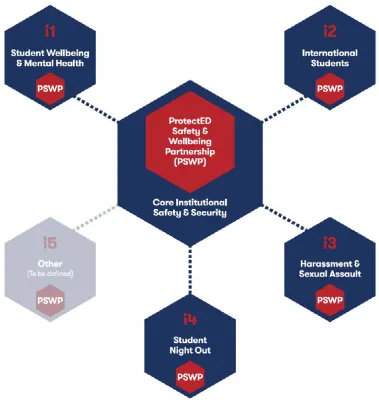
The ProtectED Code of Practice is structured as shown in Figure 1.
At the heart of ProtectED is partnership working — because student safety, security and wellbeing are a matter of collaboration rather than the responsibility of one service. What is required is a ‘joined-up’ approach across the student experience with effective collaboration between all relevant stakeholders — both internally within different areas of the institution, and externally with supporting agencies and stakeholders.
For this reason, the ProtectED structure is built around the ProtectED Safety & Wellbeing Partnership (PSWP), with this group playing a supportive role in all areas of ProtectED.
The ProtectED Code of Practice currently covers five areas — the Core and four Instruments:
‣
Core Institutional Safety & Security‣
Instrument 1: Student Wellbeing & Mental Health‣
Instrument 2: International Students‣
Instrument 3: Student Harassment & Sexual Assault‣
Instrument 4: Student Night Out2.1
An extensible framework
The combination of ‘Core Institutional Safety & Security’ with four, issue-focused instruments enables ProtectED to holistically address safety, security and wellbeing across the wider student experience.
ProtectED has been designed as an extensible framework, so that additional issue-focused instruments can be added to the scheme as required (see
2.2
ProtectED Safety & Wellbeing Partnership
ProtectED HEIs are encouraged to work across internal departments and services, and with external agencies — like the local authority, police and health services — to ensure students’ needs are met and potential risks and sources of conflict identified and managed. Such collaborative working is enabled by the ProtectED Safety & Wellbeing Partnership (PSWP) that HEIs are encouraged to establish. ProtectED accreditation requires
systematic partnership working across the student experience and therefore the PSWP plays a supportive role in all areas of ProtectED.
A partnership approach to problem solving allows HEIs to pool their resources for the mutual benefit of all parties, and to provide the most cost-effective care available. A co-ordinated and unified response — based on preventing problems as opposed to merely mitigating them — makes student life safer through reducing risk and increasing support, and also strengthens community relations.
3. The ProtectED Accreditation process
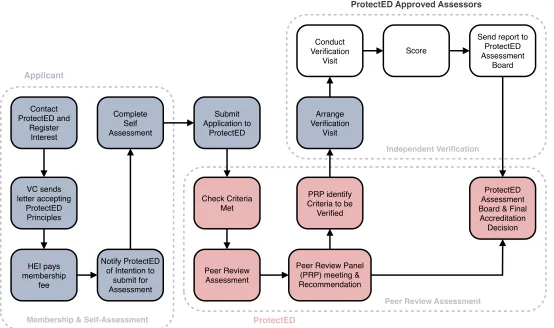
[image:19.842.148.702.163.491.2]The ProtectED Accreditation process, as shown in Figure 2, is based on a three-part process of Membership and Self-Assessment, Peer Review Assessment and Independent Verification by trained assessors.
Figure 2. ProtectED Accreditation – High Level Process
Applicant
ProtectED Approved Assessors
ProtectED
Check Criteria Met
ProtectED Assessment Board & Final Accreditation Decision Arrange Verification Visit Submit Application to ProtectED PRP identify Criteria to be
Verified Conduct Verification
Visit
Score
Send report to ProtectED Assessment
Board
Peer Review Assessment
Peer Review Panel (PRP) meeting & Recommendation
Independent Verification
Membership & Self-Assessment
Peer Review Assessment
Contact ProtectED and Register Interest Complete Self Assessment VC sends letter accepting ProtectED Principles HEI pays membership fee Notify ProtectED of Intention to
Membership & Self-Assessment
Becoming a ProtectED member is the start of the process (see 3.1 Joining ProtectED). The HEI should review the ProtectED Code of Practice, begin to set up the required organisational structures (e.g. the PSWP). When the HEI is ready to proceed with accreditation, they should notify ProtectED of their intention to submit their self-assessment submission (see 3.3 Applying for ProtectED accreditation).
Peer Review Assessment
This process of peer review assessment and independent verification determines an institution’s competency, authority, and credibility in meeting the
ProtectED Code of Practice, and potentially being awarded an accreditation certificate. To achieve ProtectED accreditation, the HEI must meet all the criteria in the Code of Practice at the required level or above.
Independent Verification
Independent verification is carried out by means of the Verification Visit by ProtectED Approved Assessors, and one or more Student Assessors. The Verification Visit follows a formal protocol, and includes an initial briefing and scheduling meeting at the member institution to plan the Assessors’ visit.
The Verification Visit results in the Verification Visit Report, which is submitted — along with Peer Review Panel recommendations — for consideration by the ProtectED Assessment Board.
3.1
Joining ProtectED
To become a ProtectED member requires a letter of endorsement from the vice-chancellor (or equivalent) of your institution.
The letter confirms the institution's acceptance of the ProtectED Principles, their commitment to these at the highest level, and commitment to action across the institution. A template letter for new members is available on the ProtectED website —www.Protect-ED.org
3.2
Accreditation award levels
Currently, there is a single level of ProtectED award — the ProtectED Accredited Institution award (see page 19).
As the number of institutions undertaking ProtectED assessment grows and evidence of best practice in the HEI sector is gathered, it is envisaged that further ProtectED award levels will be established for institutions able to demonstrate practice exceeding the ‘Required level’.
ProtectED Accredited Institution award
Institutions gaining accreditation at this level are able to refer to themselves as a ProtectED Accredited Institution.
‣
Application conditionsThe applicant institution must be a ProtectED Member that has signed up to the ProtectED Principles and have no outstanding membership fees.
‣
What assessment must demonstrateProtectED accreditation recognises that the institution meets the “Required Level” of all criteria contained in the ProtectED Code of Practice. The institution must also demonstrate it has the required resources and structures in place. This includes:
– Development of a collaborative organisational structure (if one does not already exist) to undertake ProtectED self-assessment, and to champion action on student safety, security and wellbeing across the student experience.
‣
Possible outcomes(i) ProtectED Accredited Institution award
(ii) No award.
‣
FeedbackThe Peer Review Assessment Panel provides constructive feedback on all submissions. This is supplemented with feedback from ProtectED
Approved Assessors in a Verification Visit report. Feedback highlights good practice revealed in the ProtectED assessment process, as well as making recommendations for areas in which improvements can be made.
‣
Accreditation renewal3.3
Applying for ProtectED accreditation
The applicant institution must have signed up to the ProtectED Principles and have no outstanding membership fees.
Member institutions preparing self-assessment submission should notify the ProtectED team of their intention to apply at least two months before the submission deadline. This enables the relevant accreditation resources (including Peer Review Panels and ProtectED Approved Assessors) to be scheduled.
Application submission deadline
There are two application submission deadlines per calendar year — one in the Spring and one in the Autumn.
Finite accreditation resource means there are necessarily a limited number of accreditation ‘places’ available for each submission deadline. Dates of upcoming submission deadlines and information on the number of accreditation places are published on the ProtectED website.
Confidentiality
All information submitted by an HEI to ProtectED is held in strictest confidence.
A ProtectED member’s decision to apply for assessment will not be disclosed. Similarly, members’ self-assessment submissions and information regarding assessment results is confidential, and is not disclosed outside of the ProtectED Accreditation team.
A list of ProtectED members and ProtectED Accredited institutions is publicly available from the ProtectED website.
3.4
Who should be involved in the self assessment process?
The ProtectED self-assessment submission should be completed by a Self-assessment Team.
Self-Assessment Team
Depending on the structure of the HEI, a ProtectED Self-assessment Team may involve:
‣
The institution's Head of Security, who may be responsible for ‘Core Institutional Safety & Security’‣
The Head of Student Services, who may take responsibility for Instrument 1 on 'Student Wellbeing & Mental Health'‣
The Head of the International Student Office, who may take responsibility for Instrument 2 on the 'International Students' instrument‣
The Head of Student Services or the Head of Security may take responsibility for Instrument 3 on 'Student Harassment and Sexual Assault'‣
The Head of Student Services may be responsible for Instrument 4 on the 'Student Night Out'.It is recommended that as many staff in the HEI as possible participate in the self-assessment to ensure it is a true reflection of the institution’s practices. Students’ Union sabbatical officers should be involved.
Meetings
4. The ProtectED Self-Assessment Workbook
4.1
Overall structure
Each area of the ProtectED Code of Practice — the Core and four Instruments — are included as a separate Self-Assessment Workbook (SAW), to allow easy distribution across relevant areas of the institution.
Thus, the entire ProtectED Code of Practice is made up of of six parts:
‣
Introduction & Overview (this booklet)‣
Core Institutional Safety & Security SAW‣
Instrument 1: Student Wellbeing & Mental Health SAW‣
Instrument 2: International Students SAW‣
Instrument 3: Student Harassment & Sexual Assault SAW‣
Instrument 4: Student Night Out SAW4.2
Self-Assessment Workbook content
The ProtectED Self-Assessment Workbook is a tool to help an HEI wishing to become a ProtectEDAccredited Institution, and to prepare for Peer Review and verification visit from ProtectED approved assessors.
The Self-Assessment Workbooks have been designed to help HEIs determine whether they meet the ProtectED Code of Practice prior to making a formal application to the ProtectED Accreditation award scheme.
HEIs that, after completing self-assessment, conclude that they do not meet ProtectED requirements should implement the required improvements before submitting an application for ProtectED accreditation.
The five ProtectED Self-Assessment Workbooks are each divided into a number of sections that relate to the aspect of safety, security or wellbeing being covered, as follows:
‣
Instrument 1: Student Wellbeing & Mental Health SAW — 5 sections‣
Instrument 2: International Students SAW — 5 sections‣
Instrument 3: Student Harassment & Sexual Assault SAW — 6 sections‣
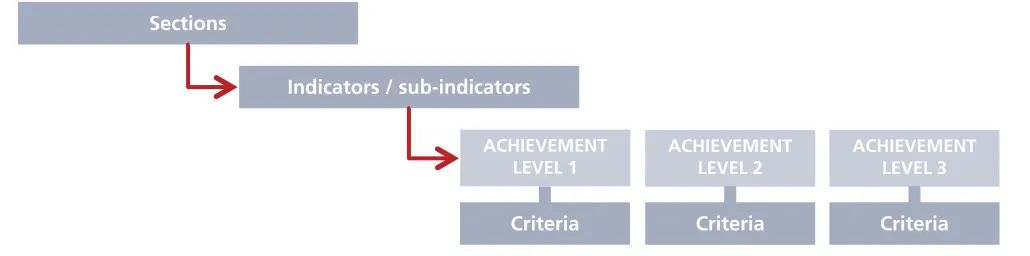
Instrument 4: Student Night Out SAW — 5 sectionsEach section contains multiple indicators and, where necessary, sub-indicators. Under each indicator are a number of criteria that describe three possible levels of achievement (see Figure 3). When met, these criteria demonstrate the level at which excellent service delivery and management in a particular ProtectED area are being achieved.
Sections
Indicators / sub-indicators
ACHIEVEMENT LEVEL 1
Criteria
ACHIEVEMENT LEVEL 2
ACHIEVEMENT LEVEL 3
[image:25.842.166.681.237.365.2]Criteria Criteria
Figure 3. ProtectED Workbook structure
To help HEIs understand where they are in relation to the requirements of ProtectED, up to three different achievement levels are defined for each indicator. These are described in three columns and represent progressive improvement in performance from left to right (see Figure 4). The
Required Level of achievement for ProtectED accreditation is indicated by the column title (with shaded cell) as so:
REQUIRED LEVEL
As ProtectED assessment and accreditation is rolled out and further HEI good practice identified, additional criteria for achievement above the required level will be defined.
The required level of achievement for all ProtectED Self-Assessment Workbook indicators is reviewed annually, and may be changed depending on current sector performance, emerging standards of good practice and the potential for improvement.
7.1 The HEI can demonstrate that it recruits safety and security staff through clear and industry-relevant policies and procedures. 7.1 The HEI can demonstrate that it recruits safety and security staff through clear and industry-relevant policies and procedures. 7.1 The HEI can demonstrate that it recruits safety and security staff through clear and industry-relevant policies and procedures.
7.1.1 The HEI has a defined and implemented recruitment policy for staff engaged in safety and security. 7.1.1 The HEI has a defined and implemented recruitment policy for staff engaged in safety and security. 7.1.1 The HEI has a defined and implemented recruitment policy for staff engaged in safety and security.
+3
+2 í All aspects of previous levels, plus:
REQUIRED LEVEL í All aspects of previous levels, plus: The HEI holds third party certification from a
Recruitment requirements for each safety and security role (e.g. experience, skills and
qualifications) within the HEI have been defined.
Private Security Industry Act 2001 licensing requirements are adhered to, including the checking of licences.
Staff engaged in safety and security must have the legal right to work in the UK.
í All aspects of previous levels, plus:
The HEI works to BS 7858 or appropriate industry sector equivalent in relation to its recruitment activities.
A drugs and alcohol policy exists which outlines the aims and purpose of the policy, explains who is covered by the policy, and clearly sets out the HEI’s rules in relation to drug and alcohol use for safety and security staff.
recognised UKAS certification body for BS7858.
Additional background checks with written responses covering ten years of employment history are completed within 16 weeks of commencement of employment for safety and security staff.
Figure 4. Example ProtectED Criterion and the three achievement levels
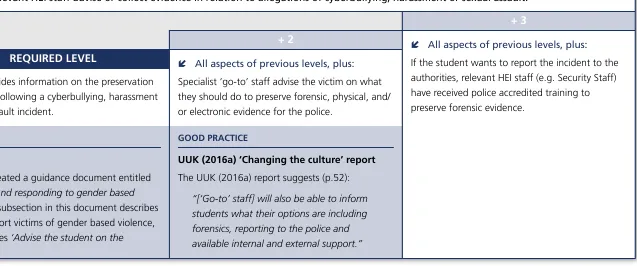
ProtectED has been designed as a quality standard that recognises existing good practice relating to HEI activities. Consequently, certain indicators include additional information relating to each Achievement Level — in the form of Good Practice and/or Case Study examples (see Figure 5).
5.2 Relevant HEI staff advise or collect evidence in relation to allegations of cyberbullying, harassment or sexual assault. 5.2 Relevant HEI staff advise or collect evidence in relation to allegations of cyberbullying, harassment or sexual assault. 5.2 Relevant HEI staff advise or collect evidence in relation to allegations of cyberbullying, harassment or sexual assault.
+ 3
+ 2 í All aspects of previous levels, plus:
REQUIRED LEVEL í All aspects of previous levels, plus:
í All aspects of previous levels, plus:
If the student wants to report the incident to the
The HEI provides information on the preservation of evidence following a cyberbullying, harassment or sexual assault incident.
í All aspects of previous levels, plus:
Specialist ‘go-to’ staff advise the victim on what they should do to preserve forensic, physical, and/ or electronic evidence for the police.
If the student wants to report the incident to the authorities, relevant HEI staff (e.g. Security Staff) have received police accredited training to preserve forensic evidence.
CASE STUDY GOOD PRACTICE
CASE STUDY
SOAS
SOAS has created a guidance document entitled ‘Preventing and responding to gender based violence’. A subsection in this document describes how to support victims of gender based violence, which includes ‘Advise the student on the
GOOD PRACTICE
UUK (2016a) ‘Changing the culture’ report
The UUK (2016a) report suggests (p.52):
[image:27.842.135.772.156.422.2]“[‘Go-to’ staff] will also be able to inform students what their options are including forensics, reporting to the police and available internal and external support.”
Figure 5. Example of Good Practice and Case Study examples included in ProtectED Self-Assessment Workbook
4.3
Using the Self-Assessment Workbooks
The ProtectED Code of Practice and associated Self-Assessment Workbooks have been designed to enable HEIs to:
‣
Work through the indicators in any order‣
Allocate those with the relevant expertise to concentrate on a particular part of ProtectED — be that the Core or a specific Instrument‣
Start, stop, and start again when the resources are available.For each indicator in the Code of Practice, the HEI should select the column that best represents the demonstrable performance of their institution. The required achievement level for ProtectED Accreditation is marked.
In order to become a ProtectED Accredited Institution, you must achieve at least a score of 1 in all indicators. The only exception will be any indicators that are Not Applicable.
Appendix 1
The Case for ProtectED
The safety and security of higher education students is a significant issue in the UK. University students are at relatively high risk of crime victimisation due to their age, circumstances and lifestyles. In 2014/15, 2.3m students started university in the UK (https://www.hesa.ac.uk/data-and-analysis/ publications/students-2014-15/introduction) — a larger population than that of Latvia. These students are at greater risk of crime than other people in Britain. Figures show that 19% of full-time students were victims of crime in 2014-15, compared to 16% of all adults in the general population11.
Moreover, full-time students experience higher levels of victimisation than the general population for a number of crimes, including burglary, violence, domestic violence, mugging, robbery and theft12.
Specific student groups face different personal safety issues. 56% of all new UK university students are female13 and recent reports show that women are at risk of sexual harassment and assault on UK university campuses. 68% of female students reported experiencing one or more kinds of sexual harassment whilst attending university14. Our research found that sexual harassment and sexual assault were the second and third most frequently raised student safety and wellbeing concerns for Student Union Sabbatical Officers. 21% of all new UK university students were from ethnic minorities15. A 2012 NUS survey16 found 18% of students with ethnic minority backgrounds stated they had experienced at least one racial hate incident whilst studying at university.
Students need to be safe when away from campus, as they travel to and from their home to the university or to the city centre. New undergraduate students, both domestic and international, may be unfamiliar with the local area and so unaware of how to get home from the city centre safely.
11 ONS (2016) All data related to Crime in England and Wales: Year ending June 2015. Data tables ‘Household Crime Prevalence’ and ‘Personal Crime Prevalence’
http://www.ons.gov.uk/peoplepopulationandcommunity/crimeandjustice/bulletins/crimeinenglandandwales/2015-10-15/relateddata?page=1
12 ONS (2016) All data related to Crime in England and Wales: Year ending June 2015. Data tables ‘Household Crime Prevalence’ and ‘Personal Crime Prevalence’ http://www.ons.gov.uk/
peoplepopulationandcommunity/crimeandjustice/bulletins/crimeinenglandandwales/2015-10-15/relateddata?page=1
13https://www.hesa.ac.uk/data-and-analysis/publications/students-2014-15/introduction
14 NUS (2010) Hidden Marks: A study of women students’ experiences of harassment, stalking, violence and sexual assault.
http://www.nus.org.uk/Global/NUS_hidden_marks_report_2nd_edition_web.pdf
15https://www.hesa.ac.uk/data-and-analysis/publications/students-2014-15/introduction
This may put them at greater risk of crimes such as theft, robbery, mugging, or violence. Students should be informed of the safe routes and transportation options to get home safely. Being under the influence of alcohol can put a student at even greater risk of crime. About 89% of university students drink alcohol; of which, 28% of university students report binge drinking and 15% report hazardous drinking levels (greater than 51 units for men and 36 for women per week)17. Such excessive drinking is a safeguarding issue, as it transforms a student into a vulnerable adult. Further, the risk of becoming a victim of sexual assault is greater for women who consume more alcohol and who get drunk more often18.
International students, who comprise 19% of all UK university students19, are increasingly concerned about safety when deciding where to study20. This influences their choice about whether to study in the UK or another country, meaning that student victimisation could hinder future
international student recruitment. International students contribute £12.75bn to the UK economy21. To recruit international students, HEIs must demonstrate their academic qualities, and show a clear commitment to international student welfare. However, a recent British Council survey found that only 32% of international students received a personal safety briefing from the police after arriving to their HEI (British Council, 201622).
Without advice on preventative behaviour such as using safe routes or carrying valuables discreetly, international students may be at greater risk of becoming a victim of crime. While international students may encounter similar difficulties to their domestic peers, such as living away from home from the first time, these are experienced during a period of major cultural adjustment in a new country, and often compounded by difficulties speaking the language. Feelings of loneliness may be exacerbated by the struggle to integrate and make friends, and the expense involved in visiting their home country. Thus, international students’ wellbeing is important for an HEI to consider.
The wellbeing and mental health of university students is fast becoming a significant issue for the sector. Our research with Students' Union
sabbatical officers found mental health to be their number one student safety and wellbeing concern. A 2015 NUS survey23 of 1,093 students found that almost 80% experienced mental health issues in the previous year. This coincides with a sharp increase in students accessing counselling
17 Royal College of Psychiatrists (2011) Mental health of students in higher education, p 26 http://www.rcpsych.ac.uk/files/pdfversion/CR166.pdf 18 Royal College of Psychiatrists (2011) Mental health of students in higher education, p 26 http://www.rcpsych.ac.uk/files/pdfversion/CR166.pdf 19https://www.hesa.ac.uk/data-and-analysis/publications/students-2014-15/introduction
20https://www.theguardian.com/higher-education-network/blog/2012/oct/22/safety-international-students-uk-universities 21 British Council (2016) https://www.britishcouncil.org/sites/default/files/f076_creating_confidence_survey_a5_web_final.pdf
22 British Council (2016) Creating Confidence: International student survey 2015-16 https://www.britishcouncil.org/sites/default/files/f076_creating_confidence_survey_a5_web_final.pdf
23 The Guardian (2015) Majority of students experience mental health issues, says NUS survey
services24 — with an annual rise in demand of around 10%. But without appropriate support, mental ill-health may result in self-harm or even suicide. Between 2007 and 2011, 518 full-time students25 aged over 18 in England and Wales committed suicide, with male students most at risk. There has been some suggestion that universities have been “negligent” in accepting their pastoral responsibilities26.
While a number of universities are taking steps to improve student safety and wellbeing services, consistency remains an issue across the sector. Current approaches to safety, security and wellbeing in the higher education sector are fragmented, varying widely between different institutions. There is currently no comprehensive best practice standard for universities wishing to more effectively address the issue of student safety and security — or the broader issue of student wellbeing. The need for ProtectED is rooted in the recognition that universities have a role to play in supporting the broader safety and wellbeing of their students — not only while they are on campus, but throughout their student experience.
24http://www.bbc.co.uk/news/education-34354405
Appendix 2
Glossary
Access control The use of either security personnel or an electronic system, usually combined with a physical barrier (e.g. door, turnstile, etc.) to restrict ingress to a building or area to only those persons with a legitimate reason to be there.
See also Physical security, below.
Asset An asset is something of value to the organisation that requires protection.
Assets are varied and include:
‣
Keys‣
Stock, i.e. classes of goods‣
IT equipment, i.e. laptops, mobile phones, cables‣
Vehicles‣
Cash‣
Commercial‣
Fixtures and fittings‣
People, including lone workers.These can be tangible assets (e.g. equipment) or intangible (e.g. reputation and intellectual property).
Different assets require different levels of security and protection, and identifying them enables appropriate levels of protection to be planned, e.g. a laptop might easily be replaced, but the files and data it contains might be irreplaceable or of value to a competitor.
Asset management The organisation should identify and manage its assets to collect the right information and put systems in place for effective asset management. Asset management is a key element in keeping assets safe and secure, and to prevent them from being lost, stolen or damaged.
[SOURCE: BS 16000: 2015, 8.7]
Concerned third parties
Individuals who are concerned about a current student at university. Such as: friends, housemates, family, parents, guardians, dependents, carers, schools or colleges
Cyberbullying Cyberbullying is any form of intimidating or abusive behaviour that happens via technology, including the use of text messages, email, social media, chat rooms and instant messages. Cyberbullying takes aspects of traditional bullying and reframes these actions within the context of technology.
Forms of cyberbullying include:
‣
Harassment‣
Defamation‣
Exclusion‣
Identity theft & impersonation‣
Manipulation‣
Circulation of private files[SOURCE: NUS Welfare & Students’ Rights: Cyberbullying]
Disability Disability is a physical or mental impairment which has a ‘substantial’ and ‘long-term’ adverse effect on one’s ability to carry out normal day-to-day activities.
‣
‘Substantial’ is more than minor or trivial (e.g. it takes much longer than it usually would to complete a daily task like getting dressed)‣
People with progressive conditions — those that get worse over time — can be classed as disabled‣
Individuals with HIV infection, cancer or multiple sclerosis automatically meet the disability definition.[SOURCE:UK Government: Definition of disability under the Equality Act 2010]
Harassment Harassment is unwanted, unsolicited or unwelcome behaviour or language that is offensive or intimidating to the recipient. This includes conduct which makes the recipient feel threatened or humiliated as a result of their gender, skin colour, race, ethnic or national origin, religious belief, sexual orientation, disability or other personal characteristic.
Examples of harassment may include:
‣
Embarrassing, abusive or insulting words or behaviour, jokes or innuendo‣
Unwelcome remarks about clothes or appearance‣
Unwanted physical contact‣
Demands for sexual favours‣
Electronic messages or electronic displays of sexually suggestive pictures and literature (including via e-mail)‣
Aggressive behaviour, physical or verbal‣
Persistently demeaning and downgrading through words and actions‣
Inappropriate and derogatory remarks in connection with performance[SOURCE: Warwick University]
Hot spot An identified physical location or point in time that is associated with elevated levels of activity, use or interest.
International student
Student from overseas studying in the UK at a Higher Education Provider. Includes students from both EU and non-EU countries.
[SOURCE:HESA]
Mental health Good or positive mental health is more than the absence or management of mental health problems; it is the foundation for wellbeing and effective functioning both for individuals and for their communities.
Mental health crisis A mental health crisis is when one feels their mental health is at breaking point. They might be experiencing:
‣
Suicidal feelings or self-harming behaviour‣
Extreme anxiety or panic attacks‣
Psychotic episodes (such as delusions, hallucinations, paranoia or hearing voices)‣
Hypomania or mania‣
Other behaviour that feels out of control, and is likely to endanger themselves or others[SOURCE:Mind]
Mental illness, mental ill health
A term generally used to refer to more serious mental health problems that often require treatment by specialist services. Such illnesses include depression and anxiety (which may also be referred to as common mental health problems) as well as schizophrenia and bipolar disorder (also sometimes referred to as severe mental illness). Conduct disorder and emotional disorder are the
commonest forms of childhood mental illness.
[SOURCE: HM Government (2011) ‘No health without mental health’]
Operational requirements
Measures identified as necessary to address risks, threats and vulnerabilities
[SOURCE: BS 16000: 2015, 2.4]
Pastoral roles Personal tutors, academic tutors, course leaders, Student Union officers, hall of residence wardens, hall mentors, etc.
Peer-to-peer Fostering co-operation and a sense of mutual responsibility amongst the student community, whereby students are encouraged to offer emotional and practical support and guidance to their peers in relation to their safety and wellbeing.
Physical security Physical security should take into account the control of access (access control), e.g. the building’s entry and exit points (including fire escapes) which restrict the flow of people into and out of the organisation's building(s).
Physical security puts a physical barrier in the way of a wrongdoer to deter them from achieving their aim. Examples include:
a) Perimeter security: fences, gates, bollards, barriers, etc..
b) Building security: security of doors and windows, airlocks, rising screens and shutters, etc.
c) Point security: safes, secure cabinets, physical locks on computers, etc.
NOTE: Physical security also includes features such as ditches, hedges and plants, which act as a natural deterrent.
[SOURCE: BS 16000: 2015, 8.2]
Postvention Activities and programmes that are intended to assist those who have been bereaved by suicide to cope with what has happened. Suicide prevention and postvention are closely related in that postvention can also prevent further deaths.
[SOURCE: New Zealand Ministry of Youth Development (2005) Guidance for community organisations involved in suicide postvention, page 3]
College and university postvention is the provision of psychological support, crisis intervention and other forms of assistance to those affected by a campus suicide.
Suicide postvention involves a series of planned interventions with those affected by a university campus suicide with the intention to:
‣
Facilitate the grieving process‣
Stabilise the environment‣
Reduce the risk of negative behaviours‣
Limit the risk of further suicides through contagion.Risk Effect of uncertainty on objectives
NOTE 1: Although sometimes used colloquially to indicate something that is undesirable, “risk” as defined here is a neutral concept that is neither inherently desirable nor undesirable; willingness to accept some uncertainty (and therefore risk) is generally necessary in order to pursue objectives.
NOTE 2: Organisations typically have multiple objectives (such as those concerning financial, safety, environmental goals and reputation), which drive all aspects of the organisation's activities (such as policies, strategies, projects, products and processes).
NOTE 3: Risk is often characterised by reference to the likelihood of experiencing consequences together with the potential for events from which such consequences could result.
NOTE 4: Uncertainty relates to a deficiency of information relevant to decision-making and takes many forms. NOTE 5: See ISO/IEC Guide 51 for this term in the context of safety.
[SOURCE: PD ISO Guide 73:2009, 1.1, modified in BS 16000: 2015]
Risk analysis Process to comprehend the nature of risk and to determine the level of risk
NOTE 1: Risk analysis provides the basis for risk evaluation and decisions about risk treatment. NOTE 2: Risk analysis includes risk estimation.
NOTE 3: See ISO/IEC Guide 51 for this term in the context of safety.
[SOURCE: PD ISO Guide 73:2009, 3.6.1]
Risk assessment Overall process of risk identification, risk analysis and risk evaluation
NOTE: See ISO/IEC Guide 51 for this term in the context of safety.
[SOURCE: PD ISO Guide 73:2009, 3.4.1]
Risk avoidance Informed decision not to be involved in, or to withdraw from, an activity in order to not be exposed to a particular risk
NOTE: Risk avoidance can be based on the result of risk evaluation and/or legal and regulatory obligations.
Risk management Coordinated activities to direct and control an organisation with regard to risk
[SOURCE: PD ISO Guide 73:2009, 2.1]
Security Condition of being protected against damage, harm or loss, achieved through the management of adverse consequences associated with natural events and the intentional and/or unwanted actions of others by physical, technical, electronic, information technology (IT) or human factors, or a combination of those factors.
[SOURCE: BS 16000: 2015, 2.18]
Security function Person(s) responsible for managing security
[SOURCE: BS 16000: 2015, 2.19]
Security management
Set of interrelated or interacting elements of an organisation to establish security policies and objectives and processes to achieve those objectives
[SOURCE: BS 16000: 2015, 2.20]
Security management system
Part of the overall management system that establishes, implements, operates, monitors, reviews, maintains and progressively improves security management
NOTE: The management system includes organisational structure, policies, planning activities, responsibilities, procedures, processes and resources.
[SOURCE: BS 16000: 2015, 2.21]
Security officers Also known as manned security.
Security officers deter, detect and apprehend wrongdoers. Security officers can provide a number of security functions for an organisation, such as:
a) Concierge duties
b) 24-hour on-site protection
d) Key holding response (response to technical systems alarms)
e) Manning gate posts for vehicle and personnel entry/exit points
f) Operation of security systems (including onsite CCTV)
g) Carry out security screening (x-ray machines, explosive detection, drug detection, etc.).
[SOURCE: BS 16000: 2015, 8.4]
Security policy Corporate document setting out the organisation's intentions and principles with regard to security, formally expressed by top management
[SOURCE: BS 16000: 2015, 2.22]
Sexual assault Sexual assault is any sexual act that a person did not consent to or is forced against their will. Consent is legally defined as agreeing by choice and having the freedom and capacity to make that choice.
Sexual assault is a form of sexual violence that includes:
‣
Sexual contact (this could include forced kissing, touching)‣
Attempted sexual intercourse (when someone has tried to have oral, anal or vaginal sex with an un-consenting individual but has not been successful)‣
Rape (an assault involving penetration of the vagina, anus or mouth)[SOURCE:NUS Hidden Marks and the NHS]
Staff engaged in security and wellbeing and asset protection roles
Student services Sometimes referred to as student support services.
An umbrella term for a variety of study support and guidance services delivered by higher education institutions, such as:
‣
Counselling‣
Mental health advice‣
Wellbeing advice and support‣
Psychiatric consultancy‣
Services for disability, dyslexia and other specific learning difficulties‣
Support provided within faculties and teaching departments including personal‣
Tutors and other pastoral systems‣
Accommodation services, including resident welfare staff and peer supporters‣
International student advice and guidance‣
Chaplaincy and multi-faith support‣
Financial guidance and resource‣
Academic learning enhancement and study skills advice‣
Mentoring and advocacy‣
Careers services‣
Student health and/or occupational health services‣
Peer-led support groups and student ambassadors and mentors.[SOURCE: UUK/MWBHE ‘Student mental wellbeing in higher education’]
Threat Action or potential action likely to cause damage, harm or loss.
EXAMPLES: physical; biological; chemical; ergonomic; psychological; criminal; fire, environmental, natural disaster; civil disturbance; espionage.
Vulnerability Intrinsic properties of something resulting in susceptibility to a risk source that can lead to an event with a consequence.
[SOURCE: PD ISO Guide 73:2009, 3.6.1.6]
Wellbeing A positive state of mind and body, feeling safe and able to cope, with a sense of connection with people, communities and the wider environment.
Wellbeing is sometimes referred to as mental wellbeing or emotional wellbeing.
Appendix 3
References
ACPO (2008) The application of neighbourhood policing to higher education institutions. London: Association of Chief Police Officers of England, Wales and Northern Ireland.
Higher Education Mental Health Alliance (HEMHA) (2014) Postvention: A guide for response to suicide on college campuses. Retrieved from https:// www.naspa.org/images/uploads/main/Postvention_Guide.pdf
Lancaster University (2002) Student mental health planning, guidance & training manual. Retrieved from http://www.studentmentalhealth.org.uk
NUS (2013) Welfare and students' rights: Cyberbullying. Retrieved from http://s3-eu-west-1.amazonaws.com/nusdigital/document/documents/10487/ f735e5d6f2e17c50228a6b7ec587aca1/Cyberbullying%20briefing.pdf
NUS (2011a) Hidden marks: A study of women students' experiences of harassment, stalking, violence and sexual assault. Retrieved from http:// www.nus.org.uk/Global/NUS_hidden_marks_report_2nd_edition_web.pdf
NUS (2011b) No place for hate – Hate crimes and incidents in further and higher education: Disability. Retrieved from http://www.nus.org.uk/ PageFiles/12238/2011_NUS_No_Place_for_Hate_Disability.pdf
NUS (2011c) No place for hate – Hate crimes and incidents in further and higher education: Sexual orientation and gender identity. Retrieved from http://www.nusconnect.org.uk/resources/no-place-for-hate-hate-crimes-and-incidents-in-further-and-higher-education-sexual-orientation-and-gender-identity
NUS (2012a) No place for hate – Hate crimes and incidents in further and higher education: Race and ethnicity. Retrieved from https:// www.nus.org.uk/PageFiles/12238/2012_NUS_No_Place_for_Hate_Race.pdf
NUS. (2015) Deposits. Retrieved from http://www.nus.org.uk/en/advice/housing-advice/deposits/
NUS. (2016) Alcohol impact. Retrieved from http://alcoholimpact.nus.org.uk/about
NUS Connect. Ready to rent. Retrieved from http://www.nusconnect.org.uk/winning-for-students/welfare/housing-and-community/ready-to-rent
NUS Connect (2015) I heart consent workshop guide. Retrieved from http://www.nusconnect.org.uk/resources/i-heart-consent-workshop-guide
Papyrus (2007) Responses and prevention in student suicide: The RaPSS study. Retrieved from http://www.papyrusuk.eu/attachments/ PSSsummary.pdf
Samaritans (2016) Step by step resources: How to prepare for and respond to suicide in schools and colleges. Retrieved from http:// www.samaritans.org/your-community/supporting-schools/step-step/step-step-resources
Security Industry Authority (SIA). Door supervisor training. Retrieved from http://www.sia.homeoffice.gov.uk/Pages/training-ds.aspx
UK Council for International Student Affairs (UKCISA) (2014) Code of practice for agents who subscribe to UKCISA. Retrieved from http:// institutions.ukcisa.org.uk//Info-for-universities-colleges--schools/About-UKCISA/Membership/Codes-of-practice/Code-of-practice-for-members/
Universities UK (2002) Reducing the risk of student suicide: Issues and responses for higher education institutions. London: Universities UK.
Universities UK (2016a) Changing the culture: Report of the Universities UK taskforce examining violence against women, harassment and hate crime
affecting university students. London: Universities UK. Retrieved from http://www.universitiesuk.ac.uk/policy-and-analysis/reports/Documents/2016/ changing-the-culture.pdf
Universities UK (2016b) Guidance for higher education institutions: How to handle alleged student misconduct which may also constitute a criminal offence. London: Universities UK. Retrieved from http://www.universitiesuk.ac.uk/policy-and-analysis/reports/Documents/2016/guidance-for-higher-education-institutions.pdf
University Mental Health Advisors Network (UMHAN) (2010) Practical guidance for the development and day-to-day provision of a higher education institution mental health service. Retrieved from http://www.umhan.com/practice-and-service-guidance.html
®
ISBN 978-1-907842-91-7
9 7 8 1 9 0 7 8 4 2 9 1 7 Issue 1 – November 2016
Introduction & Overview
This document provides an introduction to the ProtectED Code of Practice, the first code of practice and accredita-tion scheme designed to support higher educaaccredita-tion institu-tions in ensuring student safety, security and wellbeing. ProtectED recognises that universities have a wider role to play in supporting their students — not only while they are on campus, but throughout their student experience. The ProtectED Code of Practice currently comprises five parts — ‘Core Institutional Safety & Security’ and four issue-focused instruments. This extensible structure ena-bles ProtectED to holistically address safety, security and wellbeing across the wider student experience.