International Journal of Emerging Technology and Advanced Engineering
Website: www.ijetae.com (ISSN 2250-2459, ISO 9001:2008 Certified Journal, Volume 9, Issue 4, April 2019)
132
A Proficient Load Balancing Based on Prioritized Virtual
Machines in Cloud Computing
Aakash Dhar Badgaiyan
1, Rajendra Arakh
21M. Tech. Scholar, 2Asst. Professor, Dept. of Computer Science & Engineering, Global Engineering College, Jabalpur,
Madhya Pradesh, India
Abstract - Many technologies and opportunities have born with the growth of the internet. For huge amount of data processing Cloud computing is a most modern trend. It aids in providing shared resources. Cloud Computing offers the distributed parallel processing both. It is a big challenge of Distributed system to provide efficient Response time. It is gives data on basis of pay per use model and eliminates the need of having one’s own device. As cloud computing grows, more users get attracted towards it. Distributed computing need less response time and effective load balancing is one of the major issues that can improve response time. Improving the dynamic nature of load balancing algorithms in order to improve the performance of the cluster is the first and foremost requirement. In the proposed algorithm, load balancing is done by considering priority policy. Priority calculation is done by considering hardware parameters including CPU speed, memory resource and power consumption which helps to avoid the overloading and under loading of resources. A resource allocation strategy that takes into account resource utilization would lead to better energy efficiency. An Efficient Load Balancing based on prioritize virtual machines is proposed and related algorithm is executed on cloudsim and its toolkit. The results show the effectiveness of the proposed algorithm.
Keywords: Cloud Computing, Load Balancing, Existing load balancing algorithms.
I. INTRODUCTION
Cloud computing is the ability of using various computing resources through the internet including applications and storage services. The shared pool of the resources is hosted by the cloud provider. According to the National Institute of Standard and Technology [1], Cloud Computing is defined as a model for providing convenient and on demand access to the shared pool of resources including networks, storage, services etc. These services require minimal effort. From the business point, cloud computing is a new business model that has not been possible without the cloud. The main attribute of the cloud computing is the elasticity, means its tendency to grow and reduce the computation as per the requirements [2]. The other attribute is it is scalable, means its ability to balance the increased demands of the CPU storage, bandwidth etc. Cloud Computing provides the secure access to the applications as shown in the Figure 1.1.
But high level security is a challenge for the cloud developers.
II. LOAD BALANCING
A web server has the dispatcher to balance the incoming request to the servers. The main aim of dispatcher in load balancing is to transfer the request to the server that is available at that time. The front end is responsible to balance the requests by making decisions regarding the transfer so that the load is transferred efficiently to the server which can process the request at that moment. Web server’s load information is used in making the decisions by the front end. The front end may send a series of the requests to the number of the web servers. An example of the load balancing has shown in the Figure 1.6. In this, the front end distributes the load to the server with least load at that moment. The server and the front end exchanges the information about the load with each other to make the effective decisions. With the help of the correct decision about the load balancing, the service quality is improved and the system becomes more robust. The load balancer decides how to forward the requests and the decision is made correspond to the CPU load percentage on the particular virtual machine.
A.Load Balancing Algorithms
The aim of the load balancing algorithms is to increase the overall performance. The algorithm must provide scalability to ensure timely modification in case of the system state changes.
B.Static Load Balancing Algorithms
International Journal of Emerging Technology and Advanced Engineering
Website: www.ijetae.com (ISSN 2250-2459, ISO 9001:2008 Certified Journal, Volume 9, Issue 4, April 2019)
133
C.Dynamic Load Balancing Algorithms
Dynamic load balancing algorithms depend on the run-time information collected of the selected nodes. In this approach, workload is assigned and may reassign to the nodes based on the computation. These algorithms also require continuous monitoring of the tasks. This is also more accurate approach of load balancing in comparison with the static approach.
D.Cloud Simulation
Cloudsim is a simulator [17][18] that enables to instantiate more than 10.000 machines in less than 5 seconds and that too with the help of only 75MB of RAM [19]. It mainly extends the functionalities of the basic GridSim. It has been extended by various research projects. The extended functionalities include resource provisioning between the virtual machines, modeling storage and the application servers, simulation of the cloud etc. CloudSim is used in many research fields. The research fields include energy efficient cloud scheduling algorithms [10], and further enhancement in the communication flow includes the green computing energy scheduling algorithms [21]. The CloudSim is further enhanced to support the user‟s perspective. The CloudSim is also extended for the education purposes and the resultant is the TeachCloud [12] which provides the graphical interface so that the students can perform the experiments on the cloud easily.
III. RELATED WORK
Kumar Nishant et al. proposed an algorithm based on Ant’s Behaviour. Ant’s Algorithm is based on the ant’s behavior as the ants move towards the region of large amount of resources [15]. An ant is always in search of new food and uses this food sources to deliver back to the nest. In this algorithm, first a head node is chosen. The selection of the head node is based on the node which has large number of the neighboring nodes. The ant is always started from the head node.
Shu Ching Wang et al. proposed Load Balancing Min-Min (LBMM) algorithm which framework consists of three levels [16]. First is the request manager second is the service manager and the third one is the subdivision. The request manager is responsible for receiving the workload and then assigns it to the service manager. After receiving the request the service manager further subdivide the workload to increase the processing speed.
Junjie Ni et al. proposed Load balancing algorithm for virtual machines [17] which contains central scheduling to calculate the resources available for the task. The available resource is then assigned for the processing. Resource monitor is there to calculate the details of the resources available.
The algorithm is based on the machine mapping. The process consists of several stages including acceptance of the request, getting the resource information, controller calculates the resource availability to process the tasks.
Martin Randles et al. proposed Honeybee Foraging Algorithm [19]. This algorithm is based on the behavior of the honeybees. Two types of honeybees are there- one who finds the honey and the other who reaps. Finder honeybees go in search of the honey and find the food sources.
IV. PROBLEM STATEMENT
Problem Definition- In cloud computing, there is an issue
regarding overloading of the tasks due to the random arrival of the tasks. Due to the random utilization of the CPU, resources are sometimes heavily loaded whereas the other resources are idle. Load Balancing is a way to distribute the entire load over the network across a large number of virtual machines or CPU. This helps to achieve the balanced utilization which maximizes the performance and minimizes the response time. So there is an important issue to balance the load efficiently among the resources.
V. PROBLEM FORMULATION
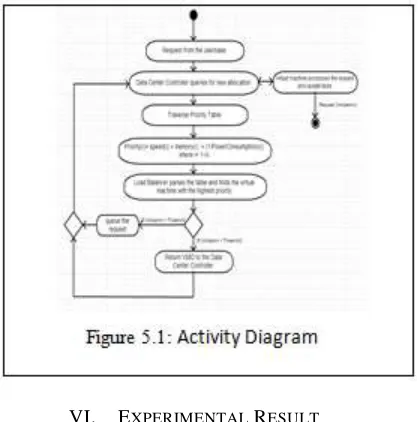
An efficient load balancing algorithm based on resource utilization is proposed for efficient resource utilization and it also avoids overloading and underloading condition. This load balancer is connected to the datacenter and all its users. All the virtual machines are managed by the datacenter controller. Load Balancer computes the priorities of the virtual machines by parsing its table, based on their speed, memory and power consumption. Load balancer then passes the load to highest priority virtual machine. Due to efficient utilization of the resources, this algorithm is also energy efficient.
A.An Efficient Load Balancing based on Prioritized
Utilization
The proposed Load Balancing Algorithm based on Prioritized Utilization description is as follows-
1. Initially all the virtual machines have no allocations. 2. Datacenter Controller receives the user request. 3. The request is passed to the load balancer.
4. Load Balancer maintains the table which contains Virtual machine ID, speed of the virtual machine, memory resource and the power consumption of the virtual machine.
International Journal of Emerging Technology and Advanced Engineering
Website: www.ijetae.com (ISSN 2250-2459, ISO 9001:2008 Certified Journal, Volume 9, Issue 4, April 2019)
134
6.After parsing the table from top to bottom, itcalculates the priority of all the virtual machines from top to bottom.
Priority (i) = s(i) + m(i) + (1/P(i)), where i=1<n and Priority lies between [0,1]
Where s= speed of CPU
m = memory resource P = Power consumption n= number of virtual machines
7.If utilization of vm > threshold, then the process will enter into queue, goto step 2.
8.The highest priority virtual machine is selected and its ID is returned to the Datacenter controller.
9.Datacenter processes the request and load balancer updates the table according.
The Data Center Controller checks if there are any waiting requests in the queue. If there are, it continues from step.
VI. EXPERIMENTAL RESULT
The proposed algorithm is implemented through the simulation software like cloudsim and the cloudsim based toolkit. For the implementation of the application, java language is used. Assuming that the application is deployed in single data center which has a number of virtual machines.
A.Load Balancing Execution
Figure 6.1: Initial Virtual Machines Before Allocation
Figure 6.2: Current Status of Load
Balancer
Figure 6.3: Next highest priority virtual machine is selected
Figure 6.4: Priority Calculation
[image:3.612.325.557.136.612.2]VII. RESULTS
Figure 7.1: Equally Spread Current Execution Load Balancer
[image:3.612.64.273.341.552.2]International Journal of Emerging Technology and Advanced Engineering
Website: www.ijetae.com (ISSN 2250-2459, ISO 9001:2008 Certified Journal, Volume 9, Issue 4, April 2019)
135
VIII. CONCLUSION AND FUTURE SCOPE
The main issue remained is load balancing and the resource utilization. Therefore, the load balancing should be more dynamic and efficient to improve the performance of the cloud computing technology. The existing work considered several load balancing techniques that manage the load distribution among various virtual machines and assigns load corresponding to their priority and states. There is an issue of overloading which means the resources may be over utilized and hence there increases the response time.
In future, the load balancing can be more dynamic by assigning the weights to the parameters dynamically in order to to calculate the priority of the virtual machine. In this paper, response time of the algorithm is improved but the effect of assigning different weight on response time can also be evaluated and the results can be compared in future. So in this way, load balancing can be more dynamic.
REFERENCES
[1] P. Mell and T. Grance, “The NIST Definition of Cloud Computing”, National Institute of Standards and Technology, Sept. 2011. [2] E. J. Qaisar, “Introduction to Cloud Computing for Developers: Key
concepts, the players and their offerings”, in proc. of IEEE Information Technology Professional Conference (TCF Pro IT), pp. 1-6, 2012.
[3] M. B. Mollah, K. R. Islam and S. S. Islam, “Next Generation of Computing through Cloud Computing Technology”, in proc. of 25th IEEE Canadian Conference on Electrical and Computer Engineering (CCECE), pp.1-6, 2012.
[4] J. Harauz, L. M. Kaufinan and B. Potter, “Data Security in the World of Cloud Computing”, in proc. of IEEE Security & Privacy, co published by IEEE Computer and Reliability Societies, pp. 61-64, July 2009.
[5] M. D. Dikaiakos, G. Pall, et al. “Cloud computing: Distributed Internet Computing for IT and Scientific Research”, in proc. of IEEE Internet Computing, pp. 10-13, 2009.
[6] Y. Jadeja and K. Modi, “Cloud Computing - Concepts, Architecture and Challenges”, in IEEE proc. of International Conference on Computing, Electronics and Electrical Technologies (ICCEET), pp. 877-880, 2012.
[7] I. M. Khalil, A. Khreishah, S. Bouktif and A. Ahmad, “Security Concerns in Cloud Computing”, in IEEE proc. of 10th International Conference on Information Technology: New Generations (ITNG), pp. 411-416, 2013.
[8] [Online: May, 2014] Retrieved from:
http://outsideinmarketing.files.wordpress. com/2012/02/cloud_difference_aas.jpg
[9] S. M. Hashemi and A. K. Bardsiri, “Cloud Computing vs. Grid Computing”, in ARPN Journal of Systems and Software, vol. 2, no. 5, pp. 188-194, 2012.
[10] S. Liu, X. Huang, H. Fu and G. Yang, “Understanding Data Characteristics and Access Patterns in a Cloud Storage System”, in 13th IEEE/ACM proc. of International Symposium on Cluster, Cloud and Grid Computing(CCCG), pp. 327-334, 2013.
[11] B. M. Purcell, “Big data using cloud computing”, in Journal of Technology Research, pp. 1-8.
[12] B. B. Gowrigolla, S. Sivaji and M. R. Masillamani, “Design and auditing of Cloud computing security,” in IEEE proc. of 5th International Conference on Information and Automation for Sustainability (ICIAFs), pp. 292-297, 2010.
[13] M. G. Avram, “Advantages and challenges of adopting cloud computing from an enterprise perspective”, in Elsevier proc. of 7th International Conference Interdisciplinary in Engineering (INTER-ENG), pp. 529-534, 2013.
[14] A. T. Velte, T. J. Velte and R. Elsenpeter, “Cloud Computing: A Practical Approach”, in Tata Mcgraw-Hill, 2010 edition, pp. 8-11. [15] T. Mather, S. Kumaraswamy and S. Latif, “Cloud Security and
Privacy: An Enterprise Perspective on Risks and Compliance”, O’Reilly Media, 2009.
[16] E. A. Rayis and H. Kurdi, “Performance Analysis of Load Balancing Architectures in Cloud Computing”, in IEEE proc. of European Modeling Symposium(EMS), pp. 520-524, 2013.
[17] R. Buyya, A. Beloglazov, and J. Abawajy, “Energy-Efficient Management of Data Center Resources for Cloud Computing: A Vision, Architectural Elements, and Open Challenges”, pp. 1-8, 2010.
[18] K. Nuaimi, N. Mohamed, M. Nuaimi and J. Jaroodi, “A Survey of Load Balancing in Cloud Computing: Challenges and Algorithms”, in IEEE Second Symposium on Network Cloud Computing and Applications(NCCA), pp. 137- 142, 2012.
[19] M. Randles, D. Lamb and A. Bendiab, “Experiments with Honeybee Foraging Inspired Load Balancing”, in IEEE proc. of 2nd International Conference on Developments in eSystems Engineering(DESE), pp. 240-247, 2009.
[20] F. Ali and M. Alakeel, “A Guide to Dynamic Load Balancing in Distributed Computer Systems”, in International Journal of Computer Science and Network Security (IJCSNS), pp. 153-160, June 2010.
[21] T. Gunarathne, T. Wu, J. Qiu and G. Fox, “MapReduce in the Clouds for Science”, in IEEE proc. of 2nd International Conference on Cloud Computing Technology and Science (CloudCom), pp. 565-572, Nov. 2010.
International Journal of Emerging Technology and Advanced Engineering
Website: www.ijetae.com (ISSN 2250-2459, ISO 9001:2008 Certified Journal, Volume 9, Issue 4, April 2019)
136
[23] L. Kolb, A. Thor, and E. Rahm, “Load Balancing for MapReducebased Entity Resolution,” in the proc. of IEEE 28th International Conference on Data Engineering (ICDE), pp. 618-629, 2012. [24] K. Radojevic, B. Zagar and M. Zagar, “Analysis of issues with load
balancing algorithms in hosted (cloud) environments”, in IEEE proc. of 34th International Convention on MIPRO, pp. 416-420, 2011.
[25] N. Kumar, P. Sharma, et al. “Load Balancing of Nodes in Cloud Using Ant Colony Optimization”, in IEEE proc. of 14th International Conference on Modeling and Simulation, pp. 3-8, 2012.