M E T H O D
Open Access
A scaling normalization method for differential
expression analysis of RNA-seq data
Mark D Robinson
1,2*, Alicia Oshlack
1*Abstract
The fine detail provided by sequencing-based transcriptome surveys suggests that RNA-seq is likely to become the platform of choice for interrogating steady state RNA. In order to discover biologically important changes in expression, we show that normalization continues to be an essential step in the analysis. We outline a simple and effective method for performing normalization and show dramatically improved results for inferring differential expression in simulated and publicly available data sets.
Background
The transcriptional architecture is a complex and dynamic aspect of a cell’s function. Next generation sequencing of steady state RNA (RNA-seq) gives unpre-cedented detail about the RNA landscape within a cell. Not only can expression levels of genes be interrogated without specific prior knowledge, but comparisons of expression levels between genes within a sample can be made. It has also been demonstrated that splicing var-iants [1,2] and single nucleotide polymorphisms [3] can be detected through sequencing the transcriptome, opening up the opportunity to interrogate allele-specific expression and RNA editing.
An important aspect of dealing with the vast amounts of data generated from short read sequencing is the pro-cessing methods used to extract and interpret the infor-mation. Experience with microarray data has repeatedly shown that normalization is a critical component of the processing pipeline, allowing accurate estimation and detection of differential expression (DE) [4]. The aim of normalization is to remove systematic technical effects that occur in the data to ensure that technical bias has minimal impact on the results. However, the procedure for generating RNA-seq data is fundamentally different from that for microarray data, so the normalization methods used are not directly applicable. It has been suggested that ‘One particularly powerful advantage of RNA-seq is that it can capture transcriptome dynamics across different tissues or conditions without
sophisticated normalization of data sets’[5]. We demon-strate here that the reality of RNA-seq data analysis is not this simple; normalization is often still an important consideration.
Current RNA-seq analysis methods typically standar-dize data between samples by scaling the number of reads in a given lane or library to a common value across all sequenced libraries in the experiment. For example, several authors have modeled the observed counts for a gene with a mean that includes a factor for the total number of reads [6-8]. These approaches can differ in the distributional assumptions made for infer-ring differences, but the consensus is to use the total number of reads in the model. Similarly, for LONG-SAGE-seq data,‘t Hoenet al. [9] use the square root of scaled counts or the beta-binomial model of Vencio et al. [10], both of which use the total number of observed tags. For normalization, Mortazavi et al. [11] adjust their counts to reads per kilobase per million mapped (RPKM), suggesting it‘facilitates transparent comparison of transcript levels both within and between samples.’By contrast, Cloonan et al. [12] log-transform the gene length-normalized count data and apply standard micro-array analysis techniques (quantile normalization and moderated t-statistics). Sultan et al. [2] normalize read counts by the ‘virtual length’of the gene, the number of unique 27-mers in exonic sequence, as well as by the total number of reads. Recently, Balwierz et al. [13] illu-strated that deepCAGE (deep sequencing cap analysis of gene expression) data follow an approximate power law distribution and proposed a normalization strategy that equates the read count distributions across samples. * Correspondence: [email protected]; [email protected]
1Bioinformatics Division, Walter and Eliza Hall Institute, 1G Royal Parade,
Parkville 3052, Australia
Scaling to library size as a form of normalization makes intuitive sense, given it is expected that sequen-cing a sample to half the depth will give, on average, half the number of reads mapping to each gene. We believe this is appropriate for normalizing between repli-cate samples of an RNA population. However, library size scaling is too simple for many biological applica-tions. The number of tags expected to map to a gene is not only dependent on the expression level and length of the gene, but also the composition of the RNA popu-lation that is being sampled. Thus, if a large number of genes are unique to, or highly expressed in, one experi-mental condition, the sequencing ‘real estate’available for the remaining genes in that sample is decreased. If not adjusted for, this sampling artifact can force the DE analysis to be skewed towards one experimental condi-tion. Current analysis methods [6,11] have not accounted for this proportionality property of the data explicitly, potentially giving rise to higher false positive rates and lower power to detect true differences.
The fundamental issue here is the appropriate metric of expression to compare across samples. The standard procedure is to compute the proportion of each gene’s reads relative to the total number of reads and compare that across all samples, either by transforming the origi-nal data or by introducing a constant into a statistical model. However, since different experimental conditions (for example, tissues) express diverse RNA repertoires, we cannot always expect the proportions to be directly comparable. Furthermore, we argue that in the discovery of biologically meaningful changes in expression, it should be considered undesirable to have under- or oversampling effects (discussed further below) guiding the DE calls. The normalization method presented below uses the raw data to estimate appropriate scaling factors that can be used in downstream statistical analy-sis procedures, thus accounting for the sampling proper-ties of RNA-seq data.
Results and discussion A hypothetical scenario
Estimated normalization factors should ensure that a gene with the same expression level in two samples is not detected as DE. To further highlight the need for more sophisticated normalization procedures in RNA-seq data, consider a simple thought experiment. Imagine we have a sequencing experiment comparing two RNA populations, A and B. In this hypothetical scenario, sup-pose every gene that is expressed in B is expressed in A with the same number of transcripts. However, assume that sample A also contains a set of genes equal in number and expression that are not expressed in B. Thus, sample A has twice as many total expressed genes as sample B, that is, its RNA production is twice the
size of sample B. Suppose that each sample is then sequenced to the same depth. Without any additional adjustment, a gene expressed in both samples will have, on average, half the number of reads from sample A, since the reads are spread over twice as many genes. Therefore, the correct normalization would adjust sam-ple A by a factor of 2.
The hypothetical example above highlights the notion that the proportion of reads attributed to a given gene in a library depends on the expression properties of the whole sample rather than just the expression level of that gene. Obviously, the above example is artificial. However, there are biological and even technical situa-tions where such a normalization is required. For exam-ple, if an RNA sample is contaminated, the reads that represent the contamination will take away reads from the true sample, thus dropping the number of reads of interest and offsetting the proportion for every gene. However, as we demonstrate, true biological differences in RNA composition between samples will be the main reason for normalization.
Sampling framework
A more formal explanation for the requirement of nor-malization uses the following framework. DefineYgkas
the observed count for gene g in libraryksummarized from the raw reads, μgk as the true and unknown
expression level (number of transcripts),Lgas the length
of geneg andNkas total number of reads for libraryk.
We can model the expected value ofYgkas:
E Y gkLg
Sk N
S L
gk k
k gk g g
G
[ ]
;
where
1
Sk represents the total RNA output of a sample. The
problem underlying the analysis of RNA-seq data is that while Nkis known,Skis unknown and can vary
drasti-cally from sample to sample, depending on the RNA composition. As mentioned above, if a population has a larger total RNA output, then RNA-seq experiments will under-sample many genes, relative to another sample.
At this stage, we leave the variance in the above model forYgkunspecified. Depending on the
experimen-tal situation, Poisson seems appropriate for technical replicates [6,7] and Negative Binomial may be appropri-ate for the additional variation observed from biological replicates [14]. It is also worth noting that, in practice, theLgis generally absorbed into theμgkparameter and
The trimmed mean of M-values normalization method The total RNA production, Sk, cannot be estimated
directly, since we do not know the expression levels and true lengths of every gene. However, the relative RNA production of two samples,fk= Sk/Sk’, essentially a
glo-bal fold change, can more easily be determined. We pro-pose an empirical strategy that equates the overall expression levels of genes between samples under the assumption that the majority of them are not DE. One simple yet robust way to estimate the ratio of RNA pro-duction uses a weighted trimmed mean of the log expression ratios (trimmed mean of M values (TMM)). For sequencing data, we define the gene-wise log-fold-changes as:
M Ygk N k
Ygk N k
glog / / 2
and absolute expression levels:
Ag21log2
Ygk NkYgk Nk’
for Yg 0To robustly summarize the observed M values, we trim both the M values and the A values before taking the weighted average. Precision (inverse of the variance) weights are used to account for the fact that log fold changes (effectively, a log relative risk) from genes with larger read counts have lower variance on the logarithm scale. See Materials and methods for further details.
For a two-sample comparison, only one relative scal-ing factor (fk) is required. It can be used to adjust both
library sizes (divide the reference by fk and multiply non-reference by fk ) in the statistical analysis (for example, Fisher’s exact test; see Materials and methods for more details).
Normalization factors across several samples can be calculated by selecting one sample as a reference and calculating the TMM factor for each non-reference sample. Similar to two-sample comparisons, the TMM normalization factors can be built into the statistical model used to test for DE. For example, a Poisson model would modify the observed library size to an effective library size, which adjusts the modeled mean (for example, using an additional offset in a generalized linear model; see Materials and methods for further details).
A liver versus kidney data set
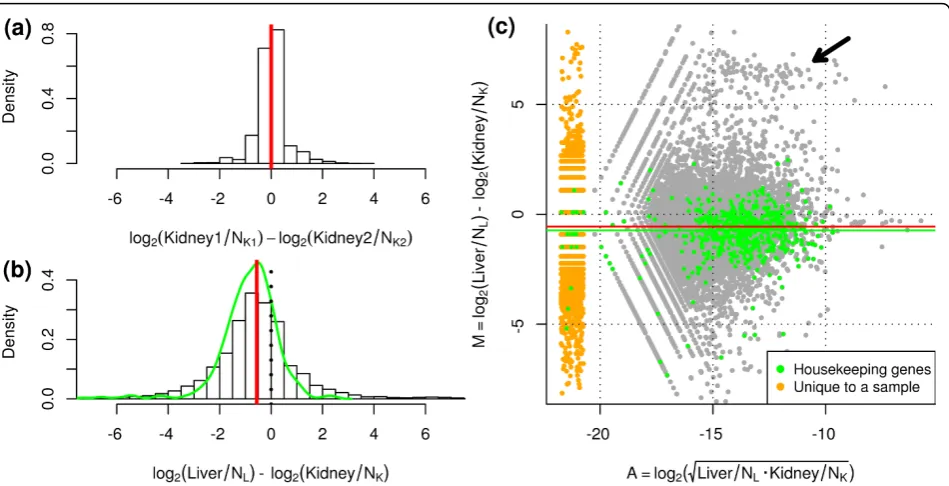
We applied our method to a publicly available transcrip-tional profiling data set comparing several technical replicates of a liver and kidney RNA source [6]. Figure 1a shows the distribution of M values between two tech-nical replicates of the kidney sample after the standard normalization procedure of accounting for the total
number of reads. The distribution of M values for these technical replicates is concentrated around zero. How-ever, Figure 1b shows that log ratios between a liver and kidney sample are significantly offset towards higher expression in kidney, even after accounting for the total number of reads. Also highlighted (green line) is the dis-tribution of observed M values for a set of housekeeping genes, showing a significant shift away from zero. If scaling to the total number of reads appropriately nor-malized RNA-seq data, then such a shift in the log-fold-changes is not expected. The explanation for this bias is straightforward. The M versus A plot in Figure 1c illus-trates that there exists a prominent set of genes with higher expression in liver (black arrow). As a result, the distribution of M values (liver to kidney) is skewed in the negative direction. Since a large amount of sequen-cing is dedicated to these liver-specific genes, there is less sequencing available for the remaining genes, thus proportionally distorting the M values (and therefore, the DE calls) towards being kidney-specific.
Other datasets
The global shift in log-fold-change caused by RNA com-position differences occurs at varying degrees in other RNA-seq datasets. For example, an M versus A plot for the Cloonan et al. [12] dataset (Figure S3 in Additional file 1) gives an estimated TMM scaling factor of 1.04 between the two samples (embryoid bodies versus embryonic stem cells), sequenced on the SOLiD™ sys-tem. The M versus A plot for this dataset also highlights an interesting set of genes that have lower overall
expression, but higher in embryoid bodies. This explains the positive shift in log-fold-changes for the remaining genes. The TMM scale factor appears close to the med-ian log-fold-changes amongst a set of approximately 500 mouse housekeeping genes (from [17]). As another example, the Liet al. [18] dataset, using the llumina 1G Genome Analyzer, exhibits a shift in the overall distri-bution of log-fold-changes and gives a TMM scaling fac-tor of 0.904 (Figure S4 in Additional file 1). However, there are sequencing-based datasets that have quite similar RNA outputs and may not need a significant adjustment. For example, the small-RNA-seq data from Kuchenbaueret al. [19] exhibits only a modest bias in the log-fold-changes (Figure S5 in Additional file 1).
[image:4.595.63.538.88.331.2]Spike-in controls have the potential to be used for normalization. In this scenario, small but known amounts of RNA from a foreign organism are added to each sample at a specified concentration. In order to use spike-in controls for normalization, the ratio of the concentration of the spike to the sample must be kept constant throughout the experiment. In practice, this is difficult to achieve and small variations will lead to biased estimation of the normalization factor. For exam-ple, using the spiked-in DNA from the Mortazaviet al. data set [11] would lead to unrealistic normalization fac-tor estimates (Figure S6 in Additional file 1). As with
Figure 1Normalization is required for RNA-seq data. Data from [6] comparing log ratios of(a)technical replicates and(b)liver versus kidney expression levels, after adjusting for the total number of reads in each sample. The green line shows the smoothed distribution of log-fold-changes of the housekeeping genes.(c)An M versus A plot comparing liver and kidney shows a clear offset from zero. Green points indicate 545 housekeeping genes, while the green line signifies the median log-ratio of the housekeeping genes. The red line shows the estimated TMM normalization factor. The smear of orange points highlights the genes that were observed in only one of the liver or kidney tissues. The black arrow highlights the set of prominent genes that are largely attributable for the overall bias in log-fold-changes.
Table 1 Number of genes called differentially expressed between liver and kidney at a false discovery rate <0.001 using different normalization methods
Library size normalization
TMM normalization
Overlap
Higher in liver 2,355 4,293 2,355
Higher in kidney
8,332 4,935 4,935
Total 10,867 9,228 7,290
House keeping genes (545)
Higher in liver 45 137 45
Higher in kidney
376 220 220
Total 421 357 265
[image:4.595.56.291.455.589.2]microarrays, it is generally more robust to carefully esti-mate normalization factors using the experimental data (for example, [20]).
Simulation studies
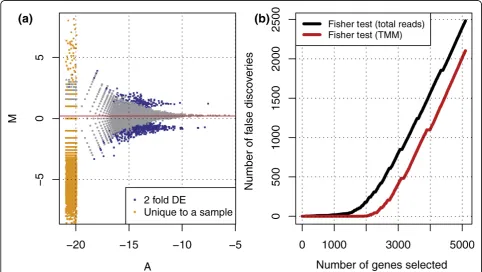
To investigate the range in utility of the TMM normali-zation method, we developed a simulation framework to study the effects of RNA composition on DE analysis of RNA-seq data. To start, we simulate data from just two libraries. We include parameters for the number of genes expressed uniquely to each sample, and para-meters for the proportion, magnitude and direction of differentially expressed genes between samples (see Material and methods). Figure 2a shows an M versus A plot for a typical simulation including unique genes and DE genes. By simulating different total RNA outputs, the majority of non-DE genes have log-fold-changes that are offset from zero. In this case, using TMM normali-zation to account for the underlying RNA composition leads to a lower number of false detections using a Fish-er’s exact test (Figure 2b). Repeating the simulation a large number of times across a wide range of simulation parameters, we find good agreement when comparing the true normalization factors from the simulation with those estimated using TMM normalization (Figure S7 in Additional file 1).
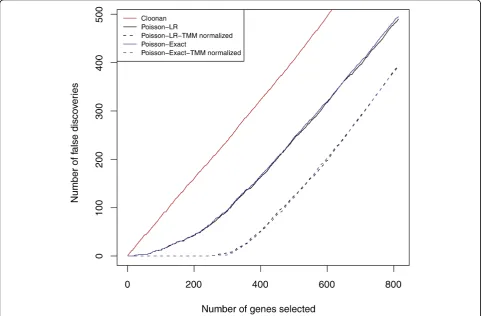
To further compare the performance of the TMM normalization with previously used methods in the con-text of the DE analysis of RNA-seq data, we extend the above simulation to include replicate sequencing runs. Specifically, we compare three published methods: length-normalized count data that have been log trans-formed and quantile normalized, as implemented by Cloonanet al. [12], a Poisson regression [6] with library size and TMM normalization and a Poisson exact test [8] with library size and TMM normalization. We do not compare directly with the normalization proposed in Balwierzet al. [13] since the liver and kidney dataset do not appear to follow a power law distribution and have quite distinct count distributions (Figure S8 in Additional file 1). Furthermore, in light of the RNA composition bias we observe, it is not clear whether equating the count distributions across samples is the most logical procedure. In addition, we do not directly compare the normalization to virtual length [2] or RPKM [11] normalization, since a statistical analysis of the transformed data was not mentioned. However, we illustrate with M versus A plots that their normalization does not completely remove RNA composition bias (Figures S9 and S10 in Additional file 1).
[image:5.595.56.539.421.693.2]For the simulation, we used an empirical joint distri-bution of gene lengths and counts, since the Cloonan
et al. procedure requires both. We made the simulation data Poisson-distributed to mimic technical replicates (Figure S11 in Additional file 1). Figure 3a shows false discovery plots amongst the genes that are common to both conditions, where we have introduced 10% unique-to-group expression for the first condition, 5% DE at a 2-fold level, 80% of which is higher in the first condi-tion. The approach that uses methodology developed for microarray data performs uniformly worse, as one might expect since the distributional assumptions for these methods are quite different. Among the remaining methods (Poisson likelihood ratio statistic, Poisson exact statistic), performance is very similar; again, the TMM normalization makes a dramatic improvement to both.
Conclusions
TMM normalization is a simple and effective method for estimating relative RNA production levels from RNA-seq data. The TMM method estimates scale fac-tors between samples that can be incorporated into cur-rently used statistical methods for DE analysis. We have shown that normalization is required in situations
where the underlying distribution of expressed tran-scripts between samples is markedly different. The assumptions behind the TMM method are similar to the assumptions commonly made in microarray normal-ization procedures such as lowess normalnormal-ization [21] and quantile normalization [22]. Therefore, adequately normalized array data do not show the effects of differ-ent total RNA output between samples. In essence, both microarray and TMM normalization assume that the majority of genes, common to both samples, are not dif-ferentially expressed. Our simulation studies indicate that the TMM method is robust against deviations to this assumption up to about 30% of DE in one direc-tion. For many applications, this assumption will not be violated.
[image:6.595.57.540.367.683.2]One notable difference with TMM normalization for RNA-seq is that the data themselves do not need to be modified, unlike microarray normalization and some implemented RNA-seq strategies [11,12]. Here, the estimated normalization factors are used directly in the statistical model used to test for DE, while preserving the sampling properties of the data. Because the data
themselves are not modified, it can be used in further applications such as comparing expression between genes.
Normalization will be crucial in many other applica-tions of high throughput sequencing where the DNA or RNA populations being compared differ in their compo-sition. For example, chromatin immunoprecipitation (ChIP) followed by next generation sequencing (ChIP-seq) may require a similar adjustment to compare between samples containing different repertoires of bound targets. Interestingly, the PeakSeq method [23] uses a linear regression on binned counts across the genome to estimate a scaling factor between two ChIP populations to account for the different coverages. This is similar in principle to what is proposed here, but pos-sibly less robust. We demonstrated that there are numerous biological situations where a composition adjustment will be required. In addition, technical arti-facts that are not fully captured by the library size adjustment can be accounted for with the empirical adjustment. Furthermore, it is not clear that DNA spiked-in at known concentrations will allow robust estimation of normalization factors.
Similar to previous high throughput technologies such as microarrays, normalization is an essential step for inferring true differences in expression between samples. The number of reads for a gene is dependent not only on the gene’s expression level and length, but also on the population of RNA from which it originates. We present a straightforward and effective empirical method for normalization of RNA-seq data.
Materials and methods TMM normalization details
A trimmed mean is the average after removing the upper and lower x% of the data. The TMM procedure is doubly trimmed, by log-fold-changes Mgkr (sample k relative to sampler for geneg) and by absolute intensity (Ag). By default, we trim theMgvalues by 30% and the
Agvalues by 5%, but these settings can be tailored to a
given experiment. The software also allows the user to set a lower bound on the A value, for instances such as the Cloonanet al. dataset (Figure S1 in Additional file 1). After trimming, we take a weighted mean of Mg,
with weights as the inverse of the approximate asympto-tic variances (calculated using the delta method [24]). Specifically, the normalization factor for samplekusing reference sampler is calculated as:
log ( ) *
* log ( ) 2 2 TMM
wgkr Mgkr g G wgkr g G M Ygk N k kr gkr
where log ; ,
2 YgrN r
w N k Ygk N kYgk
N r Ygr N rYgr Y gkr gk and Y Ygr0.
The cases where Ygk = 0 or Ygr = 0 are trimmed in
advance of this calculation since log-fold-changes cannot be calculated; G* represents the set of genes with valid Mgand Agvalues and not trimmed, using the
percen-tages above. It should be clear that TMMr( )r 1.
As Figure 2a indicates, the variances of the M values at higher total count are lower. Within a library, the vector of counts is multinomial distributed and any indi-vidual gene is binomial distributed with a given library size and proportion. Using the delta method, one can calculate an approximate variance for theMg, as is
com-monly done with log relative risk, and the inverse of these is used to weight the average.
We compared the weighted with the unweighted trimmed mean as well as an alternative robust estimator (robust linear model) over a range of simulation para-meters, as shown in Figure S4 in Additional file 1.
Housekeeping genes
Human housekeeping genes, as described in [16], were downloaded from [25] and matched to the Ensembl gene identifiers using the Bioconductor [26] biomaRt package [27]. Similarly, mouse housekeeping genes were taken to be the approximately 500 genes with lowest coefficient of variation, as calculated by de Jongeet al. [17].
Statistical testing
For a two-library comparison, we use the sage.test func-tion from the CRAN statmod package [28] to calculate a Fisher exact P-value for each gene. To apply TMM normalization, we replace the original library sizes with ‘effective’ library sizes. For two libraries, the effective library sizes are calculated by multiplying/dividing the square root of the estimated normalization factor with the original library size.
For comparisons with technical replicates, we followed the analysis procedure used in the Marioni et al. study [6]. Briefly, it is assumed that the counts mapping to a gene are Poisson-distributed, according to:
Ygk Pois gz Mk k
~ ( )
where gzk represents the fraction of total reads for genegin experimental conditionzk. Their analysis utilizes
replicated groups. The strategy is similar in principle to the Fisher’s exact test: conditioning on the total count, we calculated the probability of observing group counts as or more extreme than what we actually observed. The total and group total counts are all Poisson distributed.
We re-implemented the method from Cloonan et al. [12] for the analysis of simulated data using a custom R [29] script.
Simulation details
The simulation is set up to sample a dataset from a given empirical distribution of read counts (that is, from a distribution of observed Yg). The mean is calculated
from the sampled read counts divided by the sum Sk
and multiplied by a specified library sizeNk (according
to the model). The simulated data are then randomly sampled from a Poisson distribution, given the mean. We have parameters specifying the number of genes common to both libraries and the number of genes unique to each sample. Additional parameters specify the amount, direction and magnitude of DE as well as the depth of sequencing (that is, range of total numbers of reads). Since we have inserted known differentially expressed genes, we can rank genes according to various statistics and plot the number of false discoveries as a function of the ranking. Table S1 in Additional file 1 gives the parameter settings used for the simulations presented in Figures 2 and 3.
Software
Software implementing our method was released within the edgeR package [30] in version 2.5 of Bioconductor [26] and is available from [31]. Scripts and data for our analyses, including the simulation framework, have been made available from [32].
Additional file 1:A Word document with supplementary materials, including 11 supplementary figures and one supplementary table. Click here for file
[ http://www.biomedcentral.com/content/supplementary/gb-2010-11-3-r25-S1.doc ]
Abbreviations
ChIP: chromatin immunoprecipation; DE: differential expression; LR: likelihood ratio; RPKM: reads per kilobase per million mapped; TMM: trimmed mean of M values.
Acknowledgements
We wish to thank Terry Speed, Gordon Smyth and Matthew Wakefield for helpful discussion and critical reading of the manuscript. This work is partly supported by the National Health and Medical Research Council (481347-MDR, 490037-AO)
Author details 1
Bioinformatics Division, Walter and Eliza Hall Institute, 1G Royal Parade, Parkville 3052, Australia.2Epigenetics Laboratory, Cancer Program, Garvan
Institute of Medical Research, 384 Victoria Street, Darlinghurst, NSW 2010, Australia.
Authors’contributions
MDR and AO conceived of the idea, analyzed the data and wrote the paper.
Received: 19 November 2009 Revised: 28 January 2010 Accepted: 2 March 2010 Published: 2 March 2010
References
1. Wang ET, Sandberg R, Luo S, Khrebtukova I, Zhang L, Mayr C, Kingsmore SF, Schroth GP, Burge CB:Alternative isoform regulation in human tissue transcriptomes.Nature2008,456:470-476.
2. Sultan M, Schulz MH, Richard H, Magen A, Klingenhoff A, Scherf M, Seifert M, Borodina T, Soldatov A, Parkhomchuk D, Schmidt D, O’Keeffe S, Haas S, Vingron M, Lehrach H, Yaspo ML:A global view of gene activity and alternative splicing by deep sequencing of the human transcriptome.Science2008,321:956-960.
3. Wang X, Sun Q, McGrath SD, Mardis ER, Soloway PD, Clark AG:
Transcriptome-wide identification of novel imprinted genes in neonatal mouse brain.PLoS One2008,3:e3839.
4. Bolstad BM, Irizarry RA, Astrand M, Speed TP:A comparison of normalization methods for high density oligonucleotide array data based on variance and bias.Bioinformatics2003,19:185-193. 5. Wang Z, Gerstein M, Snyder M:RNA-Seq: a revolutionary tool for
transcriptomics.Nat Rev Genet2009,10:57-63.
6. Marioni JC, Mason CE, Mane SM, Stephens M, Gilad Y:RNA-seq: an assessment of technical reproducibility and comparison with gene expression arrays.Genome Res2008,18:1509-1517.
7. Bullard JH, Purdom EA, Hansen KD, Durinck S, Dudoit S:Statistical inference in mRNA-Seq: exploratory data analysis and differential expression.UC Berkeley Division of Biostatistics Working Paper Series2009, paper 247.
8. Robinson MD, Smyth GK:Small-sample estimation of negative binomial dispersion, with applications to SAGE data.Biostatistics2008,9:321-332. 9. t Hoen PA, Ariyurek Y, Thygesen HH, Vreugdenhil E, Vossen RH, de
Menezes RX, Boer JM, van Ommen GJ, den Dunnen JT:Deep sequencing-based expression analysis shows major advances in robustness, resolution and inter-lab portability over five microarray platforms.Nucleic Acids Res2008,36:e141.
10. Vencio RZ, Brentani H, Patrao DF, Pereira CA:Bayesian model accounting for within-class biological variability in serial analysis of gene expression (SAGE).BMC Bioinformatics2004,5:119.
11. Mortazavi A, Williams BA, McCue K, Schaeffer L, Wold B:Mapping and quantifying mammalian transcriptomes by RNA-Seq.Nat Methods2008, 5:621-628.
12. Cloonan N, Forrest AR, Kolle G, Gardiner BB, Faulkner GJ, Brown MK, Taylor DF, Steptoe AL, Wani S, Bethel G, Robertson AJ, Perkins AC, Bruce SJ, Lee CC, Ranade SS, Peckham HE, Manning JM, McKernan KJ, Grimmond SM: Stem cell transcriptome profiling via massive-scale mRNA sequencing.
Nat Methods2008,5:613-619.
13. Balwierz PJ, Carninci P, Daub CO, Kawai J, Hayashizaki Y, Van Belle W, Beisel C, van Nimwegen E:Methods for analyzing deep sequencing expression data: constructing the human and mouse promoterome with deepCAGE data.Genome Biol2009,10:R79.
14. Robinson MD, Smyth GK:Moderated statistical tests for assessing differences in tag abundance.Bioinformatics2007,23:2881-2887. 15. Oshlack A, Wakefield MJ:Transcript length bias in RNA-seq data
confounds systems biology.Biol Direct2009,4:14.
16. Eisenberg E, Levanon EY:Human housekeeping genes are compact.
Trends Genet2003,19:362-365.
17. de Jonge HJ, Fehrmann RS, de Bont ES, Hofstra RM, Gerbens F, Kamps WA, de Vries EG, Zee van der AG, te Meerman GJ, ter Elst A:Evidence based selection of housekeeping genes.PLoS One2007,2:e898.
18. Li H, Lovci MT, Kwon YS, Rosenfeld MG, Fu XD, Yeo GW:Determination of tag density required for digital transcriptome analysis: application to an androgen-sensitive prostate cancer model.Proc Natl Acad Sci USA2008, 105:20179-20184.
Hirst M, Hansen CL, Marra MA, Humphries RK:In-depth characterization of the microRNA transcriptome in a leukemia progression model.Genome Res2008,18:1787-1797.
20. Oshlack A, Emslie D, Corcoran LM, Smyth GK:Normalization of boutique two-color microarrays with a high proportion of differentially expressed probes.Genome Biol2007,8:R2.
21. Yang YH, Dudoit S, Luu P, Lin DM, Peng V, Ngai J, Speed TP:Normalization for cDNA microarray data: a robust composite method addressing single and multiple slide systematic variation.Nucleic Acids Res2002,30:e15. 22. Irizarry RA, Hobbs B, Collin F, Beazer-Barclay YD, Antonellis KJ, Scherf U,
Speed TP:Exploration, normalization, and summaries of high density oligonucleotide array probe level data.Biostatistics2003,4:249-264. 23. Rozowsky J, Euskirchen G, Auerbach RK, Zhang ZD, Gibson T, Bjornson R,
Carriero N, Snyder M, Gerstein MB:PeakSeq enables systematic scoring of ChIP-seq experiments relative to controls.Nat Biotechnol2009,27:66-75. 24. Casella G, Berger RL:Statistical InferencePacific Grove, CA: Duxbury Press
2002.
25. Housekeeping Genes.[http://www.cgen.com/supp_info/ Housekeeping_genes.html].
26. Gentleman RC, Carey VJ, Bates DM, Bolstad B, Dettling M, Dudoit S, Ellis B, Gautier L, Ge Y, Gentry J, Hornik K, Hothorn T, Huber W, Iacus S, Irizarry R, Leisch F, Li C, Maechler M, Rossini AJ, Sawitzki G, Smith C, Smyth G, Tierney L, Yang JY, Zhang J:Bioconductor: open software development for computational biology and bioinformatics.Genome Biol2004,5:R80. 27. Durinck SMY, Kasprzyk A, Davis S, De Moor B, Brazma A, Huber W:BioMart
and Bioconductor: a powerful link between biological databases and microarray data analysis.Bioinformatics2005,21:3439-3440.
28. CRAN - Package statmod.[http://cran.r-project.org/web/packages/statmod/ index.html].
29. Team RDC:R: A Language and Environment for Statistical Computing2009. 30. Robinson MD, McCarthy DJ, Smyth GK:edgeR: a Bioconductor package
for differential expression analysis of digital gene expression data.
Bioinformatics2010,26:139-140.
31. Bioconductor.[http://www.bioconductor.org/].
32. WEHI Bioinformatics - Resources.[http://bioinf.wehi.edu.au/resources/].
doi:10.1186/gb-2010-11-3-r25
Cite this article as:Robinson and Oshlack:A scaling normalization method for differential expression analysis of RNA-seq data.Genome
Biology201011:R25.
Submit your next manuscript to BioMed Central and take full advantage of:
• Convenient online submission
• Thorough peer review
• No space constraints or color figure charges
• Immediate publication on acceptance
• Inclusion in PubMed, CAS, Scopus and Google Scholar
• Research which is freely available for redistribution