Citation:
Dohme, L and Lara-Bercial (2016) Coaching Ireland Coaching Children Workshop Series: ChildCentered Coaching: Understanding Child Development & Learning & its Impact on how we Coach -Factsheet 2. Sport Ireland.
Link to Leeds Beckett Repository record:
http://eprints.leedsbeckett.ac.uk/2713/
Document Version: Other
Editor Sheelagh Quinn. Printed by Sport Ireland.
The aim of the Leeds Beckett Repository is to provide open access to our research, as required by funder policies and permitted by publishers and copyright law.
The Leeds Beckett repository holds a wide range of publications, each of which has been checked for copyright and the relevant embargo period has been applied by the Research Services team.
We operate on a standard take-down policy. If you are the author or publisher of an output and you would like it removed from the repository, please contact us and we will investigate on a case-by-case basis.
Coaching Ireland
Coaching Children Workshop Series:
CHILD-CENTRED COACHING:
UNDERSTANDING CHILD DEVELOPMENT &
LEARNING & ITS IMPACT ON HOW WE COACH
CONTENTS
Introduction...Page 3
Your Approach to Coaching...Page 3
Child Centred Coaching ...Page 4
Let's Get Real Task 1 - My Approach to Coaching...Page 5
The SPEC Model ...Page 6
The 4 Coaching Zones ...Page 8
The TREE & STEP Model...Page 9
Your Coaching Toolkit ... Page 10
Let's Get Real Task 2 - My Coaching Toolkit ... Page 12
Positive Behaviour Management...Page 13
Let's Get Real Task 3 - Positive Behaviour
Tracking Tool ...Page 14
Child Proof Sport Checklist ...Page 15
References ...Page 16
Developed for Coaching Ireland by:
COACHING CHILDREN SERIES: WORKSHOP 2
INTRODUCTION
This factsheet aims to provide you as the coach with information on child development and to consider your own approach to coaching and coaching skills for the development of child appropriate sport and physical activity programmes. It aims to help you explore your coaching approach and values. Identify the key milestones in human development using the SPEC model (Social, Physical, Emotional, Cognitive). Identify how this development impacts on your coaching practice. Understand basic learning theories and learn how to apply them to your practice, and identify key coaching skills that will allow you and each child to enjoy and get the most from your sessions.
We know that sport and physical activity, when delivered appropriately, can have a positive impact on children's physical, personal and social development. However, we have to strive to create the right conditions to enable this positive development to happen.
YOUR APPROACH TO COACHING
Being a coach can be challenging. You constantly have to make decisions which impact not only on yourself but also on the children that you work with. You are asked to find the right balance between child development, winning, fun and challenge. To be able to do all of this effectively and in a consistent manner, it is important that you are clear on your approach to coaching.
What is your approach to coaching?
An approach to coaching:
•
is a statement of your values and beliefs in relation to effective coaching•
consists of your major objectives and the principles that you adhere to in order to meet your objectives•
guides how you behave and interact with the children you coach•
gives insight into your approach to child development•
is based on your experiences, knowledge, values, opinions and beliefs•
helps you to make ethical decisionEveryone has a specific approach to coaching but not everyone takes the time to examine it. If you have not examined it, your coaching approach will be at a subconscious level. This will still impact on your coaching behaviours, but can potentially create a mismatch between what you say and what you actually do when coaching. To ensure that it is appropriate and effectively guides you, let's make it conscious!
Exploring your approach to coaching at three levels:
Now, take a step back and ask yourself:
•
How well do your (and your club's) behaviours and actions match your statements?•
Is there anything you need to change in your approach to coaching or your coaching behaviours?TIP
Your key values and beliefs should apply across the board of behaviours that you engage in. Nevertheless, they need to adjust and be adapted depending on the needs of the children that you coach. When working with other coaches, you do not need to agree on everything, however your coaching approaches should complement, not contradict, each other.
CHILD-CENTRED COACHING
What is Child-Centred Coaching?
Coaching that is fully geared towards fulfilling the needs and wants of the child and not to the adults, the club, the NGB or any other institution.
To coach in a child-centred way, coaches must take into account what children want out of sport (see factsheet 1) and their individual developmental needs.
What are your key 'life values'?
LET'S GET REAL TASK 1 - MY APPROACH TO COACHING
This task is designed to help you reflect further on your approach to coaching and give you a chance to explore if it matches the approach of your club. It will also help you to consider if your actions support your approach or if there is a mismatch and what you can do about it.
How do you think coaching should
be? Why do you
coach?
YOUR ACTIONS
Here you need to look at yourself in the mirror and think if each of your actions
around coaching are aligned with your stated approach.
THE FUTURE
Based on all you have written to the
left of this column write about the things you may want to continue to do, do more of or stop doing. YOUR CLUB'S
Write here what you think your clubs approach is like and how it matches yours. YOUR COACHING
APPROACH
Write here your answers to the questions on the left
hand column.
What are your key 'life'
THE SPEC MODEL
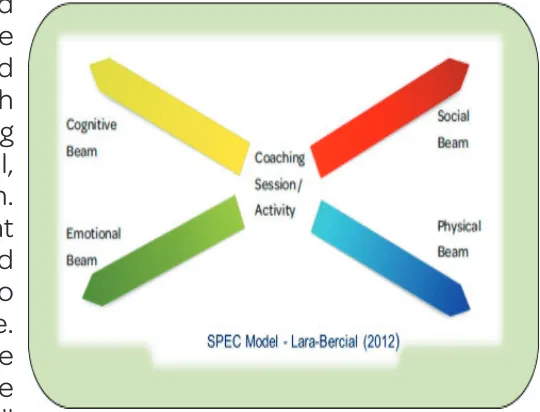
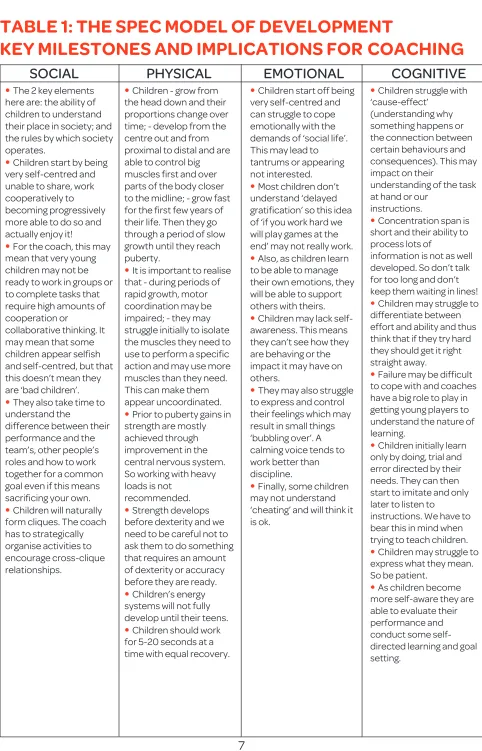
Walk the Beams with each Child, don’t Sprint the BeamsThe SPEC model (Figure 1) of child development provides a 'whistle stop tour' of the stages children and young people go through from birth to maturity. Children develop along four beams: The Social, Physical, Emotional and Cognitive Beam. Typically, coaches take into account the Physical beam of child development, but not think too much about the other three. However, as coaches we have the duty to deliver activities that are developmentally appropriate for all four beams. See table 1.
The purpose of the SPEC model is for you to understand that: a)children have to go through each stage of the beams
b)that there is no magic wand to fast-track them through them
c)each child will develop through the stages at differing rates as it is an individual process
d)that it is your job to plan, deliver and evaluate your sessions at the right level of demand in all four areas for the children you coach.
It is important to bear in mind that:
Children will develop at different rates and we are bound to have a great level of variability within the groups we coach.
•
Children will be at different stages in different beams.•
In assessing a child's development, we have to go beyond chronological age. There are three ages for each child:•
Chronological: From birth to now•
Biological: Based on the child's maturity•
Training Age: Based on how long they have been involved. [image:7.595.268.538.96.302.2]All our sessions and the activities within them contain elements that challenge children in these four beams. As children develop, they progressively travel along the beams until they become a fully mature, functional adult. Saying that a session or an activity is or is not working well is not enough. If we don’t identify the reasons why, we have no chance of either replicating success or addressing the issues. In the main, the answer to the question ‘Why is this working/not working?’ lies within one or more of the beams.
TABLE 1: THE SPEC MODEL OF DEVELOPMENT
KEY MILESTONES AND IMPLICATIONS FOR COACHING
• The 2 key elements here are: the ability of children to understand their place in society; and the rules by which society operates.
• Children start by being very self-centred and unable to share, work cooperatively to becoming progressively more able to do so and actually enjoy it!
• For the coach, this may mean that very young children may not be ready to work in groups or to complete tasks that require high amounts of cooperation or
collaborative thinking. It may mean that some children appear selfish and self-centred, but that this doesn’t mean they are ‘bad children’. • They also take time to understand the
difference between their performance and the team’s, other people’s roles and how to work together for a common goal even if this means sacrificing your own. • Children will naturally form cliques. The coach has to strategically organise activities to encourage cross-clique relationships.
• Children - grow from the head down and their proportions change over time; - develop from the centre out and from proximal to distal and are able to control big muscles first and over parts of the body closer to the midline; - grow fast for the first few years of their life. Then they go through a period of slow growth until they reach puberty.
• It is important to realise that - during periods of rapid growth, motor coordination may be impaired; - they may struggle initially to isolate the muscles they need to use to perform a specific action and may use more muscles than they need. This can make them appear uncoordinated. • Prior to puberty gains in strength are mostly achieved through improvement in the central nervous system. So working with heavy loads is not
recommended. • Strength develops before dexterity and we need to be careful not to ask them to do something that requires an amount of dexterity or accuracy before they are ready. • Children’s energy systems will not fully develop until their teens. • Children should work for 5-20 seconds at a time with equal recovery.
• Children start off being very self-centred and can struggle to cope emotionally with the demands of ‘social life’. This may lead to tantrums or appearing not interested. • Most children don’t understand ‘delayed gratification’ so this idea of ‘if you work hard we will play games at the end’ may not really work. • Also, as children learn to be able to manage their own emotions, they will be able to support others with theirs. • Children may lack self-awareness. This means they can’t see how they are behaving or the impact it may have on others.
• They may also struggle to express and control their feelings which may result in small things ‘bubbling over’. A calming voice tends to work better than discipline.
• Finally, some children may not understand ‘cheating’ and will think it is ok.
• Children struggle with ‘cause-effect’
(understanding why something happens or the connection between certain behaviours and consequences). This may impact on their
understanding of the task at hand or our
instructions.
• Concentration span is short and their ability to process lots of
information is not as well developed. So don’t talk for too long and don’t keep them waiting in lines! • Children may struggle to differentiate between effort and ability and thus think that if they try hard they should get it right straight away.
• Failure may be difficult to cope with and coaches have a big role to play in getting young players to understand the nature of learning.
• Children initially learn only by doing, trial and error directed by their needs. They can then start to imitate and only later to listen to
instructions. We have to bear this in mind when trying to teach children. • Children may struggle to express what they mean. So be patient.
• As children become more self-aware they are able to evaluate their performance and conduct some self-directed learning and goal setting.
THE 4 COACHING ZONES
Maximum learning generally happens in the space just outside and above our current level of ability. We call this ‘The Learning Zone’. However, the activities we set up for children we coach can sit in one of four zones:
• The Learning Zone:
The task and/or the set up fall just above the comfort zone thus stretching the learner’s current capacity and maximising learning.• The Comfort Zone:
The task and the set up are just below or at the current level of ability of the learner. Activities in the Comfort Zone, keep learners fairly happy and may serve to consolidate current skills and build a strong foundation for further learning. However, if the demand level does not increase over time, boredom will set in.• The Boredom Zone:
The task itself or the way the activity is set up leads to boredom and stagnation. No learning happens in the Boredom Zone.•
The Panic Zone:The task and/or the set up are too far away from the learner’s current level of ability. As anxiety and eventually panic set in, learning will decrease. Being in the Panic Zone can also jeopardise future engagement with similar tasks due to negative associations.ADAPTING ACTIVITIES TO DIFFERENT ABILITIES
The level of challenge can be raised or lowered in any of the four beams. Although initially designed to enhance the inclusion of individuals with disabilities, the following is a quick introduction to the TREE and STEP models which will help you to be able to adapt your activities to suit the different levels of abilities of the children you coach.
•
Teaching/Instructional style:•
Space:manual, verbal, practical, etc. playing surface, distance
•
Rules/Regulations: between players/obstacles, what people are allowed to do.... use zones...•
Environments:•
Task:the physical place where the change action / objective / activity happens... scoring / system / speed....
•
Equipment:•
Equipment:ball type or size, player aids... ball type or size, player aids...
•
People:change numbers, player role, limitations/advantages...
TASK
Think of two or three of your favourite drills.
Now, think of as many ways as possible in which you could modify these drills with the help of the TREE and STEP models. For each modification consider:
•
Have you increased or lowered the level of challenge?•
Whom does this drill suit now?•
Do you feel comfortable implementing some (e.g. equipment) but not other (e.g. environment) changes?•
By using the TREE and STEP models you will become better at adapting activities to suit the different abilities of the children you coach, and engagingTHE
MODEL
THE
YOUR COACHING TOOLKIT
Are you making use of all your Coaching Tools?
The term “Coaching Toolkit” represents your personal set of resources, skills and abilities that you use to coach children. The figure below outlines and describes tools that are frequently used by coaches.
Demonstrations:A practical exhibition and explanation of how something works or is performed.
•
Aims to provide a model•
Careful when choosing demonstrators•
Careful when demonstrating yourself•
Angle of demonstration•
Focus of demonstration•
Avoid distractions•
Check for understanding•
Use of video imagesExplanations:A statement or rationale that clarifies something to someone.
•
Simplify or ‘chunk’ the information to avoid overload (one or two points of focus at a time)•
Bring your body down to their level and relax (don’t talk down to them or look threatening)•
Keep language positive, simple and unambiguous•
Provide opportunities to practice what has been explained•
Direct (and re-direct) attention to the important parts of the skill or tactic•
Help children to understand by creating images and cue words that they can use to build on previous experiences and skills•
Make tone of your voice exciting to grab their attention•
Humour engages people; Sarcasm turns them off•
Check for understandingCoaching Tools Explanations
Praise Demonstration
Questioning
Trial and Error:A process of letting children experiment with various methods of doing something until they find the most successful for them.
•
Allow children to have a go (this will tell you where they are and help you decide what the focus should be)•
It also increases motivation•
It fosters initiative and self-driven learning•
It promotes self-awareness•
Combine it with questioning and feedback to turbo charge itQuestioning & Listening:Asking children questions and actively listening to what they say.
•
Provides children a chance to work out the answer themselves•
Fosters a sense of autonomy, trust and competence•
Blend with the background and take time to observe before asking questions•
Has to be focused and purposeful•
Phrased in a way they can understand exactly what you are asking them•
Give them time to think about the answer•
Rather than show hands, get all of them to think and then pick someone to answer•
Support the build-up of the answer by same children or others•
Check everyone else understands the answerFeedback: Statements that recognise good performances and provide reference points for improved ones.
•
Internal: comes from own senses, thoughts and feelings•
External Feedback: comes from others or outside sources (i.e. video)•
Focus on what they need to do to improve•
TACT Model (Lara-Bercial 2013)•
T for Timing: immediate feedback is best, but time-constraints and mental readiness must be taken into account. If emotions are high… wait•
A for Approach: positive two-way dialogue, direct vs indirect•
C for Content: specific, balanced (+/-), solution orientated, avoid excessive detail•
T for Tone: no scolding, remove high emotionsPraise: A way to reinforce positive behaviours.
•
Focus on process also not only outcomes•
Avoid praising only for ability or intelligence. Instead praise also for effort, persistence, hard work, good strategies, not giving up, etc.LET’S GET REAL TASK 2 - MY COACHING TOOLKIT
This task is about reviewing the components of the coaching toolkit and reflecting on how you use them currently in your coaching and what you could do more of or do differently going forward.
Coaching Tools What do I already do well? What could I do better? What will I do to improve thismonth?
Demonstrations
Explanations
Trial & Error/ Set Up & Stand
Back
Questioning & Listening
Feedback
POSITIVE BEHAVIOUR MANAGEMENT
The Key is to Foster Positive Behaviours rather than Eradicating Negative Ones
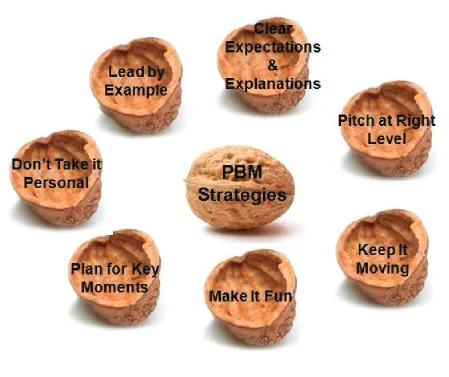
Positive Behaviour Management is about fostering the behaviours we want to see rather than using a disciplinarian approach to stopping the negative ones (Fuller et al., 2009). It is also about understanding that some of these behaviours, while they can be seen as ‘annoying and disrupting’, are typical of children of a certain age and should be managed not punished so children can move on to the next stage of their development. Finally, coaches have to accept that a large part of behaviours exhibited by children during sessions and lessons can be managed through careful planning and design and by coaches becoming more proactive behaviour managers.
Figure 3 below summarises some key ideas around Positive Behaviour Management from the perspective of a proactive coach.
[image:14.595.69.518.399.776.2]LET'S GET REAL TASK 3
POSITIVE BEHAVIOUR TRACKING TOOL
Use the PBM strategies to explore instances when the children you were coaching behaved really well or when you managed to turn a tricky situation into a resounding success. Then you will think of a couple of times when you didn't manage to get the best out of them. The key is to be able to identify why things happened and whether there is anything you could have done to steer them in a different direction.
Think about two examples of sessions or activities when things went really well
or when you managed to rescue a difficult behavioural moment.
Describe what happened from the moment you walked into the venue. What you did, what the children did, anything
else relevant.
What do you think made the biggest difference from those things you had control over (things
that you did using the PBM strategies)?
What are the key learning points you can take away and try to replicate next
time you are doing a session?
Now think about two situations when it didn't quite work and things got
a bit heated and silly. Situation 1
Situation 1 Situation 2
Situation 2
Describe what happened from the moment you walked into the venue. What you did, what the children did, anything
else relevant.
Was there anything from those things you had control over (things that you did) that could have had a negative effect using
the PBM strategies?
What are the key learning points you can take away and try to avoid/do next
MY CHILD-PROOF COACHING CHECKLIST
Theme / Item I will continue to.. I will start to.. I will stop..
consider children’s developmental needs and
plan accordingly
keep children in the learning zone most of the time
tailor my communication to the level of the children
use a range of coaching tools to facilitate learning
COACHING IRELAND - A Unit of Sport Ireland
Tel: 061 202 895
www.irishsportscouncil.ie/Coaching-Ireland/
REFERENCES:
Bailey, R., Cope, E.J., & Pearce, G. (2013). Why do children take part in, and remain involved in sport? A literature review and discussion of implications for sports coaches. International Journal of Coaching Science, 7(1), 58-75.
Lara-Bercial, S. (2012). Activ8 Wildcats Club Coaches Resource. Belfast: Sport Northern Ireland.
Lara-Bercial, S. (2013). Developing Multiskills in Sport Award. Glasgow: Sport Scotland.