A Monthly Double-Blind Peer Reviewed Refereed Open Access International e-Journal - Included in the International Serial Directories.
GE- International Journal of Management Research (GE-IJMR) Website: www.aarf.asia. Email: [email protected] , [email protected]
Page 345
CRISES MANAGEMENT PRACTICES WITHIN PRIVATE SECTOR
HOSPITALS IN MECCA REGION
Mohamed H. Al-Zahrani*2,Naill M. Momani#1, (Ph.D., P.E.)
#
King Abdul Aziz University-Faculty of Economics and Administration
Jeddah- Kingdom of Saudi Arabia
1. ABSTRACT
Private sector hospitals in Saudi Arabia, like other companies competing in this market are
under severe pressure. External changes in society and other factors can and will affect their
competiveness in the future. This is prompting the hospital’s administration to adopt and follow
new strategies to enhance their competitive position.
This study aims to shed light on the reality of crisis management in these private sector hospitals
operating in the area of Mecca. In this research, we investigated the strategies that are used by
department heads, managers and administrators. This study examined limiting factors such as
demographics including age and sex, and length of service as well as educational background.
We examined their different views from crisis management perspectives in various stages,
program elements and the obstacles faced during a crisis. To achieve this, we designed
analytical questionnaire to collect our data, a 300 questionnaires were distributed. The number
of surveys recovered that were valid for analysis was 190 or 64%.
2. THE GENERAL FRAMEWORK FOR THE STUDY
2.1The study problem
Hospitals have reached fourth place among organizations targeted during crisis due to external
A Monthly Double-Blind Peer Reviewed Refereed Open Access International e-Journal - Included in the International Serial Directories.
GE- International Journal of Management Research (GE-IJMR) Website: www.aarf.asia. Email: [email protected] , [email protected]
Page 346
are the securities industry, banking institutions and the airline industry. This creates an increased
interest in the planning and preparation for crisis and natural disasters to enhance operational
effectiveness and overall performance. (Elewa, 1997)
The concepts of crisis management from scientific point view is new for most countries and
further researches are needed in addition to general awareness campaign to improve future
understanding from general community on basic issues that might be subjected to research
investigation by future researchers. In this research we examined the strategies in place from the
point of view of hospital workers.
The problem is more evident by answering the following questions:
A. What is risk management, and does this administration meet the objectives of risk
management for private hospitals?
B. Who is in charge of risk management activities in the private hospitals?
C. Is there existing strategies in place for managing crises in the private health sector
hospitals?
D. What are the obstacles in establishing dedicated departments or units to manage crises in
the private sector hospitals?
E. To what extent private hospitals utilize methods for crisis management?
2.2Hypotheses
In this paper we will investigate different hypotheses which will enable us to understand how
private hospitals in Mecca region deal with current and future crises. These hypotheses are:
1. There is a relationship between the precautionary measures applied in the private
hospitals and the ability for recovery from disasters and crises.
2. There is a relationship between previous experiences in dealing with crises and the
precautionary measures applied.
3. There is a relationship between palliative procedures applied and the ability to respond to
disasters and crises.
4. There is a relationship between the ability to respond to disasters and crises, and the
A Monthly Double-Blind Peer Reviewed Refereed Open Access International e-Journal - Included in the International Serial Directories.
GE- International Journal of Management Research (GE-IJMR) Website: www.aarf.asia. Email: [email protected] , [email protected]
Page 347
5. There is a relationship between the personal relationships between superiors and
subordinates and the procedures applied to increase the ability to respond to disasters and
crises.
6. There is a relationship between the participation of workers in making decisions and
problem solving and the relationship between superiors and subordinates.
2.3Objectives of the study
In this research we identified the preparedness of private hospitals in the Mecca area for planning
and risk management in all health units. Also, we determined the availability of a system to
handle crisis management and their strategies in dealing with crises in the private sector hospitals
operating in the area of Mecca. Moreover, we determine the extent of preparedness/readiness
currently in place at private hospitals in the Mecca region when it comes to dealing with crises.
Also, we acknowledged obstacles to the existence of a crisis management system in hospitals in
the private sector working in the area of Mecca. Finally, we examined the consequences and
make recommendations to various entities, including contributing to the application and the
introduction of an integrated system for crisis management in private hospitals.
2.4 The importance of the study
This study contributes ideas on a topic of relevance and importance to management and should
stimulate thought on crisis management. Also, contemporary crisis management provides the
organization with a comprehensive and systematic response in dealing with various crises, and
thus it is hoped that this study will enrich the Arabic library. It is hoped to disseminate the results
of this study to hospitals, which suffer from the same circumstances and identify how to deal
with the various crises effectively and efficiently to further progress and success. Finally, this
study (to the researcher's knowledge) is the first of its kind in the western region and possibly in
the entire Kingdom. It is hoped that this study opens up new possibilities for more and diverse
researcher on this topic.
A Monthly Double-Blind Peer Reviewed Refereed Open Access International e-Journal - Included in the International Serial Directories.
GE- International Journal of Management Research (GE-IJMR) Website: www.aarf.asia. Email: [email protected] , [email protected]
Page 348
The dictionary (Webster) defines: crisis, a turning point for the better or for the worse. It is a
crucial moment, or a rough time or any situation that reaches a critical stage. The use of crisis in
Chinese is two words: (Wet - Ji) the first; Wet from danger, and the second Ji; opportunity that
can be invested, through the conversion of the crisis and what it entails risk and opportunities to
restore conditions to normal, and to find constructive solutions. (Shaalan, 2002). Despite the
large number of trading terms, crisis in the last decade of the twentieth century has resulted in
rapid and successive changes. These changes may lead to impose the use of effective processes
to meet and reduce their effects. It is difficult to define the concept of a crisis because of the
universal nature, and breadth of its use. The usage and context applied by the authors,
researchers and respondents varies in their definition as well.
There have been a range of definitions of crisis at the level of the organization, including:
Fink (1986) defined crisis is a turning point in the life of the organization for the worse or better.
It is a state of instability occurs and creates decisive change in the functioning of the organization
and may lead to undesirable result/s. Hamalawy (1997) see crisis is defect that materially affects
the whole system, and threatens the main assumptions underlying the system. Finally Al Momani
(2011) believes that crisis is an event or a sudden change (unexpectedly) in the course of action
with implications whose outcome has positive or negative effects.
The researchers believe that the:" crisis is an unusual situation that can spiral out of control and
lead to a work stoppage that threatens the organization’s achievement of their objectives. Even
those definitions deduced many of the characteristics of the crisis, based upon the concept as
follows: You do not necessarily have to be at a negative turning point. It may be an opportunity
to invest in progress and success. The complexity tangles and speed of the events increases the
degree of uncertainty in the face of the crisis. Uncertainty, lack of information, and lack of time;
in the face of the crisis, require the right decisions are fast, or loss of control over the course of
events threaten organization. The high degree of tension in the beginning of the crisis causes a
loss of balance, which weakens the potential for rapid response. A crisis requires effective
A Monthly Double-Blind Peer Reviewed Refereed Open Access International e-Journal - Included in the International Serial Directories.
GE- International Journal of Management Research (GE-IJMR) Website: www.aarf.asia. Email: [email protected] , [email protected]
Page 349
Through the review of the concepts of a crisis, we conclude their characteristics, as: The moment
of turning, a critical and decisive moment where you can lose the organization ability to work, or
a series of events that mixes uncertainty, and lack of time, lack of information, which increases
the degree of role ambiguity. Intensity and the degree of the unknown; causes a loss of balance,
and a high degree of tension that threatens the entity. This makes it difficult to deal with or make
the appropriate decisions. It requires the practice of scientific methodology in managing a crisis
to prevent (negative effects) and consider opportunities for investment in achieving desirable and
beneficial results.
In spite of the divisions of the various crisis management but there are common denominators
between the various crises. Al Momani (2012) integrated framework for earthquake
consequences model identified in the four stages is what will be used by a researcher in this
study as shown in Figure (1). They are as follows:
Mitigation phase includes measures aimed at removing the causes of the crisis and reduce the
probability of occurrence and the extent of its impact on humans and the environment. The
mitigation phase is the most important of these stages. It is most effective time to deal with the
crisis at the lowest possible cost.
Natural disasters show overlapping environmental regulations with the humanitarian activities so
the probability of influence by human factors during a crisis such as a flood, hurricane or
earthquake can change and modify environmental regulations or humanitarian activities. For
example: When you get the possibility of flooding casualties may be reduced either by building a
dam to contain the flood waters, or by changing land use to prevent habitation in the presence of
a flood zone. It is also possible that there are effective systems used to solve the problems. Do
not forget that there is a cadre of qualified and trained labor at the facility to contribute
A Monthly Double-Blind Peer Reviewed Refereed Open Access International e-Journal - Included in the International Serial Directories.
GE- International Journal of Management Research (GE-IJMR) Website: www.aarf.asia. Email: [email protected] , [email protected]
Page 350
Preparedness Mitigation
Response Recovery
Preparedness stage (precautionary), are measures aimed at protecting lives and property from the
impact of risks. It is understood that it is not possible to prevent a crisis entirely through
palliative procedures.
There is a need to take precautions if there is a risk is about to fall, and this requires the
availability of plans, procedures and resources to be properly prepared before the occurrence to
contribute to an effective response and minimize the potential damage. Precautionary measures
fall within three main themes, namely:
Before the crisis before the crisis
After crisis after crisis
Figure (1): stages of crisis management
Theme I: The elaboration of the basic rules of the stage prepping. With regard to the institutions
of government, it includes the development of institutions concerned with crisis management. It
provides specialists to within, the laws and regulations of the state, as well as prepares a plan for
crisis management and the establishment of a center for crisis management.
Theme II: Warning institutions concerned with crisis management. Time and the impact of
expected risk, these precautionary measures aimed at the development or use of technology
(forecasting and prediction). Competent institutions check the risk to make sure that there is
[image:6.612.150.535.271.420.2]A Monthly Double-Blind Peer Reviewed Refereed Open Access International e-Journal - Included in the International Serial Directories.
GE- International Journal of Management Research (GE-IJMR) Website: www.aarf.asia. Email: [email protected] , [email protected]
Page 351
early warning systems, such as the use of rain gauges, and sensors to monitor the water level to
predict floods. The use of detection radar can track storms and warn areas of impending
hurricanes. The use sensors and computers specialized to assess and determine the impact area of
radioactive materials, chemicals or biological hazards to avoid human and material losses.
Theme III: Crisis management operations, which include a lot of activities such as a plan for the
coordination between the institutions that respond to the crisis, carry out the roles assigned
during the crisis. Manage evacuation of the affected area; provide food, shelter, and medical
care. Training helps to implement the plans of responders and increase their ability to respond
when a crisis occurs. Storage of your equipment and medical sources and other needs in
warehouses makes it easier to use when needed through the crisis. Do not forget that these
needs are a major factor in determining the success or failure of efforts to respond to the crisis.
In response stage of dealing with crisis management response includes a predictable start of the
approaching danger. The ability to predict the coming risk and type of risk ease the response
effort. For example, it is possible to take action after knowing the arrival of a hurricane or access
to a flood in the area but it is difficult to predict an earthquake. Activities focus on the response
phase on the protection of persons affected by the danger and reduce the direct impact of the
occurrence. Destruction resulting from the crisis has accompanying risks. Hazards effect on the
environment sometimes far exceeds the dangers from the original crisis and must therefore be
taken into account when planning for crisis management.
Managers must during crises constantly evaluate mass response, coordinating the arrival of aid
and equipment and move it to the neediest places, in coordination with different sets of
government agencies, the private sector and volunteers. Usually the response phase is managed
in crisis management by the public security organizations, civil defense, medical services and
crisis management professionals. It should be noted in the stages of mitigation and preparedness
a delay of response, even for a few minutes a community could suffer a huge loss of life and
A Monthly Double-Blind Peer Reviewed Refereed Open Access International e-Journal - Included in the International Serial Directories.
GE- International Journal of Management Research (GE-IJMR) Website: www.aarf.asia. Email: [email protected] , [email protected]
Page 352
The final stage of the stage of crisis management is the recovery stage. Since the end of the
response phase until the return of society and its institutions to the situation as it was in before
the occurrence of the risk. The duration of this phase depends on many factors, including the
nature of the threat and the extent of the potential of community material and the presence of the
manpower needed to restore the situation to normal.
The recovery phase is divided into short-term and include the provision of assistance and
rehabilitation, and long-term reconstruction including assistance and rehabilitation such as;
debris removal, water, food, medicine and shelter to the needy. While reconstruction includes
rebuilding key facilities (buildings, roads, bridges, dams). Normally construction takes into
account the precautionary arrangements to minimize future risks and insurance needs.
In a study aimed to examine the relationship between job stress and crisis management strategies
in the field of nursing in Mjajal health network, Chrisopher et al. (2010) analyzed the work
environment and determined the current pressures and potential issues in the work environment
and how to reduce and minimize them or prevent their occurrence altogether. They explored
strategies and procedures for handling issues and workers adaptation and the relationship
between occupational stresses in function and use quality as an indicator. There is an increase in
claims against medical malpractice which force to increase the insurance premium due to
medical malpractices. Lura et al. (2009) explored the possible relationships between the activities
of clinical risk management and compensation claims for various 37 hospitals in Maryland to
take advantage of the earliest systematic information available in the risk management of
hospitals. Duckers et al. (1991) investigated safety and risk management in hospitals in order to
improve the procedures and events following safety-related incidents’ and crisis management in
hospitals. This study identified and described the components and controls, and those
responsible for the actions and events that reduce the risks in hospitals.
4 Research Methodology And Procedures
In this research we used the descriptive survey of the relevance to this study. Care was taken to
A Monthly Double-Blind Peer Reviewed Refereed Open Access International e-Journal - Included in the International Serial Directories.
GE- International Journal of Management Research (GE-IJMR) Website: www.aarf.asia. Email: [email protected] , [email protected]
Page 353
methods and describe the results and their interpretation in the clearest terms. The author’s
attempt was to draw generalizations that would lead to meaningful conclusions to benefit
managers and hospitals in the field of crisis management.
We chose descriptive approach because it is appropriate for the nature of the study and will help
as achieve the research goals. This method can even access answers to contribute to the
description and analysis of the results.
4.2The Research Community:
The research community consists of managers, heads of departments, divisions and
administrative assistants in hospitals in the private sector working in the area of Mecca, totaling
almost (730) persons as shown in Table (1), consisting sample of 300 individuals, representing
42% of the size of the study population, selected in the manner of a random sample stratified
based on variable job title, and the questionnaires recovered (217) questionnaires, 27 were
excluded for reason of lack of validity for the analysis, and therefore the number of
questionnaires completed and ready for analysis (190) questionnaires, representing the study
sample the current rate (63.3 %) of the original community of the study. The distribution of the
sample as follows: (President and Director) (24) i.e. (11.1) of the sample size, (99) head by (79)
45.8, Division by (36.6), and (14) Administrative Assistant by (6.5) of the sample size was
chosen these because they are more aware and understanding of the subject of crisis
management, with direct responsibilities in dealing with the crisis. Also because they occupy the
centers of decision-making and thus can identify the main problems and crises experienced by
the organization and how it was handled. The table (1) shows the number the demographic
characteristics of the research sample.
population of
the study questionnaires
distributed questionnaires
recovered questionnaires
excluded valid
questionnaires Private
hospital
administrator % Number % Number % Number % Number % Number 730 100
300 42
217 72
27 9
190 63.3
Table (1) - the numbers and percentages of questionnaires distributed and refunds for members
[image:9.612.67.547.583.668.2]A Monthly Double-Blind Peer Reviewed Refereed Open Access International e-Journal - Included in the International Serial Directories.
GE- International Journal of Management Research (GE-IJMR) Website: www.aarf.asia. Email: [email protected] , [email protected]
Page 354
4.3Demographic characteristics of the study sample:
Perhaps the first thing that you can start it after unloading the data contained in the questionnaire
received from the research sample is determine the nature of the general information contained in
the resolution. This enables the classification of members of the research sample by
qualification, functional category, years of on-site service, sex, site hospital, number of medical
specialties available, capacity hospital clinical, number of storey hospital, all kinds of disasters
and crises involving the hospital, the last time contributed to the hospital in the management of
crisis or disaster, as follows:
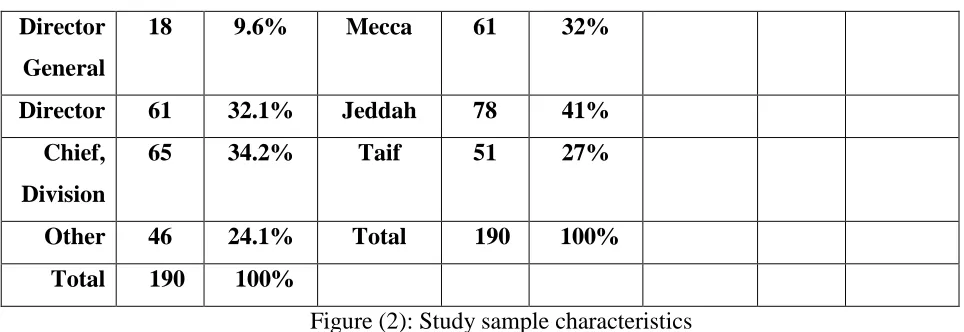
The demographic characteristics of the sample were found that 77.9% of the respondents are
male and 22.1% of them are female. Table (2), show different characteristics of the study sample
Age Numbe
r
Percentag
e
Education
al Level
Numbe
r
Percentag
e
Experienc
e
Numbe
r
Percentag
e
Less
than 30
29 15.2% Bachelor 102 53.6% Less
than 5
years
27 14.2%
30 to 40 43 22.6% Master 49 25.6% From 5
to 10
years
46 24.2%
40 to 50 65 34.4% Ph.D. 23 12.4% From 10
to 15
years
56 29.4%
Below the
bachelor
16 8.4% More
than 15
years
61 32.2%
Total 190 100% Total 190 100%
Experienc
e
Numbe
r
Percentag
e
City Numbe
r
Percentag
A Monthly Double-Blind Peer Reviewed Refereed Open Access International e-Journal - Included in the International Serial Directories.
GE- International Journal of Management Research (GE-IJMR) Website: www.aarf.asia. Email: [email protected] , [email protected]
Page 355
Director
General
18 9.6% Mecca 61 32%
Director 61 32.1% Jeddah 78 41%
Chief,
Division
65 34.2% Taif 51 27%
Other 46 24.1% Total 190 100%
Total 190 100%
Figure (2): Study sample characteristics
In our sample, we found that we have 14 - 24 majors specialty. Also, the clinical capacity of the
hospitals which were included in the sample between is 190 - 410 beds, a mean of (300) bed.
4.4Method of data collection and its tool.
We used the method of sample survey as a questionnaire tool to collect data, by reference to the
previous literature, an essential tool to collect data required to support the theoretical study. We
used in the construction of the questionnaire based it on theoretical framework for the study and
from previous studies. The questionnaire was designed to contain a series of questions that
support the subject of the study through direct relation to the objectives of the study and its
questions and hypotheses.
To examine the reality of crisis management in the private hospitals of Mecca and strategies to
deal with them, we have designed a questionnaire consisted of nine main parts, and were as
follows:
Part I: It contains questions concerned with personal data, namely: Age, qualification,
functional category, years of Experience, years of service in the job site, sex.
Part II: It contains questions concerned with the hospital's own data, namely: Hospital site, the
number of available medical specialties, hospital clinical capacity, and number of hospital floors,
types of disasters that the hospital participated, the last time the hospital contributed in the
[image:11.612.66.548.81.247.2]A Monthly Double-Blind Peer Reviewed Refereed Open Access International e-Journal - Included in the International Serial Directories.
GE- International Journal of Management Research (GE-IJMR) Website: www.aarf.asia. Email: [email protected] , [email protected]
Page 356
Part III: The tool includes a study that relates to previous experiences in dealing with crises
and includes 5 vertebrae.
Part IV: The tool includes a study that relates to mitigation procedures applied and contains
10 paragraphs.
Part V: The study includes a tool that relates to the preparedness procedures and includes a 18
paragraph.
Part VI: The study includes a tool that relates to the ability to respond to disasters and crises
and includes 3 paragraphs.
Part VII: The study includes a tool that relates to the ability to recovery from disasters and
crises and includes 4 vertebrae.
Part VIII: The study includes a tool that relates to the relationship between superiors and
subordinates and includes 5 vertebrae.
Part IX: Includes a study tool that relates to the participation of employees in decision-making
and problem-solving and includes 5 vertebrae.
We used Likert scale (strongly agree - agree - neutral -disagree - strongly disagree) to measure
the extent to approve the terms of the study in terms of strength or weakness.
We used to check the veracity of the tool on the two first called honesty virtual (Face validity),
which depends on display tool on a group of specialists experts in the field. The second is called
the internal consistency based on the expense of the correlation coefficient between each unit of
the tool, and the tool as a whole, the following steps followed by the researchers to check the
veracity of the tool according to each method of two ways:
Firstly, virtual honesty: It is honesty based on the arbitrators, as has been the study tool on a
number of experts and specialists were asked to study the tool and make their views in terms of
the extent appropriate paragraphs to achieve the objectives of the study, and inclusiveness, and
diversity of content. Assess the level of the language, and output, and any observations they
A Monthly Double-Blind Peer Reviewed Refereed Open Access International e-Journal - Included in the International Serial Directories.
GE- International Journal of Management Research (GE-IJMR) Website: www.aarf.asia. Email: [email protected] , [email protected]
Page 357
feedback. According to the study, it influenced the tool, and helped make the so-called logical or
virtual truth.
Secondly, The internal consistency: Because consistency in the literature of measurement means
consistency of the test with the same measure which was built to measure, ie it shows the
consistency of scores in the case of repeat the experiment. So it depends on persistence by
checking the internal consistency of the tool at the expense of correlation degree axis of the
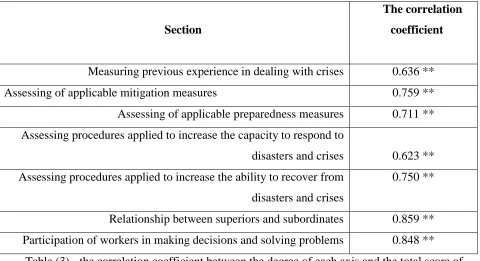
questionnaire. Table (3) shows the correlation coefficients between the degree of each axis and
the total score of the questionnaire.
The correlation
coefficient Section
0.636 ** Measuring previous experience in dealing with crises
0.759 ** Assessing of applicable mitigation measures
0.711 ** Assessing of applicable preparedness measures
0.623 ** Assessing procedures applied to increase the capacity to respond to
disasters and crises
0.750 ** Assessing procedures applied to increase the ability to recover from
disasters and crises
0.859 ** Relationship between superiors and subordinates
0.848 ** Participation of workers in making decisions and solving problems
Table (3) - the correlation coefficient between the degree of each axis and the total score of
the questionnaire
** Significant presence at the level of 0.01
As can be seen from the above table the values of correlation coefficients for total axes primarily
questionnaire ranged between (0.623) and (0.859) which means that there is a high degree of
internal consistency reflecting a high degree of honesty to paragraphs resolution. To check the
[image:13.612.68.548.285.546.2]A Monthly Double-Blind Peer Reviewed Refereed Open Access International e-Journal - Included in the International Serial Directories.
GE- International Journal of Management Research (GE-IJMR) Website: www.aarf.asia. Email: [email protected] , [email protected]
Page 358
the coefficients are high values ranking coefficients stability in the questionnaire between
(0.687-0.954) and coefficient stability total identification (0.960), indicating these high values of
coefficients stability to the validity of the questionnaire for the application and the reliability of
the results.
4.5 Processing and statistical methods used
In addition to the previously used statistical methods, we used such as Person Product-moment
correlation coefficient, and the Alpha Cronbach coefficient", it was the use of statistical methods
in the following analysis of the data collected from the application of the questionnaire to the
study sample:
First: Descriptive statistics through Frequencies and percentages to describe the study population
for the initial information. Also, we measured SMA in order to calculate the value given by the
members of the study population for each phrase of phrases axis, and the arithmetic average for
each axis. Additionally, we estimated SDs to identify the differences in the responses of the
respondents on each phrase of phrases resolution.
To calculate the degree of approval in terms of the strength or weakness of the Likert scale
quintet has been determining the degree of response so given class (5) to respond strongly agree,
and class (4) to respond agree, and class (3) to respond to a neutral, Class (2) response is
disagree, and class (1 ) to respond strongly disagree. If the value of the arithmetic average of (1
to 1.79) the degree of response is (strongly disagree). If the value of the arithmetic averages of
(1.80 to 2.59) the degree of response is (disagree). If the value of the arithmetic averages of (2.60
to 3.39) the degree of response is (neutral). And, if the value of the arithmetic average is (3.40 to
4.19) the degree of the degree of response is (agree). Finally, if the value of the arithmetic
average of (4.20 to 5.00) the degree of the response is (strongly agree).
Second: Deductive census through measuring Spearman coefficient of correlation and ranks this
test is used to check for the existence of a relationship and correlation between pairs of
quantitative data or views ordinal or ranked.
A Monthly Double-Blind Peer Reviewed Refereed Open Access International e-Journal - Included in the International Serial Directories.
GE- International Journal of Management Research (GE-IJMR) Website: www.aarf.asia. Email: [email protected] , [email protected]
Page 359
The study is aimed to know the methods of crisis management in the private sector hospitals
operating in the area of Mecca, and its relation to planning to prepare for crises. To answer the
questions of the study a questionnaire was created to include variables. The questionnaire was
applied to the members of the study's (190) of the administrative staff at government hospitals
and private hospitals in the Mecca region. The data was inputted into a computer, and using the
statistical program SPSS results was analyzed.
The results of the study were analyzed according to the questions and its hypotheses by
presenting each question and then examined the hypothesis as follows:
Question One: To what extent was their existence of previous experience in dealing with
crisis?
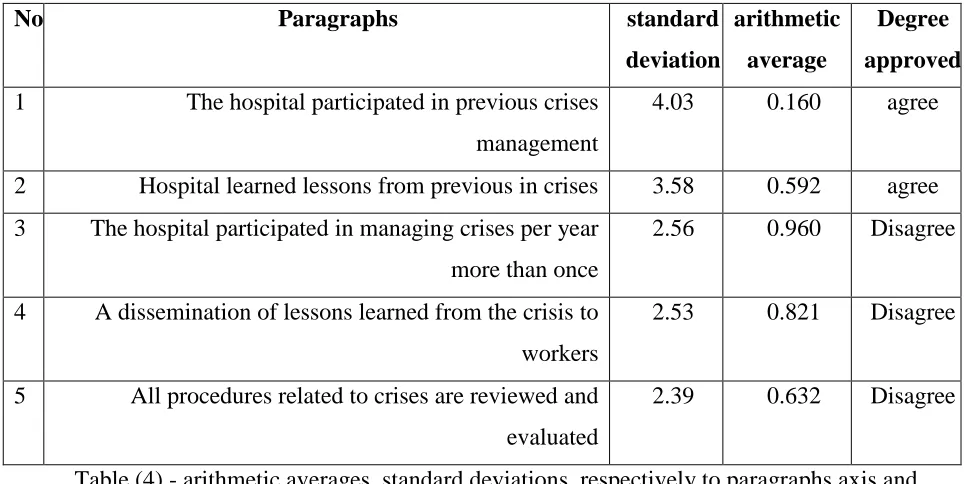
To answer the first question of the study, we allocated five questions to gauge the views of
members of the study sample about the existence of previous experience in dealing with crises,
with the following results in Table (4).
Degree
approved arithmetic
average standard
deviation Paragraphs
No
agree 0.160
4.03 The hospital participated in previous crises
management 1
agree 0.592
3.58 Hospital learned lessons from previous in crises
2
Disagree 0.960
2.56 The hospital participated in managing crises per year
more than once 3
Disagree 0.821
2.53 A dissemination of lessons learned from the crisis to
workers 4
Disagree 0.632
2.39 All procedures related to crises are reviewed and
evaluated 5
Table (4) - arithmetic averages, standard deviations, respectively to paragraphs axis and
having previous experience in dealing with crises in descending order according to the
[image:15.612.65.548.409.651.2]A Monthly Double-Blind Peer Reviewed Refereed Open Access International e-Journal - Included in the International Serial Directories.
GE- International Journal of Management Research (GE-IJMR) Website: www.aarf.asia. Email: [email protected] , [email protected]
Page 360
As seen from Table (4) as for previous experiences in dealing with crises, the averages
calculation is located between the degree of "disagree" and "agree" and ranged arithmetical
averages of paragraphs between (2.39-4.03) and the highest degree of approval for the (The
hospital participated in previous crises management) with average of 4.03.
Question Two: What are the existing mitigation measures?
To answer the second question of the study, we allocated ten questions to gauge the views of
members of the study sample on mitigation measures applied with the following results:
Degree
Approved Arithmetic
Average Standard
Deviation Paragraphs
No
agree 0.615
3.79 Hospital procedures applied for protection from the
dangers before they occur, such as early warning
systems or procedures for the protection of private
establishments such as hospitals
1
agree 0.668
3.63 Hospital contributed to the application of measures
to protect the property of the occurrence of the risk
(earthquake, flood, fire) by reducing the expected
dangers such as the installation of water heaters, use
sophisticated systems and devices, building
earthquake-resistant buildings
2
agree 0.754
3.50 Hospital contributed to the application of measures
to prevent an aggravation of the current risk as a result
of a disaster because of construction or changes in
modern society such as restrictions on building codes
and planning to become safer
3
Disagree 0.737
2.34 The hospital has implemented major projects for the
protection of people and property from unexpected
dangers, such as the rehabilitation of sensitive
A Monthly Double-Blind Peer Reviewed Refereed Open Access International e-Journal - Included in the International Serial Directories.
GE- International Journal of Management Research (GE-IJMR) Website: www.aarf.asia. Email: [email protected] , [email protected]
Page 361
buildings in the hospital to resist dangers of
earthquakes and early warning devices
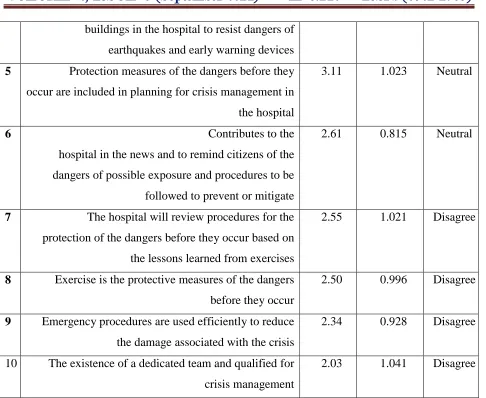
Neutral 1.023
3.11 Protection measures of the dangers before they
occur are included in planning for crisis management in
the hospital
5
Neutral 0.815
2.61 Contributes to the
hospital in the news and to remind citizens of the
dangers of possible exposure and procedures to be
followed to prevent or mitigate
6
Disagree 1.021
2.55 The hospital will review procedures for the
protection of the dangers before they occur based on
the lessons learned from exercises
7
Disagree 0.996
2.50 Exercise is the protective measures of the dangers
before they occur
8
Disagree 0.928
2.34 Emergency procedures are used efficiently to reduce
the damage associated with the crisis
9
Disagree 1.041
2.03 The existence of a dedicated team and qualified for
crisis management 10
Table (5) - arithmetic averages, standard deviations, respectively to paragraphs axis and
having previous experience in dealing with crises in descending order according to the
arithmetical averages
As seen from Table (5) to paragraphs axis measures mitigation measures get an averages
between the degree of "disagree" and "agree" and ranged arithmetical averages of paragraphs
between (2.03-3.79) and the highest degree of approval for the statement (applicable hospital
procedures for protection from the dangers before they occur, such as early warning systems or
procedures for the protection of private establishments such as hospitals, and won the average
account 3.79). The lowest degree of approval of paragraph (a specialized team and qualified to
[image:17.612.67.553.65.463.2]A Monthly Double-Blind Peer Reviewed Refereed Open Access International e-Journal - Included in the International Serial Directories.
GE- International Journal of Management Research (GE-IJMR) Website: www.aarf.asia. Email: [email protected] , [email protected]
Page 362
Question Three: What are the preparedness measures are in place?
To answer the third question of the study, we allocated fifteen questions to gauge the views
of the members of the study sample about precautionary measures applied with the following
results. Degree Approved Arithmetic Average Standard Deviation Paragraphs No agree 0.909 3.42 The hospital has a crisis management plan addresses
the various risks and how to manage them 1
Neutral 0.894
3.32 Hospital contributed to the application of measures
to protect the property of the occurrence of the risk
(earthquake, flood, fire) by reducing the expected
hazards such as installing alarms, follow-up sources of
risk, build earthquake-resistant buildings 2
Neutral 0.940
3.26 The plan contains special procedures and health care
equipment and medical equipment and qualified
personnel to work in this area 3
Neutral 0.967
3.26 The plan contains special procedures for evacuation
(a method of evacuation and the control of those
responsible for the implementation of evacuation) 4
Neutral 1.066
2.97 Plan identified the sources and their need and
possible equipment that are available in the event of a
disaster 5
Neutral 0.553
2.89 There is a difference between what is of sources and
sources of equipment and equipment possible to their
need 6
Neutral 0.866
2.79 Plan defines the limits of the responsibilities and
relationship to each other institutions to coordinate the
management of the crisis 7
Neutral 0.638
2.74 Plan identifies people, equipment, buildings and
A Monthly Double-Blind Peer Reviewed Refereed Open Access International e-Journal - Included in the International Serial Directories.
GE- International Journal of Management Research (GE-IJMR) Website: www.aarf.asia. Email: [email protected] , [email protected]
Page 363
other sources can be processed during the crisis
management process
Neutral 0.994
2.74 The plan contains a mechanism for the distribution
(the requirements in the event of a crisis such as food,
medicine, and how to communicate those needs to the
citizens 9
Neutral 1.119
2.74 The allocation of hospital facilities for use in the
event of a crisis, as part of the planning process to
manage the crisis, such as crisis management centers,
shelters, and distribution centers, storage centers 10
Neutral 0.772
2.66 Hospital devoted special places for the distribution of
needs such as food, medical needs 11
Neutral 0.932
2.63 The plan contains a mechanism to inform citizens of
what must be done during and after crises 12
Disagree 1.047
2.53 Allocates the hospital shelters to be used in the event
of a crisis shelter for needy patients, citizens and
workers in the hospital, if necessary 13
Disagree 1.022
2.50 The plan contains a mechanism to warn the citizens
and contact with them before, during and after disasters
and crises 14
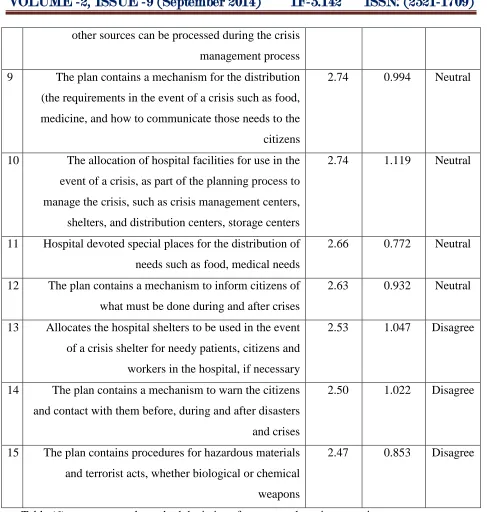
Disagree 0.853
2.47 The plan contains procedures for hazardous materials
and terrorist acts, whether biological or chemical
weapons 15
Table (6) - averages and standard deviations for paragraphs axis precautionary measures
applied in descending order according to the arithmetical averages
As seen from table (6) to paragraphs axis for applicable precautionary measures the averages
calculation is located between the degree of "disagree" and "agree" and ranged arithmetical
averages of paragraphs between (2.13-3.42) and the highest degree of approval for the phrase (no
[image:19.612.65.552.59.571.2]A Monthly Double-Blind Peer Reviewed Refereed Open Access International e-Journal - Included in the International Serial Directories.
GE- International Journal of Management Research (GE-IJMR) Website: www.aarf.asia. Email: [email protected] , [email protected]
Page 364
and get an average of 3.42). The lowest degree of approval of paragraph (crisis management
centers have people to manage in terms of administrative, financial, logistical, and get an average
of 2.13).
Question Four: To what extent the ability to respond to disasters and crises? To answer the
fourth question of the study, we allocated three questions, to gauge the views of members of the
study sample about the ability to respond to disasters and crises, with the following results:
Degree
Approved Arithmetic
Average Standard
Deviation Paragraphs
No
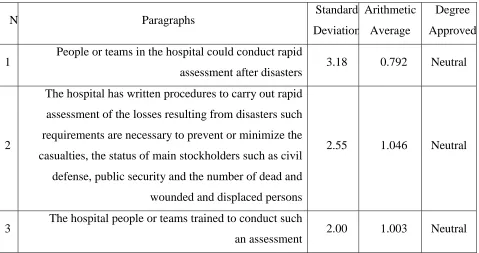
Neutral 0.792
3.18 People or teams in the hospital could conduct rapid
assessment after disasters 1
Neutral 1.046
2.55 The hospital has written procedures to carry out rapid
assessment of the losses resulting from disasters such
requirements are necessary to prevent or minimize the
casualties, the status of main stockholders such as civil
defense, public security and the number of dead and
wounded and displaced persons 2
Neutral 1.003
2.00 The hospital people or teams trained to conduct such
an assessment 3
Table (7) Arithmetic averages, standard deviations, respectively vertebrae axis of the ability
to respond to disasters and crises In descending order according to the arithmetical averages
As seen from Table (7) to paragraphs axis of the ability to respond to disasters and crises, the
averages of calculation almost "neutral" and ranged arithmetical averages of paragraphs between
(2.00-3.18) and the highest degree of approval for the gateway (people or teams in the hospital
could conduct rapid assessment after disasters 3.18). The lowest degree of approval of paragraph
(The hospital people or teams trained to conduct such an assessment and get average of 2.00)
[image:20.612.69.548.250.503.2]A Monthly Double-Blind Peer Reviewed Refereed Open Access International e-Journal - Included in the International Serial Directories.
GE- International Journal of Management Research (GE-IJMR) Website: www.aarf.asia. Email: [email protected] , [email protected]
Page 365
To answer the fifth question of the study, the researcher allocated four questions to gauge the
views of members of the study sample about the hospital's ability to recovery from disasters and
crises, with the following results:
Degree
Approved Arithmeti
c Average Standard
Deviation Paragraphs
No
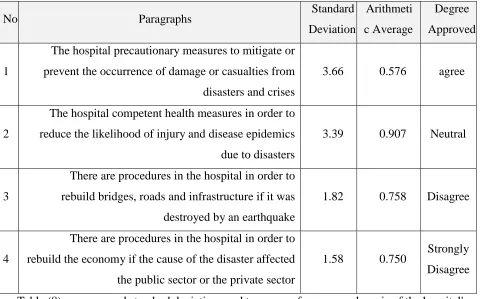
agree 0.576
3.66 The hospital precautionary measures to mitigate or
prevent the occurrence of damage or casualties from
disasters and crises 1
Neutral 0.907
3.39 The hospital competent health measures in order to
reduce the likelihood of injury and disease epidemics
due to disasters 2
Disagree 0.758
1.82 There are procedures in the hospital in order to
rebuild bridges, roads and infrastructure if it was
destroyed by an earthquake 3
Strongly
Disagree 0.750
1.58 There are procedures in the hospital in order to
rebuild the economy if the cause of the disaster affected
the public sector or the private sector 4
Table (8) averages and standard deviations and to arrange for paragraphs axis of the hospital's
ability to recovery from disasters and crises, in descending order according to the arithmetical
averages
As seen from table (8) to paragraphs axis of the ability of the hospital on recovery from disasters
and crises, the averages calculation is located between the degree of "strongly disagree" and
"agree" and ranged arithmetical averages of paragraphs between (1.58-3.66) and the highest
degree of approval for the phrase (the hospital precautionary measures to mitigate or prevent the
occurrence of damage or casualties from disasters and crises, and get an average of 3.66) while
the other paragraphs which got averages less with some variation in degrees of approval. The
[image:21.612.69.549.189.488.2]A Monthly Double-Blind Peer Reviewed Refereed Open Access International e-Journal - Included in the International Serial Directories.
GE- International Journal of Management Research (GE-IJMR) Website: www.aarf.asia. Email: [email protected] , [email protected]
Page 366
the economy if the cause of the disaster affected the public sector or the private sector, and
earned on average of 1.58).
Question Six: What is the relationship between superiors and subordinates in the hospital?
To answer the sixth question of the study, we allocated five questions to gauge the views of
members of the study sample about the hospital's ability to recovery from disasters and crises,
with the following results:
Degree
approved Arithmetic
Average Standard
Deviation paragraphs
No
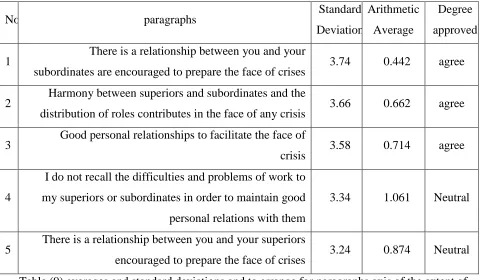
agree 0.442
3.74 There is a relationship between you and your
subordinates are encouraged to prepare the face of crises 1
agree 0.662
3.66 Harmony between superiors and subordinates and the
distribution of roles contributes in the face of any crisis 2
agree 0.714
3.58 Good personal relationships to facilitate the face of
crisis 3
Neutral 1.061
3.34 I do not recall the difficulties and problems of work to
my superiors or subordinates in order to maintain good
personal relations with them 4
Neutral 0.874
3.24 There is a relationship between you and your superiors
encouraged to prepare the face of crises 5
Table (9) averages and standard deviations and to arrange for paragraphs axis of the extent of
the relationship between superiors and subordinates in the hospital in descending order according
to the arithmetical averages
As shown in Table (9) to paragraphs axis of the relationship between superiors and subordinates
at the hospital get an averages between the degree of "neutral" and "agree" and ranged
arithmetical averages of paragraphs between (3.24-3.74) and the highest degree of approval for
the phrase (there is a relationship between you and subordinates are encouraged to prepare in the
[image:22.612.67.552.264.544.2]A Monthly Double-Blind Peer Reviewed Refereed Open Access International e-Journal - Included in the International Serial Directories.
GE- International Journal of Management Research (GE-IJMR) Website: www.aarf.asia. Email: [email protected] , [email protected]
Page 367
a relationship between you and your superiors encouraged to prepare the face of crises, and won
my average (3.24).
Question Seven: What is the extent of participation of workers in making decisions and
solving business problems?
To answer the seventh question of the study we allocated five questions to gauge the views of
members of the sample of the study on the extent of participation of employees in
decision-making and problem-solving work, with the following results:
Degree
Approved Arithmetic
Average Standard
Deviation Paragraphs
No
agree 0.442
3.74 When discussing things work in meetings accept things
running smoothly and discuss it objectively 1
agree 0.938
3.42 Workers involved in the resolution of crises, each
according to the nature of his work 2
Neutral 1.870
3.32 Avoids a lot of personnel decisions with respect to their
work for fear of falling into the embarrassment with
management 3
Neutral 1.978
3.05 There is no chance to discuss problems and spent work
only for managers 4
Neutral 1.811
3.00 If one of the workers tried to search for solutions to any
crisis himself, he will face confrontations from his
superiors 5
Table (10) - averages and standard deviations and to arrange for paragraphs axis the extent of
participation of workers in making decisions and solving problems in descending order
according to the arithmetical averages
As seen from the table (10) to paragraphs axis over the participation of workers in making
decisions and solving problems of work get averages calculation between the degree of "neutral"
and "agree " and ranged arithmetical averages of paragraphs between (3.00-3.74) and the highest
[image:23.612.68.548.256.552.2]A Monthly Double-Blind Peer Reviewed Refereed Open Access International e-Journal - Included in the International Serial Directories.
GE- International Journal of Management Research (GE-IJMR) Website: www.aarf.asia. Email: [email protected] , [email protected]
Page 368
running smoothly and discuss it objectively, and get an average of 3.74). The lowest degree of
approval to paragraph (if one of the workers tried to search for solutions to any crisis himself, he
will face confrontations from his superiors) and gets an average of 3.00.
6. Hypotheses Tests
First hypothesis: There is no statistically significant relationship between the precautionary
measures applied in the private hospitals and the ability to recovery from disasters and crises.
To validate this hypothesis the Spearman correlation coefficient was used to find a relationship
between the precautionary measures applied in the private hospitals and the ability to recovery
from disasters and crises. We found that there is existence of a positive relationship between the
precautionary measures applied in the private hospitals and the ability to recovery from disasters
and crises, where the value of the Spearman correlation coefficient is (0.910) and the level of
significance (0.000) which is significant value at the level of (0.05).
The second hypothesis: There is a statistically significant relationship between previous
experience in dealing with crises and the precautionary measures applied.
To validate this hypothesis the Spearman correlation coefficient was used to find a
relationship between previous experience in dealing with crises and the precautionary measures
applied. We found that there is a direct correlation between previous experience in dealing with
crises and the precautionary measures applied where the value of the Spearman correlation
coefficient (0.617) and the level of significance (0.000) which is significant value at the level of
(0.05).
The third hypothesis: There is no statistically significant relationship between palliative
procedures applied and the ability to respond to disasters and crises.
To validate this hypothesis the Spearman correlation coefficient was used to find a
relationship between palliative procedures applied and the ability to respond to disasters and
crises. We found that there is a direct correlation between mitigation measures and the ability to
respond to disasters and crises, where the value of the Spearman correlation coefficient (0.614)
A Monthly Double-Blind Peer Reviewed Refereed Open Access International e-Journal - Included in the International Serial Directories.
GE- International Journal of Management Research (GE-IJMR) Website: www.aarf.asia. Email: [email protected] , [email protected]
Page 369
The fourth hypothesis: There is no statistically significant relationship between the ability to
respond to disasters and crises and the ability to recovery from disasters and crises. To validate
this hypothesis the Spearman correlation coefficient was used to find a relationship between the
ability to respond to disasters and crises, and the ability to recovery from disasters and crises. We
found that a direct correlation between the ability to respond to disasters and crises, and the
ability to recovery from disasters and crises, where the value of the correlation coefficient
Spearman (0.876) and the level of significance (0.000) which is significant value at the level of (
0.05).
The fifth hypothesis: There is no statistically significant relationship between the personal
relationships between superiors and subordinates and the procedures applied to increase the
ability to respond to disasters and crises.
To validate this hypothesis the Spearman correlation coefficient was used to find a
relationship between the personal relationships between superiors and subordinates and the
procedures applied to increase the ability to respond to disasters and crises. There is existence of
a positive relationship between personal relationships between supervisors and subordinates, and
the procedures applied to increase the capacity to respond to disasters and crises, where the value
of the correlation coefficient Spearman (0.414) and the level of significance (0.000) which is
significant value at the level of (0.05).
The Sixth hypothesis: There is no statistically significant relationship between the personal
relationships between superiors and subordinates and the procedures applied to increase the
ability to respond to disasters and crises.
To validate this hypothesis the Spearman correlation coefficient was used to find a
relationship between the personal relationships between superiors and subordinates and the
procedures applied to increase the capacity to respond to disasters and crises. We found a
positive relationship between personal relationships among supervisors and subordinates,
between the procedures applied to increase the capacity to respond to disasters and crises, where
the value of the correlation coefficient Spearman (0.725) and the level of significance (0.000)
A Monthly Double-Blind Peer Reviewed Refereed Open Access International e-Journal - Included in the International Serial Directories.
GE- International Journal of Management Research (GE-IJMR) Website: www.aarf.asia. Email: [email protected] , [email protected]
Page 370
7. RESULTS OF THE STUDY
The study showed that past experience with private hospitals operating in the region of Mecca,
available but unacceptably, while they participate in the management of previous crises, but that
the degree and extent of learning of these hospitals from the lessons of the posts disasters in the
management of crises, and dissemination of learned lessons of the crisis on workers, and the
number and extent of review of all procedures related to crises and their evaluation, came to an
disagree evaluation. Mitigation measures within the study sample were acceptable but barely
exceed the minimum requirements, so administration of these hospitals need to enhance the
provision of these requirements greater than it is now , and that the participation of these
hospitals in the mitigation measures outside the boundaries of the hospital are almost virtually
non-existent, and this shows the inadequacy of this vital sector, which is the first line in the face
of disasters and crises in society, and adopt entirely on the government sector, which in turn
makes it imperative for the public sector and the Ministry of Health pressure these hospitals to
provide greater support and carry social responsibility and ethics towards society. The
precautionary measures are acceptable, with varied results of the study between the degree of
agree and disagree, where the results of having a plan in private hospitals much good, but
degrees of detail in the contents and the way of the plan and its commitment to modernization
and a team that specializes in the application came with weak results.
As illustrated by the study, the basic requirements to respond to crises and disasters (cadres, and
plans prepared in advance) are available in private sector hospitals is weak, as it lacks the
presence of people or teams trained to accurately assess and effectively, and also lacks written
procedures to carry out rapid assessment of the losses resulting from disasters such requirements
are necessary to prevent or minimize casualties, and this indicates a lack of indifference and lack
of interest in the consequences and losses by the departments of these hospitals in the event of a
crisis or disaster occurred to them.
Mixed results in terms of the ability of private hospitals on recovery from crises and disasters ,
while the results were the existence of precautionary measures to mitigate or prevent the
A Monthly Double-Blind Peer Reviewed Refereed Open Access International e-Journal - Included in the International Serial Directories.
GE- International Journal of Management Research (GE-IJMR) Website: www.aarf.asia. Email: [email protected] , [email protected]
Page 371
very weak in the proceedings the competent health, was almost non-existent in respects outside
the hospital in the case of roads, bridges and restore the economy if the disaster belong to the
public sector economy.
It is clear from the study that those working in hospitals in the private sector the relations
between superiors and subordinates, which encourages to prepare the face of crisis, but this
relationship is not up to the degree of harmony to the degree of consensus and the distribution of
administrative, and personal relationships obstacle in achieving a good degree of transparency
and clarity in resolving problems confronting disasters and crises.
The study showed that the participation of employees in decision-making role in solving
problems and cope with crises, where the results were much good, while the results were weak
degree in cases that many of the workers to avoid making decisions with respect to their work for
fear of falling into the embarrassment with management, as well as the opportunity to debate the
issues Showing spent working are only available for managers only.
There is no statistically significant differences in the answers of respondents attributed to sex on
the reality of crisis management method, except in qualified human cadres administratively,
where the degree of consent for females than males. Also, there are no statistically significant
differences in the answers of respondents attributed to age about the reality and the method of
crisis management. And, there are no statistically significant differences in the answers of
respondents attributed to the academic qualification about the reality and the method of crisis
management. As for experiences, we found that there is significant differences in the answers of
respondents attributed to the number of years of experience about the reality and the way of
crisis management in private hospitals, in the areas of decision-making, and dealing between the
president and subordinates, but as for the rest of the areas, there is no statistically significant
differences.
Finally, we can say that private hospitals operating in the area of Mecca have fundamentals but
A Monthly Double-Blind Peer Reviewed Refereed Open Access International e-Journal - Included in the International Serial Directories.
GE- International Journal of Management Research (GE-IJMR) Website: www.aarf.asia. Email: [email protected] , [email protected]
Page 372
management in the private health sector, especially with repeated disasters and crises In recent
years in the region, and is expected to continue in pace of increase in disasters and crises in the
future.
8. RECOMMENDATIONS
There is a need to implement integrated methodology for crisis management in the private sector
hospitals by activating or increasing the provision of basic elements that characterize the
successful management of crises in various stages that represent an integrated perspective of
crisis management, and try to achieve a balance between these stages. Private hospitals need to
take advantages of their previous experiences with disasters and crises to learn lessons of the past
and turn them into written procedures, and disseminate these lessons to workers, especially those
involved in crisis management or could have them participate, and upon review of procedures
based on those lessons and periodically update depending on the variables and
developments. This administration must strengthen the provision of the requirements of hospitals
mitigation measures to a greater degree than it is now.
Hospitals in the private sector need to strengthen its role to the larger community and assume
responsibilities and do the social and moral turn by not only relying on the government sector.
Also, there is a need to make sure there is a written plan in private hospitals which contains all
the details that could be needed in the event of a crisis or disaster, and make sure of its contents
and its commitment to modernization. This could be augmented by the ongoing review of crisis
management plans, and conduct mock trials to deal with various crises, to test the efficiency and
effectiveness of these programs and plans, in order to identify weaknesses to overcome them,
and identify strengths to increase their support and rooting. We recommend that private sector
hospitals create units for crisis management, and provide qualified people and specialists in crisis
management and trained to crises and disasters measures to develop plans and provide training
and continuing education about the state of the reach of science in crisis management for the
crisis management team within hospital. Such team must be trained periodically on crises and
disasters plans and to develop scenarios similar to what can happen in the event of crises and
A Monthly Double-Blind Peer Reviewed Refereed Open Access International e-Journal - Included in the International Serial Directories.
GE- International Journal of Management Research (GE-IJMR) Website: www.aarf.asia. Email: [email protected] , [email protected]
Page 373
References
Al-Shaalan, Fahad Ahmad (2002), "Crisis Management: Foundations - stages -
mechanisms", Master Thesis. Naif Arab University for Security Sciences, Riyadh
Al-Momni, Naill (2012),"Crisis and Disaster Management”,2nd edition, Dar Waill
Publishing Co.
Al Momani, Naill, (2011) "Integrated Framework for Earthquake Consequences
Management", Disaster Prevention and Management An International Journal, Vol. 20,
iss.3
Christopher, Sudhaker, Libert , Anil Gomes (2010), " Job Stress, Coping Strategies And
The Job Quality Index Of Nurses, Working In Selected Multispecialty Hospitals–
Towards Human Resource Development ", Journal of the Academy of Hospital
Administration, Vol. 22, No. 1 & 2
Dückers, Michel, Marjan, Faber (2009), " Safety and risk management in hospitals " : IQ
Scientific Institute for Quality of Healthcare, Radboud University, Nijmegen Medical
Centre.
Hamalawy, Mohammed Rashad (1997), "Crisis Management in the Egyptian industry,
Empirical Study", second conference of crisis and disaster management, Ain Shams
University, Cairo
Laura , L. Morlock, Faye , E. Malitz Bennett-Roger (1991), " Relationships Between
Risk Management Program Activities And Hospital Malpractice Claims Experience ",
Law and Contemporary Problems, Vol. 54
Elewa, Mr. Radwan, (1997), "communication skills in crisis management: application to
the hospitals", the second annual conference of crisis and disaster management, Ain
Shams University, Cairo