Citation:
Griffin, D and Mitchell, A and Griffin, S (2008) Developing a case study for the MySpace generation. Assessment, Teaching & Learning Journal, 3. 15 - 19.
Link to Leeds Beckett Repository record: http://eprints.leedsbeckett.ac.uk/1095/
Document Version: Article
The aim of the Leeds Beckett Repository is to provide open access to our research, as required by funder policies and permitted by publishers and copyright law.
The Leeds Beckett repository holds a wide range of publications, each of which has been checked for copyright and the relevant embargo period has been applied by the Research Services team.
We operate on a standard take-down policy. If you are the author or publisher of an output and you would like it removed from the repository, please contact us and we will investigate on a case-by-case basis.
Developing a case study for the MySpace generation
Dave Griffin, Andy Mitchell and Stephen Griffin
Introduction
There has been much interest in blended learning within universities. In recent years, articles and books have been written about it (Hirst, 2007; Sharma and Barrett, 2007) and conferences have been organised to discuss it
(http://perseus.herts.ac.uk/uhinfo/info/blu/blu/events/conference-2007.cfm).
In this paper, we shall adopt Oliver and Trigwell’s definition of blended learning (2005, p. 17):
“the integrated combination of traditional learning with web-based online approaches”.
This article discusses the development phase of a project set up within Innovation North to explore the potential for Web 2.0 applications to contribute to a blended learning approach. For the purposes of this research, the following definition of Web 2.0 is used:
“Web 2.0 refers to a perceived second generation of web-based communities and hosted services — such as social networking sites, and wikis — which aim to facilitate collaboration and sharing between users.” (Wikipedia, 2007)
The research questions of this project are as follows:
Q1: How active are our students in Web 2.0 sites?
Q2: Are they willing to extend beyond social networking on such sites? Q3: What is their preferred ‘blend’ of e-learning environments?
As this is the first phase of the project the aims are more limited. It provides some evidence to answer Q1 (albeit with limitations which need further testing) and lays the foundation to explore Q2 and Q3 in a future article after the case study has been used in a module.
In this stage of the project a set of Web 2.0 case study materials has been produced. The distinctive feature of this has been that the development approach itself employed the Web 2.0 design philosophy. The consumers of the case study have become its producers. Students have actively participated in the design and development of the case study to be used by other students.
Context for the research
Level 1 Computing and IT students study a module called Systems Modelling. In recent years a paper-based assignment on a vets’ practice has been used to develop their process
and the case study wiki (http://www.thestudentwiki.org/wiki-dave/index.php/Main_Page) supplemented by podcasts (http://ewok.inn.leedsmet.ac.uk/loveleeds/).
How active are our students on Web 2.0 sites?
To attempt to answer this, a questionnaire was distributed and collected in class to 167 students in Innovation North which guaranteed a response approaching 100% of the
population. Each question asked students about their online behaviour over the previous seven days (e.g. in the past seven days: have you accessed wikipedia, contributed to wikipedia?).
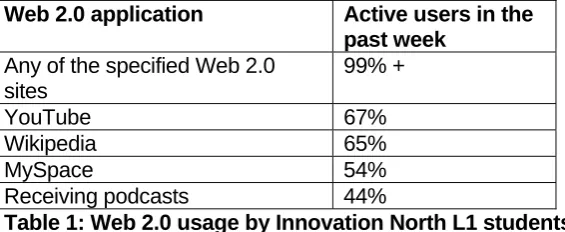
The main results are shown in Table 1. Active users are defined as the sum of the number of students who have passively visited the application in the previous seven days plus the number of students who have contributed something to it in the past week. This survey confirmed our prior belief that our students are active Web 2.0 users. Almost all respondents had accessed one or more of the applications specified during the previous seven days. Despite the rising popularity of Facebook amongst students, MySpace was still the most frequently used social networking site. The iPod was attaining ubiquity as an MP3 player, with 85% of the sample owning one. Furthermore these devices were not used exclusively to store songs. 44% of the sample had accessed, or contributed to, a podcast series in the previous week.
Web 2.0 application Active users in the past week
Any of the specified Web 2.0 sites
99% +
[image:3.595.70.353.325.441.2]YouTube 67% Wikipedia 65% MySpace 54% Receiving podcasts 44%
Table 1: Web 2.0 usage by Innovation North L1 students
Development of the Web 2.0-based case study
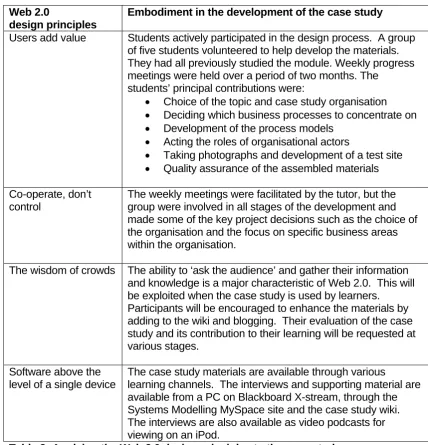
Web 2.0
design principles
Embodiment in the development of the case study
Users add value Students actively participated in the design process. A group of five students volunteered to help develop the materials. They had all previously studied the module. Weekly progress meetings were held over a period of two months. The
students’ principal contributions were:
• Choice of the topic and case study organisation
• Deciding which business processes to concentrate on
• Development of the process models
• Acting the roles of organisational actors
• Taking photographs and development of a test site
• Quality assurance of the assembled materials
Co-operate, don’t control
The weekly meetings were facilitated by the tutor, but the group were involved in all stages of the development and made some of the key project decisions such as the choice of the organisation and the focus on specific business areas within the organisation.
The wisdom of crowds The ability to ‘ask the audience’ and gather their information and knowledge is a major characteristic of Web 2.0. This will be exploited when the case study is used by learners. Participants will be encouraged to enhance the materials by adding to the wiki and blogging. Their evaluation of the case study and its contribution to their learning will be requested at various stages.
Software above the level of a single device
The case study materials are available through various
[image:4.595.63.492.67.513.2]learning channels. The interviews and supporting material are available from a PC on Blackboard X-stream, through the Systems Modelling MySpace site and the case study wiki. The interviews are also available as video podcasts for viewing on an iPod.
Table 2: Applying the Web 2.0 design principles to the case study
Reflections on the process of development of the case study
The six students were asked to reflect via email on their involvement in the project. Four of them responded. All of the students had previously studied this module. Their responses suggest that they took part in this project to deepen their systems knowledge and skills.
Student 1: “I wanted to apply, and develop, the skills I had acquired on the Systems Modelling module to a real world situation. It has helped dramatically as it has afforded me a deeper understanding of the role of systems modelling in a real world environment.”
Student 2: “I felt the Systems Modelling module was not challenging enough and I wanted to apply the newly gained skills to something more challenging than the printed case study.”
Student 4: “Involvement has given me an opportunity to help build a case study from a real business scenario. These skills are likely to prove invaluable in future employment.”
Conclusions and next steps in the project
This paper has outlined an approach for developing a case study for the MySpace generation. Exploratory empirical research has indicated that our students are active socially in Web 2.0 sites such as MySpace and FaceBook. The underlying design principle for Web 2.0 sites is participation by users of the site. This approach has been adopted in the development of the case study. Students fully participated in the design and build of the case study.
The 150 students in Innovation North who will study this case in 2007- 2008 will be encouraged to participate in its further development. Volunteers will be requested to keep a diary showing how they used the various materials to identify their preferred blend of e-learning environments. At the end of the module, all students will be surveyed to determine their attitudes to using sites normally reserved for social behaviour as a learning environment. This additional data should help us to develop blended learning materials to engage the MySpace generation.
Dave Griffin (Systems for Innovation), Andy Mitchell and Stephen Griffin (students in Computing and Information Systems, Innovation North)
References
Carr, N. (2005) The amorality of Web 2.0. Available at:
http://www.roughtype.com/archives/2005/10/the_amorality_o.php [Accessed October 2007]
Hirst, S. (2007) Teaching smarter with a blend of different learning experiences. Leeds Metropolitan University Assessment, Learning and Teaching Incubator Journal 2, Summer 2007.
Oliver, M. and Trigwell, K. (2005) Can ‘Blended Learning’ Be Redeemed? E-Learning 2(1): 17-26.
O’Reilly, T. (2005) What is Web 2.0? Available at:
http://www.oreillynet.com/pub/a/oreilly/tim/news/2005/09/30/what-is-web-20.html [Accessed October 2007]
Sharma, P. and Barrett, B. (2007) Blended Learning. London: Macmillan.