International Research Journal of Mathematics, Engineering and IT Vol. 3, Issue 6, June 2016 IF- 3.563 ISSN: (2349-0322)
© Associated Asia Research Foundation (AARF)
Website: www.aarf.asiaEmail : [email protected] , [email protected]
AN INTERVAL-VALUED INTUITIONISTIC FUZZY WEIGHTED
ENTROPY METHOD FOR FINDING OPTIMAL SEQUENCE OF
FLOW SHOP SEQUENCING PROBLEMS
R. Murugesan
School of Physical Sciences, Reva University, Bangalore, India.
ABSTRACT
This paper proposes the interval valued intuitionistic fuzzy weighted entropy
(IVIFWE) for solving flow shop sequencing problems. The processing time of n jobs and m
machines flow shop sequencing problem is modeled as fuzzy numbers by using similarity
relation and then, we consider the neighboring points are interval of these fuzzy numbers.
Used the calculated intervals in interval valued intuitionistic fuzzy weighted entropy for
solving the sequencing problem. The proposed entropy method gives the optimal sequence
for minimize the makespan Cj of flow shop sequencing problem without any condition and
minimum idle time of the machines.
Keywords— Flow shop Sequencing Problem, Intuitionistic fuzzy set, Intuitionistic fuzzy
interval value, weighted entropy.
I. INTRODUCTION
The flow shop sequencing problem has paying a great role in all production and
assembly areas. Assignment of job operations to machines for processing is big task, and
sometimes assignment may be imperfectly because of differences in machine type. Further,
the time for each operation required by different machines is different, and some machines
can execute only particular operations. Therefore, an effective scheduling method is required
for growing the productivity of the organizations with reduced cost. In the recent year, fuzzy
sets are used to model the uncertain processing times for the flow shop sequencing problems.
Zadeh[1] has introduced the membership of an element between zero and one to a fuzzy set
as single valued functions. The concept of intuitionistic fuzzy set (IFS) was introduced by
Atanassov[2] as an extension of fuzzy set and the author was define the characterization of
respectively. Li[3] used intuitionistic fuzzy set theory for solving LPP models and multi
criteria decision making problems. Xu[7] developed some optimization models to determine
the weights of attributes using IFS based score matrix. Vlachos and Sergiadis[5] derived the
De Luca–Termini non-probabilistic entropy for intuitionistic fuzzy sets. This entropy is
useful for connecting the notation of fuzzy set entropy and intuitionistic fuzzy sets in terms of
fuzziness and intuitionism. In this paper, we consider flow shop sequencing problems, and
use interval valued fuzzy numbers to represent the processing time of the problem. Section 2
present the various basic definitions on Interval valued intuitionistic fuzzy weighted entropy.
Section 3 details the flow shop sequencing problem using IVIFWE. Section 4 gives the
numerical example followed by the conclusion in section 5.
2. DEFINITIONS FOR INTERVAL-VALUED INTUITIONISTIC FUZZY WEIGHED ENTROPY
Let M [0, 1] be the set of all closed subinterval of the set [0, 1], let X be an ordinary
finite non-empty set. An interval-valued intuitionistic fuzzy set (IVIFS) in a universe X is
defined by A={x, μA(x),γA(x):xϵX},where μA:X→M[0,1], γA:X→M[0,1]. The interval μA(x)
and γA(x) denote the membership degree and non-membership degree of the element x in A
respectively. Then, for each xϵX, μA(x)andγA(x) are closed intervals and μAL(x), γAL(x) &
μAR(x), γAR(x) are lower and upper end points respectively. Hence, in the condition 0<
μAL(x) + γAL(x) ≤1, and μAL(x) ≥0 , γAL(x) ≥0; A is denoted by A=[μAL(x), γAL(x) and
μAR(x) ,γAR(x)/xϵX]. The interval-valued intuitionistic index of x in A is called as hesitancy
degree, denoted by πA(x) and abbreviated by [πAL(x), πAR(x)] can be calculated using the
following formula
πA(x)=1- ηA(x) - γA(x)
= [1- ηA R(x) - γAR(x), 1- ηAL (x) - γAL(x)].
Definition2.1.
Let A, B are two IVIFS. A subset relation is defined by A⊂B if and only if μAL(x)≤ μBL(x),
μAU(x)≤ μBU(x)and γAL(x)≥_γBL(x),γAU(x))≥_ γBU(x)), ∀ x ∈ X.
The complement Ac of A = {x,μAL(x), γAL(x): x ∈ X } : x ∈ X} is defined by Ac = {x,γAL(x)
μAL(x): x ∈ X }.
From now the interval value of membership and non-membership degree is defined by A =
Definition 2.2.
Let A = ([Δa, Δb], [Δc, Δd]) be an interval valued intuitionistic fuzzy number. Then the score
function S of an interval valued intuitionistic fuzzy value is given by
S (A) = (Δa + Δb – Δc − Δd)/2.
Here, the score function is applied to compare the grades of the interval valued intuitionistic
fuzzy set.
Definition 2.3
Let Ai be the interval valued intuitionistic fuzzy sets, the degree of the interval valued
fuzziness is measured by the entropy E (Ai) is defined by
ni i i i i i i
i i i i i i i f e d b c a f e d b c a n A E
1max , max ,
, min ,
min 1
In interval valued intuitionistic fuzzy weighted entropy method (IVIFWE), the hesitancy
degree of the intuitionistic set is preferred to be as small as possible to get more stable results.
Meanwhile, the bigger value of entropy gives the smaller weight to each corresponding
criteria.
Definition 2.4
Let wi
w1,w2,w3,....,wn
be a subjective weighting vector of decision makers with thecondition of
n i i
i w i n
w 1 . ,..., 2 , 1 , 1 ,
0 then the weight vector can be calculated by
n i i ii E A E A i n
w 1 . ,... 2 , 1 , 1 / 1 Definition 2.5
Let Aij
aij,bij
,cij,dij
,i1,2,...,n,j1,2,...m be interval valued intuitionistic fuzzysets, the interval valued intuitionistic fuzzy weighted averaging operator can be represented
i i i i w ij n i i w ij n i w ij n i w ij n i n i ij i n w d x c b a A w A A A A A 1 1 1 1 1 3 2 1 , 1 1 , 1 1 ,..., , ,Where wi
w1,w2,w3,...,wn
is the weight of
n i i j
i and w i n
A 1 . ,.., 2 , 1 , 1 ,
It is used to aggregate the interval valued intuitionistic fuzzy information corresponding to
each alternate towards the final ranking.
3. JOB SEQUENCING PROBLEM USING IVIFWE
In flow shop sequencing problem, the determination of order in which the operations
in the behavioural description will execute. It includes optimal schedule under various
constrains, machine environments and characteristics of the jobs. The possible sequence of n
jobs and m machines in the flow-shop scheduling problem is (n!)m. Among these finding the
optimal solution to the problem is very difficult. Therefore to find the optimal sequence of
jobs on each machine in order to complete all the jobs on all the machines in the minimum
total time is important.
There are few methods based on interval- valued intuitionistic fuzzy set (IVIFS) in
measuring job sequences. In this study the job system consisting of n jobs and m machines.
The machines are not identical and perform different operations. The following assumptions
are made: a) each machine can perform one operation at a time on any job, b) each machine
continuously available for processing, c) no interception is allowed during any operation,
once the current operation is over then that machine is available for next operation and d)
there is no alternate route for operations of jobs. The main objective is to minimize the total
completion time Cj (makespan) and reduce the idle time for each machines. This paper,
propose a new method to obtain an optimal sequence for flow-shop scheduling problems with
m machines. The proposed method is simple to handle and easy to understand also. With the
help of the numerical examples, the proposed method is illustrated.
The computational procedure for solving flow shop sequencing problem based on
Consider J1, J2, J3…Jn are jobs and M1, M2, M3,..Mm are machines. The given job
sequencing problem is fuzzifing for processing time according to similarity relation to create
fuzzy number data dk=(Pt – Ptlower)/(Pt upper-Ptlower) where Pt is the processing time. An
interval number can be defined based on fuzzy similarity relation. The interval fuzzy number
should be an extension of the concept of a real number and also as a subset of the real line.
The following algorithm is used for finding the optimal sequence of the job.
Step 1: Construct an interval valued intuitionistic fuzzy decision matrix D = (dij); i=1,2,...m;
j=1,2,3...n; such that
mn m
n
d d
d d
D
1
1 11
a , b , c , d , e , f
,i 1,2,...m;j 1,2,...n, dwhere ij ij ij ij ij ij ij
ij ij
ij a b
d , Represent the closed interval degree that the alternative Mi satisfied the
attribute Cj and
cij,dij
represent the closed interval degree that alternate Mi does notsatisfy the attribute Cj and
eij,fij
represent the closed interval degree of hesitationassociated with the alternative Mi and attribute Cj.
Step 2: Calculate the entropy value corresponding to the criteria Cj, j = 1,2,...n. using
definition 2.3
Step3: Calculate the weight vector Jw
w1,w2,w3,...,wn
of the criteria by usingdefinition2.4.
Step 4: Aggregate the evaluation of the alternatives by IVIFWE Jw operator and get the
synthetic evaluation Mi , i = 1,2,..,m using definition 2.5.
Step 5: Apply the definition 2.2 to obtain a crisp score function JM1, JM2... JMm for various
alternatives. The smallest value of JMi processed first and next smallest second and so on.
4. NUMERICAL EXAMPLE
Four jobs 1, 2, 3, and 4 are to be processed on each of the four machines M1, M2, M3 and M4
in the order of ABCD. The processing times in minutes are given in the Table I.
M1 M2 M3 M4
J2 30 10 18 32
J3 28 12 16 44
J4 64 16 12 42
Table I: Job sequencing Problem
An optimal crisp sequence for Table I, obtained by Johnson’s algorithm is J3→ J2→J1→
J4 and the Cj(Makespan) is 250 minutes and idle time of the machines M1, M2, M3 and M4 are
70, 198, 190 and 84 respectively.
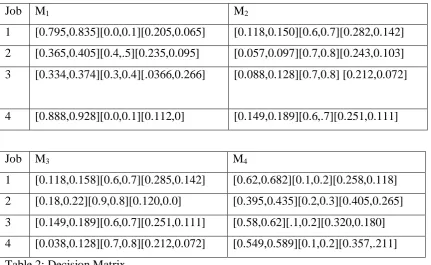
Step 1: Construct the interval valued intuitionistic fuzzy decision matrix. The interval valued
intuitionistic fuzzy decision matrix of the processing time has been constructed in table 2.
Job M1 M2
1 [0.795,0.835][0.0,0.1][0.205,0.065] [0.118,0.150][0.6,0.7][0.282,0.142]
2 [0.365,0.405][0.4,.5][0.235,0.095] [0.057,0.097][0.7,0.8][0.243,0.103]
3 [0.334,0.374][0.3,0.4][.0366,0.266] [0.088,0.128][0.7,0.8] [0.212,0.072]
4 [0.888,0.928][0.0,0.1][0.112,0] [0.149,0.189][0.6,.7][0.251,0.111]
Job M3 M4
1 [0.118,0.158][0.6,0.7][0.285,0.142] [0.62,0.682][0.1,0.2][0.258,0.118]
2 [0.18,0.22][0.9,0.8][0.120,0.0] [0.395,0.435][0.2,0.3][0.405,0.265]
3 [0.149,0.189][0.6,0.7][0.251,0.111] [0.58,0.62][.1,0.2][0.320,0.180]
[image:6.595.67.499.304.569.2]4 [0.038,0.128][0.7,0.8][0.212,0.072] [0.549,0.589][0.1,0.2][0.357,.211]
Table 2: Decision Matrix
Step 2: Applying definition2.3 to calculate the entropy value corresponding to the criteria Cj,
J=1,2,3,4. The entropy value for each criteria is calculated as given below:
E(M1)= 0.740, E(M2) = 0.600, E(M3) = 0.605, E(M4) = 0.878
Step 3: Applying definition2.4 to calculate the weight vector w= (w1, w2, w3, w4) of the
criteria. The weight vector values are calculated as given below.
Step 4: Applying definition2.5 to aggregate the evaluation of the alternatives by IVIFWE Jw
operator and get the synthetic evaluation Mi, i= 1,2,3,4 then the collection of interval
intuitionistic fuzzy value Mi, JM1 = 0.481, J M2= 0.284, JM3= 0.287, JM4= 0.512
Step 5: Rank the alternative. Apply equation 1to obtain a crisp score function value JM1 ... for
the values alternatives given below.
By comparing the score functions values, the alternatives are ranked from the lowest to
highest. Thus ranking as follows JM2<JM3<JM1<JM4. That is the sequence order is J2→J3→J1→J4
without any conditions. In this order the total completion (makespan) time is same as
Johnson’s algorithm 250 but the idle times of each machines are 70, 144, 158 and 84
respectively.
In another example we consider five jobs and four machines, the processing times are
(7,15,14,21: 11,18,18,6: 2,13,11,16: 14,4,27,14: 18,11,32,16) and the optimal sequence is
J3→J4→J2→J1→J5. The makespan is 133 and the idle time of machines on the above example are
81, 100, 31, and 58. further we consider three machines and four jobs, the processing times
are (8,2,4: 5,4,5: 6,1,3: 7,3,2). Here the sequence is J1→J2→J4→J3 , the makespan is 30 and the
idle times are 4, 22, and 16.
5. CONCLUSION
This paper discussed the flow shop sequencing problem and the processing time with
on interval valued intuitionistic fuzzy weighted entropy. Minimize the total completion time
of each job and idle time for each machine are considered as the objective. The experiment
instances show IVIFWE can effectively solved the flow shop sequencing problem with
interval processing time. The results could be tested for large scale problems. There are also
some works need to be done to obtain better results. This algorithm may apply for Job Shop
Scheduling problems and multi criteria job shop scheduling problems. IVIFWE has good
local search ability, but its global search ability can be strengthened by hybridizing with other
algorithms. More simple and more accurate interval comparison method also needs to be
researched.
References
[3] Atanassov, K.; Gargov, G.; “Interval-valued Intuitionistic Fuzzy Sets,” Fuzzy Sets and
Systems, vol. 31, no.3, pp. 343-349,. 1989.
[4] Li, D. F., “Multiattribute decision making models and methods using intuitionistic fuzzy sets”., Journal of Computer and System Sciences, 70(1), 73–85., 2005.
[5] Vlachos, I. K., & Sergiadis, G. D., “Intuitionistic fuzzy information – Applications to pattern recognition”., Pattern Recognition Letters, 28(2), 197–206.,2007.
[6] Xu, Z. S., “Methods for Aggregating Interval-valued Intuitionistic Fuzzy Information and Their Application to Decision Making,” Control and Decision, vol.22, no., pp. 215-219.,
2007.
[7] Xu, Z. S., “Multi-person multi-attribute decision making models under intuitionistic
fuzzy environment”. Fuzzy Optimization and Decision Making, 6(3), 221–236. 2007b.
[8] Xu, Z.; “A Method Based on Distance Measure for Interval-valued Intuitionistic Fuzzy Group Decision Making,” Information Sciences, vol. 180, no., pp. 181-190, 2010.
[9] Wei, C. P.; Wang, P.; Zhang, Y. Z.; “Entropy,Similarity Measure of Interval –valued Intuitionistic Fuzzy Sets and Their Applications,” Information Sciences, vol. 181, no., pp.