Citation:
Griggs, VM and McLaren„ D and Nixon, B and Smith, J (2014) Placing the transfer of learning at the heart of HRD Practice. In: 15th International Conference on Human Resource Development Research and Paractice across Europe, 4th - 6th June 2014, Edinburgh Napier University.
Link to Leeds Beckett Repository record: http://eprints.leedsbeckett.ac.uk/1503/
Document Version:
Conference or Workshop Item
The aim of the Leeds Beckett Repository is to provide open access to our research, as required by funder policies and permitted by publishers and copyright law.
The Leeds Beckett repository holds a wide range of publications, each of which has been checked for copyright and the relevant embargo period has been applied by the Research Services team.
We operate on a standard take-down policy. If you are the author or publisher of an output and you would like it removed from the repository, please contact us and we will investigate on a case-by-case basis.
Title: Placing the transfer of learning at the heart of HRD Practice
Working paper
Stream: Assessment, Measurement and Evaluation (PO) UFHRD Conference 2014
Title: Placing the transfer of learning at the heart of HRD Practice Griggs, V¹.; McLaren, D².; Nixon, B². and Smith, J.A¹.
Leeds Metropolitan University¹; Synaptic Change²
Abstract
Training evaluation is a key area of Human Resource Development, however, measuring the effectiveness of training and the transfer of learning from a training programme to the workplace can be a challenging activity. This is even more problematic for a training
provider who does not have the continuous relationship or access to performance measures of an in-house training department. This paper reports on the evaluation of a training model, assessing the impact from introduction to completion of the cycle. There are three partners in this research project: the training company, the client organisation and the university
researchers.
Synaptic Change Ltd is a training consultancy delivering bespoke training to organisations. Utilising a case study approach, this project reports on the evaluation of their training model through its introduction atConnect Housing, a charitable housing and support provider. This presents an interesting context for the study as researchers have suggested the distinctive value led culture of the Voluntary Sector can support a strong learning culture within the organisation. The project seeks to assess the value of learning to the organisation derived from the introduction of the model. The paper explores theoretical and empirical research concerning the evaluation of training and discusses the context of the case study organisation. It then positions the methodology employed and how data will be collected. As a working paper, the findings are not available at this time but will be presented and discussed at the UFHRD conference.
Introduction and Background to the Project
Underpinned by 20 years’ experience Synaptic Change have developed a training model, intended to be practical, easily understood and applied by managers, with a strong focus on monitoring and measuring effectiveness at each stage of the process. The model follows a systematic approach to designing and delivering training with a key emphasis on supporting the transfer of learning. This study examines the ‘embedding model’ and how it can be applied in a third sector organisation to aid the evaluation and transfer of learning. Baldwin and Ford (1988, p.64) define positive transfer of learning as ‘the degree to which trainees effectively apply the knowledge, skills and attitudes gained in a training context to the job’. The transfer incorporates two components; firstly the maintenance of learned material over time and, secondly, the generalization of this material from the learning context to the workplace. The basis of Baldwin and Ford’s model is that transfer is influenced by three areas, namely: the trainee characteristics, the training design factors and the work
environment. Later work (for example, Holton, 2005) supports these themes, identifying the impact of motivation, ability and environmental factors as key to transfer of learning. In a situation where the training is delivered by consultants this transfer of learning is potentially even more problematic. The model attempts to address this tension by encouraging feedback and application to the workplace at each stage.
The ‘embedding model’ was designed to provide a practical, easily understood and applied structure for the HR department to ensure transfer of learning takes place back in the
workplace and therefore proving the value of the training intervention. The focus of the study is the embedding model at each stage of the process rather than the specific training
intervention. The purpose of the case study is to also to examine and explore the role of the consultant in embedding learning in a client’s organisation and to test the rigour of the model given the limited responsibility the consultant has within the organisation to influence the successful transfer of learning. It will also examine and explore the potential barriers that the consultant and internal HR department face when attempting to embed and facilitate learning. This will be done by assessing at each stage in the embedding model where there is the
potential for it to fail and what strategies can be adopted to prevent this from happening.
The research has three key outcomes of value for the HRD community: firstly, it offersan insight into the role of HRD within one voluntary sector organisation, a sector impoverished in theoretical and empirical research; secondly, it reports on the value of learning at a time of economic pressure when there is increased emphasis for the HRD community to show a return on investment for training; finally the embedding model offers potential to enhance transfer and evaluation of learning.
This paper unfolds as follows: it begins with a background into issues regarding the
evaluation of learning and development. It then turns to the particular context of this study, and explores research into learning and development in the Voluntary Sector. The
‘embedding model’ itself is then positioned together with an outline of the methodology employed. At the conference, the presentation will discuss the findings in relation to the evaluation of the ‘embedding model’, the transfer of learning and proposed
The Evaluation of Learning and Development:
Evaluation of training and development interventions is much documented, supported by both theoretical models and empirical research. In its simplest workplace and Human Resource Development (HRD) terms, it holds a specific place at the end of a four stage training model (Gold et al, 2013 p.187). For the purposes of this paper we seek to emphasise the role of evaluation at each of the following stages:
Ex ante evaluation: at the start of the project/programme (also known as formative)
Interim evaluation: during the project/programme (formative and summative)
Ex post evaluation: at the end of the programme (summative). (Gold et al 2013)
Evaluation may be defined as ‘The process of determining the merit, worth or value of
something…’ (Scriven, 1991, p. 139). Easterby-Smith (1994) identifies four distinct purposes of evaluation: proving, improving, learning and controlling. Other than the ‘learning’
purpose, it could be argued that these are focused on the needs of HRD professionals – proving the training took place may provide compliance evidence, improving the actual training intervention particularly at interim or ex post stages and controlling training and development quality, financial costs and link between organisational objectives and the interventions supported.
However, this model may also be applied to the individual recipient of training. Evaluation of learning is a logical home to evaluate the impact on the individual but it does not guarantee whether such learning, or lack of learning, makes a real difference in the workplace. If individual recipients are required to prove their learning, show how they have improved their workplace practice and how the control measures have resulted in increased efficiencies; the model may be interpreted from another perspective.
An established and well-recognised evaluation model is Kirkpatrick’s (1998), focussing on; reaction, learning, behaviour and results. The limited value of the post event ‘happy sheet’ in terms of capturing reactions has been commented on earlier in this paper and noted by Devins and Smith in Gold et al (2013). This tends to exclude reactions from deliverers,
commissioners of training, employers and other stakeholders. The importance of stakeholders will be explored further below.
The CIRO model, Warr et al. (1970) and Hamblin (1994), refers to: Context, Inputs, Reactions and Outcomes. This holds resonance for our research given it was originally developed for the evaluation of management training. Hamblin’s (1994) four-level structure of analysis for outcomes: The learner level, the workplace level, the team/departmental/unit level, the organizational level is helpful in disaggregating the process and outcomes of evaluation by stakeholder. Additionally, Stake 2004 refers to ‘responsive evaluation’ noting the cultural and contextual factors and the importance of feedback for further learning. Patton (1997) notes the dichotomy of the evaluator as facilitator or judge. Rothman (1997) identifies ‘action evaluation’ when dealing with complex and difficult situations. This process particularly embraces the needs of different stakeholders and notes that evaluation is active and improvements continuous.
stakeholders, where, through dialogue, stakeholders jointly construct a consensus about an intervention’, (Devins and Smith in Gold et al 2013, p.179)
Anderson (2007) with work focussing on the external aspects of evaluation of learning identifies the need to balance the objective of return on investment, with the return on expectation. Investment and expectation returns may be different for different stakeholders and in some cases contradictory. This may lead to the same training intervention being seen as a great success using one set of measures from one stakeholder perspective and from another point of view, using different measures, viewed less positively. Anderson’s response is to remove a reliance on ‘one size fits all set of metrics’ and have a more nuanced approach considering, previously identified alignment, use of multiple evaluation methods and tailoring the approach by organisation.
Alliger et al. (1997) also urge designers to consider the ‘usefulness’ of learning at the
planning stage. They caution that if potential barriers to learning and specifically the transfer of learning to the workplace are not considered and strategies put in place to remove them in advance, such transfer will be limited if not stifled all together. Rouiller and Goldstein (1993, cited in Bramley 1999, p. 374) identified measures of the ‘transfer climate’, with an emphasis on managerial influence for the adoption of new behaviours from these studies, it was
reported that if the positive features below were adopted and a climate of transfer maintained by managers, transfer of learning to the workplace could improve from 8% (with no such active management) to 46%.
• goal setting
• the closeness of training behaviour to normal behaviour
• whether equipment was available in the workplace
• the autonomy of those trained to handle problems
• the degree of negative and positive feedback
• the impact of no feedback because line managers were too busy to provide it
• the degree of ridicule those trained received if they applied their learning.
The importance of return on investment of training interventions is identified by Phillips and Phillips (2001). Kearns (2005) went as far as devising a calculation process for measuring individual learning and its economic return. However return of investment is only one measure of success, as argued by Anderson, below. Also a return for the individual
participant stakeholder may not be seen as a positive return for the organisation if it does not contribute to improved business performance.
This leads to how any evaluation process manages the extraneous variables which may appear to influence evaluation results. Devins and Smith (2013) identify a number variables such as competitor failure, labour turnover, macro-economic factors such as unemployment and inflation, may all skew evaluation data and lead to mis-interpretation of findings, both positively and negatively.
interest to line managers. This appears contradictory to the earlier exhortations to involve line managers, as one of many stakeholders, in the evaluation process from the outset.’ (Devins and Smith, 2013, p.200)
Our research takes the literature and models, with all their cautions and limitations and seeks to offer a new approach to learning transfer which is pragmatic and can be valued by all stakeholders. It both measures transfer and is designed to maximise transfer, using specific techniques. It embraces the need to engage all stakeholders and to start that engagement and the earliest stage of planning / commissioning training, through to the longer term evaluation of real transfer to real workplace situations. This model and its practical application is being empirically tested in a single, third sector organisation. If our results are positive as
predicted, we will explore the extent this model and its application might serve and inform the wider HRD discipline of evaluation and transfer and how it might drive organisational improvements more broadly.
Learning and Development in the Voluntary Sector
Connect Housing is a charitable housing and support provider. It offers housing and housing support to a range of vulnerable people across the whole of Leeds area, Kirklees district and in Calderdale and Wakefield. Connect is led by its Board Members and Management Team, who bring together a wealth of different experience. There are approximately 150 employees including the Chair and 4 Directors, and twenty Management/Supervisory level.
They have commissioned a training programme from Synaptic Change and this provides an interesting context for our study as theories of HRM suggest that the most appropriate
approaches to the management of human resources will be influenced by the context in which an organisation operates and the strategy which it is pursuing (see for example, Tyson 1999). However, it has been suggested that a lot of the research on employee development activities and organisational performance has taken place in private sector organisations, with the chiefly untested assumption that the same findings will be applicable to other sectors (Birdi et al, 2007.) The extent to which research in private businesses can be applied to companies operating in a different organisational context requires further exploration. Stewart et al raise the question “is HRD different and therefore worthy of special attention in different sectors or functions, or when particular methods are adopted?” (2010, p.20). Following an extensive literature search Griggs and Holden (2013) found that research relating to HRD in the Voluntary Sector was an area underrepresented in the literature.
The Voluntary Sector in the UK has been gaining importance over recent years both in size and its role in the economy. The number of paid employees in the voluntary sector increased by approximately 18,000 between July and September 2012, this is the latest period for which data is currently available via the quarterly Labour Force Survey (ONS, 2013). This results in 793,000 paid employees working in the sector and represents around 2.7% of the UK's workforce (ibid). The Sector also has a key role to play in the Coalition Government’s Strategy for the ‘Big Society’ (Cabinet Office, 2010). However, recent cuts to public sector funding are having a corresponding impact on the voluntary sector. The National Council for Voluntary Organisations suggest charities are facing nearly £3 billion in cuts over the
1990), which moved from public provision in hospitals to providers from public, private and voluntary organizations. This was further developed with the Labour government’s focus on partnership working. This mixed economy of care has therefore resulted in a change in funding arrangements for voluntary organizations, which now receive their financial support in large part from the public sector. This in turn has implications for the management of the organizations as they are required to tender for services and are subject to performance measures on these contracts. Consequently, voluntary organizations are competing with public and private sector companies for the funding (Griggs and Holden, 2010).
With already limited financial resources, this additional pressure on budgets means that it is imperative charities make the most of the knowledge and skills of their workforce to help achieve the organisation’s goals (Akingbola, 2006, cited in Birdi et al, 2007). Keith Mogford, Chief Executive of Skills - Third Sector says: “If our sector is going to attract and retain talented people who will enable it to continue to deliver vital services to the communities we serve, it must demonstrate how it is investing intelligently in planned career pathways and the development of its staff in order to continue to meet the needs of service users.” (Reported in Third Sector Research Centre News and Events, 8 February 2013, p1).
In 2007 the Chartered Institute of Personnel and Development undertook a research project to investigate executive perceptions of the value of learning (CIPD, 2007; Anderson 2008). The researchers found that there are a number of ways learning is expected to add strategic value, but the most commonly cited view from both senior managers and HR executives, was that learning should create value by ensuring the strategic or change readiness of employees. Challenges of funding and engagement of stakeholders in securing investment in learning, require those concerned to be convinced of the significance of learning and development to the organisation. The research supported earlier findings (for example, Ulrich and Brockbank, 2005) that aligning learning to strategic priorities can be a complex and dynamic process, but the value of learning was not in doubt. The complexity within a diverse labour market
however raises an interesting question about the impact of the size, sector and ownership of a business on the contribution of its learning and development effort.
For those with an interest in HRD, the Voluntary Sector presents an appealing investigation into the role of learning and development for a number of reasons. Firstly, it instigates exploration in organisations with unique characteristics, such as a workforce composed of paid and volunteer staff. Secondly, it is cited in organisations facing substantial changes in response to political and economic pressures. Finally, it represents largely unchartered terrain in the field of existing HRD research. This study will provide empirical evidence of HRD in one Voluntary Sector organisation and contributes to emergent theory of the value of HRD in the voluntary sector.
Interestingly, the CIPD Learning and Talent Development Survey (CIPD, 2012) suggests HRD in the Voluntary Sector may be an area of increasing focus as non-profits were more likely than other sectors to report both that the Learning and Talent Development (L&TD) department has become more business focused and an expansion of L&TD into new areas of the business. This may result in greater focus on research in this area moving forward; however, the topic is currently sparsely covered in the literature.
and Leadership development. This is in recognition of the need to up skill the workforce so that they can compete with other providers in the current economic climate.
The organisation is trying to get the best value and return on the investment in training. There has been a lot change within the organisation and it is still ongoing. To survive and be
competitive the organisation is continually reviewing its’ operation and workforce. The Human Resource Manager is currently developing the L & D strategy to support the strategic objectives of the business. The development of a new performance management and
appraisal system is currently underway. The training intervention Synaptic Change has developed will support this change. The HRM’s ultimate goal is to move to a learning organisation where learning transfer will become business as usual and that knowledge sharing will ensure that the organisation will thrive and survive providing the best service for its’ clients.
The ‘Embedding Model’
The model was developed to address a constant source of frustration from the training provider, who were concerned that delegates attend training interventions, sign to say they have completed the training and then returning to the workplace to continue as they were before. Often there is very little transfer of learning that occurs. Consequently, training is not only seen as something that doesn’t add value to the business, but it is also an expense in terms of time away from the workplace, money and resources. As a result Nixon and McLaren are passionate about the transfer of learning and the embedding of behavioural change to ensure that all training interventions add value to the delegate and the organisation, and that return on investment and expectation is not only seen but experienced.
The consultants’ experience suggests that most organisations they have come into contact with have some form of training for their employees, however, very few take the time to embed and measure the transfer of learning. This raises a concern that time and effort is spent on training where nothing would be achieved as a result. The rhetoric of a training cycle was not borne out in the reality of delivery, and the consultants were keen to develop a model that remained practical and easy to use in a real life work environment. The model was originally developed as a source of reference for both Nixon and McLaren as they worked with
different organisations. This then evolved over the years into the embedding model as it is today and will be tested in this case study.
In addition to using the model for design and delivery themselves, Nixon and McLaren have also mentored and coached a number of Training Managers who were experiencing
challenges to implement training in their organisations. Embedding was always a top priority for them as they were often being asked to provide evidence of their value. The model has been used by Nixon and McLaren to highlight the checkpoints that would improve their success in this area. Until now though, the evidence of the success of the model has been based on personal experience and anecdotal evidence. The aim for this project is to undertake a more detailed analysis of its effectiveness.
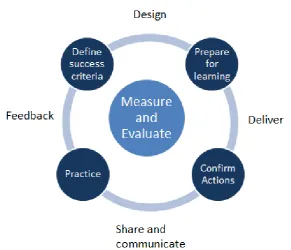
Figure 1
The first stage is to define the success criteria so that all stakeholders have a common understanding of what success will look like. It includes an analysis of the rationale for the training intervention and the training needs it seeks to address. Importantly, this stage includes the identification of the metrics at the outset that are linked to the success criteria and real life solutions. The consultants then design the training intervention with a clear view of the desired end result in mind. From the organisation’s perspective, the next stage is ‘Prepare for learning’ which takes place with participants prior to the commencement of the training. At this stage line managers would explain where appropriate why training was taking place and have honest conversations about where the delegate needs to focus their attention after the training in order to improve. This helps to ensure participants arrive with clear personal objectives. Synaptic Change would then deliver the training intervention. The next stage would involve participants confirming actions to be taken post training
intervention. These would be specific actions as a result of the training. These will be practical and easy to relate to the job role. Synaptic change would then share and communicate all actions from the workshop with line managers. Delegates would be encouraged to practice their new skills back in the workplace with support from their managers. Delegates would then receive regular support and feedback after their training whilst they put their action plan into place and practice their new skills.
As consultants, working with clients to design and deliver a training intervention is often a challenge as there are limitations to the level of influence they can exert and sometimes have limited access to information. Often the client has specific criteria and material content they wish to include, but very little thought goes into what happens afterwards to ensure success is achieved. Clients often have not aligned their learning and development strategy with the business strategy and want a quick solution to an immediate problem.
Synaptic Change design bespoke training and work in partnership with their clients to
scope of the project. This stage was initially used as a safety net to identify the scope of the project, but it soon became clear it was an integral part of the model as it established with stakeholders the purpose of the training, and identified how the delegates needed to be supported after the intervention to achieve sustained behavioural change.
There are also a number of other challenges to working externally to an organisation:
1. Prioritising training
Clients often want the training, and see the need, however, it is not often top priority to be delivered or discussed in the wider context of HR. Therefore, unless the training is compliance driven, the deadlines and priorities can shift on a regular basis
depending upon the needs of the business.
2. Gaining buy in and influencing
Gaining buy in remains a challenge as most of the time it is the HR Manager who is the initial contact. This presents the problem of influencing the senior decision maker who may not see the training intervention as beneficial to the business.
3. Access to information
With every project it is difficult to access relevant information as there is a reliance on the stakeholder to provide the information. With every project SC has arranged time to verify information with individuals on a 1-1 or group basis. Unfortunately this often takes time to arrange and is subject to change at any point. This is an essential part of the model as this provides time to verify the gaps between what the client needs and how we can meet this requirements.
4. Not a quick solution
Embedding training is an extension of the training intervention. This is a shift change from the historic mind-set of training being concluded at the end of the workshop when the evaluation form is completed. By using the embedding model the
organisation is tasked to continue the learning process which may not be appealing with task focused managers wanting to move onto the next project.
5. Culture of the organisation
The culture of the organisation is always a consideration – as learning may not feature as part of business as usual. The embedding model is inclusive for all stakeholders who may not have a natural leaning towards developing their team.
The success of the model ideally is not whether it embeds learning from one intervention but is a process that can be adopted as ’business as usual’ or a ‘way of life’ within the
Methodology
Utilising a case study approach, the project seeks to assess the value of learning to the organisation derived from the introduction of the model and more specifically to determine:
o Is the model fit for purpose?
o Does the focus on embedding learning lead to effective transfer?
o What mechanism/method should be used so that the evaluation data can be easily collected as business as usual?
o What method should be used to capture/demonstrate transfer of learning in relation to the success criteria to prove ROI/ROE?
o What internal process should be adopted to ensure transfer of learning becomes embedded into ‘business as usual’ behaviour/performance by the individual/group?
The choice of data collection, analysis and construct validity can affect the types of
conclusions drawn from research (Sackett and Larson, 1990) and it is therefore important that the design is appropriate for the aim of the report. The case study was selected as an
appropriate method to focus on a set of issues in a single organisation. It is not intended to be generalised to a broader context at this stage but to highlight issues for further examination. We are not therefore proposing that success of the model in this particular case would imply success of the model universally. Evaluation of the model is difficult for consultants who do not have the same access to information and on-going feedback that may be available to in-house HRD functions, so the value of a case study in an organisation who are supportive of the research and will give access to appropriate review and feedback opportunities provides a valuable starting point. The case study approach enables a critical test of the model and its applicability in this organisation. It provides a comprehensive description and analysis of the end to end implementation of the model.
A Qualitative approach to data collection is appropriate. In contrast to the collection and analysis of data that is at the centre of quantitative research, qualitative research focuses on the understanding of issues through description and words. It has an inductive nature. Bryman and Bell (2003) highlight the important distinction between quantitative as the adoption of a natural scientific model and qualitative as interpretivist with the emphasis on understanding the social world through examination of the interpretation of that world by its participants.
To that end it is more subjective and this has led to some criticism that as the process may rely on non-observable and non-measurable processes they are inherently non-scientific (Morse, 1992). Again, this highlights the importance of the relevance of the methodology employed to the nature of the research and the requirement for qualitative data to undergo rigorous interpretation. Robustly interpreted, qualitative data provides the rich picture upon which recommendations will be constructed.
There will be 2 main approaches to data collection: interviews/focus groups and reflective learning journals.
Firstly, Synaptic Change will conduct interviews and listening groups to learn how it worked in practice, what the obstacles were and how these could be overcome.
analyse. The advantage for semi-structured interviews for this project was the flexibility of content. Participants could be spontaneous and explore issues they felt were relevant, complex probing questions could be used where the interviewers felt an interesting avenue was opening up. Also other non-verbal clues can provide vital information. The focus group is structured with pre-determined questions but a free flow conversation so that issues can be explored in depth. Comments will be recorded during the meeting.
In addition, at each stage the training participants complete a reflective learning journal. There are 12 participants on the course. Brown et al (2011) suggest that training could benefit from using reflective tools to both evaluate training effectiveness and to enhance transfer. The journals follow a set of open ended questions prompting participants to reflect on the learning, opportunities for transfer and potential barriers. This provides an insight into each stage of the process in the words of the participants. It potentially offers depth of
understanding that could not be accessed by other means. The possible downside of this approach is our lack of control over how much information will be recorded but in combination with the other data collection methods it provides a valuable insight.
Findings
References
Alliger, G.M., Tannenbaum, S.I., Bennett, W. et al. (1997) A meta-analysis of the relations among training criteria, Personnel Psychology, 50: 341–58.
Anderson, V. (2007) The Value of Learning: A New Model of Value and Evaluation, London, CIPD.
Anderson, V (2008), View from the top: executive perceptions of the value of learning, Strategic HR Review, Vol. 7 Issue 4, p11-16.
Baldwin, T., and Ford, J., 1988. Transfer of training: A review and directions for future research. Personnel Psychology 41, no. 1: 63–105.
Birdi, K, Patterson, M, & Wood, S 2007, 'Learning to perform? A comparison of learning practices and organizational performance in profit- and non-profit-making sectors in the UK', International Journal Of Training & Development, 11, 4, pp. 265-281, Business Source Premier, EBSCOhost, viewed 25 February 2014
Brown, T., McCracken, M., and; O'Kane, P. (2011), Don't forget to write’: how reflective learning journals can help to facilitate, assess and evaluate training transfer. Human
Resource Development International. Sep2011, Vol. 14 Issue 4, p465-481. 17p. 1 Chart. DOI:
10.1080/13678868.2011.601595.
Bell, E. and Bryman , A. (2007) ‘The ethics of management research: An exploratory content analysis’, British Journal of Management, 18(1): 63-77.
Cabinet Office (2010) Building the Big Society, Available from:
<https://www.gov.uk/government/publications/building-the-big-society> [Accessed 21
March 2013]
CIPD (2012), Learning and Talent Development, Annual Survey Report 2011
Devins, D. and Smith, J. (2013) Chapter 8 Evaluation of HRD, in Gold, J. Holden R., Stewart, J., Iles P., Beardwell, J. Ed (2013) Human Resource Management, Theory and Practice, 2nd edn. Palgrave MacMillan, Basingstoke
Easterby-Smith, M. (1994) Evaluating Management Development, Training and Education, 2nd edn, Aldershot, Gower.
Gold, J. Holden R., Stewart, J., Iles P., Beardwell, J. Ed (2013) Human Resource Management,
Theory and Practice, 2nd edn. Palgrave MacMillan, Basingstoke.
Griggs, V. and Holden, R. (2013) Chapter 12 Contrasting Contexts of HRD Practice , in Gold, J. Holden R., Stewart, J., Iles P., Beardwell, J. Ed (2013) Human Resource Management,
Theory and Practice, 2nd edn. Palgrave MacMillan, Basingstoke
Guba, E.G. and Lincoln Y.S. (1989) Fourth Generation Evaluation, Newbury Park, CA, Sage.
Hamblin, A.C. (1994) Evaluation and Control of Training, Maidenhead, McGraw-Hill.
Harrison, R. (2005) Learning and Development, 4th edn, London, CIPD.
Holton, E.F. (2005). Holton’s evaluation model: New evidence and construct elaborations.
Advances in Developing HumanResources 7, no. 1: 37–54.
Kearns, P. (2005) Evaluating the ROI from Learning: How to Develop Value-based Training, London, CIPD.
Kirkpatrick, D.L. (1998) Evaluating Training Programs, 2nd edn, San Francisco, CA, Berrett-Koehler.
Morse, J. M. (2002). Myth #53: Qualitative research is cheap [Editorial]. Qualitative Health Research, 12,1307-1308.
NCVO (2012), The UK Civil Society Almanac, 11th ed., Available from:< http://data.ncvo-
vol.org.uk/almanac/voluntary-sector/work/what-impact-has-the-recession-had-on-employment-in-the-voluntary-sector/is> [Accessed 21 March 2013]
Patton, M. (1997) Utilization-focused Evaluation, 3rd edn, Thousand Oaks, CA, Sage.
Phillips, P.P. and Phillips, J.J. (2001) Measuring Return on Investment, vol. 3, Alexandria, VA, American Society of Training and Development.
Rothman, J. (1997) Resolving Identity-based Conflict in Nations, Organizations, and
Communities, San Francisco, Jossey-Bass.
Scriven, M. (1991) Evaluation Thesaurus, 4th edn, Thousand Oaks, CA, Sage.
Stake, R.E. (2004) Standards Based and Responsive Evaluation, Thousand Oaks, CA, Sage.
Tyson, S. (1999) How HR knowledge contributes to organisational performance, Human
Resource Management Journal, 9(3): 42–52.
Ulrich, D. and Brockbank,W. (2005), The HR Value Proposition, Harvard Business School Press, Boston,MA.