OF A TWO-PHASE FLUID
A. K. GHOSH AND S. P. CHAKRABORTY Received 10 July 2004The problem of heat transfer to pulsatile flow of a two-phase fluid-particle system con-tained in a channel bounded by two infinitely long rigid impervious parallel walls has been studied in this paper. The solutions for the steady and the fluctuating temperature distributions are obtained. The rates of heat transfer at the walls are also calculated. The results are discussed numerically with graphical presentations. It is shown that the pres-ence of the particles not only diminishes the steady and unsteady temperature fields but also decreases the reversal of heat flux at the hotter wall irrespective of the influences of other flow parameters.
1. Introduction
The problems of heat transfer to fluid flow systems in pipes and channels are particularly important to understand various aspects of transpiration cooling and gaseous diffusion. The exact solutions of some problems associated with heat transfer in an incompressible viscous fluid have already been reported by Schlichting [5]. It has been noticed that the generation of heat due to friction and the variation of pressure gradient usually exert a large effect on the process of cooling and these factors often make the warmer wall heated instead of being cooled.
In recent years, considerable attention has been given to the study of the problems of heat transfer to pulsatile flow of fluids in channels of various cross-sections due to their increasing applications in the analysis of blood flow and in the flows of other bio-logical fluids. Radhakrishnamacharya and Maity [3] have made an investigation of heat transfer to pulsatile flow of a Newtonian viscous fluid in a channel bounded by two in-finitely long parallel porous walls with a view to its application in the dialysis of blood in artificial kidneys. This analysis was carried out to determine theoretically the steady and the fluctuating temperature fields and the rates of heat transfer at the walls. It was shown that the rate of heat transfer at the injection wall which was maintained at temper-atureT0increases with the increase of Eckert numberEcwhile at the suction wall which was kept at temperatureT1(> T0), heat flows from the fluid to the wall even ifT1> T0.
Copyright©2005 Hindawi Publishing Corporation
On the other hand, a similar problem of heat transfer to pulsatile flow of a viscoelastic fluid in a channel bounded by two infinitely long impervious rigid parallel walls was stud-ied by Ghosh and Debnath [1] with a view to its application in the analysis of blood flow where it is assumed that blood behaves as a viscoelastic fluid in some parts of the vas-cular channel. This analysis provides theoretical results for the steady and the unsteady temperature fields and the rates of heat transfer at the walls. The effects of large pressure gradient and the elastic parameters on the process of heat transfer have been discussed numerically.
The objective of the present paper is to construct solution of the problem of heat trans-fer associated with the pulsatile flow of a two-phase fluid-particle system in a channel bounded by two infinitely long impervious rigid parallel walls seperated by a distanceh with a view to its more realistic application in the analysis of blood flow in arteries. The analysis is aimed at finding the analytical solutions for the temperature fields for both the fluid and the particles. The rates of heat transfer at the walls are also calculated. The results are discussed numerically through graphical representations. It is shown that the particles have diminishing effects on both the steady and nonsteady temperarture fields of the fluid and the reversal of heat flux at the hotter wall decreases with the increase of particles irrespective of the influences of other flow parameters.
2. Mathematical formulation
We consider an unsteady flow of an incompressible viscous fluid with uniformly dis-tributed small inert spherical particles in a channel bounded by two infinitely long im-pervious rigid parallel walls at a distancehapart which is driven by the pressure gradient of the form
−1ρ∂p∂x=A1 +eiωt, (2.1)
whereAis a known constant,is an arbitrarily chosen small positive quantity, andωis the frequency.
The flow takes place parallel to thex-axis which is taken along the lower wall aty=0 and they-axis is normal to the wall. The lower wall aty=0 and the upper wall aty=hare maintained at constant temperatureT0andT1(T1> T0), respectively. Following Saffman [4] and Marble [2] the equations governing the motion of the fluid and the particles are given by
∂u ∂t = −
1
ρ∂p∂x+ν∂ 2u
∂y2+ k τu
up−u, (2.2)
∂up ∂t =
1 τu
u−up, (2.3)
k=ρp/ρrepresents the ratio of mass density of the particles and the fluid density is usu-ally termed as mass concentration of the particles.
The energy equations for the respective phases may be written as
∂T ∂t =τkT
Tp−T+ρCχ p
∂2T ∂y2 +
µ ρCp
∂u
∂y
2
+ k
Cpτu
up−u2, (2.4)
∂Tp ∂t =
1 τT
T−Tp, (2.5)
whereCp,χ,µare respectively the specific heat, the thermal conductivity, and the co-efficient of dynamic viscosity.T and Tp are the temperature fields respectively for the fluid and the particle phases.τT is the thermal relaxation time of the particles similar in meaning to that ofτu.
Equations (2.2) to (2.5) are to be solved subject to the conditions
u=0, T=T0 aty=0,
u=0, T=T1 aty=h,T1> T0. (2.6)
We now consider the following dimensionless flow variables and the flow parameters
u∗,u∗
p =Ahu,u2/pν, z= y
h, t∗=htν2, σ= ωh2
ν ,
λ1,λ2=(τu,τT)ν
h2 , θ= T−T0
T1−T0, Pr= µCp
χ , Ec= A 2h4
ν2Cp(T1−T0), (2.7)
whereν=µ/ρis the coefficient of kinematic viscosity,Pris Prandtl number, andEcis the Eckert number.
Introducing the nondimensional quantities given in (2.7) in the equations (2.2) to (2.5) together with (2.1), we get
∂u∗
∂t∗ =1 +eiσt ∗
+∂ 2u∗
∂z2 + k λ1
u∗
p−u∗, (2.8)
∂u∗ p ∂t∗ =
1 λ1
u∗−u∗
p, (2.9)
∂θ ∂t∗=
k λ2
θp−θ+ 1 Pr
∂2θ ∂z2 +Ec
∂u∗
∂z
2 +kEc
λ1
u∗
p−u∗2, (2.10) ∂θp
∂t∗ = 1 λ2
These equations are to be solved subject to the conditions
u∗=0 atz=0, 1, (2.12)
θ=0 atz=0,
=1 atz=1. (2.13)
3. Solution for the velocity field
We assume
u∗=u0+u1eiσt∗ , u∗
p =up0+up1eiσt ∗
. (3.1)
Introducing (3.1) in (2.8) and (2.9) and solving them with the help of (2.12), we get
u0=up0=1
2z(1−z), (3.2)
u1=1 +iσλ1up1= 1 M2
1−sinhM(1−z) + sinhMz
sinhM
, (3.3)
where
M2=iσ
1 +k+iσλ1
1 +iσλ1 . (3.4)
Thus (3.1) together with (3.2) and (3.3) constitute the solution for the velocity fieldu∗ andu∗p of the fluid and the particles, respectively. The shear stress at the walls is given by
τ∗
0 =ρAτ0 =
∂u∗
∂z
z=0= 1
2+M0e i(σt∗+α0)
,
τ∗
1 =ρAτ1 =
∂u∗
∂z
z=1= − 1
2−M0e i(σt∗+α0)
,
(3.5)
where
M0= 1
MtanhM2 , (3.6)
M0= coshmr−cosmi m2
r+m2icoshmr+ cosmi
1/2
, (3.7)
α0=tan−1
m
rsinmi−misinhmr mrsinhmr+misinmi
, (3.8)
M=mr,mi=
σ
21 +σ2λ2 1
k2σ2λ2 1+
1 +k+σ2λ2 1
21/2
Sincemr,miare both positive andα0is negative, it is evident from (3.7) and (3.8) that the presence of particles decreases both the magnitude of the skin friction fluctuation and the phase lag at the walls.
4. Solution for the temperature field
Sinceu∗,u∗p in (3.1) are real,u∗,u∗p can be written in more convenient form as
u∗=u0+ 2
u1eiσt∗
+ ¯u1e−iσt∗, (4.1)
u∗
p =up0+ 2
up1eiσt∗+ ¯up1e−iσt∗. (4.2)
This leads us to assume the temperature field as
θ=θ0+ 2
θ1eiσt∗
+ ¯θ1e−iσt∗+ 2
2
θ2e2iσt∗
+ ¯θ2e−2iσt∗, (4.3)
θp=θp0+ 2
θp1eiσt∗+ ¯θp1e−iσt∗+ 2
2
θp2e2iσt∗+ ¯θp2e−2iσt∗. (4.4)
Introducing (4.1) to (4.4) in equations (2.10) and (2.11) and equating terms independent oftand the coefficients ofeiσt∗ande2iσt∗
, we obtain the following set of equations for the determination ofθ0,θ1,θ2andθp0,θp1,θp2. These equations with appropiate boundary conditions are
∂2θ0
∂z2 = −EcPr
∂u0
∂z
2 +
2
2
∂u1
∂z ∂ ¯ u1 ∂z + kσ
2λ1
1 +σ2λ2 1u1
¯
u1, (4.5)
θp0=θ0, θ0=(0, 1) atz=(0, 1), (4.6)
∂2θ1 ∂z2 −PrN
2
1θ1= −2EcPr∂u0∂z ∂u1∂z , (4.7) θp1= θ1
1 +iσλ2, θ1=(0, 0) atz=(0, 1), (4.8)
N2 1 =iσ
1 +k+iσλ2 1 +iσλ2 , ∂2θ2
∂z2 −2PrN 2
2θ2= −Ec2Pr
∂u1
∂z
2
− kσ2λ1
1 +iσλ12u 2 1
,
(4.9)
θp2= θ2
1 + 2iσλ2, θ2=(0, 0) atz=(0, 1), (4.10)
N2 2 =iσ
1 +k+ 2iσλ2
Solving (4.5) with (4.6), the steady temperature field for the fluid and the particles are given by
θ0(z)=C+Dz−EcPr
24
3z2−4z3+ 2z4
−EcPr2
8s1s2s2 3
m2
icosh 2mr(1−z)−m2rcos 2mi(1−z) + 2m2
rcoshmrcosmi(1−2z)−2m2icosmicoshmr(1−2z) +m2icosh 2mrz−m2rcos 2miz
−EcPrkσ2λ12
21 +σ2λ2 1
z2
2s2 1
− 2s4
s41s2
coshmr(2−z) cosmiz−coshmrzcosmi(2−z)
+ coshmr(1 +z) cosmi(1−z) −coshmr(1−z) cosmi(1 +z)
+4S3 s41s2
sinmizsinhmr(2−z)−sinhmrzsinmi(2−z)
+ sinhmr(1 +z) sinmi(1−z)
−sinhmr(1−z) sinmi(1 +z)
+ 1
4s21s2s2 3
m2
icosh 2mr(1−z) +m2rcos 2mi(1−z)
−2m2
rcoshmrcosmi(1−2z) +m2icosh 2mrz
−2m2
icoshmr(1−2z) cosmi+m2rcos 2miz, (4.12)
where
θp0(z)=θ0(z),
C=EcPr2
8s1s2s2 3
m2
icosh 2mr−m2rcos 2mi+ 2s4coshmrcosmi−s4
−EcPrkσ2λ12
21 +λ21σ2
2s4
s4 1
− 1
4s21s2s2 3
m2
icosh 2mr+m2rcos 2mi
−2s1coshmrcosmi+s1,
D=1 +EcPr 24 +
EcPrkσ2λ12 4s2
1
1 +σ2λ2 1
,
s1=m2
r+m2i s2=cosh 2mr−cos 2mi s3=mrmi, s4=m2r−m2i.
In particular, whenk=0, the steady temperature for clean fluid becomes
θ0c=z+E24cPr1−3z+ 4z2−2z3z
+EcPr 2
8σ
1−cosh √
σ/2(1−2z) + cos√σ/2(1−2z) cos√σ/2 + cosh√σ/2
. (4.14)
The result (4.12) shows that unlike the steady velocity field, the steady temperature field is greatly influenced by both the particles and the pressure gradient fluctuations in the fluid.
From (4.7) to (4.10), the unsteady temperature fluctuations are given by
θ1(z)=L(z)− L(0)
sinhM
sinhM(1−z) + sinhMz Pr=1 (4.15)
=Ec(1−coshM) sinhMz
2M3(sinhM)2 − zEc 2M3
coshM(1−z)−coshMz
sinhM
+ Ec(z−z 2) 2M2sinhM
sinhM(1−z) + sinhMz Pr=1,
(4.16)
θ2(z)= 1
sinh2PrN2 R(0) sinh
2PrN2(1−z) +R(1) sinh
2PrN2z
−R(z), (4.17)
where
L(z)= EcPr
M2−PrN2 1
1 sinhPrN1
coshM−
1 MsinhM −
4 M2−PrN2
1
×
sinhPrN1z+ sinh
PrN1(1−z)
+ 1−2z MsinhM
coshMz−coshM(1−z),
L(0)=L(1)= − 4EcPr
M2−PrN2 1
2,
R(z)= EcPr
4M2cosh2(M/2)
coshM(1−2z)
4M2−2P rN22
+ 1
2PrN22
+EcPrδ 2
2M4
1 2PrN22
1 + 1
2 cosh2(M/2)
+ 2
M2−2PrN2 2
×cosh(1cosh(M/2)/2)M(1−2z)− coshM(1−2z)
4 cosh2(M/2)2M2−PrN2 2
R(0)=R(1)= EcPr
4M2cosh2(M/2)
coshM
4M2−2PrN2 2
+ 1
2PrN22
+EcPrδ 2
2M4
1
2PrN22
1 + 1
cosh2(M/2)
+ 2
M2−2P rN22
− coshM
4 cosh2(M/2)2M2−P rN22
,
δ2= kσ2λ1 (1 +iσλ1)2.
(4.18)
In the limitk→0,M2=N2
1 =N22=iσ. So the results forθ1andθ2can be derived easily for the case of clean fluid. The corresponding results for the temperature fluctuations of the particles are
θp1= θ1
1 +iσλ2, θp2= θ2
1 + 2iσλ2. (4.19)
5. Rate of heat transfer
The rate of heat transfer per unit area at the platez=0 is given by
Q0=
∂θ
∂z
z=0=
∂θ0
∂z
z=0
+eiσt∂θ1 ∂z
z=0
+2e2iσt
∂θ2
∂z
z=0
=θ 0
z=0+D0cos
σt+α0+2D1cos2σt+α1,
(5.1)
where
∂θ0
∂z
z=0=1 + EcPr
24 +
EcPr2 4s1coshmr+ cosmi
sinhm
r mr −
sinmi mi
+ EcPrkσ 2λ12
4s2 1
1 +σ2λ2 1
1−mi
3m2
r−m2isinhmr−mrm2r−3m2isinmi s1s3coshmr+ cosmi
,
∂θ1
∂z
z=0=
EcPr M2−P
rN12
PrN1 sinhPrN1
coshM−1
MsinhM − 4 M2−P
rN12
×1−cosh
PrN1
−2(1M−sinhMcoshM)
+ 4M(1−coshM) M2−P
rN12
sinhM+ 1
, Pr=1,
∂θ2
∂z
z=0=
2PrN2 sinh2PrN2
R(1)−R(0) cosh2PrN2
+ 3EcPrδ
2
2M2M2−P rN22
M2−2P rN22
sinh(M/2)
cosh(M/2)
+ EcPr
2M2M2−P rN22
sinh(M/2)
cosh(M/2),
where
D0=D0r+iD0i, tanα0=D0D0i r, D1=D1r+iD1i, tanα1=D1D1i
r.
(5.3)
The expression for (∂θ0/∂z)z=0shows that the presence of particles (k=0) increases or decreases the rate of heat transfer in the steady state condition at the lower wall if the quantity within the third bracket is positive or negative. On the other hand, in absence of particles (k=0), the rate of heat transfer in the steady situation at the lower wall becomes
Q0c=1 +E24cPr+EcPr 2
(2σ)3/2F(σ) (5.4)
which is always positive whereF(σ)=(sinh√σ/2−sin√σ/2)/(cosh√σ/2 + cos√σ/2). Similarly, the rate of heat transfer per unit area at the upper wallz=1 is given by
Q1=
∂θ
∂z
z=1=
∂θ0
∂z
z=1
+eiσt∂θ1 ∂z
z=1
+2e2iσt
∂θ2
∂z
z=1
=1−EcPr 24 −
EcPr2 4s1coshmr+ cosmi
sinhm
r mr −
sinmi mi
−EcPrkσ2λ12
4s2 1
1 +σ2
1−mi
3m2
r−m2isinhmr−mrm2r−3m2isinmi s1s3coshmr+ cosmi
−eiσt EcPr M2−P
rN12
√P rN1 sinh√PrN1
coshM−1
MsinhM − 4 M2−P
rN12
×1−cosh√PrN1+M4M2−(1P−coshM) rN12
sinhM
−2(1−coshM)
MsinhM + 1
−2e2iσt 2PrN2 sinh2PrN2
R(1)−R(0) cosh2PrN2
−EcPrδ2
M3 tanh M
2
1
22M2−P rN22
− 1
M2−2P rN22
+EcPr 2M tanh
M 2
1
2M2−PrN2 2
=θ 0
z=1−D0cos
σt+α0−2D1cos2σt+α1.
1 2 3 4 0
0.1 0.2 0.3 0.4 0.5 0.6 0.7 0.8 0.9 1.0
z
θ0
EcPr=100,=1, k=0 EcPr=100,=1, k=1 EcPr=100,=0.5, k=0 EcPr=100,=0.5, k=1 EcPr=10,=1, k=0
EcPr=10,=0.5, k=0 EcPr=10,=0.5, k=1
[image:10.468.63.404.74.257.2]EcPr=50,=1, k=1 EcPr=50,=1, k=0
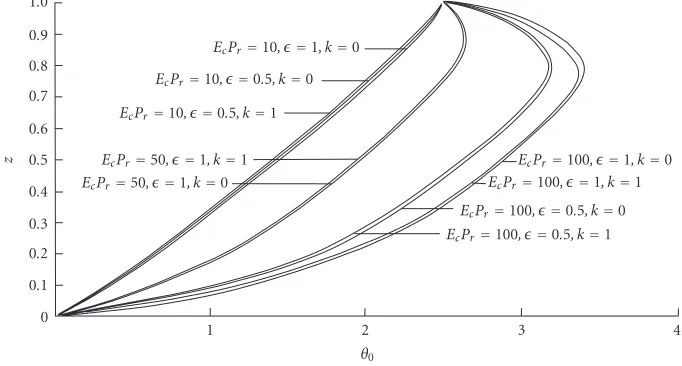
Figure 6.1. Steady temperature profiles in a two-phase fluid.
The rate of heat transfer per unit area for the clean fluid at the upper wallz=1 is given by
Q1c=1−E24cPr−EcPr 2
(2σ)3/2F(σ). (5.6)
6. Numerical results and discussions
For the problem under investigation,θ0 represents the steady temperature distribution in the two-phase fluid-particle system. The expression forθ0 contains one linear term corresponding to the fluid at rest, a biquadratic term which arises due to viscous friction and a term involving2which corresponds to the mean heating of the fluid due to dissi-pation of energy caused by the pressure gradient fluctuations. It is interesting to note that the effect of the particles modifies the mean heating of the fluid only when the pressure gradient fluctuates. Hence the expression forθ0is not the same for both viscous and par-ticulate fluids. The temperature profiles corresponding toθ0are shown inFigure 6.1for various values ofEcPr,k, and. The graphical representation clearly indicates that the value ofθ0increases with bothEcPrandbut decreases with the increase of particle con-centration (k). Moreover, in all cases, the maximum value ofθ0occurs near the boundary layer of the hotter wall.
Regarding the rate of heat transfer in the steady-state condition, the reversal of heat flux from the fluid to the hotter wall takes place whenEcPr exceeds a critical value de-pending onandkwhich in turn makes the hotter wall more hot. For example, when
Table 6.1. Critical values ofEcPrfor the reversal of heat flux at the hotter wall whenσ=10,λ1=0.1.
k/ 0 0.5 1.0
0 24 22.5 19.1
0.1 24 22.5 19.1
0.6 24 22.6 19.2
0.7 24 22.6 19.3
1.0 24 22.7 19.5
the walls are maintained at constant temperaturesT0andT1(> T0). On the other hand, for =0.5 and k=0.1, the reversal of heat flux at the hotter wall takes place when EcPr>22.5 which is further enhanced with the increase ofk. Alternately, when=1.0 and k=0.1, the reversal of heat flux from fluid to the hotter wall takes place when EcPr>19.1.All these results are shown inTable 6.1, and on the basis of these results we conclude that the critical value ofEcPr responsible for the reversal of heat flux from the fluid to the hotter wall diminishes with the increase ofand increases with the increase of particle concentration in the fluid. In fact, the value ofEcPrprovides a measure of the amount of heat generated due to friction, which, in the present case, increases with the in-crease of the pressure gradient. As a result, if the temperature difference between the walls is fixed, heat flows from the hotter wall to the fluid as long as the pressure gradient does not exceed a certain value depending on the amount of fluctuations and the presence of the particles. This phenomenon is important for cooling at high pressure gradient. How-ever, if instead of pressure gradient, the motion of the fluid is produced otherwise, such as in the case of steady Couette flow of viscous or two-phase fluids under a constant pressure gradient, the critical value ofEcPr for the reversal of heat flux at the hotter wall is found as 2. Such a reversal of heat flux occurs only when the motion of the upper (hotter) wall exceeds certain velocity provided the temperature difference between the walls remains constant.This phenomenon is also important for cooling at high velocity and is reported by Schlichting [5]. We therefore conclude that the critical value ofEcPrfor the reversal of heat flux at the hotter wall is much higher in the case of cooling at high pressure gradient compared to its value for cooling at high velocity. The effect of Eckert numberEcon the steady heat transfer coefficient for various values of pressure gradient fluctuationand the particle concentrationkis shown in theTable 6.2.
Table 6.2. Steady heat transfer coefficient (θ0)z=0and (θ0)z=1forσ=10,λ1=0.1,Pr=10.
k/Ec 1 2 3 5
0.0 0.0 1.41667 1.8333 2.25 3.08333
0.5 1.41667 1.8333 2.25 3.08333
θ 0
z=0 0.5 0.0 1.44274 1.88548 2.32822 3.21370
0.5 1.43765 1.87531 2.31296 3.18827
1.0 0.0 1.52096 2.04192 2.56288 3.60480
0.5 1.50061 2.00123 2.50184 3.50307
0.0 0.0 0.58333 0.16667 −0.25 −1.08333
0.5 0.58333 0.16667 −0.25 −1.08333
θ 0
z=1 0.5 0.0 0.55726 0.11452 −0.32822 −1.21370
0.5 0.56716 0.12534 −0.32415 −1.21042 1.0 0.0 0.47904 −0.04162 −0.56288 −1.60480 0.5 0.48867 −0.03265 −0.56098 −1.60163
0 0.1 0.2 0.3
0 0.2 0.4 0.6 0.8 1.0
z
θ
1(a) 1 2(a) 2
3(a) 3
1. σt=0, k=0 1(a)σt=0, k=0.3
2. σt=Π/4, k=0 2(a) σt=Π/4, k=0.3
3. σt=Π/2, k=0 3(a)σt=Π/2, k=0.3 1(a)
1 2 2(a) 3(a) 3
3(a) 3
1(a) 1 2(a) 2
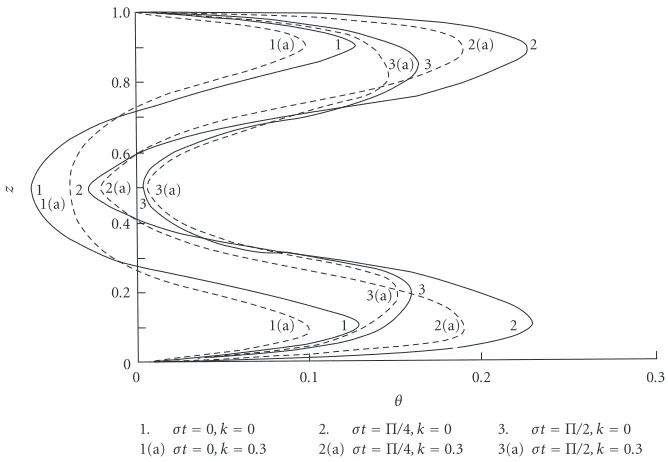
Figure 6.2. Effect of particle concentration (k) on the unsteady temperature profiles in a two-phase fluid whenEcPr=100.λ1=0.1,λ2=0.3.
[image:12.468.67.401.290.521.2]0 0.1 0.2 0
0.2 0.4 0.6 0.8 1.0
z
θ 3
2
1
[image:13.468.103.364.68.342.2]1. λ2=0.1, λ1=0.1 2. λ2=0.1, λ1=0.3 3. λ2=0.3, λ1=0.1
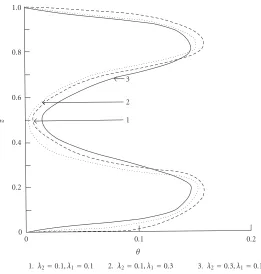
Figure 6.3. Effect of velocity relaxation time (λ1) and thermal relaxation time (λ2) on unsteady
tem-perature profiles in a two-phase fluid whenσt=Π/2,k=0.3,EcPr=100.
−0.2 −0.1 0 0.1 0.2 0.3 0.4 0.5 0.6 0.2
0.4 0.6 0.8 1.0
z
θ
1
3
4
1 2 3 4
4
3 1
1. σt=0 2. σt=Π/4
3. σt=Π/2 4. σt=3Π/4
Figure 6.4. Unsteady temperature profiles in two-phase fluid whenEcPr=300,k=0.3,λ1=0.1,λ2=
[image:13.468.87.384.399.592.2]References
[1] A. K. Ghosh and L. Debnath,On heat transfer to pulsatile flow of a viscoelastic fluid, Acta Mech. 93(1992), no. 1–4, 169–177.
[2] F. E. Marble,Dynamics of dusty gases, Annu. Rev. Fluid Mech.2(1970), 397–446.
[3] G. Radhakrishnamacharya and M. K. Maiti,Heat transfer to pulsatile flow in a porous channel, Int. J. Heat Mass Transfer20(1977), no. 2, 171–173.
[4] P. G. Saffman,On the stability of laminar flow of a dusty gas, J. Fluid Mech.13(1962), 120–128. [5] H. Schlichting,Boundary Layer Theory, 6th ed., McGraw-Hill, New York, 1968.
A. K. Ghosh: Department of Mathematics, Jadavpur University, Calcutta-700032, India E-mail address:[email protected]