Tench, R and Topic, M (2017) One Step Forward, Two Steps Back? An Analysis of European PR Practitioners’ Views on the Position of Women in the PR Industry (2009-2015). Current Politics and Economics of Europe, 28 (1). ISSN 1057-2309
Link to Leeds Beckett Repository record: http://eprints.leedsbeckett.ac.uk/3577/
Document Version: Article
The aim of the Leeds Beckett Repository is to provide open access to our research, as required by funder policies and permitted by publishers and copyright law.
The Leeds Beckett repository holds a wide range of publications, each of which has been checked for copyright and the relevant embargo period has been applied by the Research Services team.
We operate on a standard take-down policy. If you are the author or publisher of an output and you would like it removed from the repository, please contact us and we will investigate on a case-by-case basis.
Current Politics and Economics of Europe ISSN: 1057-2309 Volume 28, Number 1 © 2017 Nova Science Publishers, Inc.
O
NE
S
TEP
F
ORWARD
,
T
WO
S
TEPS
B
ACK
?
A
N
A
NALYSIS OF
E
UROPEAN
PR
P
RACTITIONERS
’
V
IEWS ON THE
P
OSITION
OF
W
OMEN IN THE
PR
I
NDUSTRY
(2009-2015)
Ralph Tench and Martina Topić
Leeds Business School, Leeds Beckett UniversityPortland Crescent, Leeds, West Yorkshire, UK
A
BSTRACTIt has been well established that Public Relations is a gendered industry, and nevertheless the one in which women earn less and face glass ceiling. Recently, researchers also reported on problems with networking and mentoring. Many of these findings have been reported in annual European Communications Monitor (ECM), the largest European research project focusing on trends in Public Relations through self-assessment of PR practitioners. In this particular paper, using the approach of liberal feminism while embracing the view of radical feminism of patriarchy, we looked at results from the ECM in the period between 2009 (when the gender came to the agenda for the first time in this research) and 2015 in an attempt to discuss how far have feminism got in achieving equality of women with men, at least when findings from the European Communications survey are in stake. The results show that inequality still exists not only in traditional areas of inequality such as the wage gap and the glass ceiling, but also in other areas such as job security and mentoring. Nevertheless, it seems that inequality transforms when one issue gets tackled and new issues continue to arise, with which it can be said that the social structure is still based on inequality between genders and that while
issues can be tackled, the whole problem of equality feels like one step forward and two steps back. The conclusion of the paper is that feminists need to work with men to tackle patriarchy and with that also inequality of genders, including in Public Relations.
Keywords: liberal feminism, radical feminism, Public Relations, inequality, women, glass ceiling, wage gap
I
NTRODUCTIONIt has been well established that Public Relations is a gendered industry, evidenced by the number of women working in the industry which has grown considerably in the past decades (Fitch, 2016a; CIPR State of the Profession Report, 2015; Verhoeven & Aarts, 2010; Fitch & Third, 2010; Daymon & Demetrious, 2010; Wyatt, 2013; Aldoory & Toth, 2002). However, even though Public Relations is a predominantly female industry, women face obstacles in achieving equality with their male colleagues. The most common problems are the wage gap (also called pay gap) and the glass ceiling (Grunig et al, 2001; Place, 2015; Merchant, 2012; Fröhlich & Peters, 2007; Dozier et al, 2007).
Liberal feminism has been arguing for decades that women face inequality in all aspects of society, and proponents of this view advocate change of the social system asking that women are allowed to compete for the same positions as men, and that they are treated equally (Rakow & Nastasia, 2009). The radical feminist position, on the other hand, has been arguing for decades that women are systematically oppressed by men and that the laws of patriarchy still exist and can be found in the social system based on historical inequality (ibid). In opposition to liberal feminism, radical feminists argue for the complete change of system to allow full equality of women, since the current system clearly does not work for women.
Using the view of liberal feminism of the lack of equality among men and women while embracing the view of radical feminism on patriarchy and historical inequality of women with men, the aim of this paper is to discuss how far have we got in gender equality? Are we reducing the inequalities between men and women or not?
One Step Forward, Two Steps Back? 3
European Communications Monitor, the largest European survey on Public Relations (PR) professionals from a period between 2009 and 2015 where practitioners were asked to self-assess the situation in the industry and the position of women to establish whether there is a trend of changes in the equality between male and female practitioners.
T
HEP
OSITION OFW
OMEN INP
UBLICR
ELATIONSIt has been widely accepted that Public Relations has become a gendered profession (Verhoeven & Aarts, 2010; Fitch & Third, 2010; Daymon & Demetrious, 2010) because the majority of PR professionals are now females. This is not only the case in the United States where gendering first occurred, but also in other countries such as Sweden, Germany, the Netherlands, Australia (Bentele & Junghanel, 2004; Fitch & Third, 2010; Verhoeven & Aarts, 2010), and the UK where women form the majority of employees in Public Relations (The House of Commons Report, 2014; CIPR State of the Profession Report, 2016) but are still paid significantly less than their male colleagues even if they managed to achieve senior managerial positions in larger numbers than before (CIPR State of the Profession Report, 2016; Dozier et al, 2007).
One of the central questions in current debates in Public Relations is the question of power in organisations in regards to managerial positions. The question asked is who has the power, and many research studies confirmed it is men who have the power when it comes to management while women seem to be powerless (Verhoeven & Arts, 2010; Grunig et al, 2001; Aldoory & Toth, 2002). In this context saying that women are powerless means that female PR practitioners are continually dealing with the glass ceiling, lower pay, lack of employee support, power in the organisation and inclusion in business networks (Place, 2012).
positions and same salaries with men (Aldoory & Toth, 2002; Toth & Grunig, 1993; Grunig, 1988; Rakow & Nastasia, 2009).
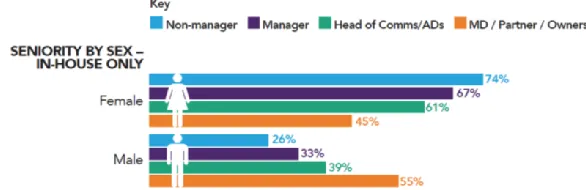
When it comes to the glass ceiling and the wage gap, the situation depends from country to country, however, it seems that discrepancies in terms of how much women and men are paid is not decreasing. For example, in the UK female PR practitioners managed to achieve progress and now do have a presence in managerial roles, however, at the same time they are still paid less than men in the same positions (CIPR State of the Profession Report, 2016; Yeomans, 2014; 2013; 2010). While women managed to increase their numbers in managerial positions and now total to 67% of managers, and 61% of heads of communications (Figure 1), some studies are showing that men are still paid significantly more, which brings to the total difference in pay of £42,976 versus £58,015 in favour of men (CIPR State of the Profession Report, 2016). This data is relevant because the UK is among top 10 countries in the world when it comes to women’s rights (YouGov, 2015), however, even such a country that gives more rights to women is still not freed from inequality.
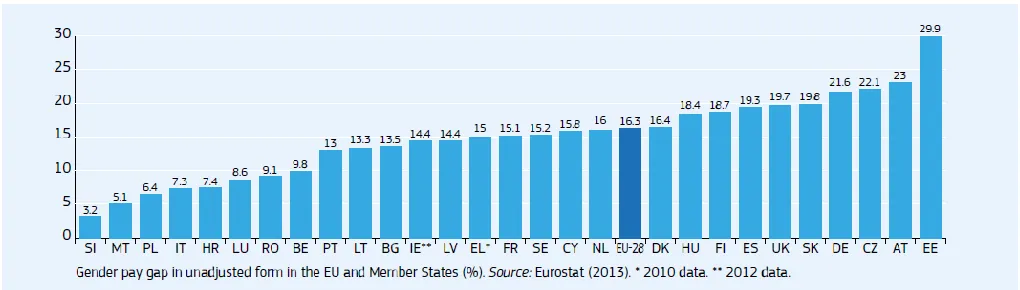
On a European level, there is data available for the European Union according to which there are “three types of disadvantages women face: lower hourly earnings; working fewer hours in paid jobs; and lower employment rates (for example when interrupting a career to take care of children or relatives) (European Commission, 2015). For example, the gender wage gap in the EU as a whole totals 41.1% and the lowest gap is recorded in Slovenia (3.2%) while the highest one is recorded in Estonia (29.9%) (Figure 2). The economically most developed countries of the EU such as the UK, Germany, France and the Netherlands are somewhere in between but tending towards larger wage gap.
[image:5.612.152.445.484.579.2]Source: CIPR State of the Profession Report (2016).
Source: European Commission (2015).
When we look at this broader picture on an EU level, we do need to ask how far has feminism got, at least when the PR industry is in stake?
L
IBERAL ANDR
ADICALF
EMINISMFeminism in general has a goal to eradicate inequality of women (Martin, 2003). However, when it comes to feminist research of Public Relations a criticism has emerged as to whether feminists address all issues in the field or solely focus on inequality in wages and the positions. For example, Hon (1995) argued that “discrimination against women in public relations cannot be separated from the organizational and societal systems that produce gender biases” (1995, p. 65), while Pompper (2012, p. 89) argued that, “most public relations researchers who study gender have focused exclusively on a female/male dichotomy in salary and job satisfaction without considering other defining human relations factors”. This criticism calls towards positioning feminist research in Public Relations within feminist paradigm that seeks to eradicate the current system of power and the way the power is managed. In other words, as legal activist Catharine A. McKinnon argued, the point of feminism is an attempt to eradicate gender hierarchy in a sense that the power means someone must dominate while feminists are challenging this assumption and the concept of power in itself (McKinnon, 1987, p. 22-23, cited from Daymon & Demetrious, 2014, p. 2). However, even though McKinnon challenged the system of power in 1987 scholars are still calling for challenging the very same thing (Pompper, 2012; Fitch et al, 2016), because power as it stands in current societies ultimately results in inequality.
One Step Forward, Two Steps Back? 7
distribution of power between men and women by distributing roles, women have been discriminated throughout history and the social change must come within existing social structures (ibid, p. 256).
Liberal feminism has been a predominant paradigm in research on women in Public Relations with some works using also radical feminism as a theoretical premise (Fitch, 2015), however, this position is predominantly present in the US while other countries often embrace radical feminism, e.g. UK (Mendes, 2011). Nevertheless, critical scholars advocate that a more thorough change is needed to understand how power is constructed in Public Relations and how identities are socially constructed (Fitch et al, 2016; Fitch, 2016a). In addition, a post-feminist position must be challenged as there is a prevailing view that equality of women and men has been achieved and feminists are seen in a negative light of those who are over-imposing women over men, while men suffer because of the success of feminism. As Fitch, James and Motion (2016, p. 283) explain, this type of view presents “a rejection of feminism, or of the need for feminism”, even though all data on the position of women proves the opposite.
Liberal feminism has also been criticised for taking uniformed stance and discussing women’s position as unified “assuming that white experience could speak for that of all women” (Humm, 1995, p. 25). For example, one of the critiques of feminism is that “only some women benefited from feminism-inspired social change: for example, the protection of women’s sexual rights helped empower white, heterosexual women, but it didn’t help sexual or racial minorities; also, improving access to work helped child-free or wealthy women, but not those with large families” (Daymon & Demetrious, 2014, p. 2; see also Dozier, 2010). In addition, radical feminists also criticised liberal feminists for differentiating men from women and considering patriarchy as systematically embedded. Because of this, radical feminism argued that the oppression of women by men must be seen as the only deep and extensive oppression (Jaggar & Rothenberg, 1994; Daymon & Demetrious, 2010; Rakow & Nastasia, 2009).
among women and their distinctive problems and needs (Bryson, 2003).
When it comes to the already mentioned issue of patriarchy advocated by radical feminism, Millett (1969) famously defined it as a set of social rules according to which older males dominate younger males, while men generally dominate over women, and this is often visible in differences in upbringing that often cements expected roles between boys and girls that later on transforms to expected roles between men and women (Eichenbaum & Orbach, 1999; Van Zoonen, 2004; Tench et al, 2016). Recently, it has been reported that women are also more successful in getting flexible hours approved because of family duties than men, which again shows the power of patriarchy and the expected roles where women are expected to stay at home and take care of their families while men who want to do the same are denied this right, as it is apparently not perceived that men should stay at home with family (Teasdale, 2013).
In sum, it can be argued that both liberal and radical feminism are similar in a sense they both advocate the same unity of women just that they envisage different methods on how this is to be achieved.
We decided to embrace the approach of liberal feminism in our paper while accepting the view of radical feminism that women are historically oppressed with the patriarchy that still exists even in the most advanced western societies. In other words, the theoretical premise of the paper is liberal feminism advocating equality between genders in Public Relations. However, the paper also embraces the view of radical feminism according to which women are systematically and historically unequal to men, and this is seen in the fact that even though there are more women who work in Public Relations there is still no equality that nevertheless seems to change its face and transform as one issue gets resolved, as this paper will demonstrate.
One Step Forward, Two Steps Back? 9
M
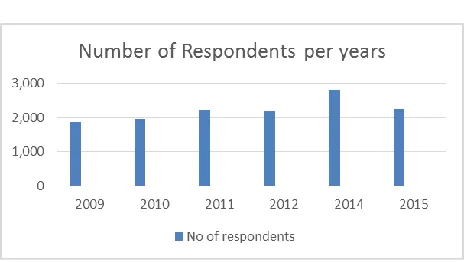
ETHOD [image:10.612.190.424.286.417.2]The European Communications Monitor is the largest survey that systematically monitors trends in the Public Relations industry and views of practitioners on the field in Europe. The survey has been conducted annually since 2007 with more than 2,700 participating communication professionals from 43 countries (see Table 1).
Table 1. Number of respondents per years
The participants are recruited via personal invitations sent to professionals throughout Europe via e-mail. The contacts of PR practitioners are collected from the database provided by the EACD and additional invitations to participate via national branch associations and networks (partly self-recruiting) are also sent.
The research has been conducted since 2007, and the gender issues have been included in questionnaires since 2009. In that, the PR practitioners are asked to report on issues in the field, predict future development of the field, as well as to report on difficulties and inequality between male and female practitioners should they believe that inequality exists. Gender issues have not been included in the survey in 2013, and in this paper we looked at all survey results from 2009 until 2015 to analyse trends in reporting inequality between male and female practitioners.
that implements different method than surveys by Eurostat used in compiling data for the European Commission, presents a valuable addition to the existing knowledge because it goes into more depth and shows that not only is it the wage gap that presents the problem in terms of equality between men and women (as traditionally demonstrated by feminist research), but that inequality is taking new forms.
Results from the European Communications Monitor have been presented individually by research consortium in numerous papers each year when the new results were published (e.g. Tench et al, 2016; Verčič et al, 2014). However, since the research has been conducted since 2007 we wanted to look at all results collected so far to get the whole picture and discuss whether something is positively changing in European PR, and to debate a question how far has feminism got in advocating equality of women, at least when it comes to PR and the views of PR practitioners. Therefore, we took all findings from 2009 until 2015, and analysed the trend to see if there is a pattern and whether something is changing positively for women in PR.
Finally, it needs to be emphasised that the European Communications Monitor is not a longitudinal research, but the largest European survey monitoring opinions and trends in the PR industry. This means that the number of participants each year vary (see Table 1), and that it is not possible to know whether the same participants report changes because we do not know which practitioners took the survey and in which year. Therefore, this paper does not claim to offer generalised conclusions but looks at trends, and debates changes in gender equality based on available data from the PR industry using feminism as a framework. The research questions set for this paper were as follows:
What problems in equality between male and female practitioners do respondents report?
Do practitioners report positive changes in terms of gender equality when it comes to wage gap?
Do practitioners report negative trends in terms of gender equality? If so, which ones?
How far has feminism got, at least when it comes to PR industry?
R
ESULTSOne Step Forward, Two Steps Back? 11
appointments. While progress in certain areas has been made inequality has not been fully resolved, and it seems that the inequality is spilling over to new areas. In other words, while inequality in salaries remains an issue throughout the years of conducting ECM research, new issues emerge and demonstrate a continuation of the inequality.
The Wage Gap
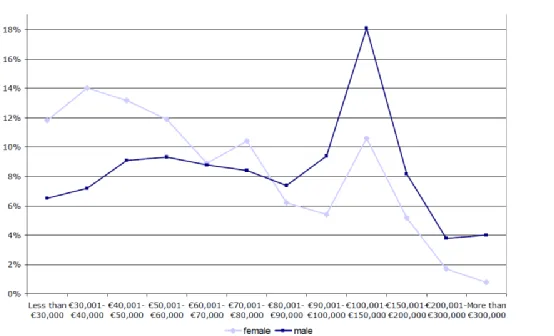
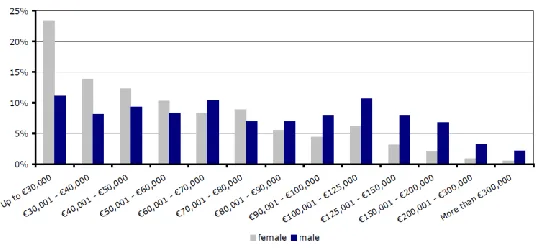
The wage gap remains a persistent problem among male and female practitioners, as men still earn more than women in the same positions. For example, in 2009 it was reported that higher positions are still male-dominated, i.e. women were not heading communication agencies, having leadership positions and consulting positions as much as men (Table 2), and the salaries of female practitioners were lower than those of male colleagues (Figure 3). This is in line with feminist criticism of the position of women in the society, and business and PR in general where women are systematically paid less for the same position and face glass ceiling when it comes to career progress.
On the other hand, in 2010, results revealed that annual salaries of male and female PR practitioners have remained different with negative trend for women (Table 3) but the results also revealed another inequality, i.e. it is not only that women and men do not earn the same, or that women cannot progress to higher positions. For example, it is quite clear that women only dominate in lower starting positions, while men dominate on the highest position (Table 3), which brings the question whether we can indeed talk about very strong patriarchal system in Europe since women only work for men, but face difficulties in progressing to become managers and executives.
workforce, e.g. female workforce predominantly earns up to 30.000 € a year (Table 3).
[image:13.612.188.443.242.375.2]Table 2. Gender differences in higher positions in PR Industry in 2009
Figure 3. Annual salaries and the gender difference in 2009.
[image:13.612.172.449.394.562.2]One Step Forward, Two Steps Back? 13
Table 4. Salaries on high positions and the gender gap in 2010
In other words, inequality remained in all fields but particularly in the highest roles with 4.1% of men earning above 300,000 € while only 0.5% of women earned the same (Table 5).
Table 5. Annual Salaries and the gender difference in 2011
[image:15.612.151.468.459.625.2]One Step Forward, Two Steps Back? 15
Figure 5. Differences in salaries and the gender gap (2015).
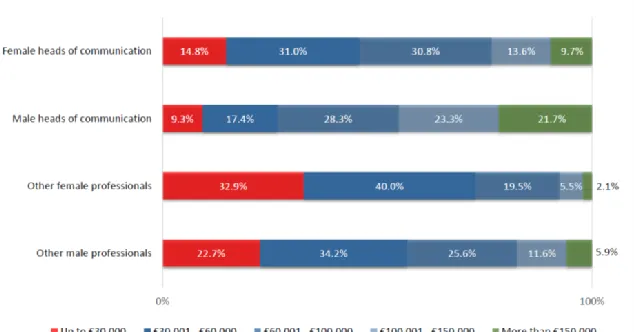
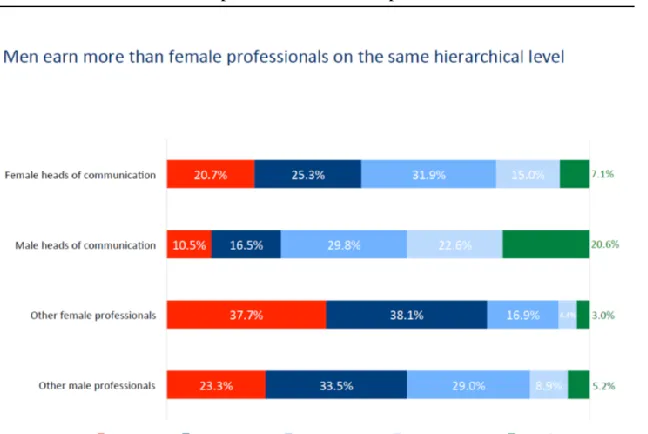
In addition, men earn more than female professionals on the same hierarchical level (Figure 4 and 5). This is particularly present in more senior level such as head of communication where in 2014 only 9.7% of women earn above 150.000 €, while 21.7% men earn the same amount (Figure 4). In 2015, this difference decreased slightly to 7.1% versus 20.6% ratio, clearly still in favour of men (Figure 5).
Other Issues: Career Opportunities, Jobs Security
and Mentoring
Table 6. Perceived influence in departments (2012)
Table 7. Increase in Career opportunities in 2014
[image:17.612.148.467.411.562.2]One Step Forward, Two Steps Back? 17
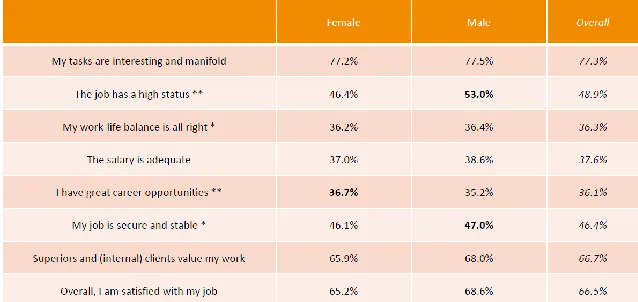
felt more secure in their positions, 47% versus 46.1% in favour of men (Table 7).
But, 2014 revealed that the inequality of women with men in Public Relations has another face, and that is mentoring. Mentoring new colleagues is becoming part of the recruitment process for leadership positions and all senior roles not just in PR but also elsewhere. Even higher positions in academia now require leadership roles, which then encompasses mentoring of younger colleagues. In 2014, the results showed that women not only mentor other colleagues less than men, but have also not been mentored themselves, which certainly can bring barriers in career progress and future mentorship appointments (Figure 6).
[image:18.612.146.468.408.592.2]It therefore seems that the main concerns are systematically reported when it comes to salaries where there is a consistent wage gap, however, the inequality is showing its other face and demonstrates itself in new areas relevant for career progress such as mentoring, influence and increased opportunities for female PR practitioners. In other words, in five out of six years analysed the wage gap emerged as an issue accompanied with other issues emerging as the industry progresses and transforms.
Figure 7. The changing nature of inequality.
As Figure 7 demonstrates the nature of inequality systematically changes (except the wage gap that remains a constant problem), and once women achieve equality in one field then new inequalities emerge. In other words, while practitioners firstly reported male dominance on higher positions, in subsequent years they reported glass ceiling when it comes to progressing to higher positions, then the lack of influence in departments, then better job security for men and finally, mentoring opportunities that then have a potential impact on leadership.
C
ONCLUSIONOne Step Forward, Two Steps Back? 19
As it has been argued in this paper and in the vast majority of available academic work, PR is seen as a gendered profession with female practitioners forming the majority of the workforce in the majority of countries, however, female practitioners are systematically facing inequality. But, to what extent have women achieved equality is not an easy question to answer. While some progress has certainly been made, at least on the European level as our results and other academic debates testify, there is still more to be achieved. It seems as if inequality continues and transforms to new areas as and when they arise. This brings into the debate the fundamental requirement of liberal feminism, which is to improve the system from within and make demands to equalise women’s positions in all aspects of the society. Given the fact inequality constantly changes its face, questions from radical feminists to change and replace the system as such also seem justified albeit not reasonable in terms of the ability to achieve that goal especially given the fact feminism is a label with potentially negative connotations.
Therefore, liberal feminists must continue to resolve issues as and when they arise. However, in order to achieve the ultimate equality between men and women, liberal feminists will have to tackle patriarchy and embrace some arguments of radical feminism such as the one on historical oppression of women against the men. This however means that liberal feminists will have to turn to men who do not want to conform to expected roles and yet are forced by the society. However, if we ask how far have feminism got (at least in the PR industry, which was subject of discussion of this paper), it is safe to say positive steps forward have been made but it has not travelled far enough. As one issue is resolved, new issue seem to arise and the social structure is still based on inequality between genders. We take one step forward and perhaps with positive improvements two steps back.
R
EFERENCESAldoory, L., & Toth, E. (2002). Gender Discrepancies in a Gendered Profession: A Developing Theory for Public Relations. Journal of Public Relations Research 14(2), 103-126.
Bentele, G., & Junghänel, I. (2004). Germany. In – Van Ruler, B., & Verčič, D. (eds.) Public relations and communication management in Europe. Berlin: Mouton de Gruyter.
CIPR State of the Profession Report (2016). Available at: https://www.cipr.co.uk/sites/default/files/CIPR_StateofPR_16.pdf
(Accessed 29 June 2016).
CIPR State of the Profession Report (2015). Results of survey on the wage gap between men and women in Public Relations. Available at: http://www.cipr.co.uk/stateofpr (Accessed 23 July 2015).
Cline, C.; Toth, E.; Turk, J.; Walters, L; Johnson, N., & Smith, H. (1986). The velvet ghetto: The impact of the increasing percentage of women in public relations and business communication. USA: IABC Foundation.
Daly, M. (1973). Beyond god the father: Toward a philosophy of women’s liberation. Boston: Beacon Press.
Daymon, C., & Demetrious, K. (2013). Introduction: Gender and public relations: making meaning, challenging assumptions. In – Daymon, C., & Demetrious, C. (eds.) Gender and Public Relations: Critical Perspectives on voice, image and identity. London: Routledge.
Daymon, C., & Demetrious, K. (2010). Gender and public relations: Perspectives, applications and questions. PRism 7(4), http://www. prismjournal.org.
Dozier, R. (2010). Accumulating Disadvantage: The Growth in the Black-White Wage Gap Among Women. Journal of African American Studies 14, 279-301.
Dozier, D.; Sha, B.-L., & Okura, M. (2007). How Much Does My Baby Cost? An Analysis of Gender Differences in Income, Career Interruption, and Child Bearing. Public Relations Journal 1(1), 1-6.
European Commission (2015). The gender pay gap in the European Union. Available at: http://ec.europa.eu/justice/gender-equality/files/gender_ pay_gap/gpg_eu_factsheet_2015_en.pdf (Accessed 29 June 2016).
Eichenbaum, L., & Orbach, S. (1999). What do Women Want? Exploding the Myth of Dependency. New York: Berkley Books.
Fitch, K. (2016a). Feminism and Public Relations. In L’Etang, J; McKie; Snow, N., & Xifra, J. (eds) The Routledge Handbook of Critical Public Relations.
London: Routledge.
Fitch, K.; James, M.; Motion, J. (2016). Talking back: Reflecting on feminism, public relations and research. Public Relations Review 42, 279–287. http://dx.doi.org/10.1016/j.pubrev.2015.05.006.
One Step Forward, Two Steps Back? 21
Fitch, K., & Third, A. (2010). Working girls: Revisiting the gendering of public relations. PRism 7(4). Available at: http://www.prismjournal.org/ fileadmin/Praxis/Files/Gender/Fitch_Third.pdf (Accessed 23 July 2015). Fröhlich, R., & Peters, S.B. (2007). PR bunnies caught in the agency ghetto?
Gender stereotypes, organizational factors, and women’s careers in PR agencies. Journal of Public Relations Research 19(3), 229-254.
Grunig, L. A.; Toth, E. L., & Hon, L. C. (2001). Women in Public Relations: How gender influences practice. New York: The Guilford Press.
Grunig, L. A. (1988). Women in public relations (special issue). Public Relations Review 14(3).
Hon, L. C. (1995). Toward a feminist theory of public relations. Journal of Public Relations Research, 7(1), 27–88. http://dx.doi.org/ 10.1207/s1532754xjprr0701 03.
House of Commons Report (2014). Women in Public life, the Professions and the Boardroom. Available at: file:///C:/Users/topic01/ Downloads/SN05170.pdf (Accessed 29 June 2016).
Humm, M. (1995). The dictionary of feminist theory. New York: Prentice Hall Harvester Wheatsheaf.
Jaggar, A., & Rothenberg, P. (eds.) (1994). Feminist frameworks. New York: McGraw-Hill.
Merchant, K. (2012). How Men and Women Differ: Gender Differences in Communication Styles, Influence Tactics, and Leadership Styles. CMS Senior Theses. Paper 513. Available at: http://scholarship.claremont.edu/ cgi/viewcontent.cgi?article=1521&context=cmc_theses (Accessed 22 July 2015).
Martin, J. (2003). Feminist theory and critical theory: Unexplored synergies. In - Alvesson, M., & Willmott, H. (eds.) Studying management critically
(pp.66–91). London: Sage.
Mendes, K. (2011). Feminism in the news: Representations of the women’s
movement since the 1960s. Basingstoke: Palgrave Macmillan. Millett, K. (1969). Sexual Politics. New York: Doubleday.
Place, K. R. (2015). Binaries, continuums, and intersections: Women public relations professionals’ understandings of gender. Public Relations Inquiry, 4(1), 61-78.
Place, K. R. (2012). Power-Control or Empowerment? How Women Public Relations Practitioners Make Meaning of Power. Journal of Public Relations Research, 24(5), 435-450.
Relations Research, 24(1), 86–103. http://dx.doi.org/10.1080/ 1062726X.2012.626137
Rakow, L. F., & Nastasia, D. I. (2009). Feminist Theory of Public Relations: An Example from Dorothy E. Smith. In – Oyvind, I., van Ruler, B., Frederiksoon, M. (eds.) Public Relations and Social Theory. London: Routledge.
Teasdale, N. (2013). Fragmented Sisters? The Implications of Flexible Working Policies for Professional Women’s Workplace Relationships. Gender, Work and Organization 20(4), 397-412.
Tench, R.; Laville, L., & Kiesenbauer, J. (2016). Exploring the magic of mentoring; Career planning for the public relations profession. In P. S. Brønn, S. Romenti & A. Zerfass (Eds.), The Management Game of Communication (pp. 205-223). Bingley, UK: Emerald.
Tench, R.; Moreno, A., & Topić, M. (2016). Public Relations and the Genderlect: Male and Female Communication Styles, and Its Impact on Leadership and the Position of Women in a “Female” Industry (under review).
Toth, E., & Grunig, L. (1993). The missing story of women in public relations.
Journal of Public Relations Research 5(3), 153-175.
Van Zoonen, L. (2004). Entertaining the citizen: when politics and popular culture converge. New York, Boulder, CO: Rowman and Littlefield. Verčič, D.; Verhoeven, P., & Zerfass, A. (2014). Key issues of public relations
of Europe: Findings from the European Communication Monitor 2007-2014 (Temas clave de las relaciones públicas en Europa: Resultados del European Communication Monitor 2007-2014). Revista Internacional De Relaciones Publicas 4(8), 5-26.
Verhoeven, P., & Aarts, N. (2010). How European public relations men and women perceive the impact of their professional activities. PRism 7(4), http://www.prismjournal.org.
Wyatt, R. (2013). The PR Census 2013.PR Week. [online] Available at: http:// www.prweek.com/article/1225129/pr-census-2013 (Accessed 2 April 2015).
Yeomans, L. (2014). The gender gap in PR: What research tells us. CIPR blog post, 10 March. Available at: http://influence.cipr.co.uk/2014/03/10/the-gender-gap-in-pr-what-research-tells-us/ (Accessed 21 July 2016).
Yeomans, L. (2013). Gendered performance and identity work in PR consulting relationships: A UK Perspective. In – Daymon, C., & Demetrious, C. (eds.)
One Step Forward, Two Steps Back? 23
Yeomans, L. (2010). Soft sell? Gendered experience of emotional labour in UK public relations firms. PRism 7(4). Available at: http://www.prismjournal.org/index.php?id=index (Accessed 21 July 2016) YouGov (2015). Global Report: Attitudes to Gender. Available at: