Technology (IJRASET)
An Efficient Virtual Machine Migration Technique
in Cloud Datacenter
Navnit Kumar1, Sachin Majithia2
1
Student, 2Assistant Professor, Department of IT, Chandigarh Engineering College, Landran, 140307
Abstract— The gist of cloud computing come from the concept of virtualization. It is a way of materializing a number of guest OS on a single host server such that CPU and memory resources of the host machine are shared with the guest systems. The guest machines are technically called as virtual machines (VMs). Virtualization enables complete utilization of a physical machine in a cost-effective manner. However, varying and continuous load from users may overload a physical machine and can shepherd to seriousparticipation on performance, reliability and other service-level-agreement (SLA) parameters. To deal with this issue, VM migrations are capable which enables the transfer of a virtual machine from an overloaded host to under-loaded host, thereby reducing the workload of the source host. In a datacenter load balancing gives a chance to obtain a materially high fault-tolerance, a feature which is very urgent during live application executions in cloud environment. The current research and documents concern is the unwanted time consumption, power utilization, and energy consumption for virtual machine migration in data center. In this paper, we developed a virtual machine migration plan for minimizing total migration time and Energy consumption. In developed virtual machine migration plan, uses monitored technique the load on every host in the data center to decide whether or not to perform VM migration and then we established the criteria to deciding which VM to migrate. An additional host is use to pre-copying processed data and sent to destination host whether VM is migrate, which reduces the total migration time and energy VM migration in datacenter. VM Migration refers to a transparent transfer of an active guest or virtual machine from a source server to a selected destination server. This method will simulate on CloudSim tools in Netbean.
Keywords — Cloud Computing, datacenters, Virtualization, Virtual Machines (VMs), VM migration.
I. INTRODUCTION
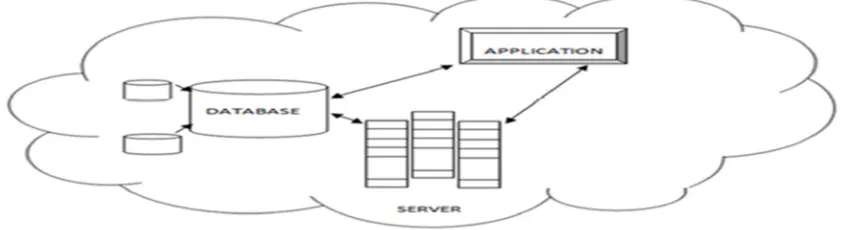
[image:2.612.90.515.530.645.2]Cloud Computing is a technology where computing is moved away from personal computers to a “cloud” of computers. It is fiction for the complex infrastructure. It is based on demand network access and internet based development. It is an amplification of distributed computing, parallel computing and grid computing. Cloud computing can be defined as “a model for enabling on demand network access that can be dynamically provisioned and released with minimal management efforts and minimal involvement of service providers”[1] . As depicted by the Figure 1.1, cloud computing provides services like storage, server application and network components[2] . Hence, cloud computing is a technology that uses internet to deliver its services.
Figure 1.Overview of Cloud Computing
Technology (IJRASET)
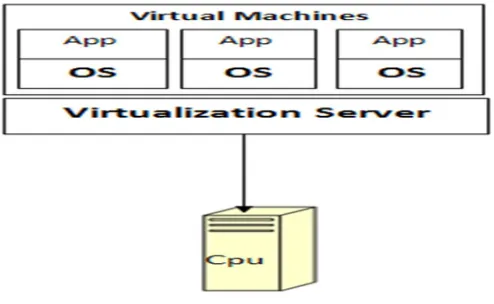
supervised effectively among the guest OS. Since the guest OS is not bound to the hardware, it is possible to move an OS one physical machine to another. This techniques also known as virtual machine (VM) migration. VM migration can be concordant as the lifeline of a cloud datacenter. As a particular guest OS or VM begins to expend more resources during a peak period, it can be migrated to another physical machine with less demand [3]. Migration of a VM seeks to meliorate manageability, performance and fault-tolerance of a system. More specifically, it substantiates the load-balancing feature of a datacenter by migration VMs out of an over-loaded server to an loaded server or physical machine. It also helps in energy saving of a datacenter by permit under-utilized physical machine to be shut down by migrating their VMs to other optimally under-utilized physical machine. The key secret of a VM migration is that the application itself or its corresponding processes are unaware that the VM migration is taking place, thus, infusing the notion of transparency.
Figure2. Overview of Cloud Virtualization
Popular hypervisors, such as Xen and VMware, allow migrating an OS as it continues to run [4]. Such procedure is known as ‘live’ or ‘hot’ migration, and ‘pure stop-and-copy’ or ‘cold’ migration, which involves hobbling a VM, copying all its memory pages to the destination machine and then restarting the VM. The prime advantage of ‘live’ migration is approx-zero downtime, which is an important feature when live services are being served in a cloud datacenter [5].
[image:3.612.181.428.198.350.2]This paper discusses the existing migration techniques and proposes an efficient migration technique in clustered environment which is reduces the migration time and also improves the service downtime considerably.
Technology (IJRASET)
II. RELATED WORK
A number of approaches have been discussed to improve VM migrations in a cloud datacenter. Their aim has been either to make the datacenter efficient or improve the fault tolerance of the cloud environment or to achieve reliability by balancing the uneven load efficiently.
Timothy Wood et al. presented a set of optimizations that reduced the cost of transferring storage and VM memory during migrations over low bandwidth and high-dormancy Internet links. They propose an approach on an operational cloud platform distributed across the continental US. During simultaneous migrations of four VMs between data centers in Texas and Illinois, Cloud Net’s optimizations minify memory migration time by 65% and lower bandwidth consumption for the memory and storage transfer by 19 GB, a 50% reduction [6].
Wenhong Tian, Minxian Xu et al. proposed a new paradigm-Prepartition: it proactively sets process-time exhaustible for each request on each PM and prepares in advance to migrate VMs to achieve the predefined balance destination. Prepartition can minify process time by preparing VM migration in advance and therefore reduce fluctuation and accomplish better load balance as desired. Trace-driven and apparent simulation results show that Prepartition has 10%-20% better performance than the well known load balancing algorithms with adapt to average CPU utilization, makespan as well as capacity makespan[7].
Feng Wang et al. presented optimal solutions to deal with cloud servers with several capacities and leaset prices, as well as the potbellied latencies in initiating and terminating tenancy in real-world cloud platforms. They wrote solution well harbor location heterogeneity, mitigating the impact from user globalization. It also capacitated seamless migration for extant streaming systems, e.g., peer-to-peer, and fully enucleates their potentials. Simulations with data traces from both cloud service providers (Amazon EC2 and Spot Cloud) and a live streaming service provider (PPTV) manifest that CALMS impressively mitigates the overall system deployment cost and yet provides users with satisfactory streaming latency and price[8].
Ruitao Xie et al. this paper capitalized the emerging named data networking (NDN) to design an efficient and hefty protocol to support seamless VM migration in cloud data center. Specifically, virtual machines (VMs) are named with the services provide. Request routing is rooted on service names instead of IP addresses that are usually bounded with physical machines. As such, services would not be frozen when migrating supported VMs to different physical machines. They further analyzed the exposition of proposed NDN-based VM migration protocol, and optimize its exposition via a load balancing algorithm. Our extensive evaluations verifyed the effectiveness and the efficiency of approach and demonstrate that it is uninterrupted [9].
Jiaqiang Liu and Li Su et al. in this paper, they investigate the problem of virtual machine migration planning for reduction of total migration time. They expound VM migration planning as an optimization problem considering both computation and bandwidth constraints. It is based expound on a step-by-step migration scheme, where multiple VMs can be migrated conjointly as long as the resource constraints are satisfied. The solution of the optimization problem outputs the migration plans which accomplish the minimum time to finish the migration task. Moreover, they verified the effect of the optimal migration plan through astronomic simulations and compare with the best algorithm in existing works [10].
Yang Wang, and Menglan Hu et al. proposed a co-migration algorithm Migkfor multiple servers, each hosting service replicas. For comparison, they also study this problem in its static off-line form by approaching a parallel dynamic programming (hereafter DP) based algorithm that integrate the branch & bound interdictory with sampling techniques in order to approximate the optimal DP results. They affirm the advantage of the proposed algorithms via exhaustive simulation studies using different requests patterns and cloud network topologies. Results showed that the proposed algorithms can efficaciously except to mobile access patterns to gratify the service request sequences in a cost-effective way [11].
Rajyashree and Vineet Richhariya et al. they proposed a double threshold based load balancing planning, where threshold is adjudicate based on the utilization. This approach has motivated by the reality that overloaded situation can’t be avoided, but can be controlled by designating the dynamic threshold. To designate the dynamic threshold they monitored host utilization for each 20 second and assigned the threshold based on the utilization in the previous interval. This approach reduces the energy consumption and minimized the number of migrations [12].
Technology (IJRASET)
Xiao Song, YaofeiMa, and Da Teng et al. They proposes a new type of federalize container, virtual machine (VM), and its dynamic migration algorithm whereas both computation and communication cost. Investigation show that the migration scheme impressively improves the running efficiency of HLA system when the distributed system is not saturated [14].
Yanbing Liu et al. this paper prepossessed a new VM migration strategic which is founded on the cloud model time series workload prediction algorithm. By adjust the upper and lower workload limit for host machines, prognathous the significance of their subsequent workloads by creating a workload time series using the cloud model, and stipulating a general VM migration criterion workload-aware migration (WAM), the proposed strategic selects a source host machine, and destination host machine, and a VM on the source host machine carriage out the task of the VM migration. Tentative results and analyses showed, through compare with other accessory research works, that the proposed method can significantly avoid VM migrations caused by deciduous peak workload values, significantly lower the number of VM migrations, and dynamically reach and maintain a resource and workload balance for virtual machines exalt an improved utilization of resources in the data center[15].
Gaganpreet Kaur Sehdev et al. the aim of this research work has therefore to pack workload into servers, selected as a function of their cost to operate, to accomplish (or as close to) the utmost endorsed employment in a cost-efficient process, avoiding incident where devices are under-utilized and management cost is acquired inadequately. This technique enhanced the existing work by introducing the dynamic wake up calls both to shut down the active servers and restart the passive server. The wakeup calls had been begin dynamically. The overall activity is to decrease the response time of user which will be increased during wakeup time in existing research work [16].
Sujesha Sudevalayam and Purushottam Kulkarni et al. in this paper they present network affinity-awareness is needed in resource provision for virtual machines. Authors have quantify their work of criterion of link network usage for both Xen and KVM virtual machine. Authors have also focused on building affinity-aware models that can anticipate anticipated CPU resource exigency based on its location relative to its communicate with set of virtual machines – upon collocation and dispersion of virtual machines[17]. Pablo Graubner, Matthias Schmidt and Bernd Freisleben et al. they presented an approach to VMs consolidation based on live virtual machine migration and energy efficient storage migration. Authors tried to save energy through virtual machine consolidation in IaaS cloud computing environment. Authors implemented the same technology using Eucalyptus which is an open source of the Amazon Elastic Compute Cloud (Amazon EC2)[18].
Andrew J. Younger et al explanted a frame work for efficient green enhancement in cloud architecture. It has based on power aware scheduling, variable management and minimal virtual machine design. It improved overall system efficiency. It has used to evaluate the performance and overall capacity of virtual machine by using power based scheduling of virtual machine [19].
Antow Beloglazov et al, explained efficient resource utilization technique. They proposed best fit decreasing that was modified best fit algorithm. This method is more efficient, but it was complex as it provides quality of service by dynamic reallocation of virtual machines [20].
Zhigang Wang et al. presented hybrid scheduling framework for the CPU scheduling in the VM monitor. Two types of applications are concurrent type and type high-throughput. Virtual machine sets concurrent type when majority of workload is concurrent applications in order to minimize cost of synchronization. Otherwise it is by-default set to high-throughput type .Experiments and results shows that scheduling strategy and framework is flexible to enhance performance of virtual machine [21].
Bo Li et al stated energy aware heuristic algorithm on base of distributed workload in virtual machine with minimum number of virtual machines or nodes required that workload. So that workload migration, workload resizes virtual machine migration these approaches are used in algorithm[22].
Qura-Tul-Ain Khan et al explained about a computing platform that existent in large data centre is cloud computing. Cloud computing is dynamically able to provide servers the ability to address wide range of needs in almost every field. Many problems are involved to deliver cloud computing resources if they were utilities like electricity, privacy issues, security, and access, regulations, reliability and other issues [23].
Technology (IJRASET)
N. Gupta et al. discussed the work on various cloud providers and research groups that are working ahead in adding the advantages of cloud services. In spite of all improvement and technology improvement that cloud computing brings, enterprises still face more challenging problems while reaching to a decision of whether to or not to adopt cloud[25].
We reviewed the existing works on data center and virtual machine migration when physical machine are breakdown or overloaded. During the virtual machine migration, it takes waste more time and energy to copy and send data from source to destination host So, there is a need of optimization of virtual machine migration. . In current researches has have decreased migration time and energy consumption during virtual machine migration in cloud data center. In reality, Service providers make high quality use of IaaS and PaaS for developing their services without interruption , while users also can access on-demand and pay-peruse services anywhere in Cloud computing. But one of major issue in datacenters found is to is decease VM migration time and Energy.
III. PROPOSED SYSTEM MODEL
Cloud datacenters distinctively implemented as a tree topographically structure. We have cleared a datacenter containing three layers of switches, as shown in figure. The top-most layer consists of core switches, followed by layer two of aggregate switches. The third layer consists of access switches, which are attached with physical resources. According to diagram CPU1, CPU2, CPU3 and CPU4 are physical resources. VM are virtual machine that’s operating on physical resource. Migration switch is connected to all physical resources and additional Host is used to the copy of current process data for migration. The index display is connected to physical all CPU and shows the current status of physical machine (which machine is overload, under load and breakdown) and it also shows the physical machine utilization percentage. When any physical machine become over load or any failure occurs then migration will perform. Virtual machine will migrate from source to destination host; destination host will decided by monitoring. In processApplications deployed on the cloud often involve multiple VMs with different properties. The VM properties belonging to the same application are often based on the same OS distribution, yet with different installed applications, leading to similarity ratio across images as high as 96%5. This will reduce the volume of data to be sent from source host to the destination host during VM migration. Keeping this in mind, we propose the following process to ensure a fast and consistent VM migration-
Figure4. Detailed VM Migration Process
A. Monitoring and selecting the server for migration
Technology (IJRASET)
migration. We have selected four major resources of a server which are used by any VM.= 1/ (1−_ )∗(1−_ )∗(1−_ )∗(1−_ )
Here _CPU, _mem, _disk and _net are the corresponding average utilization ratios of memory, CPU, network bandwidth and disk for a particular host and ranges between 0% and 1%. When this average load exceeds the maximum utilization for a particular duration T, our technique will decide to migrate a VM from this server to another server in the same data center.
B. Selecting a suitable VM to migrate
Next, we established the criteria for deciding which VM to migrate. A number of approaches are available. We are considering the VMs of a cluster in descending order of their CPU utilization. The VM having low CPU utilization will be considered as a suitable candidate for migration. However, other metrics for this selection can be minimum migration time or largest memory image.
C. The migration process
It starts with the profiling of every VM in a cluster while placing it on a physical machine by identifying which data-blocks are required at boot-time and also at application startup time. These data-blocks are collected and stored in the additional host. During the migration, the additional host sent this profiling information to destination host, without disturbing the execution of the VM at the source host. With the help of this information, destination host machine is able to reconstruct the full copy of the migrated VM for booting up. Note that the complete copy transfer of the VM has not yet taken place. This step helps in starting the VM at the destination host before the complete migration has taken place. This step is a significant improvement over the pre-copy approach where the new VM can start only after the full migration has taken place. This technique also reduces the time for the new VM to resume execution once the complete image of the source VM is transferred.
Next, our method copies the execution log of the source VM up to the last checkpoint rather than copying the memory pages from source host machine to the destination host machine. This will not only decrease the data transfer volume but will synchronize the destination VM with the source VM up to the last consistent state, without interrupting the normal execution of the source VM. After the checkpoint file is transferred, the destination machine can start the application and the input-output requests can be redirected towards the destination VM. If, however, the requested data is not available with the new VM, then transfer of those dirty data-blocks is initiated from the source machine on a high priority basis. After a while, the new VM will start functioning on an independent basis, and this will indicate that the old VM at the source host can be shut down. After migration process ends, Additional Host will delete the temporary store data.
Technology (IJRASET)
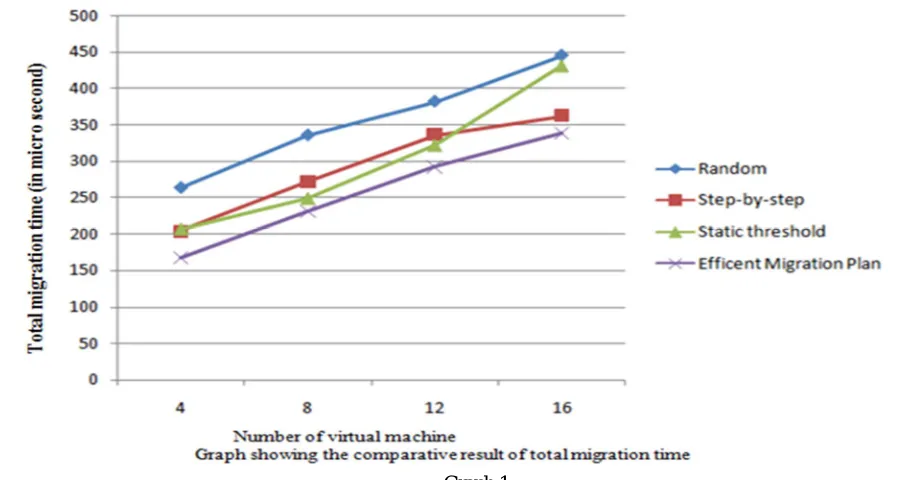
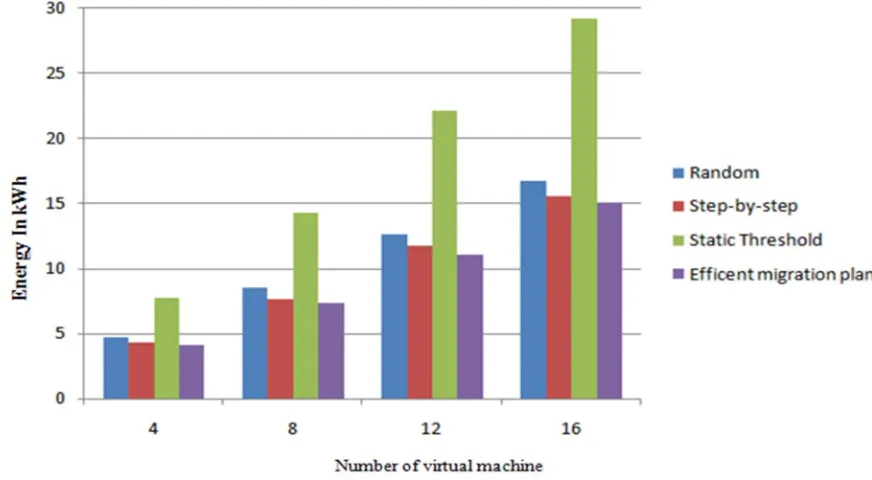
After simulation, we compare the efficient migration plan to other techniques like Random Migration Technique, Step-by-step and Static Threshold. Than we got the different and better result from other technique.
[image:8.612.79.532.146.396.2]IV. EXPERIMENTAL RESULTS
[image:8.612.68.522.464.704.2]Table no: 1 shows migration time of four migration technique (random, step-by–step, static threshold and efficient migration plan).
Table.1
Graph no: 1 shows competitive migration time of four migration technique (random, step-by–step, static threshold and efficient migration plan).
Technology (IJRASET)
[image:9.612.78.514.386.626.2]Table no: 2 energy consumption of four migration technique (random, step-by–step, static threshold and efficient migration plan).
Table. 2
Graph no: 2 shows competitive energy consumption of four migration technique (random, step-by–step, static threshold and efficient migration plan).
Graph.2
V. CONCLUSION AND FUTURE SCOPE
Technology (IJRASET)
copying the entire memory copy of the VM, we are only transferring the execution log, there by further reducing the volume of data to be migrated. And it is also save energy compare the other migration technique. In future a model with solid solution of interference management system may be developed comprising interference monitoring abilities to identify and resolve cause and effect of interferences in cloud computing. In future also develop a plan for enhancing physical device utilization.
REFERENCES
[1]. Sachin Majithia, Suman Kumar Mishra, “Scheduler for Minimum Energy Consumption and Better Job Management in Data Center”, 2015(June) Volume 3 Issue VI.
[2]. Fei Cao, Michelle M. Zhu, Chase Q. Wu, 2014 “Energy-Efferentfor resource management scientific work flow in cloud’’ IEEE 10th World Congress on Services.
[3]. Wood Timothy, Shenoy Prashant, Venkataramani Arun, and Yousif Mazin, 2007 “Black-box and Gray-box Strategies for Virtual Machine Migration” 4th USENIX Symposium on Networked Systems Design USENIX Association & Implementation, (NSDI 07).
[4]. Strunk Anja and Dargie Waltenegus, 2013 “Does Live Migration of Virtual Machines cost Energy?” 27th IEEE International Conference on Advanced Information Networking and Applications (AINA).
[5]. Voorsluys William, Broberg James, Venugopal Srikumar, and Buyya Rajkumar, 2009 “Cost of Virtual Machine Live Migration in Clouds: A Performance Evaluation” Cloud Com '09 Proceedings of the 1st International Conference on Cloud Computing .
[6]. Timothy Wood, K. K. Ramakrishnan, 2014 “CloudNet: Dynamic Pooling of Cloud Resources by Live WAN Migration of Virtual Machines”Computer Science Department, The George Washington University, Washington, DC, USA.
[7]. Wenhong Tian, Minxian Xu, Yu Chen, Yong Zhao, 2014 “Prepartition: A New Paradigm for the Load Balance of Virtual Machine Reservations in Data Centers” School of Computer Science and Engineering University of Electronic Science and Technology of China, Chengdu, China.
[8]. Feng Wang, 2014 “Migration Towards Cloud-Assisted Live Media Streaming” Member, IEEE.
[9]. Ruitao Xie, Yonggang Wen, Xiaohua Jia, Fellow, IEEE and Haiyong Xie ; MARCH- 2014 “Supporting Seamless Virtual Machine Migration via Named Data Networking in Cloud Data Center” Department of Computer Science at City University of Hong Kong.
[10]. Jiaqiang Liu, Li Su, Yuchen Jin, Yong Li, Depeng Jin and Lieguang Zeng ; AUGUST- 2014 “Optimal VM Migration Planning for Data Centers” Department of Electronic Engineering, Tsinghua University, Beijing 10084, China.
[11]. Yang Wang, and Wei Shi, 2013“Virtual Servers Co-Migration for Mobile Accesses: Online vs. Off-line” IEEE Member.
[12]. Rajyashree and Vineet Richhariya, 2013 “Double Threshold Based Load Balancing Approach by Using VM Migration for the Cloud Computing Environment” Lakshmi Narain College of Technology, Bhopal, India.
[13]. Xin Lu and Zhuanzhuan Zhang, 2014 “A Virtual Machine Dynamic Migration Scheduling Model Based on MBFD Algorithm”.
[14]. Xiao Song, YaofeiMa, and Da Teng, 2014 “TSMC: A Novel Approach for Live Virtual Machine Migration” Department of Computer Science and Technology, Tsinghua University, Beijing 100084, China.
[15]. Yanbing Liu, 2013“A Virtual Machine Migration Strategy Based on Time Series Workload Prediction Using Cloud Model” Engineering Laboratory of Network and Information Security, Chongqing University of Posts and Telecommunications, Chongqing 400065, China.
[16]. Gaganpreet Kaur Sehdev 2012 “Performance Evaluation of Power Aware VM Consolidation using Live Migration” Guru Nanak Dev University/CSE department, Amritsar, 143001, India.
[17]. Sujesha Sudevalayam and Purushottam Kulkarni, 2013 “Affinity-aware modelling of CPU usage with communicating virtual machines” in Journal of Systems and Softwares 86 2627-2638.
[18]. Pablo Graubner, Matthias Schmidt and Bernd Freisleben, March/April 2013 “Energy-Efficient Virtual Machine Consolidation” in IEEE Computer Society, IT Pro,.
[19]. Tiago C. Ferreto, Marco A. S. Netto, Rodrigo N. Calheiros and Cesar A.F. De Rose, 2011 “Server Consolidation with migration control for virtualized data centers” in Future Generation Computer Systems 27 1027-1034.
[20]. Mayank Mishra, Anwesha Das, Purushottam Kulkarni and Anirudha Sahoo, September 2012 “Dynamic Resource Management using Virtual Machine Migrations” in IEEE Communication Magazine (Cloud Computing: Networking and Communication Challenges),.
[21]. Haikum Liu, Hai Jin, Xiaotei Liao, Chen Yu and Cheng-Zhong Xu, 2011 “Live Virtual Machine Migration via Asynchronous Replication and State Synchronisation” in IEEE Transactions on Parallel and Distributed Systems, VOL 22, NO 12,.
[22]. Kejiang Ye, Xiaohong Jiang, Dawei Huang, Jianhai Chen and Bei Wang, 2011 “Live Migration of Multiple Virtual Machines with Resource Reservation in Cloud Computing Environments” in IEEE 4th International Conference on Cloud Computing, 978-0-7695-4460-1,.
[23]. Febio Checconi, Tomasso Cucunotta and Manuel Stein, 2009 “Real Time Issues in Live Migration of Virtual Machines” in Euro-Par'09 Proceedings of the international conference on Parallel processing (ACM Digital Library), Pages 454-466.
[24]. R. Suchithra,2012 “Efficient Migration –A Leading Solution for Server Consolidation,” International Journal of Computer Applications, vol. 60, no.18. [25]. N. Gupta, Jyoti and Abhay,2012 “A Survey on Cloud Providers and Migration Issues”, International Journal of Computer Applications, vol. 56, no.14, pp.