Gesture Recognition System for Physically
Challenged Persons
Pavankumar Naik1, Kirthishree katti 2, Arun Kumbi 3, Basavaraj Morgod4, Praveen K5
1, 3, 4
Computer science and Engineering Department,
2
Information science and Engineering Department,
5
Electronics & Engineering Department, VTU
Abstract: the physically challenged persons are one of the excluded sections of society and the present study is conducted among the physically challenged persons about their problems in their daily life .disable people are the people with physical or mental incapacities. There are four types of physically challenged, they are: physically handicapped, blind, deaf and dumb. The disabled people sometimes have difficulty in doing the things and other people may take for granted, such as traveling on public transport, climbing stairs are even using some house hold appliances to communicate with others. Communication barriers are experienced by people who have disabilities that effect hearing, speaking, or understanding .there are different ways to communicate with those people ,hence our paper is to reduce barrier of communication by developing an assistive device for physically challenged using Bluetooth based android application and image processing.
Keywords: mems, proximity sensor, adc, microcontroller, Bluetooth module.
I. INTRODUCTION
The main aim of this paper is to design and construct a Dumb, deaf blind monitoring system using android application and image processing. The user can wear this device near to his arms and hand, with the simple head movement and hand movement, he can request the basic needs like water, food or medicine by using IR rays. For example if the tilt is to the right side sensor will be “ON” for the first .In the same way, if the tilt is to the left side then another sensor is going to be controlled. The tilt is in upwards or downward direction the related need will be announced. This device is very
helpful for paralysis and physically challenged persons as shown in Figure 1.1.
Figure1.1: Disabled Persons
This paper makes use of Android application, proximity sensors, MEMS and Microcontroller and text to speech recognition which is programmed, with the help of embedded assembly instructions. This microcontroller is capable of communicating with transmitter and receiver modules. The IR based sensor detects the head movement and provides the information to the microcontroller (on board computer) and the controller judges whether the instruction is right movement or left movement instruction and controls the operation respectively.
A.What is mems technology?
physical dimensions of MEMS devices can vary from well below one micron on the lower end of the dimensional spectrum, all the way to several millimeters. Likewise, the types of MEMS devices can vary from relatively simple structures having no moving elements, to extremely complex electromechanical systems with multiple moving elements under the control of integrated microelectronics. The one main criterion of MEMS is that there are at least some elements having some sort of mechanical functionality whether or not these elements can move.
The term used to define MEMS varies in different parts of the world. In the United States they are predominantly called MEMS, while in some other parts of the world they are called “Microsystems Technology” or “micro machined devices”. While the functional elements of MEMS are miniaturized structures, sensors, actuators, and microelectronics, the most notable (and perhaps most interesting) elements are the micro sensors and micro actuators. Micro sensors and micro actuators are appropriately categorized as “transducers”, which are defined as devices that convert energy from one form to another. In the case of micro sensors, the device typically converts a measured mechanical signal into an electrical signal.
B.Comparator Using Op-Amp
The output of accelerometer is fed to the four comparator; the comparator compares the voltage levels of the accelerometer from the XY output’s and comparator reference voltage is adjusted to get different outputs for the different acceleration. The output of comparators is given to the microcontroller.
C.Proximity Sensor
A proximity sensor detects the presence of humans those are passed nearly to this circuit without any point of contact. Since there is no contact between the sensors and sensed object and lack of mechanical parts, these sensors have long functional life and high reliability. The different types of proximity sensors are Inductive Proximity sensors, Capacitive Proximity sensors, Ultrasonic proximity sensors, photoelectric sensors, Hall-effect sensors, etc. If the IR rays of the proximity circuit is disturbed means it will send a output, as we used this circuit in monitoring the physically challenged persons.
D.Microcontroller
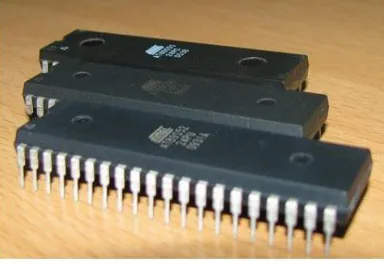
When the Microcontroller is powered up, the Program stored in the ROM of Microcontroller starts executing and microcontroller functions as per the Program. In this project the Microcontroller as in figure 1.2 keeps on checking the signals are
[image:3.612.210.402.489.622.2]arriving at the input port and display the message on LCD. A microcontroller is an economical computer-on-a-chip built for dealing with specific tasks, such as displaying or receiving information through LEDs or remote controlled devices. The most commonly used set of microcontrollers belong to 8051 Family. 8051 Microcontrollers continue to remain a preferred choice for a vast community of hobbyists and professionals. Through 8051, the world became witness to the most revolutionary set of microcontrollers.
Figure 1.2 Microcontroller
E.Bluetooth Module
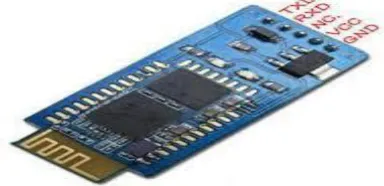
Figure 1.3 Bluetooth module
It is a class-2 Bluetooth module with Serial Port Profile, which can configure as either Master or slave. A Drop-in replacement for wired serial connections, transparent usage. You can use it simply for a serial port replacement to establish connection between MCU, PC to your embedded project and etc.
II. RELATEDWORK
Abdul Rawoof, Kulesh Kailash, Chandra Ray "ARM based implementation of Text-To-Speech (TTS) for real time Embedded System" in 2014. This proposed real time hardware implementation of Text-To-Speech system has been drawing attention community due to its various real time applications. These include reading aids for the blind, talking aid for the vocally handicapped and training aids and other commercial applications. [2] Nakul nagpal, Dr.Arun mitra, Dr.Pankaj agarwal , “Design issue and proposed implementation of communication aid for deaf and dumb people”. This paper proposes a full proof system to aid communication of deaf and dumb people communicating using sign language. [3] Yvonne may Nolan “Control and communication for physically disabled people based on Vestigial signals from the body”. This proposed method introducing EOG the electrical signals measurable around the eyes and can be used to detect eye movement with careful signal processing. [4] V.N.Syam babu V.J.K.Kishor sonti and Y.Varthamanan “Design and simulation of communication Aid for disabled using threshold base segmentation”,This proposed Method explains about sign Language which talks about non verbal way of communication with assist of hands movements, facial and body expressions to convey the meaning of sign
III. PROPOSEDMETHODOLOGY
Here we are providing 230v power supply to step down transformer, where it converts it into 12v. Bridge rectifier is used to convert alternate current to direct current. This bridge rectifier will not give pure dc so we use capacitors to convert it into pure dc. And regulator is used to give constant 5v current to microcontroller. Where microcontroller includes six input ports, in that four input ports are reserved to receive the input from MEMS and two input ports are reserved to receive the input from Proximity sensor.
Proximity sensors senses the head gestures and MEMS sensors senses hand movements, these gestures are converted into voltages then send to the input ports of the microcontroller. Then microcontroller interacts with the embedded Bluetooth to transmit the signals.
A.Components of Architecture
The above figure 3.1 shows block diagram of proposed system. It consists of five components, and they are:
B. Proximity Sensor
These are sensing devices that can detect the gestures without physical contact. A proximity sensor often emits an electromagnetic field or beam of electromagnetic radiation (infrared rays, for instance),and looks for changes in the field or return signal. The gesture being sensed is often referred to as proximity sensor’s target. The proximity sensor is sometime a same hardware as the light sensor. Android still treats them as a logically separate sensor.
C.MEMS (Micro Electro Mechanical System) based Accelerometer
D.ADC (Analog to Digital Controller)
ADC is the device which converts the analog signals to digital signals. Here in this system it gets the input from the sensors and sends to the microcontroller for further processing.
E.Microcontroller
Microcontroller incorporates all the features that are found in microprocessor. The microcontroller has built in ROM, RAM, input/output ports, and serial ports. The 8051 microcontroller is employed and the program is downloaded in the ROM, the 8051 receives the signal from the input port and executes the instructions stored in the ROM and sends the signal through the output port to display messages as per the requirement of the physically challenged person on monitor screen and also it announces voice.
F. Bluetooth
[image:5.612.214.406.269.362.2]Bluetooth technology handles the wireless communication channel. Which transmits and receives the data wirelessly between serial input and output devices using UART(Universal Asynchronous Receiver/Transmitter). This module is an easy way to use the Bluetooth serial port protocol module designed for transparent wireless serial connections is shown in figure 3.2.
Figure 3.2 Bluetooth device
Bluetooth based android application for text and voice message
Figure 3.3 Android application for text and voice message
Here we are designing Bluetooth based android application. In which we turns on the Bluetooth from our mobile phone and tries to search the nearest available microcontroller Bluetooth Device. Once it found, both devices get paired. Later on our android application reads the input from paired embedded system and thus the captured gestures converted into text and voice messages to make easier communication for dumb , deaf and blind people shown in figure 3.3.
IV. IMPLEMENTATION
[image:5.612.199.479.411.586.2]development for mobile devices which means developers need only develop for Android, and their applications should be able to run on different devices powered by Android.
A.Android Application Framework
The Application Framework layer provides many higher-level services to applications in the form of Java classes. Application developers are allowed to make use of these services in their applications.
The Android framework includes the following key services −Activity Manager− Controls all aspects of the application lifecycle and activity stack.
1)Content Providers : Allows applications to publish and share data with other applications.
2)Resource Manager : Provides access to non-code embedded resources such as strings, color settings and user interface layouts. 3)Notifications Manager : Allows applications to display alerts and notifications to the user.
4)View System : An extensible set of views used to create application user interfaces.
B.Bluetooth Device
Bluetooth is a way to send or receive data between two different devices. Android platform includes support for the Bluetooth framework that allows a device to wirelessly exchange data with other Bluetooth devices.
Android provides Bluetooth API to perform these different operations. 1)Scan for other bluetooth devices
2)Get a list of paired devices
3)Connect to other devices through service discovery 4)Methods
a)BluetoothAdapter: Android provides class to communicate with bluetooth. b)Action_request_enable():enable the bluetooth of your device.
c)Action_request_discoverable(): this constant is used for turn on the discovering of bluetooth. d)Action_found: this constant is used for receiving information about each device that is discovered. e)Getname(): this method returns the name of the bluetooth adapter.
f) Getbondeddevices(): it returns a set of bluetooth devices. g)Enable(): this method enables the adapter if not enabled.
h)startDiscovery(): This method starts the discovery process of the Bluetooth for 120 seconds.
C.Text To Speech
Android allows you convert your text into voice. Not only you can convert it but it also allows you to speak text in variety of different languages. Android provides TextToSpeech class for this purpose.
1)Addspeech(string text, string filename):This method adds a mapping between a string of text and a sound file. 2)Getlanguage(): This method returns a local instance describing the language.
3)Isspeaking():This method checks whether the texttospeech engine is busy in speaking. 4)Setpitch(float pitch): This method sets speech pitch for the texttospeech engine. 5)Setspeechrate(float speechrate): This method sets the speech rate.
6)Shutdown():This method releases resources used by the TextToSpeech engine. 7)Stop(): This method stop the speek.
V. APPLICATIONS
A.It helps for physically challenged people
B.It can be modified to transmit data for different applications C.Emergency announcement.
VI. ADVANTAGESANDDISADVANTAGES
A. Advantages
1)It helps for the physically challenged people, to convey their needs, so Physically challenged people can lead their life with more comfort.
2)Low power requirement.
3)Easy to carry because of compact design.
4)No need to carry separate remote or any other controlling unit. 5)simple circuitry as it does not require special hardware.
B. Disadvantages
1)More cabling is required.
2)It has distance limit in controlling device.
VII. RESULTS
A.Hand Gestures
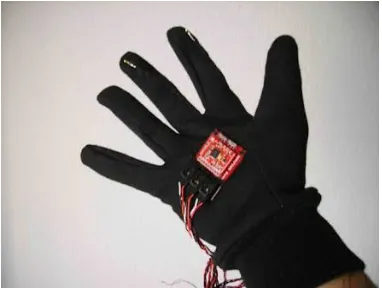
The gestures which are the inputs for the MEMS sensors will be converted to text and voice it will be displayed on mobile screen and the gestures can be transmitted using Bluetooth Module to a smart phone where gesture to text and speech conversion takes place using Hardware setup of the module which is shown below. This includes MEMS sensor gloves, microcontroller, ADC, Bluetooth device and Android device.
Figure 7.1 MEMS attachment
[image:7.612.202.393.336.480.2]Gestures of Hand to be recognized
Hand gestures are divided into four types and are the movement of the hand will indicate some message which is set by the guardian to monitor the disabled person. The movements or gestures are like
1)Forward: If the disabled moves his hand forward then it means that he is requesting for medicine. 2)Reverse: If the disabled moves his hand reverse then it means that he is in emergency.
3)Right: If the disabled moves his hand forward then it means that he is requesting for water. 4)Left: If the disabled moves his hand forward then it means that he is requesting for medicine.
[image:8.612.234.419.183.312.2]B.Head Movement
Figure 7.3 Head movement
The movement of the head will indicate some message which is set by the guardian to monitor the disabled person. The movements or gestures are like
1)Right: If the disabled moves his head right then it means that he is requesting for fan. 2)Left: If the disabled moves his head left then it means that he is requesting for medicine.
C. Interaction with Android Application
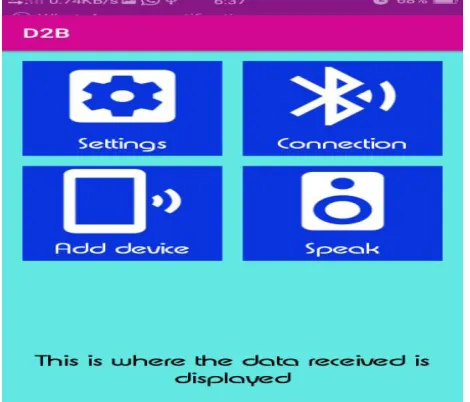
This application receives the data from the hardware device via Bluetooth and displays the text message and announces voice alerts as shown in Figure 7.4.
Figure 7.4 Home Page
VIII. CONCLUSION
[image:8.612.191.426.430.631.2]REFERENCES
[1]Abdul Rawoof Kulesh Kailash Chandra Ray "ARM based implementation of Text-To-Speech (TTS) for real time Embedded System" <em>Fifth International Conference on Signal and Image processing</em> 2014.
[2]Honggang Zhang, Kaili Zhao, Yi-Zhe Song: Text Extraction from Natural Scene Image: A Survey. Neurocomputing. 2013.
[3]Nakul Nagpal,Dr.Arun Mitra,Dr.Pankaj Agarwal: “Design Issue and proposed Implementation of communication aid for deaf and dumb people “
[4]Rajamohan Anbarasi R. Hemavathy M Dhanalakshmi "Deaf-Mute Communication Interpreter" <em>International Journal of Scientific Engineering and
Technology</em> vol. 2 no. 5 May 2013.
[5]Yvonne May Nolan “Control and communication for physically disabled people based on Vestigial signals from the body.
[6]R K Shangeetha V Valliammai S. Padmavathi "Computer Vision Based Approach for Indian Sign Language character Recognition" <em>IEEE journal on Information
Technology</em> 2012. .
[7]Yen-Lin Chen, Zeng-Wei Hong, Cheng-Hung Chuang "A knowledge-based system for extracting text-lines from mixed and overlapping text/graphics compound document images." Expert Syst. Appl., 2012
[8]Keechul Junga, Kwang In Kimb, Anil K. Jain, "Text information extraction in images andvideo: a survey",Pattern Recognition 37977 – 997, 2013
[9]Nobuo Ezaki and Marius Bulacu, Lambert Schomaker: Semantic multi-grain mixture topic model for text analysis. Expert Syst. Appl. 38(4): 3574-3579 (2013)