www.ijraset.com Volume 3 Issue V, May 2015 IC Value: 13.98 ISSN: 2321-9653
International Journal for Research in Applied Science & Engineering
Technology (IJRASET)
©IJRASET 2015: All Rights are Reserved
965
Index Based Deduplication File System in Cloud
Storage System
Mahalakshmi Parameshwaran1, Menaka Chinnasamy2
1,2
Master of Computer Application, Anna University
Abstract— In a virtualized cloud environment each instance of a guest operating system runs on a virtual machine, contact virtual hard disks symbolized as virtual disk image files in the host operating system. Because these image files are stored as regular files from the external point of view, backing up VM’s data is mainly done by taking snapshots of virtual disk images. In a virtualized cloud computing surroundings, common snapshot support of virtual disks improves hosting reliability but storage demand of such operations is huge. While dirty bit based technique can identify unmodified data among versions; full deduplication with fingerprint assessment can remove more redundant content at the cost of computing resources. So in this project we proposed a LIQUID framework to implement the deduplication scheme in both file and block level. And propose a deduplication file system with low storage consumption and high-performance IO, which satisfies the requirements of VM hosting. Finally we extend our work to address the problem of authorized data deduplication.
Keywords—phrases Deduplication, cloud computing, virtual machine, liquid, file system
I. INTRODUCTION
Technology (IJRASET)
II.RELATEDWORKS
In [1] A. Mathur, M. Cao, S. Bhattacharya, A. Dilger, A. Tomas, and L. Vivier. Ext3 has been the most widely used general Linux R○ filesystem for many years. In keeping with increasing disk capacities and state-of-the-art feature requirements, the next generation of the ext3 filesystem, ext4, was created last year. This new filesystem incorporates scalability and performance enhancements for supporting large filesystems, while maintaining reliability and stability. Ext4 will be suitable for a larger variety of workloads and is expected to replace ext3 as the “Linux filesystem.” In this paper we will first discuss the reasons for starting the ext4 filesystem, then explore the enhanced capabilities currently available and planned for ext4, discuss methods for migrating between ext3 and ext4, and finally compare ext4 and other filesystem performance on three classic filesystem benchmarks.
In [3] C. Ng, M. Ma, T. Wong, P. Lee, and J. Lui. Deduplication is an approach of avoiding storing data blocks with identical content, and has been shown to effectively reduce the disk space for storing multi-gigabyte virtual machine (VM) images. However, it remains challenging to deploy deduplication in a real system, such as a cloud platform, where VM images are regularly inserted and retrieved. We propose LiveDFS, a live deduplication file system that enables deduplication storage of VM images in an open-source cloud that is deployed under low-cost commodity hardware settings with limited memory footprints. LiveDFS has several distinct features, including spatial locality, prefetching of metadata, and journaling. LiveDFS is POSIX-compliant and is implemented as a Linux kernel-space file system. We deploy our LiveDFS prototype as a storage layer in a cloud platform based on OpenStack, and conduct extensive experiments. Compared to an ordinary file system without deduplication, we show that LiveDFS can save at least 40% of space for storing VM images, while achieving reasonable performance in importing and retrieving VM images. Our work justifies the feasibility of deploying LiveDFS in an open-source cloud.
In[9] Stoica, R.Morris, D. Karger,M.F. Kaashoek, and H Balakrishnan. A fundamental problem that confronts peer-to-peer applications is to efficiently locate the node that stores a particular data item. This paper presents Chord, a distributed lookup protocol that addresses this problem. Chord provides support for just one operation: given a key, it maps the key onto a node. Data location can be easily implemented on top of Chord by associating a key with each data item, and storing the key/data item pair at the node to which the key maps. Chord adapts efficiently as nodes join and leave the system, and can answer queries even if the system is continuously changing. Results from theoretical analysis, simulations, and experiments show that Chord is scalable, with communication cost and the state maintained by each node scaling logarithmically with the number of Chord nodes.
III.DEDUPLICATIONSYSTEM
[image:3.612.226.399.562.703.2]www.ijraset.com Volume 3 Issue V, May 2015 IC Value: 13.98 ISSN: 2321-9653
International Journal for Research in Applied Science & Engineering
Technology (IJRASET)
©IJRASET 2015: All Rights are Reserved
967
IV.TRUSTBASEDP2PDATASHARINGDEDUPLICATIONINCLOUDCOMPUTING
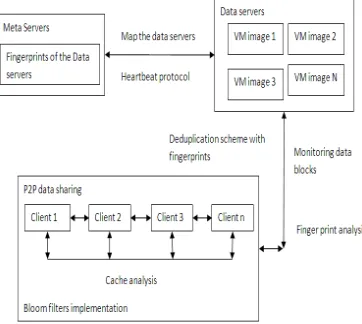
[image:4.612.220.401.177.339.2]In paper proposed centralized backup structural design with multi-level and selective deduplication. This service is hosted in the existing set of machines and resource procedure is controlled with a negligible collision to the existing applications. The deduplication procedure is first execute between snapshots inside every VM and then is perform across VMs. Given the apprehension that seeking duplicates across VMs is a global feature which can involve similar presentation and confuse failure management, only abolish the duplication of a small but accepted data set while still preserve a cost-effective deduplication ratio. For this reason, use the data characteristics of snapshots and gather most accepted data. Data sharing across VMs is limited inside this small data set such that addition replicas for it could improve fault tolerance.
Figure 2: System architecture for proposed
V. CONCLUSIONS
In cloud many data are stored again and again by user. So the user need more spaces store another data. That will reduce the memory space of the cloud for the users. To overcome this problem uses the deduplication concept. Data deduplication is a technique for reducing the amount of storage space an organization wants to save its data. In many associations, the storage systems surround duplicate copies of many sections of data. For instance, the similar file might be keep in several dissimilar places by dissimilar users, two or extra files that aren't the same may still include much of the similar data. Deduplication remove these additional copies by saving just one copy of the data and replacing the other copies with pointers that lead back to the unique copy. Companies regularly utilize deduplication in backup and failure improvement applications, but it can be utilized to liberate up space in main storage as well. In its simplest form, deduplication takes place on the file level; that is, it removes duplicate copy of the similar file. This type of deduplication is occasionally called file-level deduplication or single instance storage (SIS). Deduplication can also obtain place on the block level, removing duplicated block of data that happen in non-identical files. Block-level deduplication frees up more spaces and a exacting category recognized as variable block or variable length deduplication has become very popular. Often the phrase "data deduplication" is used as a synonym for block-level or variable length deduplication. In cloud using the DHT table the user easily searches the data and retrieves the searched data from the cloud.
REFERENCES
[1] A. Mathur, M. Cao, S. Bhattacharya, A. Dilger, A. Tomas, and L. Vivier, ‘‘The New ext4 Filesystem: CURRENT STATUS and Future Plans,’’ in Proc. Linux Symp., 2007, vol. 2, pp. 21-33, Citeseer.
[2] M. McLoughlin, The qcow2 Image Format, Sept. 2011. [Online]. Available: http://people.gnome.org/markmc/qcow-image-format.html
[3] C. Ng, M. Ma, T. Wong, P. Lee, and J. Lui, ‘‘Live Deduplication Storage of Virtual Machine Images in an Open-Source Cloud,’’ in Proc. Middleware, 2011, pp. 81-100.
[4] K. Pepple, Deploying OpenStack. Sebastopol, CA, USA: O’Reilly Media, 2011.
[5] S. Quinlan and S. Dorward, ‘‘Venti: A New Approach to Archival Storage,’’ in Proc. FAST Conf. File Storage Technol., 2002, vol. 4, p. 7. [6] R. Rivest, The md5 Message-Digest Algorithm, Apr. 1992. [Online]. Available: http://tools.ietf.org/html/rfc1321
[7] P. Schwan, ‘‘Lustre: Building a File System for 1000-Node Clusters,’’ in Proc. Linux Symp., 2003, vol. 2003, pp. 400-407.
[8] K. Shvachko, H. Kuang, S. Radia, and R. Chansler, ‘‘The Hadoop Distributed File System,’’ in Proc. IEEE 26th Symp. MSST, 2010, pp. 1-10.
[9] I. Stoica, R.Morris, D. Karger,M.F. Kaashoek, and H Balakrishnan, ‘‘. Chord: A Scalable Peer-to-Peer Lookup Service for Internet Applications,’’ in Proc. Conf. Appl., Technol., Architectures, Protocols Comput. Commun. (SIGCOMM), New York, NY, USA, Oct. 2001, vol. 31, pp. 149-160.