CIE44 & IMSS'14Proceedings, 14-160ctober 2014, Istanbul/Turkey
POPULATION BASED ANT COLONY OPTIMIZATION FOR INVENTORY ROUTING PROBLEM
N.H. Moin1' and L. Wong22
Institute of Mathematical Sciences, University of Malaya,
50603 Kuala Lumpur, Malaysia. noor hasnah®um.edu.mt
lilywong84®gma it.com
ABSTRACT
The inventory routing problem presented in this study is a one-to-many distribution network consisting of a manufacturer that produces multi products to be transported to many geographically dispersed customers. We consider a finite horizon where a fleet of capacitated homogeneous vehicles, housed at a depot/warehouse, transports products from the warehouse to meet the demand specified by the customers in each period. The demand for each product is deterministic and time varying and each customer request a distinct product. The inventory holding cost is product specific and is incurred at the customer sites. The objective is to determine the amount on inventory and to construct a delivery schedule that minimizes both the total transportation and inventory holding cost while ensuring each customer's demand is met over the planning horizon. The problem is formulated as a mixed integer programming problem and is solved using CPLEXto get the lower bound and upper bound (the best integer solution) for each instance considered. We proposed a population based ant colony optimization (ACO) where the ants are subdivided into subpopulations and each subpopulation represents one inventory level to construct the routes. In addition, we modify the standard ACO by including the inventory cost in the global pheromones updating and the selection of inventory updating mechanism is based on the pheromone value. ACO performs better on large instances compared to the upper bound and performs equally well for small and medium instances.
Keywords: Inventory Routing Problem, Multi Products, Ant Colony Optimization
1 INTRODUCTION
Inventory routing problem (IRP) is classified as a NP-hard problem that involves the integration and coordination of inventory management and transportation, which the customers are relying on a central supplier to deliver the commodity on a repeated basis. The main objective of this problem is to minimize the corresponding costs (fixed and variable costs) in order to make the deliveries to customers on time. IRP indeed arise the attention in past years and there are many meta-heuristic methods have been developed, such as genetic algorithms, tabu search and branch-and-cut algorithms to suit the problems that lead to optimal or near optimal solutions. We will first present some literatures on IRP concentrating on the most recent literatures.
Federgruen and Zipkin [13] were among the first to study the IRP. The problem was treated as a single day problem with a limited amount of inventory and the customers' demands are assumed to be a random variable. The problem decomposes into a nonlinear inventory allocation problem which determines the inventory and shortage costs and a Travelling
--
t--~ ..r 00 N
--
r"I .0.0 N r"I N r"I N
...- ..r a- ~
a-r"I r"I
..
--
0 a- ~--
~ ~ 0 ~ .ri0 ,
0- N r"I ,....; r"I ..¢ r"I
r"I t;I , ~ "7"
s
--
'"
u ~N ..r
QI 0
t-- ..r
--r"I
a-'"
r"I
--
a-00
a-...- .- 00
--
Ll'> 0 ..r 0Ll'> N 0 Ll'> 00 t-- N N r"I Ll'> Ll'>
N r"I
t--QI
-- --
--
--r"I Ll'>
...
E QI s: i= e, O u-e s: r"I
Ll'> 00 ..r N a- Ll'> QI a- .0 N
00 .0 t-- ..- 0 N t-- t-- N ..r Ll'>
> .- r"I Ll'>
N Ll'> t-- ..- .0 ..- ..- N .- N r"I
~
~ Ll'> 0 N ..- 0 N
0 0
8
0 0 0N
--
'"':t-- 00 a- N .0
s
.0 0 ~ ~r-:
.- 0
N N cO
..c
~ 0;; -.ia-t-- ..r
u ~ N t--
t--Ll'> r"I t-- 0 Ll'> r"I
~ t-- r"I N r"I 00 ~
r"I 00 a- Ll'>
--
00a-'"
N ..r ..rLl'> 0 .0 ..- .0 r"I .0 Ll'> 0 r"I QI N ..r .0
r"I t-- a- .- 00 ..- N
r"I ..- r"I ..r
10
--~ N .0 a- t-- ..r N
..- ..0 ..- ..r Ll'> .-
t--...- "'! 00
.- a- Ll'>
a-..
..r--
a- t-- N II'! ~ N ~0- N ,....; ,....; r"I -.i
r"I ..r "7"
Ll'> .0 0;-III
, ,
\!)
--
'"
UQI N 0
t--00 N ..r a- ..r
00 Ll'>
'"
..- 00 ..- ..r0 ..r a-
t--...- 0 ..r 0 ..r
.-
a-N r"I Ll'> Ll'> ..- ..- N r"I t-- a- Ll'> 00
.0
..-QI
.- ... r"I Ll'>
~ E
CO i=
0
~ .r:. r"I ..r 00 r"I N
a-Ll'>
QI a- ..0 N 00
..0 t-- 0
> ..- r"I Ll'> N Ll'>
t--.- .0 N t-- t-- N ..r
Ll'>
~
... .- ... N ..- N r"I
'"
0~ ..r r"I ..r Ll'> r"I 00 Ll'> 0 0 0 0
0 0
'"
0 a- N N ..0N ..r ..- 0 "'!
r"I ... N '<t Ll'>
U Ll'> ... N N
..c
,...:,...: c:i
t::
.0 .ri 0 0t--~ 00 ..r N N ..r a- 00 ...
00 ... 00 .0
a-'"
N ~ ..r Ll'> 0 ..0..r ... 00 00 t-- 0 a-
a-QI N ..0 r"I
t-- a- ..r 00 ..0
r"I ..0 Ll'> 0 r"I CO
... .- N r"I ... r"I ..r .r:.
--
QI a- ..0 N 00 ..0 t-- Ll'> '<t Ll'> t-- ... ..rr"I
...
~ >
... r"I Ll'> N Ll'> t-- ... .0 M a- ... M
a-~
... .- ... r"I ... N
QI
~
.E
~ ...
'"
..0r"I Ll'> 00 ... 00 N N ... ..0 M Ll'>
QI
'"
~M M t-- t-- 0 N N ~ ~ a- ... ...
CO
...
.ri ..¢ ~0 cO ...- III ... ..0 cO
a- ,....; Ll'> ... ..0 CO
0 M 0 a- a- Ll'> .0
N ... r"I 00 N r"I 00
U N M ... r"I t-- M
a- N t-- ... ..0 ... r"I
::::l N ..r ..0
M .0 a- M 00 ...
Ll'> 00 .0 '<t
... N M ... M
--
QI 00> ..r 00 Ll'> t-- M
M ..r Ll'> .0 ..r a-CO
'B
M .0 Ll'> M a-
t--Ll'> ..r 00 ..r 00 Ln ~
M ,...: ~ cO 0 ~ t-- -.i
,....; 0 cO
-I QI 0
00 ...
'<t N 0 r"I .0 0 ... 0
... 0 0 ,
...
N '<t... .t:J
0 r"I N r"I t-- .0 a- M ..r N .0
e.
..r Ll'> M .0 00N t-- M a- a- M Ln ... .- ... N ... N
III Ln
0 '<t Ln 0 ..r N
0 ..r ... Ln 0 ..r
... ... ... ... Ln
...
l- I-I-... ... N
g
~ ...III N
l-I- 0
b b b
b
5 5
I-... N N N
0 0
8
... ... N N N LnV'I Ln Ln Ll'> 0
Vi ... ...
N ... ~ -'".... ::l
I-m
~ QI .t= 0-0 0 ~'"
'0 ¢i C .D to B ~ u 0 co -.D 0 ~ ~.-~
....
0c II) :0 :!:!. Q) ~ QI II) u ~ 0 0:. "<I'
-VI Q)~ :isto
d:j
I-"<t "<t
(IE44 a IMSS'14 Proceedings, 14-160ctober 2014, Istanbul/Turkey
Salesman Problem (TSP) for each vehicle considered which produces the transportation costs. Most of the earlier works concentrates on an infinite planning horizon (see for example Aghezzaf et al. [1], Anily and Bramel [2]and Campbell and Savelsbergh [4]).However, Chien et at. [5] is amongst the first to simulate a multiple period planning model where the model is based on a single period approach. This is achieved by passing some information from one period to the next through inter-period inventory flow. Since then many researchers have focused their modeling on a finite planning horizon.
Coelho and Laporte [6] proposed branch-and-cut algorithm to solve multi product multi vehicle IRP with deterministic demand and stock out cost is not allowed. In this paper, Coelho and Laporte [6] implemented a solution improvement algorithm after branch-and-cut identifies a new best solution. The purpose of solution improvement algorithm is to approximate the cost of a new solution resulting from the vertex removal and reinsertions. In this paper, the authors also considered additional two features namely the driver partial consistency and visiting space consistency. The driver partial consistency plays the role of increasing the quality of the solution provided by the IRP both to customers and suppliers in a multi-product environment. The results show that the visiting space helps in reducing the search space while providing meaningful solution. This is the first paper that solves the problem with heterogeneous vehicles.
Dror and Trudeau [11] first introduced the split delivery VRP (SDVRP)by relaxing a constraint of the VRP that every customer is served by only one vehicle. The authors showed that the relaxation increased the flexibility of distribution and could lead to important savings, both in the total distance traveled and in the number of vehicles used. The SDVRPremains NP hard despite this relaxation (Dror and Trudeau [12]). Several authors (see for example Mjirda et al. [16], Moin et al. [17] and Yu et al. [21]) have extended the concept of split delivery in the multi-period IRP.
Moin et al. [17] had proposed an efficient hybrid genetic algorithm to solve the IRP in a many-to-one network which involves multi products where each supplier supplies different products and in multi period scenario. The problem of this paper is to find the minimum cost to pick up the products from a set of geographically dispersed suppliers over a finite planning horizon to assembly plant by using a fleet of capacitated homogeneous vehicles which housed at a depotand the split pick-ups are allowed. The proposed hybrid genetic algorithm is based on the allocation first route second strategy and takes both the inventory and the transportation costs (fixed and variable) into consideration. The computational experiments have been done on the data sets which were extended from the existing data sets to show the effectiveness of the proposed approach. Small, medium and large size problems are added to the existing data sets. With the increase of problem size, GA based algorithms performed relatively much better.
Nevertheless, the results obtained by Moin et al [17] is improved by Mjirda et al. [16] through a two-phase Variable Neighborhood Search (VNS).The first phase developed the initial solution without considering the inventory while in the seconds phase the initial solution is iteratively improved using Variable Neighborhood Descent (VND) or a VNS algorithm. Linear Programming (LP) and a heuristic method which consider the priority of rules on suppliers and vehicles are developed to calculate the amount of products to collect from each supplier at each period during the planning horizon. Both algorithms are implemented using the proposed 7 neighborhood structures based on 3 elementary moves: Drop, add and change. The computational results show that the proposed methods give better results than the existing methods from the literature for both solution quality and the running time. Both Moin et al. [17] and Mjirda et al. [16] consider the many-to-one network, which is equivalent to one-to-many network under certain assumption.
Yu et al. [21] working on a large scale IRP that delivers a single product with split delivery and vehicle fleet size constraint. The problem is solved by using a Langrangian relaxation method and it combines with the surrogate subgradient method. The solution of the model
_ . fJ""'&'.ap II.&V •.I.
ompany manufacturing chairs has four plants located around the country. The cost of manufacture, .c~udingraw material, per chair and the minimum and maximum monthly production for each plant is ~ownin the following table.
Production Plant Cost per chair Maximum Minimum
1 $5 500 0
2 $7 750 400
3 $3 1000 500
4 $4 250 250
zenty pounds of wood isrequired to make each chair. The company obtains the wood from two sources.
.e sources can supply any amount to the company, but contracts specify that the company must buy at st eight tons of wood from each supplier. The cost of obtaining the wood at the sources is:
• Source 1=$0.10/pound • Source 2= $0.075/pound
pping cost per pound of wood between each source and each plant is shown in cents by the following trix:
Wood Source
Plant
1 234
;I!I~I~I~I
: chairsare four in four major cities: New York, Chicago, San Francisco and Austin. Transportation costs veen the plants and the cities are shown in the following matrix: (All costs are in dollars per chair.)
Cities
NY A SF C
1
Plant 2 3 4
1 1 2
0
3 6 7 3
3 1 5 3
8. 2 1 4
tt
maximum and minimum demand and the selling price for the chairs in each city is shown in the following ~:
Demand
City Selling price Maximum Minimum
New York Austill
San Francisco Chicago
$20 $15 $20 $18
2000
400
1500 1500
(IE44 & IMSS'14Proceedings, 14-160ctober 2014, Istanbul/Turkey
obtained by the Lagrangian relaxation method is used to construct a near-optimal solution of the IRP by solving a series of assignment problems. Numerical experiments show that the proposed hybrid approach can find a high quality near-optimal solution for the IRPwith up to 200 customers and 10 periods in a reasonable computation time.
Recently several researchers have applied ant colony optimization algorithm (ACO) metaheuristic in several variants of IRP. Huang and Lin [14] proposed a modified ACO for solving the multi-item inventory routing problems which the demand is stochastic by choosing a delivery policy that minimizes the total costs. The algorithm was developed for the replenishment of the vending machine and this modified ACO algorithm which incorporates the stock out cost in the calculation of the pheromone values which is not included in the conventional ACO. The nodes with high stock out costs are given higher priority even though the total transportation costs are higher than other nodes. The test instances were constructed using the Solomon's[19]56 benchmark problems created for vehicle routing problem with time windows. The results show that the modified ACO algorithm achieves highly significant improvements compared to the conventional ACO. Calvete et al. [3] is the first who studied a bilevel model in the context of hierarchical production-distribution (PD) planning. In this problem, a distribution company, which is the leader of the hierarchical process, controls the allocation of retailers to each depot and the routes which serve them. The manufacturing company which is the follower of the hierarchical process will decide which manufacturing plants will produce the orders received by the depot. ACO algorithm is developed to solve the bilevel model which ants are used to construct the routes of a feasible solutions for the associated multi-depot vehicle routing problem (MDVRP).The computational experiment is carried out to analyze the performance of the algorithm. Since the bilevel model is first time proposed, there is no data for comparison purposes. The computational time is reasonable, taking into account the problem sizes.
In the most recent work, Tatsis et al. [20] developed a mixed integer mathematical model where a fleet of capacitated homogeneous vehicle is used to deliver distinct products from multi suppliers to a retailer to meet the demand in each period over the planning horizon. However, backlogging is allowed in this study. The ant based optimisation algorithm is applied to solve the corresponding vehicle routing problem. The objective of this study is to find the best compromise between the transportation, inventory and backlogging cost. Preliminary results show that the solution gaps between the algorithm and CPLEXsolutions is kept reasonably low values and offered prospective for further improvement.
In this study, we modify the formulation proposed by Yu et al. [21] to incorporate multi products. The, network comprises of a warehouse that supplies multi products to a set of geographically dispersed customers by using a fleet of capacitated homogeneous vehicles and the deliveries must be complete on time. Customers may be visited more than oncein each period and the demands are assumed to be relatively small as compared to the vehicle's capacity such that a coordinated delivery is more economically. We develop the ACO which was initially proposed by Dorigo and co-workers (Dorigo [7], Dorigo and Blum [9], and Dorigo and Caro [10]) and was inspired by the food-foraging behavior of ant to solve the proposed model. We proposed a population based ant colony optimization (ACO) where the ants are subdivided into subpopulations and each subpopulation represents one inventory level to construct the routes. The algorithm is modified by incorporating the inventory component in the global updating scheme that not only calculates the pheromone along the trail but identifies a set of feasible neighbours making use of the attractions on the nodes which differs from the classical ACO. In addition, the selection of inventory updating mechanism is based on the pheromone value.
This paper is organized as follows. Section 2 discusses problem formulation including the assumptions that are made in this model. The two modified ACO algorithms are described in
(IE44 & IMSS'14Proceedings, 14-160ctober 2014, Istanbul! Turkey
6 ACKNOWLEDGEMENT
This research is supported by Exploratory Research Grant ERGS ER-004-2013A and Postgraduate Research Fund (PG020-2012B).
7
[1 ]
[2]
[3]
[4]
REFERENCES
Aghezzaf, Raa, B., & Van Landeghem, H.. 2006. Modeling inventory routing problems in supply chains of high consumptlOn products. European Journal
of
operational Research, 169,pp 1048-1063.
Anily, S. and Bramel, J. 2004. A Probabilistic Analysis_of_a Fixed Partition Policy for the Inventory-Routing Problem.Naval Research LogIstIcs, 51, pp 925-948. 001:
10.1002lnav.20031.
Calvete, H.I., Gale, C. and Oliver~s, M.J. 2010. Bilevel model for production-distribution-planning solved by usmg ant colony optimization. Computers and
Operation Research, 38,pP 320 - 327.
Campbell, A.M. and Savelsbergh, M."!.P. ~004. A decomposition approach for the inventory-routing problem.TransportatIon SCIence, 38(4), pp 488-502.
Chien, T. W., Balakrishnan, A. ~nd Wong, R.T. 1989 .. An i~tegrated inventory routing allocation and vehicle rounns problem.TransportatIon SCIence, 23 (2), pp 67-76.
Coelho, L.C. and Laporte, G. 2012. A branch-and-cut algorithm for the multi-product multi-vehicle inventory-routing problem.ClRRELT, 2012-53.
Dorigo, M.1992. Learning and natural algorithms. Ph.D. dissertation, politecnico di Milano.
Dorigo, M., Maniezzo, V. and Colorni, A. 1996. Ant system: optimization by a colony of cooperating agents. IEEE Transactions on Systems, Man, and Cybernetics,
Part B, 26 (1), pp 29-41.
Dorigo, M. and Blum, C. 2005. Ant Colony Optimization Theory: A Survey.
Theoretical Computer Science, 344 (2-3), pp 243 - 278.
Dorigo, M., and Caro G.D. 1999. Ant Colony Optimization: A New Meta-Heuristics.
IEEE Proceedings of the Congress on Evolutionary Computation, 2, pp 1470-1477.
Dror, M., Trudeau, P.1989. Savings by split delivery routing.Transportation
Science,23, pp 141-145.
Dror, M., Trudeau, P. 1990. Split delivery routing. Naval Research Loaistics 37 pp
383-402. .> "
Federgruen, A. and P. Zipkin, P. 1984. A combined vehicle routing and inventory allocation problem.Operations Research, 32, pp 1019-1036.
Hua~g.,S. H: and Lin, P. C: 2010. A mOdifi.ed ant colony optimization algorithm for
multi-Item mventory routing problem WIth demand uncertainty. Transportation
Research Part E, 46,pp 598 - 611.
Lin, S. and Kernighan, S.W. 1973. An Effective Heuristic Algorithm for the Traveling-Salesman Problem.Operations Research, 21,pp 498-516.
Mjirda, A.-, Jarb~ui, S., Macedo, R., Hanafi, S. and Mladenovic, N. 2013. A two phase variable nelghb~rhood search for the multi-product inventory routing problem. Computers and OperatIons Research,http://dx.doLorg/10.1016/j.cor.2013.06.006i.
[5]
[6]
[7]
[8]
[9]
[10]
[11 ]
[12]
[13)
[14)
[15]
CIE44 &. IMSS'14Proceedings, 14-160ctober 2014, Istanbul/Turkey
detail in Section 3 and Section 4. It is followed by the computational results and discussion presented in Section 5. Finally, the conclusion is drawn in Section 6.
2 MODEL FORMULATION
We consider a one to many network where a fleet of homogeneous vehicle transports multi products from a warehouse or depot to a set of geographically dispersed customers in a finite planning horizon. The following assumptions are made in this model.
• The fleet of homogenous vehicles with limited capacity is available at the warehouse. • Customers can be served by more than one vehicle (split delivery is allowed).
• Each customer requests a distinct product and the demand for the product is known in advance but may vary between different periods.
• The holding cost per unit item per unit time is incurred at the customer sites but not incurred at the warehouse. The holding cost does not vary throughout the planning horizon.
• The demand must be met on time and backordering or backlogging is not allowed. The problem is modeled as mixed integer programming and the following notation is used in the model:
Indices
r = (1,2, ...,T}period index
warehouseIdepot
a set of customers where customer i demands product i only
W
=
(O}S = (1,2, ... ,N}
Parameters
C vehicles capacity (assume to be equal for all the vehicles).
F fixed vehicle cost per trip (assumed to be the same for all periods) V travel cost per unit distance
M size of the vehicle fleet and it is assumed to be00 (unlimited)
cijtravel distance between customer i and j where cij
=
Cji and the triangle inequality, Cik+
Ckj 2:cijholds for any i, j, andk with i*-
j, k*-
iand k*-
jhi inventory carrying cost at the customer for product i per unit product per unit time
a« demand of customer i in period t
Variables
ait delivery quantity to customer i in period t
lit inventory level of product i at the customer i at the end of period
t
qijt quantity transported through the directed arc (ij) in period t
Xijt number of times that the directed arc (ij) is visited by vehicles in period t
The model for our inventory routing problem is given as below:
Z =min
LLhJi/
+V(LL
LCijxijl
+LLCiOX;O/]+FLLXOi/
ter ieS lET jeS ieSuW ter ieS t er ieS
'-y--J
~
r
[17]
[18]
[19]
[20]
[21]
CIE44 & IMSS'14 Proceedings, 14-160ctober 2014, Istanbul/Turkey
MOin, N.H., Salhi S. and Aziz N.A.B. 2011. An efficient hybrid genetic algorithm for the multi-product multi-period inventory routing problem.lnt. J. Production Economics, 133,pp 334-343.
Potvin, J-Y and Rousseau, J-M. 1995. An Exchange Heuristic for Routing Problems with Time Windows. Journal of the Operational Research Society, 46, pp 1433-1446. Solomon, M.M. 1987. Algorithms for the vehicle routing and scheduling problems with time window constraints. Operations Research,35(2), pp 254-265.
Tatsis, V.A., Parsopoulos, K.E., Skouri, K. and Konstantaras, I. 2013. An Ant-Based Optimisation Approach for Inventory Routing.M. Emmerich et al. (eds.), EVOLVE- A Bridge between Probability, Set Oriented Numerics, and Evolutionary Computation
IV, Advances in Intelligent Systems and Computing 227,DOI: 10.1007/978-3-319-01128-8_8, c.,Springer International Publishing Switzerland 2013.
CI-~
subject to
lit
=
li,t-l+
ait - a«. Vi E 5, Vt E rCIE44 &IMSS'14 Proceedings, 14-160ctober 2014, IstanbuL / Turkey
2>ij,
+ai/ =2>ji,'
Vi E5, Vt ErjeSvW jeSvW
i*j t e ]
(2)
(3)
LqOi/
=
La
il , Vt E rieS ieS
(4)
" x
=
"x ../ ,v!
EW, Vt ErL.. Ij/ L.. jI
ieSvW ieSvW
;:I;j t=!
(5)
lit 2:0, Vi E5, Vt Er(6) ait 2:0, Vi E 5,Vt E r
q"t >
°
Vi E 5uW, Vj E 5, j =1= i, Vt E Tl} - ,
au < Cxi« Vi E 5uW,
v!
E5, i =1=t.
Vt E ri jt: - !}'
xijt E{O,I}, Vi,jES, VtEr
(7)
(8)
(9)
(10)
XOjt ~ 0, and integer,
vi
ES,vt
Et (11)The objective function (1) includes the inventory costs (I), the transportation costs (II) and vehicle fixed cost (III). (2) is the inventory balance equation for each product at the warehouse while (3) is the product flow conservation equations, to ensure that the flow balance at each customer and eliminating all subtours. (4) assures the collection of accumulative delivery quantity at the warehouse (split delivery). (5) ensures that the number of vehicles leaving the warehouse is equal to the number of vehicles returning to warehouse. (6) assures that the demand at the warehouse is completely fulfilled without backorder. Meanwhile, (9) guarantees that the vehicle capacity is respected and gives the logical relationship between qijt andXijt which allows for split delivery. This formulation is
used to determine the lower and upper boundsfor each data set using CPLEX12.4.
3 POPULATION BASEDACO
Ant Colony Optimization (ACO)inspired by the nature behavior of ants finding the shortest path between their colony and a source of food to solve the proposed model of inventory routing problem. The information collected by ants during the searching process is stored in pheromone trails. Hence, when an ant has built a solution, the ant deposits a certain amount of pheromone proportionally (the information about the goodnessof the solution) on the pheromone trails of the connection it used. The pheromone information directs search of the following ants while exploring the graph. The higher density of pheromones on an arc leads to attract more ants to the arc. Therefore, an appropriate formulation associated to the model for updating pheromones trail is very crucial. This is due to the reason that the greater amounts of pheromone it deposits on the arcs tend to provide a shorter path (the minimum cost).
In this study, we modified the classical ACO that comprise a single population to several subpopulations. Instead of having one population (where the ants all have the same inventory) we subdivide the ants into subpopulations. Each subpopulation represents one inventory level. Although we started with the same inventory level for all the subpopulations, we observed that after a few iterations the inventory for each subpopulation differs greatly between each other. Consequently the pheromone value differs between subpopulation as we select the best solution according to the subpopulation to generate the
CIE44 & IMSS'14Proceedings, 14-160ctober 2014, Istanbul/Turkey
pheromone value. Note that the ant shares the same pheromone value within the same subpopulation.
In the classical ACO, the routing factor is taken into account to build the routing part of the algorithms. However, out algorithm also incorporates the inventory cost in the formulation of global updating in order to balance between th,e transportation and inventory cost. The procedure for ACO can be divided into three main steps: the route construction, a local pheromone-update rule and a global pheromone-update rule. These steps are described in detail in the following subsectionsand the following definitions are required:
17ij
the amount of pheromone deposited (an initial pheromone value assigned to all arcs).
a random number generated from a uniform distribution over the interval (0, 1). a predefined real number where
°
s
a«
s
1.refer to the pheromone value allocated on arc(i, j).
c1.wherecij is the length of arc(i,j). 'J
the parameters to control the influence of the pheromone value allocated on arc (i,
j) and the desirability of arc (i, j) respectively.
Q
a,{J
all the arcs connected to unvisited node j (unvisited customer) such that the ants in nodeI passingthrough arc (i,j) will not violate any constraint.
3.1 Initial Solution
We construct the initial solution by having all the demand met in every period. In this study we adopt a simple Nearest Neighbour algorithm (NN) and the algorithm is modified to allow for split delivery. The vehicle starts at the depot and repeatedly visits the nearest customer (in terms of distance) until the capacity of the vehicle is fully occupied. Then, a new vehicle is initiated and the process continues until all customers have been assigned or visited. The total distance obtained by NN is embedded to initialize the To, the initial pheromone in the local pheromone updating. We have divided the updating of the solutions into two parts: Routing and Inventory. The updating mechanism involves the local pheromone and global pheromone updating.
3.2 Route Construction
The route construction begins by setting the value of all the parameters a.B,TO, qoandp. a,{Jare two parameters that control the influence of the pheromone value allocated on arc (i, j) and the desirability of arc(i, j) respectively whilstqo is a predefined real number where
o ::;
qos
1andp is the rate of p~erom~ne evaporations. Note the value of TO, the initialvalue of pheromonesfor each arcIS obtained from the total distance of the initial solution.
r
l
CIE44 & IMSS'14Proceedings, 14-160ctober 2014, Istanbul/Turkey
(12)
(13)
{ (r,JI1
(1]ij)P
VjE
0Pij =
L
(r
ik)11(1],k)P
IkeO,
o
Vjf£o,
tu is the amount of pheromone deposited on arc(i,j) andT]ij is inversely proportional to the
l~ngth of arc (i, j), Cij'
n,
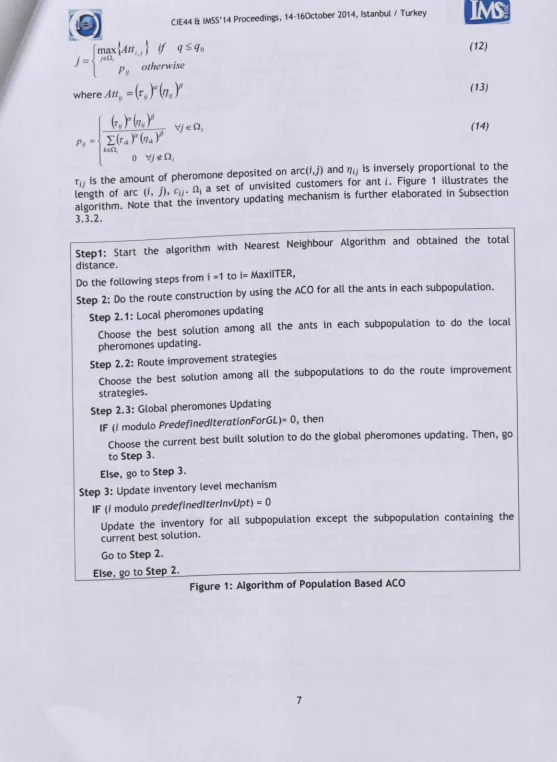
a set of unvisited customers for ant i, Figure 1 illustrates thealgorithm. Note that the inventory updating mechanism is further elaborated in Subsection 3.3.2.
(14)
Step1: Start the algorithm with Nearest Neighbour Algorithm and obtained the total distance.
Do the following steps from i =1 to i= MaxiiTER,
Step 2: Do the route construction by using the ACOfor all the ants in each subpopulation. Step 2.1: Local pheromones updating
Choose the best solution among all the ants in each subpopulation to do the local pheromones updating.
Step 2.2: Route improvement strategies
Choose the best solution among all the subpopulations to do the route improvement strategies.
Step 2.3: Global pheromones Updating
IF (i modulo PredefinedlterationForGL)= 0, then
Choose the current best built solution to do the global pheromones updating. Then, go to Step 3.
Else, go to Step 3.
Step 3: Update inventory level mechanism IF (i modulopredefinedlterlnvUpt) = 0
Update the inventory for all subpopulation except the subpopulation containing the current best solution.
[image:11.566.2.559.22.784.2]Go to Step 2. Else, go to Step 2.
Figure 1: Algorithm of Population Based ACO
ClEM & IMSS'14 Proceedings, 14-160ctober 2014, Istanbul/Turkey
3.2.1 Local Pheromones Updating
Local updating is used to reduce the amount of pheromone on all the visited arcs in order to simulate the natural evaporation of pheromone and it is intended to avoid a very strong arc being chosen by all the ants. After each of the ants in every subpopulation has built the solution the best built solution from each subpopulation will be selected. Then, the local updating will be done on each arc of the best solution from each subpopulation by using equation (15).
(15)
Tij
=
(1- p)Tij+
(P)Towherep represents the rate of pheromone evaporation.
3.2.2 Global Pheromones Updating
After a predefined number of iterations, the current best solution
r"
among all the subpopulations is selected and its routes are used as a reference for the global pheromones-updating for all subpopulation. Hence, the pheromones value for each arc of the best solution is updated by using the equation (16) for all the subpopulations. The global pheromone-updating rule resets the ant colony's situation to a better starting point and encourages the use of shorter routes. Moreover, it increases the probability that future routes use the arcs contained in the best solutions. In the classical ACe, only the transportation cost is taken into account in the global updating. Since the IRPtries to find a balanced between the transportation and inventory cost, it is natural to incorporate the inventory holding cost in the formulation. The global update rule is enhanced as follows:T" - (1- p)r,' +L(i j) Eygl lJ - tl iyo! '
(16)
wherefyo! is the weight of the best solution found where it incorporates the inventory element as well as the variable transportation costs and is given by
fyo!
=
L LhJi/
+V(L L. LCijXijl
+L LCiOXiO/1
lET ieS tet}eSleSuW tatleS )
(17)
3.2.3 Route improvement strategies
The routes can be further improved by adding route improvement strategies in the route construction procedure. In this study, there are three local searches: swap 2 - opt: and 2
-opt are applied to improve the solution built by ACe. '
Swap
The fi,rst local search is the swap algo~ithm focusing on the split customers and they compnse of a tran,sfer to the s~lected vehicle or a swap between different vehicles. Starting from the last vehicle, the split customer is identified and we try to merge tl t d hi l if h ' ' 0 the current se,ec e ve 1C e I t e respectivevehtcle capacity is not violated. If this fails, then the swap WIth th~ other customers from t~e preceding vehicle or to the current selected vehicle that results, 10 the least transportation cost IS carried out' " . If none of the swap provl es anid
Imp~?vemen~'lmIItheh,0lbJe~tIVevalue, than the route remains unchanged. The process cO,n~nuesun I a ,ve 1Ces10 every period have been examined. The aim of this method is to el1~1O~tethe split customers (merge as many as possible) if the merged impr d th
objective value. ave e
2-opt*
Weapptied 2 - opt' [18] heuristic as inter route optimization procedure. The purpose of tht
improvement in the objective function can be attained. The heuristic calculates the distances for all pair wise permutations and compared those distances with the current solution. If any of these solutions is found to improve the objective function, then it
replaces the current solution.
CIE44
a
IMSS'14 proceedings, 14_16October 2014, Istanbul/Turkeyz-oot
2 _ opt [15) heuristic which is an intra-route optimization procedure is utilized to improve the route within the same vehicle. The implementation is slightly different from 2 - opt',2 _ opt test on all possible pair wise exchange within a vehicle instead of between vehicles to see if an overall improvement in the objective function can be obtained. The current
solution is replaced if the improved solution is better.
3.3 Updating Inventory Level
After the predefined number of iterations, the inventory updating mechanism will be initiated. We propose tWOtypes of transfers, the forward and backward transfers to update the inventory level. The selection of the forward and backward transfer is controlled by a random number but the emphasis is more towards the forward transfer. The selection of period is done randomly but we experiment tWOways of selecting the customer to transfer their quantity delivery based on the predefined number. If the current number of iteration is less than the predefined number, then the customer will be selected randomly. Otherwise, the customer who fulfilled the conditions (highest and lowest inventory holding cost for the forward and backward transfer respectively) will be selected. We observed that implementing a combination of randomly generated and deterministically generated customers allOWthe ants to have more explorations at the beginning of the iterations.
In our first algorithm we observe that the algorithm is more likely to give savingsin term of transportatiOn costs instead of inventory. We modified the algorithm such that the inventory updating is based on the pheromone value of each customer. The following equation is used to update the pheromonesof customer's inventory for customer j in period p, invpherjp:
invpherjp ~ (1- p). (invpherjp)
+
P' ~: (18)OJ,is the quantity delivery of customer j in period P while C'j is the distance between the customer Iand) for the routmg of the current best solution andp represents the rate of
pheromone evaporatlonas defined earher. The second element of equation (18) spe T
that if the ratiO of the delivery quantity of the respective customer to its distance is hC~les then higher pheromone value will be allocated. The selection of c., for local and 19l ber'l
. . d. d . d·l· h f IJ goa
Inventory 1S 1SCUSSem more etai sIn t e ollowing subsections.
3.3.1 Local pheromones updating
of
customer's inventoryFor the local inventory updating the c·· value is taken from the btl·. .." es soutton a ter somef
predefmed number of Iterations. Note that the predefined number of iterations is smaller
than the predefmedtb t l t. value of the overall mventory updatingf f . . . The purpose 0f·selectmg the
curren es so u JOna ter a ew 1teratlOns instead of selecting th b t f l
built solutions is to avoid the customer with strong customer's in~e ets ro~ aIthe current chosen all the time by all the subpopulations. n ory p eromones bemg
3.3.2 Global pheromones updating
of
customer's inventoryA slightly differentd ti Th. mechanism is used in selecting the value of
vu
for thegotobatal Inventoryiup a mg. e value of Cij 1S selected from the current best l .
solution is chosen among all the current built. The aim of thi
.te
utton. The current bestselect the best amount of quantity delivery to be carrinedSfs ep h1Stoor t e customer.guide the .ants toFigure 2
(<!laD
CIE""a
'MSS'".,,,,.,d',,,,,,
1.-"Octob" 201., ''',"00' J Turkey ~illustrates the algorithm for the process o~ invent~ry updating. Note that
predefi nedlter/ nvUptGL<predefi nedlterlnvUpt<Predefl nedl teratlonF orGLp,and
pre de finedI ter InvUpt PredefinedlterationForGLp =PredefinedlterationForGL
Figure 2: Algorithm of updating customer's inventory pheromones for the second modified algorithm of ACO
Continue with the route construction part. For i =1 to i= MaxilTER
Do the following steps after the route construction of ACO. IFi modulo predefinedlterlnvUpt = 0, then
IFi modulopredefinedlterlnvUptGL = 0, then
Choose the current best solution among all the built solutions.
Use the routing part of the best solution to update the customer's inventory pheromones (Global pheromones updating of customer's inventory)
Then, continue with the updating inventory mechanism. Else
Choose the best solution from PredefinedlterationForGLp solutions that have been
built.
Use the routing part of the best solution to update the customer's inventory pheromones (Local pheromones updating of customer's inventory)
Then, continue with the updating inventory mechanism. Else
3.3.3 Procedure
of
updating inventory level for each subpopulationAfter the customer's inventory pheromones have been updated, the algorithm proceeds to select the customer to undergo the transfer. As mentioned earlier, the mechanism of selecting customer is based on the random numb:r that has been generated but the priority is given to the customer based on t~e attra~tlOn. If rand?m value is less than certain predefined parameter, the customer with the highest attraction of inventory pheromones is selected to do the undergo the transfer. The attraction of customer's inventory pheromones for customer j in period p, Attlnvipin each subpopulation is calculated using the equation
Attlnvjp
=
(invPherjPt*
(l/ajp)W (19)Otherwise, the deterministic backward I forward transferring mechanism (highest and lowest inventory holding cost for the forward and backward transfer respectively) will be used to select the customer to update the inventory.
4 COMPUTATIONALRESULTS
CIE44 ft IMSS'14Proceedings, 14-160ctober 2014, Istanbul ITurkey
4.1 Data sets
_ . t d on 12 20 50 and 100 customers, and combination with different The algorithm I.SJes ~ 10 14 and 21. The coordinates for each customer is generated
number o! peno s, 'of
ioo
x 100. The coordinates of each customer for the 20 customer randomly In the. squa;:e existing 12 customer instance with additional 8 newly randomly instance compn~es t The same procedure is used to create the 50 and 100 customer ?enerated coor~17~. e;'cost for each customer lies between 0 and 10 while the demand for Instances. The 0 In I'Sgenerated randomly between 0 and 50. The vehicle capacity is 100. each of the customer4.2 Results and Discussion
. es we let CPLEX 12.4 run for a limited time 9000s (2.5 hours) in order to For ~ll the Inlstanc bound and the best integer solution. The results of ACOBF which ?btaln the d °t~er forward as well as backward transferring in the mechanism of updating ~mplement~evel eand results of ACOPher which implemented the customer's inventory Inventory shown in Table 1. The parameters for both ACOBF and ACOPher are set as
Pheromones are1 0 {3 - SO qo
=
0.9 P=
0.1, TO=
1/Lnn wereh Lnn IS t e. h tota l d'tstancef uows: a = . I -. I I. •
o . d from nearest neighbor algonthm. The values of a, {3 and qo are taken from Dongo
obtame , . . ACOPh .. .. II
»:»
8] Th Pheromones on customers s Inventory In er IS tmtta y set as d. 1 dip
et al.[. e LP
, l to 0 otherwise set asO. In both ACOBF and ACOPher, there are 5 subpopulations IS not equa,h bpopulation consIsts of 5 ants to, bUlttd so u Ion.l ti
and eac su
l 1 how the results of the population based ACO, ACOBF and the population based Ta~ eh tS'ncludes the inventory pheromones, ACOPher. Table 1 presents the best costs, the AC ~ a ~f vehicles, the CPU time, the lower bound and the upper bound (best integer nU~t'e~S) which are obtained from CPLEX. From Table 1, we observed that the gaps which is so lU1~ted as the ratio of the difference between the lower bound and the upper bound to c~ c~o~er bound, for all the solutions are greater than 10%. This ratio increases as the t e. ds and the number of customers increase. Thus, it is hard to justify the quality of the foe~~r bound obtained by CPLEX. This may due to the lower bound is really loose or the
upper bound is rather poor.
From the results show in Table 1 for both ACOBF and ACOPher, we note that the total costs f the data sets with 100 and 50 customers are less than the upper bound which means the ~lgorithm is able to obtain better results whe.n compared with the upper bound for 50 and 100 customer instances. However, both algorithms perform equally well for the small and medium instances and produced the gaps between the results and the best integer solutions that are less than 4.5 percent. The ACOPher perform better in 10 out of 14 instances.
5 CONCLUSION
The integration of inventory and transportation plays an important role in supply chain management. In this study we present the formulation of the model that consists of multi-products and multi-periods IRP as well as the development of a modified ACO to construct the routes. We design a population based ACO by segregating each subpopulation by the inventory level. We have constructed a modified global routing updating that includes some information on inventory. A new transfer/swap aims at split customers is also proposed. This is carried out in order to collapse some the vehicles and to reduce the overall transportation
cost.
A new inventory updating mechanism is also proposed where it takes into account the customers inventory in the local and global pheromone updating. The selection of customers for the transfer is based on the attraction. We found that, by including the selection based on the attraction, the results better in almost all instances.