University of Huddersfield Repository
Olszewska, Joanna Isabelle
MultiScale, MultiFeature Vector Flow Active Contours for Automatic MultipleFace Detection
Original Citation
Olszewska, Joanna Isabelle (2013) MultiScale, MultiFeature Vector Flow Active Contours for
Automatic MultipleFace Detection. In: Proceedings of the 6th International Conference on Bio
Inspired Systems and Signal Processing. BIOSTEC 2013 . Springer Verlag, Barcelona, Spain, pp.
429435.
This version is available at http://eprints.hud.ac.uk/id/eprint/17406/
The University Repository is a digital collection of the research output of the
University, available on Open Access. Copyright and Moral Rights for the items
on this site are retained by the individual author and/or other copyright owners.
Users may access full items free of charge; copies of full text items generally
can be reproduced, displayed or performed and given to third parties in any
format or medium for personal research or study, educational or notforprofit
purposes without prior permission or charge, provided:
•
The authors, title and full bibliographic details is credited in any copy;
•
A hyperlink and/or URL is included for the original metadata page; and
•
The content is not changed in any way.
For more information, including our policy and submission procedure, please
contact the Repository Team at: [email protected].
MULTI-SCALE, MULTI-FEATURE VECTOR FLOW ACTIVE
CONTOURS FOR AUTOMATIC MULTIPLE FACE DETECTION
Joanna Isabelle Olszewska
School of Computing and Engineering, University of Huddersfield, Queensgate, Huddersfield, HD1 3DH, UK
Keywords: Face Detection; Active Contours; Multiscale Snakes; Multi-Feature Vector Flow; Unsupervised Segmentation.
Abstract: To automatically detect faces in real-world images presenting challenges such as complex background and multiple foregrounds, we propose a new method which is based on parametric active contours and which does not require any supervision, model nor training. The proposed face detection technique computes multi-scale representations of an input color image and based on them initializes the multi-feature vector flow active con-tours which, after their evolution, automatically delineate the faces. In this way, our computationally efficient system successfully detects faces in complex pictures with varying numbers of persons of diverse gender and origins and with different types of face views (front/profile) and variate face alignments (straight/oblique), as demonstrated in tests carried out on several datasets.
1
INTRODUCTION
Automatic face detection (Wood and Olszewska, 2012) is a cornerstone task in processes such as face recognition and analysis.
In particular, active contours are a suitable ap-proach for face location and extraction in context of facial expression analysis (Lanitis et al., 2005) and facial animation generation (Hsu and Jain, 2003). In-deed, active contours are designed to automatically evolve from an initial position to the objects’ bound-aries by means of internal forces such as elasticity and rigidity and external forces computed based on image features (Olszewska, 2009). Therefore, active contours are continuous and smooth curves whose de-formability enables them to precisely delineate the shape of foregrounds such as faces.
However, the current methods using active con-tours to detect faces are usually only dealing with images containing one single foreground such as in (Hanmin and Zhen, 2008), (Kim et al., 2010), (Zhou et al., 2010); a simple background (Sobottka and Pitas, 1996), (Gunn and Nixon, 1998), (Vatsa et al., 2003); frontal views of face(s) (Yokoyama et al., 1998), (Perlibakas, 2003), (Huang and Su, 2004); or they are time consuming as they require template learning (Lanitis et al., 2005), (Li et al., 2006) or prior training (Bing et al., 2004).
Another important issue for automatic face de-tection using active contours is their initialization.
Indeed, some approaches use manual initialization (Gunn and Nixon, 1998), (Vatsa et al., 2003), or quasi-automatic one which requires one user-defined point (Tauber et al., 2005) or two end-points (Neuen-schwander et al., 1994), and thus are not fully auto-matic.
Automatic initialization techniques have been pro-posed in the literature and are usually based on the segmentation of the external force field as in the case of Center of Divergence (CoD) (Xingfei and Jie, 2002), (Charfi, 2010), Force Field Segmenta-tion (FFS), or Poisson Inverse Gradient (PIG) ini-tialization (Li and Acton, 2008). However, these approaches are limited to images with simple back-grounds. Other automatic methods use dense grids of boxes (Heiler and Schnoerr, 2005) or variations (Ohliger et al., 2010), but these techniques lead to the detection of groups of objects and not of distinct foregrounds. Some initialization techniques such as (Pluempitiwiriyawej and Sotthivirat, 2005) or (Ol-szewska, J. I. et al., 2007) are rather based on the object-of-interest movements, and therefore are not suitable in the case of static images.
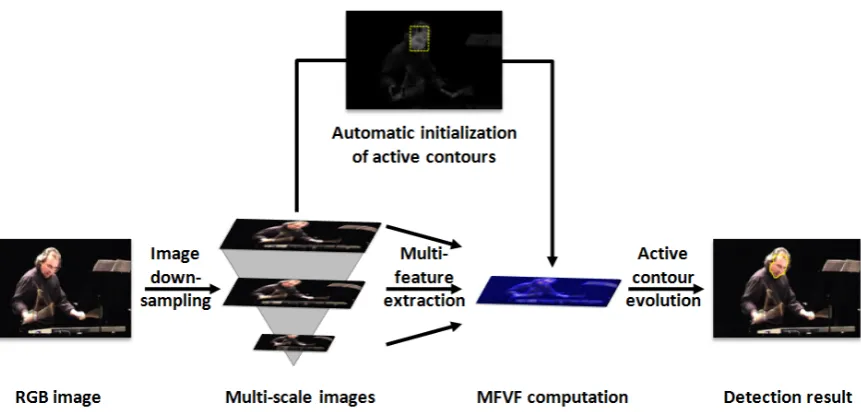
ellip-Figure 1: Overview of our automatic system of face detection based on multi-scale, multi-feature vector flow (MFVF) active contours.
tical foregrounds in an image, while those computing the interframe difference (Zhou et al., 2010), (Bajpai et al., 2011) are restricted to image sequences. Meth-ods relying on the symmetry test (Yokoyama et al., 1998) or facial feature tests (Sobottka and Pitas, 1996) are only suitable for single-face images and are not adapted to profile views.
Thus, we propose in this paper to develop an ac-tive contour technique for fully automatic detection of multiple faces of people from different origins and with diverse gender, photographed under differ-ent views such as profile or frontal ones and whatever their alignment (straight/oblique), given a static pic-ture.
For this purpose, we have applied the multi-feature vector flow method introduced by (Olszewska, J. I. et al., 2008) on multi-scale color images. In this way, the evolution of the active contours relies on fea-tures such as edges extracted from the original image and regions computed based on the scaled images.
We propose also an original automatic initializa-tion technique based on color and area-based criteria, whose major advantages are:
• robustness even if other body parts are visible, un-like skin-color techniques;
• robustness when other elliptical foregrounds are present in an image, unlike methods using ellipti-cal tests;
• compatibility with static images, unlike motion-driven approaches;
• robustness in case of complex backgrounds, un-like CoD techniques;
• robustness when faces are close to each other or occluded, unlike grid techniques;
• suitability for profile views of faces, unlike meth-ods relying on facial symmetry detection;
• online compatibility since no training is required such as in Viola-Jones-based approaches. Our multi-scale, multi-feature vector flow active contour method embeds the multi-target approach de-scribed in (Olszewska, 2012) to efficiently detect mul-tiple faces in complex-background images, while our approach developed for the automatic initialization of the parametric active contours involves the use of RGB color space representation of real-world pic-tures.
In summary, the contribution of this paper is two-fold. On one hand, we present a new active contour approach which involves a multi-scale, multi-feature vector flow leading to the computation of an efficient external field for a fast, robust, accurate, and auto-matic delineation of foregrounds. On the other hand, we introduce a new method for the automatic initial-ization of active contours. Our new multi-scale ini-tialization approach uses color and areas criteria and outperforms other state-of-the-art active contour ini-tialization methods in the case of multiple face detec-tion.
[image:3.595.84.515.91.297.2]delin-(a) (b)
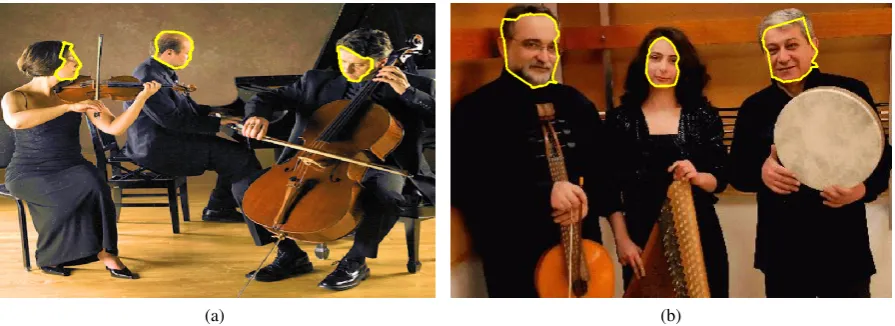
Figure 2: Our system’s performance in the case of multiple face detection in images with (a) mixed profile and frontal views; (b) variate elliptical foregrounds.
eates the multiple faces present in the processed im-age has been successfully tested on real-world pic-tures characterized by complex background, varying numbers of persons of diverse gender/origins and pre-senting frontal as well as slanting views with variate alignments, as reported and discussed in Section 3. Conclusions are drawn up in Section 4.
2
MULTIPLE FACE DETECTION
USING MULTI-SCALE ACTIVE
CONTOURS
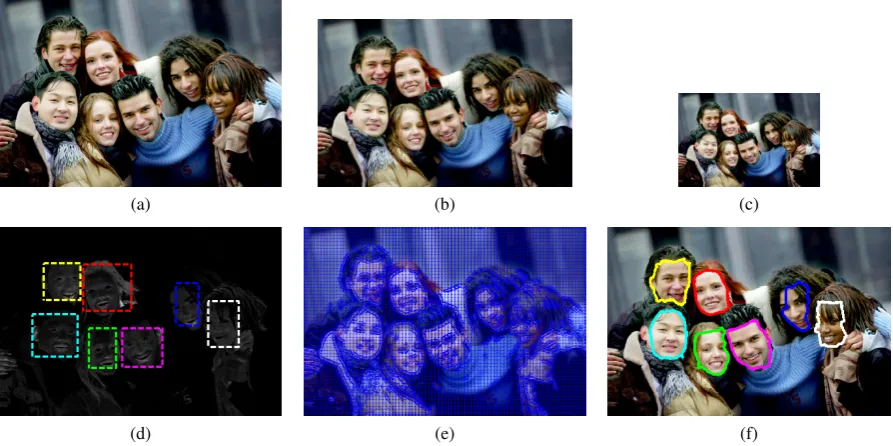
The multi-scale, multi-feature vector flow active con-tour approach consists first in their automatic initial-ization (Fig. 3 (d)) based on multi-scale representa-tions (Figs. 3 (a),(b),(c)) of the given image (Fig. 3 (a)) as explained in Section 2.1, while their evolution is guided by the Multi-Feature Vector Flow (MFVF) (Fig. 3 (e)) built on features such as edges and re-gions extracted from the original and the downsam-pled images, respectively, as detailed in Section 2.2. This method leads to the accurate delineation of each of the faces present in a given color image (Fig. 3 (f)), as described in Section 2.3.
2.1
Multi-Scale Active Contour
Initialization
Let us consider a color imageI(x,y)with M and N, its width and height, respectively, and RGB, its color space. Firstly, this image isn-times downsampled by applyingn(n∈N)different ratiosdn(0<dn≤1)to
get a set ofndownscaled imagesID={Idn}.
Secondly, in order to take into account the skin
color to pre-detect faces at each scale, the correspond-ingRnandGnchannels are subtracted to computen
imagesIRGnas follows:
∀Idn(Rn,Gn,Bn), IRGn=Rn−Gn. (1)
Then, an average imageIRGis computed based on
the rescaledIRGnimages. In order to compute the
ini-tialization maskIMASK,IRGis binarized usingTas the
threshold, leading to
IB(x,y) =
(
1 ifIRG(x,y)>T,
0 otherwise, (2)
and treated by morphological mathematical oper-ation as follows:
IMASK(x,y) =IB(x,y)•S, (3)
where• is the closing operation and S is a 3x3 square structuring element.
Next,bbounding boxes (Bb) are computed by
tak-ing the minimum and maximum values in x an y, respectively, of all the b (b∈N) candidate regions
Rb(x,y)⊂IMASK(x,y), such asRb(x,y)6=0.
Finally,minitial active contours are initialized us-ing thembounding boxesBm(withm≤b) validated
by the following area proportion criterion:
∀Bb(x,y), Bm=Bbi f ABOX>
AIMAGE
24 &ABOX<
AIMAGE
12 , (4)
with AIMAGE = M × N and ABOX =
|Bb(xmax)−Bb(xmin)| × |Bb(ymax)−Bb(ymin)|.
(a) (b) (c)
[image:5.595.75.522.96.319.2](d) (e) (f)
Figure 3: Our system’s performance in the case of multiple face detection in an image of a group consisting of several persons with diverse gender and origins: (a) original image; (b)-(c) downsampled images; (d) initial active contours; (e) multi-scale, multi-feature vector flow field; (f) final active contour results.
2.2
Multi-Scale Multi-Feature Vector
Flow Active Contours
In this work, the selected features are, on one hand, the edge mapf1computed as follows
f1(x,y) =|∇(Gσe(x,y)∗I(x,y))|
2, (5)
where
Gσe=
1 2πσ2eexp
−x
2+y2
2σ2e
, (6)
withGσe, an isotropic two-dimensional Gaussian
function with standard deviationσe.
On the other hand, the multi-scaleIRGnimages as
computed by (1) constitute the second type of features (f2) used in this work.
Once these features are selected, their associa-tion is ensured by the generic algorithm providing a unique multi-feature vector flow (MFVF)ΞΞΞ(x,y) =
[ξu(x,y),ξv(x,y)] vectorial field, and defined as a
weighted combination of theNF feature vector flow Ξ
ΞΞj(x,y)fields (Olszewska, 2009).
Each feature vector flow ΞΞΞj(x,y) =
[ξu j(x,y),ξv j(x,y)] is generated by minimizing
the following functional
εj=
ZZ
µj(ξ2ux j+ξuy j2 +ξ2vx j+ξ2vy j)
+ (fx j2+fy j2)((ξu j−fx j)2+ (ξv j−fy j)2)dxdy,
(7)
whereµjis the diffusion parameter and fjis
cor-responding to the jthadopted feature.
Hence, each of the multi-feature vector flow active contours, which is a parametric curve
CCC
(s):[0,1]−→R2, evolves from its initial position computed in
Sec-tion 2.1 to its final posiSec-tion, guided by internal and external forces as follows
CCC
t(s,t) =αCCC
ss(s,t)−βCCC
ssss(s,t) +ΞΞΞ, (8)where
CCC
ss andCCC
ssss are respectively the secondand the fourth derivative with respect to the curve pa-rameters;αis the elasticity;βis the rigidity; andΞΞΞis
the multi-feature vector flow (MFVF).
2.3
Multiple Face Detection System
Based On Parametric Active
Contours
close/occluding each other as proven in (Olszewska, 2012). Hence, the automatic and simultaneous detec-tion of all the faces is done quickly and precisely as demonstrated in Section 3.
3
EXPERIMENTS AND
DISCUSSION
We have tested our system by carrying out several experiments on image databases such asMusic En-sembleandGroup, running the MatLab software on a computer with an Intel (R) Core (TM)2 Duo CPU T9300 2.5 GHz processor, 2 Gb RAM, 32-bit OS.
The dataset calledMusic Ensembleconsists of 407 color images of different music ensembles ranging fromsolotooctetones, with c. 50 images per class. These images have an average resolution of 320x480 pixels and present real-world backgrounds as well as multiple foregrounds.
The datasetGroupcontains 593 color images pre-senting different groups of people from any gender and origins. Image resolution is around 500x330 pix-els. This dataset presents challenges such as multi-ple faces per view, mixed face views (frontal and pro-file ones) and varying (straight or oblique) face align-ments.
Examples of the results obtained using our method to detect multiple faces in images ofMusic Ensemble
andGroup datasets are presented in Figs. 2 and 3, respectively.
In the first experiment, we have assessed the per-formance of our automatic initialization method by computing the face detection rate defined as
detection rate = T P
T P+FN, (9)
with TP, true positive and FN, false negative. The ob-tained average face detection rate by our method has been reported and compared to state-of-art techniques in Table 1.
Table 1: Face detection rates.
(Harper and Reilly, 2000) (Huang and Su, 2004) our method
89% 91% 99%
We can observe that our method outperforms the state-of-art ones. Indeed, techniques like (Harper and Reilly, 2000) applying skin-color tests usually over-segment images, such as Fig. 2 (a), containing many visible body parts which are not only faces. Thus, these state-of-art approaches do not detect the exact number of faces, unlike our method. On the other
hand, methods such as (Huang and Su, 2004), which use the elliptical validation of the detected faces, fail e.g. in situations depicted in Fig. 2 (b), where ellip-tical objects of interest other than faces are present in the processed image, whereas in that case, our method successfully detects all the faces without being dis-turbed by any other round foreground such as the tam-bourine.
In the second experiment, we have measured the precision of our multi-scale, multi-feature vector flow approach in delineating the faces in Music Ensem-ble and Group image datasets, using the following MPEG-4 segmentation error (Se) metric
Se=
Nf n ∑ k=1
dkf n+
Nf p ∑ l=1
dlf p
card(Mr)
, (10)
where card(Mr) is the number of pixels of the
reference mask defined by the reference curve Cr
(groundtruth);dkf nis the distance of thekthfalse neg-ative pixels from the computed active contour to the reference curve with Nf n, the number of false
nega-tive pixels; and dlf p is the distances of the lth false positive pixels from the computed contour to the ref-erence curve with Nf p, the number of false positive
pixels.
The value of Se is in the range of[0,∞[, and the
smaller, the better. Our approach results as well as those of the state-of-art methods are reported in Table 2.
Table 2: Face delineation error.
(Vatsa et al., 2003) (Perlibakas, 2003) our method
0.11 0.10 0.01
It appears that the segmentation error of our method is much lower than those of other state-of-the-art methods. Hence, our method is accurate in both detecting and delineating multiple faces in color images.
Moreover, our method is ten to twenty-five times faster than (Vatsa et al., 2003) and (Perlibakas, 2003), respectively, and could thus be used to detect faces in image sequences as well as in static images, un-like state-of-art methods such as presented in (Bajpai et al., 2011).
4
CONCLUSIONS
images of persons with diverse gender and origins, whose faces are taken under different views such as frontal or profile ones and could have varying align-ments from straight to oblique ones.
Our developed system is based on parametric ac-tive contours whose innovaac-tive automatic initializa-tion is based on the set of downscaled images and ap-plies new validation criteria involving skin color and area information. The evolution of these active con-tours is guided by the multi-scale, multi-feature vec-tor flow mechanism which uses the original combi-nation of edges and regions extracted from the multi-scale representations of the processed color image.
REFERENCES
Bajpai, S., Singh, A., and Karthik, K. V. (2011). An exper-imental comparison of face detection algorithms. In Proceedings of the IEEE International Workshop on Conference on Machine Vision, pages 196–200. Bing, X., Wei, Y., and Charoensak, C. (2004). Face contour
extraction using snake. InProceedings of the IEEE International Workshop on Biomedical Circuits and Systems, pages S3.2.5–8.
Charfi, M. (2010). Using the GGVF for automatic initial-ization and splitting snake model. InProceedings of the IEEE International Symposium on I/V Communi-cations and Mobile Network, pages 1–4.
Gunn, S. R. and Nixon, M. S. (1998). Global and local active contours for head boundary extraction. Inter-national Journal of Computer Vision, 30(1):43–54. Hanmin, H. and Zhen, J. (2008). Application of an
im-proved snake model in face location based on skin color. InProceedings of the IEEE World Congress on Intelligent Control and Automation, pages 6897– 6901.
Harper, P. and Reilly, R. B. (2000). Color based video seg-mentation using level sets. InProceedings of the IEEE International Conference on Image Processing, pages 480–483.
Heiler, M. and Schnoerr, C. (2005). Natural image statistics for natural image segmentation.International Journal of Computer Vision, 63(1):5–19.
Hsu, R.-L. and Jain, A. K. (2003). Generating discrimi-nating cartoon faces using interacting snakes. IEEE Transactions on Pattern Analysis and Machine Intel-ligence, 25(11):1388–1398.
Huang, F. and Su, J. (2004). Multiple face contour detection based on geometric active contours. InProceedings of the IEEE International Conference on Automatic Face and Gesture Recognition, pages 385–390.
Kim, G., Suhr, J. K., Jung, H. G., and Kim, J. (2010). Face occlusion detection by using B-spline active contour and skin color information. In Proceedings of the IEEE International Conference on Control, Automa-tion, Robotics and Vision, pages 627–632.
Lanitis, A., Taylor, C. J., and Cootes, T. F. (2005). Au-tomatic face identification system using flexible ap-pearance models. Image and Vision Computing, 13(5):393–401.
Li, B. and Acton, S. T. (2008). Automatic active model ini-tialization via Poisson inverse gradient. IEEE Trans-actions on Image Processing, 17(8):1406–1420. Li, Y., Lai, J. H., and Yuen, P. C. (2006). Multi-template
ASM method for feature points detection of facial image with diverse expressions. In Proceedings of the IEEE International Conference on Automatic Face and Gesture Recognition, pages 435–440.
Neuenschwander, W., Fua, P., Szekeley, G., and Kubler, O. (1994). Initializing snakes. InProceedings of the IEEE Computer Society Conference on Computer Vi-sion and Pattern Recognition, pages 658–663. Ohliger, K., Edeler, T., Condurache, A. P., and Mertins,
A. (2010). A novel approach of initializing region-based active contours in noisy images by means of unimodality analysis. InProceedings of the IEEE In-ternational Conference on Signal Processing, pages 885–888.
Olszewska, J. I. (2009). Unified Framework for Multi-Feature Active Contours. PhD thesis, UCL.
Olszewska, J. I. (2012). Multi-target parametric active con-tours to support ontological domain representation. In Proceedings of the Conference on Shape Recognition and Artificial Intelligence (RFIA 2012), pages 779– 784.
Olszewska, J. I. et al. (2007). Non-rigid object tracker based on a robust combination of parametric active contour and point distribution model. InProceedings of the SPIE International Conference on Visual Communi-cations and Image Processing, pages 6508–2A. Olszewska, J. I. et al. (2008). Multi-feature vector flow for
active contour tracking. InProceedings of the IEEE International Conference on Acoustics, Speech and Signal Processing, pages 721–724.
Perlibakas, V. (2003). Automatical detection of face fea-tures and exact face contour.Pattern Recognition Let-ters, 24(16):2977–2985.
Pluempitiwiriyawej, C. and Sotthivirat, S. (2005). Active contours with automatic initialization for myocardial perfusion analysis. InProceedings of the IEEE Inter-national Conference on Engineering in Medicine and Biology, pages 3332–3335.
Sobottka, K. and Pitas, I. (1996). Segmentation and tracking of faces in color images. InProceedings of the IEEE International Conference on Automatic Face and Ges-ture Recognition, pages 236–241.
Tauber, C., Batatia, H., and Ayache, A. (2005). A gen-eral quasi-automatic initialization for snakes: Appli-cation to ultrasound images. InProceedings of the IEEE International Conference on Image Processing, volume 2, pages 806–809.
Wood, R. and Olszewska, J. I. (2012). Lighting-variable AdaBoost based-on system for robust face detection. In Proceedings of the International Conference on Bio-Inspired Systems and Signal Processing, pages 494–497.
Xingfei, G. and Jie, T. (2002). An automatic active con-tour model for multiple objects. InProceedings of the IEEE International Conference on Pattern Recogni-tion, volume 2, pages 881–884.
Yokoyama, T., Yagi, Y., and Yachida, M. (1998). Active contour model for extracting human faces. In Pro-ceedings of the IEEE International Conference on Pat-tern Recognition, volume 1, pages 673–676.