2017 2nd International Conference on Artificial Intelligence and Engineering Applications (AIEA 2017)
ISBN: 978-1-60595-485-1
Research on Resource Scheduling Strategy in
University Private Cloud
LING ZHANG and WANLI SONG
ABSTRACT
The emergence of cloud computing has brought new revolution for higher vocational education. Network virtualization based on cloud technology leads to tremendous innovation of the traditional teaching model and diversified web virtual teaching can be achieved by the use of virtualization technology. Moreover, private cloud in school could effectively implement open teaching and research work and make up for the shortage of facilities as well as reduce the working strength of school operation. Existing learning system has been perfected by virtualization technology. As an application of cloud computing, private cloud in school needs to deal with huge amount of data, and meet the high demand for resource scheduling. In this paper, the cloud computing technology based on the study of resource scheduling algorithm is researched; the feasibility of ant colony algorithm applied to cloud task scheduling is analyzed; the basic strategy for resource scheduling algorithm in cloud environment is proposed; the training of cloud system with high availability and load balancing is worked to be implemented. This work may provide some useful ideas for further research.
KEYWORDS
Private Cloud, Virtualization, Resource Scheduling, ACO Algorithm.
INTRODUCTION
University private cloud is a typical application of cloud computing under the environment of higher education. It can simulate an environment which is similar to the environment of commercial cloud computing and build its own private cloud by the use of open source cloud platform. With the existing and future infrastructure, own private cloud could be deployed by the use of open source cloud platform. This private cloud can be deployed inside the firewall, which would avoid some potential security exposure during the process of transferring data to the third party data center. At the same time, school can provide students with platform service, resources service and process services through cloud environment. But, resource scheduling is always a key point and problem of building private cloud, which is directly related to the stability of system, the resource utilization as well as the Quality of Service of users. However, the resource scheduling system and the method of support exists in present cloud computing is unfit to private cloud environment. In this paper, a resource scheduling model and algorithm will be proposed based on the characteristics of university private cloud.
_________________________________________
ANALYSIS OF PRIVATE CLOUD RESOURCE SCHEDULING PROBLEM
The completion time, resource utilization, quality of service as well as load balancing are the performance index to evaluate task scheduling algorithm of cloud computing. The target of task scheduling of cloud computing is to make the cloud computing system run better, and to improve the overall throughput while guaranteeing the smooth execution of user tasks. Cost, performance and Qos- those are the primary considerations of the current research contents of resource scheduling, which mainly existing in the environment of cloud are computing. It is difficult to find a general method to meet the specific requirements of users in the traditional environment of cloud computing. But there are some merits like centralized management and scheduling, load balancing, no task priority and high execution rate in the resource scheduling of university private cloud.
Since loud resource scheduling is a NP-hard problem, traditional algorithm and heuristic intelligent algorithm are commonly used. Traditional algorithm is not suitable for cloud resource scheduling for it doesn’t take resource utilization and Qos into consideration. But heuristic intelligent algorithm includes Genetic Algorithm, Ant Colony Optimization, Particle Swarm Optimization, Simulated Annealing, Tabu Search and so forth. Of all the Heuristic Intelligent Algorithm, Ant Colony Optimization discussed in this article has the qualities of global convergence, parallelism, high positive feedback and solving efficiency, it also has advantages in solving distributed problems.
RESOURCE SCHEDULING MODEL
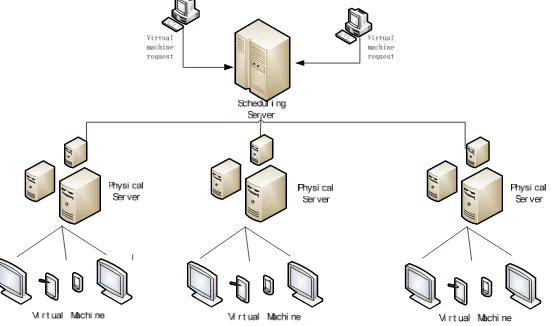
[image:2.612.160.436.506.669.2]In the cloud computing model, computing resource expanded as needed, flexible scheduling and deployment is to meet the requirements of load balancing. With the increasing of visits, some servers are over loaded, while some are in idle state, load balancing is to distribute load to every server evenly. Resource scheduling is key of the load balancing system, it can achieve the migration of virtual machines to meet the requirement of load balancing. Compared with public cloud, the resource.
Scale and user requests of university private cloud are limited, thus centralized scheduling model is reasonable to be used. No load bottleneck emerges while task execution efficiency is guaranteed. At the same time, the requests are finally distributed to many physical nodes, which achieves the extension and error-tolerant capability of data centers. Set figure 1 as the architecture of university private cloud: cloud resource scheduling server is at the top to dispatch all physical servers. Its main work is to arrange proper order for virtual machines in queue with the principle of “first come, first served.” Physical servers are also called compute nodes, they are composed of high-performance server or server cluster, and customers can visit all the virtual machines running in the physical servers through Internet.
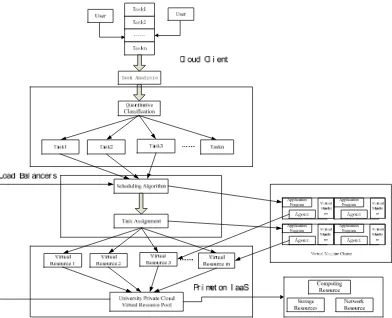
Figure 2 is the resource scheduling model of university private cloud. It is logically split into Cloud Client, Load Balancers and Primeton IaaS. 1) Through Cloud Client, private cloud users can transfer tasks to the model, get the request of users and get services quantified and classified. On the basis of task type, degree of urgency as well as resource requirement, pushing the tasks into task queue in the load balancer to get scheduled. 2) Load balancer mainly completes task scheduling, collects load information like resource metrics and conditions of load execution. By the calculation and analysis of various resources, load balancer would evaluate the load condition and utilization of cluster. According to the results of the evaluation, load balancer would give task request to selected virtual machine in virtual machine cluster. 3) Cloud resource management platform includes virtual machine cluster and resource pool, its main job is to complete the management of virtual machine. The platform integrates all resources and build virtual machine by the use of cooperative deployment device. The platform receives the executive instructions from the load –balancer to complete the construction, startup, shutdown and restart of virtual machine.
Figure 2. Frame of Resource Scheduling Model of University Private Cloud.
Advantages of Ant Colony Algorithm, a scheduling strategy which can realize load balancing and maximum utilization of resources can be made. Ant Colony Algorithm is a simulation of the food-seeking behavior by ants, it has good self-organization, robustness, outstanding positive feedback, superior parallel processing capability as well as the capability of easily being combined by other algorithms. Moreover, it has high efficiency to solve TSP problem. But Ant Colony Algorithm needs to be optimized when it faces the problem of resource scheduling of university private cloud.
OPTIMIZED ANT COLONY SCHEDULING ALGORITHM
Basic Idea of Algorithm
Under the environment of university private cloud, the dynamic migration of virtual resources should be realized to guarantee the scheduling of system resources and the completion of tasks. This article mainly discusses pheromone updating and ant colony scheduling in the optimization of Ant Colony Algorithm. Pheromone model is the basis of algorithm, its main job is to monitor the load condition of the whole system. In the scheduling of ant colony, ants prefer the nodes with high pheromone concentration, so giving high pheromone to low load nodes can induce ant colony to transfer to nodes with low load to achieve load balancing of the system.
Pheromone Update Strategy of Ant Colony Algorithm
Pheromone update strategy is the key factor for the execution of Ant Colony Algorithm. The response of pheromone to the load status of system will directly influence the task scheduling of ant colony. As the basis of resource scheduling of Ant Colony Algorithm, the main job of pheromone model is to monitor the load status of virtual machine. Assume the pheromone on the virtual machine VMi updates to =1 , is the load condition of the virtual machine VMi, that is, the CPU utilization rate of VMi. Thus, is a decimal between 0 and 1, the higher value of means the lower value of . for the overloaded virtual nodes, the value of pheromone is assigned to 0. The probability of the target nodes being selected is decided by pheromone concentration, so the higher load of the nodes means the lower possibility of being selected, and the overloaded or disabled nodes would never be scheduled, pheromone model would get updated continuously. Meanwhile, to avoid the locally premature convergence of the system, MMAS can be taken to solve this problem. MMAS restricts the value of pheromone on ants’ search trajectory between τ ,τ , which can reduce the possibility of search stagnation while the optimality of the algorithm is improved.
Defining Tmax and Tmin. MMAS restricts pheromone on the search trajectory within τ ,τ . Every pheromone will fit τ t ∈ τ ,τ .Every time a cycle is completed, pheromone increment should follow this principle: if τ , then τ t τ , if τ t τ , then τ t τ . The locally premature convergence of the system can be avoided by the determination of the boundary of pheromone trajectory. In addition, assume as the highest pheromone increment on the iterative path, when it comes to the optimum solution of the update, τ and τ should be updated, and τ is proportional to pheromone volatilization factor and . It can be seen that the setting of τ and τ is very important. Firstly, initialize the pheromone concentration to get its maximum, after the algorithm is activated, on the basis of the reduction index of Pheromone Volatilization Coefficient when one iteration is completed, algorithm can be dynamically adjusted with the following method:
①before the update of pheromone
τ t τ t 20 (2)
②after the update of pheromone
τ t 1 2 1 ρ ∗ (3)
Assume that at the t moment, the pheromone concentration of VMi isτ t , so at t+1 moment, the pheromone concentration of VMi is
τ t 1 1 ρ ∗τ t ∆ . (4)
∆ Can represent the path research of single ant and the ant colony, which corresponds to local pheromone update and global pheromone update. The best resource scheduling strategy can be figured out if the optimal path is the update of global pheromone.
Algorithm Scheduling
Pheromone Initialization
At the initial time of the system, place the ants on the virtual machine in the private cloud randomly, and get the performance parameter, number of processorsC. num, the handling capacity of each processor C. mips, as well as network bandwidthbandwith. Based on these parameters, the pheromone of each virtual machine would be initialized, formula for calculation is as follows:
τ 0 C. num ∗ C. mips bandwith (5)
In this formula, C. num is the number of processors of VMi, C. mips is the processing speed of each processor, bandwith is the communication bandwidth of virtual machine VMi.
Probability of Ants Transfer
Ants choose the next virtual machine through the calculating of pheromone concentration and load factor. At the t moment, the probability of the ant k choosing virtual machine i to perform the next task can be calculated as follows:
p
τ αη β
∑ τ αη β , if 1 i, n m
0 , otherwise
(6)
Step1, initialize the pheromone of virtual machine in private cloud by referring to formula (5)
Step2, put an ant in one virtual machine randomly
Step3, According to formula (6), every ant would choose a virtual machine to execute the next task
Step4, if the search task has been completed and a solution has been found, then local pheromone in all virtual machines on this search path should be updated by referring to formula (4)
Step5, if the ant colony has completed all search tasks in a cycle, execute step6 and find the optimal path in current iteration, then update global pheromone in all virtual machine. Otherwise, execute step3.
Step6, cycle times plus one, then get the optimal solution of the current interaction.
Step7, judge the ending condition, if maximum cycle times has been reached, finish Ant Colony Algorithm and output optimal result. If not, continuously repeat step2 until the termination condition is reached.
ACKNOWLEDGEMENTS
This work was partially supported by the following research grants:
(1)No.2016-R-49047 from the subject of modern educational technology research in Jiangsu Province, 2016(key topic);
(2)No.CESEZ2016-75 from the Teaching research project of computer major in China Electronic Education Association, 2016;
(3)No.2017-R-53084 from the subject of modern educational technology research in Jiangsu Province, 2017;
(4)No.BM2013123 from the Jiangsu Engineering Research Center for Networking of Elementary Education Resources
Corresponding author: Wanli Song, Nanjing Xiaozhuang University, Nanjing, 211171, China.
REFERENCES
1. Dorigo M., Maniezzo V., Colorni A. The ant system: optimization by a colony of cooperating agents
[J]. IEEE Transactions on SysteVMi, Man, and Cybernetics1996, 26: 29-41.
2. Hong Lu, Analysis of University Private Cloud in Vocational Education [J]. Software and
Application of Computer, 2013(6): 97, 99.
3. Jianguo Xi. Vehicle Routing Problems Based on Max-Min Ant Colony Algorithm [J]. Journal of
Shandong Jiaotong University, 2007(2): 19-22.
4. Jidong Zhao. The Study of Strategies to Improve Ant Colony Algorithm [J]. China Science and
Technology Information [J], 2012(12): 149 -150.
5. Yinghua Zha. Improvement of the Application of Ant Colony Algorithm in Task Scheduling Of