2017 2nd International Conference on Computer Engineering, Information Science and Internet Technology (CII 2017) ISBN: 978-1-60595-504-9
Multi-Features Group Emotion Analysis Based on
CNN for Weibo Events
SHUMIN SHI, MENG ZHAO, JUN GUAN and HEYAN HUANG
ABSTRACT
With the development of social network, group emotion analysis on social media such as Facebook, Twitter and Weibo becomes a new trend in recent years. Many different methods have been proposed for group emotion analysis, including traditional methods like SVM and NB and deep learning methods like RNN and CNN. This paper proposes a CNN model with multi-features. We first analyze the characteristic of weibos to collect features including basic features, user-based features and content-based features. We introduce these features to our CNN model to analyze emotions for Weibo events, which has been proved in experiment that it is effective to get the accurate sentiment of weibos. We crawl 5,319,687 weibos about 724 events from Sina Weibo and apply several feature matrices to classify them to 4 types. We use the new model to analyze 4 kinds of events to get the group emotion. The results suggest that the classification we suggested can capture the emotions within different event group.
KEYWORDS
Social media, Sentiment analysis, Group emotion, Deep learning, Convolutional neural networks.
INTRODUCTION
With the development of Internet, social media has become an important part of people’s social life, the media such as Weibo, Tieba, Zhihu are used to exchange options and ideas. The amount of information that generated and shared through these platforms yields unprecedented opportunities to study millions of individuals’ daily lives and their response to social events. The information is valuable people’s response to some events or policy announcement. Group emotion over large scale has big influence on someone’s decision, and it can even change a policy and determine the result of an election. Some massive societal disturbances caused by group emotion have been becoming a serious problem worldwide. More and more experts start to study group emotion and try to obtain more insights about the relationship between people’s emotion and their impact on social events.
_________________________________________
Shumin Shi, [email protected], and Heyan Huang, [email protected], School of Computer Science and Technology, Beijing Institute of Technology, Beijing 100081 China; Beijing Engineering Research Center of High Volume Language Information Processing and Cloud Computing Applications, Beijing 100081, China.
So, first of all, it is necessary to introduce the definition of group emotion. Group emotion might be looked upon in a top down or, "the group as a whole" perspective, meaning that an emotional entity is influencing factors such as the individual members' emotional state. However, a different perspective would look upon the issue in a bottom up or, "the group as a sum of its parts" angle, which would assume that the individuals' affective states combined make up for the emotional status of the group as a whole. In this paper, we’d like to choose the bottom up way, meaning that we treat group emotion as the sum of the individuals' emotional states.
In this study, our aim is to reflect more believable emotion experiences of individuals in social situations. So we take Weibo as scenario, and explore the complex dynamics intertwining sentiment on Weibo to analyze group emotion. In order to achieve our goals, we utilize deep learning algorithm to analyze sentiment. Then we summarize the result to get group emotions.
The rest of the paper is structured as followed: We introduce related work in Section 2. Then in Section 3, we analyze the features of weibos data, and introduce these features to the CNN model in Section 4. We apply our method to get and analyze group emotion in Section 5. Finally the conclusion and the future work are given in Section 6.
RELATED WORK
The research on group emotion is a very valuable field in natural language processing (NLP). Schramm, a German, used the method of communication science to establish a relatively complete system of group and interaction in 1960 [1]. In 2010, Gryc et al. who belongs to Oxford University proposed a method of mining the orientation of text in the blog community [2]. They analyzed the orientation about Obama through 2.8 million texts in blog community which are posted by 16741 users, and treated the partition of blog community as one of characteristics of classification of the users’ orientation. Also in 2010, Zafarani et al. in Arizona State University researched the diffusion of orientation in LiveJournal social network data set and measured the orientation of diffusion [3]. Xu et al. in City University of Hong Kong analyzed the orientation of text and then found the groups who had the same orientation with the method of community discovery in 2011 [4]. At the same time, Bollen et al. in Indiana University researched Twitter and proposed that users may influence people who have a relationship with them, which leads that they will have the same or similar emotion [5]. What’s more, Aoki et al. in Tokai University utilized representation method of vector to modeling multi-sentiment in 2011, while their method was based on emoji without the information of content [6].
FEATURE ANALYSIS
classification, which contains the number of word, the number and the type of emoji and if there are vulgar speech. Besides, the basic features, always used in traditional methods, are also important. Word feature and syntactic feature are basic features which we will use in our experiment. In this paper, from labeled corpus, we randomly select 5000 positive weibos, 5000 negative weibos and 5000 neutral weibos for analysis. We analyze the differences between the three categories in order to select the most effective features.
Basic Features (BF)
WORD FEATURE
Word feature is one of the most popular features for classification. In this paper, we use Random Decision Forests (RDF) to select words as word feature. We finally chose 750 words in experiment.
SYNTACTIC FEATURE
Syntactic feature is the kind of features exacted based on the word structure in the original sentence. In order to get syntactic parsing tree of texts, we utilize Stanford Parser to analyze the texts. Than we can get rewriting rule and syntactic tag from the tree which we treat as syntactic feature.
User-based Features (UF)
THE HISTORICAL CHARACTERISTIC OF USERS
There has been effective achievement about utilizing users’ historical information for classification. Tang [7] proposed a new model named “User Word Composition Vector Model (UWCVM)” that transforming users’ historical information into vector and matrix so as to introduce them into CNN model. It is proved through their experiment on Yelp13 and RT05 that users’ historical information is significant for sentiment classification. So we choose the information to be a feature in this paper.
THE NUMBER OF FOLLOWER AND FOLLOWEE
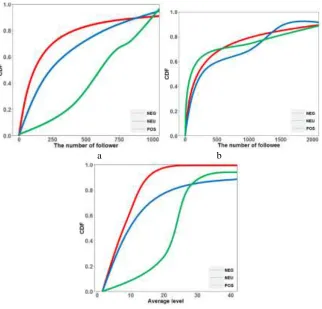
In order to analyze the user-based features more obviously, cumulative distribution function (CDF) is introduced in Fig. 1. In Fig. 1, (a) and (b) analyze the different number of followers and followees between users who post positive, negative or neutral weibos. It illustrates that most users who have lots of followers produce less negative weibos than the others, and the reason maybe that these people must pay attention to their own public image. However, the number of followees is useless for us because of the similar curve of three kinds of weibos, which means that we are not able to distinguish one type form the others only through the number of followee.
THE LEVEL OF USERS
a b
[image:4.612.138.460.53.362.2]c
Figure 1. CDF of user-based features.
Content-based Features (CF)
VULGAR SPEECH
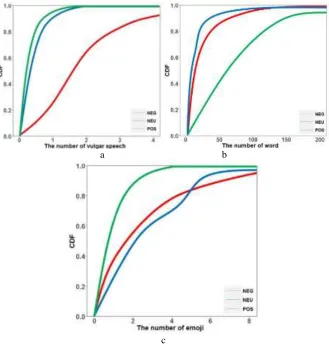
In social media, people can say everything they want without supervision, which leads to so many vulgar speeches, such as “屌丝” (loser) and “他妈的” (damn it). As we can see in Fig. 2 (a), there is hardly any vulgar speech in positive and neutral weibos while negative weibos are always accompanied by it. It is obvious that we can treat vulgar speech as a unique characteristic of negative weibos.
THE NUMBER OF WORD
In Fig. 2 (b), we find that most of positive and negative weibos are less than 100 words while neutral weibos has no regular pattern. This is because that people usually express their emotions in short text, and most of news which are neutral always have more words.
THE NUMBER OF EMOJI
a b
[image:5.612.134.463.53.398.2]c
Figure 2. CDF of content-based features.
EXPERIMENT
Dataset
We crawl weibos from Sina Weibo from January 2016 to April 2017 and finally get 5,319,687 weibos in total. We asked three annotators to label 30000 weibos. They need to judge if a weibo is positive, negative or neutral. If there is a disagreement between the three annotators, we ignore these weibos. We randomly select 5000 weibos from every category as training data. And another 5000 weibos as test data.
MULTI-FEATURE GROUP EMOTION ANALYSIS BASED ON CNN
In machine learning, CNN is a class of deep, feed-forward artificial neural networks that has successfully been applied to analyzing visual imagery and also in nature language processing. CNN use a variation of multilayer perceptrons designed to require minimal preprocessing. They are also known as shift invariant or space invariant artificial neural networks (SIANN), based on their shared-weights architecture and translation invariance characteristics.
In this paper, we introduce some features described above to a CNN model. We use the features to represent weibos and treat them as the input of the CNN model. Then we can get results through the network. And it has been proved through experiment that the CNN model works more effectively than other state-of-the-art methods.
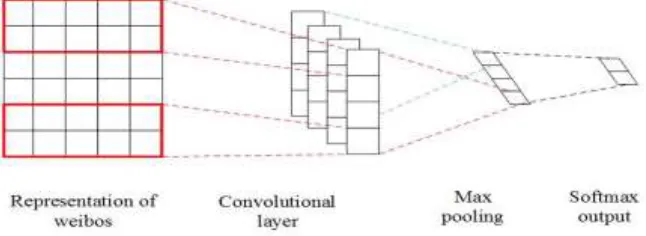
The architecture of the CNN model is shown in Fig. 3. We first collect features as we described in Section 3 from training data and utilize the features to get the representation of weibos, and then introduce it as the input to the CNN model. Through the convolutional layer and pooling layer we can get the final result.
Baselines
NB (NAIVE BAYES)
NB is a common technique for constructing classifiers: models that assign class labels to problem instances, represented as vectors of feature values, where the class labels are drawn from some finite set using Bayes' theorem. All Naive Bayes classifiers assume that the value of a particular feature is independent of the value of any other feature given the class variable. A naive Bayes classifier considers each of these features to contribute independently to the probability.
SVM (SUPPORT VECTOR MACHINES)
[image:6.612.134.457.590.708.2]In machine learning, SVM is a supervised learning model with associated learning algorithms that analyze data used for classification and regression analysis. An SVM training algorithm builds a model that assigns new examples to one category or the other, making it a non-probabilistic binary linear classifier. An SVM model is a representation of the examples as points in space, mapped so that the examples of the separate categories are divided by a clear gap that is as wide as possible. New examples are then mapped into that same space and predicted to belong to a category based on which side of the gap they fall. In addition to performing linear classification, SVM can efficiently perform a non-linear classification using what is called the kernel trick, implicitly mapping their inputs into high-dimensional feature spaces.
Experiment and Results
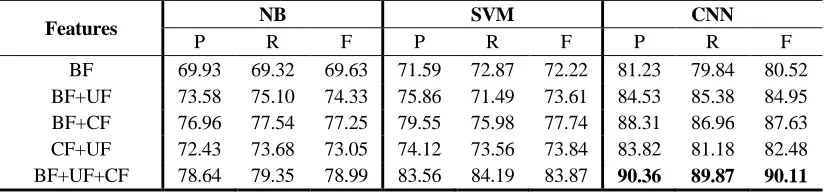
As for each model, we use the same evaluation metrics (precision, recall and F-measure). As we can see in Table 1, CNN model achieves the best F-measure with all three features, which indicates that the features we choose are good contribution to our model.
What’s more, the combinations of multi-features can always work better compared with the single feature, which illustrates that each feature has a positive effect on the classification. Compared with user feature, content feature is more effective. In the next experiment, we will use the model to analyze group emotions.
GROUP EMOTION ANALYSIS FOR EVENTS
Experiment
[image:7.612.92.504.444.542.2]In this paper, we mainly study the group emotions based on events. So in the beginning, according to the 724 different events which occurred from January 2016 to April 2017, we crawl 5,319,687 weibos from Sina Weibo. It is obvious that there are some useless weibos which generated by some cybermob. Cybermobs according to Urban Dictionary and Defining refer to “persons acting in cyberspace as to hold someone accountable for a real or imagined misdeed or social faux pas and join together to humiliate or manipulate via the Internet” [8]. Cybermob always spreads negative sentiment without any reason, they will influence the accuracy of our experiment badly. Fortunately, Xinyu Zhou proposed a method to identify suspected cybermob in 2016, which we can use to delete the weibos which posted by cybermob [8]. After this work, we have 4,198,534 weibos remain.
TABLE 1. RESULTS OF DIFFERENT MODELS WITH DIFFERENT FEATURES.
Features NB SVM CNN
P R F P R F P R F
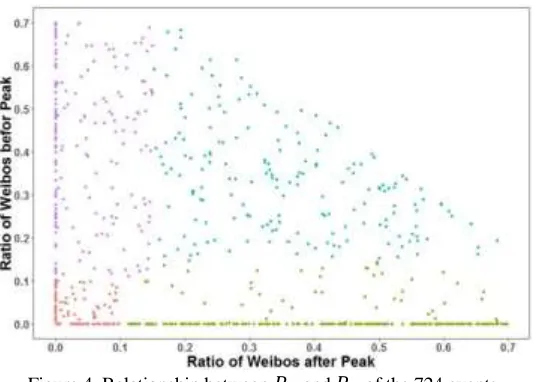
Figure 4. Relationship between 𝑅𝑏 and 𝑅𝑎 of the 724 events.
In order to analyze these events clearly, we learn some methods from Kwak et al. who has a previous studies that aimed at finding how many types of different conversations occur on Twitter [9-10]. We first find the day which exhibits the maximum number of weibos about the event, we call it “Peak”. Then we can characterize our discussions according to three features: the ratio 𝑅𝑏 of weibos
produced before its peak, the ratio 𝑅𝑑 of weibos produced during the peak, and finally
the ratio 𝑅𝑎 of weibos produced after the peak. Fig. 4 is the relationship between 𝑅𝑏
and 𝑅𝑎 of the 724 events which we have crawled, we can simply find the differences
between the events and classify them to 4 types: 164 continuing events (blue), 246 unexpected events (green), 212 expected events (purple) and 102 transient events (red).
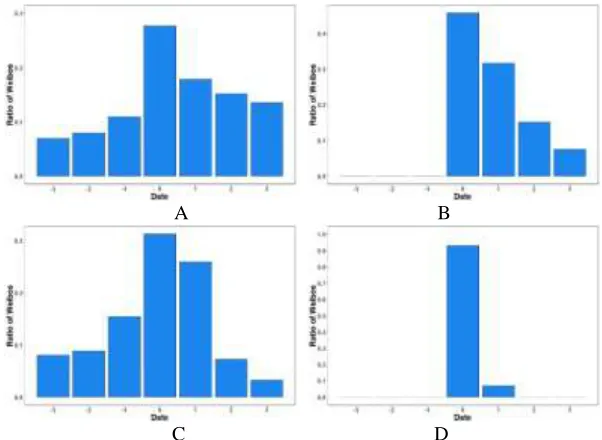
We use the point in the Fig. 4 to distinguish the events. In order to know the process intuitively, we choose 4 typical events to do some further research. We set the peak-day as “0”, the three days before the peak as “-3”, “-2” and “-1” and three days after as “1”, “2” and “3”. The y-axis represents the ratio of weibos exhibited in the day of all the 7 days.
In this way we get the Fig. 5. A in the picture is the topic about “Terminal High Altitude Area Defense” (THAAD), which is a continuing event. This event keeps on a hotspot for a long time, so that the weibos of each day about it are almost the same except the peak because of the appearance of something relevant. B is an unexpected event which is about “the United Airlines forces passenger to leave the airplane”. This event is unexpected so that there is no weibos before the event happening while people keep discussing for a few days after the event. C is a typical expected event, it is a concert of Hebe who is a famous singer. The characteristic of the event is that most of the activity is before and during the peak and quickly fade out after the peak. We call D in the Fig. 4 transient event because that the life of this event is really short. The peak of transient event is reached suddenly as a reaction to some exogenous event, and the discussion quickly decays afterwards. This event in our picture is that O2O Hedadlines asks Yun Ma why he wanted to establish Alipay.
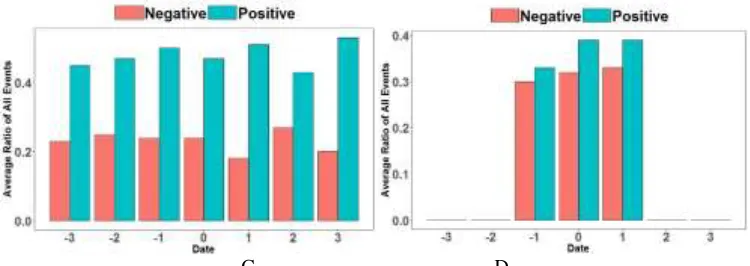
sentiment of all weibos which are exhibited in the corresponding day. The result is in the Fig. 6.
A B
[image:9.612.146.447.80.300.2]
C D Figure 5. The ratio of weibos of 4 typical events.
The unexpected events are quite the contrary from continuing events, negative sentiment is dominant that positive sentiment is almost half of it average. This may be easy to be understood because that most of unexpected events are not good to public, such as disaster, failure, terrorist attack and so on. When people have to face these situations, there is always sadness, fear and pain. So unexpected events always follows negative sentiment.
In Fig. 6 C, expected events, it looks like continuing events because that there is intersection between these two kinds of events. The expected events may become continuing events sometime. However, differences between two kinds of events are also obvious. In expected events, the amount of positive sentiment maintain about 40% steadily, while the amount of negative content is much below the dataset average, fluctuating between 10% and 20%. This suggests that, expected events are emotionally positive in general. What’s more, the difference between positive sentiment and negative sentiment in expected events is more remarkable than it in continuing events and both of two kinds of sentiment are stable relatively, which means that there is no drift of group emotions in most cases.
C D
Figure 6. Result of sentiment analysis for 4 type events.
The last, D, due to their short-lived lengths, represent more the average discussions, some event with more positive sentiment while some carries more negative sentiment. It is hard to say that transient events could lead to positive group emotion or negative. If there is a transient event, we need to analyze it concretely.
Discussion
According to the result of the experiment, we could get some information about group emotions. We find that most of continuing events and expected events are characterized by positive sentiment, while unexpected events often carries more negative sentiment. And transient events, whose duration is very short, are not characterized by any particular emotion which represents the norm of short-text on social media. It is easy to understand these conclusions by common sense. Continuing events and expected events are similar that they are always the events which are concerned by all the publics such as an election, a sport match and an entertainment event. Most Chinese netizens have ability to distinguish between truth and falsehood, cybermob is not so much after all. So the atmosphere in Weibo is good that the weibos about continuing events are always characterized by positive sentiment. However, unexpected events are often relate to something bad such as disasters and emergencies which will certainly lead to negative emotions from the audience, including fear, sorrow and pain.
The findings of this paper have really practical significance not only for companies to make more money but also for government to work more efficiently. For companies, analyzing the group emotions will help themselves to know what people like or dislike, which would make them to do what people want to earn more money. For government, they could figure out if publics are satisfied with a policy, if an emergency management works effectively and which candidate has more supporters by finding the group emotions.
CONCLUSION
Weibo to 4 types. Finally we analyze the four types of events to find the group emotions and discuss the reason behind it.
However, this paper only focuses on the study about single social media Sina Weibo. The emotions on Weibo may not contain information about all publics, we have to consider more social medias such as Baidu Tieba, Tianya Community, and so on. Besides, this paper’s researched group emotions is only based on events; it may be narrow and more should be done about other social phenomena. In the future, we will do some researches based on time to analyze group emotions more specifically.
ACKNOWLEDGEMENTS
We thank reviewers for their constructive comments, and gratefully acknowledge the support of the National Natural Science Foundation of China (NO.61671064, 61201352) and the Basic Research Foundation of Beijing Institute of Technology (NO.20160742017).
Corresponding author e-mail: Meng Zhao, zhaomengbit @bit.edu.cn, School of Computer Science and Technology, Beijing Institute of Technology, Beijing 100081 China
REFERENCES
1. Schramm, W. "Mass communication." Annual Review of Psychology 13.13(1962):251-284. 2. Gryc, Wojciech, and K. Moilanen. Leveraging Textual Sentiment Analysis with Social Network
Modelling: Sentiment Analysis of Political Blogs in the 2008 U.S. Presidential Election. From Text to Political Positions. 2010.
3. Zafarani, Reza, W. D. Cole, and H. Liu. Sentiment Propagation in Social Networks: A Case Study in LiveJournal. Advances in Social Computing, Third International Conference on Social Computing, Behavioral Modeling, and Prediction, SBP 2010, Bethesda, MD, USA, March 30-31, 2010. Proceedings DBLP, 2010:413-420.
4. Xu, Kaiquan, J. Li, and S. S. Liao. Sentiment community detection in social networks. Iconference 2011, Inspiration, Integrity, and Intrepidity, Seattle, Washington, Usa, February DBLP, 2011:804-805.
5. Bollen, Johan, et al. Happiness Is Assortative in Online Social Networks. Artificial Life 17.3(2011):237.
6. Aoki, Sho, and O. Uchida. A method for automatically generating the emotional vectors of emoticons using weblog articles. Proceedings of the 10th WSEAS international conference on Applied computer and applied computational science World Scientific and Engineering Academy and Society (WSEAS), 2011:132-136.
7. Tang, Duyu, et al. User modeling with neural network for review rating prediction. International Conference on Artificial Intelligence AAAI Press, 2015:1340-1346.
8. Shi, Shumin, et al. Identifying Suspected Cybermob on Tieba. Chinese Computational Linguistics and Natural Language Processing Based on Naturally Annotated Big Data. Springer International Publishing, 2016.
9. Kwak, Haewoon, et al. What is Twitter, a social network or a news media? International Conference on World Wide Web 2010:591-600.
10. Lehmann, Janette, and C. Cattuto. Dynamical classes of collective attention in twitter. International Conference on World Wide Web ACM, 2012:251-260.