2017 2nd International Conference on Artificial Intelligence: Techniques and Applications (AITA 2017) ISBN: 978-1-60595-491-2
Comparison of PSO and ABC: From A Viewpoint of Learning
Guo-sheng HAO
1,*, Gai-ge WANG
1, Zhao-jun ZHANG
2and De-xuan ZOU
21
School of Computer Science & Technology, Jiangsu Normal University, Xuzhou, 221116, China
2
School of electrical engineering & automation, Jiangsu Normal University, Xuzhou, 221116, China
*Corresponding author
Keywords: Learning mechanism, PSO, ABC, Learning rules, Exploration, Exploitation.
Abstract. The learning mechanisms in Partial Swarm Optimization (PSO) and Artificial Bee Colony (ABC) algorithm are studied. Four basic learning elements are considered, including learning subject, learning object, learning result and learning rules. Both PSO and ABC generate new solutions by learning to explore/exploit promising subspace. For the solution generation operators in each algorithm, we study the learning mechanism and analyze their exploration and exploitation ability. This study gives more insights on the similarity and differences between PSO and ABC.
Introduction
For many decades, researchers have been developing ever more sophisticated nature-inspired metaheuristic algorithms (NIOAs)[1] to solve hard optimization problems. Among NIOAs, Genetic Algorithm (GA) [2] was firstly introduced. Since then, various other optimization algorithms have been proposed such as Particle Swarm Optimization (PSO)[3] [4], Artificial Bee Colony (ABC) algorithm [5] and so on.
Faced with many NIOAs, there are some questions that are often asked by researchers and application researchers such as: (1) Learning is at the core of intelligence. How does learning work in NIOAs? (2)How does learning guide the exploitation and exploration? (3) What are the similarities and differences among NIOAs, such as between PSO and ABC? Different NIOAs are inspired by different natural phenomena and different NIOAs may have different learning strategies or mechanisms to update their population.
There are, of course, many learning methods or many ways to generate new solutions. Regardless of the specific ways, it is generally agreed that NIOAs utilize operators to carry out learning or generate new solutions.
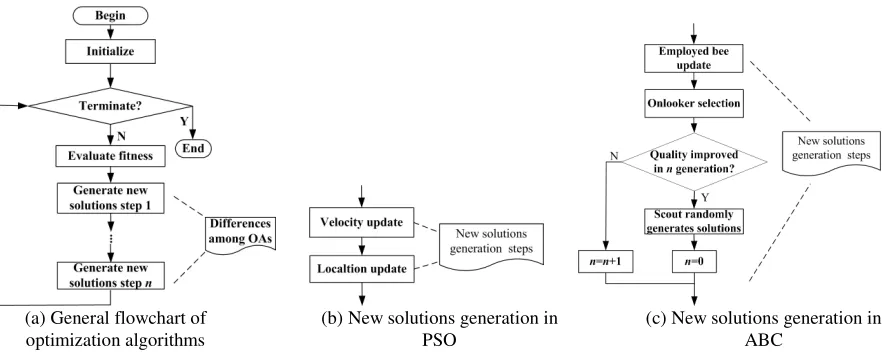
Almost all NIOAs are implemented with the flowchart shown in Figure 1 (a). Therefore, different NIOAs can be compared briefly from the viewpoint of new solution generation, e.g., PSO and ABC in Figure 1 (b) and (c) respectively.
(a) General flowchart of optimization algorithms
(b) New solutions generation in PSO
(c) New solutions generation in ABC
[image:1.612.86.527.555.733.2]The following study is based on the maximum optimization case.
It should be noted that it is not the goal of this paper to declare one algorithm or the other are somehow better. Instead, the goal is to provide the comparison among NIOAs from the viewpoint of learning mechanism behinds the operators in NIOAs.
The aim of learning is to explore or exploit the promising search space. Therefore, we can measure learning results by measuring the exploration and exploitation. How to measure exploration and exploitation is an open question [6]. Here we measure them by borrowing the measurement of the modal or peaks of the optimized problem. If the learning results have the same peak with learning subjects (or learning objects , if applicable), we call that the learning is exploitation. If the learning results have the different peak with learning subjects (or learning objects , if applicable), we call that the learning is exploration.
Swarm intelligence algorithm has a key feature as self-organization which results collective behavior by means of local interactions among simple swarm agent [7]. The swarm agent can be birds, fishes, bees, krill, cuckoos, fireflies, wolves and so on.
Analysis of Learning Mechanism of Solution Generation in Partial Swarm Optimization
Particle swarm optimization is a swarm intelligence technique developed by Eberhart and Kennedy [3, 4], based on the social behaviour of bird flocking and fish schooling. For every swarm, it flies (or swims or moves) with a variable velocity to a promising location where they can profit from the discoveries or previous experiences of all other members of the school during the search for food.
Different from Genetic Algorithm (GA), PSO does not adopt an explicit selection function. The absence of a selection mechanism in PSO is compensated by the use of leaders to guide the search. In addition, different from GA, there is no notion of offspring generation in PSO [8]. The location of a particle is treated as a solution in search space. The update of solution is the update of the position of a particle. Rather than use crossover or mutation, it uses real-number randomness and global communication among the swarm particles [9].
PSO has been shown as a very effective optimizer, especially in large convoluted search space [10]. Generally, a particle update includes two properties update: velocity update and location update.
We will analyse the learning mechanism in the update of velocity and location in PSO. The partial flowchart of PSO is shown in Figure 1(b), and for the other part, one is referred to Figure 1.
In PSO, the best previous position of a solution is recorded and represented as . And the index of the best particle among all the particles in the population is represented by the symbol g and the corresponding position of this solution is represented as
.
Velocity Update. Denote the velocity of a particle as . Then the learning subject and learning objects in velocity update is: , , and the
learning rule is: , where
are weights value and rand1, rand2 are two random values. Generally, there is [11]. In next iteration, uses as its new value.
The parameter is also called as the inertial weight to control the impact of the previous history of velocities on the current velocity.
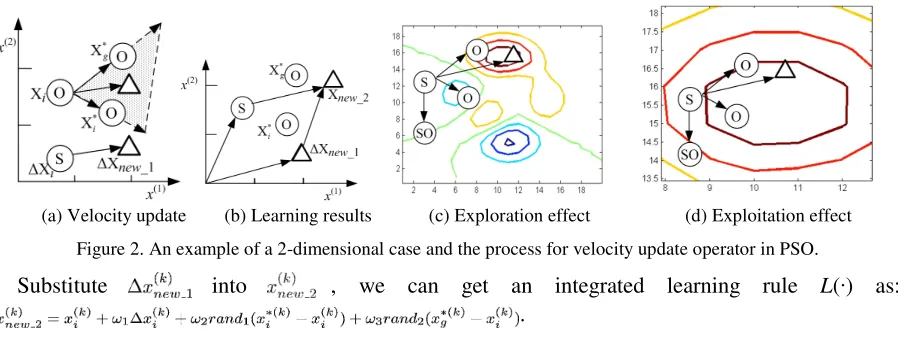
In the velocity update, a solution can learn not only from its own previous best solution but also from the global best solution. By learning, Xi adjusts its motion toward to and .
Figure 2 (a) shows velocity update and the shaded part is the value area of
+ .
An example of a 2-dimensional case and the process for location update is shown in Figure 2 (b)-(d). Figure 2 (b) shows the relationship of learning results, learning subject and learning objects. Figure 2 (c) shows the exploration effect of solution update and Figure 2 (d) shows the exploitation effect of solution update.
[image:3.612.82.531.125.294.2](a) Velocity update (b) Learning results (c) Exploration effect (d) Exploitation effect
Figure 2. An example of a 2-dimensional case and the process for velocity update operator in PSO.
Substitute into , we can get an integrated learning rule L(·) as:
.
Analysis of Learning Mechanism of Solution Generation in Artificial Bee Colony Algorithm
Several approaches have been proposed to model the collective intelligence of honeybee [5] [12-19]. The honeybee swarms model consists of three components: food sources, employed foragers and unemployed foragers [20]. The food sources are corresponding to the solutions in the search space. Employed foragers are associated with a particular solution, which they are currently exploiting or are “employed” at. Unemployed foragers are continually at look out for a food source to exploit. There are two types of unemployed foragers: scouts and onlookers. Scouts searching the environment surrounding the nest for new food sources and onlookers waiting in the nest and establishing a food source through the information shared by employed foragers [20]. The mean number of scouts averaged over conditions is about 5-10% of other bees [21].
In Artificial Bee Colony (ABC) algorithm, there are two modes of the behavior: the recruitment to a rich nectar source and the abandonment of a poor nectar source. Initially, scout bees discover all food source positions. Thereafter, the nectar of food sources are exploited by employed bees and onlooker bees. Then, the employed bee which was exploiting the exhausted food source becomes a scout bee in search of further food sources once again [20].
The partial flowchart is shown in Figure 1 (c), and for the other part, one is referred to Figure 1 (a). We study the learning mechanism in ABC in the order of employed bee update, onlooker selection and scout randomly generated solutions.
Employed Bee Update. The employed bees carry out exploitation by learning from other bees including onlookers, scout and other employed bees. Therefore, the learning subject and object are , , where j is randomly selected in the set {1, 2, …, |P|}. And the learning rule L(·) is: , where rand is a random value in [-1, 1].
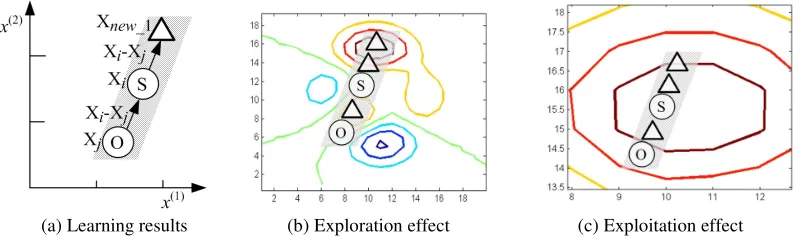
An example of a 2-dimensional case and the process for employed bee update is shown in Figure 2, where the shaded area is location for all the learning results for rand is in [-1, 1]. The relationship of learning subject, learning object and learning results are shown in Figure 2 (a). And the exploration and exploitation effect are shown in Figure 2 (b) and (c).
After the components update, the solution will be determined by competing as
[image:4.612.101.500.75.194.2]
(a) Learning results (b) Exploration effect (c) Exploitation effect
Figure 3. An example of a 2-dimensional case and the process for employed bee update in ABC.
Onlookers update. Onlookers exchange their information with employed bees. An onlooker chooses the solution depending on the probability value associated with fitness. The choosing of solutions support the mechanism of learning from promising solution [22] and it is similar to the selection
operator in GA. The learning rule L(·) is , .
The probability for a solution to be selected by onlookers is proportion to its fitness: . The exploitative effect is also the same as selection operator in GA, and we omit it
here.
Scout Update. The scout produces random solution. If the solution that employed bee manipulated cannot be improved further through a predetermined number of iterations, the solution will be replaced by the scout produced solution. The scout helps ABC to avoid the risk of becoming trapped by a local optimum.
Conclusion
From the viewpoint of learning mechanism, we study the similarities and differences between PSO and ABC. This will help theory and application researcher to understand these algorithms better.
Acknowledgement
This research was financially supported by the National Science Foundation of China under Grants No. 61673196, 61503165, 61403174.
References
[1] K. Smith-Miles, and L. Lopes, “Measuring instance difficulty for combinatorial optimization problems,” Computers & Operations Research, vol. 39, no. 5, pp. 875-889, 2012.
[2] J. H. Holland, Adaptation in natural and artificial systems, Ann Arbor: University of Michigan Press, 1975.
[3] J. Kennedy, and R. Eberhart, “Particle swarm optimization,” in IEEE International Conference on Neural Networks, 1995, pp. 1942-1948 vol. 4.
[4] R. C. Eberhart, and J. Kennedy, “A new optimizer using particle swarm theory,” in Proceedings of the sixth international symposium on micro machine and human science, 1995, pp. 39-43.
[6] H.-G. Beyer, and K. Deb, “On self-adaptive features in real-parameter evolutionary algorithms,”
Evolutionary Computation, IEEE Transactions on, vol. 5, no. 3, pp. 250-270, 2001.
[7] E. Bonabeau, M. Dorigo, and G. Theraulaz, Swarm intelligence: from natural to artificial systems: Oxford university press, 1999.
[8] M. Reyes-Sierra, and C. C. Coello, “Multi-objective particle swarm optimizers: A survey of the state-of-the-art,” International journal of computational intelligence research, vol. 2, no. 3, pp. 287-308, 2006.
[9] X.-S. Yang, Nature-Inspired Optimization Algorithms, Oxford: Elsevier, 2014.
[10] R. C. Eberhart, and Y. Shi, "Comparison between genetic algorithms and particle swarm optimization." pp. 611-616.
[11] Y. Shi, and R. Eberhart, “A modified particle swarm optimizer,” in Evolutionary Computation Proceedings, 1998. IEEE World Congress on Computational Intelligence., The 1998 IEEE International Conference on, 1998, pp. 69-73.
[12] D. Teodorović, and M. Dell’Orco, “Bee colony optimization–a cooperative learning approach to
complex transportation problems,” in Advanced OR and AI Methods in Transportation: Proceedings of 16th Mini–EURO Conference and 10th Meeting of EWGT (13-16 September 2005).–Poznan: Publishing House of the Polish Operational and System Research, 2005, pp. 51-60.
[13] V. Tereshko, and T. Lee, “How information-mapping patterns determine foraging behaviour of a honey bee colony,” Open Systems & Information Dynamics, vol. 9, no. 02, pp. 181-193, 2002.
[14] V. Tereshko, and A. Loengarov, “Collective decision making in honey-bee foraging dynamics,”
Computing and Information Systems, vol. 9, no. 3, pp. 1, 2005.
[15] D. Teodorovic, “Transport modeling by multi-agent systems: a swarm intelligence approach,”
Transportation Planning and Technology, vol. 26, no. 4, pp. 289-312, 2003.
[16] P. Lucic, and D. Teodorovic, “Transportation modeling: an artificial life approach,” in IEEE International Conference on Tools with Artificial Intelligence, 2002, pp. 216-223.
[17] H. Drias, S. Sadeg, and S. Yahi, "Cooperative bees swarm for solving the maximum weighted satisfiability problem," Computational Intelligence and Bioinspired Systems, pp. 318-325: Springer, 2005.
[18] K. Benatchba, L. Admane, and M. Koudil, "Using bees to solve a data-mining problem expressed as a max-sat one," Artificial Intelligence and Knowledge Engineering Applications: A Bioinspired Approach, pp. 212-220: Springer, 2005.
[19] H. F. Wedde, M. Farooq, and Y. Zhang, "BeeHive: An efficient fault-tolerant routing algorithm inspired by honey bee behavior," Ant colony optimization and swarm intelligence, pp. 83-94: Springer, 2004.
[20] D. Karaboga, B. Gorkemli, C. Ozturk, and N. Karaboga, “A comprehensive survey: artificial bee colony (ABC) algorithm and applications,” Artificial Intelligence Review, vol. 42, no. 1, pp. 21-57, 2014/06/01, 2014.
[21] T. D. Seeley, The wisdom of the hive: the social physiology of honey bee colonies: Harvard University Press, 2009.