for
Earthquake Early Warning
Thesis by
Gokcan Karakus
In Partial Fulfillment of the Requirements
for the Degree of
Doctor of Philosophy
California Institute of Technology
Pasadena, California
2016
© 2016
Gokcan Karakus
Acknowledgements
I would like to thank my advisor, Prof. Thomas H. Heaton, for his extremely
helpful advice and limitless patience towards me everyday, without exception, during our
collaboration. I feel tremendous honor to be his student.
I would like to thank Prof. James L. Beck for his very important help on the
statistical portion of my research. I could not have achieved it without you; thank you.
Starting with Prof. Jean Paul Ampuero, I would like to thank my PhD examining
committee. It has been my honor to have him, Prof. Hiroo Kanamori and Prof. Domniki
Asimaki on my PhD examining committee.
Starting with Dr. In Ho Cho, I would like to thank the students of Civil
Engineering option at Caltech for their company and help during my stay at Caltech.
Starting with Dr. Arthur Lipstein, I would like to thank my friends at Caltech who
were associated with options other than Civil Engineering.
Starting with Carolina Oseguera, I would like to thank the staff of the Civil
Engineering option at Caltech for creating a positive work environment for me.
Starting with Dr. Yannik Daniel Behr, Dr. Men-Andrin Meier and Dr. Maren
Boese, I would like to thank my colleagues at institutions different from Caltech for their
help and support.
Starting with the International Student Program (ISP), I would like to thank all of
the offices and staff at Caltech for doing their job so well so that I could focus on my
Starting with Prof. Cem Yalcin, I would like to thank the civil engineering faculty
in my undergraduate institution, Bogazici University, who helped me prepare for a
journey of lifelong learning.
I would like to especially thank Dr. Georgia B. Cua for her constant help, and for
starting an envelope based earthquake early warning method.
And, finally, I would like to thank my family in Turkey for their emotional
Abstract
Current earthquake early warning systems usually make magnitude and location
predictions and send out a warning to the users based on those predictions. We describe
an algorithm that assesses the validity of the predictions in real-time. Our algorithm
monitors the envelopes of horizontal and vertical acceleration, velocity, and
displacement. We compare the observed envelopes with the ones predicted by Cua &
Heaton’s envelope ground motion prediction equations (Cua 2005). We define a “test
function” as the logarithm of the ratio between observed and predicted envelopes at every
second in real-time. Once the envelopes deviate beyond an acceptable threshold, we
declare a misfit. Kurtosis and skewness of a time evolving test function are used to
rapidly identify a misfit. Real-time kurtosis and skewness calculations are also inputs to
both probabilistic (Logistic Regression and Bayesian Logistic Regression) and
nonprobabilistic (Least Squares and Linear Discriminant Analysis) models that ultimately
decide if there is an unacceptable level of misfit. This algorithm is designed to work at a
wide range of amplitude scales. When tested with synthetic and actual seismic signals
Table of Contents
Acknowledgements ... iii
Abstract ... v
Chapter 1 Introduction ... 1
Chapter 2 Data Processing ... 4
2.1 Data Processing ... 4
2.2 Prelude: Virtual Seismologist ... 4
2.3 Test Functions ... 6
2.4 Virtual Seismologist Assumption Regarding Misfit ... 8
2.5 Higher Order Statistics ... 11
2.5.1 Higher Order Statistics – Kurtosis ... 11
2.5.2 Higher Order Statistics – Skewness ... 12
2.6 An Example – Missed Event ... 13
2.7 Another Example – False Event ... 15
2.8 Summary of Test Function States ... 17
Chapter 3 Probabilistic Classifications ... 21
3.1 Classifications – Probabilistic Generative Model ... 22
3.2 Discussion of Results for Tables 3.1 to 3.3 ... 34
3.3 Classification – Probabilistic Discriminative Model with Maximum Likelihood Estimate (MLE) ... 34
3.5 Classification – Probabilistic Discriminative Model with Maximum A Posteriori
(MAP) Value ... 41
3.6 Discussion of Results in Table 3.7 to 3.9 ... 48
3.7 Discussion of Results in Table 3.10 to 3.12 ... 52
3.8 Discussion of Results in Table 3.13 to 3.15 ... 56
3.9 Classification – Posterior Predictive Distribution ... 56
3.10 Classification – Bayesian Model Class Selection (Method I) ... 58
3.11 Classification – Sparse Bayesian Learning (Method II) ... 68
Chapter 4 Case Studies – Okay Predictions ... 75
4.1 Okay-Prediction Examples ... 76
4.1.1 Okay-prediction example 1 ... 76
4.1.2 Discussion of okay-prediction example 1 ... 77
4.1.3 Okay-prediction example 2 ... 84
4.1.4 Discussion of okay-prediction example 2 ... 84
4.1.5 Okay-prediction example 1 with arrival time perturbations ... 94
4.2 A Supplementary Method for the Reality Check Algorithm ... 106
4.2.1 Karakus-Heaton Moment of Signal Data ... 108
Chapter 5 Case Studies – Over Predictions ... 118
5.1 Over-prediction example 1 ... 118
5.1.1 Discussion of over-prediction example 1 ... 126
5.2 Over-prediction example 1 with matching envelope arrival times ... 128
5.3 Over-prediction example 2 ... 134
5.3.1 Discussion of over-prediction example 2 ... 147
Chapter 6 Case Studies – Under Predictions ... 149
6.1 Discussion of under-prediction example ... 156
Chapter 7 Concluding Remarks and Future Work ... 158
Appendix A Virtual Seismologist Envelope Equations ... 162
Appendix B Multiple Window Approach ... 164
Appendix C Non-probabilistic Classifications ... 167
C.1 Classifications: Least Squares ... 167
C.2 Discussion of Results in Tables C.1 to C.3 ... 169
C.3 Classifications – Linear Discriminant Analysis (LDA) ... 174
C.4 Discussion of Results in Tables C.4 to C.6 ... 185
List of Figures
1.1 Schematic illustration of the reality check algorithm ………... 3
2.1 Example of an observed and a predicted envelope ……… 5
2.2 Examples of predicted envelopes generated using the Virtual Seismologist method ……… 7
2.3 Envelopes and their test function ………... 9
2.4 A test function result and its histogram ………... 10
2.5 Graphical interpretation of higher order statistics ………... 13
2.6 Example of a double event seismogram and its envelope ………... 14
2.7 Under-prediction, i.e., missed event example ……….. 16
2.8 Over-prediction, i.e., false alarm example ………... 18
2.9 Three states of the test function ………... 20
4.1 Reality Check Algorithm’s performance plot for the okay-prediction example 1 computed using (3.68) from acceleration input using Method I ……….. 78
4.2 Reality Check Algorithm’s performance plot for the okay-prediction example 1 computed using (3.69) from velocity input using Method I ……….... 79
4.3 Reality Check Algorithm’s performance plot for the okay-prediction example 1 computed using (3.70) from displacement input using Method I ……….... 80
4.4 Reality Check Algorithm’s performance plot for the okay-prediction example 1 computed using (3.99) from acceleration input using Method II ……… 81
4.6 Reality Check Algorithm’s performance plot for the okay-prediction example 1
computed using (3.101) from displacement input using Method II ………. 83
4.7 Reality Check Algorithm’s performance plot for the okay-prediction example 2
computed using (3.68) from acceleration input using Method I ……….. 85
4.8 Reality Check Algorithm’s performance plot for the okay-prediction example 2
computed using (3.69) from velocity input using Method I ……….... 86
4.9 Reality Check Algorithm’s performance plot for the okay-prediction example 2
computed using (3.70) from displacement input using Method I ……….... 87
4.10 Reality Check Algorithm’s performance plot for the okay-prediction example 2
computed using (3.99) from acceleration input using Method II ……… 88
4.11 Reality Check Algorithm’s performance plot for the okay-prediction example 2
computed using (3.100) from velocity input using Method II ………. 89
4.12 Reality Check Algorithm’s performance plot for the okay-prediction example 2
computed using (3.101) from displacement input using Method II ………. 90
4.13 Reality Check Algorithm’s performance plot for the okay-prediction example 2
computed using (3.101) from displacement input using Method II (zoomed-in on
the first over-prediction indication) ………. 92
4.14 Reality Check Algorithm’s performance plot for the okay-prediction example 2
computed using (3.101) from displacement input using Method II (zoomed-in on
the second over-prediction indication) ………. 93
4.15 Reality Check Algorithm’s performance plot for the okay-prediction example 2
4.16 Reality Check Algorithm’s performance plot for the okay-prediction example 1
(with early predicted P-wave arrival) computed using (3.99) from acceleration
input using Method II ………... 96
4.17 Reality Check Algorithm’s performance plot for the okay-prediction example 1
(with early predicted P-wave arrival) computed using (3.100) from velocity input
using Method II ……… 98
4.18 Reality Check Algorithm’s performance plot for the okay-prediction example 1
(with early predicted P-wave arrival) computed using (3.101) from displacement
input using Method II ………... 99
4.19 Reality Check Algorithm’s performance plot for the okay-prediction example 1
(with early predicted P-wave arrival) computed using (3.100) from velocity input
using Method II (zoomed-in on the early predicted P-wave arrival) …………. 100
4.20 Reality Check Algorithm’s performance plot for the okay-prediction example 1
(with late predicted P-wave arrival) computed using (3.99) from acceleration
input using Method II ………. 101
4.21 Reality Check Algorithm’s performance plot for the okay-prediction example 1
(with late predicted P-wave arrival) computed using (3.100) from velocity input
using Method II ……….. 102
4.22 Reality Check Algorithm’s performance plot for the okay-prediction example 1
(with late predicted P-wave arrival) computed using (3.101) from displacement
4.23 Reality Check Algorithm’s performance plot for the okay-prediction example 1
(with late predicted P-wave arrival) computed using (3.101) from displacement
input using Method II (zoomed-in on the late predicted P-wave arrival) …….. 104
4.24 Static moment computation illustration in 2D ………... 110
4.25 Comparison of taking logarithm with applying Karakus-Heaton Moment of Signal
Data ……… 113
4.26 Performance of the supplementary method to RCA for the okay-prediction
example 1 ………... 115
4.27 Performance of the supplementary method to RCA for the okay-prediction
example 1 (with early predicted P-wave arrival) ………... 116
4.28 Performance of the supplementary method to RCA for the okay-prediction
example 1 (with late predicted P-wave arrival) ………. 117
5.1 Summary of July 1st 2015 false alarms ……….. 119
5.2 Reality Check Algorithm’s performance plot for the over-prediction example 1
(with predicted wave arriving earlier than observed calibration pulse) computed
using (3.99) from acceleration input using Method II ………... 122
5.3 Reality Check Algorithm’s performance plot for the over-prediction example 1
(with predicted wave arriving earlier than observed calibration pulse) computed
using (3.100) from velocity input using Method II ……… 123
5.4 Reality Check Algorithm’s performance plot for the over-prediction example 1
(with predicted wave arriving earlier than observed calibration pulse) computed
5.5 Performance of the supplementary method to RCA for the over-prediction
example 1 (with predicted wave arriving earlier than observed calibration pulse)
125
5.6 Reality Check Algorithm’s performance plot for the over-prediction example 1
(with predicted wave arriving earlier than observed calibration pulse) computed
using (3.99) from acceleration input using Method II (zoomed-in at arrival times
of observed and predicted envelopes) ……… 127
5.7 Reality Check Algorithm’s performance plot for the over-prediction example 1
(with predicted wave arriving at the same time as observed calibration pulse)
computed using (3.99) from acceleration input using Method II ……….. 129
5.8 Reality Check Algorithm’s performance plot for the over-prediction example 1
(with predicted wave arriving at the same time as observed calibration pulse)
computed using (3.100) from velocity input using Method II ………... 130
5.9 Reality Check Algorithm’s performance plot for the over-prediction example 1
(with predicted wave arriving at the same time as observed calibration pulse)
computed using (3.101) from displacement input using Method II …………... 131
5.10 Performance of the supplementary method to RCA for the over-prediction
example 1 (with predicted wave arriving at the same time as observed calibration
5.11 Reality Check Algorithm’s performance plot for the over-prediction example 1
(with predicted wave arriving at the same time as observed calibration pulse)
computed using (3.99) from acceleration input using Method II (zoomed-in at
arrival times of observed and predicted envelopes) ………... 135
5.12 Reality Check Algorithm’s performance plot for the over-prediction example 1
(with predicted wave arriving at the same time as observed calibration pulse)
computed using (3.101) from displacement input using Method II (zoomed-in at
arrival times of observed and predicted envelopes) ………... 136
5.13 Seismic data for the calibration pulse that is used as an over-prediction example 1
from the Northern California Earthquake Data Center ……….. 137
5.14 Seismic data for the calibration pulse that is used as an over-prediction example 1
from the Northern California Earthquake Data Center, zoomed-in around missing
data ………. 138
5.15 Reality Check Algorithm’s performance plot for the over-prediction example 2
computed using (3.99) from acceleration input using Method II ……….. 139
5.16 Reality Check Algorithm’s performance plot for the over-prediction example 2
computed using (3.100) from velocity input using Method II ………... 140
5.17 Reality Check Algorithm’s performance plot for the over-prediction example 2
computed using (3.101) from displacement input using Method II …………... 141
5.18 Performance of the supplementary method to RCA for the over-prediction
5.19 Reality Check Algorithm’s performance plot for the over-prediction example 2
computed using (3.99) from acceleration input using Method II with matching
arrival times of observed abnormal noise increase and predicted P-wave …… 143
5.20 Reality Check Algorithm’s performance plot for the over-prediction example 2
computed using (3.100) from velocity input using Method II with matching
arrival times of observed abnormal noise increase and predicted P-wave …… 144
5.21 Reality Check Algorithm’s performance plot for the over-prediction example 2
computed using (3.101) from displacement input using Method II with matching
arrival times of observed abnormal noise increase and predicted P-wave …… 145
5.22 Performance of the supplementary method to RCA for the over-prediction
example 2 with matching arrival times of observed abnormal noise increase and
predicted P-wave ……… 146
6.1 Reality Check Algorithm’s performance plot for the under-prediction example
computed using (3.99) from acceleration input using Method II ……….. 151
6.2 Reality Check Algorithm’s performance plot for the under-prediction example
computed using (3.100) from velocity input using Method II ………... 152
6.3 Reality Check Algorithm’s performance plot for the under-prediction example
computed using (3.101) from displacement input using Method II …………... 153
6.4 Performance of the supplementary method to RCA for the under-prediction
6.5 Reality Check Algorithm’s performance plot for the under-prediction example
computed using (3.99) from acceleration input using Method II (zoomed-in at
arrival time of the small preceding event in the seismogram, and Cucapah – El
Mayor earthquake in ground motion envelopes) ………... 155
B.1 Kurtosis computation example with a single window of length 20 seconds …. 165
B.2 Multiple windows approach for a kurtosis computation with two different window
lengths and their sum ………. 166
C.1 Histogram for all three classes obtained using LDA with acceleration values only
177
C.2 Histogram for all three classes obtained using LDA with velocity values only 180
C.3 Histogram for all three classes obtained using LDA with displacement values only
List of Tables
3.1 Confusion matrix for probabilistic generative classification using acceleration
data ………... 29
3.2 Confusion matrix for probabilistic generative classification using velocity data
31
3.3 Confusion matrix for probabilistic generative classification using displacement
data ………... 33
3.4 Confusion matrix for probabilistic discriminative classification with MLE using
acceleration data ………... 38
3.5 Confusion matrix for probabilistic discriminative classification with MLE using
velocity data ………... 39
3.6 Confusion matrix for probabilistic discriminative classification with MLE using
displacement data ………... 40
3.7 Confusion matrix for probabilistic discriminative classification with MAP
(!σ =100) using acceleration data ………... 45
3.8 Confusion matrix for probabilistic discriminative classification with MAP
(!σ =100) using velocity data ……….. 46
3.9 Confusion matrix for probabilistic discriminative classification with MAP
(!σ =100) using displacement ………... 47
3.10 Confusion matrix for probabilistic discriminative classification with MAP
(!σ =10) using acceleration data ……….. 49
3.11 Confusion matrix for probabilistic discriminative classification with MAP
3.12 Confusion matrix for probabilistic discriminative classification with MAP
(!σ =10) using displacement data ……….... 51
3.13 Confusion matrix for probabilistic discriminative classification with MAP (!σ =0.05) using acceleration data ………... 53
3.14 Confusion matrix for probabilistic discriminative classification with MAP (!σ =0.05) using velocity data ………... 54
3.15 Confusion matrix for probabilistic discriminative classification with MAP (!σ =0.05) using displacement data ………... 55
3.16 List of features included in alternative models ……… 64
3.17 Bayesian model class selection results for acceleration input ………... 65
3.18 Bayesian model class selection results for velocity input ……… 66
3.19 Bayesian model class selection results for displacement input ………... 67
C.1 Confusion matrices for least squares classification using acceleration data ….. 171
C.2 Confusion matrices for least squares classification using velocity data ……… 172
C.3 Confusion matrices for least squares classification using displacement data … 173 C.4 Confusion matrix for LDA using acceleration data ………... 178
C.5 Confusion matrix for LDA using velocity data ………. 181
Chapter 1
Introduction
Recently, the earthquake early warning (EEW) systems are being developed in
many parts of the world. These systems do not predict when an earthquake is going to
happen; rather they predict the eventual characteristics of earthquakes, such as their
magnitude and location, by using the first few seconds of the earthquakes’ ground motion
data that are being recorded by seismic stations in real-time. Unfortunately, the seismic
stations records do not only contain earthquake data, but also any activity that “shakes”
the ground, such as sonic booms, quarry blasts, and even heavy traffic noise. These types
of activities may confuse a warning system that relies on ground motion amplitudes
recorded by seismograms being larger than certain thresholds. In addition to
non-earthquake activity, temporal distribution of actual non-earthquakes, such as an non-earthquake
swarm instead of an isolated earthquake being preceded and followed by quiet ground
motion periods, may affect the accuracy of the alert messages sent to the EEW system
subscribers.
The current EEW system being tested in California does not have a mechanism
that checks the accuracy of the messages sent to the system subscribers. However, we
desire to have a sophisticated real-time checking mechanism that will oversee and verify
the system predictions. To develop a robust alert confirmation mechanism, we examined
more than 500 synthetically created false and missed EEW alert scenarios for earthquakes
We used earthquake waveform envelope data predicted by Cua & Heaton’s
envelope ground motion prediction equations (Cua 2005) to verify the predictions made
by the EEW system. During the comparison calculations between observed and predicted
ground motions, we measured the disagreement using higher order statistics: kurtosis and
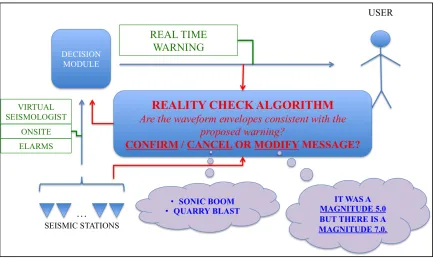
skewness. We developed a new algorithm called reality check (Figure 1) that classifies
the state of an EEW system alert based on the kurtosis and skewness measures of the
misfit between observed and predicted waveform envelope data.
This thesis presents the step-by-step development process of the reality check
algorithm and shows how this technique helps protect the credibility of an EEW system
Figure 1.1: Schematic illustration of the reality check algorithm. The recorded ground motion data are sent to a main computer called Decision Module. Decision Module
makes a prediction using several algorithms (Virtual Seismologist, Onsite, and Elarms)
and sends an alert to the users if necessary. The Reality check algorithm receives the sent
alert messages, and then compares them with the real-time recorded data by seismic
stations and reports the accuracy of the messages back to the decision module. We
Chapter 2
Data Processing
2.1 Data Processing
This section describes the choice of input used regarding the ground motion data.
The seismic stations in California can record ground motion in from 80 samples
per second (broadband seismometers) to 100 samples per second (strong motion
seismometers). Our algorithm does not use these recordings directly. Instead, we use
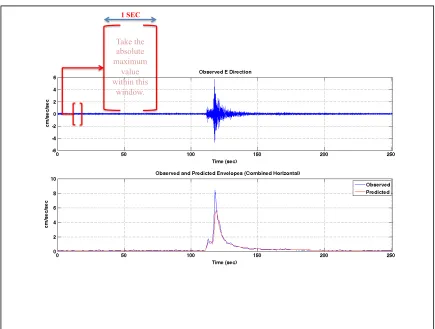
envelopes of the waveform data. We run a 1 second long window throughout the
continuous records in real-time, and take the absolute maximum value within the window
and make it our envelope amplitude at the corresponding second in real-time (Figure 2.1).
Then, we slide the window to the next second and so on. This process gives us the
“envelope of the observed data” whether there is an event or just noise at a site.
2.2 Prelude: Virtual Seismologist
The Virtual Seismologist (VS) (Cua 2005) is briefly explained in this section,
because it is a prerequisite for our algorithm.
Our work uses envelopes of earthquake waveform data rather than the
seismogram recordings directly as explained in the previous section. In addition to the
observed earthquake envelopes, we make use of predicted envelopes that are created by
the ground motion prediction equations provided by the Virtual Seismologist. The Virtual
Seismologist (VS) (Cua 2005) was developed at Caltech. It is a Bayesian Inference
Framework based on waveform envelopes and prior information, e.g., foreshocks,
Figure 2.1: Example of an observed and a predicted envelope. Plot on top shows a broadband seismogram recorded at 80 samples per second rate at a station in E-W
direction. We run a 1 second long window throughout the continuous records in
real-time, and take the absolute maximum value within the window and make it our envelope
amplitude at the corresponding second in real-time. Note that the envelope shown in blue
in the bottom plot is a combination on E-W and N-S horizontal envelopes. Note that the
bottom plot also shows the corresponding predicted envelope created using the Virtual
Seismologist method.
1 SEC
Take the absolute maximum
value within this
waveform envelopes as a function of amplitude and distance. We need to provide the
magnitude ofthe event and the distance between its epicenter and a particular station to
create the estimated envelopes at that station. In addition to the P- and S-wave envelopes,
VS predicted envelopes also contain a constant noise envelope that represents the noise
level at a particular station. These three envelopes (P-wave, S-wave, and constant noise)
are combined in a square root of sum of squares fashion to produce the VS predicted
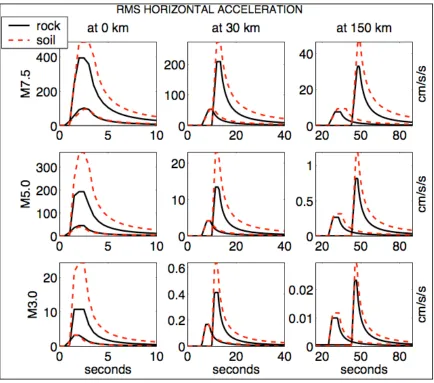
envelopes at a given station for a given earthquake. Examples of VS predicted envelopes
are shown in Figure 2.2.
!VS!Envelope!=! P-wave!Envelope
(
)
2
+
(
S-wave!Envelope)
2+(
Noise!Envelope)
2 (2.1)
The data for this work are collected from Southern California Seismic Network (SCSN)
and Next Generation Attenuation (NGA) strong motion data. Figure 2.2 shows examples
of predicted envelopes generated using the Virtual Seismologist method. VS equations
for predicting envelopes are given in Appendix A.
2.3 Test Functions
This section explains what we do right after we obtain both the observed and
predicted envelopes. Because the seismic stations continuously record ground motions
and we assume there will always be some noise being recorded at a station, the predicted
envelope (2.1) only consists of constant noise when the decision module is not publishing
any earthquake data. That means we have both observed and predicted envelope data at
any given time. Therefore, the following steps are performed at every second in real-time.
Once we have both predicted and observed envelope values, we calculate the
Figure 2.2: Examples of predicted envelopes generated using the Virtual Seismologist method. Note that there is a binary classification as soil/rock at station sites. A different
set of ground motion prediction equations are provided for each site class by VS.
[image:25.612.110.544.70.453.2]! !
φ
( )
nΔt =BHP∗log Observed!Envelope( )
nΔt Predicted!Envelope( )
nΔt⎛ ⎝
⎜⎜ ⎞⎠⎟⎟ (2.2)
where
= 1,2,…
: envelope sampling rate (1 second)
: convolution symbol
: Butterworth high-pass filter, 2nd order, 600 seconds, see below for justification.
: test function
Test functions, denoted , are second by second misfit computations between observed
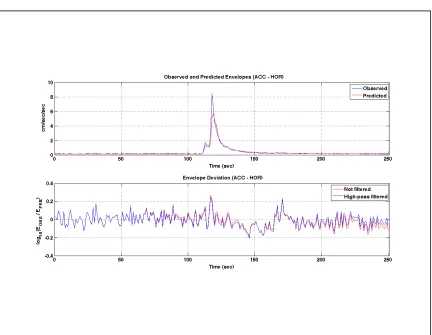
and predicted envelopes. Figure 2.3 shows that a test function represents the time
evolution of the misfit between observed and predicted ground motion values.
In some of our calculations, we noticed that the misfit in the S-wave coda is
usually different from the rest of the misfit, especially for the displacement misfit, if we
do not apply high-pass filtering to the ratio of logarithm of envelope values (Figure 2.3).
In order not to confuse our algorithm, which indirectly depends on the amplitude of the
misfit, we decided to high-pass filter the ratios between observed and predicted ground
motion values. We apply a recursive high-pass Butterworth filter to the raw misfit.
2.4 Virtual Seismologist Assumption Regarding Misfit
The data fitting process in creating the predicted envelope GMPE’s was done by
modeling the difference between predicted and observed ground motion envelopes as a
Gaussian distribution with a mean of zero in logarithm space. This model was chosen by
the VS creators and we should check how well it does. The histogram of the test function
results from the previous example is shown in Figure 2.4.
!n
!Δt
∗
!BHP
φ
Figure 2.3: Envelopes and their test function. (On top) The observed and predicted envelopes shown in Figure 2.1. (On bottom) Test function computed using (2.2) both
[image:27.612.112.544.63.398.2]Each one of the bins shown at the bottom of Figure 2.4 represents an amplitude value in
the graph above. All of the values of the test function are distributed about the mean as
shown in the histogram, and a Gaussian (!µ =−0.0104,σ =0.0718) distribution is
adequate to explain it. The VS regression analysis included more than 30,000
seismograms, so this much departure from normality in one example is within acceptable
limits (this is not based on an analysis, it is just a qualitative judgment). The assumption
is observed to be valid.
It is relatively easy for a human to visually notice if a distribution departs from a
Gaussian one, but how can we make a computer detect any unacceptable departure
automatically in real-time? One answer is to use higher order statistics: kurtosis and
skewness.
2.5 Higher Order Statistics
We use higher order statistics to detect departure from normality. Using higher
order statistics makes these techniques more robust than just using the mean and the
standard deviation.
2.5.1 Higher Order Statistics – Kurtosis
Kurtosis is a normalized fourth moment of a distribution about its mean where the
normalization is done using the square of the variance (Langet, Maggi et al. 2014), so it
does not have a unit. It is mainly used to detect outliers based on a normal distribution.
Kurtosis for a normal distribution is the value three (3), so outliers in the tails of the
(2.3)
where
: expected value
: set of values in a distribution
: mean of the set of values in
2.5.2 Higher Order Statistics – Skewness
Skewness, on the other hand, is the third moment about the mean of a distribution,
and just like kurtosis, it is normalized using the appropriate power of the variance, so
skewness too is dimensionless. Skewness is used to detect departure from symmetry. Its
sign depends on the direction of the skew as shown in Figure 2.5. A normal distribution is
perfectly symmetric about its mean and so its skewness is zero.
(2.4)
Note that higher order statistics equations, i.e., (2.3) and (2.4) are for theoretical moments
and they must be replaced by sample moments when applied to data. Matlab functions
‘kurtosis’ and ‘skewness’ are used on the data, however, ‘bias correction’, as explained in
the function definition in Matlab, was not applied.
! !
Kurtosis= E X
(
−µ)
4 ⎡⎣⎢ ⎤⎦⎥
E X⎡
(
−µ)
2 ⎣⎢ ⎤⎦⎥ ⎛ ⎝⎜ ⎞⎠⎟ 2 !E !X µ !X ! !Skewness= E X
(
−µ)
3 ⎡⎣⎢ ⎤⎦⎥
E X⎡
(
−µ)
2 ⎣⎢ ⎤⎦⎥ ⎛⎝⎜ ⎞⎠⎟
2.6 An Example – Missed Event
We now take a look at an example and see the algorithm in action. The following
example aims to simulate an ‘under-prediction’ case where the system misses an event. In
order to emphasize an under-prediction case, the following figure also includes a case
where the system successfully detects an earthquake, i.e., the first one (Figure 2.6). The
top of Figure 2.6 shows a synthetic seismogram. We basically put two identical events
Figure 2.5: Graphical interpretation of higher order statistics.
KURTOSIS FOR A
NORMAL
DISTRIBUTION IS 3.
OUTLIERS IN “TAILS”
OF A DISTRIBUTION
CAUSE POSITIVE
KURTOSIS
(i.e. KURTOSIS >>3).
SKEWNESS FOR A
NORMAL
DISTRIBUTION IS 0.
“ASYMMETRY”
CAUSES NON-ZERO
Figure 2.6: Example of a double event seismogram and its envelope. (On top) seismogram, (on bottom) envelope. Envelopes on the bottom are two horizontal
(~M4.6) back to back in time. On the bottom of Figure 2.6, we see the envelopes created
using the technique demonstrated earlier. From now on, we will not show the
seismogram itself, and we will work with the envelopes instead.
In this scenario (Figure 2.7), incoming data from the first event stimulated the
system to the point where an alarm is issued. The magnitude and the location of the event
related to the first alarm are used to create the VS envelopes and they are overlaid on top
of the observed ones using the origin time predicted by the decision module. However,
there happens to be a second event and the system does not catch it. We calculate our test
function in real-time as more data are recorded. Then, time derivatives of kurtosis and
skewness, which are computed using a multiple window approach (see Appendix B) on
the test function values, are computed in real-time as well.
Everything seems fine until the second event arrives at the station. In other words,
both derivative of excess kurtosis and derivative of skewness values indicate normality;
therefore, there is agreement between the decision module alert and what is actually
observed. But, once the second event arrives, the test function shows values that are
considered as outliers and this produces significantly greater values of the derivatives.
Moreover, because the symmetry is lost, derivative of skewness values indicate positive
skew.
2.7 Another Example – False Event
With an example of a false alarm case, we now show some justification for using
two higher order statistics functions instead of one. Kurtosis would give us a very large
number if we had a false alarm. That is, if the corresponding test function value was a
computed by using equation (2.2), it would be considered as an outlier, similar to the case
of missed alarm example. In other words, as far as kurtosis is concerned, there is no
difference between the outliers on the left or on the right tail of the mean. However,
skewness would detect a negative skew in that scenario (Figure 2.8), and we would know
the “nature” of the departure from normality. That is why we use both kurtosis and
skewness in our algorithm.
In the scenario shown in Figure 2.8, the decision module predicts an earthquake,
and issues the parameters that are needed to create the VS predicted envelopes. All is
well. After the earthquake, however, the station that recorded this seismogram
experiences some non-earthquake shaking in the form of a short lasting burst of energy,
for example, traffic noise nearby. This blip seen in the top row tricks the decision module
to issue another alarm, then our algorithm creates the corresponding VS envelope and
starts measuring the agreement between the observed and predicted envelopes. As soon
as the unacceptable mismatch is detected with the help of derivative of higher order
statistics, our algorithm indicates an over-prediction.
2.8 Summary of Test Function States
To sum up, we declare that there are three states that a test function can be in
(Figure 2.9):
State 1: The ideal case where the decision module reports agreement with the
observed data, i.e., okay-prediction.
State 2: There is a second event when we thought there was only one, i.e.,
State 3: A non-earthquake vibration such as noise at a station tricks the system
into believing that there is an earthquake, i.e., false event/alarm. This one is especially
tricky because one might lose confidence in the warning system.
We perform separate analyses for different ground motion parameters influenced
by different frequency contents; acceleration, velocity, and displacement are separately
used as inputs to our computations. We obtained our training data by synthetically
creating over- and under- prediction scenarios. The VS predicted envelopes were created
using the cataloged magnitude and location. Our training data included 1000
okay-prediction, 250 over-okay-prediction, and 250 under-prediction input values in both horizontal
and vertical acceleration, velocity, and displacement.
The peak values of derivatives of kurtosis and skewness for both horizontal and
vertical acceleration, velocity, and displacement, at the moment of unacceptable
mismatch between observed and predicted envelopes as shown in the figures above, are
considered as inputs that belong to under- and over- prediction classes: under-prediction
if observed envelope value is significantly larger, and over-prediction if predicted
envelope value is significantly larger. Maximum and minimum values of the derivatives
preceding the peak values mentioned above are considered as inputs of the
okay-predictions because they represent the boundaries within which the state of the prediction
is acceptable. We use these values as inputs for various classification models explained in
the following sections. Note that the coefficient values presented in this thesis are
truncated versions although they are used, in computations, as the computer programs
produced, i.e. with higher precision. We used our judgment regarding meaningful
Figure 2.9: Three states of the test function.
• STATE 1: ϕ ≈ 0 (i.e. Agreement between envelopes)
• STATE 2: ϕ >> 0 (i.e. Under prediction)
• STATE 3: ϕ << 0 (i.e. Over prediction)
We use Linear Discriminant and Bayesian Analyses to classify the states at every second in real-time by minimizing the overlapped areas.
Env(obs) << Env(pred)
Kurtosis >> 3
Skewness << 0 Env(obs) >> Env(pred)
Kurtosis >> 3
Skewness >> 0
Env(obs) ≈ Env(pred)
Kurtosis ≈ 3
Skewness ≈ 0
MISSED OK FALSE
State 1
Chapter 3
Probabilistic Classifications
Mathematical Notation:
Throughout this work, unless stated otherwise, we use lowercase bold Roman
letters, such as , to denote vectors. All vectors are assumed to be column vectors.
Therefore is a -dimensional vector. We use uppercase bold Roman
letters, such as , to denote matrices.
Classifications:
In the following sections, we present different ways of applying classification.
Two probabilistic classification methods are described in this chapter (towards the end of
it): Method I which uses Ockham’s razor on a given set of models, and Method II which
uses Sparse Bayesian Learning (SBL), i.e., models with Automatic Relevance
Determination (ARD) prior. Note that both of these methods are using Bayesian Ockham
razor by maximizing evidence (or posterior probability); with ARD prior, it is a
continuum of model classes, each defined by specifying hyperparameters (prior
variances), instead of a discrete set of model classes (personal communication with Prof.
James L Beck). Two non-probabilistic classification methods were also examined: least
squares and linear discriminant analysis. The theory and results for these
non-probabilistic methods are presented in Appendix C. Appendix C is included for two main
purposes: 1) to provide classification methods that do not require as much run time as the
!x
! !
!x=⎡⎣x1,x2,,xD⎤⎦ T
!D
probabilistic methods, 2) to help some interested readers understand probabilistic
classification models if classification is a new concept to them.
We aim to have the least amount of misclassification rate when we take an input
vector and assign it to a class among discrete classes. Unless it is specified
otherwise, we will use linear models where the decision boundaries that separate classes
are linear functions of the input. The number of classes in our work is three, i.e.,
(Figure 2.9). We will use a coding scheme (as described in Bishop, 2006) in
which the target vector is of length such that if the class for an input is , then
all elements of are zero except element , which takes the value 1 (Bishop 2006).
Our classifications will generally be done using a discriminant function. The parameters
of the discriminant functions are obtained with several different techniques in the
following sections.
3.1 Classifications – Probabilistic Generative Model
The following theory is based on the concepts described in Chapter 4, Linear
Models for Classification in Bishop, 2006.
In this chapter, we work with Bayesian probabilistic classifications so when a new
input is observed, we compute probability (the degree of plausibility) that it belongs to
any class.
We start with generative models. Generative models use a probability model for
the inputs and outputs; that is, we can create synthetic input data by sampling from the
generative probabilistic model. In this section, we aim to compute posterior probabilities,
!x !K
!
!K=3
!
!1−of −K
!t !!K =3 !Cj
!
!p C
( )
k x , with the help of Bayes’ theorem. In order to do that, we model bothclass-conditional densities !
!p
( )
xCk and class priors !p C( )
k .Our classification problem has three classes. In practice, the problems with more
than two classes, i.e., !!K >2 are considered “multiclass” classification problems. It is
common to use a softmax function in a multiclass classification problem. So, to better
understand what a softmax function represents, let us start with a two-class classification
problem set up (!!K=2) and then try to generalize our computations to a multiclass
classification problem. If we had only two classes, i.e., !!C1 and !!C2 we could write the
posterior probability for class !!C1 as
!
!
!
p C
( )
1x = p( )
xC1 p C( )
1p
( )
xC1 p C( )
1 +p( )
xC2 p C( )
2 (3.1)We can write (3.1) as
! !
!
p C
( )
1 x =σ( )
a = 11+exp
( )
−a (3.2)where !a is implicitly defined as
!
!
!
a=lnp
( )
xC1 p C( )
1p
( )
xC2 p C( )
2 (3.3)and
!σ
( )
a defined by (3.2) is called the logistic sigmoid function. For a multiclass case(where !!K>2), we consider !a to be a linear function of the input !x. From Bayes
!
!
!
p C
( )
k x = p( )
xCk p C( )
kp
( )
xCj p C( )
jj
∑
= exp
( )
ak exp( )
ajj
∑
(3.4)
Expression (3.4) is known as the softmax function (or the normalized exponential). It is
regarded as a generalization of the logistic sigmoid to a multiclass problem. In this case,
the quantities !ak are defined as
!
!
!ak=ln
(
p( )
xCk p C( )
k)
(3.5)Let us now see what happens if we choose a Gaussian form for the
class-conditional densities
!
!p
( )
xCk . For simplicity, let us assume that all classes have the samecovariance matrix Σ but each class has a distinct mean !!mk. Then, we can write the
class-conditional density for class !Ck as
! ! !
p
( )
xCk = 12π
( )
D/21
Σ1/2exp −
1
2 x
T−m
k
(
)
TΣ−1 xT−m
k
(
)
⎧ ⎨ ⎩ ⎫ ⎬⎭ (3.6)
where !D is the dimensionality of !x. Using (3.4) and (3.5), we can write
!
!
!ak
( )
x =wTx+w
k0 (3.7)
where we used the following definitions
!
! !
wk=Σ−1m
k
wk0=−1
2mk TΣ−1m
k+lnp C
( )
k(3.8)
Thanks to our assumption that all classes have the same covariance matrix, the quadratic
terms cancel and the !
boundaries being defined as linear functions of !x, as opposed to the case where we do
not make the same covariance assumption. In that case (where each class has its own
covariance matrix), the quadratic terms would not cancel and we would no longer have a
linear discriminant.
In the next step, we will use maximum likelihood (maximum a posteriori for
uniform priors) to calculate the parameters,!!wk and!!wk0, and the prior class probabilities,
!p C
( )
k . We have chosen a Gaussian form for class-conditional densities, !!p( )
xCk , as wementioned above. We will use the data set described in Chapter 2; the training data set is
given as
!
!
!
{ }
xn,tn with !!n=1,,N. We construct !X with its !nth row
!
!xn
T given by an
instance of ! ! ! x= d
dt
(
Kurtosis!of!Horizontal!Acceleration)
ddt
(
Kurtosis!of!Vertical!Acceleration)
ddt
(
Skewness!of!Horizontal!Acceleration)
ddt
(
Skewness!of!Vertical!Acceleration)
⎡ ⎣ ⎢ ⎢ ⎢ ⎢ ⎢ ⎢ ⎢ ⎢ ⎢ ⎢ ⎤ ⎦ ⎥ ⎥ ⎥ ⎥ ⎥ ⎥ ⎥ ⎥ ⎥ ⎥ (3.9)
The target vector !!tn is a binary vector of length !!K=3. It uses the !!1−of −K coding
scheme; it has components
!tnj=δjk (Kronecker delta) if input !n is from class !Ck. We denote the prior class probabilities as
We chose a probability model where the predictions of the features for class !Ck
are independent, so the likelihood function is given by
! !
!p
(
T,Xπk,mk,Σ)
={
p( )
xnCk πk}
tnk
k=1 K
∏
n=1N
∏
(3.11)After taking the logarithm of (3.11), we get
!
!
!lnp
(
T,Xπk,mk,Σ)
= k=1tnk{
lnp( )
xnCk +lnπk}
K
∑
n=1
N
∑
(3.12)To determine the prior probability for !Ck, we take the derivative of (3.12) with respect to
!πk and equate it to zero, and note that !!
∑
kπk=1. Then we obtain!πk = Nk
N (3.13)
where !Nk represents the number of data points assigned to class !Ck.
Let us next determine !!mk. We will take the derivative of (3.12) with respect to
!
!mk and set the result to zero. Using (3.6) as the functional form of class-conditional
densities, we obtain
!
!
!
mk = 1
Nk tnkxn
n=1 N
∑
(3.14)which is simply the mean of all of the input vectors assigned to class !Ck.
The only parameter left to determine is the shared covariance, Σ. Once again,
taking the derivative with respect to Σ and setting it to zero gives
! ! !Σ=
Nk N Sk k=1
K
∑
= πkSkk=1
K
∑
(3.15)!
!
! Sk= 1
Nk tnk
(
xn−mk)
(
xn−mk)
Tn=1
N
∑
(3.16)Expressions (3.15) and (3.16) show that we can compute Σ by weighting the covariances of the data of each class by their prior probabilities and then averaging the result.
For the following confusion matrices (where the rows are the total percentage of a
labeled class, and hence the values in a row add up to 100, and the columns are the
fraction of the total number of cases for that row that is classified as the indicated class
on the top row of that column), we choose the maximum probability value for a given
input. Although the parameter values, !!wk and !!wk0, are computed using the entire data
set for training, we provide confusion matrices for cross validation results for different
ground motion quantities. The confusion matrix is useful to assess the algorithm’s
performance. We divided our data set into two halves: training and validation sets. We
first trained our algorithm using one set (training set) and then calculated the result using
the other half (validation set). Then, we swapped the sets, that is, we used the validation
set from the previous step as the training set and the training set as the validation set.
Then, we computed the average performance of these two validations. As a final step, we
used the entire data set as both training and validation data sets.
Note that !!k=1 represents okay-prediction, !!k=2 represents over-prediction, and
!
The parameter values and the shared covariance matrix computed using the entire
acceleration data set for training are
! ! ! w1 acceleration= 0.0001 0.003 0.022 '0.020 ⎡ ⎣ ⎢ ⎢ ⎢ ⎢ ⎤ ⎦ ⎥ ⎥ ⎥ ⎥ w1
acceleration0 ='0.450
(3.17) ! ! ! w2 acceleration= 0.016 0.019 (0.113 (0.120 ⎡ ⎣ ⎢ ⎢ ⎢ ⎢ ⎤ ⎦ ⎥ ⎥ ⎥ ⎥ w2
acceleration0 =(8.812
(3.18) ! ! ! w3 acceleration= 0.011 0.019 0.118 0.038 ⎡ ⎣ ⎢ ⎢ ⎢ ⎢ ⎤ ⎦ ⎥ ⎥ ⎥ ⎥ w3
acceleration0 =(7.936
(3.19)
!
!
Σacceleration=
6926.366 5284.517 258.698 241.974 5284.517 7306.191 134.662 316.073 258.698 134.662 201.493 164.134 241.974 316.073 164.134 217.947
Table 3.1: Confusion matrix for probabilistic generative classification using acceleration data.
ALL DATA PREDICTED CLASSES
ACTUAL CLASSES Acceleration Okay Over Under
Okay 97.4 0.5 2.1
Over 33.2 66.8 0
Under 24.4 0 75.6
FIRST HALF PREDICTED CLASSES
ACTUAL CLASSES Acceleration Okay Over Under
Okay 93.2 0.6 6.2
Over 13.6 86.4 0
Under 12.8 0 87.2
SECOND HALF PREDICTED CLASSES
ACTUAL CLASSES Acceleration Okay Over Under
Okay 98.4 0.2 1.4
Over 59.2 40.8 0
Under 42.4 0 57.6
AVERAGE
OF CROSS
VALIDATIONS
PREDICTED CLASSES
ACTUAL CLASSES Acceleration Okay Over Under
Okay 95.8 0.4 3.8
Over 36.4 63.6 0
The parameter values and the shared covariance matrix computed using the entire
velocity data set for training are
! ! ! w1 velocity = 0.001 0.002 0.015 '0.011 ⎡ ⎣ ⎢ ⎢ ⎢ ⎢ ⎤ ⎦ ⎥ ⎥ ⎥ ⎥ w1
velocity0='0.437
(3.21) ! ! ! w2 velocity = 0.031 0.007 (0.222 (0.030 ⎡ ⎣ ⎢ ⎢ ⎢ ⎢ ⎤ ⎦ ⎥ ⎥ ⎥ ⎥ w2
velocity0 =(7.235
(3.22) ! ! ! w3 velocity = 0.015 0.015 0.122 0.048 ⎡ ⎣ ⎢ ⎢ ⎢ ⎢ ⎤ ⎦ ⎥ ⎥ ⎥ ⎥ w3
velocity0 =*8.034
(3.23)
!
!
Σvelocity =
5682.072 4229.134 384.569 313.847 4229.134 5958.392 254.687 310.505 384.569 254.687 165.553 132.205 313.847 310.505 132.205 186.711
Table 3.2: Confusion matrix for probabilistic generative classification using velocity data.
ALL DATA PREDICTED CLASSES
ACTUAL CLASSES Velocity Okay Over Under
Okay 96.8 0.7 2.5
Over 37.6 62.4 0
Under 26.8 0 73.2
FIRST HALF PREDICTED CLASSES
ACTUAL CLASSES Velocity Okay Over Under
Okay 91 1 8
Over 18.4 81.6 0
Under 10.4 0 89.6
SECOND HALF PREDICTED CLASSES
ACTUAL CLASSES Velocity Okay Over Under
Okay 97 0.6 2.4
Over 71.2 28.8 0
Under 48 0 52
AVERAGE
OF CROSS
VALIDATIONS
PREDICTED CLASSES
ACTUAL CLASSES Velocity Okay Over Under
Okay 94 0.8 5.2
Over 44.8 55.2 0
Under 29.2 0 70.8
The parameter values and the shared covariance matrix computed using the entire
displacement data set for training are
! ! ! w1 displacement = 0.0005 0.005 0.008 '0.023 ⎡ ⎣ ⎢ ⎢ ⎢ ⎢ ⎤ ⎦ ⎥ ⎥ ⎥ ⎥ w1
displacement0 ='0.431
(3.25) ! ! ! w2 displacement = 0.052 0.009 '0.324 '0.045 ⎡ ⎣ ⎢ ⎢ ⎢ ⎢ ⎤ ⎦ ⎥ ⎥ ⎥ ⎥ w2
displacement0 ='5.490
(3.26) ! ! ! w3 displacement= 0.019 0.007 0.169 0.066 ⎡ ⎣ ⎢ ⎢ ⎢ ⎢ ⎤ ⎦ ⎥ ⎥ ⎥ ⎥ w3
displacement0 =)7.186
(3.27)
!
!
Σdisplacement=
3188.044 2203.698 386.171 311.242
2203.698 2678.795 281.599 332.173
386.171 281.599 100.443 72.613
311.242 332.173 72.613 96.763
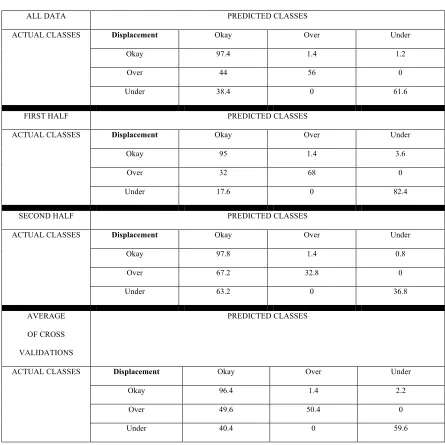
Table 3.3: Confusion matrix for probabilistic generative classification using displacement data.
ALL DATA PREDICTED CLASSES
ACTUAL CLASSES Displacement Okay Over Under
Okay 97.4 1.4 1.2
Over 44 56 0
Under 38.4 0 61.6
FIRST HALF PREDICTED CLASSES
ACTUAL CLASSES Displacement Okay Over Under
Okay 95 1.4 3.6
Over 32 68 0
Under 17.6 0 82.4
SECOND HALF PREDICTED CLASSES
ACTUAL CLASSES Displacement Okay Over Under
Okay 97.8 1.4 0.8
Over 67.2 32.8 0
Under 63.2 0 36.8
AVERAGE
OF CROSS
VALIDATIONS
PREDICTED CLASSES
ACTUAL CLASSES Displacement Okay Over Under
Okay 96.4 1.4 2.2
Over 49.6 50.4 0
Under 40.4 0 59.6
3.2 Discussion of Results for Tables 3.1 to 3.3
The confusion matrices show a consistent decrease in prediction performances
with decreasing frequencies (acceleration is dominated by high-frequencies, velocity by
mid-frequencies, and displacement by low-frequencies) although this decrease is not
significant. Cross validation using the first half of the data set for training and the rest for
validation produces reasonable prediction performances (at least more than 65 percent
accurate predictions). On the other hand, using the second half for training and the first
half for validation gives not so desirable cross validation results. This trend is seen in all
types of input: acceleration, velocity, and displacement. The simplest explanation is that
the models could be suffering from overfitting because we did not use a prior distribution
to provide regularization. We will propose a solution that is robust to overfitting by using
a full Bayesian treatment in the next sections.
3.3 Classification – Probabilistic Discriminative Model with Maximum Likelihood Estimate (MLE)
The following theory is based on the concepts described in Chapter 4, Linear
Models for Classification in Bishop, 2006.
In the previous section, we determined the parameters of the class-conditional
densities,
!
!p
( )
xCk , along with the class priors, !p C( )
k . Then, we used Bayes’ theorem tocompute the posterior class probabilities,
!
!p C
( )
k x . The posterior class probabilities aregiven by a softmax function of a linear function of the input feature vector !x. The
coefficients (parameters !!wk and !!wk0) of the linear function of !x are computed using the
parameters of the class-conditional densities, i.e., !!mk and Σ and the class priors,
The advantage of the probabilistic generative model is that we can create (generate)
synthetic input values, !x, by sampling from the marginal distribution
!
!p
( )
x . However,the predictive performance may decrease, especially when the Gaussian form, which we
used to model the class-conditional densities, does not give a good representation. In this
section, we compute the parameter values in a more direct approach by maximization of
the likelihood function or the posterior probability density function (PDF). By not
modeling the class-conditional densities explicitly, we will have less number of
parameters to determine, and this may lead to an increase in predictive performance.
Directly determining the parameters is an example of a probabilisticdiscriminative
approach.
The likelihood function we want to maximize to determine the parameters
consists of the conditional distributions introduced earlier:
!
!p C
( )
k x . We start with arelabeling of the variables first, and then we simplify as much as possible to avoid clutter
in our mathematical expressions. In the previous section, we obtained the functional form
of the posterior class probability, conditional on an input vector, as (3.4). Using this
definition, let us define
! ! !
yk
( )
x =p C(
k x,wk)
= exp(
ak( )
x wk)
exp(
aj( )
x w j)
j
∑
(3.29)where !ak are called activations and are given by
!
!ak
( )
x wk =wkTx (3.30)
In the expression above,
!
!
!wk= wk0,wk T
(
)
Tand
! !
!x= 1,x
T
( )
T, that is, we augment the input
vector with a dummy input !!x0=1, similar to what we did in the least squares
classification in Appendix C. In order to decrease the clutter in the mathematical
notation, let us redefine the parameters (!w →w and !x→x) such that
!
!
!wk =
(
wk0,wk1,,wkD)
Tand
! !
!x=
(
1,x1,x2,,xD)
T. Then, we consider maximization of
the likelihood function to determine the parameters
!
!
{ }
wk directly.Now, we need the likelihood function. As we mentioned above, it consists of the
posterior class probabilities !
!p C
( )
k x if the prior on the !Ck’s is uniform. We will followthe same !!1−of −K coding scheme as we did above for the target vectors: the target
vector !!tn associated with the input vector !!xn, which is assigned to class !Ck, will be a
unit vector of dimension !!K=3 with each of its elements being zero unless it is the !kth
element, which is one. Then, we obtain the likelihood function as
! !
!p
(
T X,W)
= p C(
k xn,wk)
tnk= ynktnk
k=1 K
∏
n=1 N
∏
k=1 K
∏
n=1 N
∏
(3.31)where the elements !tnk form the matrix !T whose dimension is !N×K with !N as the
number of data points and !K as the number of classes, and !W is formed by !!D+1
-dimensional vector !!wk as its !kth column, and
!X is formed by !!D+1-dimensional vector
!
!xn
T as its
!nth row. So, !W and !X are matrices with dimensions
!
!
( )
D+1 ×K and!
!
! !
ynk= yk
( )
xn =p C(
k xn,wk)
= exp wk Txn
(
)
exp wjTx
n
(
)
j
∑
∈⎡⎣ ⎤⎦0,1 (3.32)Before we start evaluating the probabilistic discriminative model from a Bayesian
perspective, let us use the maximum likelihood method to find !!WMLE by maximizing the
likelihood function given by (3.31). Note that the value we will find is in fact the
Bayesian maximum a posteriori (MAP) value but we are taking a flat (non-informative)
prior for !W, so !MAP≡MLE. I solved this optimization problem by an algorithm
provided by Matlab.
We maximized (3.31) with respect to !W separately for acceleration, velocity, and
displacement input and obtained the following confusion matrices by assigning an input
vector !x to class !Ck, where
!
!
!p C
(
k x,wk)
is a maximum over !!k=1,2,3. Similar to theprevious confusion matrices, we show the predictive performance of our models by cross
validation; we divide the data sets into two: training data set and validation data set. Then
we swap these data sets and average the predictive performances in the form of confusion
matrices.
Let us start with acceleration results. The maximum likelihood estimate (MLE) of
the parameter matrix,
!
!WMLEacceleration, computed using the entire acceleration data set for
! ! ! W MLE acceleration = 2.899 &0.003 0.002 &0.002 &0.008 &1.263 0.018 0.013 &0.118 &0.067 &1.606 0.003 &0.005 0.075 0.117 ⎡ ⎣ ⎢ ⎢ ⎢ ⎢ ⎢ ⎢ ⎤ ⎦ ⎥ ⎥ ⎥ ⎥ ⎥ ⎥ (3.33)
Table 3.4: Confusion matrix for probabilistic discriminative classification with MLE using acceleration data.
ALL DATA PREDICTED CLASSES
ACTUAL CLASSES Acceleration Okay Over Under
Okay 95.2 2 2.8
Over 16.8 83.2 0
Under 21.2 0 78.8
FIRST HALF PREDICTED CLASSES
ACTUAL CLASSES Acceleration Okay Over Under
Okay 88.4 1.4 10.2
Over 12 88 0
Under 9.6 0 90.4
SECOND HALF PREDICTED CLASSES
ACTUAL CLASSES Acceleration Okay Over Under
Okay 97.2 1.8 1
Over 37.6 62.4 0
Under 39.2 0 60.8
AVERAGE
OF CROSS
VALIDATION