Trends and policy issues for the e-learning implementation
in Libyan universities
Thuraya Kenan, Crinela Pislaru, Abdussalam Elzawi
University of Huddersfield
School of Computing and Engineering
Queensgate, Huddersfield HD1 3DH, United Kingdom
Email: [email protected]
Abstract
—This paper provides an overview the current
trends and the policy issues for e-learning implementation in Libyan universities LUs.; where is present a sample model to comparative between two questionnaires in 2009& 2013; as a technique to evolution the e-learning policy implementation process in LUs. The paper emphasizes that in spite of the drawbacks faced by most HE institutions, some have managed to successfully introduce e-learning into their strategies. This paper concludes brief considerations of issues of the implementation policy; difficulties in the process and other challenges.Finally the paper aims into: Provision of a study on overall difficulties of the followed policy initiatives of e-learning implementation into the decision-makers in LUs; provision of conception to the developers to consider the strength and the weakness points when new strategies mode. And provision a set of suggestions for improving the effectiveness of the e-learning systems usage in Libyan HE based on the results of these SWOT analyses.
Keywords
—E-learning implementation, e-learning strategy,
Libyan universities, policy issues.I. INTRODUCTION
The Libyan ICT infrastructure has been destroyed by the war in 2011, but many people (especially young generation) started to use more the social media and Internet tools to communicate with their relatives and the rest of the world. The armed conflict in Libya left the country forced it to “start from scratch” in building up its infrastructure and services []. One of the challenges is the reconstruction and the policy issues to redeveloping the education system because most of the educational institutions and universities in the affected areas have lost their infrastructure and resources. Implementing any type of process that involves change and alters how people work can present difficulties for an organization. Estimates have shown that up to 70 percent of the cost of implementing a major organizational change effort has been linked to managing employee behavior during the transition [2]. The process of transforming organizations’ objectives into strategies that deliver lasting, sustainable change is, to a large extent, dependent on how institutions approach changing everyday processes. When there are major shifts in the processes faculty and staff rely on to do their jobs on a daily basis, senior administration must fully endorse and engage in the
planning, development, and launch of the initiative for it to be successful.
This paper presents the trends and policy issues of e-learning implementation in Libyan universities (LUs) through modern model of SWOT analysis to reflect the evolution of the current implementation strategies. It is obvious that some universities have managed to implement successfully e-learning systems despite the drawbacks faced due to economical, political and social difficulties existing in Libya. The model analyses the actual stage of e-learning implementation in several LUs. to offer appropriate suggestions for improving and to guide the implementation team into the correct performance of e-learning in Libyan HE institutions.
II. THE PROGRESSION OF E-LEARNING IMPLEMENTATION IN LIBYAN UNIVERSITIES FROM 2009 TO 2013.
SWOT is an acronym for Strengths, Weaknesses,
Opportunities and Threats. The ‘opportunity’ and ‘threat’
should both focus on possible future of analysed situation. “ The people who use SWOT might conclude that they have done an adequate job of planning and ignore such sensible things as defining the firm's objectives for alternate strategies” [3]. So it is important to consider various solutions after examining the results of SWOT analysis. SWOT method can be used during the design, development and implementation stages of any project. It is also a convenient tool for the evaluation stage in order to have an initial idea of the future consequences.
A. Strength points:
All respondents have been using the computers for various educational activities as shown in Table 1.
[image:2.595.313.540.80.205.2]
TABLE 1: PERCEPTIONS OF RESPONDENTS OF THE COMPUTER USAGE IN 2009& 2013.
Frequency of computer
usage
No. of qu. 2009
% 2009
No. of qu. 2013
% 2013
Every day 13 20.6% 62 80.5%
3-4 times
every week 22 34.9% 11 14.3%
-2 times
every week 25 39.6% 4 5.2%
Rarely 3 4.7% 0 0%
Never 0 0% 0 0%
The total 63 100% 77 100%
The access of Internet was active since 2000 in most the LUs. [5], and from Table that shows there has been an increase in the interest in technology, Because of the LUs are spending more of their budgets on providing their ICT.
B. Opportunity points:
[image:2.595.57.280.157.299.2]The respondents have chosen the following benefits of using e-learning from a list of options provided in the questionnaire as shown in Table 2. The difference between Qu.2009 & Qu.2013, the question was changed to multi-options.
TABLE 2: PERCEPTIONS OF RESPONDENTS ABOUT E-LEARNING BENEFITS IN 2009& 2013.
Frequency of the benefits
No. of
qu. 2009 % 2009
No. of
qu. 2013 % 2013 Language
skills acquired 37 58.7% 68 88.3%
IT skills
acquired 10 15.9% 73 94.8%
Time
management 7 11.1% 51 66.2%
Comfortable
education 6 9.5% 36 46.7%
New method 3 4.8% 27 35.1%
The total 63 100% Multi-option
question
Even though, the method of question had chanced, but still clear the agreement of acquirement to new languages and IT skills.
C. Weakness points:
The respondents have chosen the following barriers to e-learning implementation front of Libyan universities LU. As shown in in Table 3
TABLE 3: PERCEPTIONS OF RESPONDENTS ABOUT THE BARRIERS OF E-LEARNING IMPLEMENTATION IN 2009& 2013
Frequency of the barriers
No. of qu. 2009
% 2009
No. of qu. 2013
% 2013
Technological
barriers 22 34.9% 25 32.5%
Mismanageme
nt barriers 18 28.6% 31 40.4%
Cultural
barriers 13 20.6% 12 15.5%
Others: such
as cost, etc. 10 15.9% 9 11.6%
The total 63 100% 77 100%
The barriers changed from 2009 to 2013, from the technological to mismanagemenal barriers. This change due to the following short synopsis for each barrier:
. Mismanagement and Other reasons include: the social impact after the war; lack of a general strategy of education linking the different stages of study, with a consequent difficulty in accepting E-learning [6]; lack of common regulations or standards for E-learning in a country, which does not generally approve of such methodology; disapproval from the Ministry of Education for E-learning courses [7]; difficulty in securing accreditation collaboration; the management-corruption and lack of cross-institutional collaboration [8].
2. Technological barriers include: insufficient network and systems infrastructures; weaknesses of E-learning development in HE institutions; difficulties in overcoming initial implementation problems; lack of experience in using technology; lack of provision of robust Internet access; lack of specific student services [9].
3. Cultural barriers include: unfamiliarity with the Internet and related technologies results in lack of appreciation and understanding of E-learning and its benefits; opposition to the adoption of the necessary educational changes (e.g. self-regulation, student centred) required for successful E-learning [10].
D. Threat points:
The answers given by the respondents shown that the following categories display resistance to e-learning implementation in Libyan HE as shown in Table 4.
TABLE 4: PERCEPTIONS OF THE E-LEARNING RESISTORS IN 2009& 2013.
Frequency of the resistance to e-learning
No. of
qu. 2009 % 2009
No. of
qu. 2013 % 2013
Academic staff
(teachers) 18 28.6% 40 51.9%
Training staff 14 22.2% 59 76.6%
Government
team 13 20.6% 22 28.5%
Leadership 10 15.9% 68 88.3%
Students and
scholars 8 12.7% 21 27.2%
The total 63 100% Multi-option
[image:2.595.51.287.502.640.2] [image:2.595.310.544.636.775.2]These results of Strength, Opportunity, Weakness and Threat points reflect the SWOT analysis for the main aspects, which should be considered when developing more effective e-learning implementation strategies. It also presents the reflections of the students, lectuerers, and technical staff on the trial implementation.
Also Rhema and Miliszewska [0] undertook a SWOT study about the e-learning implementation at Data Analysis Department and identified that technological and cultural barriers are hindering the e-learning implementation in University of Gharian-Libya. Artemi and Ajit [11] emphasized that many people perceive the technological barriers as being essential in the e-learning implementation because people need access to modern technology in order to improve the quality of the teaching and learning processes. SWOT analysis is an essential step to analyse various factors before implementing an e-learning solution at any institution, because the success or failure of an e-learning initiative will be directly related to the policy issues that underpins it [12].
III. SWOT MODEL
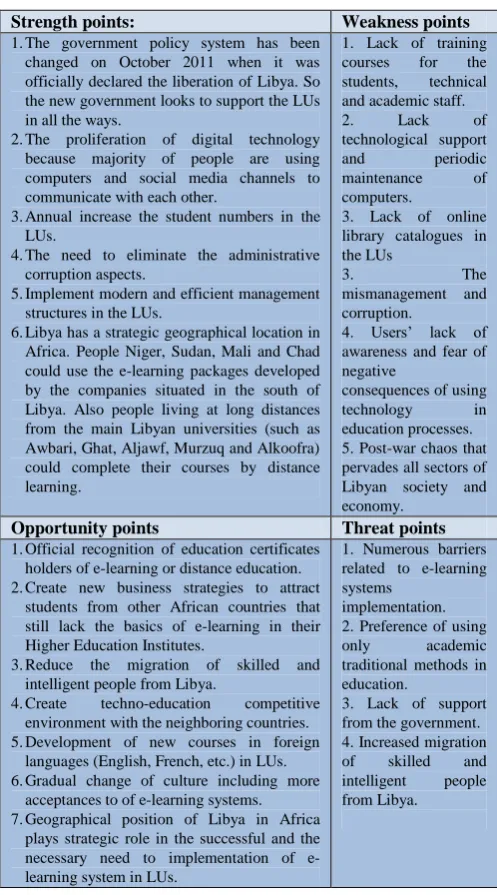
The authors have agreed on that “SWOT analysis is an essential step to analyse various factors before implementing an e-learning solution at any institution” because the success or failure of an e-learning initiative will be directly related to the quality of strategic thinking that underpins it. It is thus important to have an e-learning strategy in place before beginning the implementation process.
This model is based on the personal experiences of the authors who have studied at Tripoli University and then became Lecturers at the same university. Also is based on the study of the latest results related in 2009 to recent SWOT analyses in 2013 of LUs performed by other authors such as (Artemi and Ajit in 2009; Rhema and Miliszewska in 2012). See Table 5.
An e-learning initiative must be tied to the institution’s core business to ensure that that the quality of the educational processes is enhanced [11]. The review recommends that the institutions should start working hard on minimizing the weaknesses (such as poor English skills of students as well as instructors, lacking ICT infrastructure, lack of e-learning know-how, etc). Also the use of blended learning approach will enable the academics and students to have a smooth transition during the e-learning systems implementation [12].
SWOT analysis should help the decision makers at the departmental level to decide on opportunities with respect to e-learning implementation and choose the appropriate policy issues for it, and should be considered: improvement of the learners’ knowledge, learning outcomes, efficiency of the teaching and learning processes and the reductions of costs.
TABLE 5: MODERN SWOT ANALYSIS OF E-LEARNING IMPLEMENTATION IN LIBYAN UNIVERSITIES
Strength points: Weakness points
1. The government policy system has been changed on October 2011 when it was officially declared the liberation of Libya. So the new government looks to support the LUs in all the ways.
2. The proliferation of digital technology because majority of people are using computers and social media channels to communicate with each other.
3. Annual increase the student numbers in the LUs.
4. The need to eliminate the administrative corruption aspects.
5. Implement modern and efficient management structures in the LUs.
6. Libya has a strategic geographical location in Africa. People Niger, Sudan, Mali and Chad could use the e-learning packages developed by the companies situated in the south of Libya. Also people living at long distances from the main Libyan universities (such as Awbari, Ghat, Aljawf, Murzuq and Alkoofra) could complete their courses by distance learning.
1. Lack of training courses for the students, technical and academic staff. 2. Lack of technological support and periodic maintenance of computers.
3. Lack of online library catalogues in the LUs
3. The
mismanagement and corruption.
4. Users’ lack of awareness and fear of negative
consequences of using technology in education processes. 5. Post-war chaos that pervades all sectors of Libyan society and economy.
Opportunity points Threat points
1. Official recognition of education certificates holders of e-learning or distance education. 2. Create new business strategies to attract
students from other African countries that still lack the basics of e-learning in their Higher Education Institutes.
3. Reduce the migration of skilled and intelligent people from Libya.
4. Create techno-education competitive environment with the neighboring countries. 5. Development of new courses in foreign
languages (English, French, etc.) in LUs. 6. Gradual change of culture including more
acceptances to of e-learning systems. 7. Geographical position of Libya in Africa
plays strategic role in the successful and the necessary need to implementation of e-learning system in LUs.
1. Numerous barriers related to e-learning systems
implementation. 2. Preference of using only academic traditional methods in education.
3. Lack of support from the government. 4. Increased migration of skilled and intelligent people from Libya.
IV. POLICY ISSUES AND ACCESSIBILITY CHALLENGES
There are still many challenges that face on the successful policy and suitable strategy of e-learning implementation. These challenges are mainly pedagogical, technological, and attitudinal [13] as follows:
A. Lack of training courses and languages Skills: Although most LUs provide each faculty member with a personal computer, a significant percentage of faculty members are still computer illiterate, and one might reasonably estimate resistance from those members toward any attempt to adopt an e-learning model in their discipline within the university. Also some of faculty members have difficulty with the English language.
[image:3.595.302.551.79.527.2]Staff team in the Arabic universities fear from e-learning that would abruptly shift traditional education into a new pedagogical venture for which lecturers and policymakers are not sufficiently familiar.
C. Strong learner- lecturer power structuration: In Libya had been a strong power structure governing the relationship between a learner and a lecturer, and any learner may feel subservient to the lecturer and this could prove a problem when the learner is asked to discuss his/her views freely with the lecturer.
D. Lack of Arabic learning tools and applications for E-learning courses:
This will be a serious challenge in implementing e-learning into LUs, where Arabic language is the teaching language. But even for the science based colleges where English is the official teaching language, the lack of Arabic learning applications might cause a problem for a large proportion of students.
E. Highest load on the academic staff:
The teaching load in Libyan universities is typically large, for example: the average number of teaching hours for academic staff is 24 hours per week, and Libyan universities have not yet established an academic research tradition [15]. Thus, even professors find it difficult to find the time for research activity and educational development. The Libyan business executive survey/global competitiveness report (LBES/GCR) ranks Libya 97th out of 111 countries in university/industry research collaboration [9]. Some academic staff does undertake extra activities such as writing and publishing, e.g. text books, to increase their income.
F. Lack of official recognition by the qualifications of online studies:
The teaching and learning are the cornerstones of any HEI. However, maintaining the quality of such processes is a continuous challenge. There is no official recognition in Libya for distance or online learning as a valid mode of education and most LUs have not appointed staff members with formal qualifications in either distance learning or online learning [12].
Once the key players are committed to the implementation process, quality control and measurable outcomes must be considered as part of implementation [16]. So the SWOT analysis should look at the main policy issues, the strategy trends (such as the economic situation), social impacts and technological developments.
V. CONCLUSION AND A SET OF SUGGESTIONS FOR THE IMPLEMENTATION OF E-LEARNING STRATEGY IN HE
INSTITUTIONS IN LIBYA
Libyan universities could take many benefits from combining the active learning methods with suitable policy or accessibility into e-learning implementation [8]. Both active learning and e-learning encourage students to use
numerous sources of knowledge, and persuade them to integrate and employ information efficiently.
Libya must be match and compete with the standards of other countries’ universities strategies. This goal is part of Libya’s move towards a knowledge society for which ICT is considered a prerequisite to make decisions about technology issues before the implementation of practical e-learning systems aiming to reduce the investment of time, effort and money.
A. Suggestions to improve the learners’ knowledge and understanding
LUs should hire an adequate number of support staff to be responsible for administrative duties and take this heavy burden away from academic staff. Support staff may be utilized to regularly check that the course content has been updated. The lecturers should share with the learners their availability schedule to let them know when to expect a response from a lecturer. A backup plan should be put in place in cases where the lecturers will be out of reach or unavailable for a long period and staff members should be provided for support. It would be beneficial for the e-learning policies to have the course content available in Arabic and English languages. As the country has not yet reached a stage where most of the learning materials are home developed, it might be premature to suggest course content to be only in Arabic, as English is considered to be the medium of instruction.
B. Suggestions for the universities in implementation of policies
The change policy system must be gives dedication and strong motivation to all the decision makers; and the employees should be encouraged to attend internal and external workshops so the software and hardware packages and the relevant ICT support can be updated continuously [12]. To be successful E-learning should have the affirmative support of senior management and a fixed budget that has been set aside to maintain and develop the facilities. Also, the course lecturers and developers should attend regular training courses related to the new hardware, software and learning management packages. The Libyan learners have different educational experiences based on the geographic location of their colleges and universities: the learners from rich areas (such as Tripoli Town Centre) have access to the latest state-of-the-art technology [13]; learners from suburban areas have a lifestyle similar to more developed countries, and learners from areas such as Al-Koofra city have third world experiences and never saw or used a computer until they reach HE. Therefore, the mindsets and the attitudes towards learning of such diverse learners should be taken into consideration.
C. Suggestions for governmental policies in the LUs
More coordination and resource sharing between different LUs could be of general benefit. Government departments of Higher Education Ministry have all responsibility to sponsor development of technologies in LUs that will produce a workforce that is competent in technologies.
REFERENCES:
[] A. Rhema, and I. Miliszewska, “The Potential of E-Learning in Assisting Post-Crisis Countries in Re-Building Their Higher Education Systems: The Case of Libya”. Issues in informing Science and information technology, 2012, vol. 9, pp. 149-160. [2] J. DYCHE, “The CRM Handbook”, Boston, MA. Addison-Wesley
Pearson Education. Education Economics, 2002, vol. 9, no. 2, pp. 139 -144.
[3] J. SCOTT, “The Value of Formal Planning for Strategic Decisions”. Strategic Management Journal, 1982, 3, 4.
[4] T. Kenan, “The Barriers of E-Learning in Higher Education in Libya”. Published MSc Dissertation, 2009, University of Salford, UK.
[5] M. Porter, and D. Yegin, “National Economic Strategy: An Assessment of the Competitiveness of the Libya”. The general planning council of Libya. 2006, Cera, UK.
[6] T. Kenan, C. Pislaru, and A. Elzawi, “Comparing the impact of E-learning and ICT in Higher Education institutions in Libya and United Kingdom”. ICEIC 2011. Florida, USA, 2010, pp. 162-173. [7] A. Elzawi, and S. Wade, “Barriers to ICT adoption in quality of
engineering research in Libya: how to bridge the digital divide?”. In: Proceedings of The Queen’s Diamond Jubilee Computing and Engineering Annual Researchers’ Conf.; CEARC’12. UK: University of Huddersfield. 2012, pp. 98-103.
[8] T. Kenan, and C. Pislaru, “Challenges related to the implementation of e-learning in higher education institutions in Libya”. In: Proceedings of The Queen’s Diamond Jubilee Computing and Engineering Annual Researchers’ Conference 2012: CEARC’12. Huddersfield: University of Huddersfield. 2012, pp. 116-122. [9] A. Elzawi, T. kenan, S. Wade, and C. Pislaru, “Bridging the Digital
Divide and Enhancing the Quality of Engineering Research in Libyan Universities”. In: 6th Conference on Quality in Middle East, 2012, Hamdan Bin Mohammed University, 2012, Dubai, Unpublished.
[0] A. Rhema, and I. Miliszewska, “Reflections on a Trial Implementation of an E-Learning Solution in a Libyan University”. Issues in informing Science and information technology, 2011, 8, 16. [11] M. ARTEMI, & K. AJIT, “A SWOT Analysis of E-Learning Model for the Libyan Educational Institutions.” In: UNIVERSITY, A.-A. (ed.) The 3rd National Conference of Basic Science. Aljabal-Algharbi University, 2009, Gharian – Libya.
[12] T. Kenan, C. Pislaru, and A. Elzawi, “Novel SWOT Analysis of E-learning Implementation in HE Institutions in Libya”. In: Intenational journal on E-learning (IJEL): Association for the Advancement of Computing in Education (AACE), 2013. to be published
[13] T. Kenan, C. Pislaru, and A. Elzawi, “Analysing the effectiveness of e-learning based on national and international cultures and approaches to pedagogy”. In: 17th UKAIS Conf. on Information Systems, March 2012,UK. 2012, New College, Oxford University (unpublished)
[15] A. Elzawi, and J. Underwood, “How Higher Engineering Researchers in Libya Perceive The Use of Internet Technology”. The International Arab Conf. on Information Technology (ACIT'2010 ), University of Garyounis, Benghazi, Libya, 2010, pp. 89-98.
[16] T. P.JAN, R. GARY, & GENTRY. “Developing an e-learning strategy in higher education”. Western Governors University. USA: Emerald Group Publishing Limited. 2009.
Mrs. Thuraya kenan (Tripoli / Libya, 1974) is a Member (M) of Association for the Advancement of Computing in Education (AACE) with start 2013, the Digital Library for Education & Information Technology (EdITLib) in 2012, and Institution of Engineering and Technology (IET) in 2011. She obtained BSc in Electronic& Computer Engineering from University of Sabratha, Libya in 1998. Then she received MSc in IT Management from the University of Salford, UK in 2009.
Mrs. kenan is currently a PhD researcher in the School of Computing and Engineering at the University of Huddersfield, UK. She is the author of six conference papers and two journal papers and her current research explores issues in the fields of e-Learning design, methodologies, policy issues, standards; social impact and cultural issues in e-Learning; virtual learning environments; Internet and emerging technologies; audio and video technologies for e-Learning; assessment and feedback for online courses; using technology for modern Higher Education courses; innovative curriculum in E-Learning; instructional design for E-Learning and knowledge management in E-Learning
Dr. Crinela Pislaru became a Member (M) of IEEE in 1999. She obtained MEng (Distinction) degree in Electrical and Electronic Engineering from Transilvania University Brasov, Romania in 1991. She received her PhD in Control Engineering 2001 and MSc in Multimedia and E-learning from the School of Education and Profesional Development, University of Huddersfield in 2008. She is currently Senior Lecturer in the Engineering and Technology department at the University of Huddersfield, UK. She is the author of over 100 refereed publications and reviewer for several internationally leading journals. Dr Pislaru’s pedagogical research is focused on the underpinning knowledge and behaviours needed for academic staff to work across boundaries and develop intelligent learning technology and interactive E-learning systems. They should attract and engage industry and successfully guide and support the development of a sustainable engineering and informatics workforce able to learn and operate in a digital age.
Dr. Pislaru is a Fellow of Higher Education Academy (FHEA) and Leader of Pedagogical Research group within the School of Computing and Engineering at the University of Huddersfield, UK. She is the Chair of West Yorkshire network of the Institution of Engineering and Technology (IET) and Member of UK Engineering Council and ASPE (American Society for Precision Engineering). Dr Pislaru is a reviewer for ten internationally leading journals and Engineering and Physical Science Research Council (EPSRC) projects and external examiner for international institutions.
Mr.Abdussalam Elzawi (Tripoli/Libya, 1965) is a PhD researcher in the Computing and Engineering school ( Department of Informatics ) at University of Huddersfield in the UK. He focused on the ICT applecations; the digital gap and Internet’s performance in the Higher Education Institues in Libya, development it and many isusse related on throgh his research. Now, He is a membership in IET and good experince in the analysis the issuses of the digital gap in Libyan Higher Education Institutes due to his publications,which are about Five in this felid.