The London School of Economics and Political Science
Hegemony, Transformism and Anti-Politics: Community-Driven
Development Programmes at the World Bank
Emmanuelle Poncin
A thesis submitted to the Department of Government of the London
School of Economics for the degree of Doctor of Philosophy.
Declaration
I certify that the thesis I have presented for examination for the MPhil/PhD degree of the London School of Economics and Political Science is solely my own work other than where I have clearly indicated that it is the work of others (in which case the extent of any work carried out jointly by me and any other person is clearly identified in it).
The copyright of this thesis rests with the author. Quotation from it is permitted, provided that full acknowledgement is made. This thesis may not be reproduced without my prior written consent.
I warrant that this authorisation does not, to the best of my belief, infringe the rights of any third party.
I declare that my thesis consists of 99,559 words.
Statement of use of third party for editorial help
Abstract
This thesis scrutinises the emergence, expansion, operations and effects of community-driven development (CDD) programmes, referring to the most popular and ambitious form of local, participatory development promoted by the World Bank. On the one hand, this thesis draws on the writings of Antonio Gramsci to explore new ways of contextualising and understanding CDD programmes along the lines of hegemony and transformism, as promoting social stability and demobilising counter-hegemonic challenges under conditions of democratisation and decentralisation, in support of economic liberalisation. On the other hand, it scrutinises the performative operations of CDD discourse in producing, legitimising and reproducing interventions, along the lines of "anti-politics," inspired by the Foucauldian approaches of James Ferguson and Tania Li. It also examines the performances elicited by CDD discourse, which "hails" politicians as "progressive" leaders, and "interpellates" the population as an "empowered" and "civil" society.
Contents
List of Figures and Tables...7
Acknowledgements ...8
List of Acronyms ...9
Chapter 1–Introduction ...11
A New Paradigm in Local Development ...11
CDD as Instrument of “Good Governance”: The Liberal CommunitarianView ...14
Empirical Record ...17
“Social Capital” and “Empowerment,” Revisited...21
Anti-Politics Machine ...27
Hegemony and Transformism...33
A Material-Discursive Analytical Framework of CDD Programmes...39
Methodology and Data Sources ...45
Research Design and Methodology ...45
Scope and Limitations...49
Sources...52
Thesis Overview...54
Chapter 2–The Emergence and Rise of CDD Programmes Worldwide...56
Free Market and Oligarchical Democracies in the 1980s ...59
Bringing the State back in: “Good Governance” in the early 1990s...65
The Emergence of CDD Programmes: The Cases of Brazil and Mexico...72
Mexico...72
Brazil...78
Bringing Society Back in: “Civil Society” and “Empowerment” at the Bank...84
The Evolution and Expansion of CDD Programmes: Indonesia’s KDP and Beyond...92
Conclusion...103
Chapter 3–Kalahi in Philippine Oligarchical Democracy ...108
Oligarchical Democracy...117
Crises and Transformist Responses ...120
People Power II ...127
The Emergence of Kalahi and the 2004 Elections ...131
The Kalahi Vision ...136
Expansion...141
Conclusion...143
Spanish Colonial Rule (1521-1898)...153
American Colonial Era (1898-1946)...156
Post-Independence Commercialisation of the Economy ...161
Going Global ...166
Tourism ...168
Agriculture ...171
Local Growth Coalition...174
Contestation, Containment and Counterinsurgency...178
Conclusion...184
Chapter 5– The “Enabled” Environment...188
Kalahi Operations in Bohol: An Overview ...194
The Rise of “Progressive” Leaders in the 1990s...203
The Aumentado Provincial Administration, 2001-2010...206
Electoral Domination and Development ...213
Performing Kalahi in Bohol’s Municipalities...216
Counterinsurgency-led Development...224
Conclusion...230
Chapter 6–Institutional Interests, Priorities and Pressures at the World Bank and the Philippine Department of Social Welfare and Development ...235
The Lending Race ...239
“Organizational Need for Ignorance” at the Social Development Department...242
The Knowledge Bank...250
The Philippine Department of Social Welfare and Development...256
Conclusion...265
Chapter 7– Performing CDD at the World Bank: CDD Practitioners’ (Self-) Representations of CDD Programmes ...269
The Two Spheres of CDD Programmes...271
Paradoxical Positions ...279
Performed Representations ...283
Tailoring and Improving ...287
A Fragile Edifice? ...291
Conclusion...295
Chapter 8–Conclusion ...298
CDD Programmes as Instruments of Hegemony, Transformism and Anti-Politics ...298
Revisiting the Argument ...302
Annex 1–Coded List of Interviewees...323
List of Figures and Tables
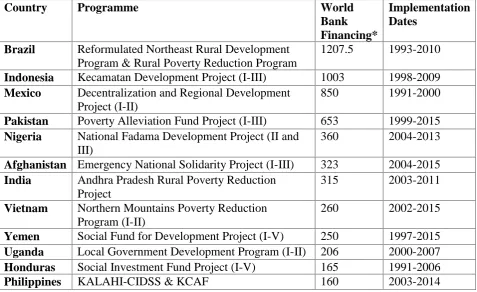
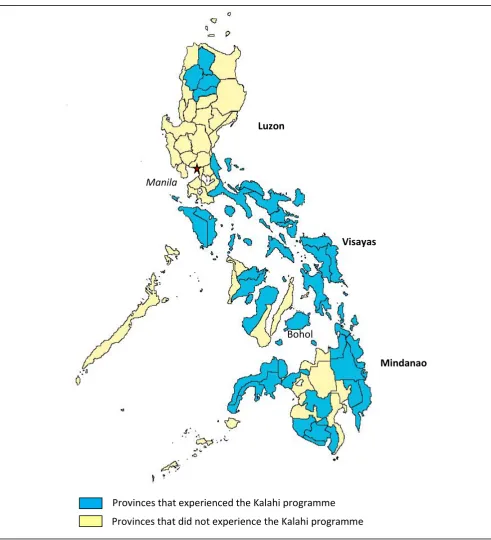
Table 1–Top 12 CDD Programmes Financed by the World Bank Worldwide...99 Figure 1–Provinces that Experienced Kalahi in 2003-2009...109 Figure 2– Illustration of the Kalahi “Story of Radical Change” Entitled “Peace Means
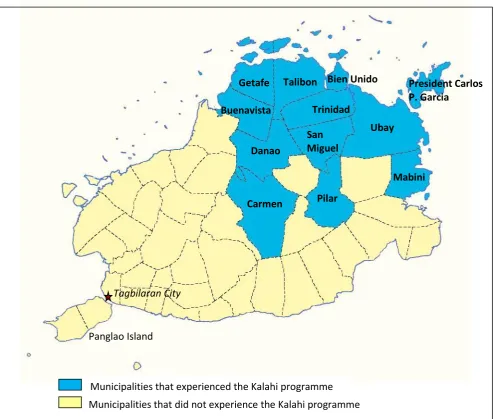
Walking the Same Road,” Province of Lanao del Norte, Northern Mindanao...140 Figure 3–Illustration of the Kalahi “Story of Radical Change” Entitled “Our Town Folk Pull off an Electrifying Victory,” Province of Siquijor, Central Visayas...140 Figure 4–Municipalities that Experienced Kalahi in Bohol between 2003 and 2009...189 Table 2–Poverty Incidence amongst Population (%) in Kalahi Municipalities, Bohol,
Acknowledgements
To John Sidel, my supervisor, who has been incredibly patient and supportive throughout the past four years, and who has enabled me to turn my often unruly ideas into a PhD thesis through his many comments and suggestions, I am truly indebted and very grateful. Thanks also to Mathias Koenig-Archibugi, my advisor, for patiently reading my chapters, discussing them with me, and encouraging me to question and consolidate my arguments.
I am very grateful to all the people who have shared their experiences of development in Bohol with me, and to my Boholano friends, who made me feel at home during my stay there. Thanks also to the many people I met in Manila and in Cebu, in development organisations, government departments, universities, NGOs, and research institutes, for their insights on community-driven development in the Philippines, which have encouraged and inspired me during this research.
I am grateful to the people from World Bank offices in Manila and in Washington, D.C., for taking the time to answer my many questions on CDD programmes; their insights into the world of community-driven development in the Philippines and beyond have been crucial for this thesis.
Although in the past two years, I spent most of my time working from my kitchen table, I have not felt lonely, thanks to the many phone converstations with my grandmothers, Huguette and Jeanne, my aunts, Brigitte and Pascale, and my parents, which have helped me to keep abreast of all the latest family gossips. Patricia, my mother-in-law, and Neil, my brother-in-law, have also always been nearby to share a cup of coffee or redbush during a break.
I owe some of my best breaks to my brother, Nicolas, whose great movie advice has helped me to completely switch off, and remember that there is a world outside of my PhD. Throughout these four years, my father, Philippe, has been particularly good at letting me complain about my work, whilst my mother, Madeleine, has been my main reader and supporter.
List of Acronyms
ADB Asian Development Bank
AFP Armed Forces of the Philippines
APCR Apoio às Pequenas Comunidades Rurais (Support to Small Rural
Communities)
BAMDECOR Bohol Agro-Marine Development Corporation
BAYAN Bagong Alyansang Makabayan (New Patriotic Alliance)
CBD Community-based Development
CDD Community-driven Development
CIDA Canadian International Development Agency
COMELEC Commission on Elections
CPP Communist Party of the Philippines
DENR Department of Environment and Natural Resources DFID Department for International Development
DRD Decentralization and Regional Development DSWD Department of Social Welfare and Development
EDSA Epifanio de los Santos Avenue
FARDEC Farmers Development Center
FCB First Consolidated Bank
FDN Frente Democrático Nacional (National Democratic Front)
GATT General Agreement on Tariffs and Trade
GDP Gross Domestic Product
GNP Gross National Product
GOLD Governance and Local Democracy
HUMABOL Hugpong sa mga Mag-uumang Bolanon(Bohol Farmers’ Association)
IBDR International Bank for Reconstruction and Development IDA International Development Association
IFAD International Fund for Agricultural Development
IMF International Monetary Fund
IPAG Investment Promotion Advisory Group
JBIC Japan Bank for International Cooperation JICA Japan International Cooperation Agency
KALAHI-CIDSS Kapit Bisig Laban sa Kahirapan (Linking Hands in the Fight against
Poverty)-Comprehensive and Integrated Delivery of Social Services Kalahi OBAMA KALAHI Operation for Barangay and Municipality Assistance
KCAF KALAHI-CIDSS Additional Financing
KDP Kecamatan Development Project
KMP Kilusang Magbubukid ng Pilipinas (Peasant Movement of the
Lakas-Kampi-CMD Lakas (Strength)-Kabalikat ng Malayang Pilipino (Partner of the Free
Filipino)-Christian Muslim Democrats
Lakas-NUCD Lakas-National Union of Christian Democrats
LDP Laban ng Demokratikong Pilipino (Fight of Democratic Filipinos)
MAKAMASA Bohol Makusganong Kapunungan sa mga Gagmayung Mananagat sa Bohol (Federation of Small Fishermen in Bohol)
MCC Millennium Challenge Corporation
MILF Moro Islamic Liberation Front
MPDC Municipal Planning and Development Coordinator NEDA National Economic Development Authority
NGO Non-governmental Organisation
NPA New People’s Army
NSCB National Statistical Coordination Board
ODA Official Development Assistance
OED Operations Evaluation Department
OPLAN Bantay Laya Operational Plan Bantay Laya (Freedom Watch) PALM Philippine Agricultural Land Development and Mill
PDI-P Partai Demokrasi Indonesia Perjuangan (Indonesian Democratic Party
of Struggle)
PDMS Poverty Database and Monitoring System
PFL Partido da Frente Liberal (Liberal Front Party)
PMDB Partido do Movimento Democrático Brasileiro (Brazilian Democratic
Movement Party)
PO People’sOrganisation
PRI Partido Revolucionario Institucional (Institutional Revolutionary
Party)
PRONASOL Programa Nacional de Solidaridad (National Solidarity Program)
PT Partido dos Trabalhadores(Workers’ Party)
R-NRDP Reformulated Northeast Rural Development Program
SEARICE Southeast Asia Regional Initiatives for Community Empowerment
UNICEF UN Children’s Fund
USAFFE United States Armed Forces Far East
USAID United States Agency for International Development
Chapter 1
–
Introduction
A New Paradigm in Local Development
Community-driven development (CDD) refers to the most popular and ambitious form of local, participatory development advanced by the World Bank (alongside other major development organisations) in the past two decades. CDD programmes allegedly promote four overarching, interrelated aims, namely (i) establishing “good governance,” broadly understood as the efficient delivery of public goods and services supported by a capable
bureaucracy; (ii) “empowering” communities, referring to “the expansion of assets and capabilities of poor people to participate in, negotiate with, influence, control, and hold
accountable institutions that affect their lives” (Narayan2002, 14; emphasis in original); (iii)
building “social capital” understood as “the norms and networks that enable collective
action” (World Bank 2011f); and (iv) alleviating poverty. In theory, CDD programmes directly provide communities with resources, in the form of training, facilitation and information for them to prepare their own development project proposals in a participatory manner. Communities are then asked to compete over block grants to finance their proposals, and, if successful, to become responsible for implementing, managing, operating, monitoring and maintaining their projects, for which they receive further training and supervision, and must provide local contributions towards projects’ costsin cash and/or in kind.
The experience of CDD programmes is expected to increase community members’
“voice,” and “empower” them to actively participate in public affairs and hold their government accountable (Alsop et al. 2006, 11-12; Appadurai 2004). CDD programmes supposedly enhance the supply-side of governance, moreover, by building local government
officials’ policy-making and service-delivery capacities, fostering their “innovative” and “progressive” potential and encouraging “synergistic” relationships between communities and the state. In short, CDD programmes appear to have adopted a holistic approach to local development, whichpromises to deliver “good governance” and “community empowerment”
in support of democratisation and decentralisation reforms throughout the developing world (Wong and Guggenheim 2005; Chase and Woolcock 2005; Narayan 2002; World Bank 2003; Binswanger-Mkhize et al. 2009b). In view of their exceptionally promising premises, CDD programmes have been promoted as the alternative to top-down development (McCalla and Ayres 1997), and have quickly been elevated to the status of a new paradigm in local, participatory development at the World Bank (Binswanger-Mkhize et al. 2009b).
The Bank has presented the rapid expansion of CDD programme across the developing world as a relatively straightforward enterprise,likened to that of a McDonalds’
franchise: it starts with small-scale field testing of a simple institutional model, follows with diagnostic and pilot phases for scaling up, to refine procedures, logistics and tools, and goes
for “mass replication,” whilst reportedly still adapting the model to specific socio-economic contexts“just as McDonalds adapts burgers for different countries (in Japan it sells a teriyaki burger, in India a potato burger)” (Binswanger-Mkhize et al. 2009a, 5). The rationale for such an expansion was formulated in terms of extending the benefits of CDD programmes as widely as possible, as CDD proponents at the World Bank have asserted that:
“We all are familiar with islands of success in community-driven development. These empower a few villages, urban neighborhoods, or producer organizations in a country. How wonderful if they could be scaled up to cover all communities in a province or nation!”(Binswanger-Mkhize and Aiyar 2009b, 47)
Despite such enthusiastic claims, it is striking that the rapid and far-reaching expansion of CDD programmes has taken place in the absence of conclusive empirical evidence on the operations and effects of these programmes on local governance, empowerment and social capital, as revealed by the close examination of CDD’s empirical
CDD as Instrument of “Good Governance”: The Liberal Communitarian View
The World Bank’s representation of CDD programmes as instruments of “good governance” – empowering communities and building social capital whilst also alleviating poverty – is strongly anchored in the intellectual tradition of Tocquevillean communitarianism, integrated within a mainstream liberal economic framework based on assumptions of methodological individualism and free market principles. As such, this representation finds a strong resonance with a large body of mainstream academic literature concerned with the role of civil society in democratic societies. This work has contended that civic engagement is the key to make democracy work, following the influential writings of Alexis de Tocqueville, the nineteenth century French aristocrat disillusioned by what he saw
as the failure of the French democratic revolution to significantly shape the “laws, ideas,
customs, and manners, [...] necessary to render such a revolution beneficial” (1848, 6). In his study of American democracy, Tocqueville celebrated civil society, the realm of voluntary citizen association, as the key to truly democratic societies. He depicted voluntary associations as governed by the rule of law, reason, and free will, and as promoting any aim
that “the human will, seconded by the collective exertions of individuals,” hopes of attaining,
in particular “public order, commerce, industry, morality, and religion” (ibid., 205). Tocqueville further proposed that through associational life, free and equal citizens learn democratic values and become “empowered,” by “learn[ing] voluntarily to help each other”
(ibid., 115). Thus he viewed a vibrant civil society as a necessary condition for democratic
societies to thrive, protected from both the “tyranny of the majority” and the tyranny of
government, concludingthat “in the end political institutions never fail to become the image and expression of civil society” (ibid., 203).
that the quality and performance of democratic institutions mirror the “civicness” of the societies in which they operate inspired a large body of literature which identified a dense, vibrant, plural civil society as a prerequisite to (re)democratisation and democracy consolidation. For instance, American sociologist and political scientist Larry Diamond (1999) proposed that the likelihood of (re)democratisation and democratic consolidation is proportional to the vibrancy of civil society, which he presented as a pluralistic, market-oriented actor concerned with the promotion of democracy and of the public interest, and serving the dual role of restricting and legitimising state power by holding the state accountable to the rule of law. In turn, in their comparative study of democratic transition in South America and Southern, Eastern and Central Europe, Juan Linz and Alfred Stepan, professors of political science at Yale and Oxford University respectively, identified a “lively and independent civil society” as the first necessary condition for democratic consolidation, proposing that a “robust civil society, with the capacity to generate political alternatives and
to monitor government and state can help [democratic] transitions get started, help resist reversals, help push transitions to their completion, help consolidate, and help deepen democracy” (1996,9).
Taking a different approach in their study of civil society, high-profile social and political scientists in leading American universities have sought to determine and quantify features of social organisation that could enhance the effectiveness of societies, such as social norms (Coleman 1990) and social trust (Fukuyama 1996). One of the most influential articulations of the (quantifiable) link between the quality of democratic governance and the features of social organisation has been offered by Harvard professor Robert Putnam’s theory
degree of “civicness” of societies, understood as citizens’ participation in public affairs,
political equality, solidarity, trust, tolerance, and associational life (Putnam 1993, 87–90). For Putnam, civicness itself stems from social capital, defined as the “features of social
organization, such as trust, norms, and networks, that can improve the efficiency of society by facilitating coordinated actions”(1993, 167). In Putnam’s view, membership in voluntary associations imparts their members with shared social norms and trust, as well as civic virtues of collaboration, collective action, and self-discipline, which are in turn expected to give rise to compelling, collective citizens’ demands for “good governance.” Hence the conclusion
that “building social capital [...] isthe key to making democracy work” (ibid.,185).
Building on Putnam’s work, others have sought to incorporate the state into theories of social capital. For instance, development scholars and practitioners have proposed that social capital that“spans the public-private divide” encourages government and civil society organisations to mutually support each other, as they become enmeshed through social networks, which reportedly produces “state-society synergy” and promotes “good governance” (Evans 1996a and 1996b; Woolcock and Narayan 2006; Tsai 2007). A large body of mainstream literature on participatory democracy has advanced similar arguments, proposing that to be effective as an agent of democratisation or democratic deepening, civil society must be supported by “reformist” and “progressive” government officials, who are both willing and able to open up participatory avenues in government and to meet societal demands for“good governance”(Herzer and Pirez 1991; Fox 1994; Fung 2002).
Viewed in the light of mainstream literature on civil society and participatory democracy, CDD programmes appear as sophisticated instruments of “good governance.”
decision-making, promoting principles of transparency, accountability and broad-based participation
inclusive of “vulnerable” groups, in particular “the poor;” and (iii) stimulating interactions and trust between the state and communities to foster “synergy” between the state and society, thus “creating the conditions that produce, recognize, and reward good governance”
(Woolcock and Narayan 2006, 43). To further “empower” community members and
stimulate their civicness, social capital accumulation is complemented by activities seeking to enhance their access to information and skills, and to habituate them to norms of participation, transparency, accountability and competition. Considered against the backdrop of liberal communitarian theories, CDD programmes must thus be understood as very
promising instruments of “good governance,” which, in the words of a leading architect and supporter of the CDD approach at the World Bank, represent platforms where communities
“learn about democracy by practicing it”(Guggenheim 2006, 138).
Empirical Record
Examining the evidence on CDD programmes’ operations and effects highlights the limitations of the approach. The scrutiny of CDD programmes’ empirical record of “good governance,” including “community empowerment” and social capital, reveals that evidence is scarce, largely anecdotal and decidedly inconclusive. Successive reviews of CDD
programmes’ operations and impacts, conducted by World Bank staff and consultants, have pointed towards a conspicuous lack of evidence to back up claims that CDD programmes empower communities and improve local governance. For instance, in their review of programmes adopting a CDD approach or the closely-related community-based development (CBD) approach,1World Bank economists Ghazala Mansuri and Vijayendra Rao highlighted
participatory elements of a CBD [or CDD] project,” further stressing the “dearth of well-designed evaluations of such project”(2004, 1; emphasis in original). In response to Mansuri
and Rao’s alarming findings,World Bank staff attempted to conduct a meta-analysis of CDD impact evaluations, which was deterred by the low quality of existing evaluations (Wassenich and Whiteside 2004). This lack of solid evidence on the operations and effects of CDD programmes led the World Bank Operations Evaluation Department (OED) to remark that the Bank “has lacked a comprehensive understanding of the evolution and scope of its work” in the area of CDD (2005, 49; emphasis in original). Two years later, Mansuri and Rao (2007) published an update on the state of evidence on the operations and impacts of CDD programmes, which pointed out that very little evidence had emerged since their first review, in 2004.
Moreover, the little evidence available on the operations and effects of CDD programmes in terms of governance, empowerment and social capital has proven largely inconclusive. For instance, empirical studies have suggested that “elite capture” of CDD processes and benefits has been frequent, and that CDD programmes have occasionally triggered violent struggles for control over development resources (Woodhouse 2002; Ponzzoni and Kumar 2005; Dasgupta and Beard 2007; Crost and Johnston 2010; Arcand et al. 2010). Evidence on the effects of CDD projects on collective action and social cohesion has also been contradictory and inconclusive. Research has indicated that whilst CDD programmes have appeared to stimulate social capital in some cases, they have disrupted existing social networks and have weakened local “capacitiesfor collective action” in others
“Empowerment efforts from the bottom up, such as community driven development (CDD), can address real needs and are more inclusive than elite-dominated local
governments. However, these interventions may limit poor people’s potential to
enhance political capabilities by de-mobilizing them” (Alsop and Norton2004, 8).
In their third and most recent review of the Bank’s participatory interventions, including
CDD programmes, Mansuri and Rao thus concluded that:
“The evidence we do have, shows that participation has little effect on the exercise of
voice or on community organized collective action outside the participatory project.
Instead, some evidence points to a decline in collective activities outside the needs of the project” (2011, 68; emphasis in original).
In view of such a poor empirical record, professionals at the World Bank (and beyond) have largely held the view that “CDD rests on a commitment among local leaders to empowerment” (Poteete in World Bank 2003, 2).2Illustrating this trend, several studies have proposed that CDD interventions havea positive effect as instruments of “good governance”
only in better-off, “enabled” environments, where they can supposedly “support nascent or
existing practices of good governance or community empowerment” (McLaughlin et al. 2007, xi; see also OED 2005a; McLean et al. 2005; World Bank 2009a).3As remarked in the case of the Philippines, the adoption and institutionalisation of CDD principles to guide processes of decision-making and resource allocation in local governance is most likely to happen in places “where the mayor recognizes the value of community empowerment”
(World Bank 2004a, paragraph 67), since“the expansion of opportunity spaces toincorporate participation, accountability and transparency can only be led by an LCE [local chief 2
executive] who is willing to “share power”” (DSWD-DILG 2009, 23). The influence of this argument within the Bank has been increasingly reflected in the deployment of CDD programmes, whose expansion in localities across the developing world has often become conditional upon local leaders’ performances. Thus CDD programmes have been used as
rewards for “progressive” politicians who appear to be “genuinely committed to shifting power to the grassroots” (Binswanger-Mkhize et al. 2009a, 9), by offering them the opportunity to “not only get bigger budgets but also build reputations and advance their political careers”(Binswanger-Mkhize et al. 2009b, 155).
The causal link between local leaders’ “progressiveness” and the quality of
governance is strongly supported by a branch of mainstream literature on decentralisation and democratisation, which has explained local governments’ performances in terms of the character or agency of local government officials (Rodrik 1996; Grindle 2007; von Luebke 2009).4 For instance, Harvard professor of international development Merilee Grindle found
that the main determinant of local governments’ performance was theindividual leadership of local government officials, understood as their “[i]deas, leadership skills and the strategic
choices made to promote a reform agenda” (2007, 11), as well as their “commitments,
personality, persistence, and political networks” (ibid., 171). However, the conclusion that
local leaders’ “vision” or “reform-mindedness” is the main determinant of CDD
programmes’ operations and effects in communities across the developing world has been formulated intuitively, rather than on the basis of solid empirical evidence.
Taking a different approach to explain the poor empirical record of CDD programmes, others at the World Bank have highlighted that since villages or communities are not egalitarian and socially-homogenous entities,
4
“it cannot be assumed that community-driven approaches to development will per se increase the possibilities for broader-based participation in political, social and economic processes [...] in certain instances, they may exacerbate the exclusion of locally disempowered groups from access to public decision-making processes and public resources” (Bebbington, Dharmawan et al. 2004, 201).
In a similar vein, the OED evaluation of the World Bank’s portfolio of CDD programmes
concluded that:
“In the end, the Bank should be aware that it is largely trying to use a single financial channel— project financing—to bring about changes in empowerment and social capital, which are affected by a long history of social, cultural, and political forces embedded in the societies in which the Bank is trying to support development. [...] when the Bank tries to initiate empowerment and enhance social capital through CBD/CDD projects, it is often not enough—or can even be counterproductive if the better-off sections of the community gain more than the less-well-off” (OED 2005a, xiv).
These remarks point towards more fundamental shortcomings of CDD programmes as instruments of “good governance,” whose roots can be traced back to Tocqueville’s view of civil society as the egalitarian terrain where participatory democracy is produced and guaranteed.
“Social Capital”and“Empowerment,”Revisited
According to some very visible proponents of CDD programmes at the World Bank, the CDD approach has marked the reintroduction of a long-absent awareness of social structures, politics, power, and culture in local development interventions. It supposedly reflects theBank’srecognition that issues of community development cannot be regarded as
“technical problems,” and allegedly represents a move “away from a construct that sees
been challenged by a large body of critical literature that has carefully analysed the key CDD concepts of empowerment, civil society and social capital, highlighting their underlying apolitical, decontextualised and sanitised quality (Jenkins 2001, Cornwall and Eade 2010), which hasbeen inherited from Tocqueville’s treatment ofcivil society in the early nineteenth century.
In his study of the nineteenth-century United States, Tocqueville sought and reportedly saw the “image of democracy itself” (1848, 13), identifying the“general equality of conditions” as the most striking and fundamental characteristic of American society (ibid., 1). Tocqueville’s assumption of egalitarian, classless society has largely persisted, often unacknowledged, in mainstream academic writings on civil society and social capital at the turn of the twenty-first century. Thus, armed with horizontal modelling of the social world, divided into communities endowed with greater or lesser stocks of social capital and greater or lesser levels of empowerment, mainstream development scholars have identified the root
causes of “underdevelopment” as “incorrect” social organisation and “deficient” individual
agency. They have depicted civil society as a unified terrain representing the shared interests
of “the people,” where social capital is used to counterbalance the power of the state, and, if necessary, to rise in defence of democracy.
Assumptions of horizontally-structured societies peopled by utility-maximising agents have led Putnam to postulate that “poor governance” largely results from “dilemmas of collective action” – when imperfect information or externalities5 lead rational individuals, who would be better off if they resorted to collective action, to act alone and selfishly.6 As
5In this context, an externality is understood as an “uncompensated interdependency,” which arises “whenever the behavior of a person affects the situation of other persons without the explicit agreement of that person or
persons” (Buchanan in Kollock 1998, 188).
6This postulate is based on the logic of a handful of classic parables in game theory, such as the classic tragedy of the commons, where herders who are granted unlimited access to an open, communal pasture are all
social capital allegedly stimulates flows of information, as well as social trust and norms of cooperation, it supposedly allows individuals to overcome these dilemmas and to become
part of a vibrant civil society, which is, according to Putnam and others, key to “good
governance” and democracy.However, this set of propositions is only theoretically valid if it is built upon an assumption of classless, egalitarian societies ruled by market laws.
When dimensions of power, politics, inequality and contestation are reintroduced in the analysis, the chain of causation outlined above crumbles, as heterodox analysts have shown. Most notably, French sociologist Pierre Bourdieu (1980) showed that when adopting a vertically-structured model of analysis, where individuals are solidly anchored to their respective social positions, and where practices are influenced by social milieux, social capital reinforces existing social structures by reaffirming relations of domination between members of different social classes. He proposed that individuals use their social capital, understood as social relationships and networks, to serve their own, private interests and to obtain benefits, within the boundaries delimited by their social positions (ibid.). In other
words, social capital reaffirms individual’s social positions, reinforcing both the dominance of the more powerful and the low status of the subaltern classes.
In turn, John Harriss warned us that in the World Bank’s discourse, “social capital”
has taken the quality of “buzz-word,” often deployed alongside “civil society,” “participation,” and “empowerment” to create an “attractive” yet “deceptive” discourse, which has been “used to veil the nature and the effects of power, and [...] hold out the prospects of democracy (in ‘civil society’) without the inconveniences of contestational politics and of the conflicts of ideas and interests that are an essential part of democracy”
market expansion (ibid.; see also Cornwall 2010). In turn, Ben Fine (1999, 2001, and 2003) has explored theories of social capital inspired by Putnam’s writings, which have gained
prominence at the World Bank and in mainstream development studies. Fine has shown that adopting an all-encompassing, ill-defined notion of social capital has enabled the Bank to treat societies and governments as imperfect markets to correct,7remarking that:
“Social capital is truly analytically barbaric, not least because it is parasitic. It takes
existing literature and its corresponding concepts. It strips them of their complexities, diversities and traditions. It reconstructs them in its own bland image” (2003, 598).
As both Fine and Harriss concluded, social capital has no demonstrable link with the quality of governance, or with civicness and democracy.
These insights help us to make sense of the wealth of evidence challenging the causal link between social capital and the quality of governance. For instance, empirical studies have found that strong ties between communities and state representatives form a fertile ground for corruption, clientelism and rent-seeking (Matin and Hulme 2003; Putzel 2000; Dasgupta and Beard 2007). They have identified trust and reciprocity as the basis of political patronage, enabling politicians to tightly control their constituencies, directly or through brokers, and encouraging “elite capture” and corruption (Matin and Hulme 2003; Auyero 2000). Empirical research hasalso highlighted that citizens’ capacity for collective action is often used to advance personalistic rather than civic interests. For instance, in her recent study of local governments in Mexico, Grindle concluded that whilst citizens have a great capacity to organise and petition their governments, they mostly use it to extract resources for their private gain, rather than to demand“good governance”(2007, 124–143).
In turn, the conception of empowerment as agency-building, equipping individuals with new assets in the form of enhanced skills, experience, information and civic values, is 7
based on the assumption that issues of “non-participation,” “voiceless-ness” and “powerless
-ness”stem mainly, if not solely, from a deficit of agency. However, analyses of the interplay
between social structures and individuals’ political practices and cognition have highlighted
that “non-participation” is rooted in the pervasive influence of unequal social structures. Bourdieu (1984) captured the rootedness and resilience of social inequalities, and the
constitutive effect of power relations on individuals’ practices and representations, through the concept of habitus, which refers to the matrix of accumulated predispositions, understandings and judgements shaped by individuals’ social milieu, through which individuals encounter the social world. In a similar vein, Stephen Lukes (2005) attempted to go beyond Robert Dahl and the pluralists’ view of power as exercised in situations of open decision making, and beyond the more critical view of power as exercised in “creating or
reinforcing social and political values and institutional practices that limit the scope of the
political process” (Bachrach and Baratz 1962, 948). Lukes proposed that power is
fundamentally exercised in shaping individuals’ “perceptions, cognitions and preferences in such a way that they accept their role in the existing order of things, either because they can see or imagine no alternative to it, or because they see it as natural and unchangeable, or
because they value it as divinely ordained and beneficial” (2005, 28).8 These analyses have concurredin highlighting that individuals’choices and preferences, and their level of political engagement, are not simply function of their asset endowments, but instead are strongly anchored in hierarchical and resilient social structures. Thus, as Saba Mahmood remarked,
The disregard for the strength, resilience and stickiness of social inequalities by CDD promoters and by theorists of empowerment has led one observer to note that “[f]or the new conception of empowerment emerging in development thought, the idea of power has proven remarkably difficult to digest” (Drydyk 2008, 5). When reintroducing the notion of power as
inhering not only in individuals’ agency, but also in resilient, hierarchical, vertical social structures that are not easily amenable to intervention without a restructuring of social and economic relations, empowerment becomes a “radical project of social transformation”
(Luttrell et al. 2007, 3). It must be understood as a challenge to existing power structures through political struggles, rather than a smooth programmatic exercise orchestrated by international development organisations and governments themselves. Against this backdrop, one observer echoed Harriss’ remark on social capital, noting that empowerment has been
“skilfully co-opted by conservative and even reactionary political ideologies in pursuit of their agenda ofdivesting ‘big government’ (for which read: the welfarestate) of its purported
power and control by ‘empowering’ communities to look after their own affairs” (Batliwala 2007, 558).
In short, the representation of CDD programmes asinstruments of “good governance”
does not only suffer from empirical weaknesses, but also from important theoretical shortcomings and problems, insofar as it overlooks dimensions of power, politics, inequality and contestation. As such, CDD discourse’s constative dimension, the passive communication of meanings and presentation of facts that can be true or false (Yurchak 2006, 19), is flawed. Yet discourse is not only a passive instrument of communication. It is understood, following Ernesto Laclau and Chantal Mouffe, as a structured system of
meanings, representations, positions, and relations, which inevitably modifies the identity of
discourse is performative: it actively produces meaning and, in so doing, affects the social world (Yurchak 2006, 19) in ways that this thesis sets out to explore.
Anti-Politics Machine
Another way to understand the World Bank's CDD programmes is to situate them within the context of what scholars have described as “development discourse.” Drawing upon the writings of Michel Foucault, a growing body of literature has scrutinised and deconstructed development discourse, to uncover the effects of power in the particular set of representations conveyed by this discourse (Ferguson 1990; Escobar 1995; Parpart et al. 2002; Li 2007; Cornwall and Eade 2010).9 Here, the writings of anthropologists James Ferguson (1990) and Tania Li (2007) offer particularly valuable insights into the performative dimension of development discourse and its characteristic obliviousness to elements of power, inequality and contentious politics.10 Li and Ferguson have proposed that development discourse must be understood as a practice deployed to order arenas for intervention, so as to render interventions “intelligible” and possible. Ferguson analysed the specific operations of development discourse in reshaping countries selected for development intervention to fit a standardised model of “less developed country.” He showed how countries came to be represented as traditional and predominantly agricultural economies, endowed with a geography (determining local resources) but no history or politics, with a
state as “an apolitical tool for delivering social services and agricultural inputs and
engineering economic growth,”and with a people with backwards attitudes and values (1990,
9See also della Faille (2011) for a review of discourse analysis in development studies.
55–67).11 In the words of Ferguson, development discourse is deployed to represent the field to be developed (whether a country, a region, a province or a village) as “an enormously
promising candidate for the only sort of intervention a “development” agency is capable of
launching: the apolitical, technical “development” intervention” (ibid., 69).12 In so doing,
discourse “orders the “conceptual apparatus”” within which interventions become intelligible (ibid., 275).
Building on Ferguson’s study, Li referred to this process as “rendering technical,”
which she defined, following Nikolas Rose, as representing the development arena as:
“an intelligible field with specifiable limits and particular characteristics...defining
boundaries, rendering that within them visible, assembling information about that which is included and devising techniques to mobilize the forces and entities thus
revealed” (Rose in Li 2007,7).
Arenas for intervention have thus been represented as bounded social entities characterised by variables that can supposedly be quantified, rationalised, remodelled, corrected, and optimised, in the context of development interventions, so as to render interventions
“intelligible” and possible (Li2007, 7). In identifying barriers to development and rendering them technical, development discourse has enabled the World Bank and other development agencies to treat complex social issues as technical, quantifiable variables to be built when absent, reshuffled when misplaced, and freed when constrained.
A crucial insight stemming from Ferguson’s study is that development discourse has
the effect of “depoliticizing both poverty and the state,” discharging objects of intervention from any tension that might arise from considerations of social structures or material bases of
11Ferguson aptly remarked that “[i]n its extreme forms, “development” discourse sometimes speaks as if the problem of poverty is all in the head–as if impoverished villagers could escape their condition by a simple
change of attitude or intellectual conversion” (1990, 58).
12Ferguson further noted that: “An analysis that suggests that the causes of poverty [...] are political and structural (not technical and geographical), that the national government is part of the problem (not a neutral instrument for its solution), and that meaningful change can only come through revolutionary social
power (Ferguson 1990, 256).13 In the case of CDD programmes, such a process has enabled the Bank to widen dramatically the realm of its interventions, in the name of “good
governance,” empowerment and civil society, laying claims on communities as new,
“depoliticised” arenas to “correct” and “improve” through CDD interventions, as chapters to come will attempt to show. A further effect of development discourse identified by Ferguson, arising from representations of technical, a-political development projects and arenas for
intervention, is that “a “development” project can end up performing extremely sensitive political operations involving the entrenchment or expansion of institutional state power almost invisibly, under cover of a neutral, technical mission to which no one can object”
(ibid.). These effects are what Ferguson termed“the anti-politics machine.”
Ferguson and Li’s Foucauldian analyses thus offer a particularly promising avenue to analyse CDD discourse, which has been deployed to represent arenas for intervention, and to examine the indirect effects of such representations on power relations outside the development apparatus. Yet, Ferguson and Li’s accounts provide no explanation for the emergence of development discourse, in terms of the specific institutional context in which it emerged, or for shifts in such discourse. Moreover, Ferguson’s analysis offers little insight that would help us to make sense of the political operations and effects of CDD programmes as material resources, and as discourse directly deployed in localities, notably to habituate its recipients to particular norms, values, positions, and relations (rather than ordering arenas for intervention),14 both of which affect social practices and social relations, as this thesis will attempt to show. Ferguson further suggested that the political effects of development
discourse simply “turn out in the end to have a kind of political intelligibility” (Ferguson
13
Richard Rottenburg further noted that the representations conveyed through development discourse are
1990, 20), a proposition which does not fully account for the dynamics behind the production of specific political effects, and of the narratives that they become wrapped in.
Anthropologists of development have pointed towards these weaknesses of Foucauldian analyses of development discourse. In particular, they have highlighted that such analyses:
“overlook[...] the collaboration and complicity (or duplicity) of marginal
actors/institutions in development such as the “consumer practices” (de Certeau 1984) of “beneficiaries who understand and manipulate the rhetorics, rules, and rewards of aid delivery; or the “recipient strategies” of locally powerful state actors who entrench
their authority behind subservience to neoliberal donorparadigms” (Lewis and Mosse
2006b, 4).
In other words, Foucauldian analyses have not paid sufficient attention to the ways in which discourse is enacted of performed locally. To overcome these limitations, anthropologists of development have proposed to develop a “methodological deconstructivist” approach which seeks to better understand the relationship between policy models and the practices and material outcomes they give rise to; and to uncover how policy ideas (or discourse) work to enrol supporters and to negotiate and produce common development meanings (Lewis and Mosse 2006a).15
The methodological deconstructivist approach is largely informed by the actor-oriented theory, whose aim is to build “an ethnographic understanding of the “social life” of
development projects—from conception to realization—as well as the responses and lived experiences of the variously located and affected social actors” (Long in Lewis and Mosse 2006b, 9). As such, methodological deconstructivists seek to uncover processes of producing and negotiating development meanings, placing a particular emphasis on the role of
“brokers” or actors “operating at the “interfaces” of different world views and knowledge
“an act of performative omission and addition” which “establishes a relation and mediates between multiple elements and makes them compatible and comparable” (Rottenburg2009, xxxi).
The methodological deconstructivist approach also focuses on the social processes of production and reproduction of development discourse, whose stability and authoritative nature depend on the ability to enrol a wide range of supporters – by tying their interests to specific representations–who will confirm the validity of such discourse (Mosse 2004, 646). In turn, these social processes of production and reproduction of development discourse are identified as the main determinant of the relative “success” of development policies and projects such as CDD (Latour in ibid.), insofar as “power lies in the narratives that maintain an organization’s definition of the problem [...] —that is, success in development depends
upon the stabilization of a particular interpretation” (ibid.). Thus methodological deconstructivists conclude that in practice, development unfolds not in line with development discourse but in "a messy free-for-all in which processes are often uncontrollable and results uncertain" (Lewis and Mosse 2006b, 9).
industry into their orbit, this thesis turns to theories developed by Italian Marxist theorist Antonio Gramsci. Gramsci’s writings are particularly useful to understand CDD
programmes’ Tocquevillean claims to stimulate the rise of civic, empowered and well-governed communities in a new light, as they place dimensions of power, politics, inequality and contestation at the centre of the analysis of civil society.
Before turning to examine Gramsci’s key concepts of hegemony and transformism, which are central to this thesis, it is important to note that Foucault and Gramsci belong to the very different intellectual traditions of post-structuralism and Marxism. As such, their respective conceptions of power, practice, human agency and consent offer much contrast, and may, at times, be viewed as conflicting (and rightly so). Yet, many have pointed out that when combined in a common frame of analysis, elements of Gramsci and Foucault’s
respective theories may be combined to offer a rich and sophisticated analytical perspective (Cocks 1989; Laclau and Mouffe 2001). For instance, whilst Foucault’s writings offer rich insights on the effects of power at play in sets of representations conveyed by discourse– as
captured in his concept of “power/knowledge” – his notion of power “pays little attention to
the structural conditions under which power effects are produced in people” (Layder in Olssen 1999, 91). In contrast, Gramscian analyses focus on the structural sources of power, which opens up avenues to analyse the operations and effects of non-discursive practices and material resources, alongside discursive practices. A related point is that whilst Foucault proposed that “power is everywhere” and “comes from everywhere” (1998, 63), Gramsci
offered a clearer articulation of the relation between agency and structure, i.e. of how social contexts shape the practices and representations of diverse social groups, as elaborated throughout this thesis.
hegemony, the distinction between consent and coercion is not decisive for Foucault, who (much like Bourdieu) saw the constitution of subjects as an effect of power–which, whether
exercised through coercion or consensus, he viewed as essentially a “set of actions upon other
actions” (Foucault in Dreyfus and Rabinow 1982, 789). By adopting an understanding of
consent, the basis of hegemony, as an effect of power itself, this thesis proposes that Foucauldian insights on the workings of discourse can be deployed alongside a Gramscian understanding of the structural logic guiding the deployment of CDD programmes (as discourse and as resources), to yield a rich, multi-layered understanding of CDD programmes. Overall, although bringing together Foucault and Gramsci remains a highly contentious enterprise, this thesis hopes to show that both analyses offer particularly useful and often complementary understandings which help to shed light on CDD programmes in the Philippines and elsewhere.
Hegemony and Transformism
In stark contrast to Tocqueville, who depicted civil society as counterbalancing the power of the state and representing the general interest, Gramsci depicted civil society as the sphere of struggle for hegemony, understood as “the “spontaneous” consent given by the
great masses of the population to the general direction imposed on social life by the dominant fundamental group,” enabling the dominant bloc to exercise“political, moral, and intellectual
leadership”(Gramsci 1971, 12). In Gramsci’s writings, whilst the state isthe realm of “direct domination” enforced through coercive means, civil society is the realm of “hegemony,” of domination over meaning, the articulation of interests, and modes of social reproduction (ibid.). In other words, civil society complements (if it is not even part of16) the state as the
exerts a collective pressure and obtains objective results in the form of an evolution of customs, ways of thinking and acting, morality, etc” (ibid., 142).
Gramsci’s writings have served to contextualise the World Bank, alongside other actors, from states and political parties to associations and non-governmental organisations (NGOs), as embedded within a broad “transnational dominant bloc” of social forces and interests (e.g. Cox 1987; Robinson 1996 and 2003). William I. Robinson, for example, highlighted that from the 1970s onwards, the “accelerated concentration of capital and
economic power around the transnational capitalist class” gave rise to new transnational elites, whose interests have been tied to the global (rather than national) economy, and who
“became hegemonic within the vast majority of countries in the world and began to transform
their countries” (2003,40–42). As a result,Robinson noted, “[n]ational states, once captured
by these transnational groups, internalize the authority structures of global capitalism; the global is incarnated in local social structures and processes” (ibid., 41). In this context, the World Bank and the International Monetary Fund (IMF), amongst others, have been
understood as the “institutional agents” of transnational capital, whose operations have indirectly enabledtransnational elites to “penetrate and restructure national states” (ibid.,45–
46) and localities throughout the developing world.
Against this backdrop, scholars of the “Italian school” of international relations and international political economy have proposed that the operations of international organisations such as the World Bank must be understood along the lines of hegemony promotion (Krasner 1985; Augelli and Murphy 1988; Cox 1993; Wade 2002; Peet 2003; Goldman 2005). For instance, Robert W. Cox identified five hegemonic functions of international organisations:
“(1) they embody the rules which facilitate the expansion of hegemonic world orders;
ideologically legitimate the norms of the world order; (4) they co-opt the elites from peripheral countries and (5) they absorb counter-hegemonic ideas” (1993,62).
Examining the IMF and the World Bank, Robert Wade has shown that these international organisations clearly meet the first two hegemonic characteristics identified by Cox. In particular, Wade (1996, 2001 and 2002) represented the World Bank as an instrument and product of U.S. hegemony, whose role has largely been to promote U.S. free market ideology and foreign policy interests throughout the developing world.
Inturn, Michael Goldman’s analysis of the World Bank’s “green neoliberal” policies
and interventions focuses on the last three hegemonic functions that Cox listed. Goldman examined the extent and ways in which the World Bank itself exercised hegemony, understanding the organisation as:
“a productive agent maintained through its interactions in multiple sites (from MIT’s economics department to Wall street investment firms and Cargill’s agro-industrial goods division in the United States, to rural research institutes, fertile fields, and the agro-industry sector in India), enabling a diverse set of elite projects, with deeply
exploitative effects” (2005,12).
He showed that the World Bank has relied on its knowledge production activities to mobilise consent and create “global consensus” on policy areas such as waterprivatisation, which have
been discursively promoted as “pro-poor,” yet have been deeply rooted in the political and economicinterests of “the world’s largest firms and dispersed comprador classes eager to be part of this new wave of development capital investment” (2007,796). As a result, Goldman concluded,“the shocking tragedy that much of the world lacks access to affordable and clean water is an image that may create new opportunities in the business of development but may have little to do with ultimately quenching those basic needs” (ibid., 797). Goldman’s
us that although hegemony has been frequently (mis)interpreted as referring solely to the domain of culture, ideas and beliefs (Crehan 2002), it is rooted in both the discursive and material realms.
Gramsci’s writings signal that “consent,” which is understood in this thesis as an
effect of power (as noted above), may be engineered through direct domination over social, economic and political processes, as well as through domination over meaning, preferences and perceptions. Such an insight is particularly useful to analyse the operations and effects of CDD programmes in at least three ways. First of all, an understanding of hegemony as rooted in both the discursive and material realms enables us to analyse the deployment of CDD
programmes’ material resources through clientelistic channels in terms of hegemony promotion. Indeed, the clientelistic incorporation of the broad mass of the population has been shown to participate in producing and reproducing elites’ hegemonic positions (Fox 1994; Auyero 2000; Sives 2002). For example, Amanda Sives’ study of political clientelism in Jamaica showed that elites use clientelism to maintain their hegemonic position, through the distribution of economic incentives to elicit consent, and through “political inclusion through clientelist ties,” which “can alleviate some of the negative consequences of economic and social exclusion by providing a sense of belonging, identity, and hope” (2002, 70; see also Güneş-Ayata 1994).
Secondly, viewed in the light of Gramscian theory, CDD programmes’ endeavour to strengthen civil society and to promote social capital,“good governance” and empowerment,
without modifying existing patterns of economic and political power distribution, can be seen
as an attempt to strengthen the hegemonic position of the transnational dominant bloc. In particular, by deploying material resources in villages that are often characterised by highly unequal power structures, without altering these structures (concentrating instead on forming
likely to be channelled towards the interests and priorities of local elites, rather than those of the broad mass of the population. Furthermore, Giles Mohan and Kristian Stokke highlighted that by overlooking the element of power, and by representing “‘the local’ as a harmonious community” from which a consensual view oflocal problems and solutions could and should be extracted, participatory development strategies risk reproducing social inequalities and
empowering “powerful vested interests” that dominate development procedures and operations (2000, 253).
Thirdly, CDD programmes’ endeavour to diffuse and promote market norms of
participation, transparency, accountability and competition, which are amongst the core values of the dominant bloc, in localities throughout the developing world, appears as an attempt to“create and maintain a social consensus around the interests of the dominant power structures, which in the twenty-first century are encased in and are functional to the neo-liberal world order” (Leal 2010, 94).Furthermore, the diffusion of these norms in the name of
“community empowerment” has a particularly strong resonance with the concept of
transformismo or “transformism,” a process identified by Gramsci as the “gradual but continuous absorption” of radical pressures by dominant social forces, to prevent, defuse, or demobilise counter-hegemonic challenges (Gramsci 1971, 58–59).
Indeed, CDD discourse has been characterised by the absorption of a lexicon of participation and empowerment, which has been traditionally associated with radical, Marxist-inspired discourse, into the dominant discourse of the World Bank. By appropriating these notions – whilst modifying their “chains of equivalence,” meanings and goals – the Bank has borrowed a popular discourse endowed with an aura of morality and righteousness
attempt to domesticate, channel and absorb counter-hegemonic challenges within the ambit of the dominant bloc,17and to promote transformism and hegemony through a process:
“whereby the values of the ruling culture – in this case, the captains of the Development Industry – capture the ideology, self-understanding, and organisations of the working class – in this case, those whose lives are most significantly affected by international development policies and by the ministrations of development assistance” (Eade 2010,viii).18
In this regard, it is important to note that to fulfil its potential as instrument of
hegemony and transformism, CDD discourse must be “enacted” by its subjects, so as to act
upon their perceptions and preferences and thus elicit their “consent,” the basis of hegemony. To do so, CDD discourse “hails” the broad mass of the population as “empowered”
individuals who are part of a thriving civil society, and “interpellates” local politicians as
“progressive” and “reformist” leaders.19 In so doing, CDD discourse succeeds or not in
triggering “recognition by the interpellated subject” (Purvis and Hunt 1993, 482). Such recognition is expressed in the interpellated subject’s performance, which is understood,
following Judith Butler, as a“ritualized production, and ritual reiteration” (1993, 95). In this sense, performance does not imply an insincere or disingenuous act involving dissimulation, but rather refers to “what enables a subject and constitutes the temporal conditions for the
subject” (ibid.). Bourdieu further proposed that the performative strength of discourse, its
“efficacy” in triggering recognition and desired performances, resides in the “institutional conditions of [its] production and reception” (1991, 111). The chapters to come will thus scrutinise the institutional conditions of production and reception of CDD discourse, seeking
17Echoing this argument, Harriss remarked that through its discourse of participation and empowerment, the World Bank promotes participation without contestation, rather than democracy (2002, 118).
18
On the discursive level, transformism can thus be understood as the process of discursive absorption of the language of radical critics in the dominant discourse, deployed to rearticulate the interests of diverse social groups in order to promote demobilisation and shore up hegemony.
19The process of interpellation was described by Louis Althusser (e.g. Althusser 1994), building on the work of
to identify what, in these contexts, can account for the operations and effects of CDD discourse.
A last, crucial point to highlight here is that a Gramscian analysis of civil society
directs attention towards specific conjunctures of “contested hegemony” or “crises of
hegemony.”20 These crises occur at times when “long-term changes in socioeconomic
structures surface in immediate political realignments” (Hedman 2006, 7), and call for
reasserting the hegemonic position of the dominant bloc by carrying the process of
transformism “into the zone of civil society”(ibid., 18). Eva-Lotta Hedman (2006) developed a Gramscian framework to explore such conjunctures, from which this thesis draws important insights and inspiration, in particular to analyse the contexts in which CDD programmes emerged and expanded. Overall, a Gramscian understanding of CDD programmes, along the lines of transformism and hegemony, provides us with a promising perspective from which to make sense of the emergence, evolution, expansion, operations, and effects of CDD programmes throughout the developing world.
A Material-Discursive Analytical Framework of CDD Programmes
promoting social stability and demobilisation of challenges from below – rather than empowering people to take control over their livesand promoting “good governance.”
To do so, it examines CDD programmes as (i) material resources, whose deployment from central governments to (predominantly rural) localities influences social relations and practices in these localities, by affecting the material base of existing social structures;21 (ii) discourse deployed in localities, notably to habituate its recipients to particular norms, values, positions and relations, which influences social relations and practices by affecting the immaterial base of existing power structures (operating at the levels of meaning, perceptions and preferences); and (iii) discourse deployed to represent arenas for intervention, whose performative operations and effects are located both within and outside the development apparatus. To capture the various, often simultaneous effects of CDD programmes as part of
an “anti-politics machine” and as instruments of hegemony and transformism, this thesis develops a “material-discursive” analytical framework22 consisting of two sets of three propositions inspired by Foucauldian and Gramscian approaches respectively. On the one hand, this thesis identifies three main effects of CDD discourse (deployed to represent arenas for intervention) as part of an “anti-politics machine,” whose performative operations are located both within and outside the development apparatus:
(1) CDD discourse opens up politics and societies across the developing world to
development interventions by “colonising” and “depoliticising”political and social arenas.
The absence of dimensions of power, politics, inequality and contestation from the concepts of “good governance,” social capital and empowerment adopted in CDD discourse has
21It must be noted that the deployment of these resources is still embedded in discourse or discourses–as CDD discourse is often enmeshed with a clientelistic discourse, as chapters to come will show–which echoes Laclau
and Mouffe’s remark that “every object is constituted as an object of discourse” (2001, 108). Yet, distinguishing
between CDD as material resource and CDD as discourse enables us to further distinguish between the
discursive operations and effects of CDD programmes, which affect meanings, preferences and perceptions, and the material operations and effects of CDD programmes, which affect the material base of social structures. 22Material-discursive analyses have been developed in feminist scholarship to capture the “inseparability of the