2017 International Conference on Information, Computer and Education Engineering (ICICEE 2017) ISBN: 978-1-60595-503-2
Estimating the Effect of Negative Affect on
Migrant Workers’ Wage
Mi Zhou, Xiao-tong Sun and Li Huang
ABSTRACT: The relationship between income and depression has generated a burgeoning cross-disciplinary literature, such as sociology, phycology, economy and behavior science. Amount of paper confirm that more wealth, more health. However, this paper provides the mediate path of the reverse: more depression, less wage. Using CFPS data, OLS and instrumental variables (local temperate in the July), this study concludes that depression can decrease the migrant workers” wage.
Key Words: Depression; Migrant Workers; Wage Cost
1. Introduction
Migrant workers are special immigrant groups in the background of Chinese household registration system. It is estimated that the proportion of depressive symptoms in migrant workers has reached 23.7% in China[1]. The wage growth rate of migrant workers fell sharply in recent years, down from 13.9% in 2013 to 6.6% in 20161. Based on these two phenomena, there is a need for testing whether the negative emotions of migrant workers will have a significant impact on the wage?
The marginal contributions of this study include: (1) We used the CES-D depression scale, which is most widely used self-evaluation tests on the respondent’s mental health condition, to estimate the depression of migrant workers. (2) Based on the province and time of investigation (July), the average
temperature in July and its square in the sample provinces were selected as the instrumental variables and the annual mean temperature of the provinces were selected as the control variables, which intends to strip the fixed effects between provinces.(3) In view of the possible sample selection problems, this paper verified the impact of depression on the lack of wage data, the reasons for the loss, and adopt Heckman two-step method to solve the problem of possible sample selection.
2. Literature review
In recent years, personality economics which is an emerging branch of economics has drawn increasing attention of the academic field. Although the influence of the "Big Five" personality traits on wage income has been confirmed[2], some scholars have suggested that it is more meaningful to use specific personality traits than to use a few broad dimensions.
Many literatures have discussed the influence of positive emotions on wages, but few literatures have explored the effects of negative emotions on wages. The literature has shown that the negative psychological factors of young Americans have a passive effect on their later income[3]. However, few studies have been explored the effects of negative emotion on wage in developing countries. Therefore, this paper will provide more developing countries' experience and results about this field and then measure the depression degree of migrant workers by using the Center for Epidemiologic Studies Depression scale.
3. Data, Variables and Models 3.1 Data
This paper mainly uses China Family Panel Studies(CFPS)2012 data to test the effects of depression on the current wage income of migrant workers. This is based on the following considerations: In the data of the three modules of CFPS (2010, 2012 and 2014), The 2012 CFPS question-naire is the first to contain the standard 20 questions of the Center for Epidemiologic Studies Depression Scale (CES-D). We measured the depression of the respondents in detail and screened migrant workers with depressive symptoms.
3.2 Variables
3.2.1. Definition of migrant workers. Rural workers who have a rural household registration and work in the city for six months or more on one year are defined as migrant workers. In the end, 5411 samples of migrant workers are obtained.
_________________________
3.2.2. Degree of depression. The CES-D scale scores were directly added to get the scores of the individual depression of the migrant workers which is originally developed by Radloff (1977). A score of 16–28 indicates that the person suffers from depressive symptoms, and a score higher than 28 indicates severe depression. The article defines people who have depressive symptoms and severe depression as migrant workers.
3.2.3. Income: The income of this article mainly refers to the monthly wage income and hourly wage income of migrant workers.
3.2.4. Other characteristic variables[4]. The education level controls the universal human capital of migrant workers. The non-education training times of migrant workers control specialization human capital accumulation. The variable of organization membership controls the social capital. Gender, age, marriage and nationality control the individual characteristics. In addition, since this article chooses the average temperature of July in the area where migrant workers are located as a instrumental variable for depression, which may contain inter-provincial differences in the temperature, we add the annual average temperature of each province as a controlled variable.
3.3 Model and method
3.3.1. The influence of depression on wage income
(1) log-linear regression models. The regression equation is set up as a logarithmic regression model based on the individual level:
(1)
Subscript i represents the number of samples, represents the constant
term, represents the coefficient of depressive variable, represents the
vector of regression coefficients of control variables, represents the random
disturbance term. which is called explained variable represents the
logarithm of wage income of migrant workers. which is called
explanatory variable represents whether the ith migrant workers are depressed
(virtual variable). X is a series of controlled variables, including the number of non-academic training, gender, age, marriage, education, nationality, region, the members of the organization and the annual average temperature of the provinces where they are located.
problem of endogeneity in the model, this article uses instrumental variable method.
4. Empirical analysis 4.1 Depression and Income
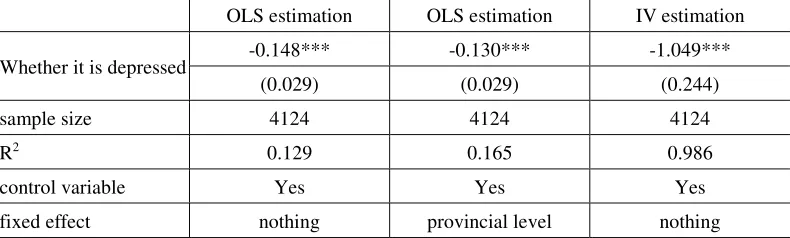
[image:4.612.100.495.295.414.2]TableⅠshows that depression can significantly reduce the wage income of migrant workers. Specifically, column (1) is the regression result obtained by the Ordinary Least Square method. The result shows that the salary of depressed migrant workers were 14.8 percent lower than healthy migrant workers. Column (2) takes into account the influence of non-observation factors in different regions and adds the result of the Ordinary Least Square regression of regional fixed effect. After thinking regional fixed effects, The salary of depressed migrant workers were 13 percent lower than healthy migrant workers.
TABLE I.INCOME EQUATON ESTIMATION OF MIGRANT WORKERS.
OLS estimation OLS estimation IV estimation
Whether it is depressed -0.148*** -0.130*** -1.049*** (0.029) (0.029) (0.244)
sample size 4124 4124 4124
R2 0.129 0.165 0.986
control variable Yes Yes Yes
fixed effect nothing provincial level nothing
Note: There statistics reported the robust standard errors in parentheses. ***, ** and * denote
statistical significance at 1%, 5% and 10% levels, respectively.; The control variables include the
number of non-academic training, gender, age, education, marital status, whether the members of
the organization, the nation and the average temperature of the province in 2012. The fixed effect
is to control the provinces where migrant workers are located.
Column (3) takes into account the endogenous problems in the model and gets the regression result obtained by instrumental variables. The result still shows that depression reduces the wages of migrant workers significantly.
5. Conclusions
Based on the nationally representative CFPS 2012 dataset and the internationally comparable CES-D metrics, we measure the depression level and study the depressive effect about income of migrant workers empirically. The results of the Ordinary Least Squares (OLS) and instrumental variable models confirmed that depression significantly reduced the wage levels of migrant workers. Moreover, the lower the wage level, the greater the effect of depression.
workers' emotional management. This is not only conducive to harmonious labor relations, but also can improve the efficiency of migrant workers, thus promoting the construction of new urbanization.
Acknowledgement
Li Huang is a corresponding author. This work is supported by NSFC (71573179, 71203146),
Liaoning social science planning fund (L17AGL009), the program for excellent talents in Liaoning province (WJQ2014016), and agriculture youth science and technology innovation talent
training plan in Liaoning province (2014055). References
[1]Qiu, Peiyuan, Eric Caine, Yang Yang, Quan Chen, Jin Li, and Xiao Ma, 2011, “Depression and
associated factors in internal migrant workers in China”, Journal of affective disorders 134 (1),
198-207.
[2]Cheng Hong and Li Tang, 2017,” The Effects of Personality Traits on Wages: Empirical Analyses Based on the China Employer-Employee Survey (CEES)”, economic research, (2),
171-186.
[3]Larson M., and Luthans F., 2006, “Potential added value of psychological capital in predicting
work attitudes”, Journal of leadership & organizational studies, 13(2), 75-92.
[4]Zhou Guangsu, Fan Gang and Shen Guangjun,2014,”The Income Disparity, the Social Capital