2019 2nd International Conference on Informatics, Control and Automation (ICA 2019) ISBN: 978-1-60595-637-4
Visual Servo Control Based on HSV
Xue-song ZHENG
1, An LU
2, Qing XIA
1, Xu PAN
1and Tao HU
1 1No. 3 Xiyuan South Street, Xiyong Micropower Park, Shapingba District, Chongqing, China2No. 1 Yangliu North Road, Yubei District, Chongqing, China
Keywords: Robot, Vision, Servo Control, HSV Color Space, Target Recognition.
Abstract. In view of the reliability and accuracy of robot operation in practical application, visual technology is needed to control the robot servo. Therefore, a scheme based on HSV color space is proposed to realize the servo control of the robot. The method mainly analyzes the acquired image in real time, preprocesses the image, converts it into HSV color space and recognizes it to guide the robot to operate on the target. The effectiveness of the proposed method is proved by experiments.
Introduction
At present, in the field of servo control, visual servo control has become an important research direction, but also the current research hotspot. Jia Bingxi et al. expounded the visual servo control from three aspects of vision system, control strategy and implementation strategy, and prospected the future visual servo control [1]. The visual servo control of robot based on RBF neural network can simplify the control model. The simulation results show that the visual servo control time and the real-time performance of the control system are well optimized [2]. Aiming at the problem of poor real-time control in visual servo system due to the complexity of Jacobian matrix calculation, the identification using neural network can effectively improve the control accuracy [3]. The double closed-loop structure is used for the dynamic visual servo control of the robot. The performance of the system is verified by simulation using V-rep. A visual servo operation system is developed, which combines autonomous control with teleoperation to control the robot accurately. So-Youn Park et al. proposed an image-based servo control method which did not know the depth information of the image in advance. The obtained image information was transformed into angle information by forward and backward kinematics, and the effective control of the robot was realized. Linear quadratic Gauss (LQG) controller is used to compensate disturbance motion, and image visual servo control is realized. Aiming at the problem of time-consuming acquisition of robot and camera models, a quadratic fuzzy hybrid controller based on expert knowledge is designed to improve the control accuracy [8]. Due to the complexity and difficulty of image Jacobian identification, Ren Xiaolin et al. proposed an adaptive Kalman filter to process the covariance information of uncertain noise. The simulation results show that the algorithm has good performance [9]. For monocular vision system, the motion mapping, error representation and control law design of servo control are analyzed, and the future trend of monocular vision servo is described. In this paper, HSV color space visual servo control is proposed, which not only provides a good man-machine interface, but also simplifies the detection model of the system and achieves effective servo control for the robot.
Image Servo Control
Joint Controller Robot Image features Desired image Image Controller Output image Camera
Figure 1. Image-based servo control.
Image Processing and Analysis
Image Processing Flow
Based on HSV color space, the whole process is divided into three parts: image preprocessing, HSV color space calculation and object contour extraction. It is necessary to collect the target object in real time, process the image by computer (pre-processing and HSV color space recognition), mark the center of the target, and the whole process is as follows (As shown in figure 2):
Real-time image acquisition
Image preprocessing
Color Space
Conversion HSV color detection
Contour extraction
N
Figure 2. Image Processing Flow.
Image Preprocessing
Generally speaking, in the process of image generation, transmission and transformation, due to noise interference, it will lead to image output quality and affect image recognition. Therefore, it is necessary to pre-process the image before recognition. The so-called image noise is the random signal interference when the image is taken or transmitted, and the median filter is a non-linear method to remove noise. Under certain conditions, it can not only eliminate noise, but also protect the details and edges of the image, and obtain better image restoration effect.
The basic principle of median filtering is to replace the value of a point in a digital image with the median of each point in a neighborhood of that point.
Let{ ( , ), ( , )x i j i j I I}denote the gray value of the points of the digital image. The definition of two-dimensional median filtering is as follows:
( , ) ( , ) | ( , )
I u v median I ui v j i j R (1)
HSV Color Space Computing
A color model refers to a set of visible photons in a three-dimensional color space, which includes all the colors in a color domain. In the process of color image processing, it is very important to choose a suitable color model. Digital image processing mainly involves RGB, HSV, YUV and other models.
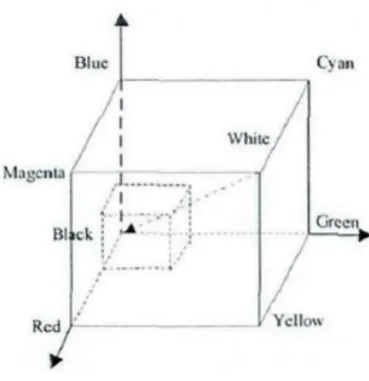
In the RGB color model, there are three main colors: red, green and blue, and each color is composed of these three components:
R r =
R + G + B ,
G g =
R + G + B ,
B b =
R + G + B (2)
[image:2.595.85.507.277.341.2]Figure 3. RGB color cube schematic.
[image:3.595.217.379.340.483.2]HSV color model is evolved from RGB color cube. Each color is represented by hue, saturation and value. As shown in Figure 4, the HSV color model is an inverted hexadiamond cone. On the top of the cone, whenv1, H and S have no definitions, representing white, v = 1ands = 1 representing pure color.
Figure 4. Stereo schematic of HSV color model.
In some image processing, RGB color space needs to be converted into HSV color space, mainly as follows:
V = max(R,G,B) (3)
(V - min(R,G,B))×255
S = V ,(V! = 0)
0
(4)
(G - B)×60
,(V = R) S
(B - G)×60
H = 180 - ,(V = G)
S (R - G)×60
240 + ,(V = R)
S
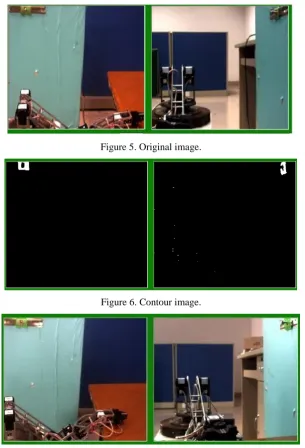
background, extracts its contour (Fig. 6), adds all the pixels in the contour area, calculates its average value, and obtains the center point of the target object (Fig. 7 red dot), so that the target object can be recognized from the background.
Figure 5. Original image.
Figure 6. Contour image.
Figure 7. Target object marking.
Experimental Analysis
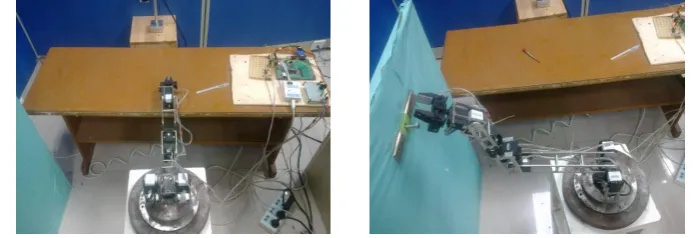
Figure 8. Initial state on the left and coarse positioning state on the right.
Figure 9. Left is the exact state and right is the manipulator grasp.
Conclusion
This paper describes the principle and composition of image-based visual servo control system, and the key technologies used. HSV image processing technology is used to recognize the target object in the scene, and the target is identified by servo control operation. HSV color space is better than RGB color space in object recognition, and the computation is less. Experiments show that visual servo control based on HSV color space is feasible.
Summary
If you follow the “checklist” your paper will conform to the requirements of the publisher and facilitate a problem-free publication process.
Acknowledgement
This research was financially supported by the Ministry of Industry and Information Technology's New Model Application Project of Intelligent Manufacturing in 2018(GGY1804050).
Reference
[1] Jia Bingxi, Liu Shan, Zhang Kaixiang, Chen Jian. Research Progress of Robot Visual Servo: Visual System and Control Strategy [J]. Journal of Automation, 2015, 41 (05): 861-873.
[2] Application of Zheng Libin, Wang Hongmei, Gu Jinan, Shi Changhua, He Hui. RBF Neural Network in Robot Visual Servo Control [J]. Machine Tools and Hydraulics, 2015, 43 (15): 41-43.
[5] T. Suetsugu, Y. Matsuda, T. Sugi, S. Goto and N. Egashira, "A visual supporting system for teleoperation of robot arm using visual servo control, "2014 Proceedings of the SICE Annual Conference (SICE), Sapporo, 2014, pp. 1847-1852.
[6] So-Youn Park, Yeoun-Jae Kim, Ju-Jang Lee, Byung Soo Kim and K. A. Alsaif, "Controlling robot arm manipulator using image-based visual servoing without pre-depth information, "IECON 2011 - 37th Annual Conference of the IEEE Industrial Electronics Society, Melbourne, VIC, 2011, pp. 3276-3280.
[7] F. Mangkusasmito, T. H. Nugroho, B. R. Trilaksono and T. Indriyanto, "Visual servo strategies using linear quadratic Gaussian (LQG) for Yaw-Pitch camera platform, "2018 International Conference on Signals and Systems (ICSigSys), Bali, 2018, pp. 146-150.
[8] F. Abadianzadeh, V. Derhami and M. Rezaeian, "Visual servoing control of robot manipulator in 3D space using fuzzy hybrid controller, "2016 4th International Conference on Robotics and Mechatronics (ICROM), Tehran, 2016, pp. 61-65.
[9] R. Xiaolin, L. Hongwen and L. Yuanchun, "Online image Jacobian identification using optimal adaptive robust Kalman filter for uncalibrated visual servoing, "2017 2nd Asia-Pacific Conference on Intelligent Robot Systems (ACIRS), Wuhan, 2017, pp. 53-57.